Canada’s national centre for
particle and nuclear physics
and accelerator-based science
Increased Rigour & Discipline in TRIUMF’s
Controlled Work Process
A. Trudel
August 17, 2017
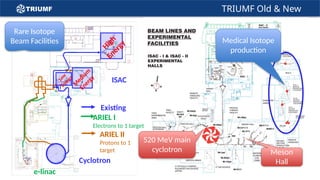
TRIUMF Old & New
Cyclotron
ISAC
M
e
d
i
u
m
E
n
e
r
g
y
H
i
g
h
E
n
e
r
g
y
e-linac
Existing
ARIEL I
Electrons to 1 target
ARIEL II
Protons to 1
target
L
o
w
E
n
e
r
g
y
Medical Isotope
production
520 MeV main
cyclotron Meson
Hall
Rare Isotope
Beam Facilities
TRIUMF Facilities
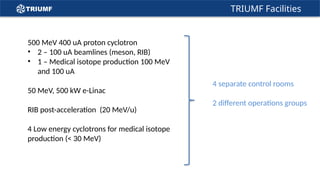
500 MeV 400 uA proton cyclotron
• 2 – 100 uA beamlines (meson, RIB)
• 1 – Medical isotope production 100 MeV
and 100 uA
50 MeV, 500 kW e-Linac
RIB post-acceleration (20 MeV/u)
4 Low energy cyclotrons for medical isotope
production (< 30 MeV)
4 separate control rooms
2 different operations groups
Controlled Work Process
Why is Change Needed?
Current State of Controlled Work
Opportunity for Improvement
Where we are and Where we’re
going
DOE-ASW August 2017 4
Why Change?
TRIUMF can be proud of its very knowledgeable people with extensive expertise
• Around 2600 work permits per year are opened and closed
• Work is being done with only occasional incidents
• Our accelerators work at high efficiency, exceeding annual targets
• The overall radiation dose to workers is at an all-time low
• There are very few injuries and lost days
 This is a testament to personnel competence and dedication!
• One is tempted to say: Everything works just fine
BUT … DOE-ASW August 2017 5
BUT…
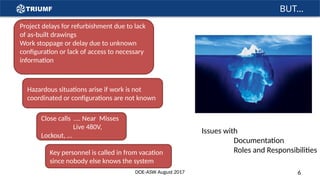
Project delays for refurbishment due to lack
of as-built drawings
Work stoppage or delay due to unknown
configuration or lack of access to necessary
information
Close calls …. Near Misses
Live 480V,
Lockout, …
Key personnel is called in from vacation
since nobody else knows the system
Hazardous situations arise if work is not
coordinated or configurations are not known
Issues with
Documentation
Roles and Responsibilities
DOE-ASW August 2017 6
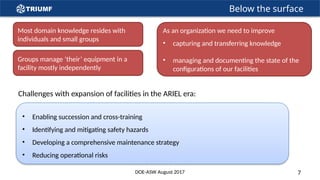
Below the surface
Most domain knowledge resides with
individuals and small groups
As an organization we need to improve
• capturing and transferring knowledge
• managing and documenting the state of the
configurations of our facilities
Groups manage ‘their’ equipment in a
facility mostly independently
• Enabling succession and cross-training
• Identifying and mitigating safety hazards
• Developing a comprehensive maintenance strategy
• Reducing operational risks
Challenges with expansion of facilities in the ARIEL era:
DOE-ASW August 2017 7
Paradigm shift
New Paradigm:
Doing it right safely the first time is more
important than just getting it done quickly
Old paradigm:
Beam delivery supersedes everything
“Get it done”
If it is not documented it does not exist
8
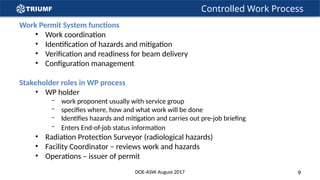
Work Permit System functions
• Work coordination
• Identification of hazards and mitigation
• Verification and readiness for beam delivery
• Configuration management
Stakeholder roles in WP process
• WP holder
‒ work proponent usually with service group
‒ specifies where, how and what work will be done
‒ Identifies hazards and mitigation and carries out pre-job briefing
‒ Enters End-of-job status information
• Radiation Protection Surveyor (radiological hazards)
• Facility Coordinator – reviews work and hazards
• Operations – issuer of permit
Controlled Work Process
DOE-ASW August 2017 9
Issues with Work Permit Process
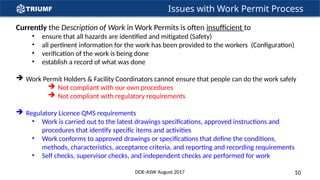
Currently the Description of Work in Work Permits is often insufficient to
• ensure that all hazards are identified and mitigated (Safety)
• all pertinent information for the work has been provided to the workers (Configuration)
• verification of the work is being done
• establish a record of what was done
 Work Permit Holders & Facility Coordinators cannot ensure that people can do the work safely
 Not compliant with our own procedures
 Not compliant with regulatory requirements
 Regulatory Licence QMS requirements
• Work is carried out to the latest drawings specifications, approved instructions and
procedures that identify specific items and activities
• Work conforms to approved drawings or specifications that define the conditions,
methods, characteristics, acceptance criteria, and reporting and recording requirements
• Self checks, supervisor checks, and independent checks are performed for work
DOE-ASW August 2017 10
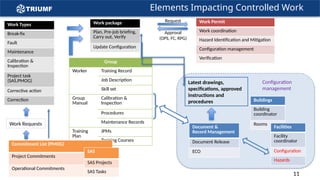
Latest drawings,
specifications, approved
instructions and
procedures
Configuration
management
Group
Worker Training Record
Job Description
Skill set
Group
Manual
Calibration &
Inspection
Procedures
Maintenance Records
Training
Plan
JPMs
Training Courses
Document &
Record Management
Document Release
ECO
Work package
Plan, Pre-job briefing,
Carry out, Verify
Update Configuration
Work Types
Break-fix
Fault
Maintenance
Calibration &
Inspection
Project task
(SAS,PMOG)
Corrective action
Correction
Commitment List (PMOG)
Project Commitments
Operational Commitments
Buildings
Building
coordinator
Rooms
Facilities
Facility
coordinator
Configuration
Hazards
SAS
SAS Projects
SAS Tasks
Work Requests
Work Permit
Work coordination
Hazard Identification and Mitigation
Configuration management
Verification
Approval
(OPS, FC, RPG)
Request
Elements Impacting Controlled Work
11
Opportunity for improvement
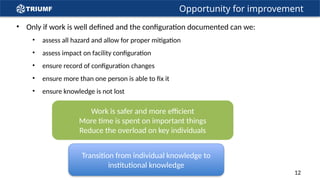
• Only if work is well defined and the configuration documented can we:
• assess all hazard and allow for proper mitigation
• assess impact on facility configuration
• ensure record of configuration changes
• ensure more than one person is able to fix it
• ensure knowledge is not lost
Work is safer and more efficient
More time is spent on important things
Reduce the overload on key individuals
Transition from individual knowledge to
institutional knowledge
12
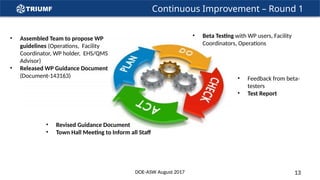
Continuous Improvement – Round 1
• Assembled Team to propose WP
guidelines (Operations, Facility
Coordinator, WP holder, EHS/QMS
Advisor)
• Released WP Guidance Document
(Document-143163)
• Beta Testing with WP users, Facility
Coordinators, Operations
• Feedback from beta-
testers
• Test Report
• Revised Guidance Document
• Town Hall Meeting to Inform all Staff
DOE-ASW August 2017 13
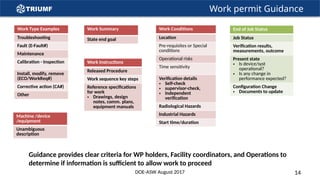
Work permit Guidance
Machine /device
/equipment
Unambiguous
description
Work Type Examples
Troubleshooting
Fault (E-Fault#)
Maintenance
Calibration - Inspection
Install, modify, remove
(ECO/WorkReq#)
Corrective action (CA#)
Other
Work Summary
State end goal
Work Conditions
Location
Pre-requisites or Special
conditions
Operational risks
Time sensitivity
Verification details
• Self-check
• supervisor-check,
• independent
verification
Radiological Hazards
Industrial Hazards
Start time/duration
End of Job Status
Job Status
Verification results,
measurements, outcome
Present state
• Is device/syst
operational?
• Is any change in
performance expected?
Configuration Change
• Documents to update
Work Instructions
Released Procedure
Work sequence key steps
Reference specifications
for work
• Drawings, design
notes, comm. plans,
equipment manuals
Guidance provides clear criteria for WP holders, Facility coordinators, and Operations to
determine if information is sufficient to allow work to proceed
DOE-ASW August 2017 14
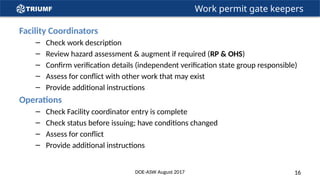
Work permit gate keepers
Facility Coordinators
– Check work description
– Review hazard assessment & augment if required (RP & OHS)
– Confirm verification details (independent verification state group responsible)
– Assess for conflict with other work that may exist
– Provide additional instructions
Operations
– Check Facility coordinator entry is complete
– Check status before issuing; have conditions changed
– Assess for conflict
– Provide additional instructions
DOE-ASW August 2017 16
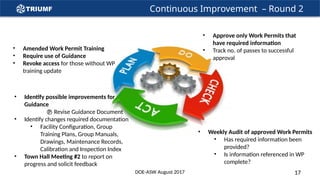
Continuous Improvement – Round 2
• Amended Work Permit Training
• Require use of Guidance
• Revoke access for those without WP
training update
• Approve only Work Permits that
have required information
• Track no. of passes to successful
approval
• Weekly Audit of approved Work Permits
• Has required information been
provided?
• Is information referenced in WP
complete?
• Identify possible improvements for
Guidance
 Revise Guidance Document
• Identify changes required documentation
• Facility Configuration, Group
Training Plans, Group Manuals,
Drawings, Maintenance Records,
Calibration and Inspection Index
• Town Hall Meeting #2 to report on
progress and solicit feedback
DOE-ASW August 2017 17
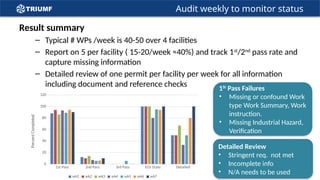
Audit weekly to monitor status
Result summary
– Typical # WPs /week is 40-50 over 4 facilities
– Report on 5 per facility ( 15-20/week ≈40%) and track 1st
/2nd
pass rate and
capture missing information
– Detailed review of one permit per facility per week for all information
including document and reference checks
1st Pass 2nd Pass 3rd Pass EOJ State Detailed
0
20
40
60
80
100
120
wk1 wk2 wk3 wk4 wk5 wk6 wk7
Percent
Completed
Detailed Review
• Stringent req. not met
• Incomplete info
• N/A needs to be used
1St
Pass Failures
• Missing or confound Work
type Work Summary, Work
instruction.
• Missing Industrial Hazard,
Verification
Feedback & Benefits
• Facility coordinators report there is less work following up with WP holders so permit
approval process is more efficient
• WP holders report that it takes longer to fill out WP
Short term
• Longer to find appropriate documentation (drawings, procedures) and complete
hazard assessment
• Immediate benefit - improved work planning and safer work environment
• Long term benefit:
• Work is done more efficiently
• People have the tools, resources and knowledge to do their work
• Work done correctly the first time and less time wasted
• More time for creative tasks….
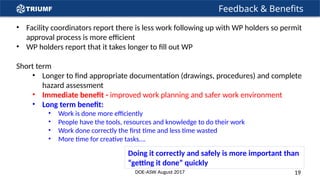
Doing it correctly and safely is more important than
“getting it done” quickly
DOE-ASW August 2017 19
…. Ongoing work
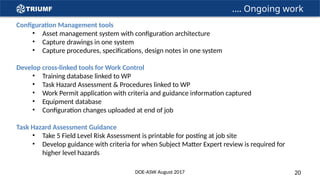
Configuration Management tools
• Asset management system with configuration architecture
• Capture drawings in one system
• Capture procedures, specifications, design notes in one system
Develop cross-linked tools for Work Control
• Training database linked to WP
• Task Hazard Assessment & Procedures linked to WP
• Work Permit application with criteria and guidance information captured
• Equipment database
• Configuration changes uploaded at end of job
Task Hazard Assessment Guidance
• Take 5 Field Level Risk Assessment is printable for posting at job site
• Develop guidance with criteria for when Subject Matter Expert review is required for
higher level hazards
DOE-ASW August 2017 20
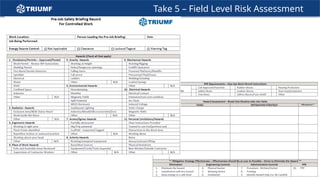
Take 5 – Field Level Risk Assessment
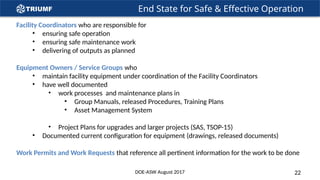
End State for Safe & Effective Operation
Facility Coordinators who are responsible for
• ensuring safe operation
• ensuring safe maintenance work
• delivering of outputs as planned
Equipment Owners / Service Groups who
• maintain facility equipment under coordination of the Facility Coordinators
• have well documented
• work processes and maintenance plans in
• Group Manuals, released Procedures, Training Plans
• Asset Management System
• Project Plans for upgrades and larger projects (SAS, TSOP-15)
• Documented current configuration for equipment (drawings, released documents)
Work Permits and Work Requests that reference all pertinent information for the work to be done
DOE-ASW August 2017 22
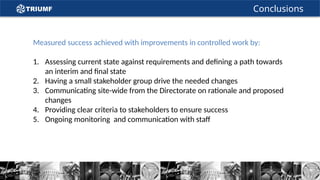
Conclusions
Measured success achieved with improvements in controlled work by:
1. Assessing current state against requirements and defining a path towards
an interim and final state
2. Having a small stakeholder group drive the needed changes
3. Communicating site-wide from the Directorate on rationale and proposed
changes
4. Providing clear criteria to stakeholders to ensure success
5. Ongoing monitoring and communication with staff
Canada’s national laboratory
for particle and nuclear
physics
Laboratoire national canadien
pour la recherche en physique
nucléaire et en physique des
particules
TRIUMF: Alberta | British Columbia | Calgary |
Carleton | Guelph | Manitoba | McGill |
McMaster | Montréal | Northern British
Columbia | Queen’s | Regina | Saint Mary’s |
Simon Fraser | Toronto | Victoria | Western |
Winnipeg | York
Thank you!
Acknowledgements to R. Kruecken, J. Aoki, B.
Laxdal, M. Marchetto, B. Richert, V. Toma, P. Jones

Increased Rigour & Discipline in TRIUMF’s Controlled Work Process

  • 1.
    Canada’s national centrefor particle and nuclear physics and accelerator-based science Increased Rigour & Discipline in TRIUMF’s Controlled Work Process A. Trudel August 17, 2017
  • 2.
    TRIUMF Old &New Cyclotron ISAC M e d i u m E n e r g y H i g h E n e r g y e-linac Existing ARIEL I Electrons to 1 target ARIEL II Protons to 1 target L o w E n e r g y Medical Isotope production 520 MeV main cyclotron Meson Hall Rare Isotope Beam Facilities
  • 3.
    TRIUMF Facilities 500 MeV400 uA proton cyclotron • 2 – 100 uA beamlines (meson, RIB) • 1 – Medical isotope production 100 MeV and 100 uA 50 MeV, 500 kW e-Linac RIB post-acceleration (20 MeV/u) 4 Low energy cyclotrons for medical isotope production (< 30 MeV) 4 separate control rooms 2 different operations groups
  • 4.
    Controlled Work Process Whyis Change Needed? Current State of Controlled Work Opportunity for Improvement Where we are and Where we’re going DOE-ASW August 2017 4
  • 5.
    Why Change? TRIUMF canbe proud of its very knowledgeable people with extensive expertise • Around 2600 work permits per year are opened and closed • Work is being done with only occasional incidents • Our accelerators work at high efficiency, exceeding annual targets • The overall radiation dose to workers is at an all-time low • There are very few injuries and lost days  This is a testament to personnel competence and dedication! • One is tempted to say: Everything works just fine BUT … DOE-ASW August 2017 5
  • 6.
    BUT… Project delays forrefurbishment due to lack of as-built drawings Work stoppage or delay due to unknown configuration or lack of access to necessary information Close calls …. Near Misses Live 480V, Lockout, … Key personnel is called in from vacation since nobody else knows the system Hazardous situations arise if work is not coordinated or configurations are not known Issues with Documentation Roles and Responsibilities DOE-ASW August 2017 6
  • 7.
    Below the surface Mostdomain knowledge resides with individuals and small groups As an organization we need to improve • capturing and transferring knowledge • managing and documenting the state of the configurations of our facilities Groups manage ‘their’ equipment in a facility mostly independently • Enabling succession and cross-training • Identifying and mitigating safety hazards • Developing a comprehensive maintenance strategy • Reducing operational risks Challenges with expansion of facilities in the ARIEL era: DOE-ASW August 2017 7
  • 8.
    Paradigm shift New Paradigm: Doingit right safely the first time is more important than just getting it done quickly Old paradigm: Beam delivery supersedes everything “Get it done” If it is not documented it does not exist 8
  • 9.
    Work Permit Systemfunctions • Work coordination • Identification of hazards and mitigation • Verification and readiness for beam delivery • Configuration management Stakeholder roles in WP process • WP holder ‒ work proponent usually with service group ‒ specifies where, how and what work will be done ‒ Identifies hazards and mitigation and carries out pre-job briefing ‒ Enters End-of-job status information • Radiation Protection Surveyor (radiological hazards) • Facility Coordinator – reviews work and hazards • Operations – issuer of permit Controlled Work Process DOE-ASW August 2017 9
  • 10.
    Issues with WorkPermit Process Currently the Description of Work in Work Permits is often insufficient to • ensure that all hazards are identified and mitigated (Safety) • all pertinent information for the work has been provided to the workers (Configuration) • verification of the work is being done • establish a record of what was done  Work Permit Holders & Facility Coordinators cannot ensure that people can do the work safely  Not compliant with our own procedures  Not compliant with regulatory requirements  Regulatory Licence QMS requirements • Work is carried out to the latest drawings specifications, approved instructions and procedures that identify specific items and activities • Work conforms to approved drawings or specifications that define the conditions, methods, characteristics, acceptance criteria, and reporting and recording requirements • Self checks, supervisor checks, and independent checks are performed for work DOE-ASW August 2017 10
  • 11.
    Latest drawings, specifications, approved instructionsand procedures Configuration management Group Worker Training Record Job Description Skill set Group Manual Calibration & Inspection Procedures Maintenance Records Training Plan JPMs Training Courses Document & Record Management Document Release ECO Work package Plan, Pre-job briefing, Carry out, Verify Update Configuration Work Types Break-fix Fault Maintenance Calibration & Inspection Project task (SAS,PMOG) Corrective action Correction Commitment List (PMOG) Project Commitments Operational Commitments Buildings Building coordinator Rooms Facilities Facility coordinator Configuration Hazards SAS SAS Projects SAS Tasks Work Requests Work Permit Work coordination Hazard Identification and Mitigation Configuration management Verification Approval (OPS, FC, RPG) Request Elements Impacting Controlled Work 11
  • 12.
    Opportunity for improvement •Only if work is well defined and the configuration documented can we: • assess all hazard and allow for proper mitigation • assess impact on facility configuration • ensure record of configuration changes • ensure more than one person is able to fix it • ensure knowledge is not lost Work is safer and more efficient More time is spent on important things Reduce the overload on key individuals Transition from individual knowledge to institutional knowledge 12
  • 13.
    Continuous Improvement –Round 1 • Assembled Team to propose WP guidelines (Operations, Facility Coordinator, WP holder, EHS/QMS Advisor) • Released WP Guidance Document (Document-143163) • Beta Testing with WP users, Facility Coordinators, Operations • Feedback from beta- testers • Test Report • Revised Guidance Document • Town Hall Meeting to Inform all Staff DOE-ASW August 2017 13
  • 14.
    Work permit Guidance Machine/device /equipment Unambiguous description Work Type Examples Troubleshooting Fault (E-Fault#) Maintenance Calibration - Inspection Install, modify, remove (ECO/WorkReq#) Corrective action (CA#) Other Work Summary State end goal Work Conditions Location Pre-requisites or Special conditions Operational risks Time sensitivity Verification details • Self-check • supervisor-check, • independent verification Radiological Hazards Industrial Hazards Start time/duration End of Job Status Job Status Verification results, measurements, outcome Present state • Is device/syst operational? • Is any change in performance expected? Configuration Change • Documents to update Work Instructions Released Procedure Work sequence key steps Reference specifications for work • Drawings, design notes, comm. plans, equipment manuals Guidance provides clear criteria for WP holders, Facility coordinators, and Operations to determine if information is sufficient to allow work to proceed DOE-ASW August 2017 14
  • 16.
    Work permit gatekeepers Facility Coordinators – Check work description – Review hazard assessment & augment if required (RP & OHS) – Confirm verification details (independent verification state group responsible) – Assess for conflict with other work that may exist – Provide additional instructions Operations – Check Facility coordinator entry is complete – Check status before issuing; have conditions changed – Assess for conflict – Provide additional instructions DOE-ASW August 2017 16
  • 17.
    Continuous Improvement –Round 2 • Amended Work Permit Training • Require use of Guidance • Revoke access for those without WP training update • Approve only Work Permits that have required information • Track no. of passes to successful approval • Weekly Audit of approved Work Permits • Has required information been provided? • Is information referenced in WP complete? • Identify possible improvements for Guidance  Revise Guidance Document • Identify changes required documentation • Facility Configuration, Group Training Plans, Group Manuals, Drawings, Maintenance Records, Calibration and Inspection Index • Town Hall Meeting #2 to report on progress and solicit feedback DOE-ASW August 2017 17
  • 18.
    Audit weekly tomonitor status Result summary – Typical # WPs /week is 40-50 over 4 facilities – Report on 5 per facility ( 15-20/week ≈40%) and track 1st /2nd pass rate and capture missing information – Detailed review of one permit per facility per week for all information including document and reference checks 1st Pass 2nd Pass 3rd Pass EOJ State Detailed 0 20 40 60 80 100 120 wk1 wk2 wk3 wk4 wk5 wk6 wk7 Percent Completed Detailed Review • Stringent req. not met • Incomplete info • N/A needs to be used 1St Pass Failures • Missing or confound Work type Work Summary, Work instruction. • Missing Industrial Hazard, Verification
  • 19.
    Feedback & Benefits •Facility coordinators report there is less work following up with WP holders so permit approval process is more efficient • WP holders report that it takes longer to fill out WP Short term • Longer to find appropriate documentation (drawings, procedures) and complete hazard assessment • Immediate benefit - improved work planning and safer work environment • Long term benefit: • Work is done more efficiently • People have the tools, resources and knowledge to do their work • Work done correctly the first time and less time wasted • More time for creative tasks…. Doing it correctly and safely is more important than “getting it done” quickly DOE-ASW August 2017 19
  • 20.
    …. Ongoing work ConfigurationManagement tools • Asset management system with configuration architecture • Capture drawings in one system • Capture procedures, specifications, design notes in one system Develop cross-linked tools for Work Control • Training database linked to WP • Task Hazard Assessment & Procedures linked to WP • Work Permit application with criteria and guidance information captured • Equipment database • Configuration changes uploaded at end of job Task Hazard Assessment Guidance • Take 5 Field Level Risk Assessment is printable for posting at job site • Develop guidance with criteria for when Subject Matter Expert review is required for higher level hazards DOE-ASW August 2017 20
  • 21.
    Take 5 –Field Level Risk Assessment
  • 22.
    End State forSafe & Effective Operation Facility Coordinators who are responsible for • ensuring safe operation • ensuring safe maintenance work • delivering of outputs as planned Equipment Owners / Service Groups who • maintain facility equipment under coordination of the Facility Coordinators • have well documented • work processes and maintenance plans in • Group Manuals, released Procedures, Training Plans • Asset Management System • Project Plans for upgrades and larger projects (SAS, TSOP-15) • Documented current configuration for equipment (drawings, released documents) Work Permits and Work Requests that reference all pertinent information for the work to be done DOE-ASW August 2017 22
  • 23.
    Conclusions Measured success achievedwith improvements in controlled work by: 1. Assessing current state against requirements and defining a path towards an interim and final state 2. Having a small stakeholder group drive the needed changes 3. Communicating site-wide from the Directorate on rationale and proposed changes 4. Providing clear criteria to stakeholders to ensure success 5. Ongoing monitoring and communication with staff
  • 24.
    Canada’s national laboratory forparticle and nuclear physics Laboratoire national canadien pour la recherche en physique nucléaire et en physique des particules TRIUMF: Alberta | British Columbia | Calgary | Carleton | Guelph | Manitoba | McGill | McMaster | Montréal | Northern British Columbia | Queen’s | Regina | Saint Mary’s | Simon Fraser | Toronto | Victoria | Western | Winnipeg | York Thank you! Acknowledgements to R. Kruecken, J. Aoki, B. Laxdal, M. Marchetto, B. Richert, V. Toma, P. Jones

Editor's Notes

  • #6 What fraction of one’s time is spent fighting fires? How often is work stopped because one encountered something unexpected that was not part of the documented configuration? Does one spend significant time clarifying information or searching for information that is required but is not readily available?
  • #9 This is our current state. The future state may evolve to slight difference in roles for operations.
  • #12 Implementation focusses on meeting regulatory requirements for all work moving forward. How we meet the requirements in the longer term will be addressed with upgrades to configuration management documentation for facilities and equipment.
  • #13 Assembled a small team of stakeholders to propose changes, monitor implementation, and report and propose further changes as needed.
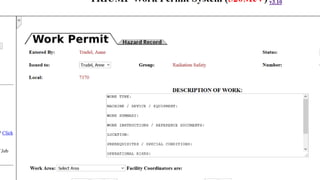
  • #15 Added fields for work type, summary, instructions, equipment and prerequisites. Hazard Record has Radiological including waste, and industrial hazards and mitigation. Other improvements will be made with hazard assessment drop-down menu and displaying training status for workers.
  • #17 Monitor and iterate guidance with feedback from personnel. Communication is key for buy in and feedback.
  • #18 Monitoring is a key part of ensuring that the process is working and is being followed. It also provides an opportunity to tweak and make improvements. Monitor at weekly intervals until process is stable, and then less frequently.
  • #21 Field level risk assessment based on oil & gas industry. An accelerator facility because of the distributed configuration is more akin to field work in the oil & gas industry than a factory floor setting.
  • #22 A project plan with all elements is being developed so that different components can be prioritized for roll out.