OSMOREGULATION
AND EXCRETION
Key Concepts
 Osmoregulation balances the uptake and loss of
water and solutes
 An animal’s nitrogenous wastes reflect its
phylogeny and habitat
 Diverse excretory systems are variations on a
tubular theme
 Nephrons and associated blood vessels are the
functional units of the mammalian kidney
 The mammalian kidney’s ability to conserve water
is a key terrestrial adaptation
 Diverse adaptations of the vertebrate kidney have
evolved in different environments
Key Words
 homeostasis
 excretion
 uric acid
 filtration
 renal vein
 urethra
 nephron
 proximal tubule
 collecting duct
 efferent arteriole
 antidiuretic hormone
(ADH)
 secretion (selective
reabsorption)
 renal artery
 urinary bladder
 renal medulla
 Bowman's capsule
 distal tubule
 afferent arteriole
 vasa recta
 ammonia
 filtrate
 ureter
 renal cortex
 glomerulus
 loop of Henle
 cortical nephrons
 peritubular
capillaries
 aldosterone
 osmoregulation
 urea
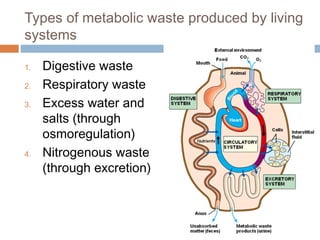
Types of metabolic waste produced by living
systems
1. Digestive waste
2. Respiratory waste
3. Excess water and
salts (through
osmoregulation)
4. Nitrogenous waste
(through excretion)
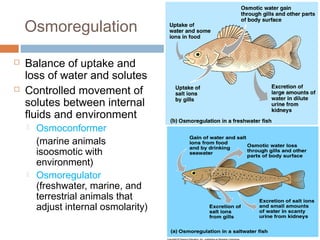
Osmoregulation
 Balance of uptake and
loss of water and solutes
 Controlled movement of
solutes between internal
fluids and environment
 Osmoconformer
(marine animals
isoosmotic with
environment)
 Osmoregulator
(freshwater, marine, and
terrestrial animals that
adjust internal osmolarity)
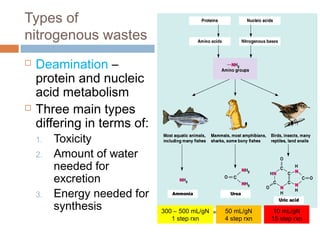
Types of
nitrogenous wastes
 Deamination –
protein and nucleic
acid metabolism
 Three main types
differing in terms of:
1. Toxicity
2. Amount of water
needed for
excretion
3. Energy needed for
synthesis 300 – 500 mL/gN
1 step rxn
50 mL/gN
4 step rxn
10 mL/gN
15 step rxn
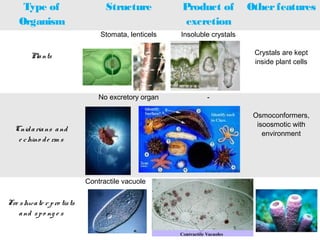
Type of
Organism
Structure Product of
excretion
Otherfeatures
Plants
Stomata, lenticels Insoluble crystals
Crystals are kept
inside plant cells
Cnidarians and
e chino de rm s
No excretory organ -
Osmoconformers,
isoosmotic with
environment
Fre shwate r pro tists
and spo ng e s
Contractile vacuole
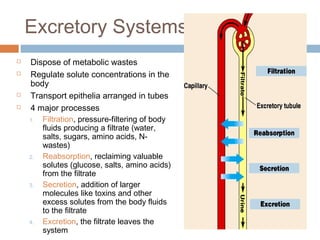
Excretory Systems
 Dispose of metabolic wastes
 Regulate solute concentrations in the
body
 Transport epithelia arranged in tubes
 4 major processes
1. Filtration, pressure-filtering of body
fluids producing a filtrate (water,
salts, sugars, amino acids, N-
wastes)
2. Reabsorption, reclaiming valuable
solutes (glucose, salts, amino acids)
from the filtrate
3. Secretion, addition of larger
molecules like toxins and other
excess solutes from the body fluids
to the filtrate
4. Excretion, the filtrate leaves the
system
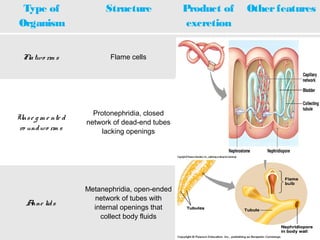
Flatwo rm s Flame cells
Unse g m e nte d
ro undwo rm s
Protonephridia, closed
network of dead-end tubes
lacking openings
Anne lids
Metanephridia, open-ended
network of tubes with
internal openings that
collect body fluids
Type of
Organism
Structure Product of
excretion
Otherfeatures
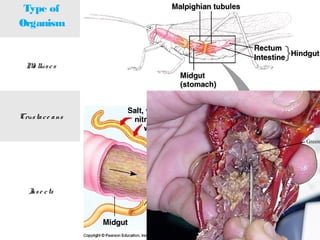
Mo lluscs Nephridia or metaphridia
Crustace ans Antennal/green gland
Inse cts
Malpighian tubules and
digestive tract
Uric acid
Type of
Organism
Structure Product of
excretion
Otherfeatures
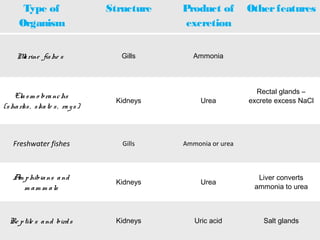
Marine fishe s Gills Ammonia
Elasm o branchs
(sharks, skate s, rays)
Kidneys Urea
Rectal glands –
excrete excess NaCl
Freshwater fishes Gills Ammonia or urea
Am phibians and
m am m als
Kidneys Urea
Liver converts
ammonia to urea
Re ptile s and birds Kidneys Uric acid Salt glands
Type of
Organism
Structure Product of
excretion
Otherfeatures
Proximal tubule – secretion and reabsorption
Filtrate
H2O
Salts (NaCl and others)
HCO3
–
H+
Urea
Glucose; amino acids
Some drugs
>> Same concentration of
substances in blood plasma
Key
Active transport
Passive transport
CORTEX
OUTER
MEDULLA
INNER
MEDULLA
Descending limb
of loop of
Henle – reabsorption
-Permeable to water but not to salt
Thick segment
of ascending
limb –
reabsorption
- Impermeable to
water but
permeable to salt
Thin segment
of ascending
limb
Collecting
Duct – permeable to water
but not to salt, bottom portion is
permeable to urea
NaCl
NaCl
NaCl
Distal tubule – secretion and reabsorption
NaCl Nutrients
Urea
H2O
NaCl
H2O
H2OHCO3

K+
H+
NH3
HCO3

K+
H+
H2O
1 4
32
3 5
From Blood Filtrate to Urine: A Closer Look
 Two solutes: NaCl
and urea,
contribute to the
osmolarity of the
interstitial fluid
 Cause the
reabsorption of
water in the kidney
and concentrates
the urine
H2O
H2O
H2O
H2O
H2O
H2O
H2O
NaCl
NaCl
NaCl
NaCl
NaCl
NaCl
NaCl
300
300 100
400
600
900
1200
700
400
200
100
Active
transport
Passive
transport
OUTER
MEDULLA
INNER
MEDULLA
CORTEX
H2O
Urea
H2O
Urea
H2O
Urea
H2O
H2O
H2O
H2O
1200
1200
900
600
400
300
600
400
300
Osmolarity of
interstitial
fluid
(mosm/L)
300
Nervous system and
hormones regulate
kidney functions
 Antidiuretic hormone
(ADH)
 Stimulated by a rise in the
blood’s osmolarity (>300
mosm/L)
 Enhances fluid retention by
making the kidneys reclaim
more water
 Increases water reabsorption
in the distal tubules and
collecting ducts of the kidney
Osmoreceptors
in hypothalamus
Drinking reduces
blood osmolarity
to set point
H2O reab-
sorption helps
prevent further
osmolarity
increase
STIMULUS:
The release of ADH is
triggered when osmo-
receptor cells in the
hypothalamus detect an
increase in the osmolarity
of the blood
Homeostasis:
Blood osmolarity
Hypothalamus
ADH
Pituitary
gland
Increased
permeability
Thirst
Collecting duct
Distal
tubule
Increased Na+
and H2O reab-
sorption in
distal tubules
Homeostasis:
Blood pressure,
volume
STIMULUS:
The juxtaglomerular
apparatus (JGA) responds
to low blood volume or
blood pressure (such as due
to dehydration or loss of
blood)
Aldosterone
Adrenal gland
Angiotensin II
Angiotensinogen
Renin
production
Renin
Arteriole
constriction
Distal
tubule
JGA
 The renin-angiotensin-
aldosterone system
(RAAS)
 Responds to a loss of salt
and water in the blood
 Stimulated by low blood
volume or pressure
 Increases water and sodium
ion reabsorption in the
proximal and distal tubules
 Leads to an increase in
blood volume and pressure
 Opposed by the hormone
atrial natriuretic factor (ANF)
 Released by atria
 Inhibits release of renin
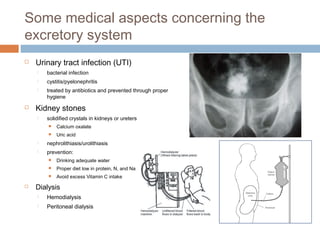
Some medical aspects concerning the
excretory system
 Urinary tract infection (UTI)
 bacterial infection
 cystitis/pyelonephritis
 treated by antibiotics and prevented through proper
hygiene
 Kidney stones
 solidified crystals in kidneys or ureters
 Calcium oxalate
 Uric acid
 nephrolithiasis/urolithiasis
 prevention:
 Drinking adequate water
 Proper diet low in protein, N, and Na
 Avoid excess Vitamin C intake
 Dialysis
 Hemodialysis
 Peritoneal dialysis

Osmoregulation and-excretion

  • 1.
  • 2.
    Key Concepts  Osmoregulationbalances the uptake and loss of water and solutes  An animal’s nitrogenous wastes reflect its phylogeny and habitat  Diverse excretory systems are variations on a tubular theme  Nephrons and associated blood vessels are the functional units of the mammalian kidney  The mammalian kidney’s ability to conserve water is a key terrestrial adaptation  Diverse adaptations of the vertebrate kidney have evolved in different environments
  • 3.
    Key Words  homeostasis excretion  uric acid  filtration  renal vein  urethra  nephron  proximal tubule  collecting duct  efferent arteriole  antidiuretic hormone (ADH)  secretion (selective reabsorption)  renal artery  urinary bladder  renal medulla  Bowman's capsule  distal tubule  afferent arteriole  vasa recta  ammonia  filtrate  ureter  renal cortex  glomerulus  loop of Henle  cortical nephrons  peritubular capillaries  aldosterone  osmoregulation  urea
  • 4.
    Types of metabolicwaste produced by living systems 1. Digestive waste 2. Respiratory waste 3. Excess water and salts (through osmoregulation) 4. Nitrogenous waste (through excretion)
  • 5.
    Osmoregulation  Balance ofuptake and loss of water and solutes  Controlled movement of solutes between internal fluids and environment  Osmoconformer (marine animals isoosmotic with environment)  Osmoregulator (freshwater, marine, and terrestrial animals that adjust internal osmolarity)
  • 6.
    Types of nitrogenous wastes Deamination – protein and nucleic acid metabolism  Three main types differing in terms of: 1. Toxicity 2. Amount of water needed for excretion 3. Energy needed for synthesis 300 – 500 mL/gN 1 step rxn 50 mL/gN 4 step rxn 10 mL/gN 15 step rxn
  • 7.
    Type of Organism Structure Productof excretion Otherfeatures Plants Stomata, lenticels Insoluble crystals Crystals are kept inside plant cells Cnidarians and e chino de rm s No excretory organ - Osmoconformers, isoosmotic with environment Fre shwate r pro tists and spo ng e s Contractile vacuole
  • 8.
    Excretory Systems  Disposeof metabolic wastes  Regulate solute concentrations in the body  Transport epithelia arranged in tubes  4 major processes 1. Filtration, pressure-filtering of body fluids producing a filtrate (water, salts, sugars, amino acids, N- wastes) 2. Reabsorption, reclaiming valuable solutes (glucose, salts, amino acids) from the filtrate 3. Secretion, addition of larger molecules like toxins and other excess solutes from the body fluids to the filtrate 4. Excretion, the filtrate leaves the system
  • 9.
    Flatwo rm sFlame cells Unse g m e nte d ro undwo rm s Protonephridia, closed network of dead-end tubes lacking openings Anne lids Metanephridia, open-ended network of tubes with internal openings that collect body fluids Type of Organism Structure Product of excretion Otherfeatures
  • 10.
    Mo lluscs Nephridiaor metaphridia Crustace ans Antennal/green gland Inse cts Malpighian tubules and digestive tract Uric acid Type of Organism Structure Product of excretion Otherfeatures
  • 11.
    Marine fishe sGills Ammonia Elasm o branchs (sharks, skate s, rays) Kidneys Urea Rectal glands – excrete excess NaCl Freshwater fishes Gills Ammonia or urea Am phibians and m am m als Kidneys Urea Liver converts ammonia to urea Re ptile s and birds Kidneys Uric acid Salt glands Type of Organism Structure Product of excretion Otherfeatures
  • 13.
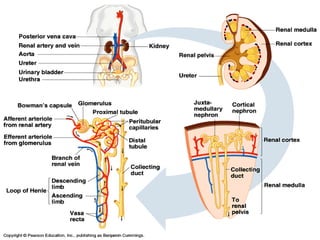
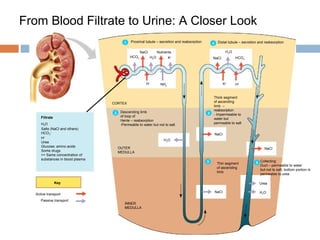
    Proximal tubule –secretion and reabsorption Filtrate H2O Salts (NaCl and others) HCO3 – H+ Urea Glucose; amino acids Some drugs >> Same concentration of substances in blood plasma Key Active transport Passive transport CORTEX OUTER MEDULLA INNER MEDULLA Descending limb of loop of Henle – reabsorption -Permeable to water but not to salt Thick segment of ascending limb – reabsorption - Impermeable to water but permeable to salt Thin segment of ascending limb Collecting Duct – permeable to water but not to salt, bottom portion is permeable to urea NaCl NaCl NaCl Distal tubule – secretion and reabsorption NaCl Nutrients Urea H2O NaCl H2O H2OHCO3  K+ H+ NH3 HCO3  K+ H+ H2O 1 4 32 3 5 From Blood Filtrate to Urine: A Closer Look
  • 14.
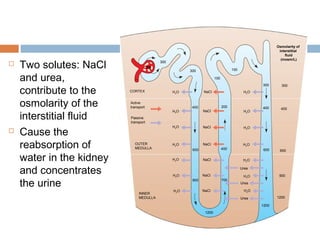
     Two solutes:NaCl and urea, contribute to the osmolarity of the interstitial fluid  Cause the reabsorption of water in the kidney and concentrates the urine H2O H2O H2O H2O H2O H2O H2O NaCl NaCl NaCl NaCl NaCl NaCl NaCl 300 300 100 400 600 900 1200 700 400 200 100 Active transport Passive transport OUTER MEDULLA INNER MEDULLA CORTEX H2O Urea H2O Urea H2O Urea H2O H2O H2O H2O 1200 1200 900 600 400 300 600 400 300 Osmolarity of interstitial fluid (mosm/L) 300
  • 15.
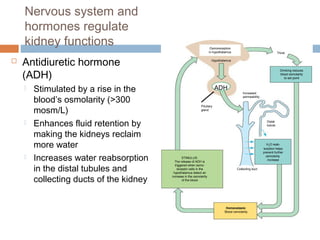
    Nervous system and hormonesregulate kidney functions  Antidiuretic hormone (ADH)  Stimulated by a rise in the blood’s osmolarity (>300 mosm/L)  Enhances fluid retention by making the kidneys reclaim more water  Increases water reabsorption in the distal tubules and collecting ducts of the kidney Osmoreceptors in hypothalamus Drinking reduces blood osmolarity to set point H2O reab- sorption helps prevent further osmolarity increase STIMULUS: The release of ADH is triggered when osmo- receptor cells in the hypothalamus detect an increase in the osmolarity of the blood Homeostasis: Blood osmolarity Hypothalamus ADH Pituitary gland Increased permeability Thirst Collecting duct Distal tubule
  • 16.
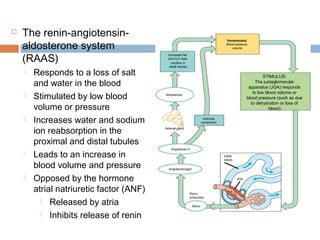
    Increased Na+ and H2Oreab- sorption in distal tubules Homeostasis: Blood pressure, volume STIMULUS: The juxtaglomerular apparatus (JGA) responds to low blood volume or blood pressure (such as due to dehydration or loss of blood) Aldosterone Adrenal gland Angiotensin II Angiotensinogen Renin production Renin Arteriole constriction Distal tubule JGA  The renin-angiotensin- aldosterone system (RAAS)  Responds to a loss of salt and water in the blood  Stimulated by low blood volume or pressure  Increases water and sodium ion reabsorption in the proximal and distal tubules  Leads to an increase in blood volume and pressure  Opposed by the hormone atrial natriuretic factor (ANF)  Released by atria  Inhibits release of renin
  • 17.
    Some medical aspectsconcerning the excretory system  Urinary tract infection (UTI)  bacterial infection  cystitis/pyelonephritis  treated by antibiotics and prevented through proper hygiene  Kidney stones  solidified crystals in kidneys or ureters  Calcium oxalate  Uric acid  nephrolithiasis/urolithiasis  prevention:  Drinking adequate water  Proper diet low in protein, N, and Na  Avoid excess Vitamin C intake  Dialysis  Hemodialysis  Peritoneal dialysis