OSEA Production Conference 7th
December 2006
The Impact of Offshore Pipeline Installation and Pre-commissioning on Future System Integrity
OSEA – Production Conference
THE IMPACT OF OFFSHORE PIPELINE INSTALLATION AND
PRE-COMMISSIONING ON FUTURE SYSTEM INTEGRITY
John Grover
7th December 2006
OSEA Production Conference 7th
December 2006
The Impact of Offshore Pipeline Installation and Pre-commissioning on Future System Integrity
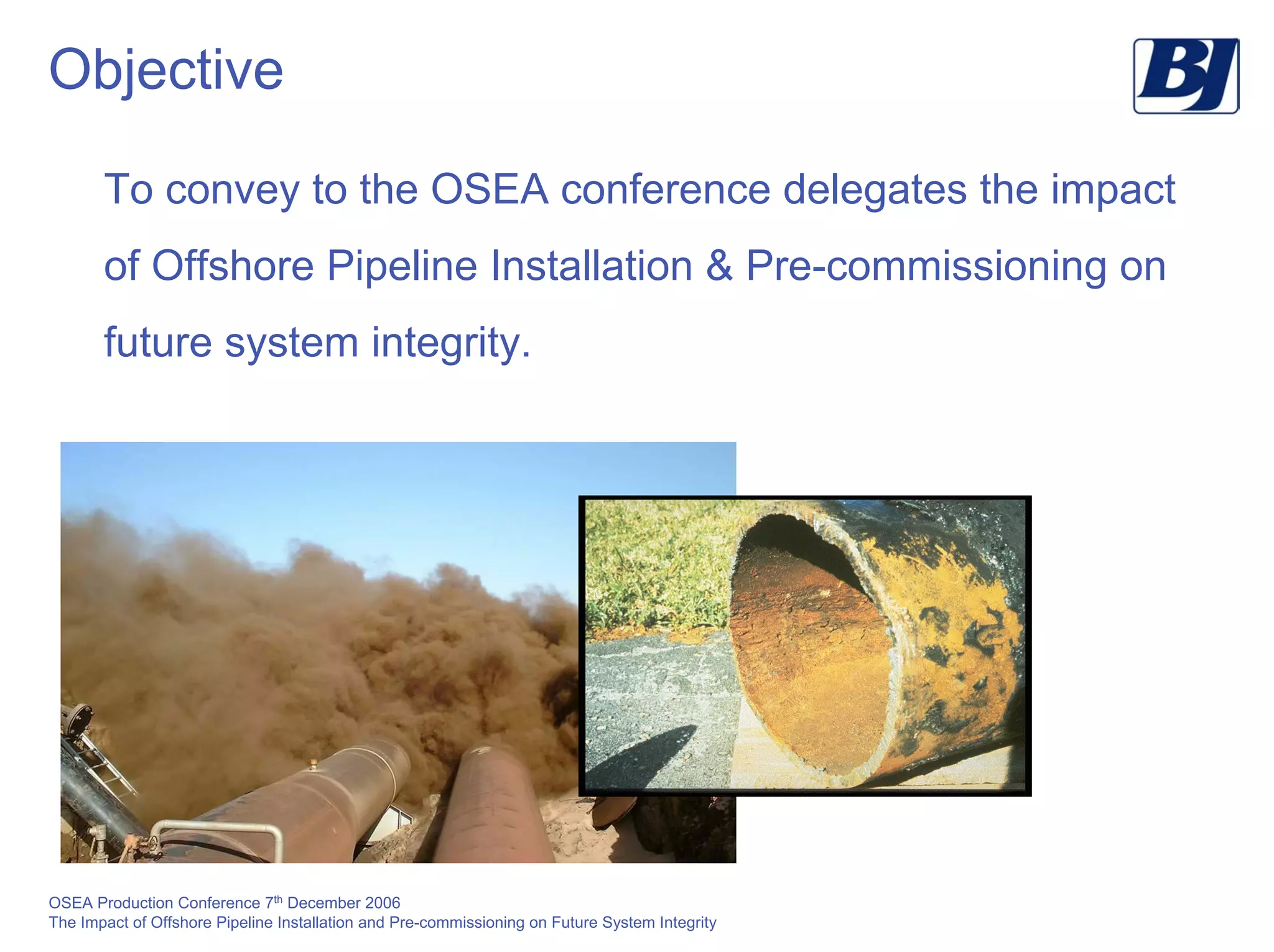
Objective
To convey to the OSEA conference delegates the impact
of Offshore Pipeline Installation & Pre-commissioning on
future system integrity.
OSEA Production Conference 7th
December 2006
The Impact of Offshore Pipeline Installation and Pre-commissioning on Future System Integrity
Contents
• Introduction
• Fundamentals of Pipeline Pre-commissioning
• Corrosion Caused During Installation & Pre-
commissioning
› Case Study
› Mitigation & Measurement
• Debris resulting from Installation & Pre-commissioning
› Case Study
› Mitigation
• Measurement Techniques
• Summary & Conclusions
OSEA Production Conference 7th
December 2006
The Impact of Offshore Pipeline Installation and Pre-commissioning on Future System Integrity
Introduction
This paper examines some of the common mistakes and oversights in
the areas of:
• Pipe joint storage and preservation
• Prevention of seawater ingress during lay
• Wet buckle impact and possible contingencies
• Pre-operational cleaning
• Source and treatment of hydrotest water
• Dewatering and drying
Then via case studies we look at the impact on pipeline integrity and
what mitigation steps can be taken.
Finally we look at techniques to measure corrosion and debris and
draw some conclusions
OSEA Production Conference 7th
December 2006
The Impact of Offshore Pipeline Installation and Pre-commissioning on Future System Integrity
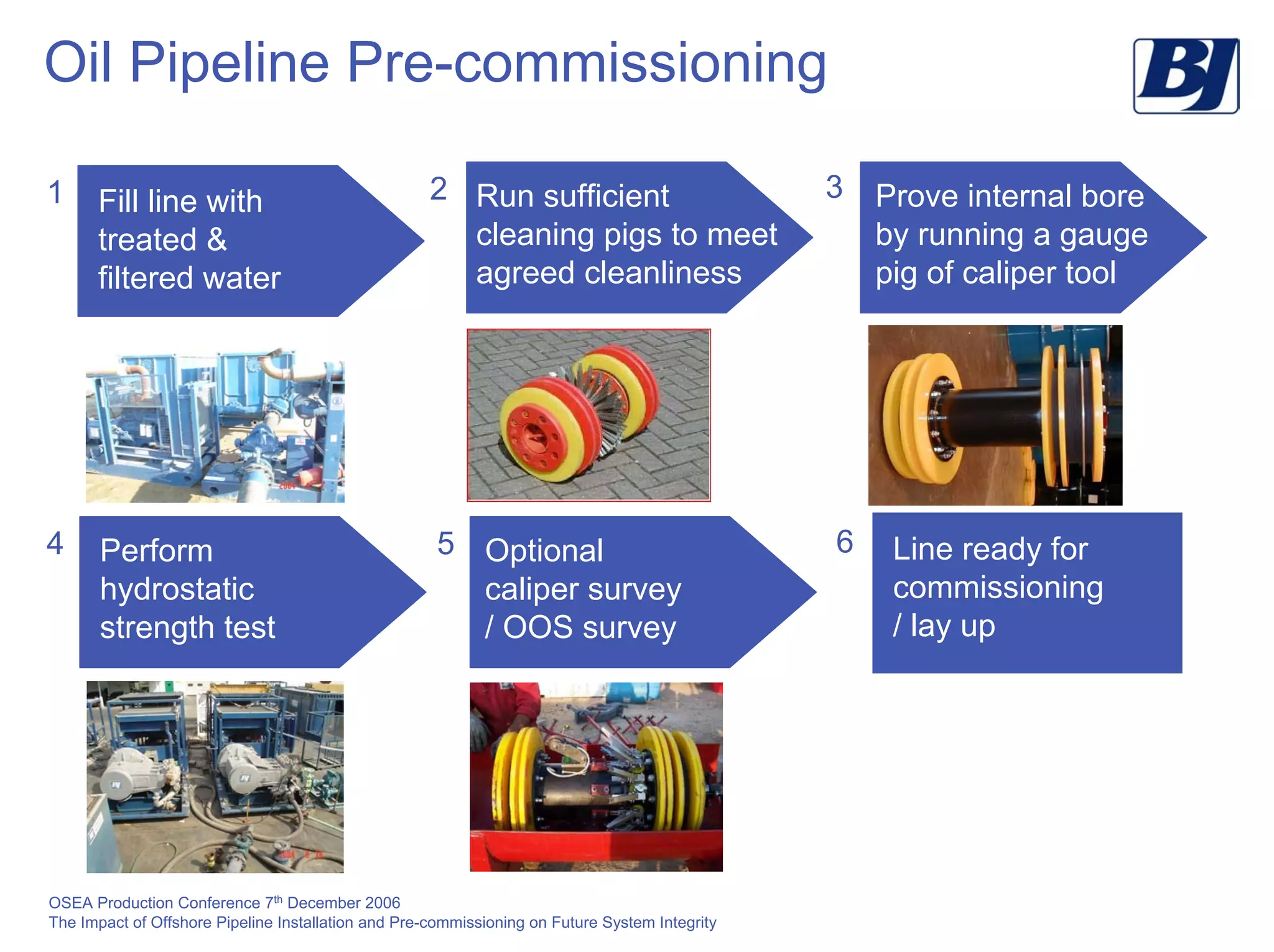
Oil Pipeline Pre-commissioning
Run sufficient
cleaning pigs to meet
agreed cleanliness
Prove internal bore
by running a gauge
pig of caliper tool
3Fill line with
treated &
filtered water
21
Line ready for
commissioning
/ lay up
Perform
hydrostatic
strength test
Optional
caliper survey
/ OOS survey
64 5
OSEA Production Conference 7th
December 2006
The Impact of Offshore Pipeline Installation and Pre-commissioning on Future System Integrity
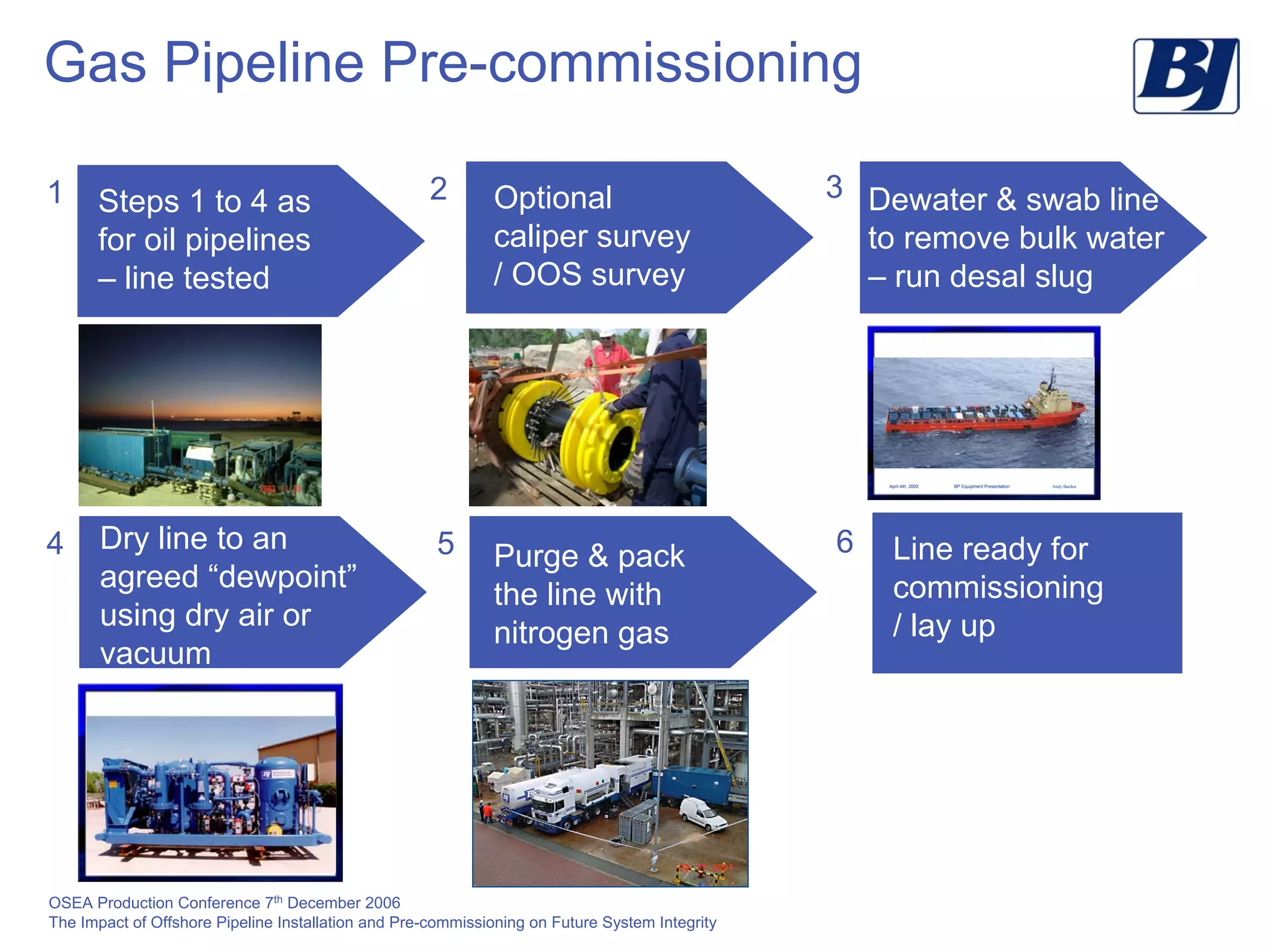
Gas Pipeline Pre-commissioning
Optional
caliper survey
/ OOS survey
Dewater & swab line
to remove bulk water
– run desal slug
3Steps 1 to 4 as
for oil pipelines
– line tested
21
April 4th, 2003 BP Equipment Presentation Andy Barden
Line ready for
commissioning
/ lay up
Dry line to an
agreed “dewpoint”
using dry air or
vacuum
Purge & pack
the line with
nitrogen gas
64 5
April 4th, 2003 BP Equipment Presentation Andy Barden
OSEA Production Conference 7th
December 2006
The Impact of Offshore Pipeline Installation and Pre-commissioning on Future System Integrity
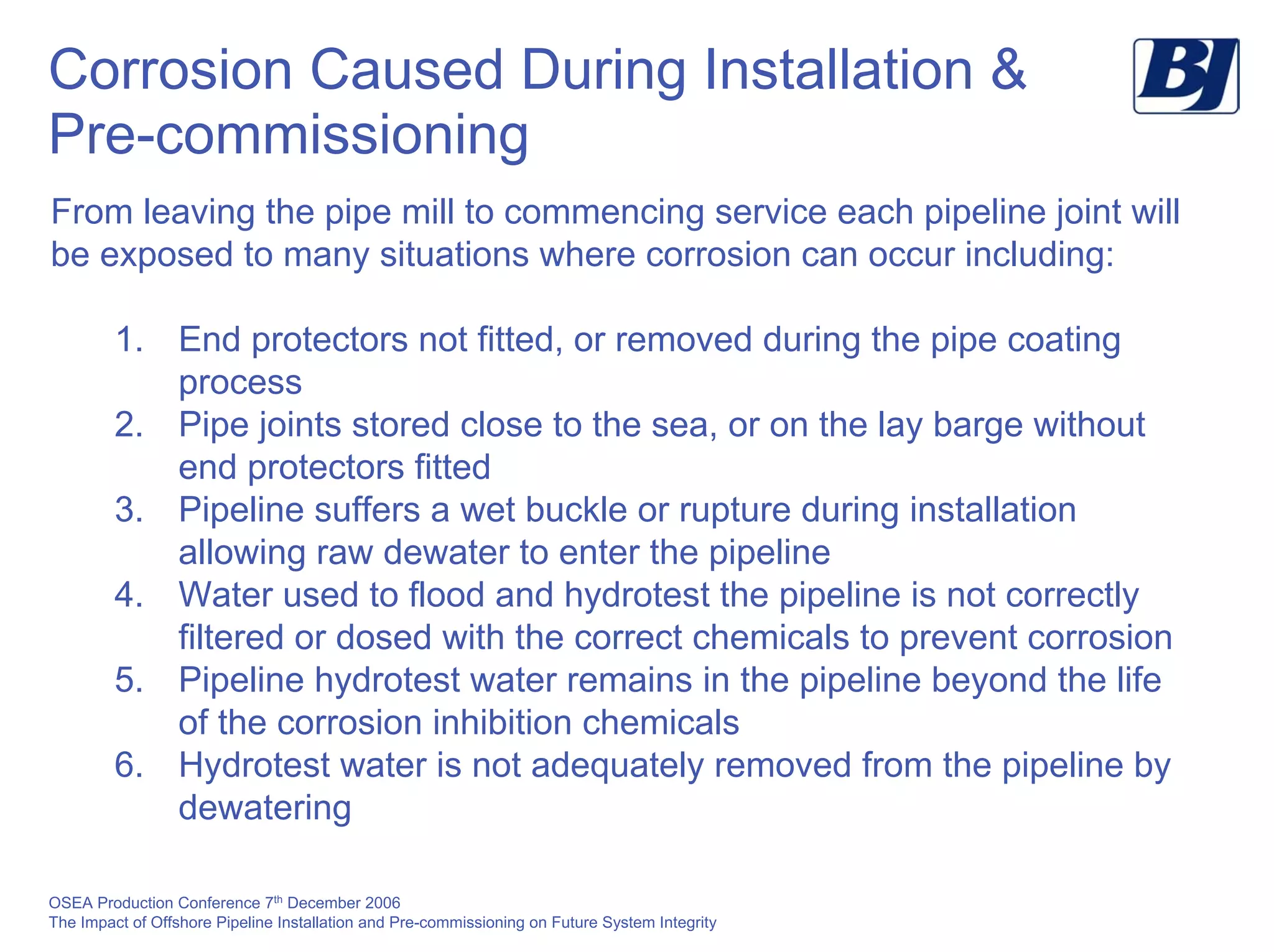
Corrosion Caused During Installation &
Pre-commissioning
From leaving the pipe mill to commencing service each pipeline joint will
be exposed to many situations where corrosion can occur including:
1. End protectors not fitted, or removed during the pipe coating
process
2. Pipe joints stored close to the sea, or on the lay barge without
end protectors fitted
3. Pipeline suffers a wet buckle or rupture during installation
allowing raw dewater to enter the pipeline
4. Water used to flood and hydrotest the pipeline is not correctly
filtered or dosed with the correct chemicals to prevent corrosion
5. Pipeline hydrotest water remains in the pipeline beyond the life
of the corrosion inhibition chemicals
6. Hydrotest water is not adequately removed from the pipeline by
dewatering
OSEA Production Conference 7th
December 2006
The Impact of Offshore Pipeline Installation and Pre-commissioning on Future System Integrity
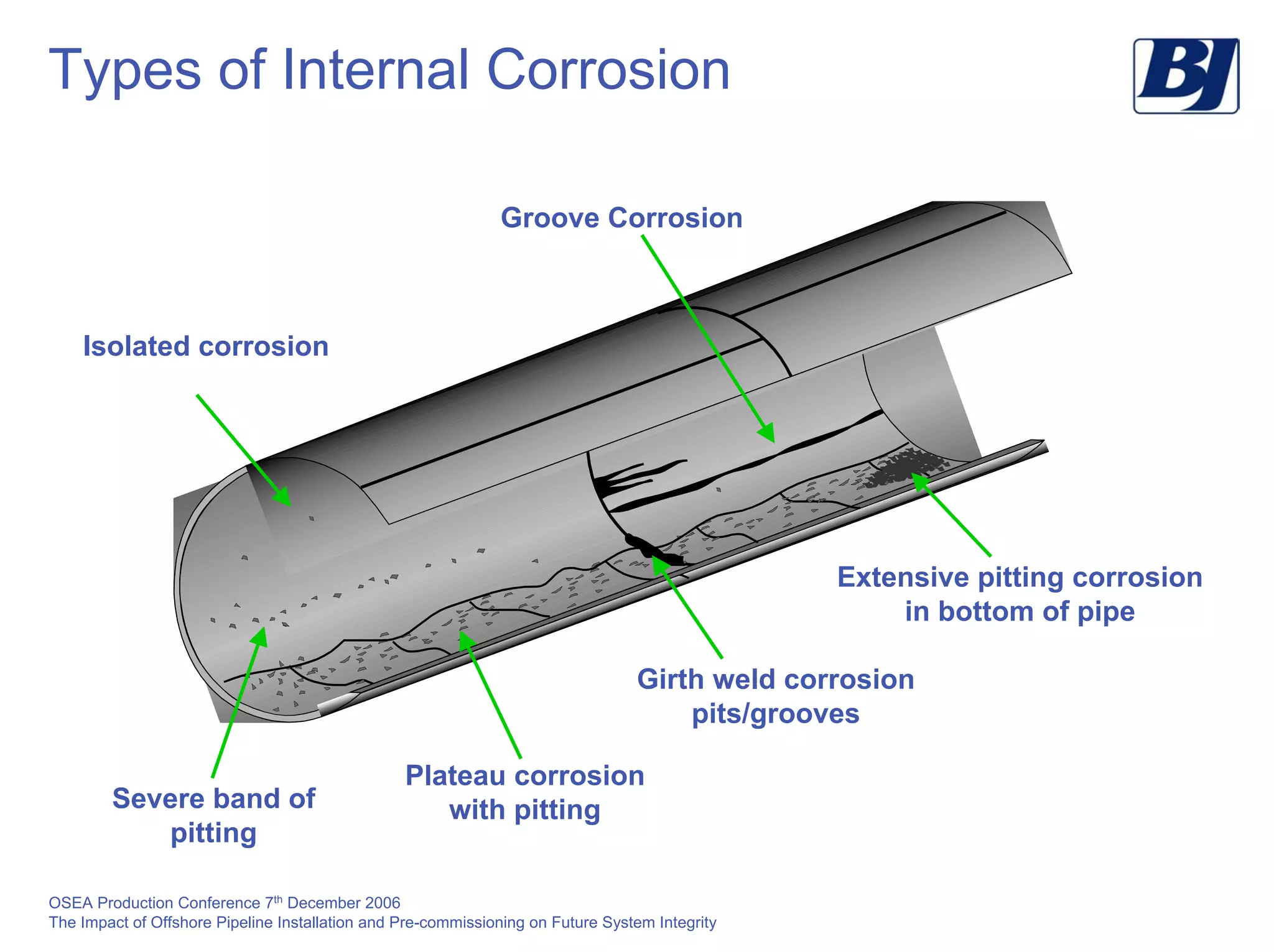
Types of Internal Corrosion
Extensive pitting corrosion
in bottom of pipe
Groove Corrosion
Isolated corrosion
Severe band of
pitting
Plateau corrosion
with pitting
Girth weld corrosion
pits/grooves
OSEA Production Conference 7th
December 2006
The Impact of Offshore Pipeline Installation and Pre-commissioning on Future System Integrity
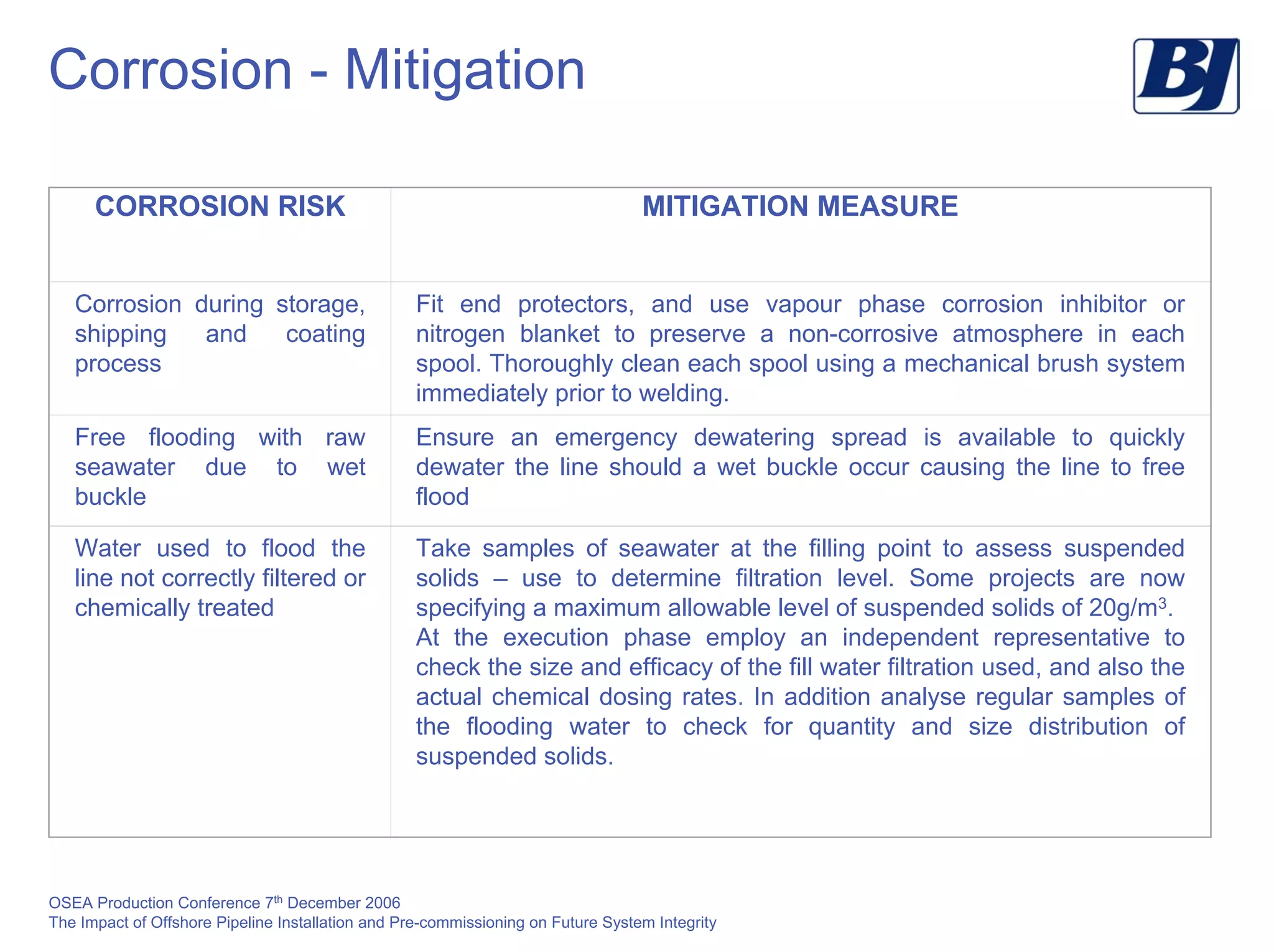
Corrosion - Mitigation
CORROSION RISK MITIGATION MEASURE
Corrosion during storage,
shipping and coating
process
Fit end protectors, and use vapour phase corrosion inhibitor or
nitrogen blanket to preserve a non-corrosive atmosphere in each
spool. Thoroughly clean each spool using a mechanical brush system
immediately prior to welding.
Free flooding with raw
seawater due to wet
buckle
Ensure an emergency dewatering spread is available to quickly
dewater the line should a wet buckle occur causing the line to free
flood
Water used to flood the
line not correctly filtered or
chemically treated
Take samples of seawater at the filling point to assess suspended
solids – use to determine filtration level. Some projects are now
specifying a maximum allowable level of suspended solids of 20g/m3.
At the execution phase employ an independent representative to
check the size and efficacy of the fill water filtration used, and also the
actual chemical dosing rates. In addition analyse regular samples of
the flooding water to check for quantity and size distribution of
suspended solids.
OSEA Production Conference 7th
December 2006
The Impact of Offshore Pipeline Installation and Pre-commissioning on Future System Integrity
Corrosion - Mitigation
CORROSION RISK MITIGATION MEASURE
Pipeline hydrotest water
remains in the line beyond
the effective life of the
chemicals
Often a pipeline may be “laid up” for a fixed period between the
completion of hydrotesting and the commencement of dewatering /
commissioning. Where this period extends beyond the original
planned duration, the chemical protection may not be adequate.
Such an event needs to be recorded and the hydrotest water
displaced with a fresh batch of water, suitably treated for the revised
lay up period.
Hydrotest water is not
adequately removed from
the pipeline by dewatering
A thorough pipeline dewatering operation should leave a water film in
the pipe of approx. 0.1mm for uncoated pipe and 0.07mm for
internally coated pipe. A desalination slug forms part of the pig train
suitably sized to dilute the residual seawater – typically this is 4% of
the line volume with acceptance criteria of a final chloride content of
below 200ppm.
If there is a delay between dewatering and subsequent swabbing /
drying / commissioning, the remaining water film will drain down to the
bottom of the line and collect at any low points. If this residual water
has not been suitably desalinated it can pose an additional corrosion
risk.
OSEA Production Conference 7th
December 2006
The Impact of Offshore Pipeline Installation and Pre-commissioning on Future System Integrity
Corrosion – Case Study
A 36” x 350km offshore gas transmission line suffered a wet buckle during pipelay causing the line to
free flood with raw seawater at the buckle point when approx. 160km of the line had been laid. The pipe
was free flooded with seawater for 3 months. When fully immersed in seawater, steel will corrode at a
remarkably steady rate to produce the oxide Fe2O3 (haematite) or Fe3O4 (magnetite). The corrosion is
very rapid initially, but falls off gradually over several months to a fairly steady rate (Table 2).
Exposure
Time
(months)
Average
corrosion rate
(mm/year)
1 0.33
2 0.25
3 0.19
6 0.15
12 0.13
24 0.11
48 0.11
Therefore, assuming a corrosion rate of 0.13mm/yr over a
three month period the wall thickness loss for the 150km
pipeline will be d=0.00325cm
Volume = 2 x 3.14 x 44.3 x 0.00325 x 161000 x 100 = 1.5 x
107 cm3
From calculation the total mass of iron oxide
formed = 157,000 KG
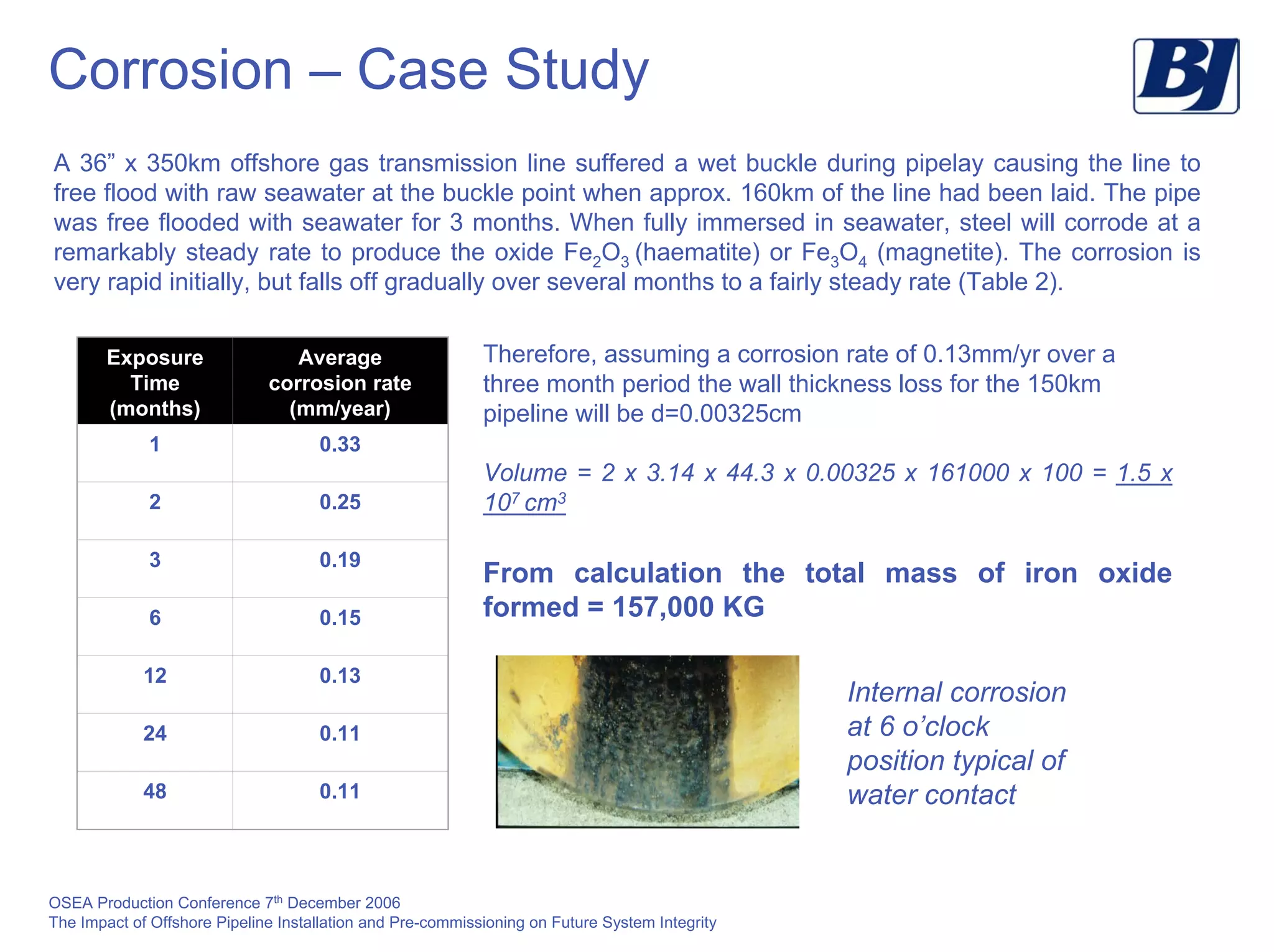
Internal corrosion
at 6 o’clock
position typical of
water contact
OSEA Production Conference 7th
December 2006
The Impact of Offshore Pipeline Installation and Pre-commissioning on Future System Integrity
Corrosion – Case Study
This pipeline was then subject to a baseline MFL survey where the impact of this corrosion
was noted in a number of ways:
•Hard bed of debris at 6 o’clock position masking pipe wall
•Internal corrosion measured up to 35% WT
•Blockage of filters from excessive debris removed during the pigging operation
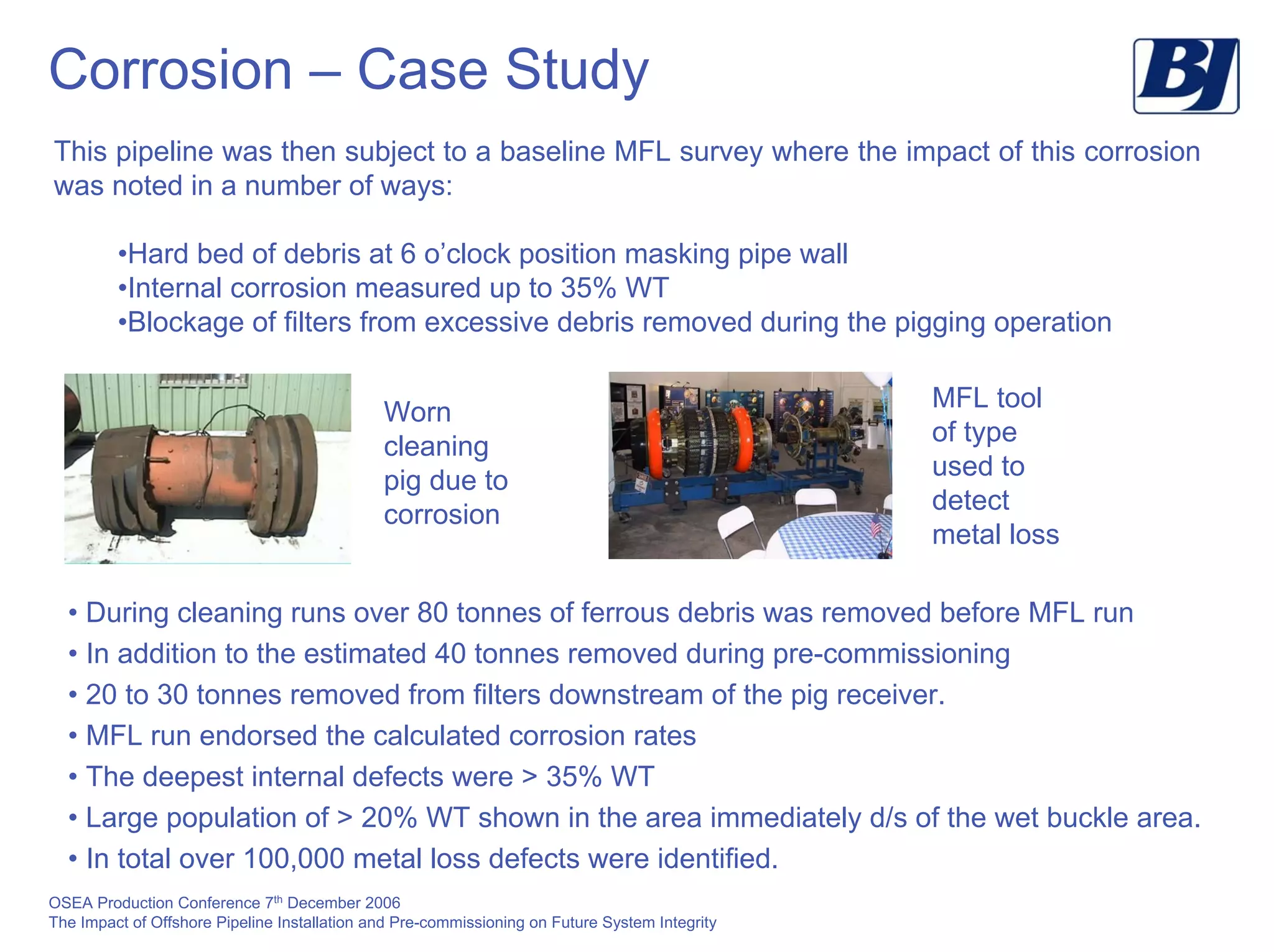
MFL tool
of type
used to
detect
metal loss
Worn
cleaning
pig due to
corrosion
• During cleaning runs over 80 tonnes of ferrous debris was removed before MFL run
• In addition to the estimated 40 tonnes removed during pre-commissioning
• 20 to 30 tonnes removed from filters downstream of the pig receiver.
• MFL run endorsed the calculated corrosion rates
• The deepest internal defects were > 35% WT
• Large population of > 20% WT shown in the area immediately d/s of the wet buckle area.
• In total over 100,000 metal loss defects were identified.
OSEA Production Conference 7th
December 2006
The Impact of Offshore Pipeline Installation and Pre-commissioning on Future System Integrity
Debris - Installation & Pre-commissioning
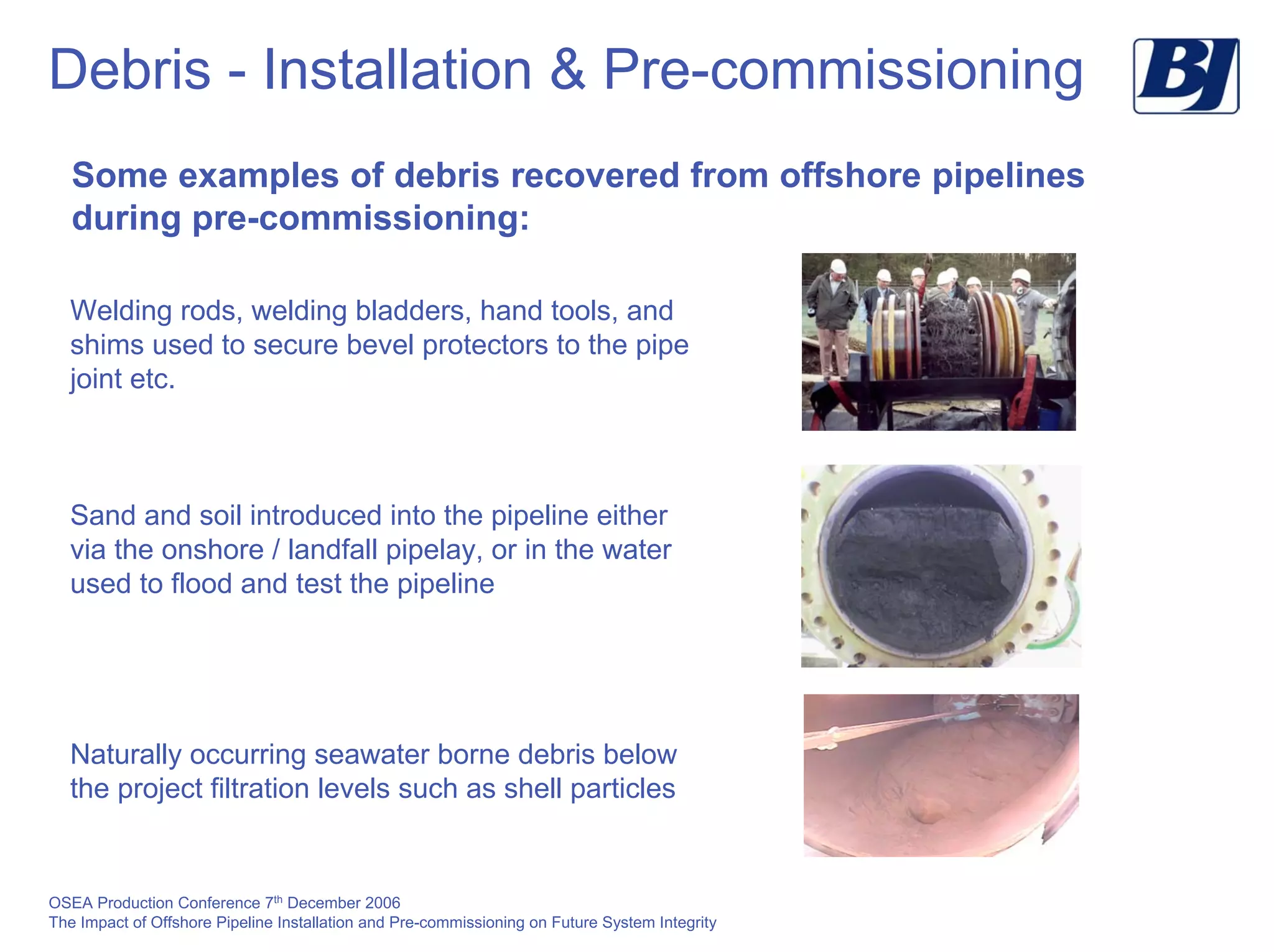
Some examples of debris recovered from offshore pipelines
during pre-commissioning:
Welding rods, welding bladders, hand tools, and
shims used to secure bevel protectors to the pipe
joint etc.
Sand and soil introduced into the pipeline either
via the onshore / landfall pipelay, or in the water
used to flood and test the pipeline
Naturally occurring seawater borne debris below
the project filtration levels such as shell particles
OSEA Production Conference 7th
December 2006
The Impact of Offshore Pipeline Installation and Pre-commissioning on Future System Integrity
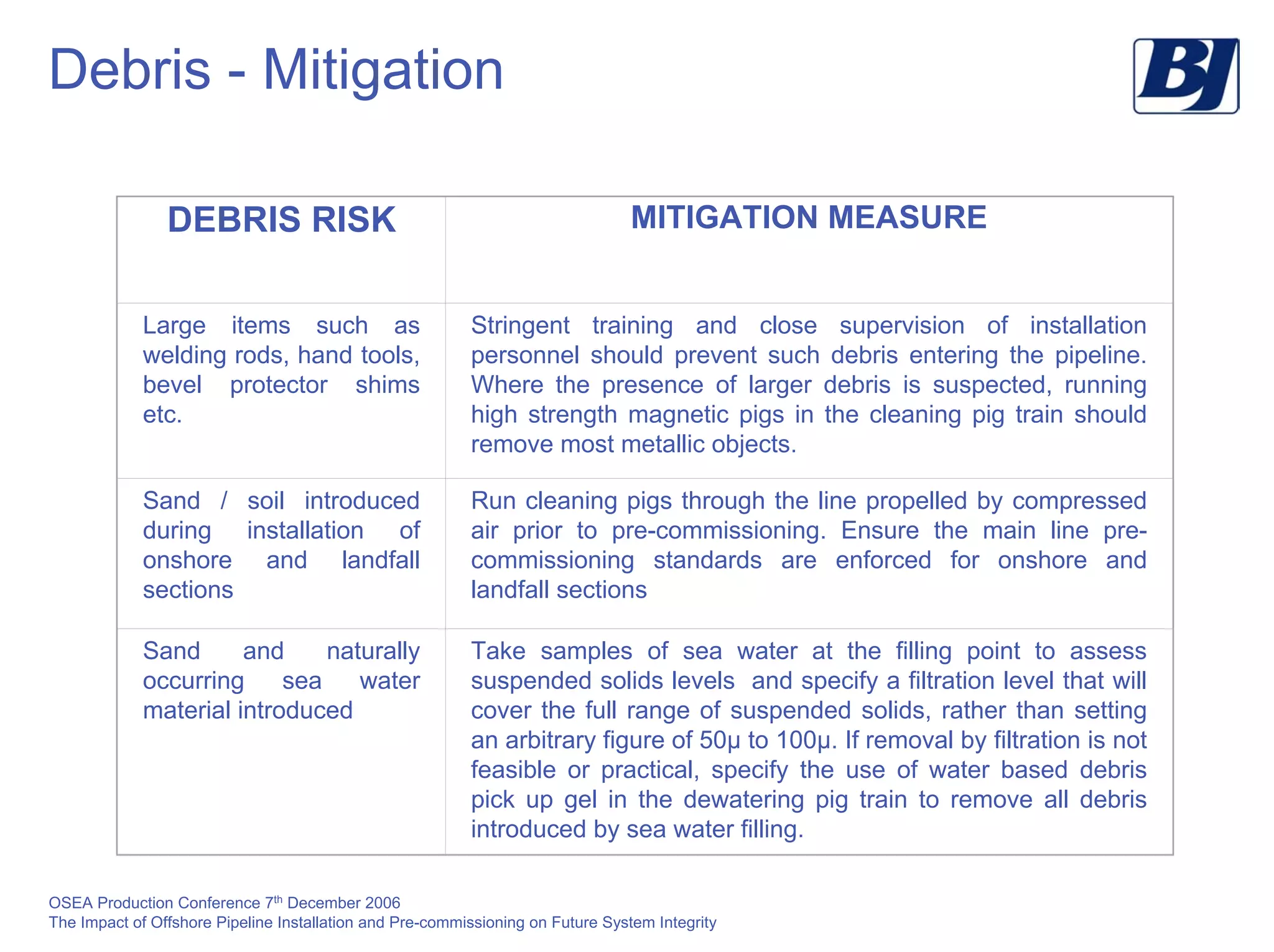
Debris - Mitigation
DEBRIS RISK MITIGATION MEASURE
Large items such as
welding rods, hand tools,
bevel protector shims
etc.
Stringent training and close supervision of installation
personnel should prevent such debris entering the pipeline.
Where the presence of larger debris is suspected, running
high strength magnetic pigs in the cleaning pig train should
remove most metallic objects.
Sand / soil introduced
during installation of
onshore and landfall
sections
Run cleaning pigs through the line propelled by compressed
air prior to pre-commissioning. Ensure the main line pre-
commissioning standards are enforced for onshore and
landfall sections
Sand and naturally
occurring sea water
material introduced
Take samples of sea water at the filling point to assess
suspended solids levels and specify a filtration level that will
cover the full range of suspended solids, rather than setting
an arbitrary figure of 50µ to 100µ. If removal by filtration is not
feasible or practical, specify the use of water based debris
pick up gel in the dewatering pig train to remove all debris
introduced by sea water filling.
OSEA Production Conference 7th
December 2006
The Impact of Offshore Pipeline Installation and Pre-commissioning on Future System Integrity
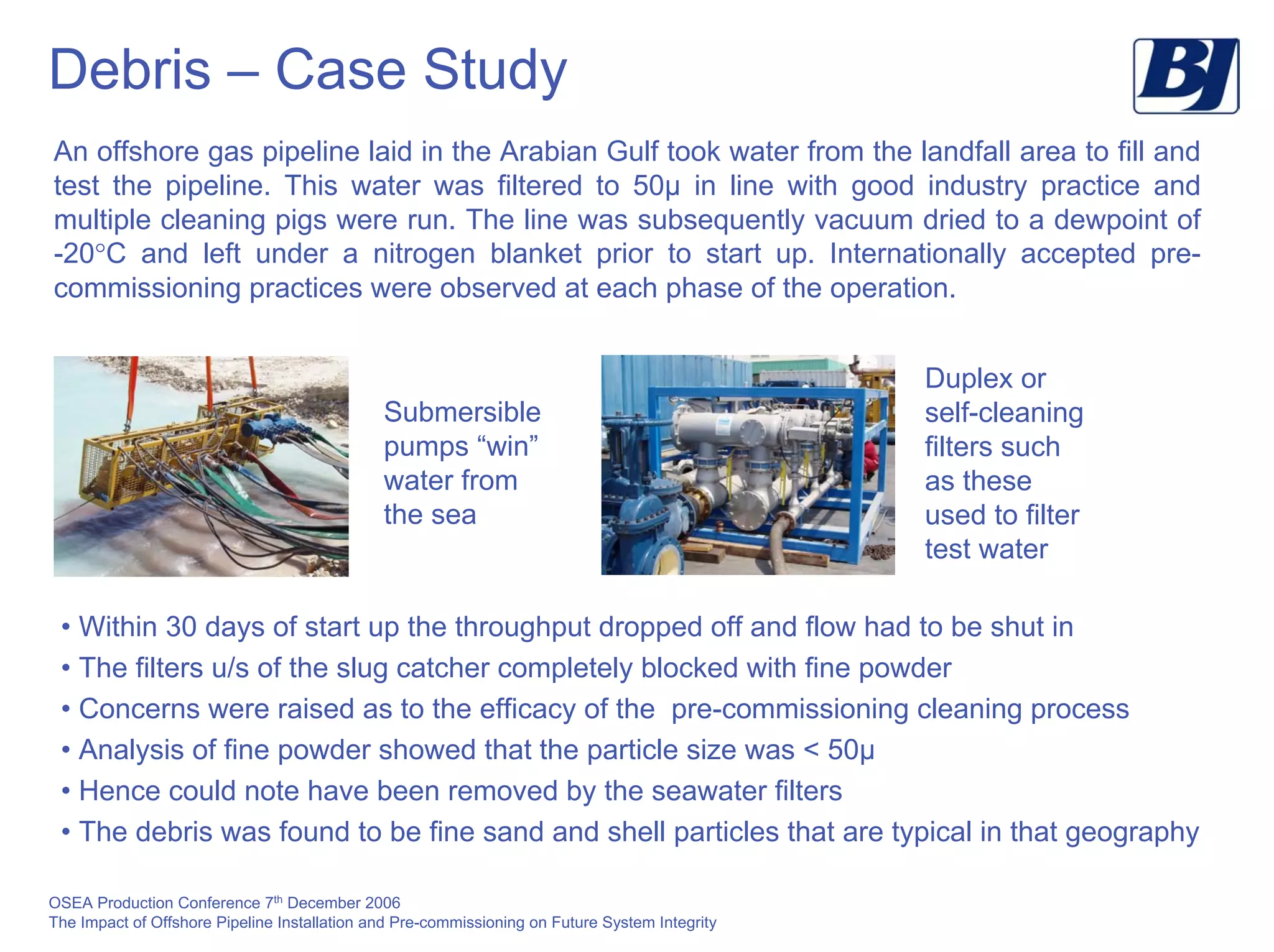
Debris – Case Study
An offshore gas pipeline laid in the Arabian Gulf took water from the landfall area to fill and
test the pipeline. This water was filtered to 50µ in line with good industry practice and
multiple cleaning pigs were run. The line was subsequently vacuum dried to a dewpoint of
-20°C and left under a nitrogen blanket prior to start up. Internationally accepted pre-
commissioning practices were observed at each phase of the operation.
Duplex or
self-cleaning
filters such
as these
used to filter
test water
Submersible
pumps “win”
water from
the sea
• Within 30 days of start up the throughput dropped off and flow had to be shut in
• The filters u/s of the slug catcher completely blocked with fine powder
• Concerns were raised as to the efficacy of the pre-commissioning cleaning process
• Analysis of fine powder showed that the particle size was < 50µ
• Hence could note have been removed by the seawater filters
• The debris was found to be fine sand and shell particles that are typical in that geography
OSEA Production Conference 7th
December 2006
The Impact of Offshore Pipeline Installation and Pre-commissioning on Future System Integrity
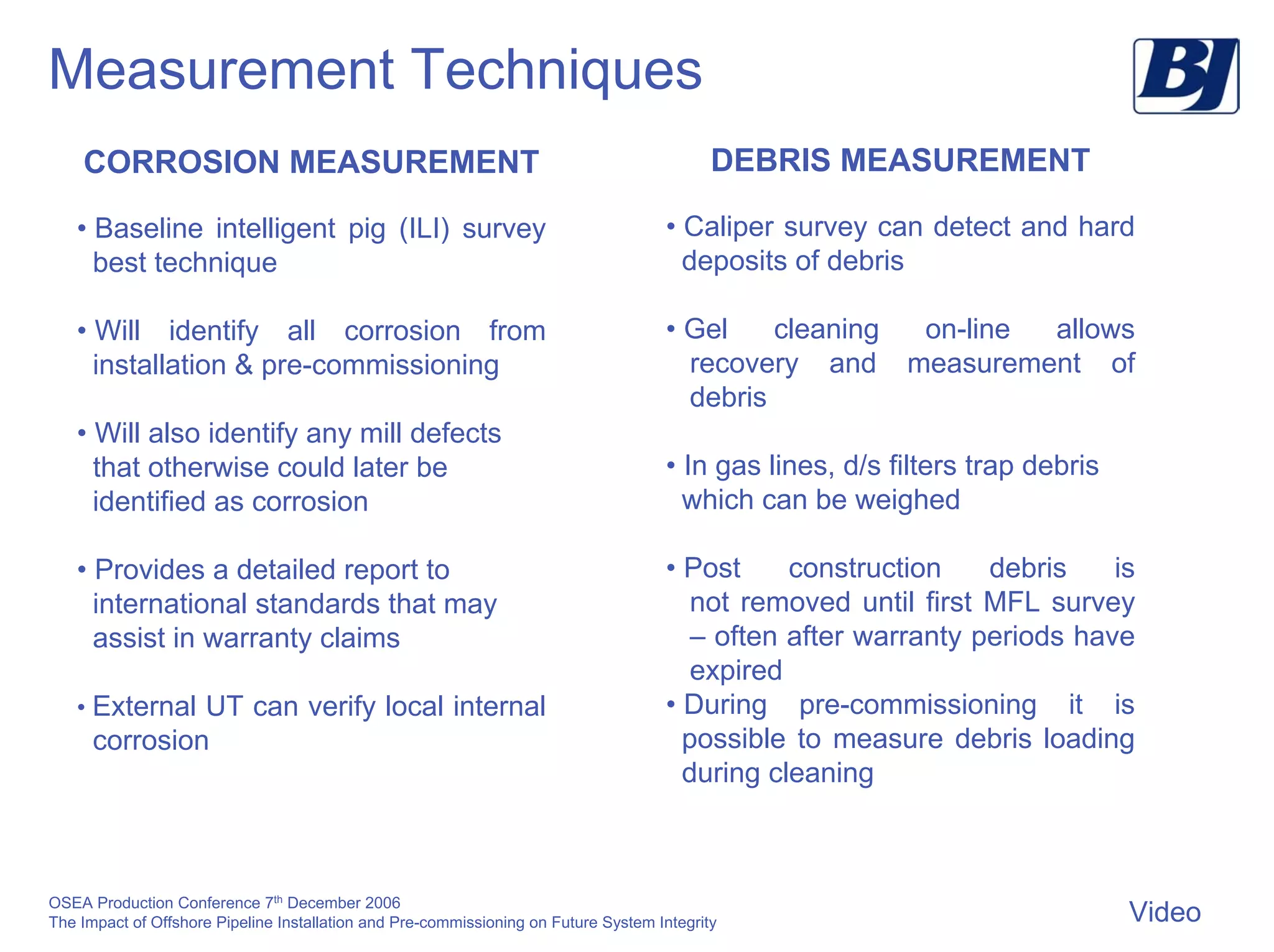
Measurement Techniques
CORROSION MEASUREMENT
• Baseline intelligent pig (ILI) survey
best technique
• Will identify all corrosion from
installation & pre-commissioning
• Will also identify any mill defects
that otherwise could later be
identified as corrosion
• Provides a detailed report to
international standards that may
assist in warranty claims
• External UT can verify local internal
corrosion
DEBRIS MEASUREMENT
• Caliper survey can detect and hard
deposits of debris
• Gel cleaning on-line allows
recovery and measurement of
debris
• In gas lines, d/s filters trap debris
which can be weighed
• Post construction debris is
not removed until first MFL survey
– often after warranty periods have
expired
• During pre-commissioning it is
possible to measure debris loading
during cleaning
Video
OSEA Production Conference 7th
December 2006
The Impact of Offshore Pipeline Installation and Pre-commissioning on Future System Integrity
Measurement - Corrosion
OSEA Production Conference 7th
December 2006
The Impact of Offshore Pipeline Installation and Pre-commissioning on Future System Integrity
Summary & Conclusions
1. When planning a new offshore pipeline it is important to look at the
environment in which it will be installed to assess any fundamental
problems that could adversely affect the line during pre-commissioning,
particularly the source and quality of water to be used to fill and test the
line.
2. For gas pipelines, internal coating should be considered not just on the
merits of flow efficiency, but also on the corrosion protection and ease of
cleaning and drying facilitated by the internal coating.
3. Wet buckles in uncoated pipelines will cause significant internal corrosion
if the line is not quickly dewatered – for projects in remote areas a
permanent dewatering spread should be considered as mobilisation of
such a spread may take many weeks.
OSEA Production Conference 7th
December 2006
The Impact of Offshore Pipeline Installation and Pre-commissioning on Future System Integrity
Summary & Conclusions
4. Corrosion caused by untreated seawater entering uncoated pipelines can
cause significant internal corrosion, reducing the effective corrosion
allowance and design life of the line
5. Simply filtering the fill and test water to 50µ will not prevent smaller sized
particles from entering and collecting in the line - there are many
examples of fine powder being recovered from gas lines immediately
after start-up, damaging in-line components and affecting downstream
facilities
6. Pipeline debris can build up during pre-commissioning into hard lumps
that can resemble dents. This can lead to false data on geometry
surveys, adversely affecting a project in both financial and schedule
terms
7. When executing a new pipeline, pre-commissioning should be viewed
with equal importance to design, procurement and installation, with the
process being overseen by the pipeline end user
END

OSEA J Grover 7 Dec 06

  • 1.
    OSEA Production Conference7th December 2006 The Impact of Offshore Pipeline Installation and Pre-commissioning on Future System Integrity OSEA – Production Conference THE IMPACT OF OFFSHORE PIPELINE INSTALLATION AND PRE-COMMISSIONING ON FUTURE SYSTEM INTEGRITY John Grover 7th December 2006
  • 2.
    OSEA Production Conference7th December 2006 The Impact of Offshore Pipeline Installation and Pre-commissioning on Future System Integrity Objective To convey to the OSEA conference delegates the impact of Offshore Pipeline Installation & Pre-commissioning on future system integrity.
  • 3.
    OSEA Production Conference7th December 2006 The Impact of Offshore Pipeline Installation and Pre-commissioning on Future System Integrity Contents • Introduction • Fundamentals of Pipeline Pre-commissioning • Corrosion Caused During Installation & Pre- commissioning › Case Study › Mitigation & Measurement • Debris resulting from Installation & Pre-commissioning › Case Study › Mitigation • Measurement Techniques • Summary & Conclusions
  • 4.
    OSEA Production Conference7th December 2006 The Impact of Offshore Pipeline Installation and Pre-commissioning on Future System Integrity Introduction This paper examines some of the common mistakes and oversights in the areas of: • Pipe joint storage and preservation • Prevention of seawater ingress during lay • Wet buckle impact and possible contingencies • Pre-operational cleaning • Source and treatment of hydrotest water • Dewatering and drying Then via case studies we look at the impact on pipeline integrity and what mitigation steps can be taken. Finally we look at techniques to measure corrosion and debris and draw some conclusions
  • 5.
    OSEA Production Conference7th December 2006 The Impact of Offshore Pipeline Installation and Pre-commissioning on Future System Integrity Oil Pipeline Pre-commissioning Run sufficient cleaning pigs to meet agreed cleanliness Prove internal bore by running a gauge pig of caliper tool 3Fill line with treated & filtered water 21 Line ready for commissioning / lay up Perform hydrostatic strength test Optional caliper survey / OOS survey 64 5
  • 6.
    OSEA Production Conference7th December 2006 The Impact of Offshore Pipeline Installation and Pre-commissioning on Future System Integrity Gas Pipeline Pre-commissioning Optional caliper survey / OOS survey Dewater & swab line to remove bulk water – run desal slug 3Steps 1 to 4 as for oil pipelines – line tested 21 April 4th, 2003 BP Equipment Presentation Andy Barden Line ready for commissioning / lay up Dry line to an agreed “dewpoint” using dry air or vacuum Purge & pack the line with nitrogen gas 64 5 April 4th, 2003 BP Equipment Presentation Andy Barden
  • 7.
    OSEA Production Conference7th December 2006 The Impact of Offshore Pipeline Installation and Pre-commissioning on Future System Integrity Corrosion Caused During Installation & Pre-commissioning From leaving the pipe mill to commencing service each pipeline joint will be exposed to many situations where corrosion can occur including: 1. End protectors not fitted, or removed during the pipe coating process 2. Pipe joints stored close to the sea, or on the lay barge without end protectors fitted 3. Pipeline suffers a wet buckle or rupture during installation allowing raw dewater to enter the pipeline 4. Water used to flood and hydrotest the pipeline is not correctly filtered or dosed with the correct chemicals to prevent corrosion 5. Pipeline hydrotest water remains in the pipeline beyond the life of the corrosion inhibition chemicals 6. Hydrotest water is not adequately removed from the pipeline by dewatering
  • 8.
    OSEA Production Conference7th December 2006 The Impact of Offshore Pipeline Installation and Pre-commissioning on Future System Integrity Types of Internal Corrosion Extensive pitting corrosion in bottom of pipe Groove Corrosion Isolated corrosion Severe band of pitting Plateau corrosion with pitting Girth weld corrosion pits/grooves
  • 9.
    OSEA Production Conference7th December 2006 The Impact of Offshore Pipeline Installation and Pre-commissioning on Future System Integrity Corrosion - Mitigation CORROSION RISK MITIGATION MEASURE Corrosion during storage, shipping and coating process Fit end protectors, and use vapour phase corrosion inhibitor or nitrogen blanket to preserve a non-corrosive atmosphere in each spool. Thoroughly clean each spool using a mechanical brush system immediately prior to welding. Free flooding with raw seawater due to wet buckle Ensure an emergency dewatering spread is available to quickly dewater the line should a wet buckle occur causing the line to free flood Water used to flood the line not correctly filtered or chemically treated Take samples of seawater at the filling point to assess suspended solids – use to determine filtration level. Some projects are now specifying a maximum allowable level of suspended solids of 20g/m3. At the execution phase employ an independent representative to check the size and efficacy of the fill water filtration used, and also the actual chemical dosing rates. In addition analyse regular samples of the flooding water to check for quantity and size distribution of suspended solids.
  • 10.
    OSEA Production Conference7th December 2006 The Impact of Offshore Pipeline Installation and Pre-commissioning on Future System Integrity Corrosion - Mitigation CORROSION RISK MITIGATION MEASURE Pipeline hydrotest water remains in the line beyond the effective life of the chemicals Often a pipeline may be “laid up” for a fixed period between the completion of hydrotesting and the commencement of dewatering / commissioning. Where this period extends beyond the original planned duration, the chemical protection may not be adequate. Such an event needs to be recorded and the hydrotest water displaced with a fresh batch of water, suitably treated for the revised lay up period. Hydrotest water is not adequately removed from the pipeline by dewatering A thorough pipeline dewatering operation should leave a water film in the pipe of approx. 0.1mm for uncoated pipe and 0.07mm for internally coated pipe. A desalination slug forms part of the pig train suitably sized to dilute the residual seawater – typically this is 4% of the line volume with acceptance criteria of a final chloride content of below 200ppm. If there is a delay between dewatering and subsequent swabbing / drying / commissioning, the remaining water film will drain down to the bottom of the line and collect at any low points. If this residual water has not been suitably desalinated it can pose an additional corrosion risk.
  • 11.
    OSEA Production Conference7th December 2006 The Impact of Offshore Pipeline Installation and Pre-commissioning on Future System Integrity Corrosion – Case Study A 36” x 350km offshore gas transmission line suffered a wet buckle during pipelay causing the line to free flood with raw seawater at the buckle point when approx. 160km of the line had been laid. The pipe was free flooded with seawater for 3 months. When fully immersed in seawater, steel will corrode at a remarkably steady rate to produce the oxide Fe2O3 (haematite) or Fe3O4 (magnetite). The corrosion is very rapid initially, but falls off gradually over several months to a fairly steady rate (Table 2). Exposure Time (months) Average corrosion rate (mm/year) 1 0.33 2 0.25 3 0.19 6 0.15 12 0.13 24 0.11 48 0.11 Therefore, assuming a corrosion rate of 0.13mm/yr over a three month period the wall thickness loss for the 150km pipeline will be d=0.00325cm Volume = 2 x 3.14 x 44.3 x 0.00325 x 161000 x 100 = 1.5 x 107 cm3 From calculation the total mass of iron oxide formed = 157,000 KG Internal corrosion at 6 o’clock position typical of water contact
  • 12.
    OSEA Production Conference7th December 2006 The Impact of Offshore Pipeline Installation and Pre-commissioning on Future System Integrity Corrosion – Case Study This pipeline was then subject to a baseline MFL survey where the impact of this corrosion was noted in a number of ways: •Hard bed of debris at 6 o’clock position masking pipe wall •Internal corrosion measured up to 35% WT •Blockage of filters from excessive debris removed during the pigging operation MFL tool of type used to detect metal loss Worn cleaning pig due to corrosion • During cleaning runs over 80 tonnes of ferrous debris was removed before MFL run • In addition to the estimated 40 tonnes removed during pre-commissioning • 20 to 30 tonnes removed from filters downstream of the pig receiver. • MFL run endorsed the calculated corrosion rates • The deepest internal defects were > 35% WT • Large population of > 20% WT shown in the area immediately d/s of the wet buckle area. • In total over 100,000 metal loss defects were identified.
  • 13.
    OSEA Production Conference7th December 2006 The Impact of Offshore Pipeline Installation and Pre-commissioning on Future System Integrity Debris - Installation & Pre-commissioning Some examples of debris recovered from offshore pipelines during pre-commissioning: Welding rods, welding bladders, hand tools, and shims used to secure bevel protectors to the pipe joint etc. Sand and soil introduced into the pipeline either via the onshore / landfall pipelay, or in the water used to flood and test the pipeline Naturally occurring seawater borne debris below the project filtration levels such as shell particles
  • 14.
    OSEA Production Conference7th December 2006 The Impact of Offshore Pipeline Installation and Pre-commissioning on Future System Integrity Debris - Mitigation DEBRIS RISK MITIGATION MEASURE Large items such as welding rods, hand tools, bevel protector shims etc. Stringent training and close supervision of installation personnel should prevent such debris entering the pipeline. Where the presence of larger debris is suspected, running high strength magnetic pigs in the cleaning pig train should remove most metallic objects. Sand / soil introduced during installation of onshore and landfall sections Run cleaning pigs through the line propelled by compressed air prior to pre-commissioning. Ensure the main line pre- commissioning standards are enforced for onshore and landfall sections Sand and naturally occurring sea water material introduced Take samples of sea water at the filling point to assess suspended solids levels and specify a filtration level that will cover the full range of suspended solids, rather than setting an arbitrary figure of 50µ to 100µ. If removal by filtration is not feasible or practical, specify the use of water based debris pick up gel in the dewatering pig train to remove all debris introduced by sea water filling.
  • 15.
    OSEA Production Conference7th December 2006 The Impact of Offshore Pipeline Installation and Pre-commissioning on Future System Integrity Debris – Case Study An offshore gas pipeline laid in the Arabian Gulf took water from the landfall area to fill and test the pipeline. This water was filtered to 50µ in line with good industry practice and multiple cleaning pigs were run. The line was subsequently vacuum dried to a dewpoint of -20°C and left under a nitrogen blanket prior to start up. Internationally accepted pre- commissioning practices were observed at each phase of the operation. Duplex or self-cleaning filters such as these used to filter test water Submersible pumps “win” water from the sea • Within 30 days of start up the throughput dropped off and flow had to be shut in • The filters u/s of the slug catcher completely blocked with fine powder • Concerns were raised as to the efficacy of the pre-commissioning cleaning process • Analysis of fine powder showed that the particle size was < 50µ • Hence could note have been removed by the seawater filters • The debris was found to be fine sand and shell particles that are typical in that geography
  • 16.
    OSEA Production Conference7th December 2006 The Impact of Offshore Pipeline Installation and Pre-commissioning on Future System Integrity Measurement Techniques CORROSION MEASUREMENT • Baseline intelligent pig (ILI) survey best technique • Will identify all corrosion from installation & pre-commissioning • Will also identify any mill defects that otherwise could later be identified as corrosion • Provides a detailed report to international standards that may assist in warranty claims • External UT can verify local internal corrosion DEBRIS MEASUREMENT • Caliper survey can detect and hard deposits of debris • Gel cleaning on-line allows recovery and measurement of debris • In gas lines, d/s filters trap debris which can be weighed • Post construction debris is not removed until first MFL survey – often after warranty periods have expired • During pre-commissioning it is possible to measure debris loading during cleaning Video
  • 17.
    OSEA Production Conference7th December 2006 The Impact of Offshore Pipeline Installation and Pre-commissioning on Future System Integrity Measurement - Corrosion
  • 18.
    OSEA Production Conference7th December 2006 The Impact of Offshore Pipeline Installation and Pre-commissioning on Future System Integrity Summary & Conclusions 1. When planning a new offshore pipeline it is important to look at the environment in which it will be installed to assess any fundamental problems that could adversely affect the line during pre-commissioning, particularly the source and quality of water to be used to fill and test the line. 2. For gas pipelines, internal coating should be considered not just on the merits of flow efficiency, but also on the corrosion protection and ease of cleaning and drying facilitated by the internal coating. 3. Wet buckles in uncoated pipelines will cause significant internal corrosion if the line is not quickly dewatered – for projects in remote areas a permanent dewatering spread should be considered as mobilisation of such a spread may take many weeks.
  • 19.
    OSEA Production Conference7th December 2006 The Impact of Offshore Pipeline Installation and Pre-commissioning on Future System Integrity Summary & Conclusions 4. Corrosion caused by untreated seawater entering uncoated pipelines can cause significant internal corrosion, reducing the effective corrosion allowance and design life of the line 5. Simply filtering the fill and test water to 50µ will not prevent smaller sized particles from entering and collecting in the line - there are many examples of fine powder being recovered from gas lines immediately after start-up, damaging in-line components and affecting downstream facilities 6. Pipeline debris can build up during pre-commissioning into hard lumps that can resemble dents. This can lead to false data on geometry surveys, adversely affecting a project in both financial and schedule terms 7. When executing a new pipeline, pre-commissioning should be viewed with equal importance to design, procurement and installation, with the process being overseen by the pipeline end user END