Agenda Introduction Field Operations Pipeline inspections Visions and objectives Our strategy Products and services Pipescan Laser video Neptune Project deliveries Case studies
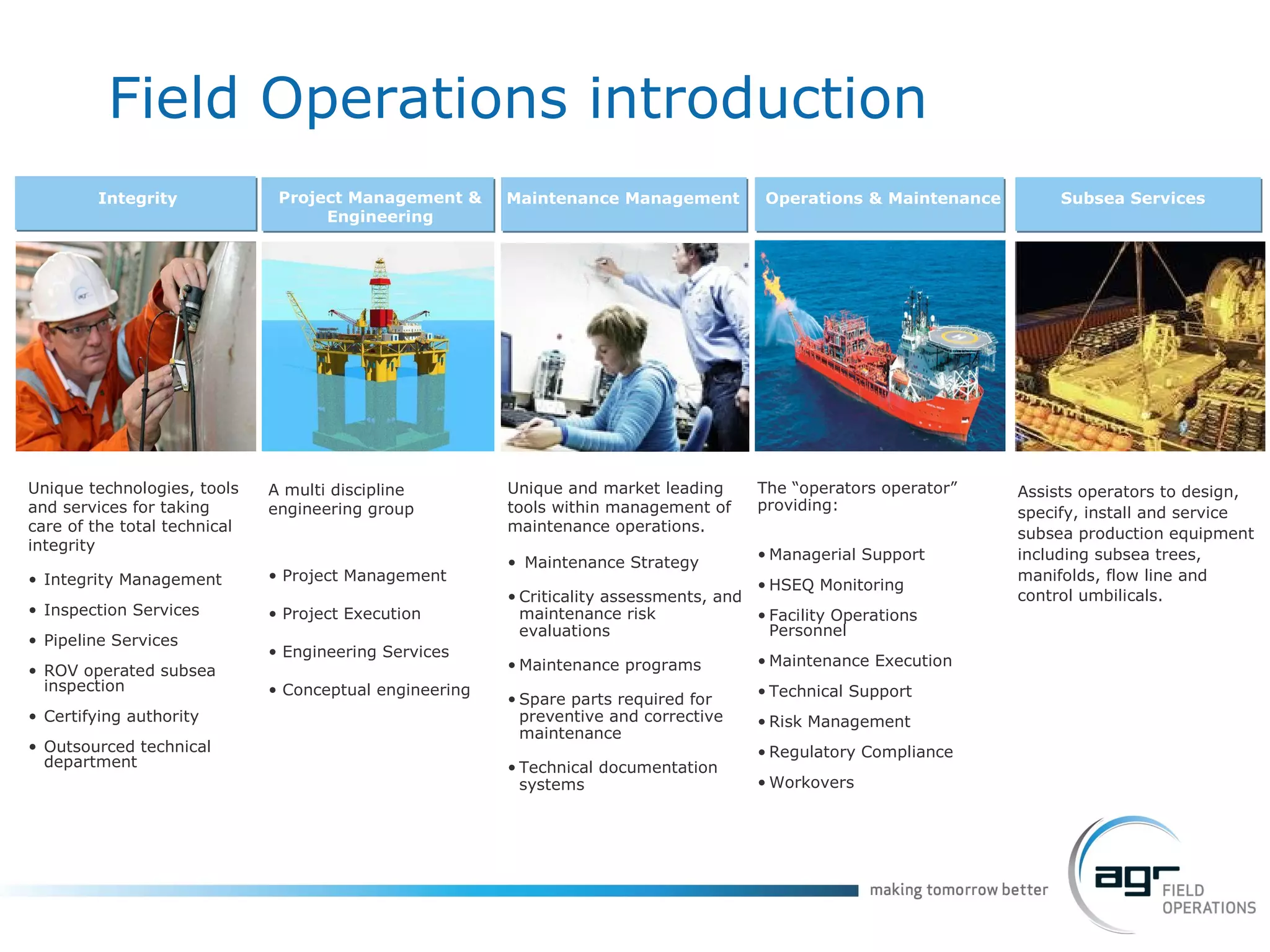
Unique technologies, tools and services for taking care of the total technical integrity Integrity Management  Inspection Services Pipeline Services ROV operated subsea inspection Certifying authority  Outsourced technical department Integrity Project Management & Engineering Maintenance Management Operations & Maintenance A multi discipline engineering group Project Management Project Execution Engineering Services Conceptual engineering Unique and market leading tools within management of maintenance operations.  Maintenance Strategy Criticality assessments, and maintenance risk evaluations Maintenance programs  Spare parts required for preventive and corrective maintenance  Technical documentation systems The “operators operator” providing:  Managerial Support HSEQ Monitoring Facility Operations Personnel Maintenance Execution Technical Support Risk Management Regulatory Compliance Workovers Subsea Services Assists operators to design, specify, install and service subsea production equipment including subsea trees,  manifolds, flow line and control umbilicals.  Field Operations introduction
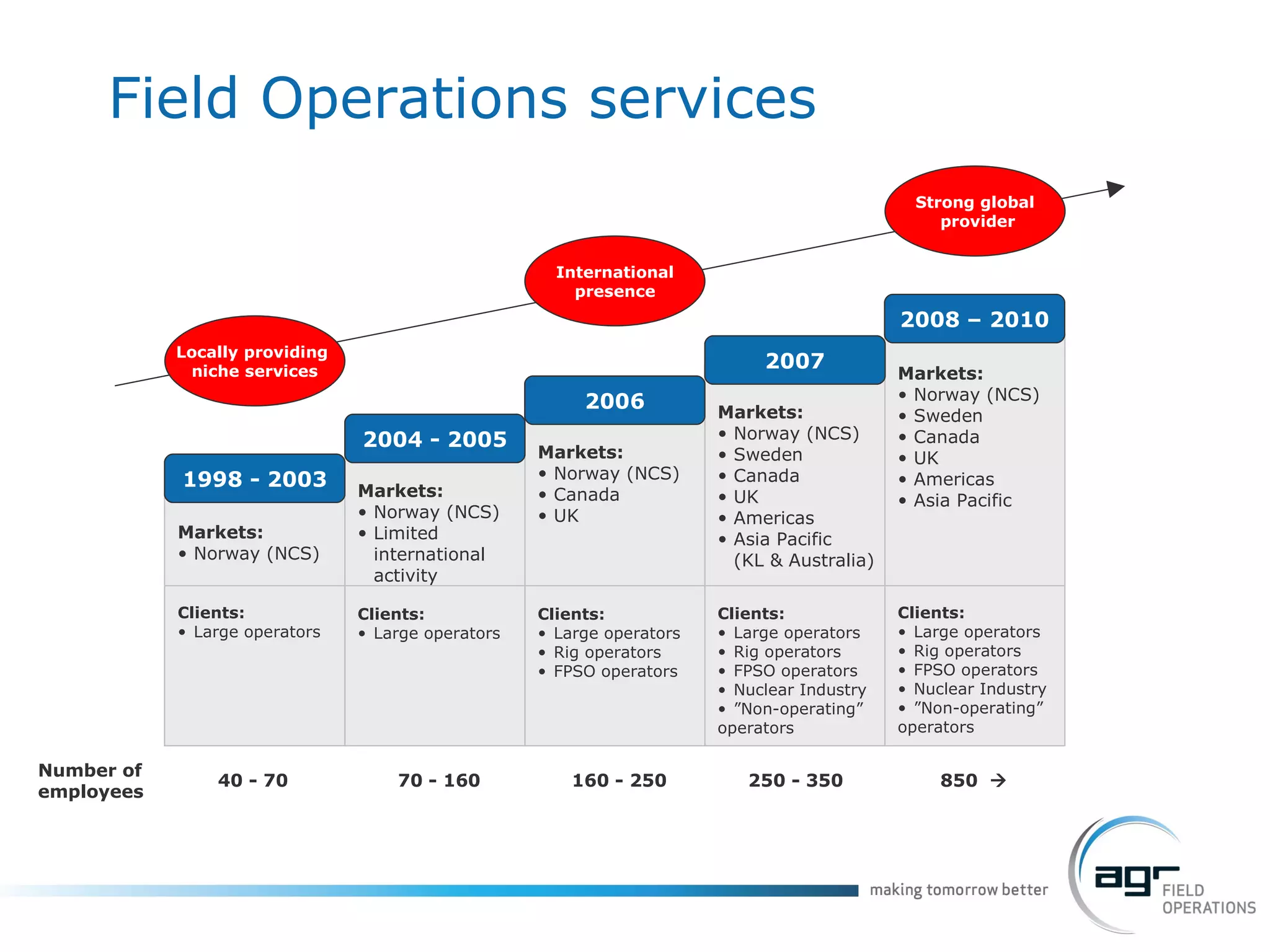
Field Operations services 1998 - 2003 2004 - 2005 2006 2007 Markets: Norway (NCS) Markets: Norway (NCS) Limited international activity Markets: Norway (NCS) Canada UK  Markets: Norway (NCS) Sweden Canada UK Americas Asia Pacific (KL & Australia) Markets: Norway (NCS) Sweden Canada UK Americas Asia Pacific Clients: Large operators Clients: Large operators Clients: Large operators Rig operators FPSO operators Clients: Large operators Rig operators FPSO operators Nuclear Industry ” Non-operating” operators Clients: Large operators Rig operators FPSO operators Nuclear Industry ” Non-operating” operators Locally providing  niche services International presence Strong global provider Number of  employees 40 - 70 70 - 160 160 - 250 250 - 350 850   2008 – 2010
We are a global provider Product based service company, with a niche area in tethered internal inline cleaning and inspection International provider of pipeline inspection services  Continued development of cutting edge technology and method that enable customers to control and manage their business
Our strategy Our business concept is based on the knowledge of pipeline business methods and techniques We provide customers with cost-effective integrated solutions designed for adaptation We are committed to continuous learning and new methods
The need for integrity services Aging pipeline systems  The need for lifetime extensions Re-qualification of existing pipelines Optimised design, a stricter need for monitoring PIM for onshore pipelines regulation (API1160, ASME31.8S)
How can AGR help? Identify potential degradation mechanisms  Perform corrosion risk assessments and failure analysis Fatigue and remaining life assessments Fitness for service assessments Risk assessment of equipment, structures and machinery Evaluation of inspection results  Risk re-assessment post inspection Our systems can be used with the clients’ own systems
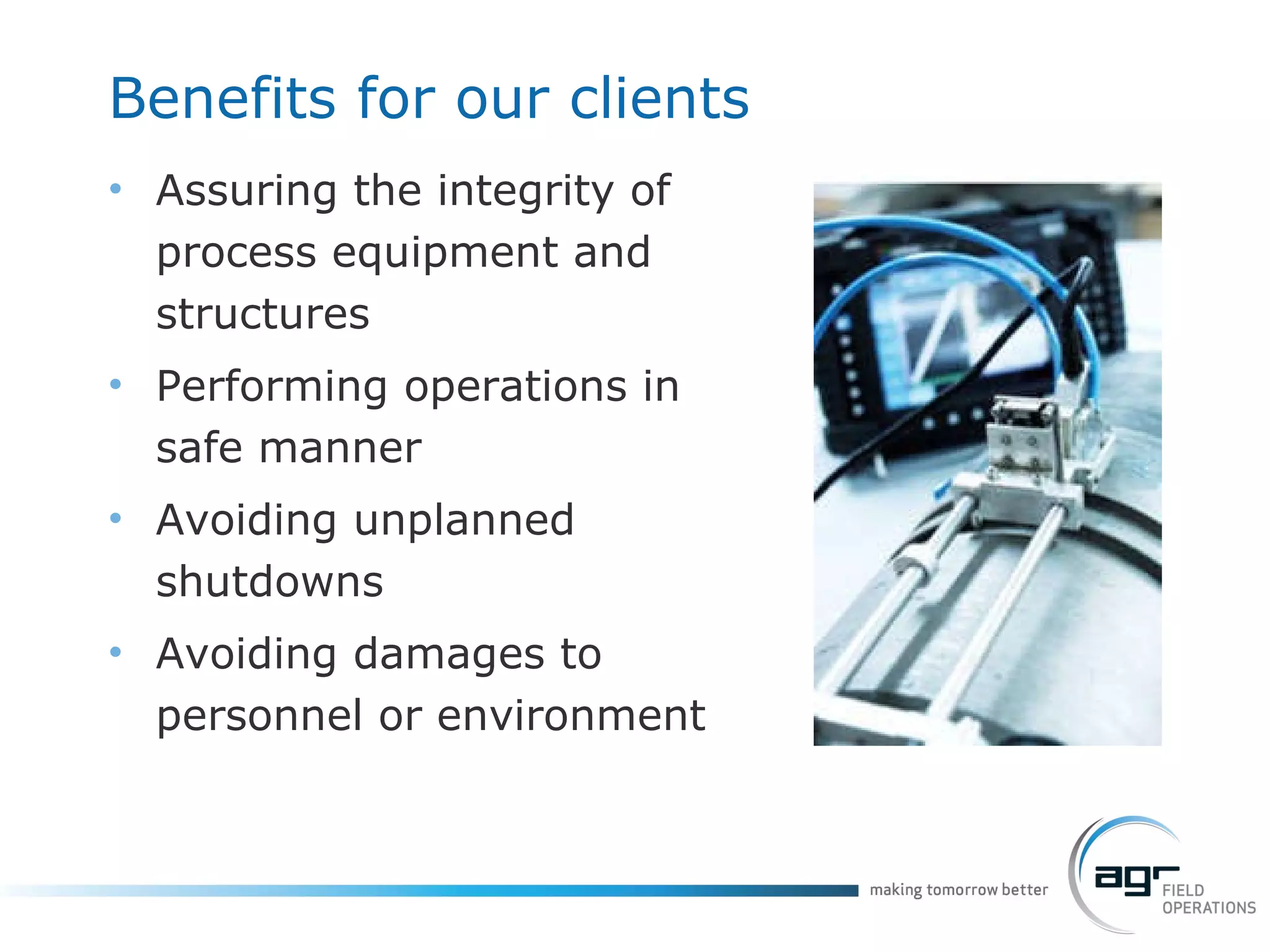
Benefits for our clients Assuring the integrity of process equipment and structures Performing operations in safe manner Avoiding unplanned shutdowns Avoiding damages to personnel or environment
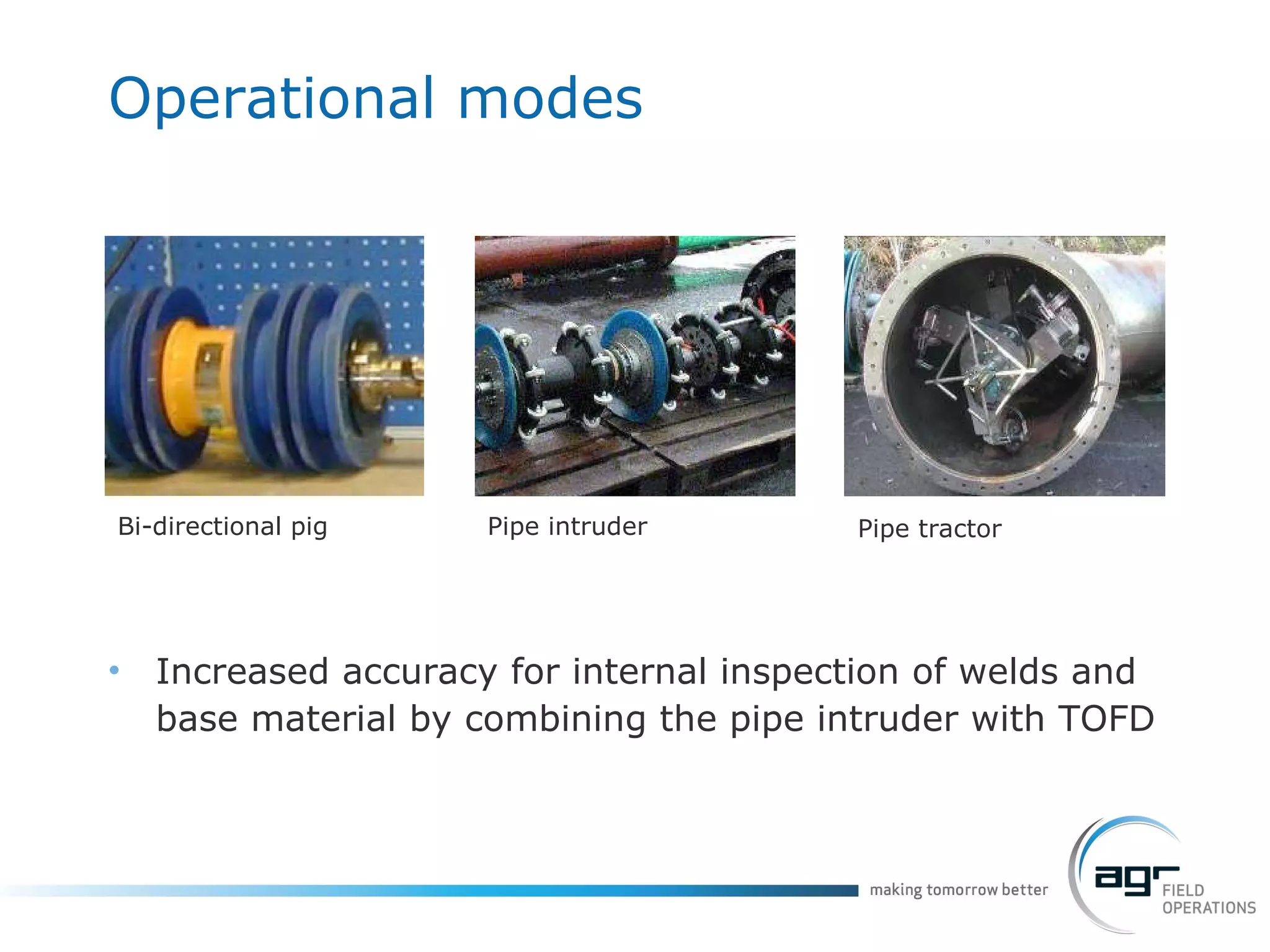
Operational  modes Increased accuracy for internal inspection of welds and base material by combining the pipe intruder with TOFD Pipe intruder Pipe tractor Bi-directional   pig
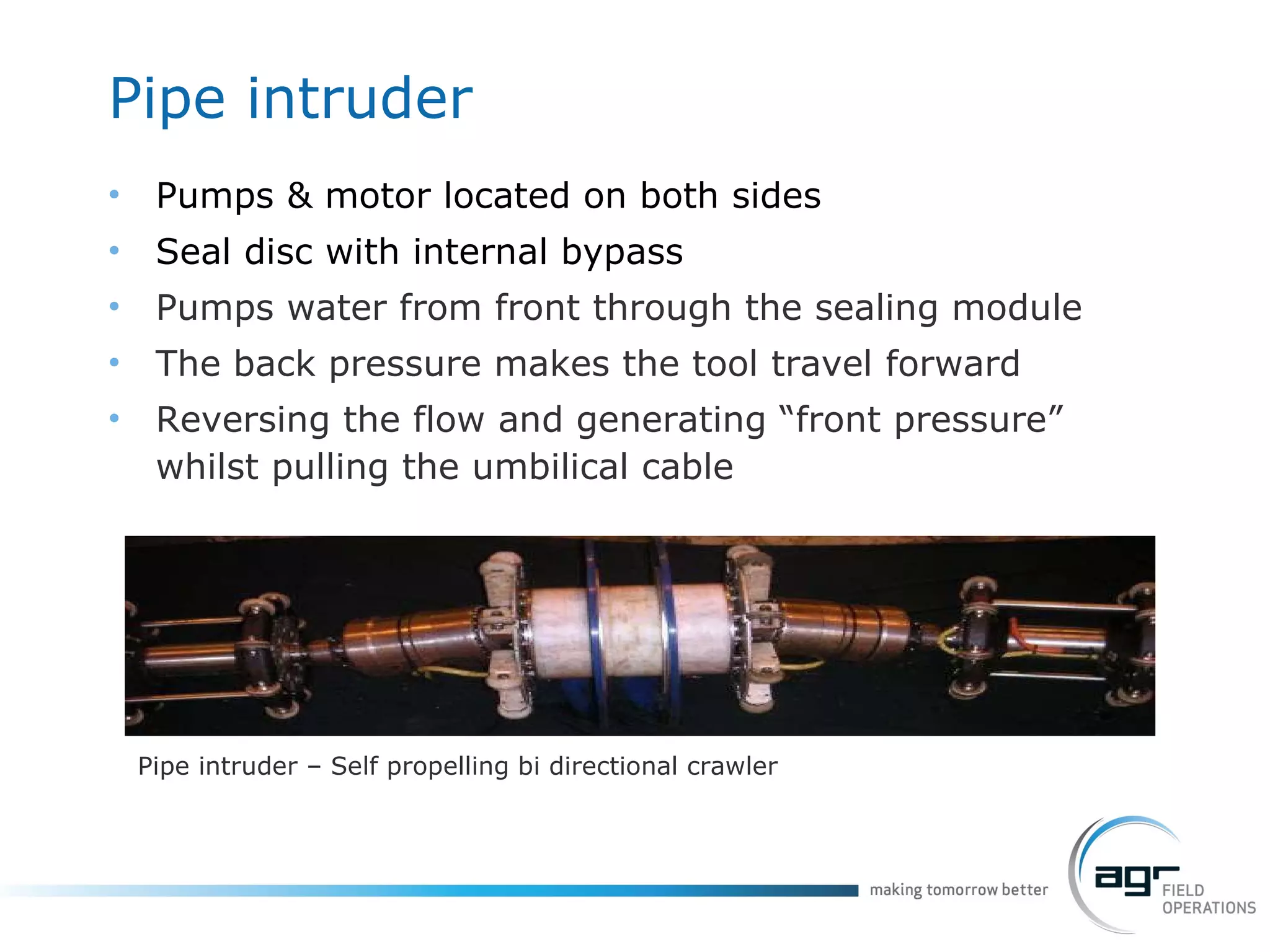
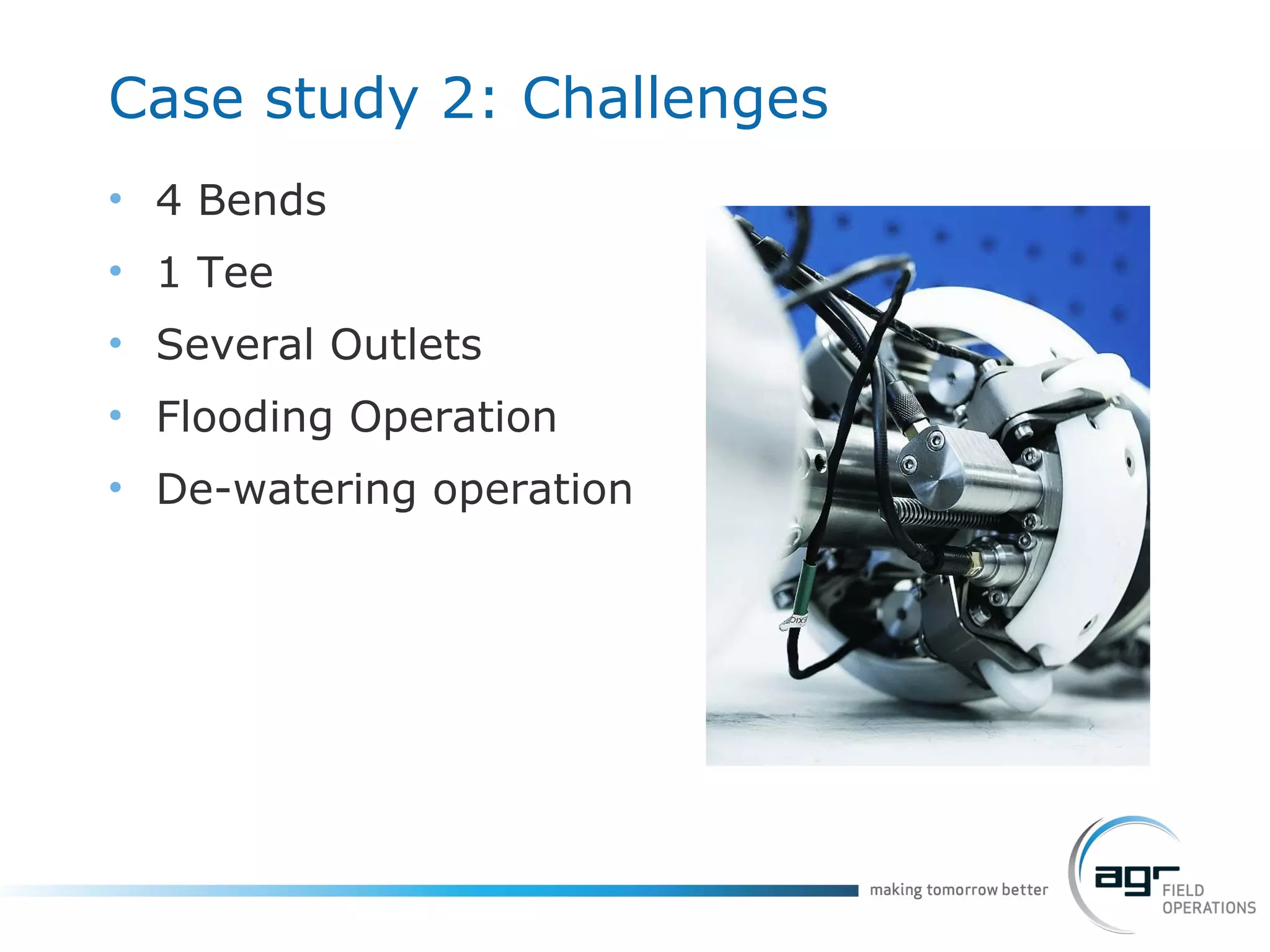
Pipe  intruder Pumps & motor located on both sides Seal disc with internal bypass Pumps water from front through the sealing module The back pressure makes the tool travel forward Reversing the flow and generating “front pressure” whilst pulling the umbilical cable Pipe intruder – Self propelling bi directional crawler
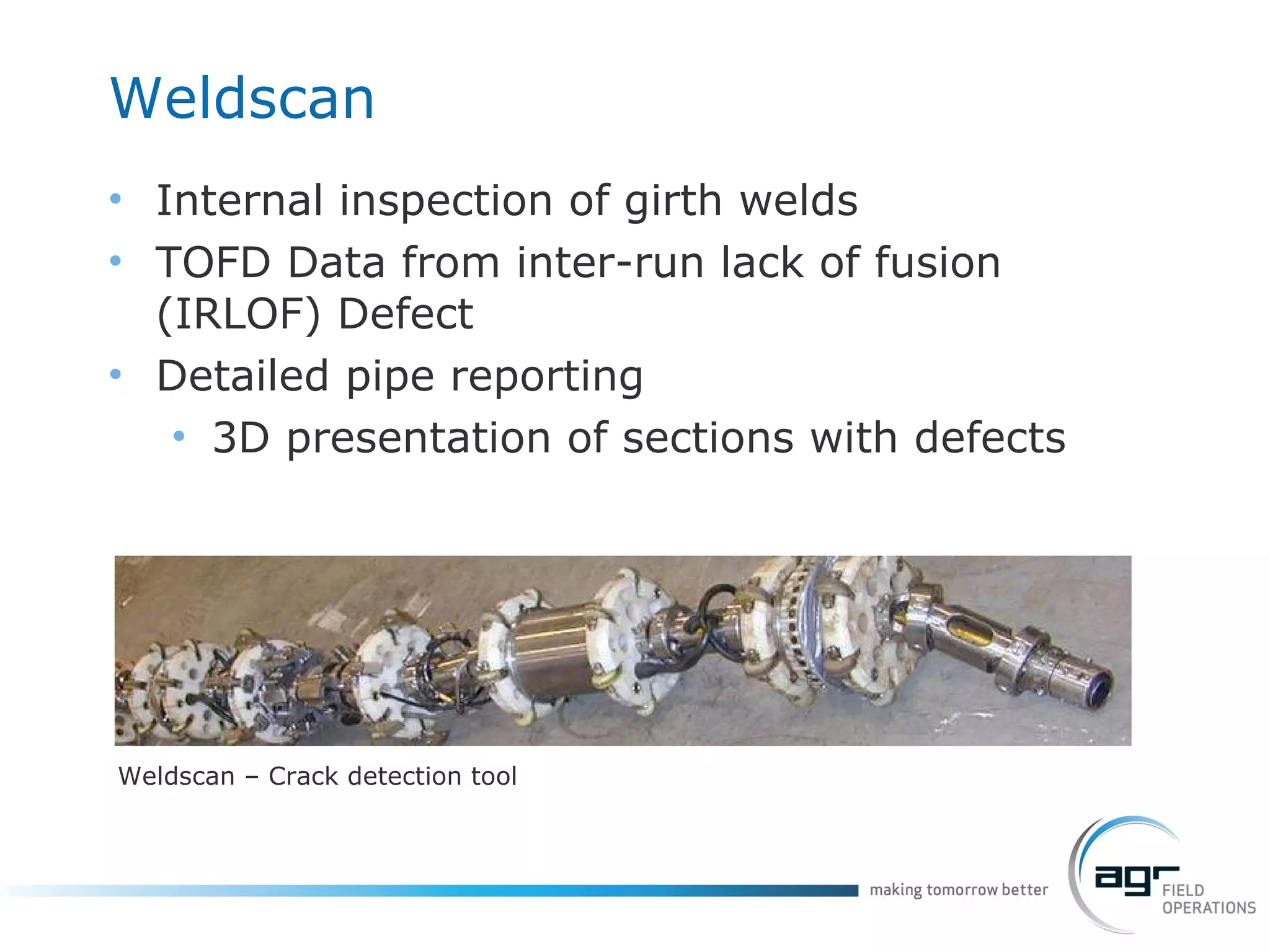
Weldscan Internal inspection of girth welds TOFD Data from inter-run   lack of fusion  ( IRLOF) Defect Detailed pipe reporting 3D presentation of sections with defects Weldscan – Crack detection tool
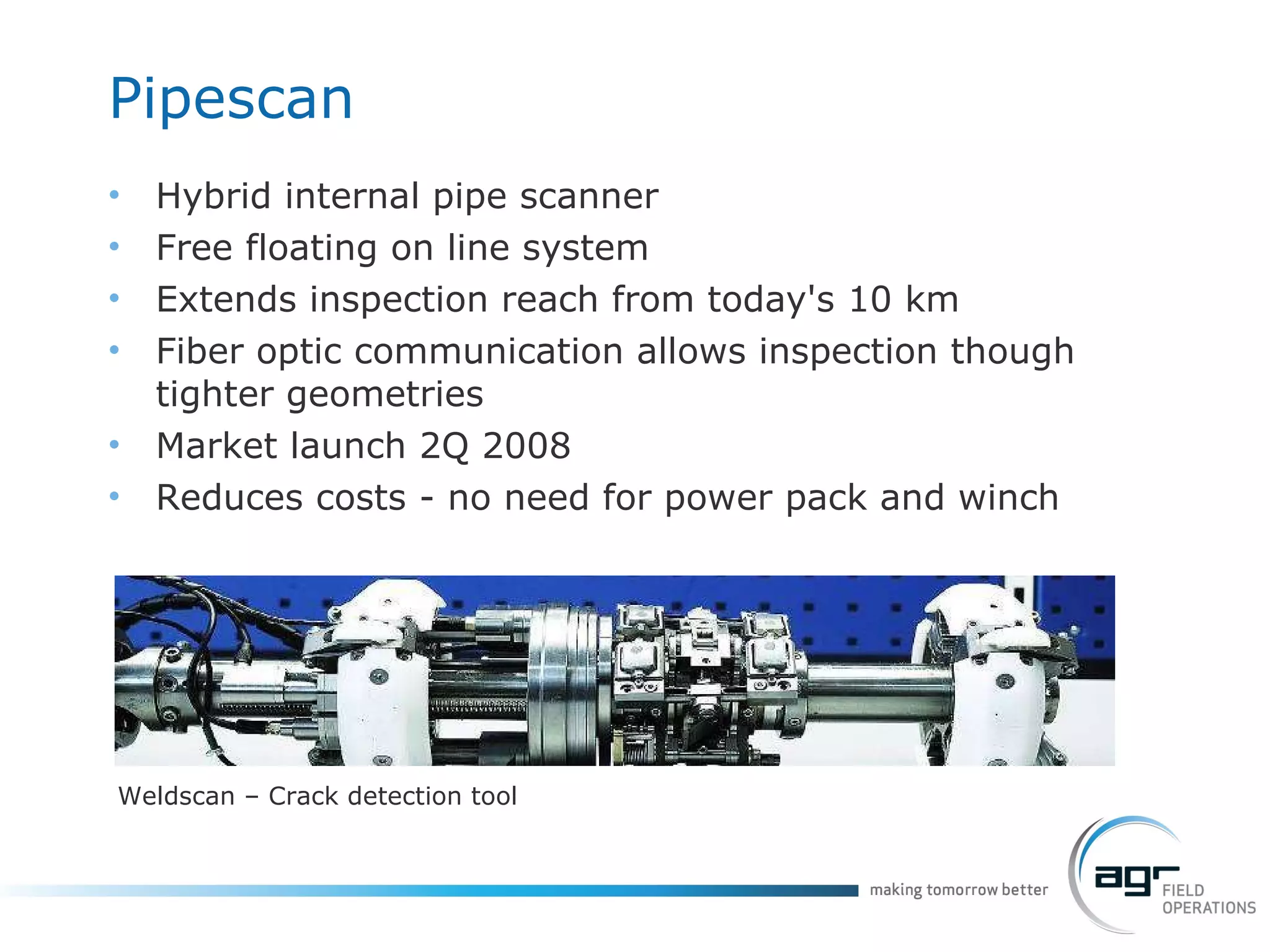
Pipescan Hybrid internal pipe scanner Free floating on line system Extends inspection reach from today's 10 km Fiber optic communication allows inspection though tighter geometries Market  launch  2Q 2008 Reduces costs - no need for power pack and winch Weldscan – Crack detection tool
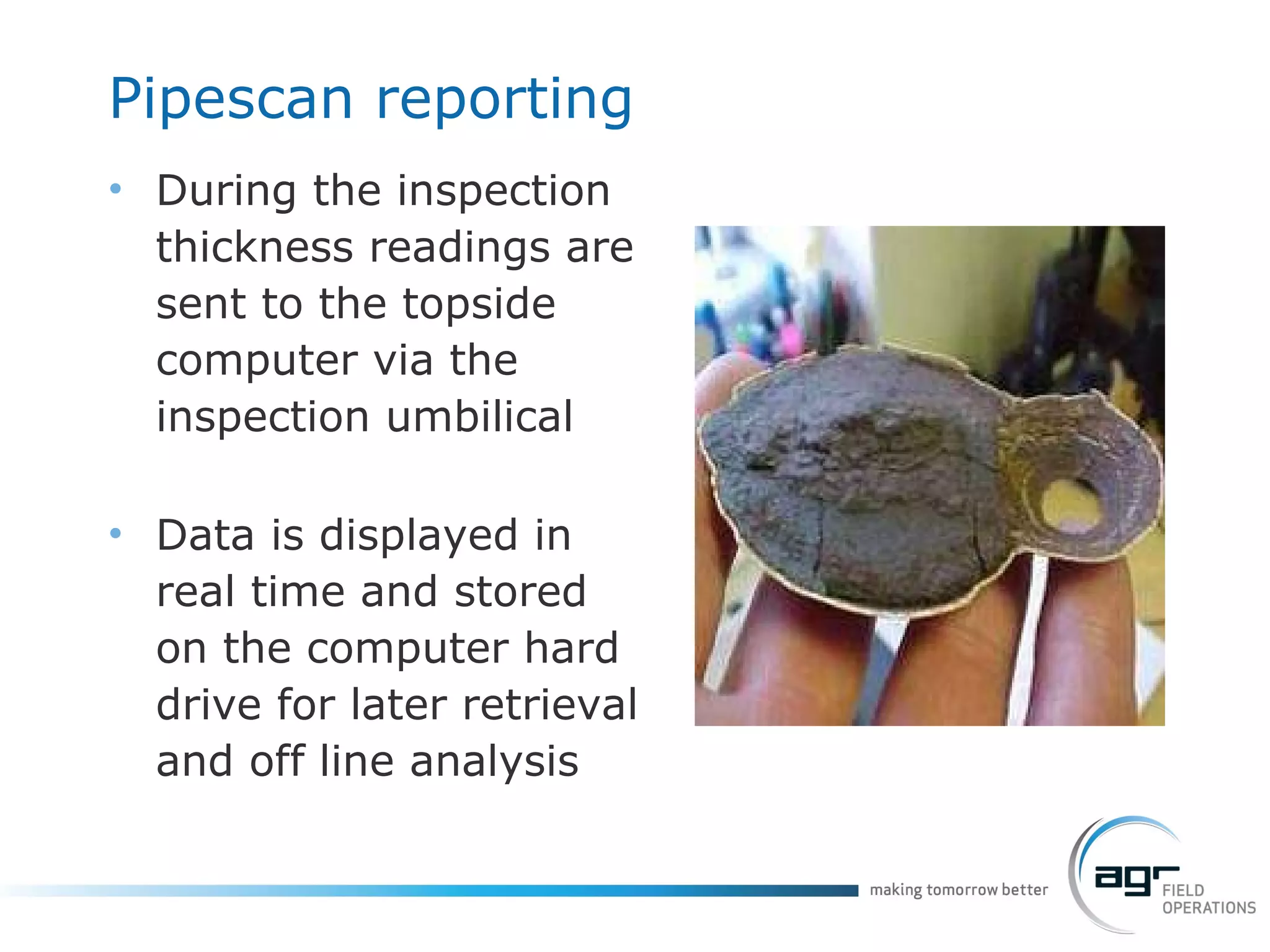
Pipescan  reporting During the inspection thickness readings are sent to the topside computer via the inspection umbilical Data is displayed in real time and stored on the computer hard drive for later retrieval and off line analysis
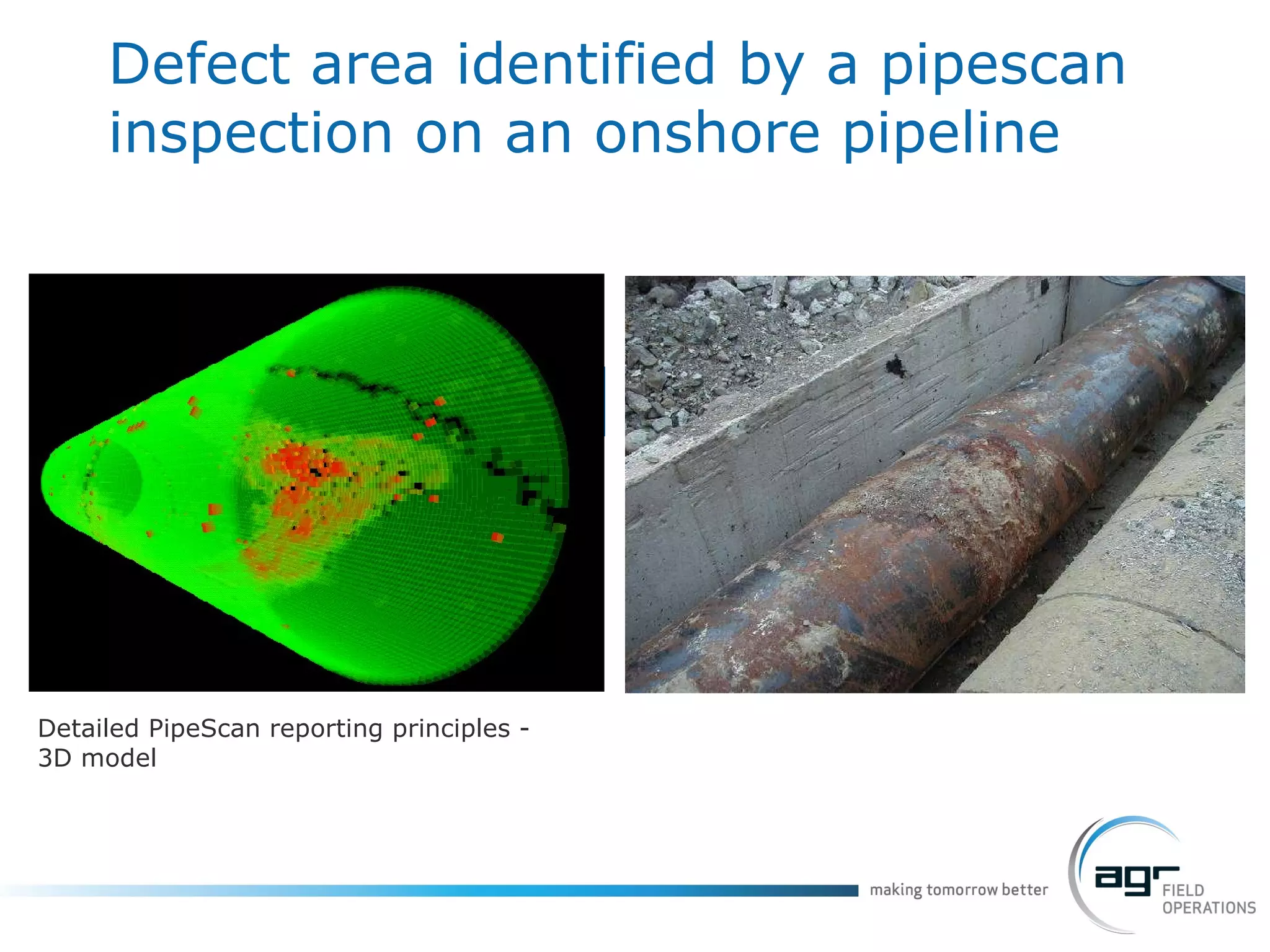
Defect area identified by a pipescan inspection on an onshore pipeline Detailed PipeScan reporting principles -  3D model
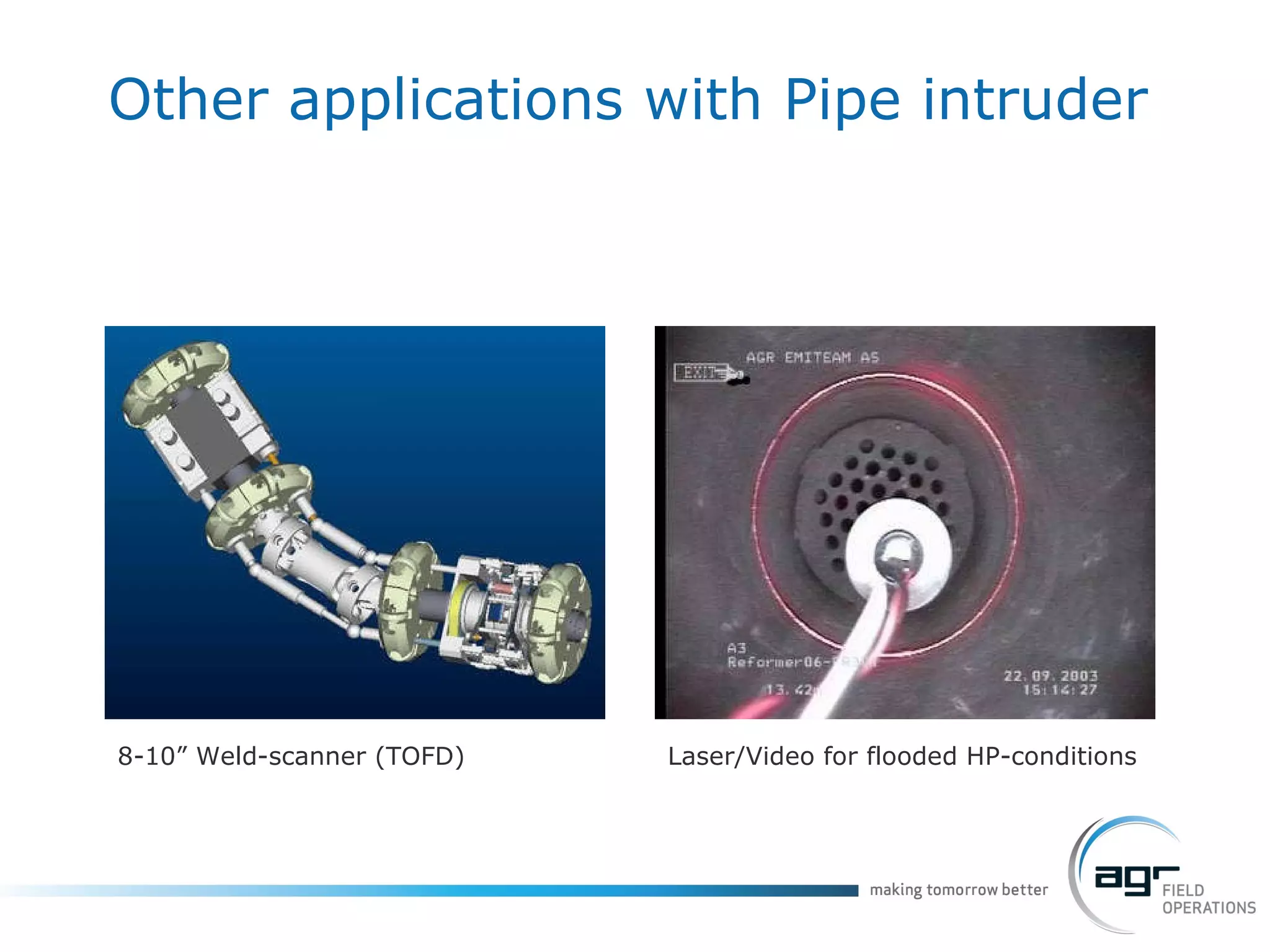
Other applications with Pipe intruder 8-10” Weld-scanner (TOFD) Laser/Video for flooded HP-conditions
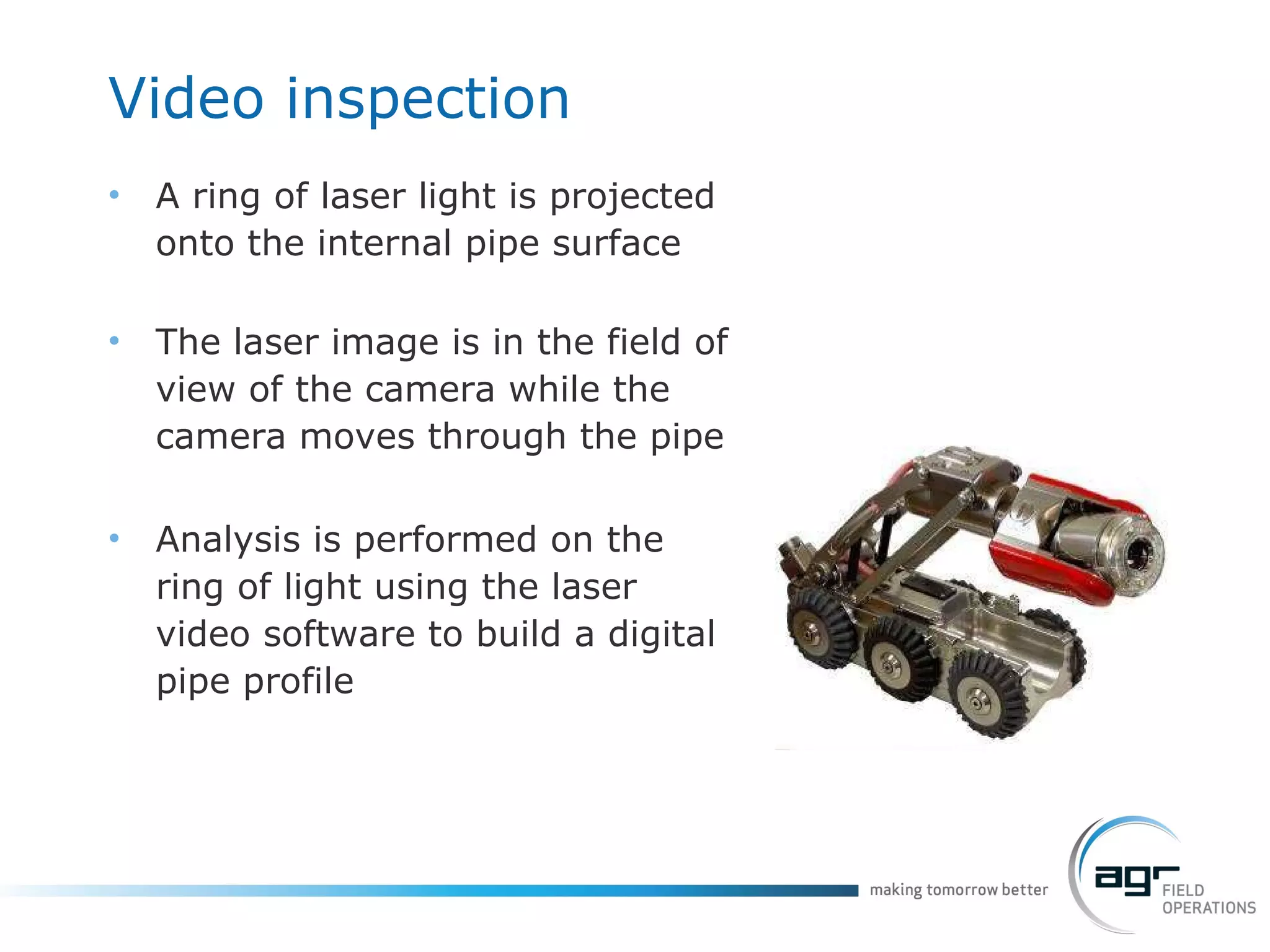
Video  inspection A ring of laser light is projected onto the internal pipe surface The laser image is in the field of view of the camera while the camera moves through the pipe Analysis is performed on the ring of light using the laser video software to build a digital pipe profile
Benefits with laser / video inspection Accurate real time measuring of the internal pipe wall Easily discovery of geometric changes Detect defects and other foreign body size Easily adaptable to different pipe sizes Can be used in liquid-filled pipes Clear variance presentation Good quality control Digital storage of information Inspects pipe diameters from 10-2000 mm Inspection length up to 8000 meter
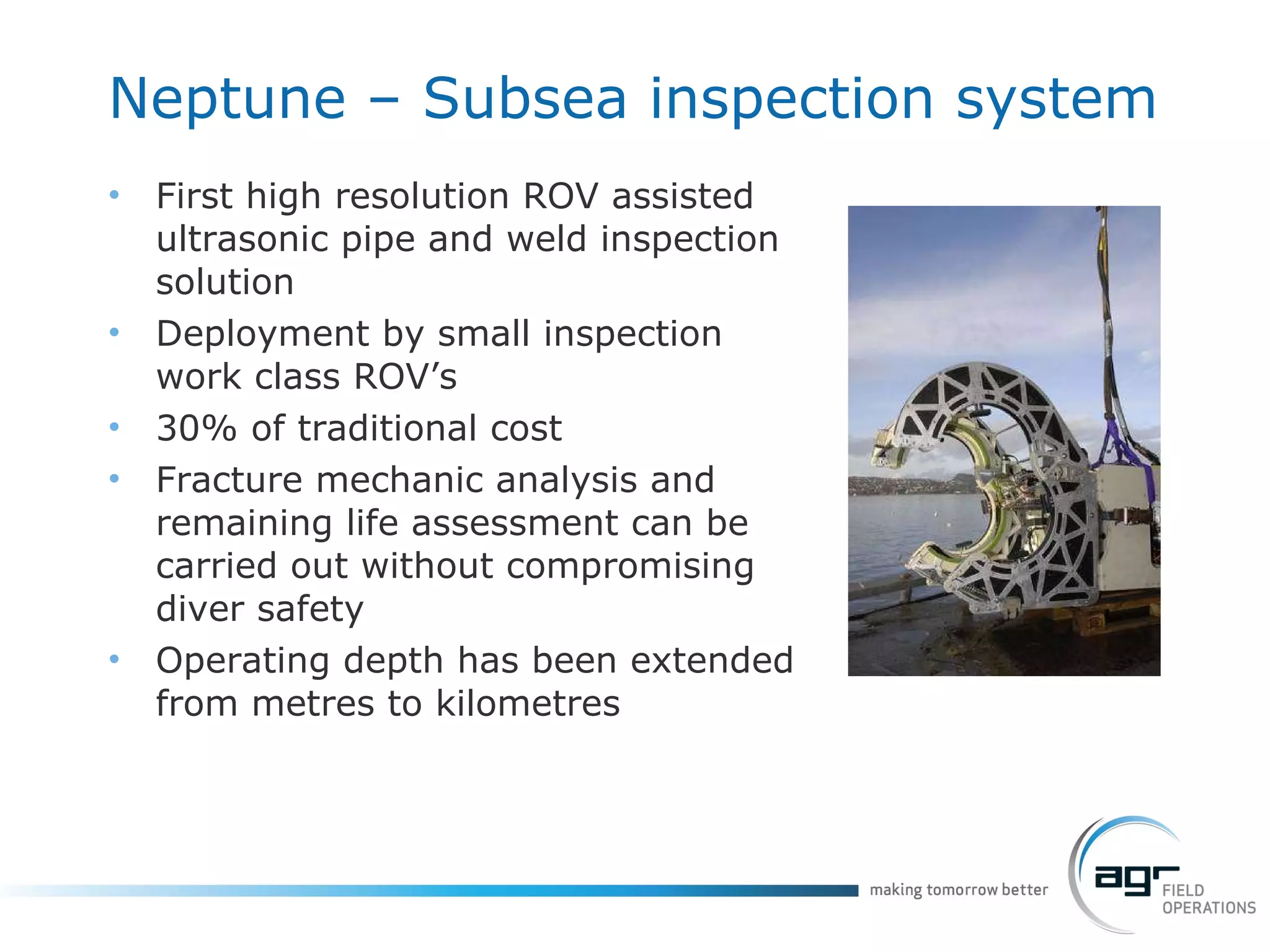
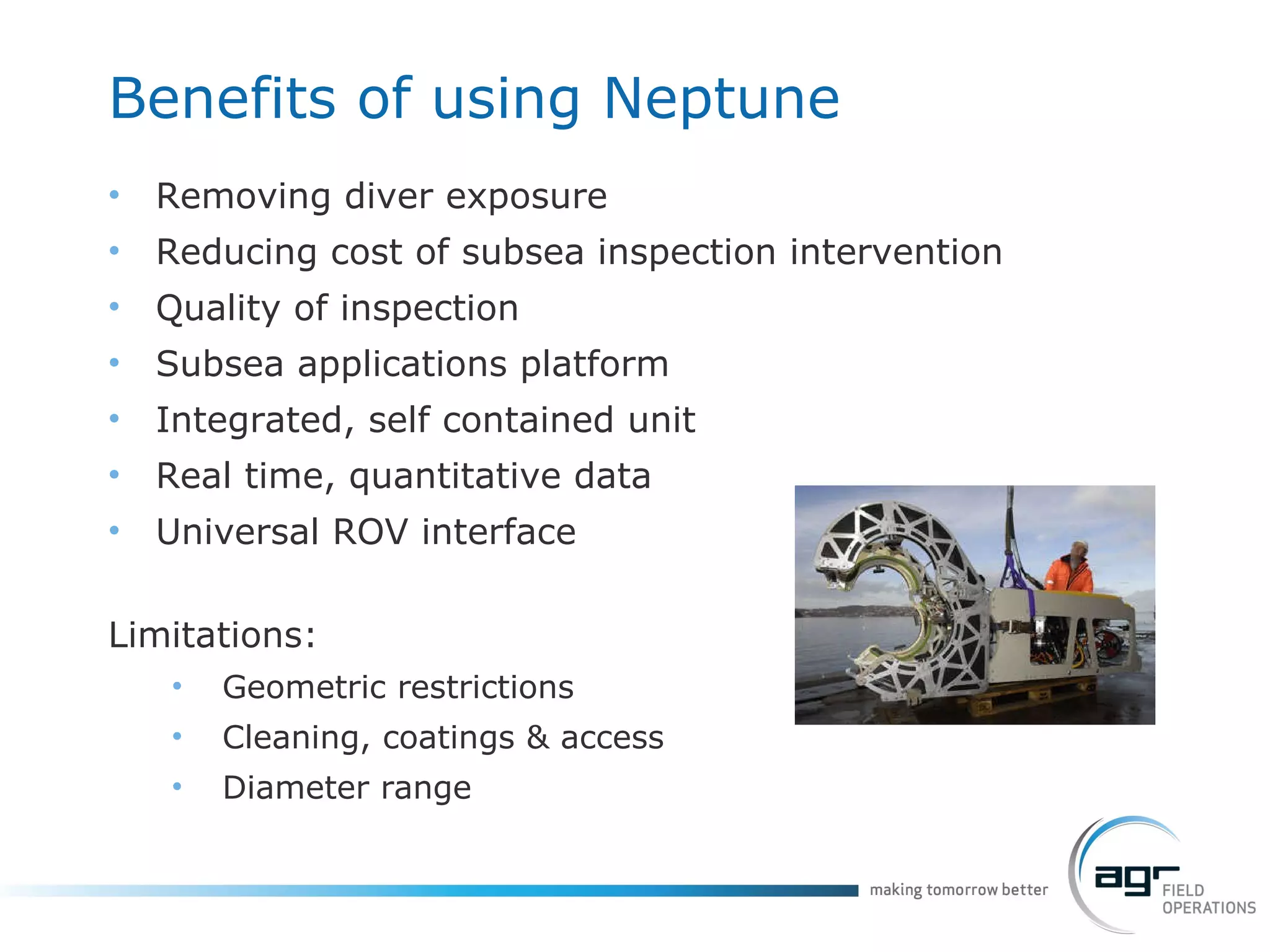
Neptune – Subsea inspection system First high resolution ROV assisted ultrasonic pipe and weld inspection solution Deployment by small inspection work class ROV’s 30% of traditional cost Fracture mechanic analysis and remaining life assessment can be carried out without compromising diver safety Operating depth has been extended from metres to kilometres
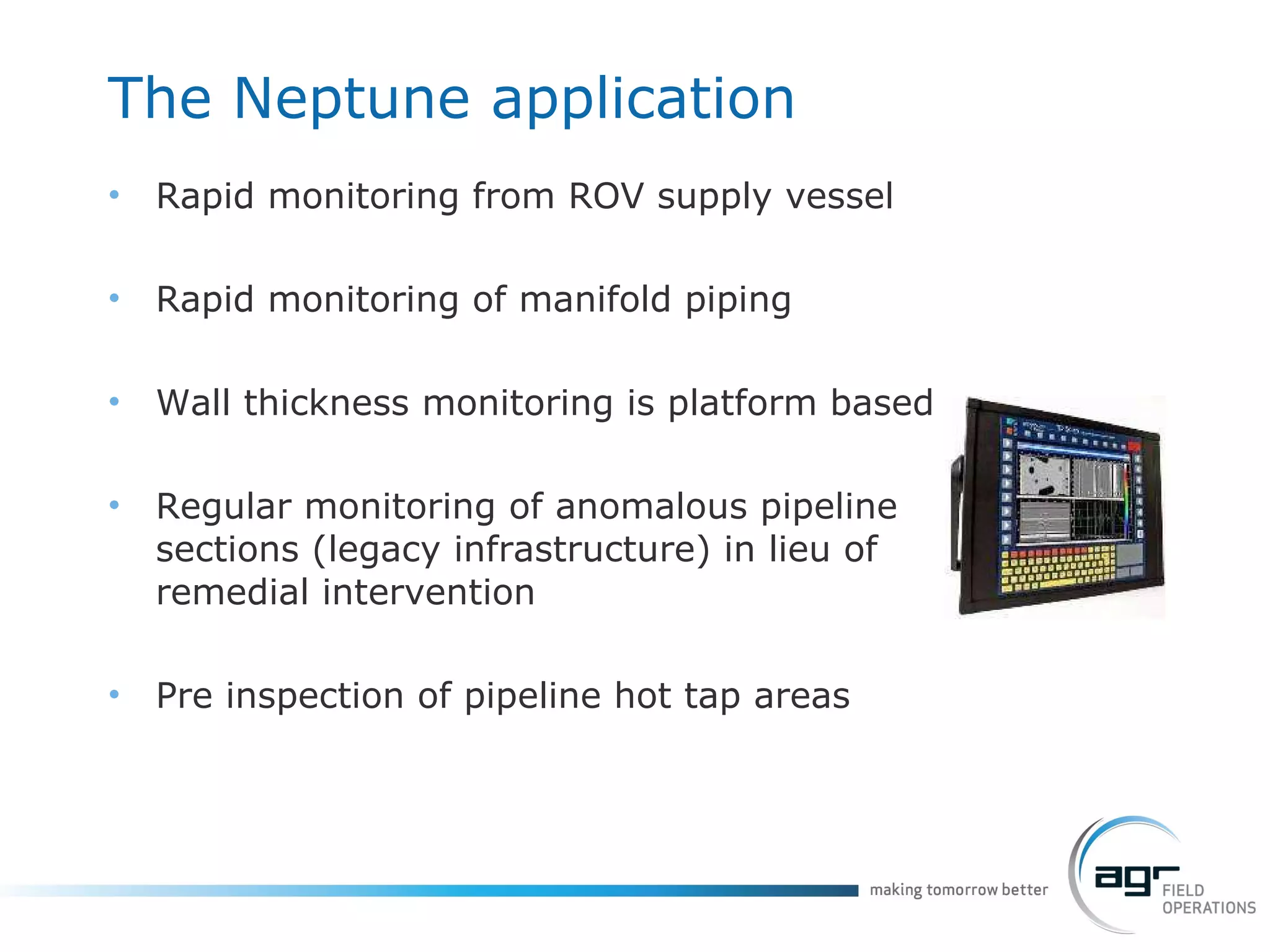
The Neptune application Rapid monitoring from ROV supply vessel Rapid monitoring of manifold piping Wall thickness monitoring is platform based Regular monitoring of anomalous pipeline sections (legacy infrastructure) in lieu of remedial intervention Pre inspection of pipeline hot tap areas
Benefits of using Neptune Removing diver exposure Reducing cost of subsea inspection intervention Quality of inspection Subsea applications platform Integrated, self contained unit Real time, quantitative data Universal ROV interface Limitations: Geometric restrictions Cleaning, coatings & access Diameter range
Corrosion mapping Predetermined thickness readings are allocated specific colours As the corrosion or erosion is scanned the image is built up like contour lines on an ordnance survey map The quality of the ROV gathered data provides fracture mechanic friendly data and allows integrity analysis, fitness for service and remaining life assessment to be carried out throughout the year without compromising diver safety
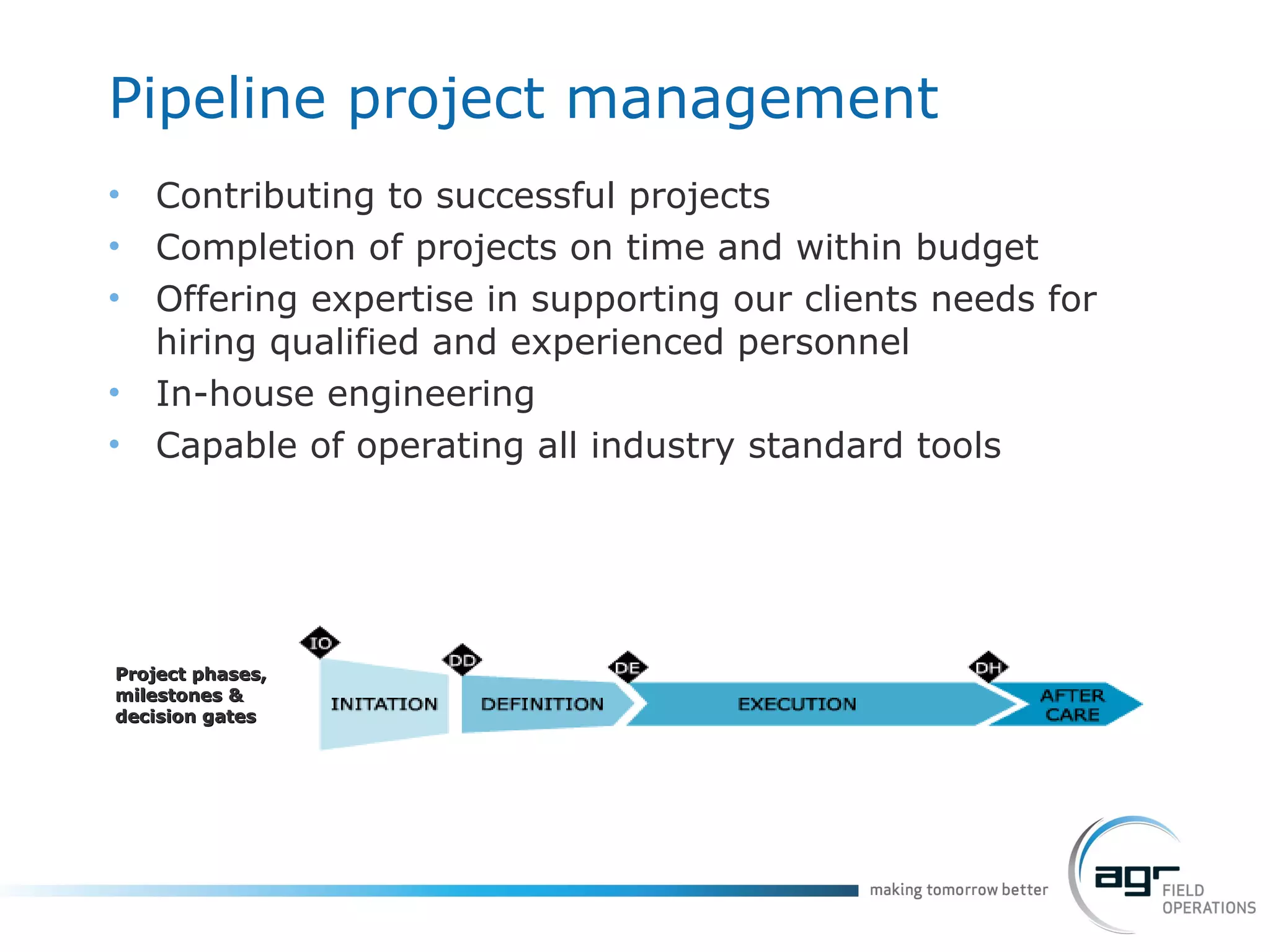
Pipeline project management Contributing to successful projects Completion of projects on time and within budget Offering expertise in supporting our clients needs for hiring qualified and experienced personnel In-house engineering Capable of operating all industry standard tools Project phases, milestones & decision gates
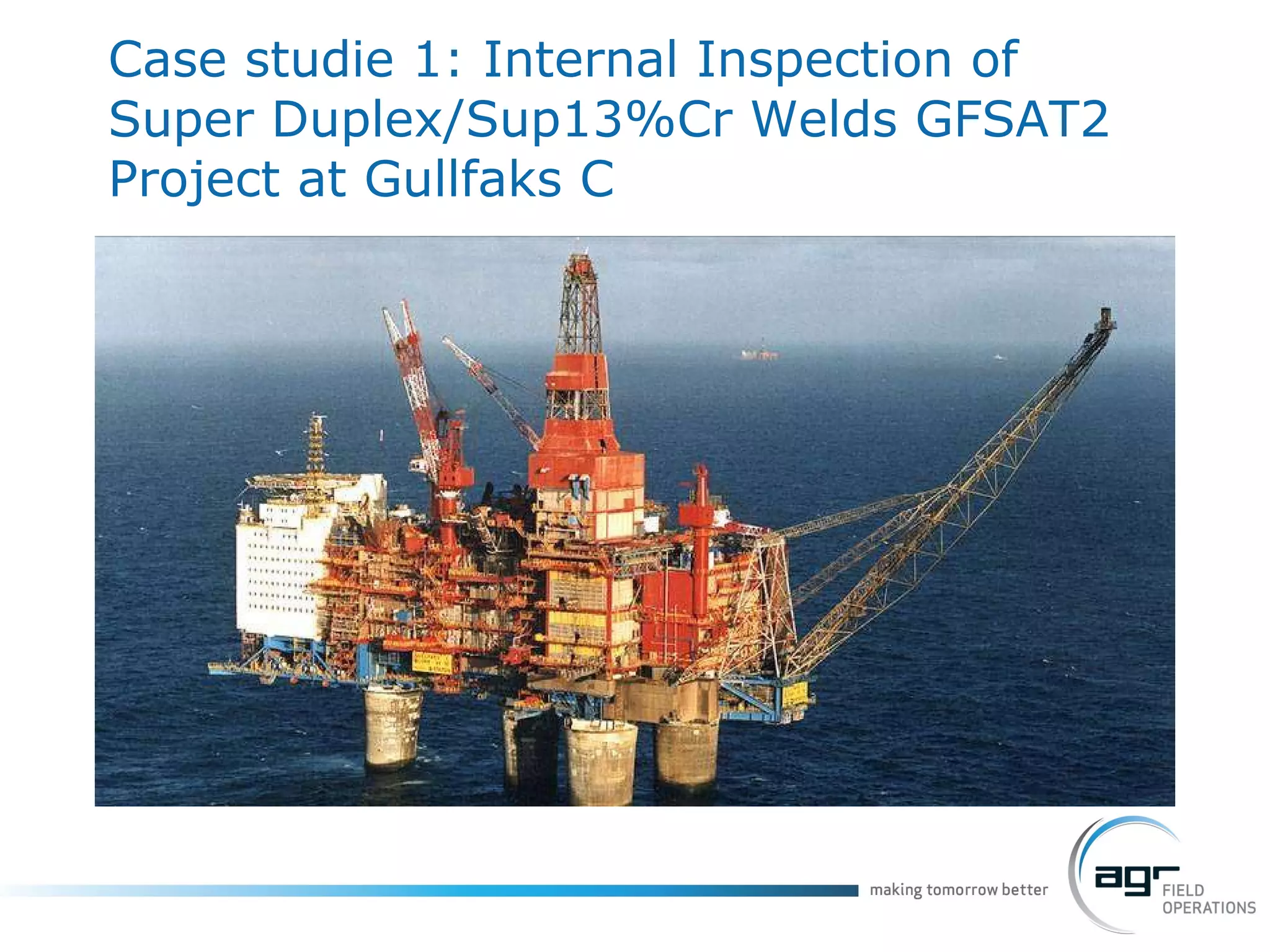
Case studie 1:  Internal Inspection of Super Duplex/Sup13%Cr Welds GFSAT2 Project at Gullfaks C
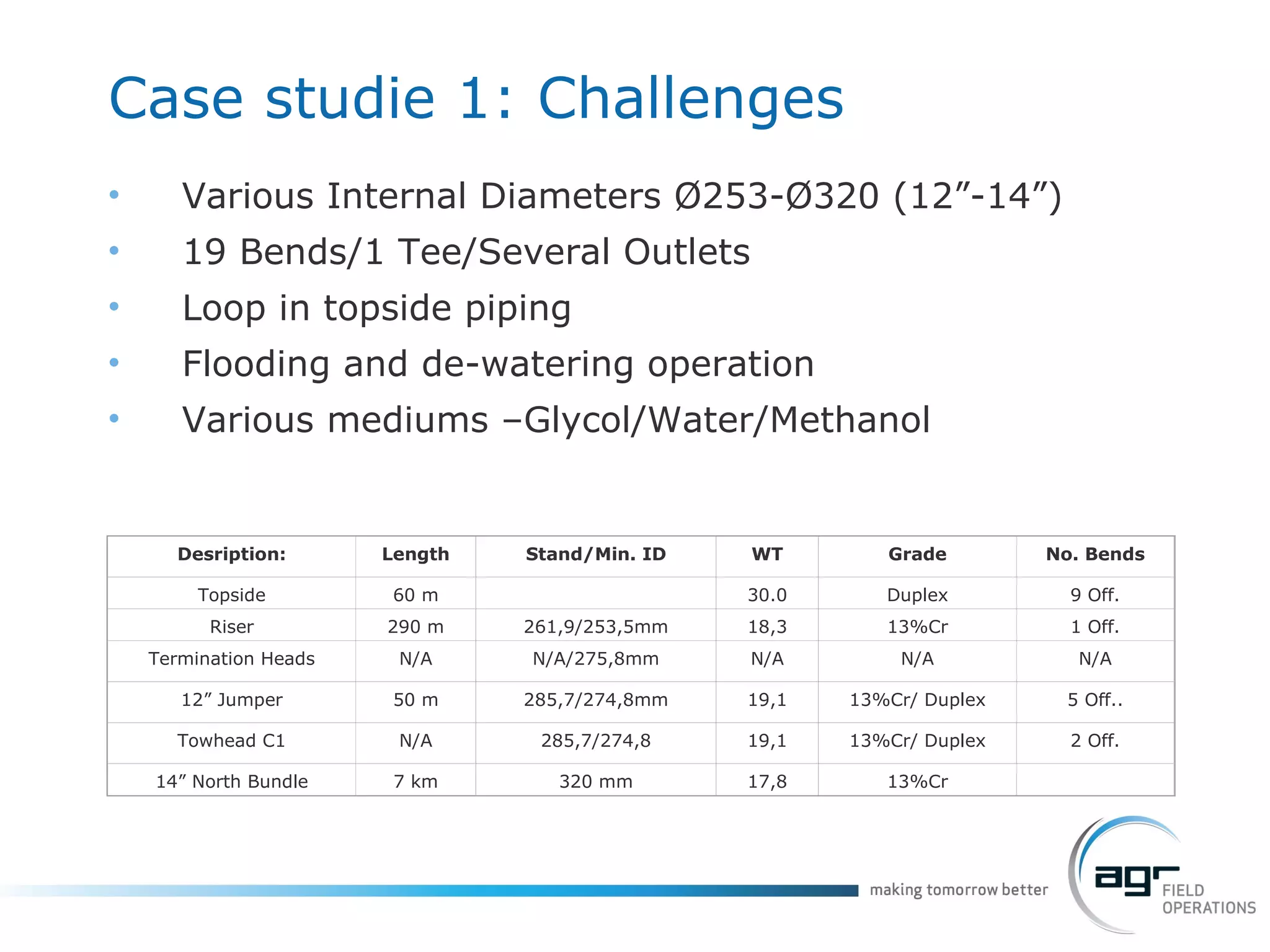
Case studie 1:  Challenges Various Internal Diameters Ø253-Ø320 (12”-14”) 19 Bends/1 Tee/Several Outlets Loop in topside piping Flooding and de-watering operation Various mediums –Glycol/Water/Methanol Desription: Length Stand/Min. ID WT Grade No. Bends Topside 60 m   30.0 Duplex 9 Off. Riser 290 m 261,9/253,5mm 18,3 13%Cr 1 Off. Termination Heads N/A N/A/275,8mm N/A N/A N/A 12” Jumper 50 m 285,7/274,8mm 19,1 13%Cr/ Duplex 5 Off.. Towhead C1 N/A 285,7/274,8 19,1 13%Cr/ Duplex 2 Off. 14” North Bundle 7 km 320 mm 17,8 13%Cr  
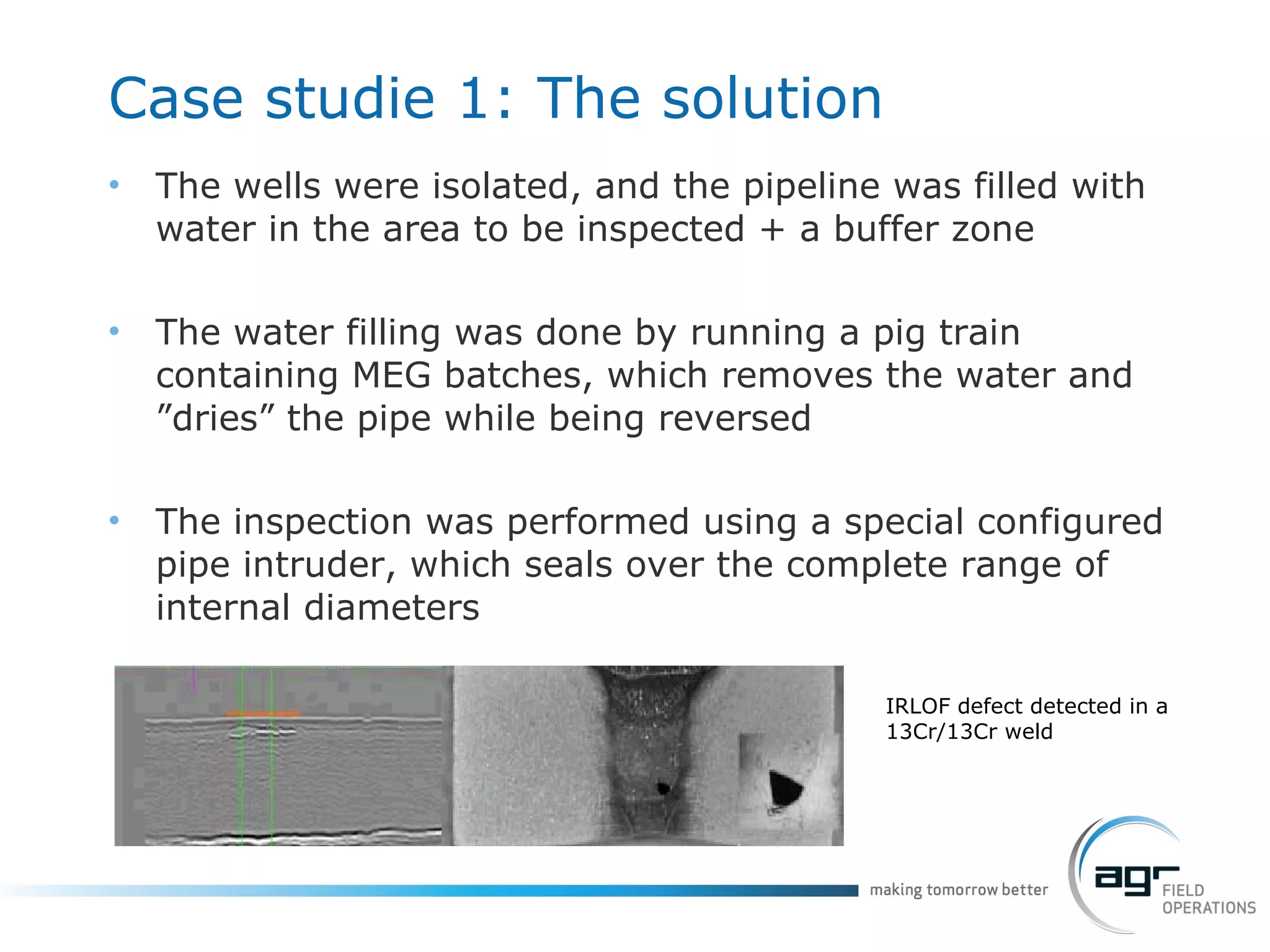
Case studie 1:  The solution The wells were isolated, and the pipeline was filled with water in the area to be inspected + a buffer zone The water filling was done by running a pig train containing MEG batches, which removes the water and ”dries” the pipe while being reversed The inspection was performed using a special configured pipe intruder, which seals over the complete range of internal diameters IRLOF defect detected in a 13Cr/13Cr weld
Case study 1: Summary Deployment of tool from a Subsea launcher into the pipe The launcher was designed to fit the end connection (14” Cameron Hub), and controlled by 2 ROV’s Demands was forwarded toward the equipments ability to negotiate a 12/14” reducer and to avoid any breakdowns of equipment 3 Days of testing in a mock up simulating the subsea pipe work The scope was to inspect a repaired weld connection and additional welds in the area The operation was controlled from a diving vessel The complete operation was performed in 24 hours Benefits:   The integrity of the pipeline could be confirmed A new pipeline investment were not necessary
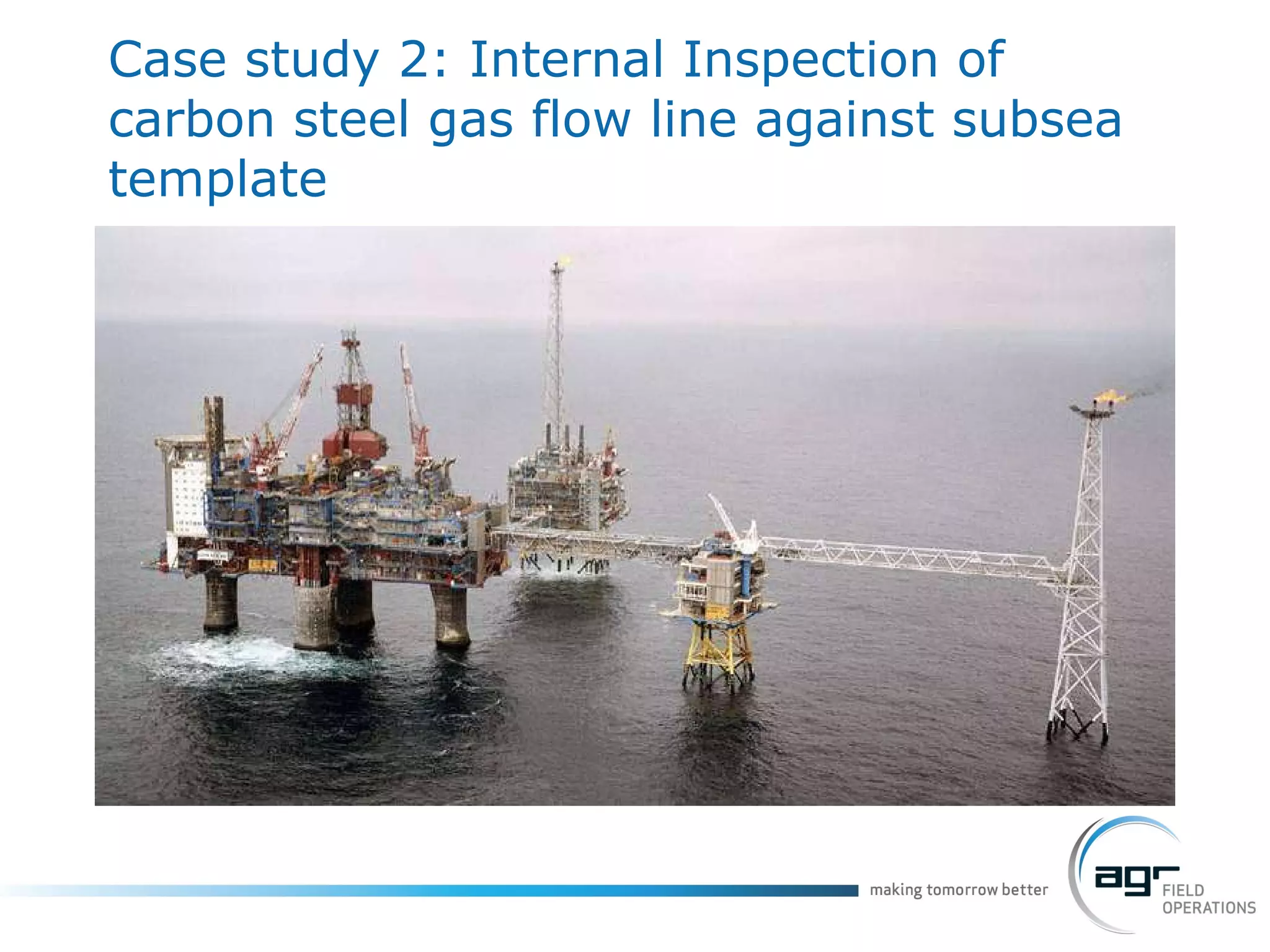
Case study 2:  Internal Inspection of carbon steel gas flow line against subsea template
Case study 2:  Challenges 4 Bends 1 Tee Several Outlets Flooding Operation De-watering operation
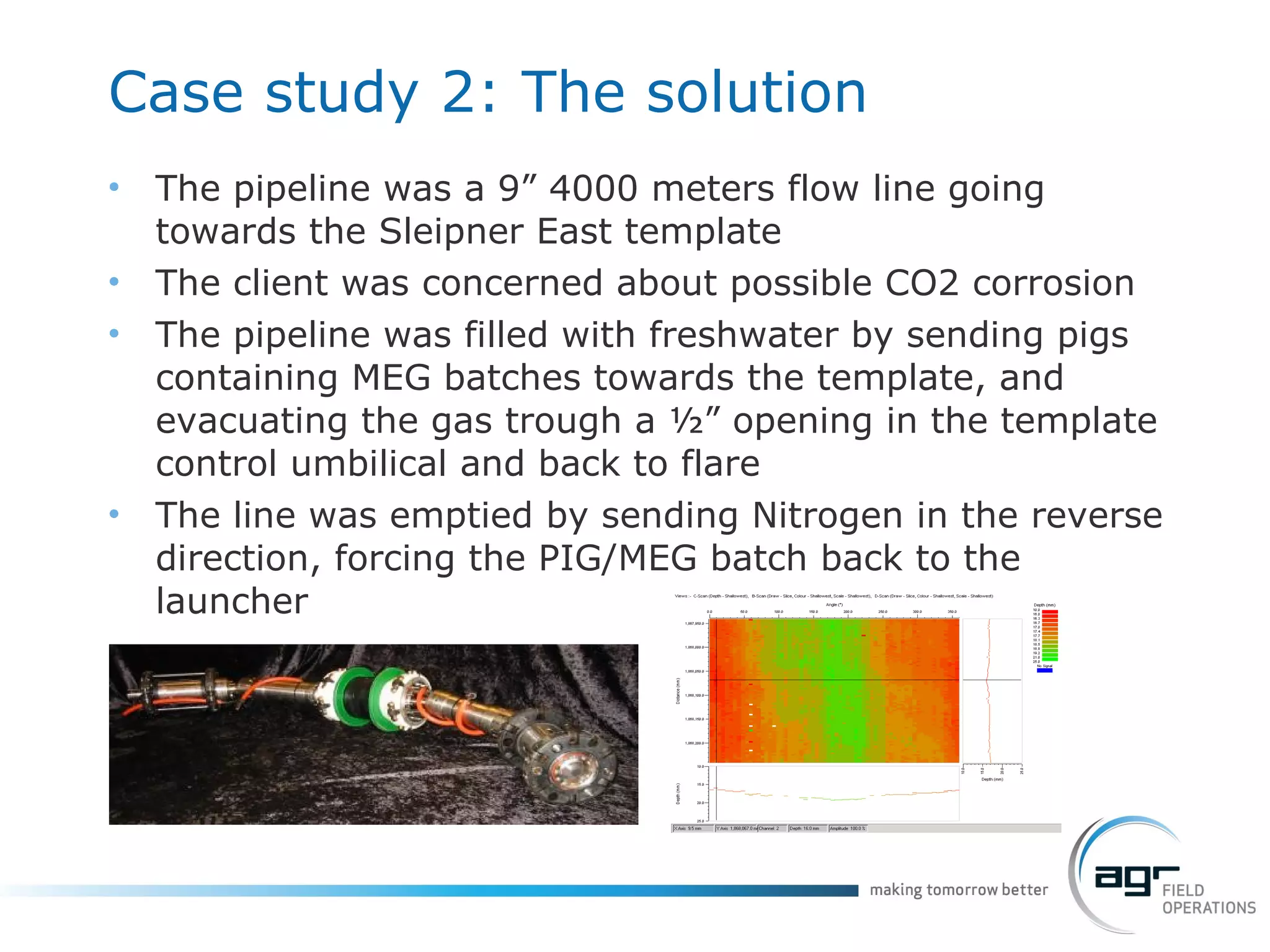
Case study 2: The solution The pipeline was a 9” 4000 meters flow line going towards the Sleipner East template The client was concerned about possible CO2 corrosion The pipeline was filled with freshwater by sending pigs containing MEG batches towards the template, and evacuating the gas trough a ½” opening in the template control umbilical and back to flare The line was emptied by sending Nitrogen in the reverse direction, forcing the PIG/MEG batch back to the launcher
Case study 2: Benefits Inspection by using a standard intelligent pig was estimated to approximately 4 MUSD The tethered inspection and the flooding/dewatering operation had a cost which was 10% of above No subsea activities were required The pipeline could be operated at an increased pressure by phasing in more wells
Pipeline inspections advantages Worlds most advanced internal weld inspection equipment for pipelines World leading pipeline inspection technology Unparalleled resolution Unique propulsion technology Introducing products from pipeline to down-hole to new markets Capable of inspection lines of up to 10 000 meters Providing full size range from 6/8 – 52 + Inches Expanding work scope on preparatory work rather than on tail/integrity side
AGR has competitive advantages A “best practice” approach  Smart methods to maximise efficiencies and profitability Unique technology and engineering solutions  Advanced and cost-effective inspection techniques Sophisticated data transmission and storage facilities  Our engineers specialises in the industry needs  We use technology to improve your business processes We understand your needs
Why AGR Field Operation? Meets client needs Is implemented in time and within budget Is flexible and deliver quality In house developed solutions that meets future market needs Meets the challenges of the future Is the best value for money to: Optimise Asset management & control Increase operational efficiency Comply with regulations
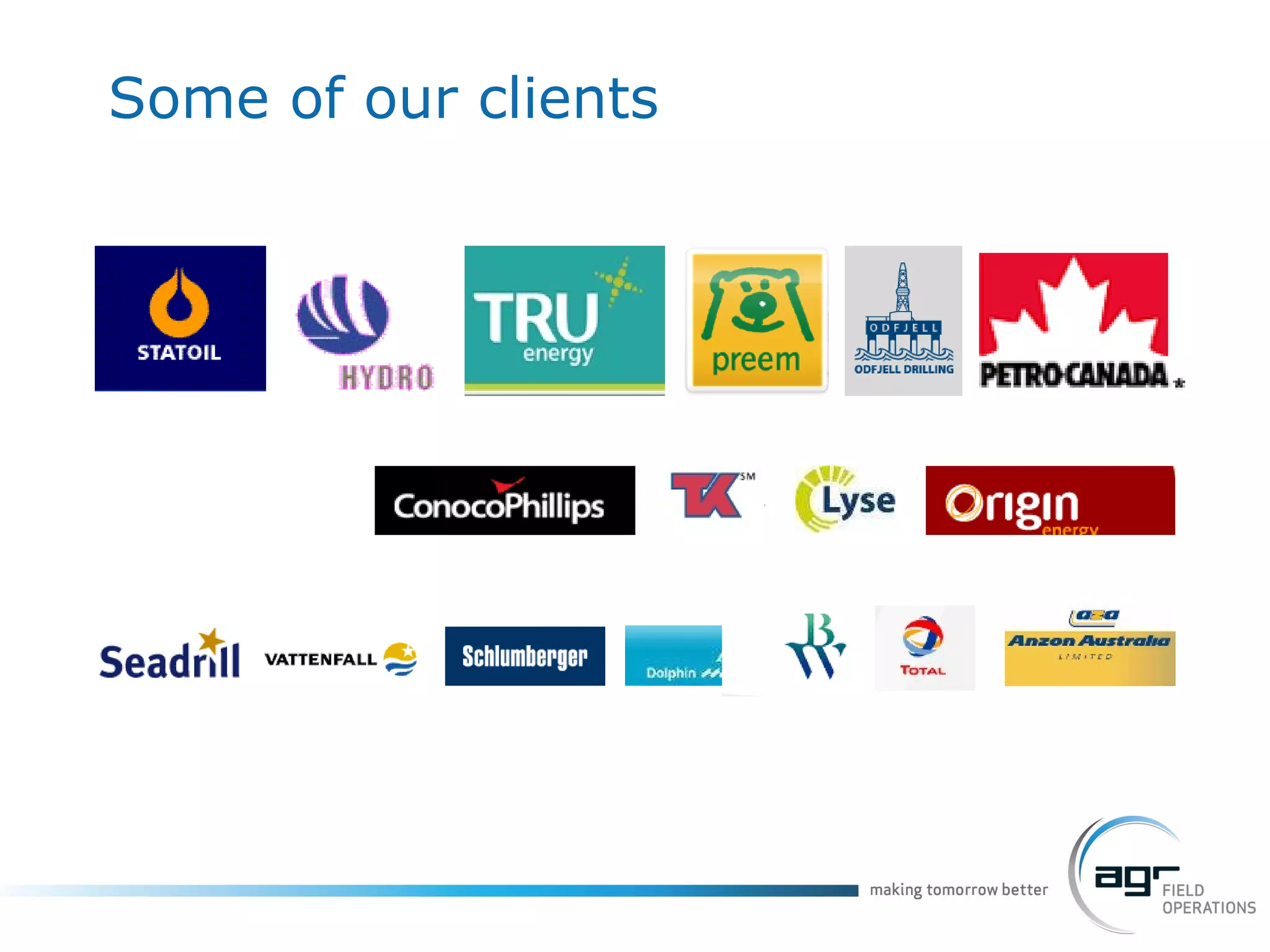
Some of our clients
Flexible Integrity
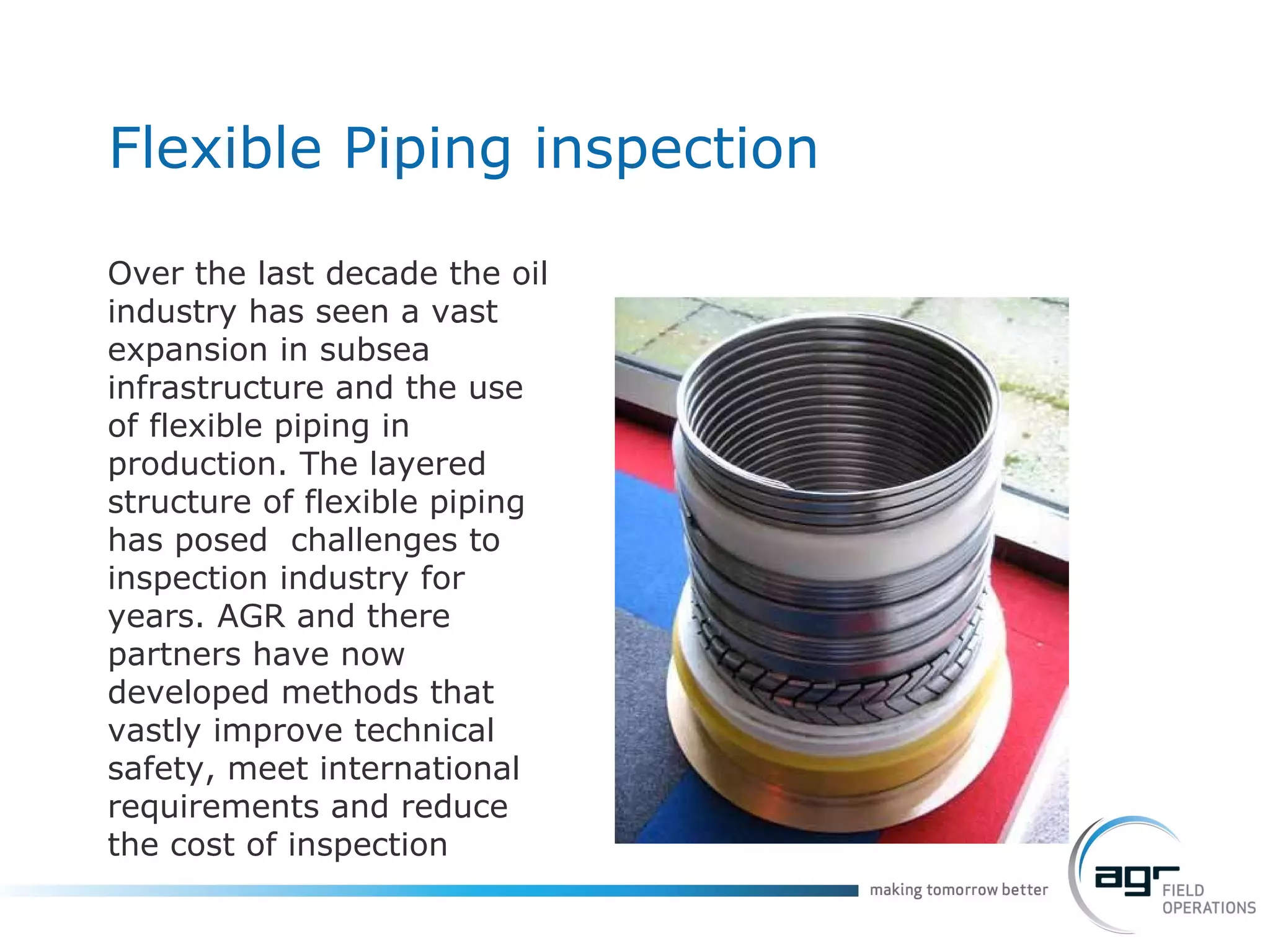
Flexible Integrity & Inspection Over the last decade the oil industry has seen a vast expansion in subsea infrastructure and the use of flexible piping in production The layered structure of flexible piping has posed  challenges to inspection industry for years AGR and our partners have now developed methods that vastly improve technical safety, meet international requirements and reduce the cost of inspection
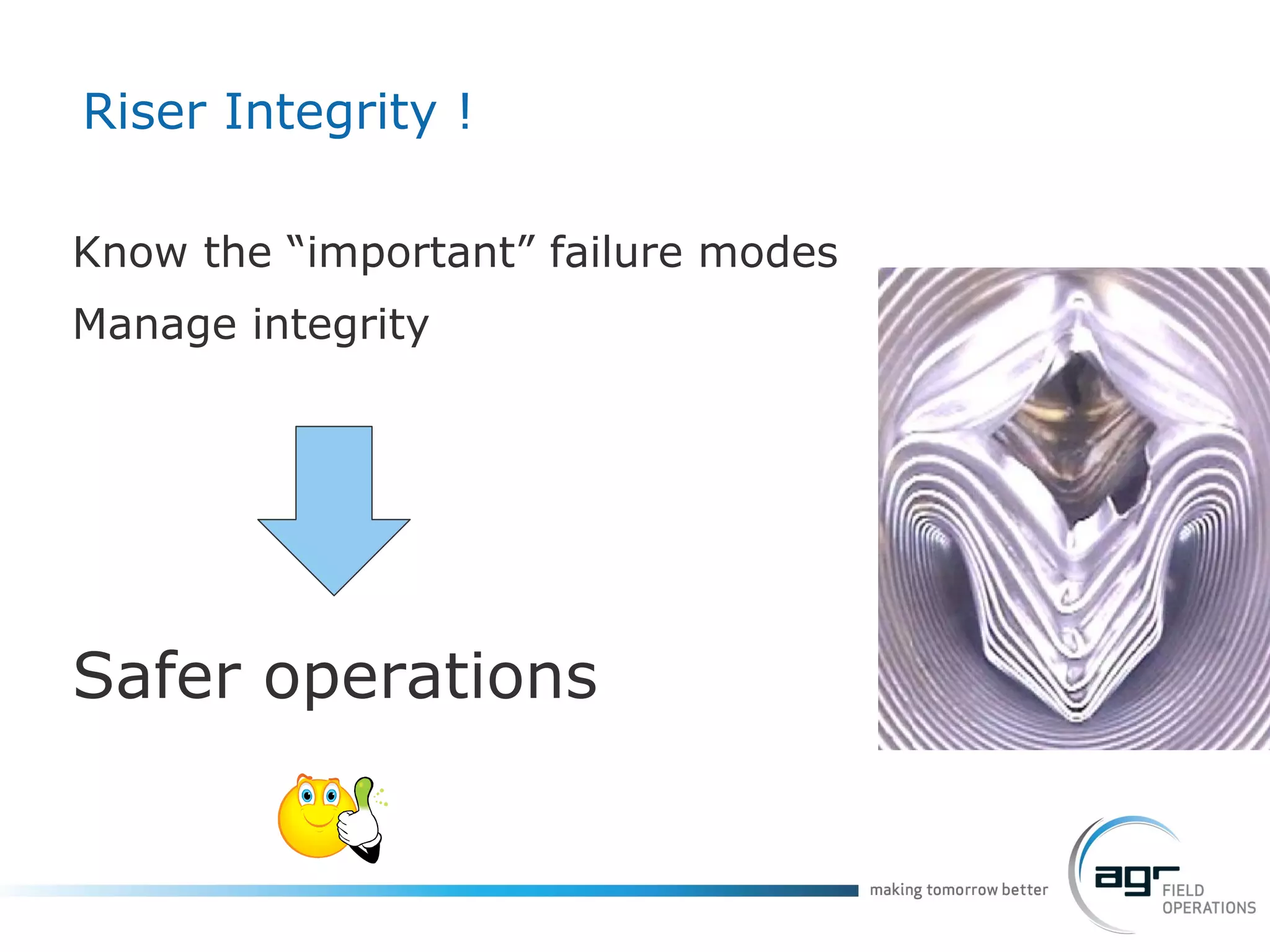
Riser Integrity ! Know the “important” failure modes Manage integrity Safer operations
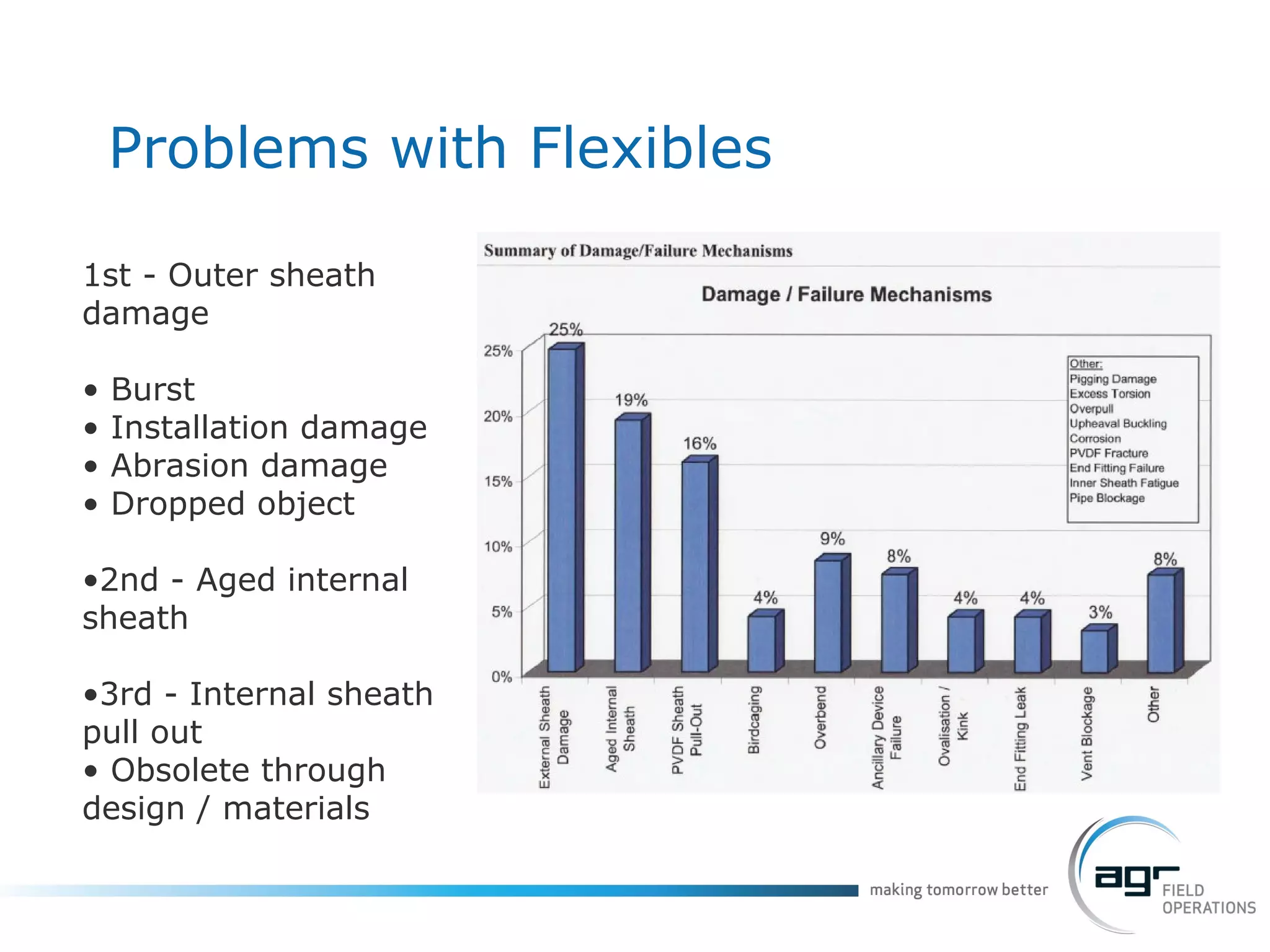
Problems with Flexibles 1st - Outer sheath  damage •  Burst •  Installation damage •  Abrasion damage •  Dropped object • 2nd - Aged internal  sheath • 3rd - Internal sheath  pull out •  Obsolete through  design / materials
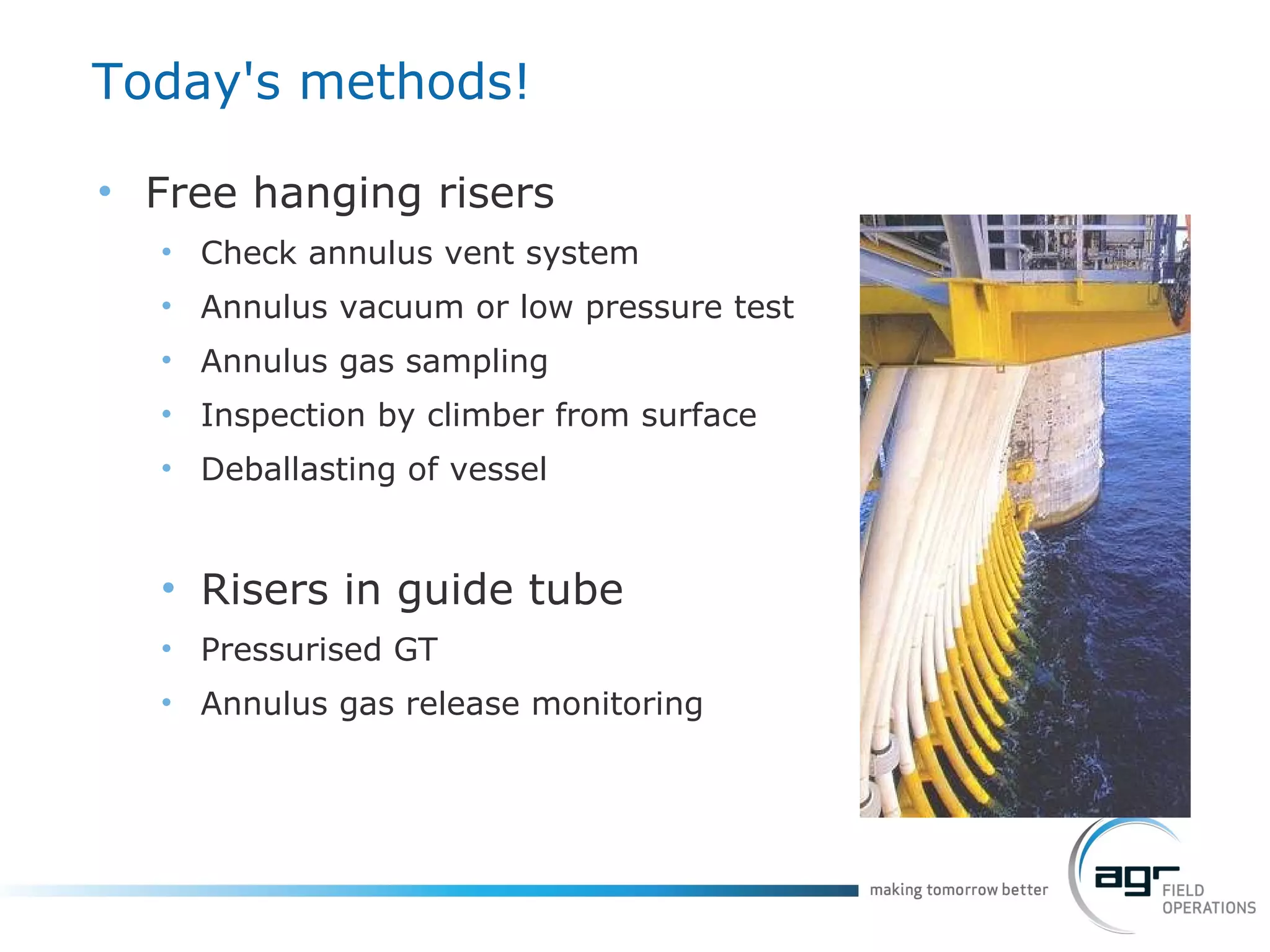
Today's methods! Free hanging risers Check annulus vent system Annulus vacuum or low pressure test Annulus gas sampling Inspection by climber from surface Deballasting of vessel Risers in guide tube Pressurised GT Annulus gas release monitoring
Flexible Piping inspection Over the last decade the oil industry has seen a vast expansion in subsea infrastructure and the use of flexible piping in production. The layered structure of flexible piping has posed  challenges to inspection industry for years. AGR and there partners have now developed methods that vastly improve technical safety, meet international requirements and reduce the cost of inspection
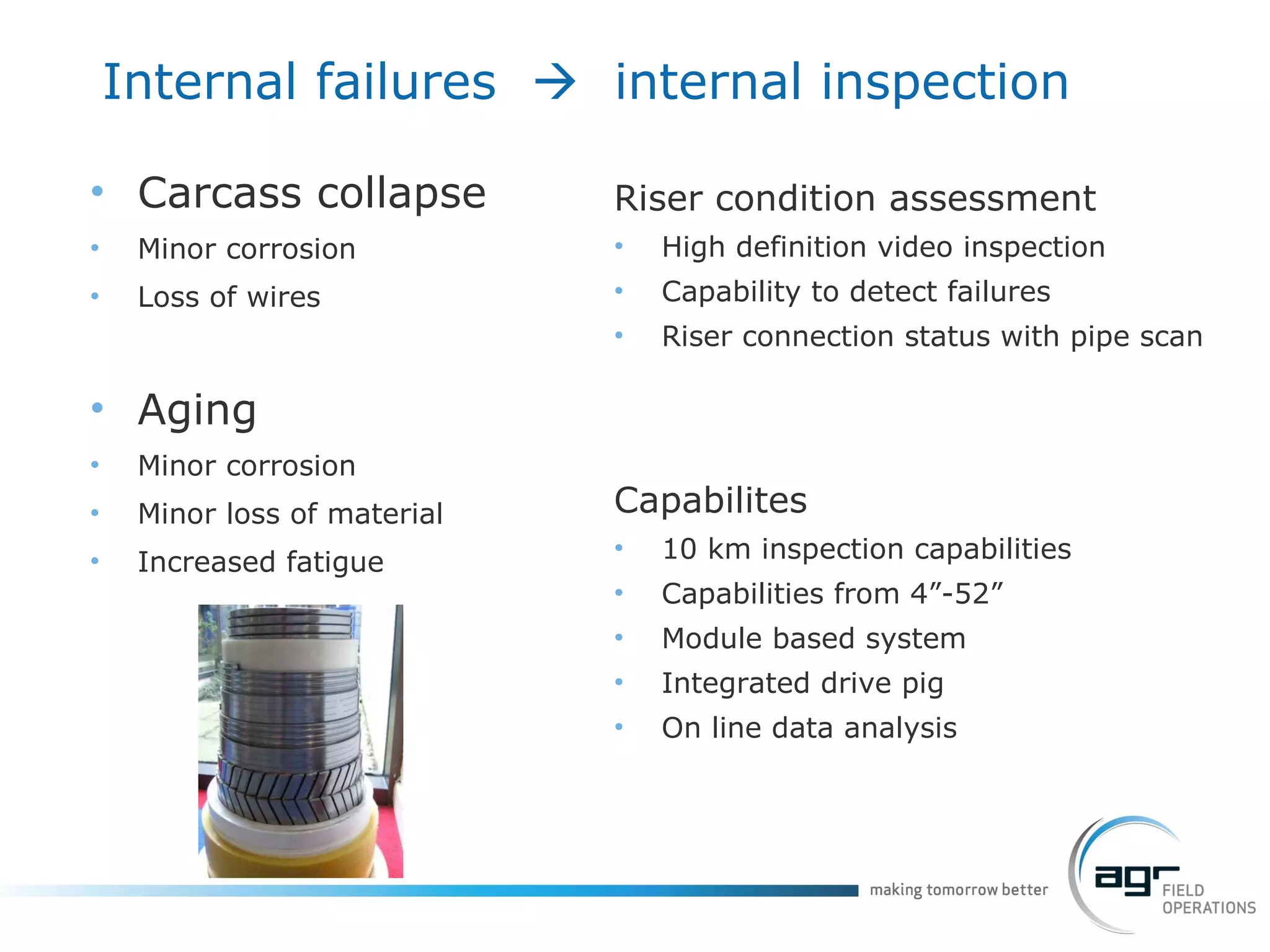
Internal failures     internal inspection Carcass collapse Minor corrosion Loss of wires Aging Minor corrosion Minor loss of material Increased fatigue Riser condition assessment High definition video inspection Capability to detect failures Riser connection status with pipe scan Capabilites 10 km inspection capabilities Capabilities from 4”-52” Module based system Integrated drive pig On line data analysis
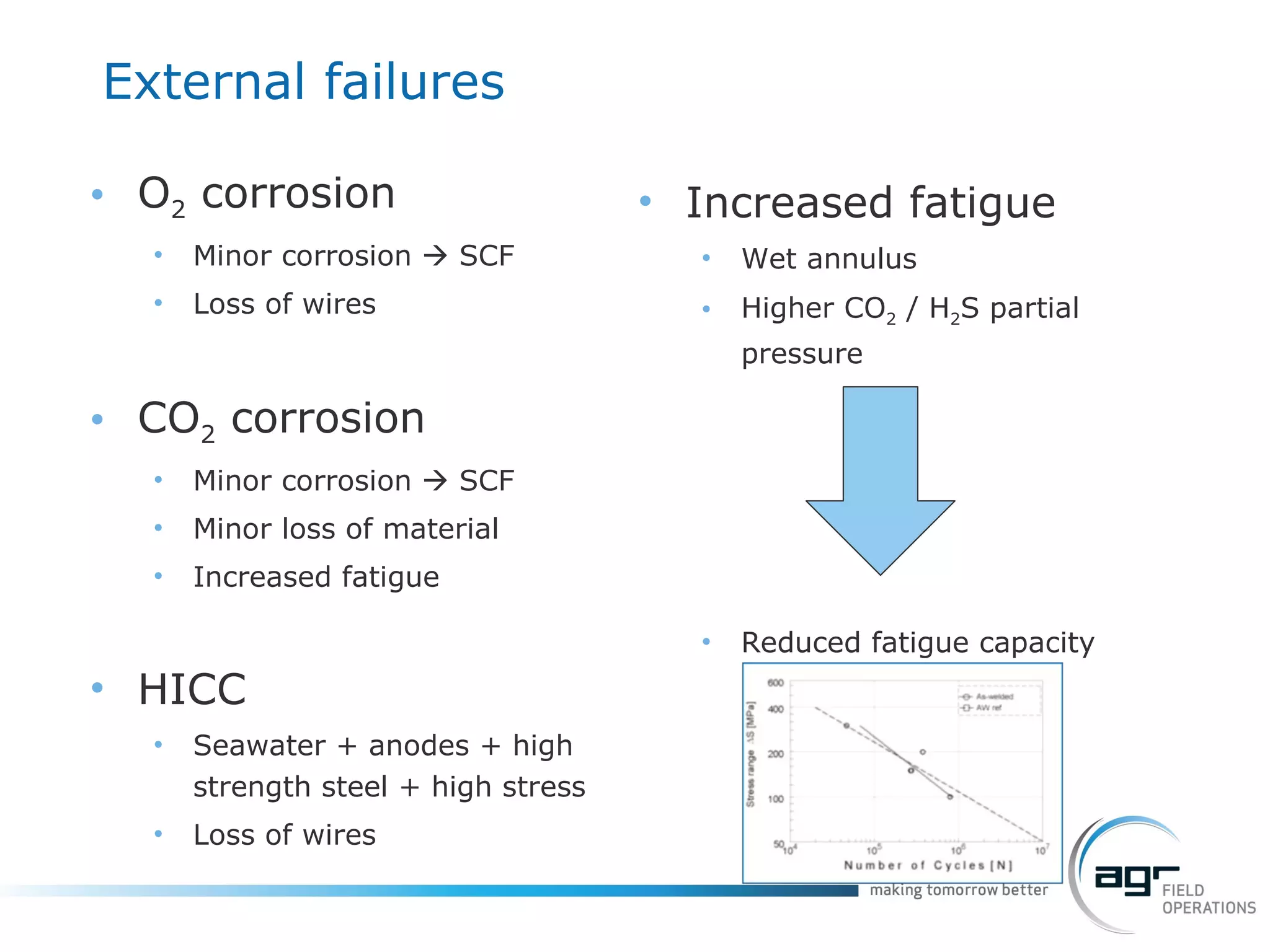
External failures  O 2  corrosion Minor corrosion    SCF Loss of wires CO 2  corrosion Minor corrosion    SCF Minor loss of material Increased fatigue HICC Seawater + anodes + high strength steel + high stress Loss of wires Increased fatigue Wet annulus  Higher CO 2  / H 2 S partial pressure Reduced fatigue capacity
HYDROGEN INDUCED CRACKING Focus area: HISC in flexible flowlines
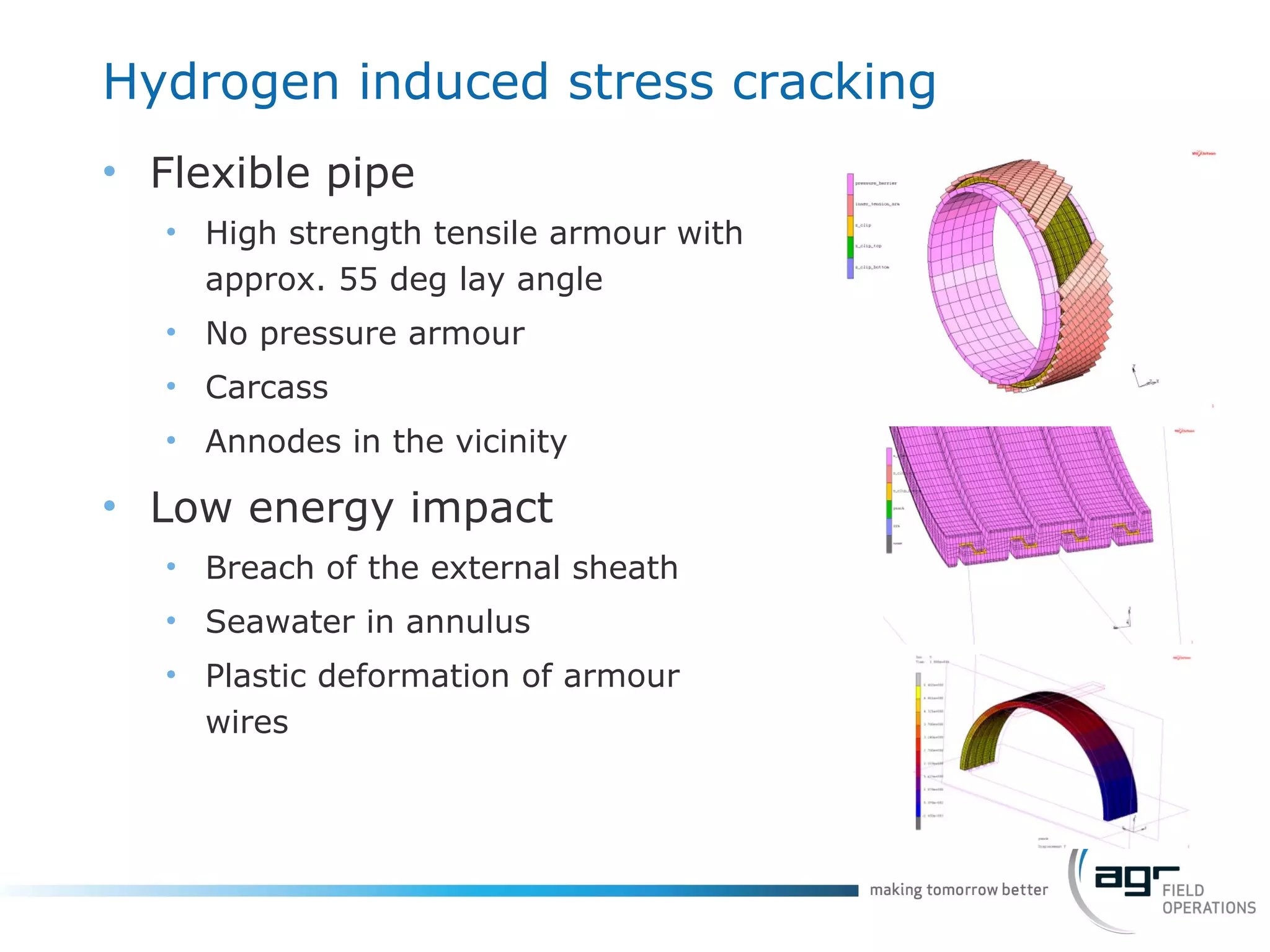
Hydrogen induced stress cracking Flexible pipe High strength tensile armour with approx. 55 deg lay angle No pressure armour Carcass Annodes in the vicinity Low energy impact Breach of the external sheath Seawater in annulus Plastic deformation of armour wires
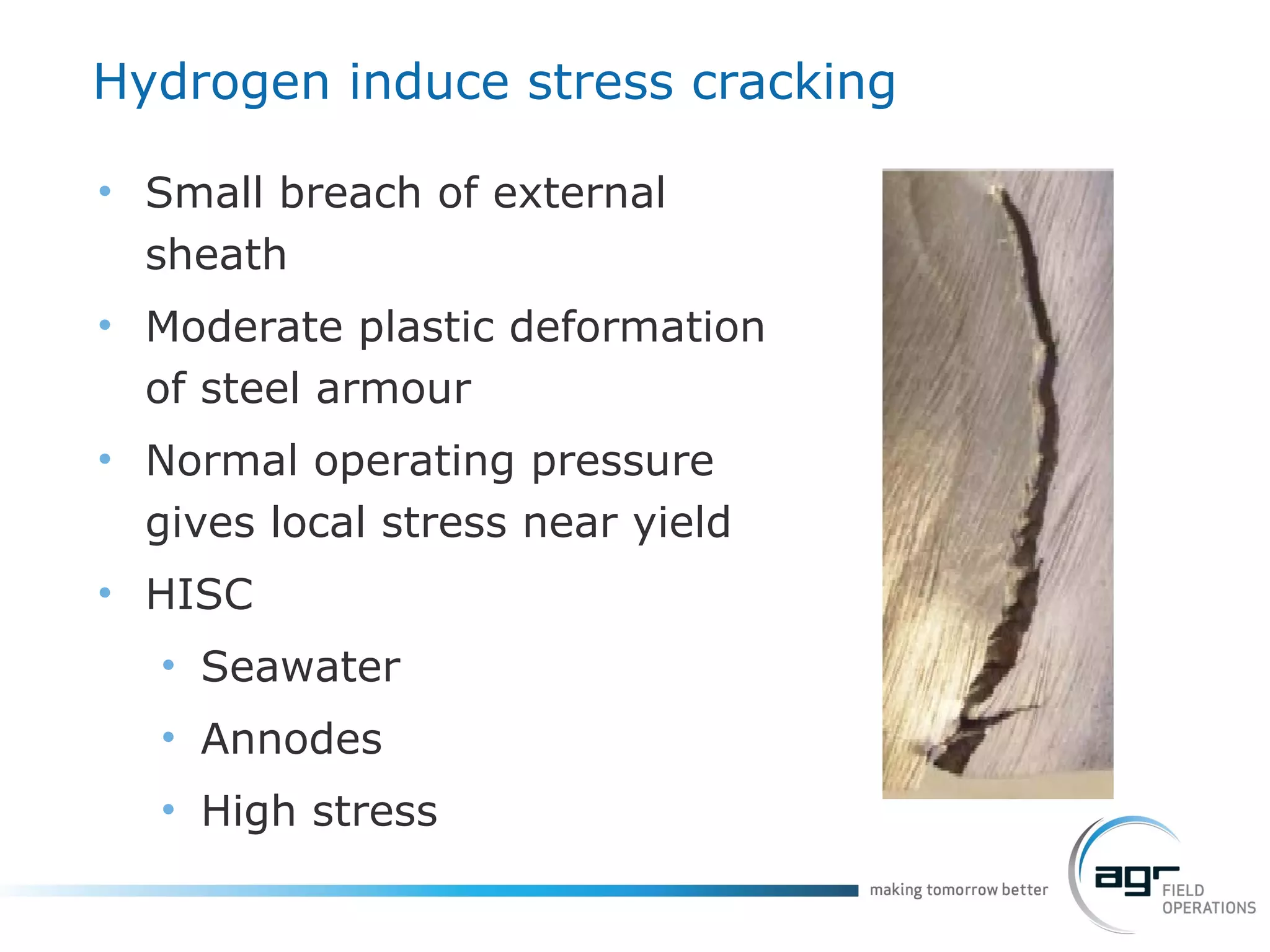
Hydrogen induce stress cracking Small breach of external sheath Moderate plastic deformation of steel armour Normal operating pressure gives local stress near yield HISC Seawater Annodes High stress
Focus area: Corrosion
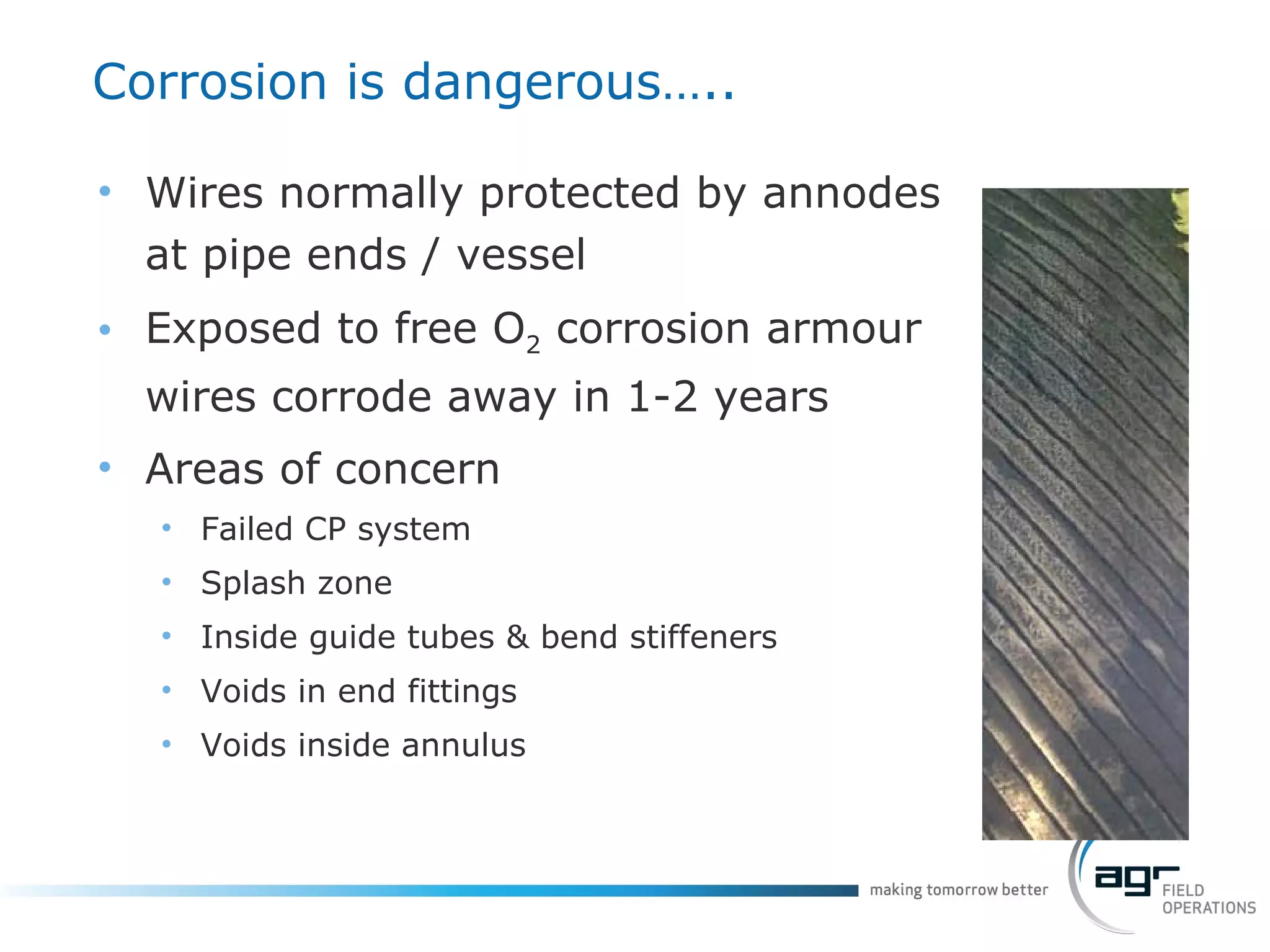
Corrosion is dangerous….. Wires normally protected by annodes at pipe ends / vessel Exposed to free O 2  corrosion armour wires corrode away in 1-2 years Areas of concern Failed CP system Splash zone Inside guide tubes & bend stiffeners Voids in end fittings Voids inside annulus
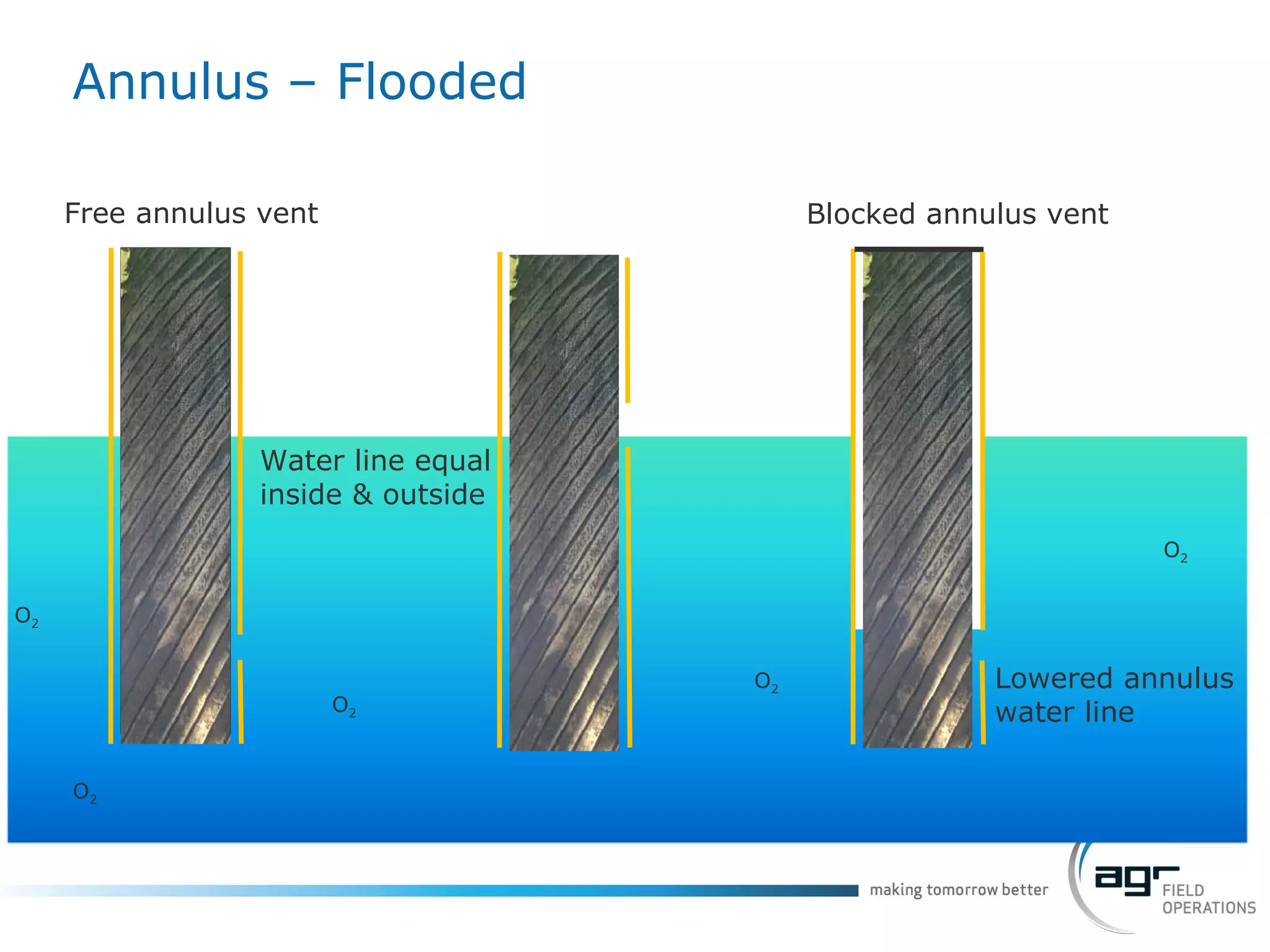
Annulus – Flooded Free annulus vent Blocked annulus vent Water line equal inside & outside O 2 O 2 O 2 O 2 Lowered annulus water line O 2
Internal Inspection
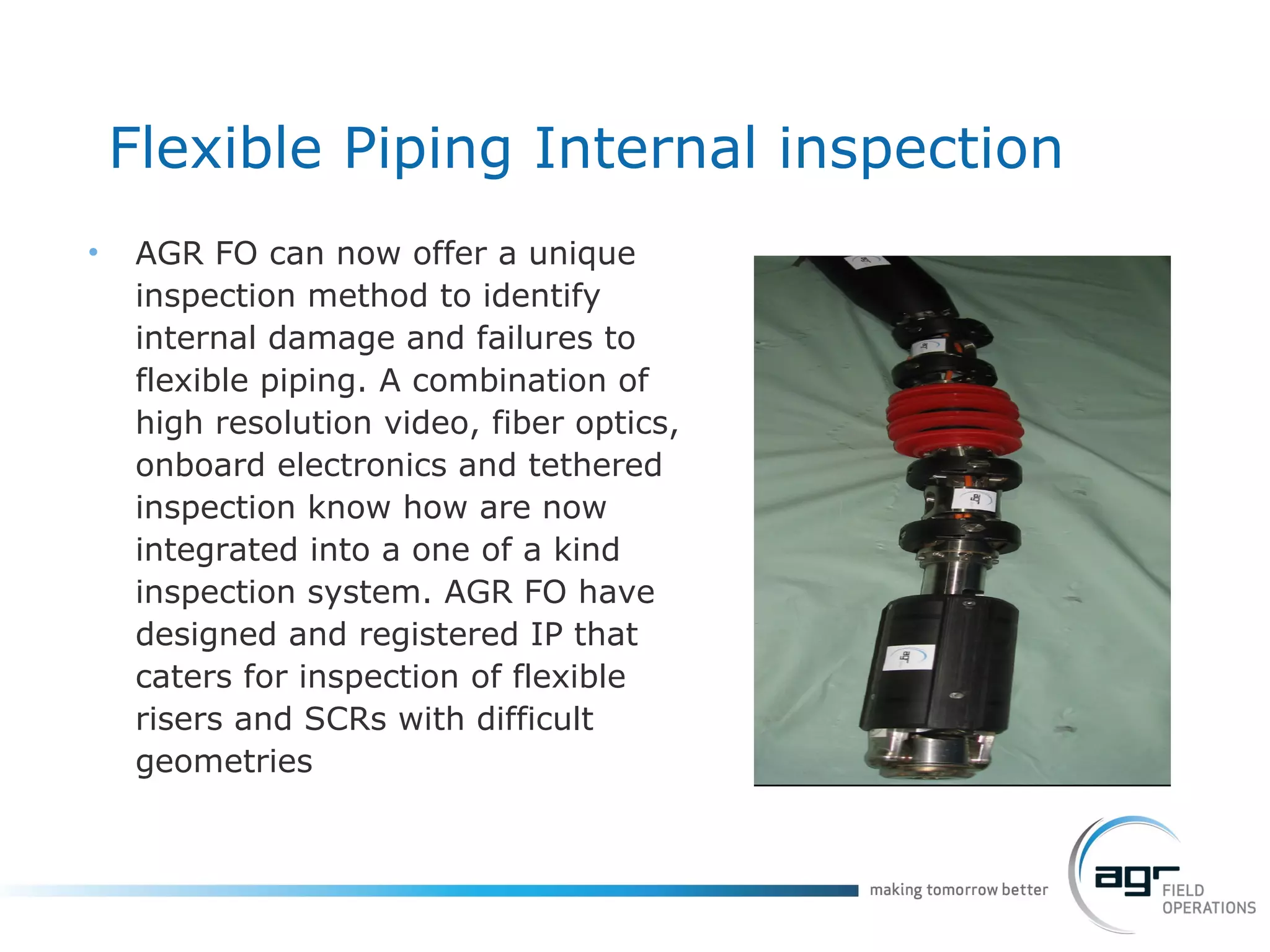
AGR FO can now offer a unique inspection method to identify internal damage and failures to flexible piping. A combination of high resolution video, fiber optics, onboard electronics and tethered inspection know how are now integrated into a one of a kind inspection system. AGR FO have  designed and registered IP that caters for inspection of flexible risers and SCRs with difficult geometries  Flexible Piping Internal inspection
Flexible Piping Internal inspection High definition Video Inspection Capability to detect Internal Failures 10km inspection capabilities Dia Capabilities from 2”-48” Module Based system Integrated drive pig On line data analysis
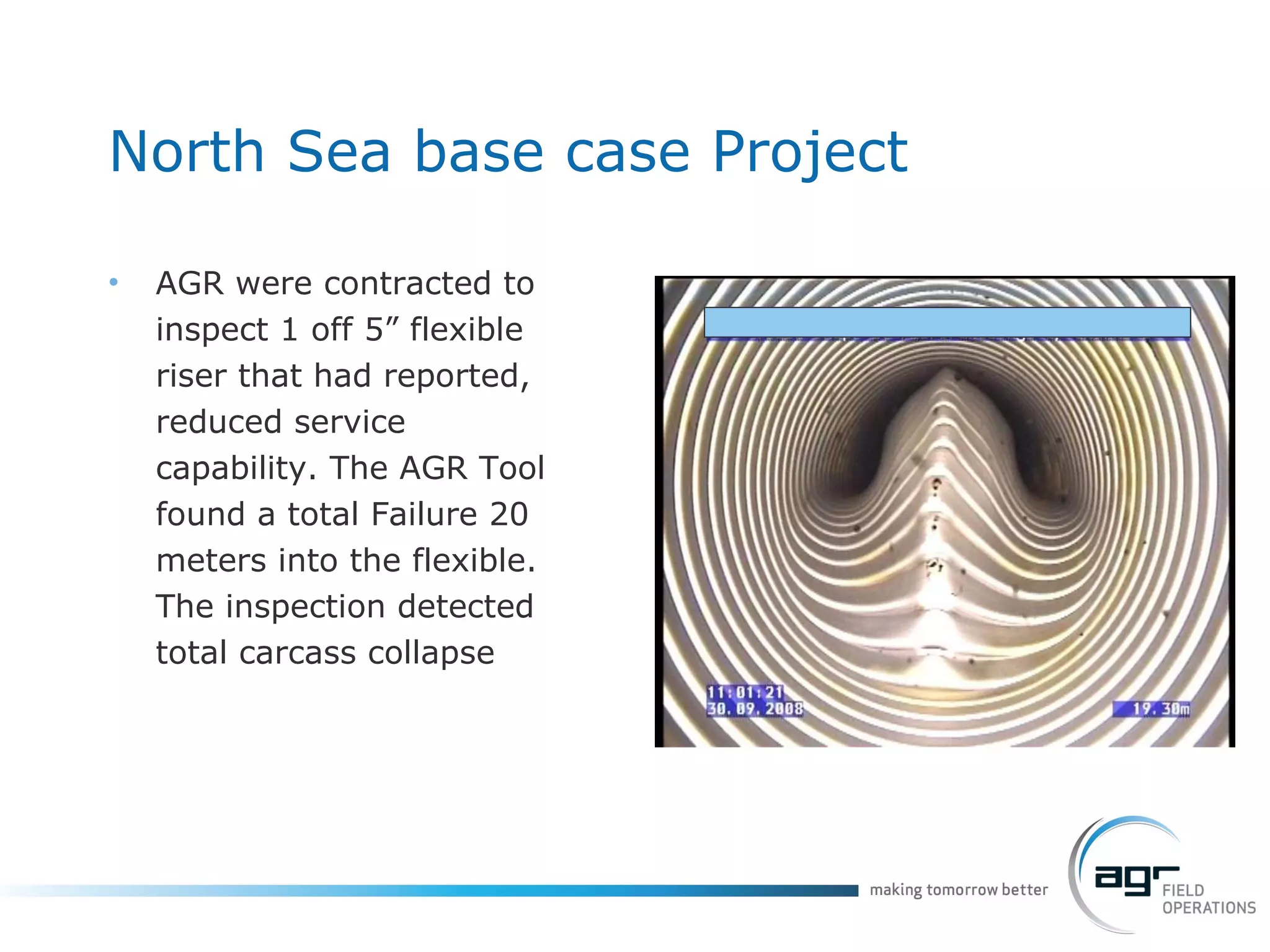
North Sea base case Project AGR were contracted to inspect 1 off 5” flexible riser that had reported, reduced service  capability. The AGR Tool found a total Failure 20 meters into the flexible. The inspection detected total carcass collapse
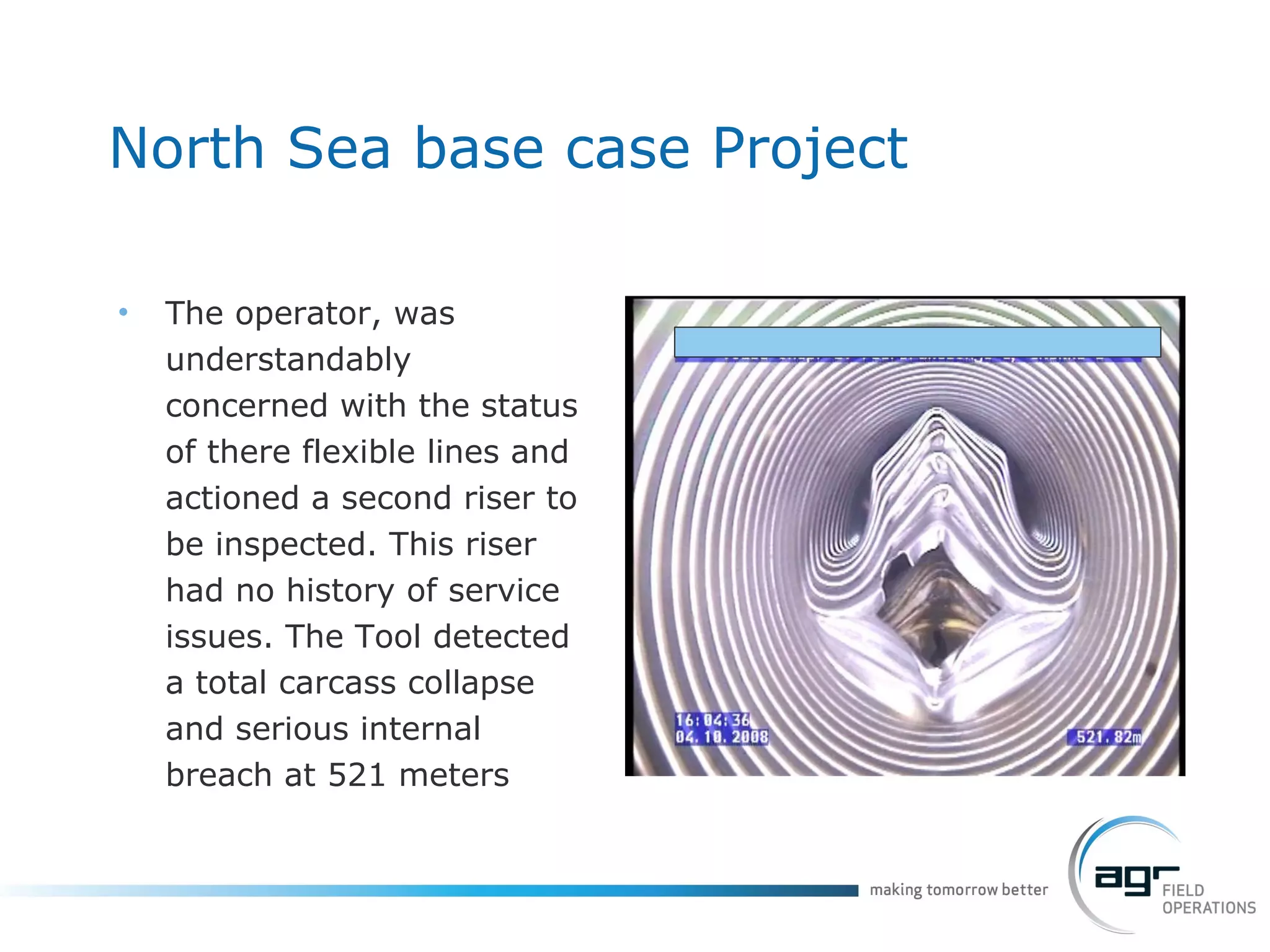
North Sea base case Project The operator, was understandably concerned with the status of there flexible lines and actioned a second riser to be inspected. This riser had no history of service issues. The Tool detected a total carcass collapse and serious internal breach at 521 meters
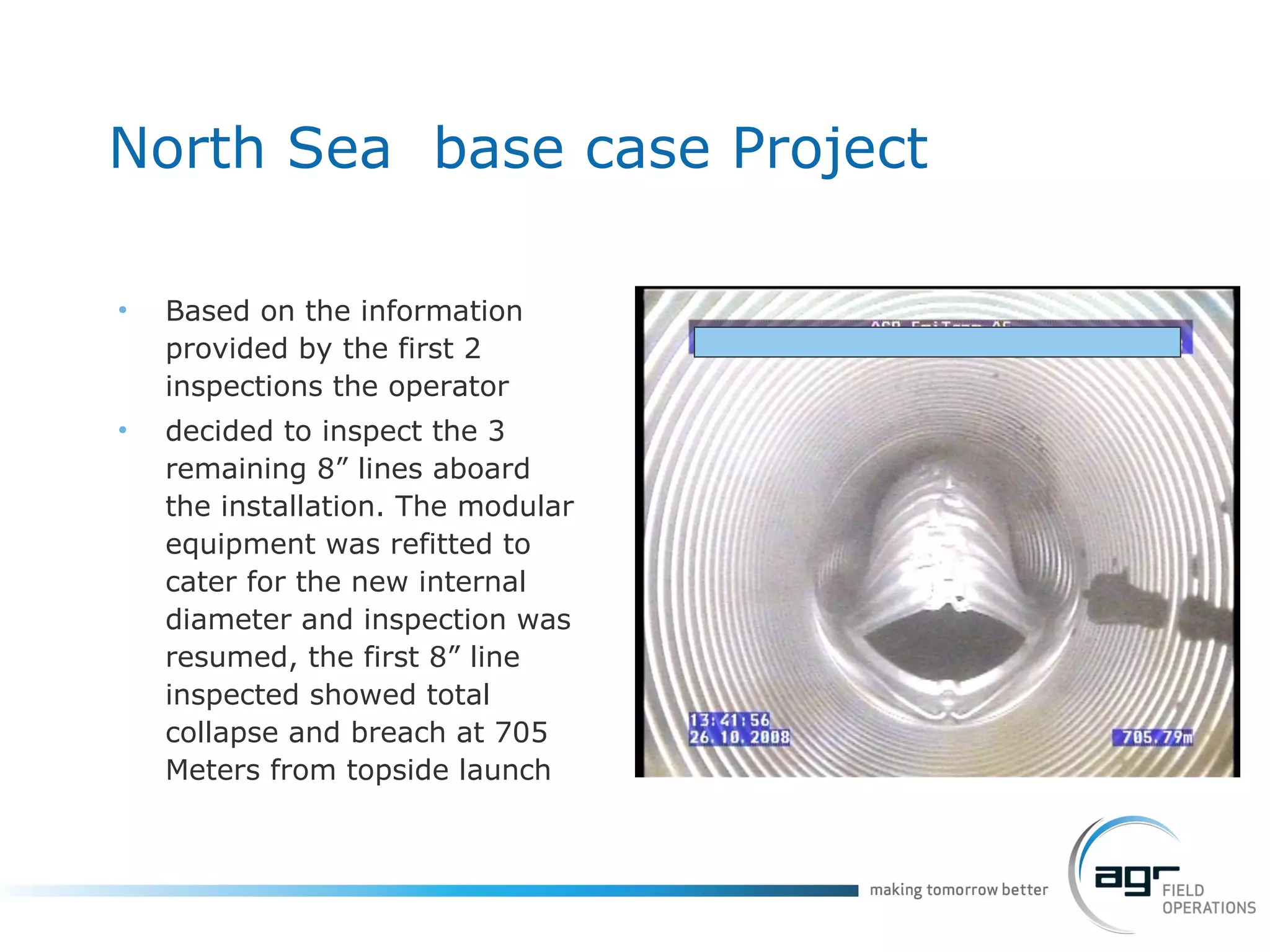
North Sea  base case Project Based on the information provided by the first 2 inspections the operator  decided to inspect the 3 remaining 8” lines aboard the installation. The modular equipment was refitted to cater for the new internal diameter and inspection was resumed, the first 8” line inspected showed total collapse and breach at 705 Meters from topside launch
North Sea base case Project Conclusion AGR have a proven inspection method that can identify internal damage and failures to flexible piping. Operational know how has allowed good internal conditions for inspection. The inspection method has inspected 100% of the internal surface of Flexible risers from top side launch to subsea manifold. The inspection method does demand a temporary shutdown to the riser, but the information gained is valuable and paramount to the integrity to the production facility.
External Inspection
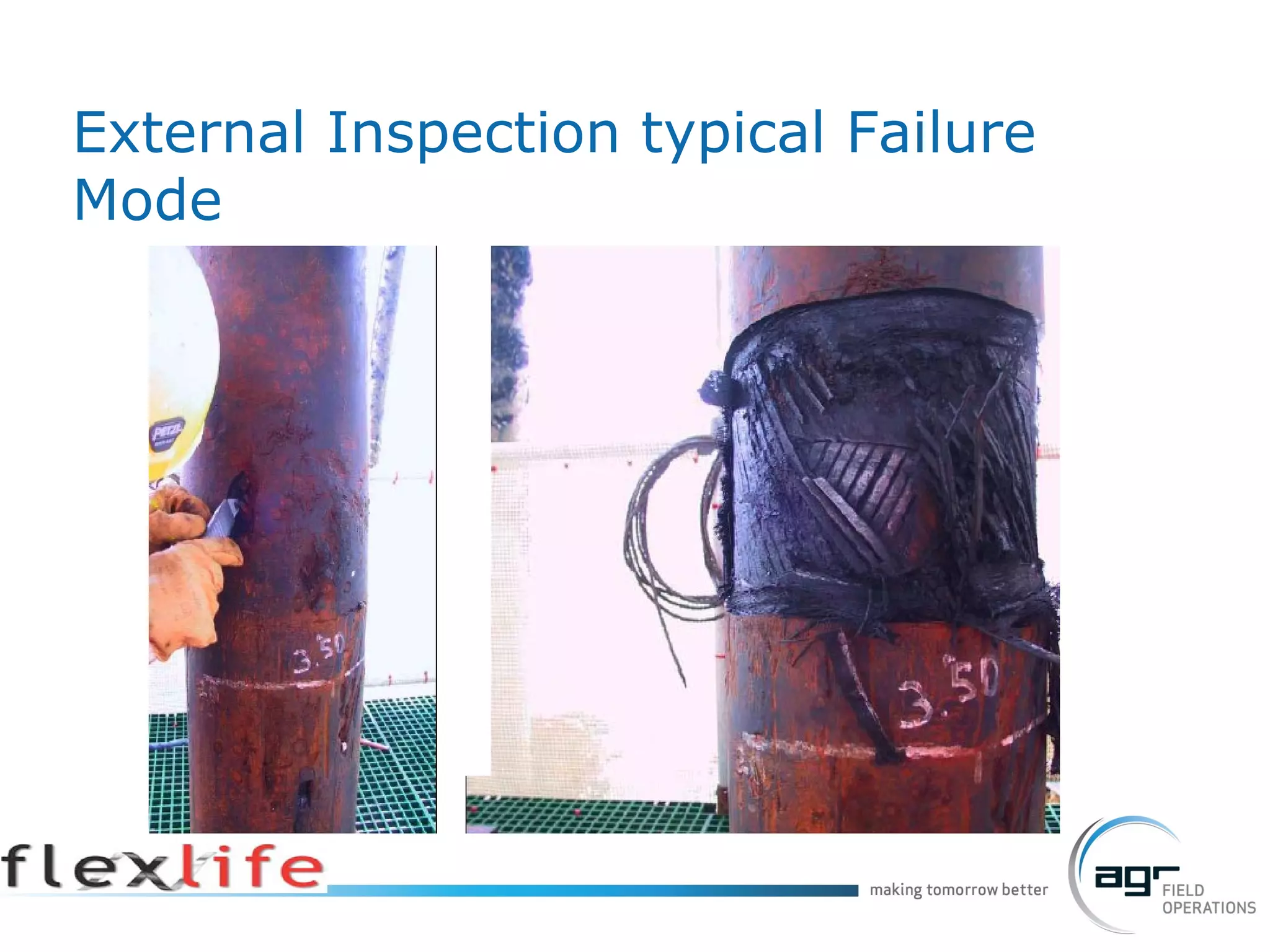
External Inspection typical Failure Mode
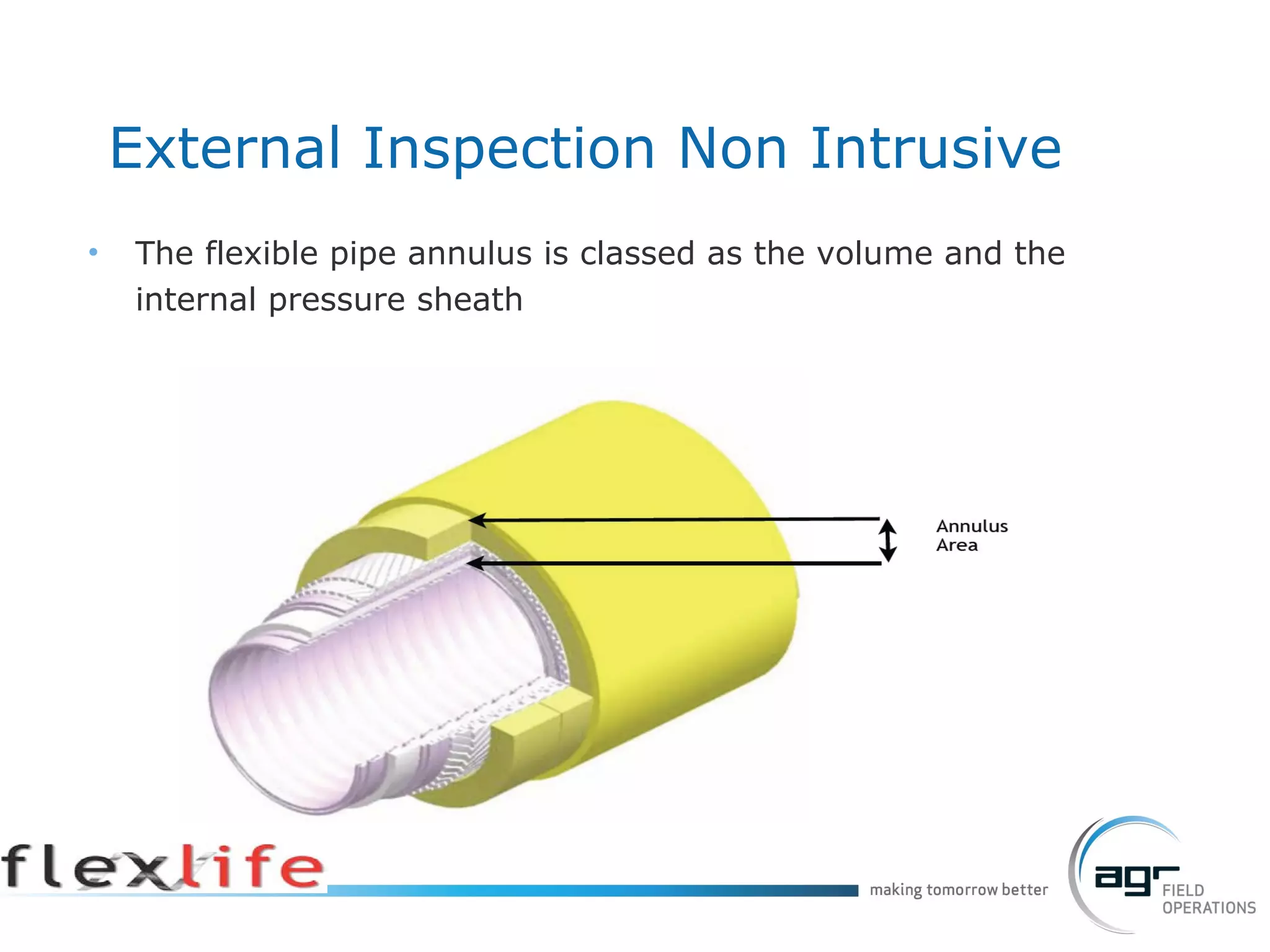
The flexible pipe annulus is classed as the volume and the internal pressure sheath External Inspection Non Intrusive
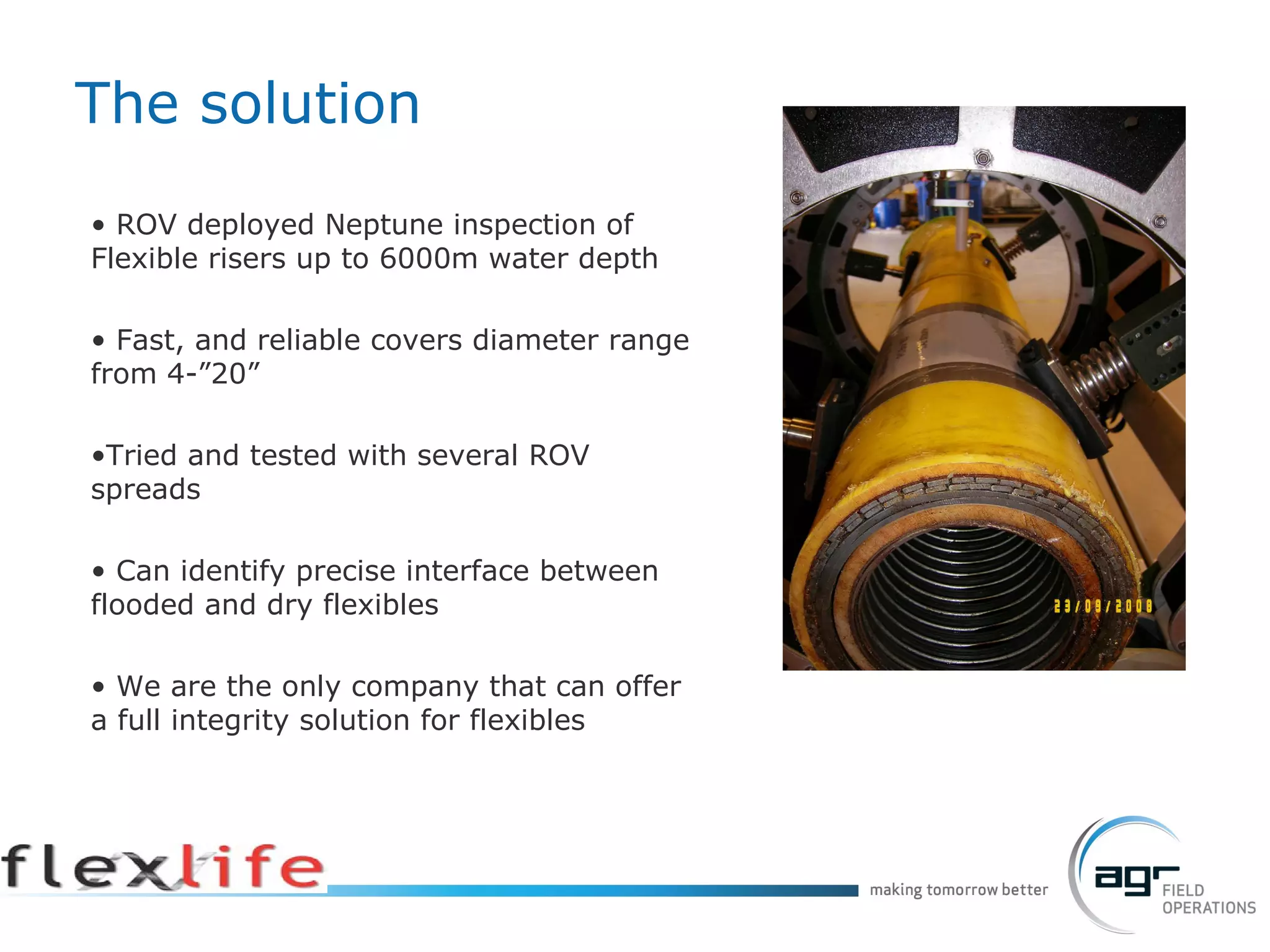
ROV deployed Neptune inspection of Flexible risers up to 6000m water depth Fast, and reliable covers diameter range from 4-”20”  Tried and tested with several ROV spreads Can identify precise interface between flooded and dry flexibles We are the only company that can offer a full integrity solution for flexibles The solution
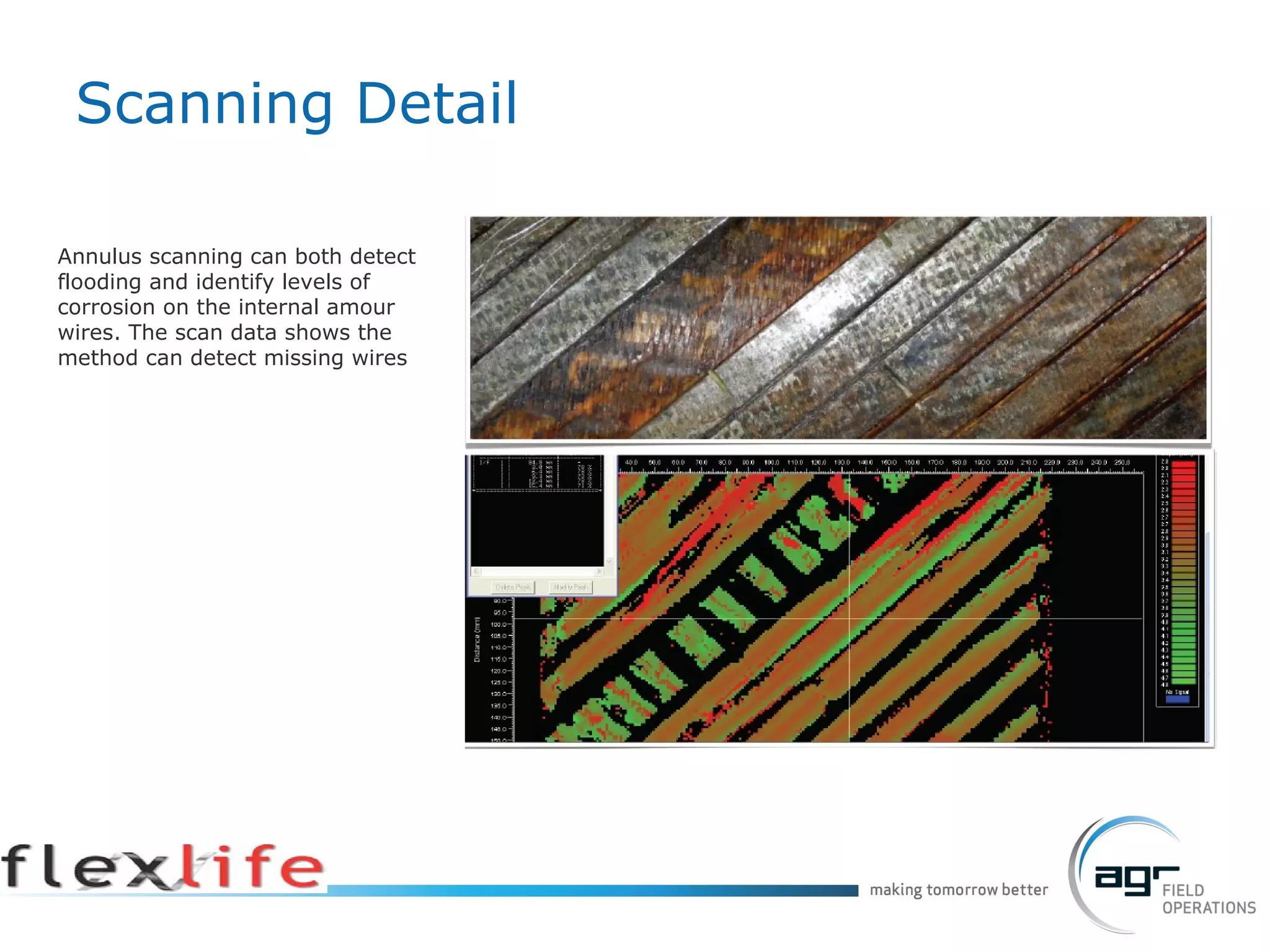
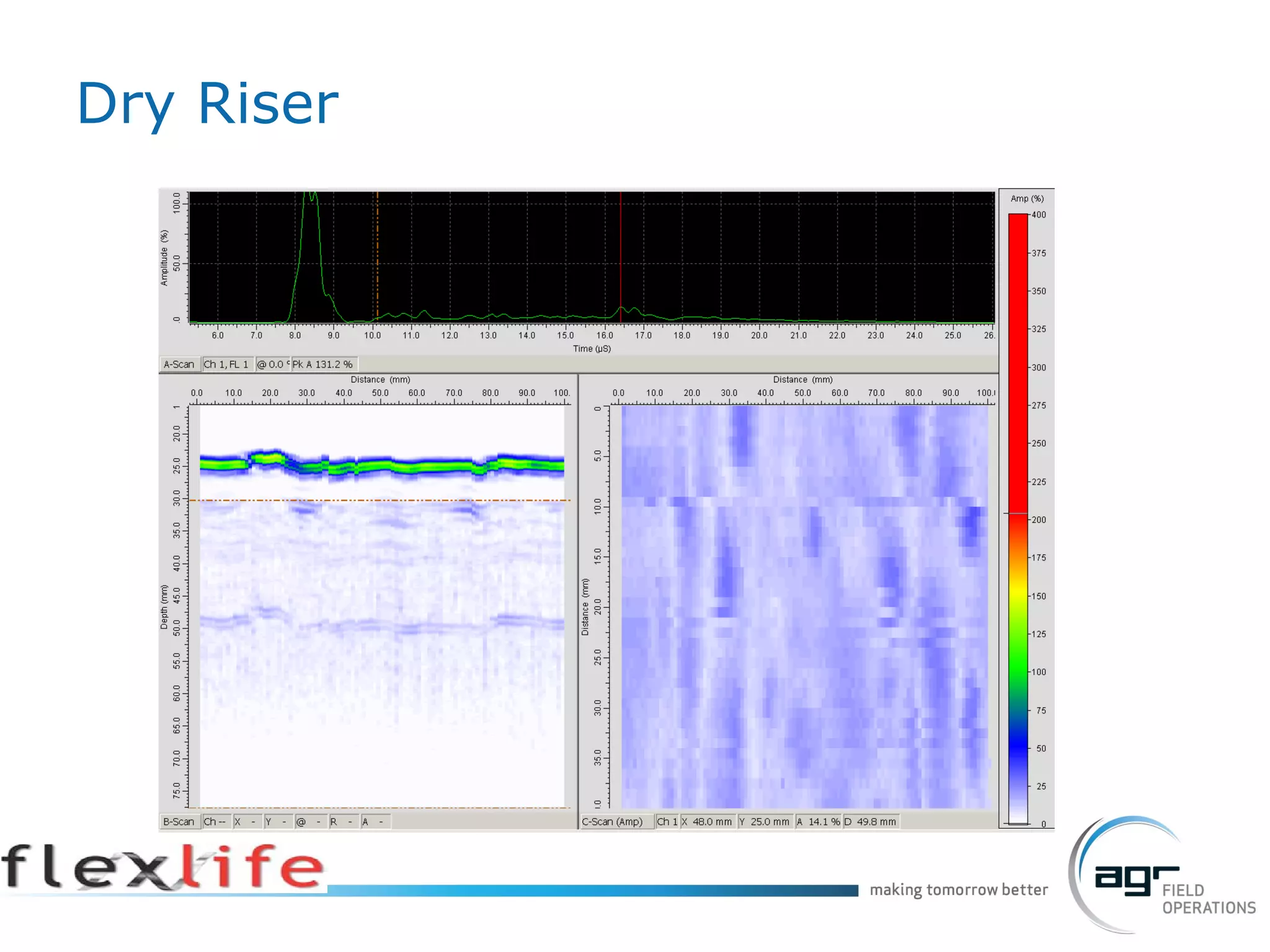
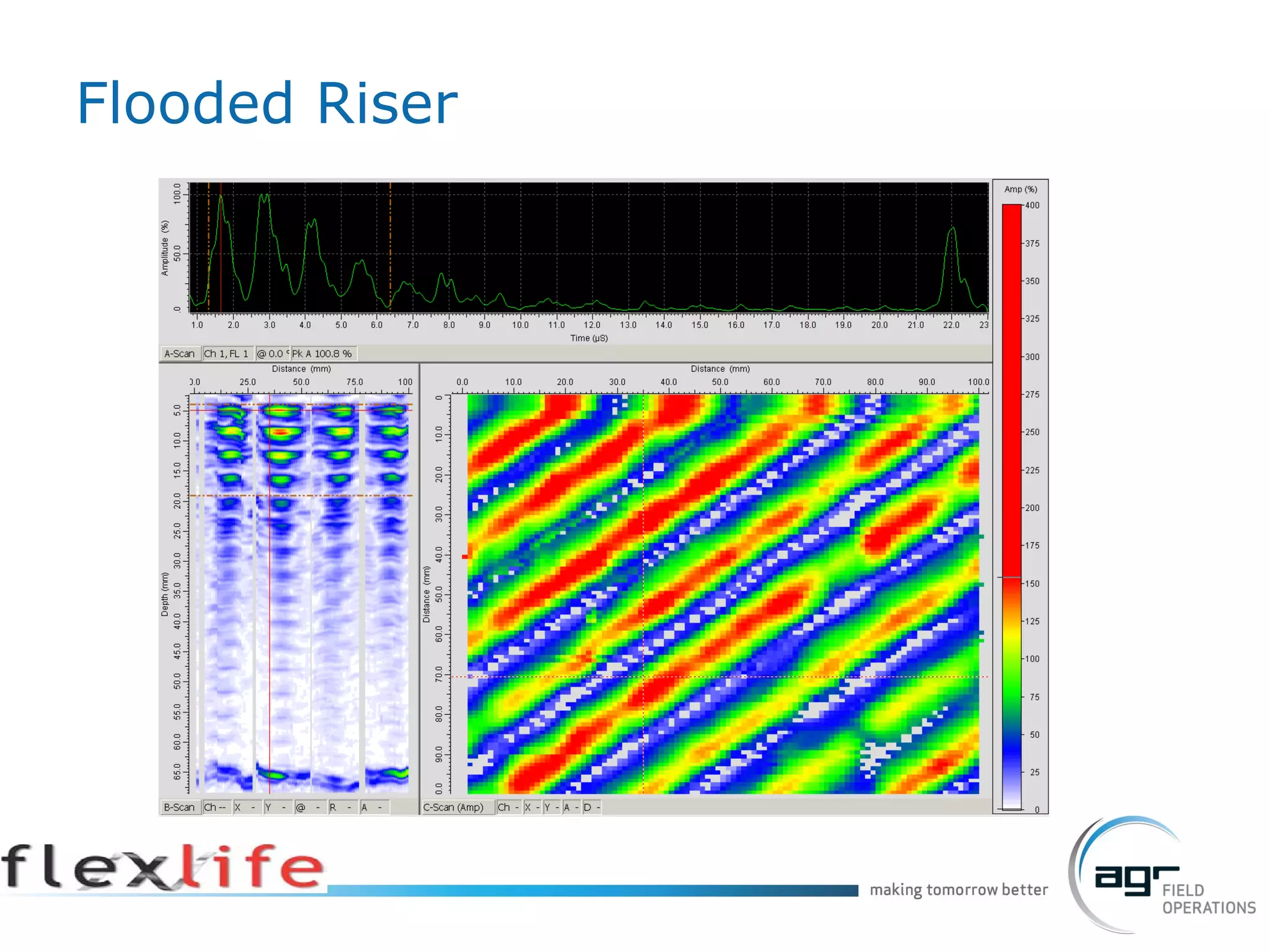
Scanning Detail Annulus scanning can both detect flooding and identify levels of corrosion on the internal amour wires. The scan data shows the method can detect missing wires
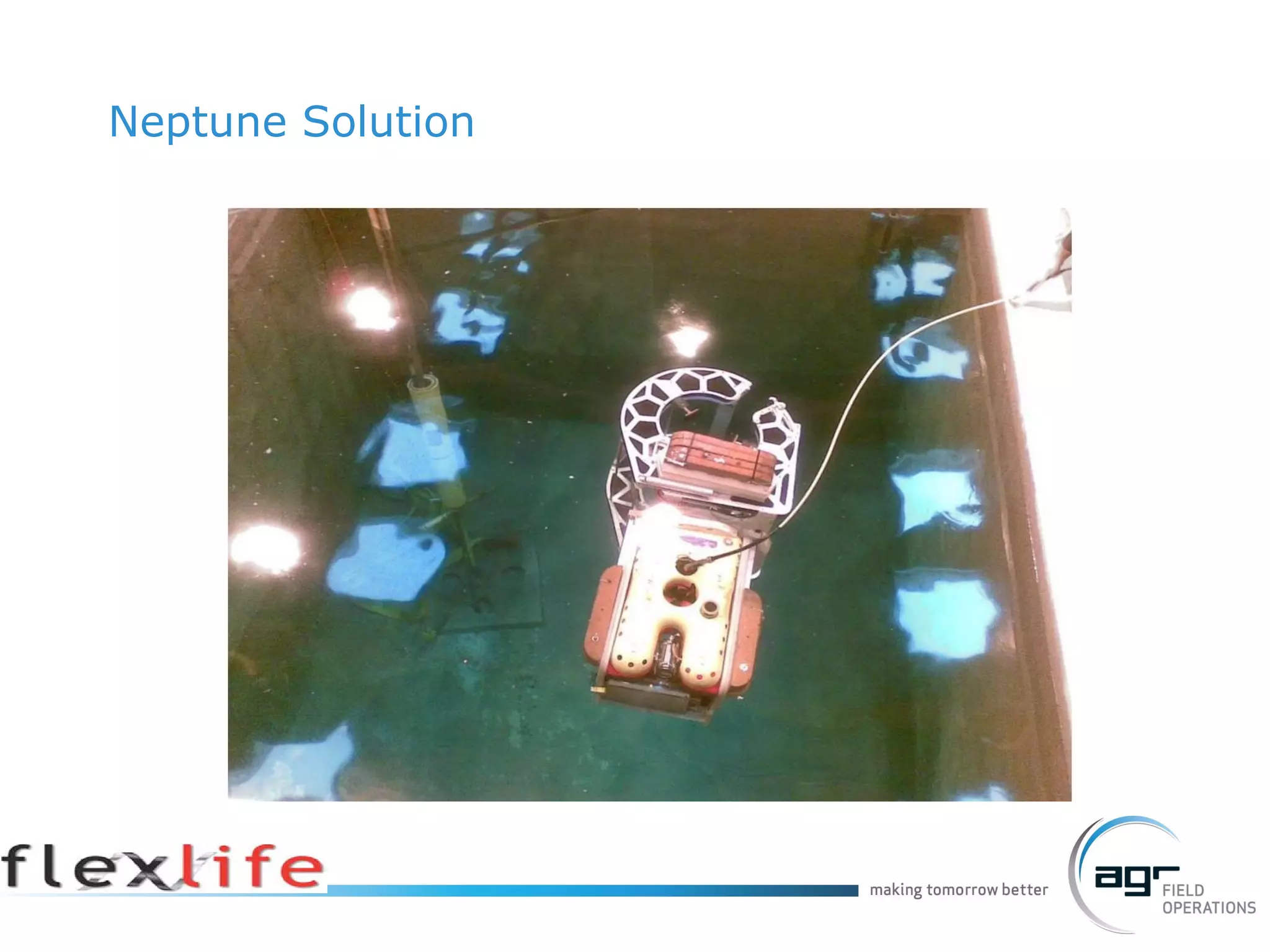
Neptune Solution
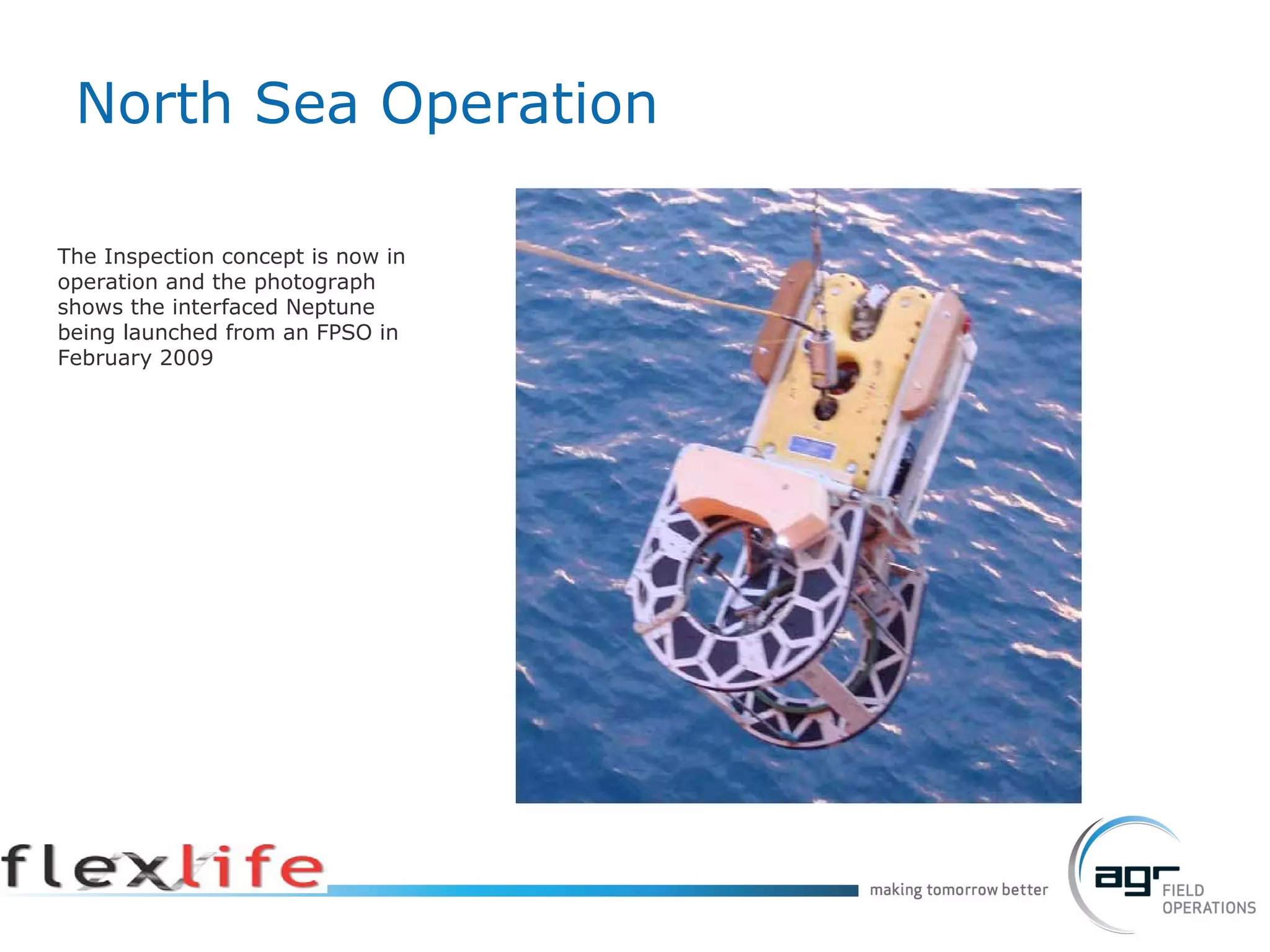
North Sea Operation The Inspection concept is now in operation and the photograph shows the interfaced Neptune being launched from an FPSO in February 2009
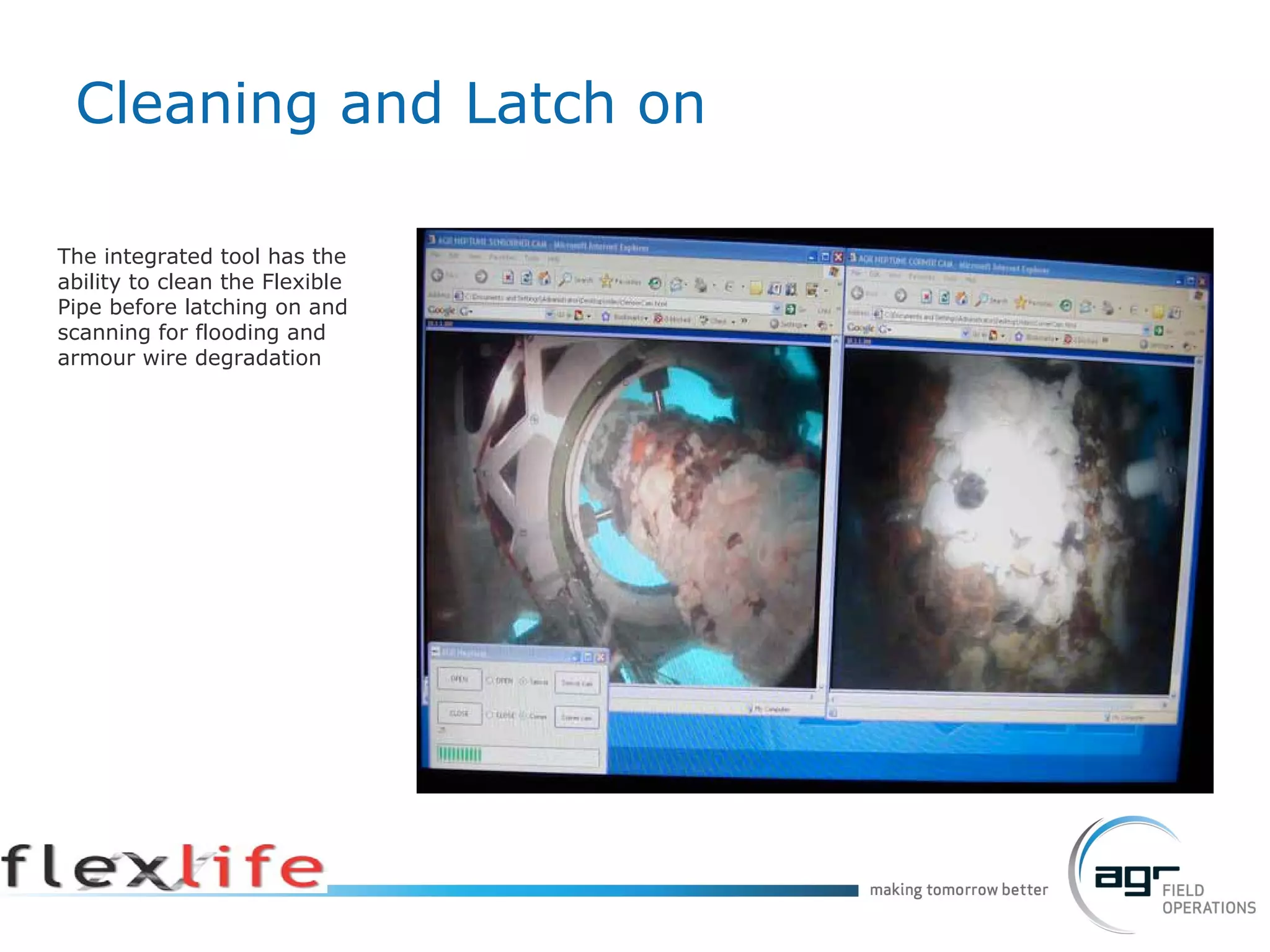
The integrated tool has the ability to clean the Flexible Pipe before latching on and scanning for flooding and armour wire degradation Cleaning and Latch on
Dry Riser
Flooded Riser
North Sea base case Project Conclusion AGR have a proven inspection method that can identify flooded annulus and failures to flexible piping. The tool is can be operated with an Eye ball class ROV. The inspection method has proved 100% successful in both testing and operation. The non intrusive approach to the inspection does not require shut down to any equipment. The equipment setup can reliably be operated in North Sea conditions and perform inspections with limited cleaning
Agr Field Operations Pipeline Inspection

  • 1.
  • 2.
    Agenda Introduction FieldOperations Pipeline inspections Visions and objectives Our strategy Products and services Pipescan Laser video Neptune Project deliveries Case studies
  • 3.
    Unique technologies, toolsand services for taking care of the total technical integrity Integrity Management Inspection Services Pipeline Services ROV operated subsea inspection Certifying authority Outsourced technical department Integrity Project Management & Engineering Maintenance Management Operations & Maintenance A multi discipline engineering group Project Management Project Execution Engineering Services Conceptual engineering Unique and market leading tools within management of maintenance operations. Maintenance Strategy Criticality assessments, and maintenance risk evaluations Maintenance programs Spare parts required for preventive and corrective maintenance Technical documentation systems The “operators operator” providing: Managerial Support HSEQ Monitoring Facility Operations Personnel Maintenance Execution Technical Support Risk Management Regulatory Compliance Workovers Subsea Services Assists operators to design, specify, install and service subsea production equipment including subsea trees, manifolds, flow line and control umbilicals. Field Operations introduction
  • 4.
    Field Operations services1998 - 2003 2004 - 2005 2006 2007 Markets: Norway (NCS) Markets: Norway (NCS) Limited international activity Markets: Norway (NCS) Canada UK Markets: Norway (NCS) Sweden Canada UK Americas Asia Pacific (KL & Australia) Markets: Norway (NCS) Sweden Canada UK Americas Asia Pacific Clients: Large operators Clients: Large operators Clients: Large operators Rig operators FPSO operators Clients: Large operators Rig operators FPSO operators Nuclear Industry ” Non-operating” operators Clients: Large operators Rig operators FPSO operators Nuclear Industry ” Non-operating” operators Locally providing niche services International presence Strong global provider Number of employees 40 - 70 70 - 160 160 - 250 250 - 350 850  2008 – 2010
  • 5.
    We are aglobal provider Product based service company, with a niche area in tethered internal inline cleaning and inspection International provider of pipeline inspection services Continued development of cutting edge technology and method that enable customers to control and manage their business
  • 6.
    Our strategy Ourbusiness concept is based on the knowledge of pipeline business methods and techniques We provide customers with cost-effective integrated solutions designed for adaptation We are committed to continuous learning and new methods
  • 7.
    The need forintegrity services Aging pipeline systems The need for lifetime extensions Re-qualification of existing pipelines Optimised design, a stricter need for monitoring PIM for onshore pipelines regulation (API1160, ASME31.8S)
  • 8.
    How can AGRhelp? Identify potential degradation mechanisms Perform corrosion risk assessments and failure analysis Fatigue and remaining life assessments Fitness for service assessments Risk assessment of equipment, structures and machinery Evaluation of inspection results Risk re-assessment post inspection Our systems can be used with the clients’ own systems
  • 9.
    Benefits for ourclients Assuring the integrity of process equipment and structures Performing operations in safe manner Avoiding unplanned shutdowns Avoiding damages to personnel or environment
  • 10.
    Operational modesIncreased accuracy for internal inspection of welds and base material by combining the pipe intruder with TOFD Pipe intruder Pipe tractor Bi-directional pig
  • 11.
    Pipe intruderPumps & motor located on both sides Seal disc with internal bypass Pumps water from front through the sealing module The back pressure makes the tool travel forward Reversing the flow and generating “front pressure” whilst pulling the umbilical cable Pipe intruder – Self propelling bi directional crawler
  • 12.
    Weldscan Internal inspectionof girth welds TOFD Data from inter-run lack of fusion ( IRLOF) Defect Detailed pipe reporting 3D presentation of sections with defects Weldscan – Crack detection tool
  • 13.
    Pipescan Hybrid internalpipe scanner Free floating on line system Extends inspection reach from today's 10 km Fiber optic communication allows inspection though tighter geometries Market launch 2Q 2008 Reduces costs - no need for power pack and winch Weldscan – Crack detection tool
  • 14.
    Pipescan reportingDuring the inspection thickness readings are sent to the topside computer via the inspection umbilical Data is displayed in real time and stored on the computer hard drive for later retrieval and off line analysis
  • 15.
    Defect area identifiedby a pipescan inspection on an onshore pipeline Detailed PipeScan reporting principles - 3D model
  • 16.
    Other applications withPipe intruder 8-10” Weld-scanner (TOFD) Laser/Video for flooded HP-conditions
  • 17.
    Video inspectionA ring of laser light is projected onto the internal pipe surface The laser image is in the field of view of the camera while the camera moves through the pipe Analysis is performed on the ring of light using the laser video software to build a digital pipe profile
  • 18.
    Benefits with laser/ video inspection Accurate real time measuring of the internal pipe wall Easily discovery of geometric changes Detect defects and other foreign body size Easily adaptable to different pipe sizes Can be used in liquid-filled pipes Clear variance presentation Good quality control Digital storage of information Inspects pipe diameters from 10-2000 mm Inspection length up to 8000 meter
  • 19.
    Neptune – Subseainspection system First high resolution ROV assisted ultrasonic pipe and weld inspection solution Deployment by small inspection work class ROV’s 30% of traditional cost Fracture mechanic analysis and remaining life assessment can be carried out without compromising diver safety Operating depth has been extended from metres to kilometres
  • 20.
    The Neptune applicationRapid monitoring from ROV supply vessel Rapid monitoring of manifold piping Wall thickness monitoring is platform based Regular monitoring of anomalous pipeline sections (legacy infrastructure) in lieu of remedial intervention Pre inspection of pipeline hot tap areas
  • 21.
    Benefits of usingNeptune Removing diver exposure Reducing cost of subsea inspection intervention Quality of inspection Subsea applications platform Integrated, self contained unit Real time, quantitative data Universal ROV interface Limitations: Geometric restrictions Cleaning, coatings & access Diameter range
  • 22.
    Corrosion mapping Predeterminedthickness readings are allocated specific colours As the corrosion or erosion is scanned the image is built up like contour lines on an ordnance survey map The quality of the ROV gathered data provides fracture mechanic friendly data and allows integrity analysis, fitness for service and remaining life assessment to be carried out throughout the year without compromising diver safety
  • 23.
    Pipeline project managementContributing to successful projects Completion of projects on time and within budget Offering expertise in supporting our clients needs for hiring qualified and experienced personnel In-house engineering Capable of operating all industry standard tools Project phases, milestones & decision gates
  • 24.
    Case studie 1: Internal Inspection of Super Duplex/Sup13%Cr Welds GFSAT2 Project at Gullfaks C
  • 25.
    Case studie 1: Challenges Various Internal Diameters Ø253-Ø320 (12”-14”) 19 Bends/1 Tee/Several Outlets Loop in topside piping Flooding and de-watering operation Various mediums –Glycol/Water/Methanol Desription: Length Stand/Min. ID WT Grade No. Bends Topside 60 m   30.0 Duplex 9 Off. Riser 290 m 261,9/253,5mm 18,3 13%Cr 1 Off. Termination Heads N/A N/A/275,8mm N/A N/A N/A 12” Jumper 50 m 285,7/274,8mm 19,1 13%Cr/ Duplex 5 Off.. Towhead C1 N/A 285,7/274,8 19,1 13%Cr/ Duplex 2 Off. 14” North Bundle 7 km 320 mm 17,8 13%Cr  
  • 26.
    Case studie 1: The solution The wells were isolated, and the pipeline was filled with water in the area to be inspected + a buffer zone The water filling was done by running a pig train containing MEG batches, which removes the water and ”dries” the pipe while being reversed The inspection was performed using a special configured pipe intruder, which seals over the complete range of internal diameters IRLOF defect detected in a 13Cr/13Cr weld
  • 27.
    Case study 1:Summary Deployment of tool from a Subsea launcher into the pipe The launcher was designed to fit the end connection (14” Cameron Hub), and controlled by 2 ROV’s Demands was forwarded toward the equipments ability to negotiate a 12/14” reducer and to avoid any breakdowns of equipment 3 Days of testing in a mock up simulating the subsea pipe work The scope was to inspect a repaired weld connection and additional welds in the area The operation was controlled from a diving vessel The complete operation was performed in 24 hours Benefits: The integrity of the pipeline could be confirmed A new pipeline investment were not necessary
  • 28.
    Case study 2: Internal Inspection of carbon steel gas flow line against subsea template
  • 29.
    Case study 2: Challenges 4 Bends 1 Tee Several Outlets Flooding Operation De-watering operation
  • 30.
    Case study 2:The solution The pipeline was a 9” 4000 meters flow line going towards the Sleipner East template The client was concerned about possible CO2 corrosion The pipeline was filled with freshwater by sending pigs containing MEG batches towards the template, and evacuating the gas trough a ½” opening in the template control umbilical and back to flare The line was emptied by sending Nitrogen in the reverse direction, forcing the PIG/MEG batch back to the launcher
  • 31.
    Case study 2:Benefits Inspection by using a standard intelligent pig was estimated to approximately 4 MUSD The tethered inspection and the flooding/dewatering operation had a cost which was 10% of above No subsea activities were required The pipeline could be operated at an increased pressure by phasing in more wells
  • 32.
    Pipeline inspections advantagesWorlds most advanced internal weld inspection equipment for pipelines World leading pipeline inspection technology Unparalleled resolution Unique propulsion technology Introducing products from pipeline to down-hole to new markets Capable of inspection lines of up to 10 000 meters Providing full size range from 6/8 – 52 + Inches Expanding work scope on preparatory work rather than on tail/integrity side
  • 33.
    AGR has competitiveadvantages A “best practice” approach Smart methods to maximise efficiencies and profitability Unique technology and engineering solutions Advanced and cost-effective inspection techniques Sophisticated data transmission and storage facilities Our engineers specialises in the industry needs We use technology to improve your business processes We understand your needs
  • 34.
    Why AGR FieldOperation? Meets client needs Is implemented in time and within budget Is flexible and deliver quality In house developed solutions that meets future market needs Meets the challenges of the future Is the best value for money to: Optimise Asset management & control Increase operational efficiency Comply with regulations
  • 35.
    Some of ourclients
  • 36.
  • 37.
    Flexible Integrity &Inspection Over the last decade the oil industry has seen a vast expansion in subsea infrastructure and the use of flexible piping in production The layered structure of flexible piping has posed challenges to inspection industry for years AGR and our partners have now developed methods that vastly improve technical safety, meet international requirements and reduce the cost of inspection
  • 38.
    Riser Integrity !Know the “important” failure modes Manage integrity Safer operations
  • 39.
    Problems with Flexibles1st - Outer sheath damage • Burst • Installation damage • Abrasion damage • Dropped object • 2nd - Aged internal sheath • 3rd - Internal sheath pull out • Obsolete through design / materials
  • 40.
    Today's methods! Freehanging risers Check annulus vent system Annulus vacuum or low pressure test Annulus gas sampling Inspection by climber from surface Deballasting of vessel Risers in guide tube Pressurised GT Annulus gas release monitoring
  • 41.
    Flexible Piping inspectionOver the last decade the oil industry has seen a vast expansion in subsea infrastructure and the use of flexible piping in production. The layered structure of flexible piping has posed challenges to inspection industry for years. AGR and there partners have now developed methods that vastly improve technical safety, meet international requirements and reduce the cost of inspection
  • 42.
    Internal failures  internal inspection Carcass collapse Minor corrosion Loss of wires Aging Minor corrosion Minor loss of material Increased fatigue Riser condition assessment High definition video inspection Capability to detect failures Riser connection status with pipe scan Capabilites 10 km inspection capabilities Capabilities from 4”-52” Module based system Integrated drive pig On line data analysis
  • 43.
    External failures O 2 corrosion Minor corrosion  SCF Loss of wires CO 2 corrosion Minor corrosion  SCF Minor loss of material Increased fatigue HICC Seawater + anodes + high strength steel + high stress Loss of wires Increased fatigue Wet annulus Higher CO 2 / H 2 S partial pressure Reduced fatigue capacity
  • 44.
    HYDROGEN INDUCED CRACKINGFocus area: HISC in flexible flowlines
  • 45.
    Hydrogen induced stresscracking Flexible pipe High strength tensile armour with approx. 55 deg lay angle No pressure armour Carcass Annodes in the vicinity Low energy impact Breach of the external sheath Seawater in annulus Plastic deformation of armour wires
  • 46.
    Hydrogen induce stresscracking Small breach of external sheath Moderate plastic deformation of steel armour Normal operating pressure gives local stress near yield HISC Seawater Annodes High stress
  • 47.
  • 48.
    Corrosion is dangerous…..Wires normally protected by annodes at pipe ends / vessel Exposed to free O 2 corrosion armour wires corrode away in 1-2 years Areas of concern Failed CP system Splash zone Inside guide tubes & bend stiffeners Voids in end fittings Voids inside annulus
  • 49.
    Annulus – FloodedFree annulus vent Blocked annulus vent Water line equal inside & outside O 2 O 2 O 2 O 2 Lowered annulus water line O 2
  • 50.
  • 51.
    AGR FO cannow offer a unique inspection method to identify internal damage and failures to flexible piping. A combination of high resolution video, fiber optics, onboard electronics and tethered inspection know how are now integrated into a one of a kind inspection system. AGR FO have designed and registered IP that caters for inspection of flexible risers and SCRs with difficult geometries Flexible Piping Internal inspection
  • 52.
    Flexible Piping Internalinspection High definition Video Inspection Capability to detect Internal Failures 10km inspection capabilities Dia Capabilities from 2”-48” Module Based system Integrated drive pig On line data analysis
  • 53.
    North Sea basecase Project AGR were contracted to inspect 1 off 5” flexible riser that had reported, reduced service capability. The AGR Tool found a total Failure 20 meters into the flexible. The inspection detected total carcass collapse
  • 54.
    North Sea basecase Project The operator, was understandably concerned with the status of there flexible lines and actioned a second riser to be inspected. This riser had no history of service issues. The Tool detected a total carcass collapse and serious internal breach at 521 meters
  • 55.
    North Sea base case Project Based on the information provided by the first 2 inspections the operator decided to inspect the 3 remaining 8” lines aboard the installation. The modular equipment was refitted to cater for the new internal diameter and inspection was resumed, the first 8” line inspected showed total collapse and breach at 705 Meters from topside launch
  • 56.
    North Sea basecase Project Conclusion AGR have a proven inspection method that can identify internal damage and failures to flexible piping. Operational know how has allowed good internal conditions for inspection. The inspection method has inspected 100% of the internal surface of Flexible risers from top side launch to subsea manifold. The inspection method does demand a temporary shutdown to the riser, but the information gained is valuable and paramount to the integrity to the production facility.
  • 57.
  • 58.
  • 59.
    The flexible pipeannulus is classed as the volume and the internal pressure sheath External Inspection Non Intrusive
  • 60.
    ROV deployed Neptuneinspection of Flexible risers up to 6000m water depth Fast, and reliable covers diameter range from 4-”20” Tried and tested with several ROV spreads Can identify precise interface between flooded and dry flexibles We are the only company that can offer a full integrity solution for flexibles The solution
  • 61.
    Scanning Detail Annulusscanning can both detect flooding and identify levels of corrosion on the internal amour wires. The scan data shows the method can detect missing wires
  • 62.
  • 63.
    North Sea OperationThe Inspection concept is now in operation and the photograph shows the interfaced Neptune being launched from an FPSO in February 2009
  • 64.
    The integrated toolhas the ability to clean the Flexible Pipe before latching on and scanning for flooding and armour wire degradation Cleaning and Latch on
  • 65.
  • 66.
  • 67.
    North Sea basecase Project Conclusion AGR have a proven inspection method that can identify flooded annulus and failures to flexible piping. The tool is can be operated with an Eye ball class ROV. The inspection method has proved 100% successful in both testing and operation. The non intrusive approach to the inspection does not require shut down to any equipment. The equipment setup can reliably be operated in North Sea conditions and perform inspections with limited cleaning