DR ALI SHER
CHANDIO
FCPS TRAINEE
PAEDES UNIT III
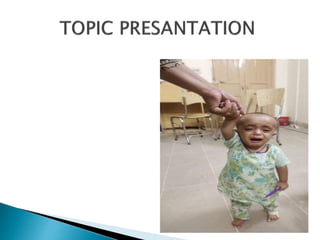
 A 12 months old Urooj D/O Mukhtyar Ali , product
of consanguineous marriage resident of Nau-Dero
admitted in paeds unit iii on 13/07/22 via ER with
complaints of
 Fever for 3 days
 Cough for 3 days
 Shortness of breath for 1 day
 According to mother child has history of fever
cough from last 3 days and SOB for 1 day. Fever is
sudden in onset high grade and intermittent
relived by taking antipyretics.
 However, fever is Not associated with rigors, chills,
rash, ear discharge, sore throat, night sweats and
pain in abdomen.
 Cough was dry, sudden in onset, mild in
intensity, associated with shortness of breath,
not associated with blood, chest pain,
hoarseness of voice, cyanosis and no special
time of occurrence, it is not aggravated with
feeding.
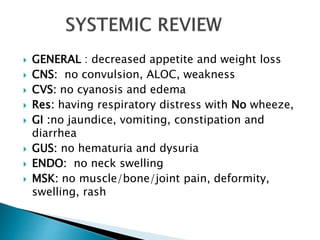
 GENERAL : decreased appetite and weight loss
 CNS: no convulsion, ALOC, weakness
 CVS: no cyanosis and edema
 Res: having respiratory distress with No wheeze,
 GI :no jaundice, vomiting, constipation and
diarrhea
 GUS: no hematuria and dysuria
 ENDO: no neck swelling
 MSK: no muscle/bone/joint pain, deformity,
swelling, rash
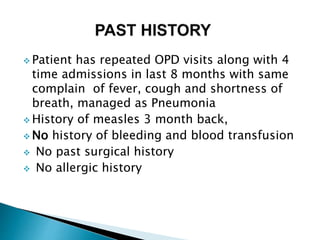
 Patient has repeated OPD visits along with 4
time admissions in last 8 months with same
complain of fever, cough and shortness of
breath, managed as Pneumonia
 History of measles 3 month back,
 No history of bleeding and blood transfusion
 No past surgical history
 No allergic history
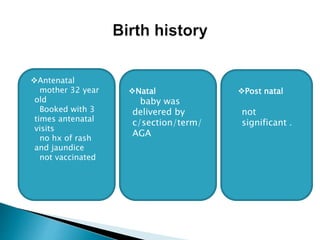
Antenatal
mother 32 year
old
Booked with 3
times antenatal
visits
no hx of rash
and jaundice
not vaccinated
Natal
baby was
delivered by
c/section/term/
AGA
Post natal
not
significant .
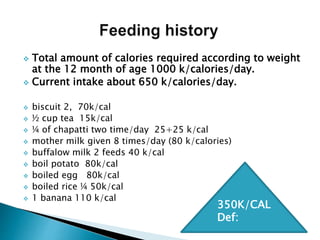
 Total amount of calories required according to weight
at the 12 month of age 1000 k/calories/day.
 Current intake about 650 k/calories/day.
 biscuit 2, 70k/cal
 ½ cup tea 15k/cal
 ¼ of chapatti two time/day 25+25 k/cal
 mother milk given 8 times/day (80 k/calories)
 buffalow milk 2 feeds 40 k/cal
 boil potato 80k/cal
 boiled egg 80k/cal
 boiled rice ¼ 50k/cal
 1 banana 110 k/cal
350K/CAL
Def:
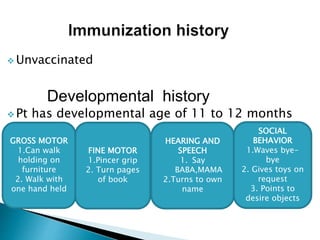
 Unvaccinated
Developmental history
 Pt has developmental age of 11 to 12 months
GROSS MOTOR
1.Can walk
holding on
furniture
2. Walk with
one hand held
FINE MOTOR
1.Pincer grip
2. Turn pages
of book
HEARING AND
SPEECH
1. Say
BABA,MAMA
2.Turns to own
name
SOCIAL
BEHAVIOR
1.Waves bye-
bye
2. Gives toys on
request
3. Points to
desire objects
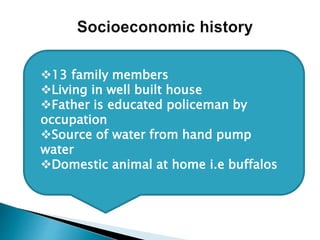
13 family members
Living in well built house
Father is educated policeman by
occupation
Source of water from hand pump
water
Domestic animal at home i.e buffalos
 Oxygen inhalation
 I/V antibiotic
 Antipyretic
 m/v
 Syp zincat
 On child
Decreased appetite
 On parents
Parents are worried about child illness
And have to face socio-economic stress
 GENERAL PHYSICAL EXAMINATION
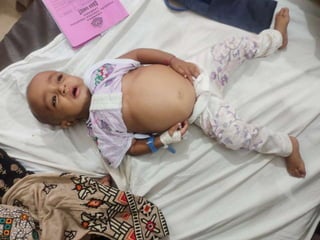
 Child is conscious looking ill with obvious signs of
respiratory distress and abdominal distention having
average built and length without any dysmorphic
features.
VITALS
R/R: 54 Br/Min
H/R 125 Bt/Min
BP: 85/50 (both at 50th centile)
TEMP 101 F
Subvitals:
A+, J-, Cl-, Cy-, E-, D-, LN-, Thyroid not enlarge,
JVP not raised, BCG scar is absent
 Length at (25th centile LFA)
72CM
 WEIGHT at (less than 2 centile WFA)
6.6KG
WFL (<-1SD, >-2SD)
 MUAC
13CM
 OFC at (25th centile)
44CM
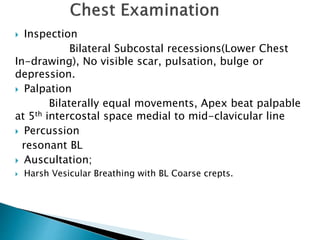
 Inspection
Bilateral Subcostal recessions(Lower Chest
In-drawing), No visible scar, pulsation, bulge or
depression.
 Palpation
Bilaterally equal movements, Apex beat palpable
at 5th intercostal space medial to mid-clavicular line
 Percussion
resonant BL
 Auscultation;
 Harsh Vesicular Breathing with BL Coarse crepts.
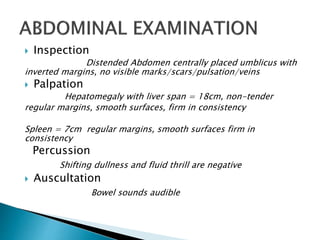
 Inspection
Distended Abdomen centrally placed umblicus with
inverted margins, no visible marks/scars/pulsation/veins
 Palpation
Hepatomegaly with liver span = 18cm, non-tender
regular margins, smooth surfaces, firm in consistency
Spleen = 7cm regular margins, smooth surfaces firm in
consistency
Percussion
Shifting dullness and fluid thrill are negative
 Auscultation
Bowel sounds audible
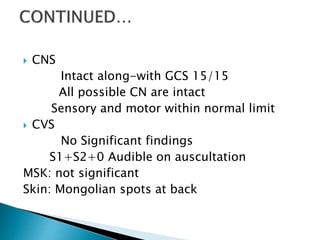
 CNS
Intact along-with GCS 15/15
All possible CN are intact
Sensory and motor within normal limit
 CVS
No Significant findings
S1+S2+0 Audible on auscultation
MSK: not significant
Skin: Mongolian spots at back
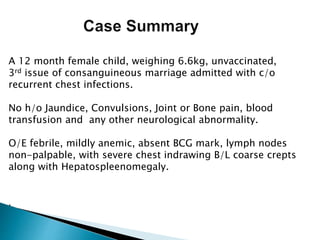
A 12 month female child, weighing 6.6kg, unvaccinated,
3rd issue of consanguineous marriage admitted with c/o
recurrent chest infections.
No h/o Jaundice, Convulsions, Joint or Bone pain, blood
transfusion and any other neurological abnormality.
O/E febrile, mildly anemic, absent BCG mark, lymph nodes
non-palpable, with severe chest indrawing B/L coarse crepts
along with Hepatospleenomegaly.
.
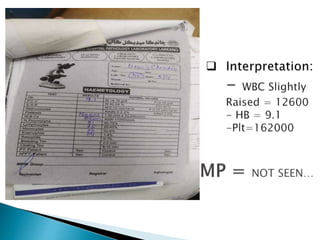
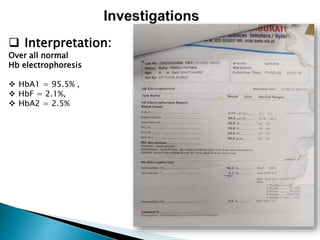
 Interpretation:
Over all normal
Hb electrophoresis
 HbA1 = 95.5% ,
 HbF = 2.1%,
 HbA2 = 2.5%
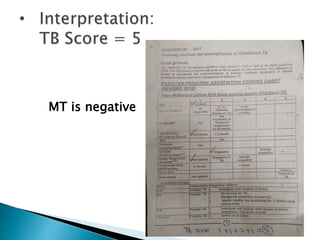
MT is negative
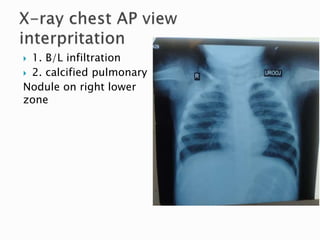
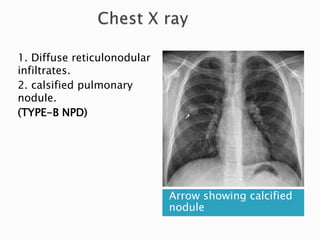
 1. B/L infiltration
 2. calcified pulmonary
Nodule on right lower
zone
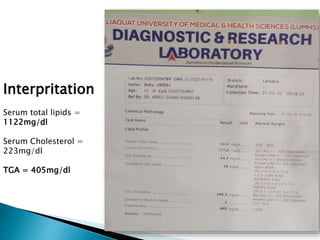
Interpritation
Serum total lipids =
1122mg/dl
Serum Cholesterol =
223mg/dl
TGA = 405mg/dl
 Cherry red spot was not seen
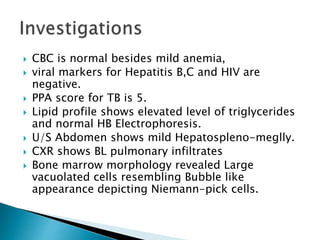
 CBC is normal besides mild anemia,
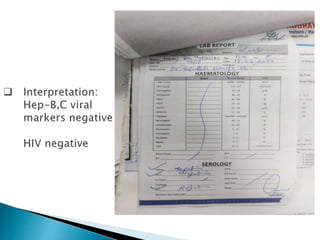
 viral markers for Hepatitis B,C and HIV are
negative.
 PPA score for TB is 5.
 Lipid profile shows elevated level of triglycerides
and normal HB Electrophoresis.
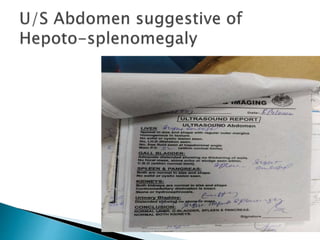
 U/S Abdomen shows mild Hepatospleno-meglly.
 CXR shows BL pulmonary infiltrates
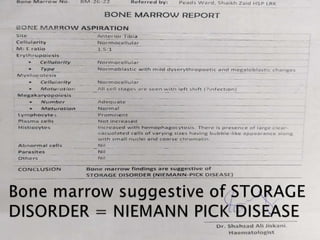
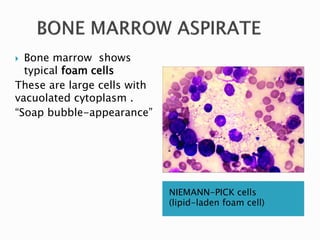
 Bone marrow morphology revealed Large
vacuolated cells resembling Bubble like
appearance depicting Niemann-pick cells.
 Child is suspected Niemann Pick Disease
type-B on the basis of clinical manifestations
and characteristic cells on Bone marrow
report.
 Acid sphingomylinase enzyme activity could
not be seen due to lack of facilities.
 NPD is autosomal recessive LIPID storage
disorder that results from the deficiency of a
lysozomal enzyme ACID SPHINGOMYLINASE.
 Which involves breakdown transport and use
of fats and cholesterol in body.
 Abnormal metabolism causes harmful
amount of lipids to accumulate in the liver,
spleen, lung, bone marrow and Brain.
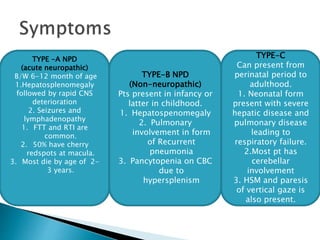
TYPE -A NPD
(acute neuropathic)
B/W 6-12 month of age
1.Hepatosplenomegaly
followed by rapid CNS
deterioration
2. Seizures and
lymphadenopathy
1. FTT and RTI are
common.
2. 50% have cherry
redspots at macula.
3. Most die by age of 2-
3 years.
TYPE-B NPD
(Non-neuropathic)
Pts present in infancy or
latter in childhood.
1. Hepatospenomegaly
2. Pulmonary
involvement in form
of Recurrent
pneumonia
3. Pancytopenia on CBC
due to
hypersplenism
TYPE-C
Can present from
perinatal period to
adulthood.
1. Neonatal form
present with severe
hepatic disease and
pulmonary disease
leading to
respiratory failure.
2.Most pt has
cerebellar
involvement
3. HSM and paresis
of vertical gaze is
also present.
 Deficient activity of Acid sphingomylinase (ASM)
in WBC and cultured skin fibroblasts is diagnostic.
 CBC pancytopenia
 LFTs increase transaminase
 LIPID PROFILE High cholesterol, high triglycerides
 Clinical diagnosis of type-C NPD supported by
filpin stain positivity in cultured cell fibroblasts and
identification of a specific mutation in the NPC1 or
NPC2 gene.
Arrow showing calcified
nodule
1. Diffuse reticulonodular
infiltrates.
2. calsified pulmonary
nodule.
(TYPE-B NPD)
NIEMANN-PICK cells
(lipid-laden foam cell)
 Bone marrow shows
typical foam cells
These are large cells with
vacuolated cytoplasm .
“Soap bubble-appearance”
 Prenatal diagnosis of type A & B by measuring
ASM activity in cultured amniocytes or
chorionic villi.
 pancytopenia
 Respiratory failure
 Cor pulmonale
 Bronchopneumonia
 Cirrhosis, portal hypertension, Ascites
 Prolonged neonatal jaundice
 Psychomotor retardation
 siezures
 No specific treatment is available .
 BONE MARROW TARNSPLANTATION in small
number of type-B NPD patient have been
successful in reducing the sphingomylinase
content of viscera's, Niemann-pick cells in
bone marrow and radiological detected
infiltration of the lung.
 Enzyme replacement therapy with
recombinant human Acid sphingomylinase is
currently in clinical trials for the treatment of
type-B NPD
 MIGLUSTAT has been approved for the
treatment of type-C NPD .
 Treatment of type A NPD has not been
successful because of the severe neurological
involvement
CASE PRESENTATION BY DR ALI SHER_1.pptx

CASE PRESENTATION BY DR ALI SHER_1.pptx

  • 2.
    DR ALI SHER CHANDIO FCPSTRAINEE PAEDES UNIT III
  • 3.
     A 12months old Urooj D/O Mukhtyar Ali , product of consanguineous marriage resident of Nau-Dero admitted in paeds unit iii on 13/07/22 via ER with complaints of  Fever for 3 days  Cough for 3 days  Shortness of breath for 1 day
  • 4.
     According tomother child has history of fever cough from last 3 days and SOB for 1 day. Fever is sudden in onset high grade and intermittent relived by taking antipyretics.  However, fever is Not associated with rigors, chills, rash, ear discharge, sore throat, night sweats and pain in abdomen.
  • 5.
     Cough wasdry, sudden in onset, mild in intensity, associated with shortness of breath, not associated with blood, chest pain, hoarseness of voice, cyanosis and no special time of occurrence, it is not aggravated with feeding.
  • 6.
     GENERAL :decreased appetite and weight loss  CNS: no convulsion, ALOC, weakness  CVS: no cyanosis and edema  Res: having respiratory distress with No wheeze,  GI :no jaundice, vomiting, constipation and diarrhea  GUS: no hematuria and dysuria  ENDO: no neck swelling  MSK: no muscle/bone/joint pain, deformity, swelling, rash
  • 7.
     Patient hasrepeated OPD visits along with 4 time admissions in last 8 months with same complain of fever, cough and shortness of breath, managed as Pneumonia  History of measles 3 month back,  No history of bleeding and blood transfusion  No past surgical history  No allergic history
  • 8.
    Antenatal mother 32 year old Bookedwith 3 times antenatal visits no hx of rash and jaundice not vaccinated Natal baby was delivered by c/section/term/ AGA Post natal not significant .
  • 9.
     Total amountof calories required according to weight at the 12 month of age 1000 k/calories/day.  Current intake about 650 k/calories/day.  biscuit 2, 70k/cal  ½ cup tea 15k/cal  ¼ of chapatti two time/day 25+25 k/cal  mother milk given 8 times/day (80 k/calories)  buffalow milk 2 feeds 40 k/cal  boil potato 80k/cal  boiled egg 80k/cal  boiled rice ¼ 50k/cal  1 banana 110 k/cal 350K/CAL Def:
  • 10.
     Unvaccinated Developmental history Pt has developmental age of 11 to 12 months GROSS MOTOR 1.Can walk holding on furniture 2. Walk with one hand held FINE MOTOR 1.Pincer grip 2. Turn pages of book HEARING AND SPEECH 1. Say BABA,MAMA 2.Turns to own name SOCIAL BEHAVIOR 1.Waves bye- bye 2. Gives toys on request 3. Points to desire objects
  • 12.
    13 family members Livingin well built house Father is educated policeman by occupation Source of water from hand pump water Domestic animal at home i.e buffalos
  • 13.
     Oxygen inhalation I/V antibiotic  Antipyretic  m/v  Syp zincat
  • 14.
     On child Decreasedappetite  On parents Parents are worried about child illness And have to face socio-economic stress
  • 17.
     GENERAL PHYSICALEXAMINATION  Child is conscious looking ill with obvious signs of respiratory distress and abdominal distention having average built and length without any dysmorphic features. VITALS R/R: 54 Br/Min H/R 125 Bt/Min BP: 85/50 (both at 50th centile) TEMP 101 F Subvitals: A+, J-, Cl-, Cy-, E-, D-, LN-, Thyroid not enlarge, JVP not raised, BCG scar is absent
  • 18.
     Length at(25th centile LFA) 72CM  WEIGHT at (less than 2 centile WFA) 6.6KG WFL (<-1SD, >-2SD)  MUAC 13CM  OFC at (25th centile) 44CM
  • 19.
     Inspection Bilateral Subcostalrecessions(Lower Chest In-drawing), No visible scar, pulsation, bulge or depression.  Palpation Bilaterally equal movements, Apex beat palpable at 5th intercostal space medial to mid-clavicular line  Percussion resonant BL  Auscultation;  Harsh Vesicular Breathing with BL Coarse crepts.
  • 20.
     Inspection Distended Abdomencentrally placed umblicus with inverted margins, no visible marks/scars/pulsation/veins  Palpation Hepatomegaly with liver span = 18cm, non-tender regular margins, smooth surfaces, firm in consistency Spleen = 7cm regular margins, smooth surfaces firm in consistency Percussion Shifting dullness and fluid thrill are negative  Auscultation Bowel sounds audible
  • 21.
     CNS Intact along-withGCS 15/15 All possible CN are intact Sensory and motor within normal limit  CVS No Significant findings S1+S2+0 Audible on auscultation MSK: not significant Skin: Mongolian spots at back
  • 22.
    A 12 monthfemale child, weighing 6.6kg, unvaccinated, 3rd issue of consanguineous marriage admitted with c/o recurrent chest infections. No h/o Jaundice, Convulsions, Joint or Bone pain, blood transfusion and any other neurological abnormality. O/E febrile, mildly anemic, absent BCG mark, lymph nodes non-palpable, with severe chest indrawing B/L coarse crepts along with Hepatospleenomegaly. .
  • 26.
     Interpretation: Over allnormal Hb electrophoresis  HbA1 = 95.5% ,  HbF = 2.1%,  HbA2 = 2.5%
  • 27.
  • 28.
     1. B/Linfiltration  2. calcified pulmonary Nodule on right lower zone
  • 32.
    Interpritation Serum total lipids= 1122mg/dl Serum Cholesterol = 223mg/dl TGA = 405mg/dl
  • 33.
     Cherry redspot was not seen
  • 35.
     CBC isnormal besides mild anemia,  viral markers for Hepatitis B,C and HIV are negative.  PPA score for TB is 5.  Lipid profile shows elevated level of triglycerides and normal HB Electrophoresis.  U/S Abdomen shows mild Hepatospleno-meglly.  CXR shows BL pulmonary infiltrates  Bone marrow morphology revealed Large vacuolated cells resembling Bubble like appearance depicting Niemann-pick cells.
  • 36.
     Child issuspected Niemann Pick Disease type-B on the basis of clinical manifestations and characteristic cells on Bone marrow report.  Acid sphingomylinase enzyme activity could not be seen due to lack of facilities.
  • 38.
     NPD isautosomal recessive LIPID storage disorder that results from the deficiency of a lysozomal enzyme ACID SPHINGOMYLINASE.  Which involves breakdown transport and use of fats and cholesterol in body.  Abnormal metabolism causes harmful amount of lipids to accumulate in the liver, spleen, lung, bone marrow and Brain.
  • 39.
    TYPE -A NPD (acuteneuropathic) B/W 6-12 month of age 1.Hepatosplenomegaly followed by rapid CNS deterioration 2. Seizures and lymphadenopathy 1. FTT and RTI are common. 2. 50% have cherry redspots at macula. 3. Most die by age of 2- 3 years. TYPE-B NPD (Non-neuropathic) Pts present in infancy or latter in childhood. 1. Hepatospenomegaly 2. Pulmonary involvement in form of Recurrent pneumonia 3. Pancytopenia on CBC due to hypersplenism TYPE-C Can present from perinatal period to adulthood. 1. Neonatal form present with severe hepatic disease and pulmonary disease leading to respiratory failure. 2.Most pt has cerebellar involvement 3. HSM and paresis of vertical gaze is also present.
  • 40.
     Deficient activityof Acid sphingomylinase (ASM) in WBC and cultured skin fibroblasts is diagnostic.  CBC pancytopenia  LFTs increase transaminase  LIPID PROFILE High cholesterol, high triglycerides  Clinical diagnosis of type-C NPD supported by filpin stain positivity in cultured cell fibroblasts and identification of a specific mutation in the NPC1 or NPC2 gene.
  • 41.
    Arrow showing calcified nodule 1.Diffuse reticulonodular infiltrates. 2. calsified pulmonary nodule. (TYPE-B NPD)
  • 42.
    NIEMANN-PICK cells (lipid-laden foamcell)  Bone marrow shows typical foam cells These are large cells with vacuolated cytoplasm . “Soap bubble-appearance”
  • 43.
     Prenatal diagnosisof type A & B by measuring ASM activity in cultured amniocytes or chorionic villi.
  • 44.
     pancytopenia  Respiratoryfailure  Cor pulmonale  Bronchopneumonia  Cirrhosis, portal hypertension, Ascites  Prolonged neonatal jaundice  Psychomotor retardation  siezures
  • 45.
     No specifictreatment is available .  BONE MARROW TARNSPLANTATION in small number of type-B NPD patient have been successful in reducing the sphingomylinase content of viscera's, Niemann-pick cells in bone marrow and radiological detected infiltration of the lung.
  • 46.
     Enzyme replacementtherapy with recombinant human Acid sphingomylinase is currently in clinical trials for the treatment of type-B NPD  MIGLUSTAT has been approved for the treatment of type-C NPD .  Treatment of type A NPD has not been successful because of the severe neurological involvement

Editor's Notes

  • #9 unevenful
  • #14 jhasbdkjskjs
  • #15 One of consultatnt has told there is no cure of disease
  • #22 Rest of examination is unremarkable