UPPER LIMB ORTHOSIS
-
Contents:
 Introduction
 Objectives of upper limb orthosis
 Nomenclature
 Classification
 Biomechanics of orthosis
 General principles
 Special principles
 Assessment of upper limb
orthosis
 Description of upper limb
orthosis
 Recent advances
Introduction
 Mechanical device- anatomical
and functional position
 Orthos – to correct or maintain
straight
 Any externally device used to modify
structural and functional characteristics
of the neuromuscular skeletal system
 Physiotherapist + orthotist
 Categorized :
- Upper limb
orthosis
- Trunk orthosis
- Lower limb
orthosis
 Objectives of upper limb
orthosis:
1) Protection :
- stabilization
- Dynamic control
2)Correction
3)Assistance
 To immobilize a body part to promote
tissue healing
 Prevent contractures
 Increase ROM
 Correct deformities
 Strengthen muscles
 Reduce tone
 Reduce pain
 Restrict motion to prevent harmful
postures
Nomenclature :
 On basis of
- joint they cover
- the function they provide
- condition they treat
- by appearance
- name of the person who designed
them
 Mainly three systems:
1)International Organization for
Standards(ISO) which gives anatomic region
wise names
2)1992, American Society of Hand Therapists
published ASHT splint classification system
(SCS) which gives function and body part
wise.
In that, numbering system – ‘type’
3)McKee and Morgan
Common name ASHT splint
classificatio
n system
IOS McKee
and
Morgan
Humeral fracture
brace
Non articular
splints- humerus
Not applicable Circumferential
non-articular
humerus
stabilizing
Tennis elbow
splints or
brace
45 degree
elbow flexion
immobilization
type 1[1]
Shoulder- elbow
– wrist – hand
orthosis
Circumferential
non-articular
proximal
forearm strap
Duran splint,
post operative
flexor tendon
splint
Wrist and
finger flexion
immobilization;
type 0[4]
WHO Dorsal forearm
based static MCP-
IP protective
flexion and MCP
extension
blocking orthosis
Thumb spica splint Thumb MCP
extension
immobilizatio
n type 2[3]
WHFO Volar forearm-
based static
wrist thumb
orthosis
Classification :
 On basis of anatomical
regions:
- Shoulder and arm orthosis
- Elbow orthosis
- Wrist orthosis
- Hand orthosis
 Based on function:
- Supportive
- Functional
- Corrective
- Protective
- Prevent substitution of
function
- Prevent weight bearing
- Relief of pain
 Based on design:
- non-articular
- Static
- Serial static
- Static motion-blocking
- Static progressive
- Dynamic
- Dynamic motion-blocking
- Dynamic traction splints
- Tenodesis
- Continuous passive motion
orthoses
- Adaptive or functional usage
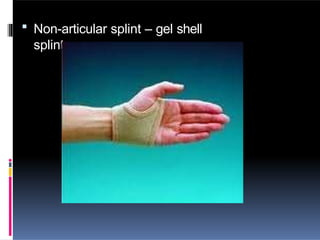
 Non-articular splint – gel shell
splint
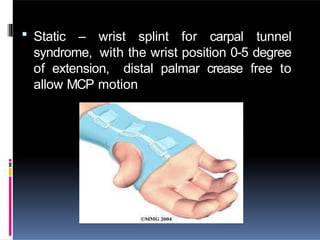
 Static – wrist splint for carpal tunnel
syndrome, with the wrist position 0-5 degree
of extension, distal palmar crease free to
allow MCP motion
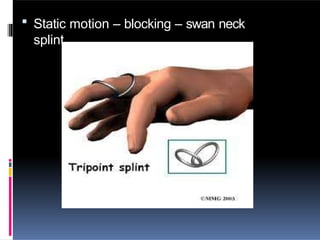
 Static motion – blocking – swan neck
splint
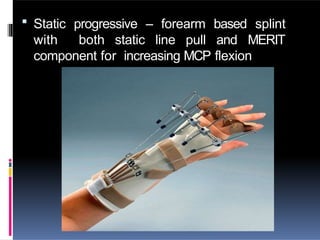
 Static progressive – forearm based splint
with both static line pull and MERIT
component for increasing MCP flexion
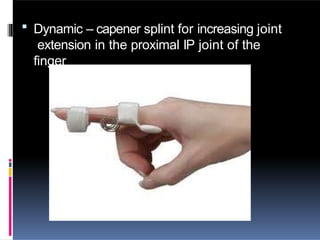
 Dynamic – capener splint for increasing joint
extension in the proximal IP joint of the
finger
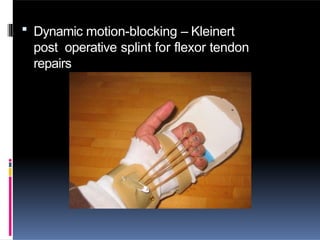
 Dynamic motion-blocking – Kleinert
post operative splint for flexor tendon
repairs
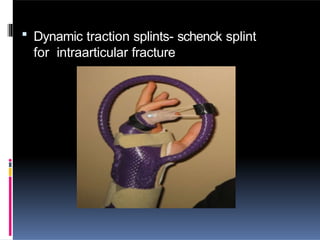
 Dynamic traction splints- schenck splint
for intraarticular fracture
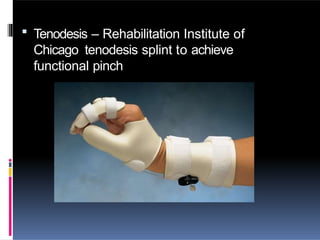
 Tenodesis – Rehabilitation Institute of
Chicago tenodesis splint to achieve
functional pinch
Description of orthoses:
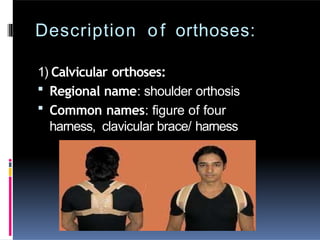
1) Calvicular orthoses:
 Regional name: shoulder orthosis
 Common names: figure of four
harness, clavicular brace/ harness
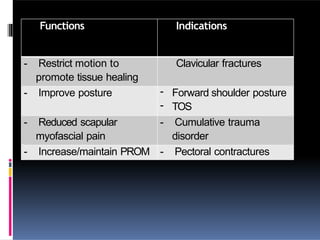
Functions Indications
- Restrict motion to
promote tissue healing
Clavicular fractures
- Improve posture - Forward shoulder posture
- TOS
- Reduced scapular
myofascial pain
- Cumulative trauma
disorder
- Increase/maintain PROM - Pectoral contractures
 Placement :
- Material goes over clavicles, under arms and
crosses over high thoracic spinous
processes.
 Biomechanical efficacy:
- Restrict movement of the clavicle and to
some extent inhibit scapular protraction
while allowing free movement at the GH
joint.
 Materials :
-Webbing straps
- Padding and velcro
- Prefabricated orthoses often used.
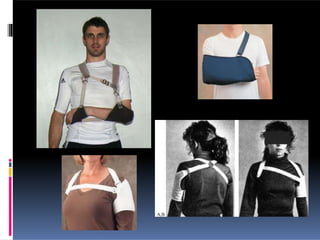
2) Arm sling
 Regional name: shoulder orthosis
 Common names:
 figure of eight slings
 universal sling
 Nothern ring sling
 Cuff sling
 Hemi sling
 Orthopaedic sling
 Flail arm sling
 Homemade Bandanna- Type sling
 Glenohumeral support
 Hook hemiharness
 Rolyan hemi Arm sling(vertical arm
sling)
Functions indications
- Immobilize to promote tissue
healing
- AC joint injury
- Scapular, humeral fractures
- PO shoulder repair/arthroplasty
- PO tendon,artery, or nerve repairs
- Rotator cuff injury
- Bicipital tendinitis
- Prevent overstretching of GH
musculature/ligaments
- Brachial plexus lesion
- Decreased shoulder pain related
to arm distraction and
shoulder- hand syndrome
- Upper motor neuron lesion:
hemiparesis with subluxation
- Keep hand and forearm elevated
to reduce oedema
 Placement :
 Most slings support the forearm with the
elbow flexed, shoulder internally rotated and
arm adducted.
-The Rolyan hemi arm sling supports the
humerus and allows the elbow and forearm to
be free by using a humeral cuff with figure of
eight suspension.
-The hook hemiharness has two humeral cuffs
connected by a posterior yoke and abduct
each arm slightly while allowing the elbow
and forearm to be free.
 Biomechanical efficacy :
- Slings may be static or dynamic.
- Dynamic slings use elastic straps and are
designed to allow some motion of the
forearm while supporting the arm.
-The wrist should be supported by the sling
to prevent wrist drop if there is distal
weakness.
- Hand should be higher than the elbow
to decrease the oedema.
- Care must be taken to mobilize the shoulder
SOS possible to prevent adhesive capsulitis.
 Materials :
-Cloth
-Webbing
- Elastic
- Metal ring/ fastners
-Velcro
- Prefabricated slings are often
used.
 Contraindications:
- Slings have fallen over out of favour with a
neurodevelopment treatment approach to UMN
lesion because they are thought to encourage
flexion synergy, increase flexor tone, and
promote contractures.
-The Rolyan hemi arm slings or the hook
hemiharness may not approximate the GH
joint in a large patient.
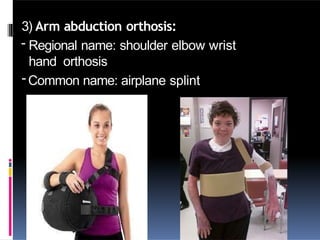
3) Arm abduction orthosis:
- Regional name: shoulder elbow wrist
hand orthosis
- Common name: airplane splint
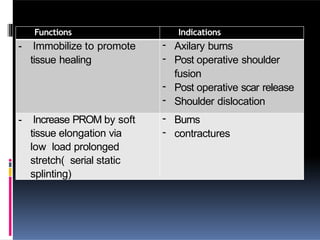
Functions Indications
- Immobilize to promote
tissue healing
- Axilary burns
- Post operative shoulder
fusion
- Post operative scar release
- Shoulder dislocation
- Increase PROM by soft
tissue elongation via
low load prolonged
stretch( serial static
splinting)
- Burns
- contractures
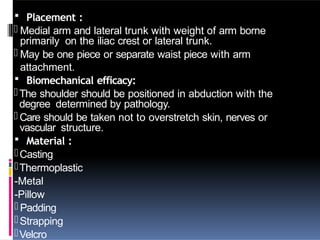
 Placement :
- Medial arm and lateral trunk with weight of arm borne
primarily on the iliac crest or lateral trunk.
- May be one piece or separate waist piece with arm
attachment.
 Biomechanical efficacy:
-The shoulder should be positioned in abduction with the
degree determined by pathology.
- Care should be taken not to overstretch skin, nerves or
vascular structure.
 Material :
-Casting
-Thermoplastic
-Metal
-Pillow
- Padding
-Strapping
-Velcro
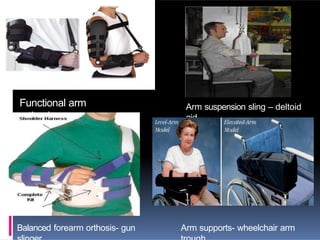
Functional arm
orthosis
Arm suspension sling – deltoid
aid
Balanced forearm orthosis- gun Arm supports- wheelchair arm
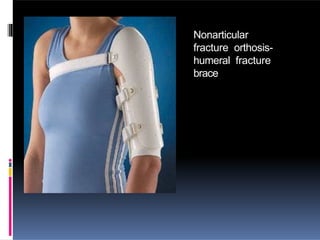
Nonarticular
fracture orthosis-
humeral fracture
brace
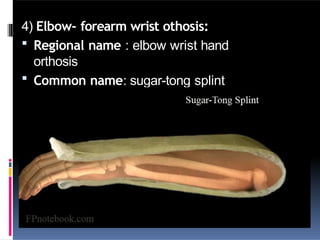
4) Elbow- forearm wrist othosis:
 Regional name : elbow wrist hand
orthosis
 Common name: sugar-tong splint
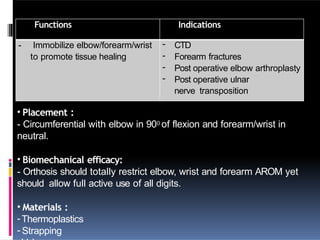
Functions Indications
- Immobilize elbow/forearm/wrist
to promote tissue healing
- CTD
- Forearm fractures
- Post operative elbow arthroplasty
- Post operative ulnar
nerve transposition
• Placement :
- Circumferential with elbow in 900 of flexion and forearm/wrist in
neutral.
• Biomechanical efficacy:
- Orthosis should totally restrict elbow, wrist and forearm AROM yet
should allow full active use of all digits.
• Materials :
-Thermoplastics
- Strapping
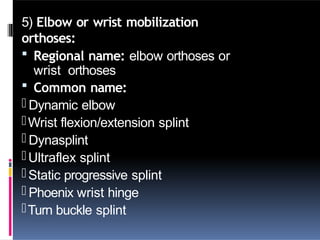
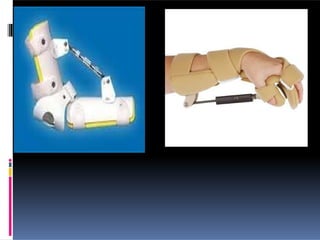
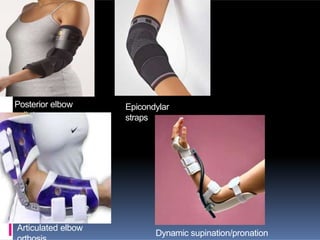
5) Elbow or wrist mobilization
orthoses:
 Regional name: elbow orthoses or
wrist orthoses
 Common name:
- Dynamic elbow
-Wrist flexion/extension splint
- Dynasplint
-Ultraflex splint
-Static progressive splint
- Phoenix wrist hinge
-Turn buckle splint
Functions Indications
- Increased PROM by soft tissue - Contracture
elongation via low-load prolonged - Post operative scar release
stretch - Burns
- Fracture (late phase)
- Replace or assist weak wrist - Radial nerve lesion
extensors to enhance ADL - Spinal cord injury
- Brachial plexus lesion
- polio
Placement :
•Dorsal (posterior), volar (anterior) or
circumferential
 Biomechanical efficacy:
 Two distinct methods can be used to stretch soft tissue,
thereby encouraging tissue elongation and increased PROM.
1) Serial splinting:
- With low temperature thermoplastics (progressive static splinting)
or serial casting.
 Advantages: good conformity, little shifting
 Disadvantage : potential skin breakdown
2) Traction :
 (via elastics, coils, or springs) is applied across the joint(often a
hinged
joint)
 Advantage : amount of load can be adjusted
 Disadvantage: forces can cause shifting of orthosis such splints
are more difficult to fabricate unless prefabrications are used.
 Non compliant patients can remove the orthosis.
 Materials:
-Casting
-Thermoplastics
- Elastics
- Neoprene
- Metal
-Strapping
-Velcro
-Springs
 Contraindications:
- Dynamic traction put on muscles with high tone
may increase tone.
Posterior elbow
splint
Epicondylar
straps
Articulated elbow
Dynamic supination/pronation
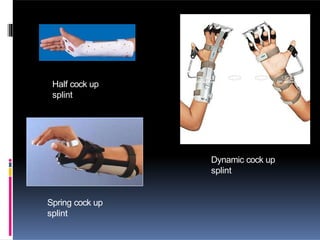
6) Forearm-wrist orthosis:
 Regional name: wrist-hand orthosis
 common name:
- Thumb whole wrist cock up splint
- Wrist extension splint
- Static wrist splint
- Bunnell dorsal wrist splint
- Bunnell spring cock up splint
- Serpentine splint
- Neoprene or leather prefabricated wrist
extension splint
- Gutter splint
Dynamic cock up
splint
Half cock up
splint
Spring cock up
splint
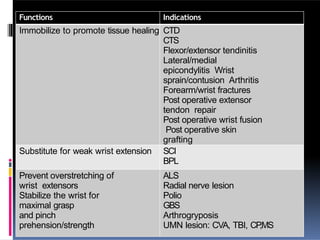
Functions Indications
Immobilize to promote tissue healing CTD
CTS
Flexor/extensor tendinitis
Lateral/medial
epicondylitis Wrist
sprain/contusion Arthritis
Forearm/wrist fractures
Post operative extensor
tendon repair
Post operative wrist fusion
Post operative skin
grafting
Substitute for weak wrist extension SCI
BPL
Prevent overstretching of
wrist extensors
Stabilize the wrist for
maximal grasp
and pinch
prehension/strength
ALS
Radial nerve lesion
Polio
GBS
Arthrogryposis
UMN lesion: CVA, TBI, CP
,MS
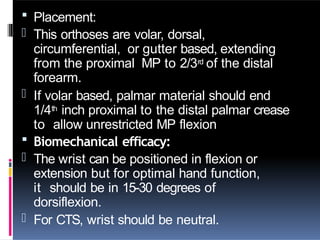
Immobilize wrist / forearm
to maintain PROM
Restrict motion to prevent
harmful wrist postures during
activities
-Burns
-Post operative scar release
-CTD
- arthritis
Elongate soft tissue via low-
load prolonged stretch( serial
static splinting)
-Burns
- wrist contractures
 Placement:
- This orthoses are volar, dorsal,
circumferential, or gutter based, extending
from the proximal MP to 2/3rd of the distal
forearm.
- If volar based, palmar material should end
1/4th inch proximal to the distal palmar crease
to allow unrestricted MP flexion
 Biomechanical efficacy:
- The wrist can be positioned in flexion or
extension but for optimal hand function,
it should be in 15-30 degrees of
dorsiflexion.
- For CTS, wrist should be neutral.
 Materials:
- Rigid: metal, thermoplastics, casting,
straping, velcro
- Flexible: neoprene leather, plastics,
fabric, strapping, velcro
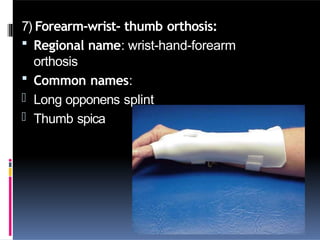
7) Forearm-wrist- thumb orthosis:
 Regional name: wrist-hand-forearm
orthosis
 Common names:
- Long opponens splint
- Thumb spica
Functions Indications
Immobilize thumb/wrist to
promote tissue healing
-CMC/MP synovitis/ arthritis
-CTD
- de Queryain’s disease
-Tenosynovitis
-Thenar tendinitis
-Thumb sprain
-CMC/MP collatral ligament
injury( gamekeeper’s thumb)
-Scaphoid/ thumb fracture
-Post operative thumb
- ORIF
- Surgical CMC/MP fusion
- arthroplasty or
reconstruction
- tendon transfer
- tendon/ligament repair
- nerve repair
- postoperative
trapeziumectomy
Substitute for weak thumb
muscles, stabilize thumb in
opposition for three jaw chuck
Median/ ulnar nerve lesion
UMN lesion: CVA, TBI, CP
Maintain thumb prom burns
Restrict motion to prevent harmful
thumb positions during activities
CTD
Arthritis
Athletes or performing artists
Elongate soft tissues via low-load,
prolonged stretch (serial static
splinting)
-Burns
-Thumb contractures
• Placement :
- The orthotic material usually cover 2/3rd of the distal radial
forearm and surrounds the thumb to the IP ( but can extend to
tip)
 Biomechanical efficacy:
- In most cases, the thumb should be positioned
in palmar abduction so that three jaw chuck
prehension is easily achieved , unless
pathology dictates otherwise.
- Material should not restrict motion of digits 2-
5.
 Materials :
- rigid: thermoplastics, metal, strapping,
velcro, casting, padding
- Flexible: neoprene, elastics, fabric,
leather, strapping, velcro
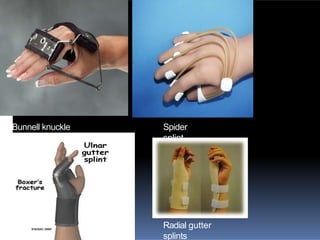
Bunnell knuckle
bender
Spider
splint
Radial gutter
splints
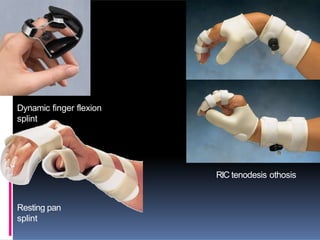
Dynamic finger flexion
splint
RIC tenodesis othosis
Resting pan
splint
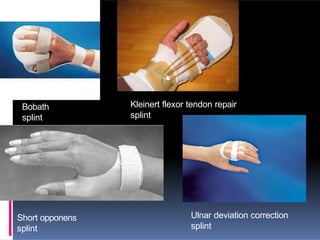
Bobath
splint
Kleinert flexor tendon repair
splint
Short opponens
splint
Ulnar deviation correction
splint
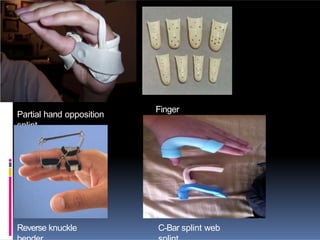
Partial hand opposition
splint
Finger
orthosis
Reverse knuckle C-Bar splint web
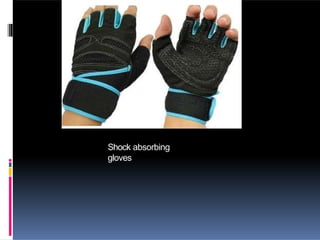
Shock absorbing
gloves
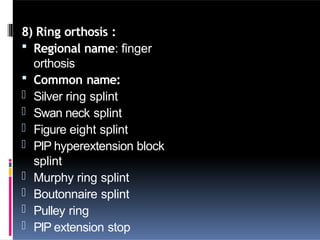
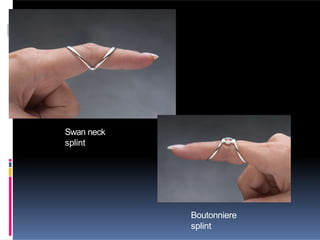
8) Ring orthosis :
 Regional name: finger
orthosis
 Common name:
- Silver ring splint
- Swan neck splint
- Figure eight splint
- PIP hyperextension block
splint
- Murphy ring splint
- Boutonnaire splint
- Pulley ring
- PIP extension stop
Swan neck
splint
Boutonniere
splint
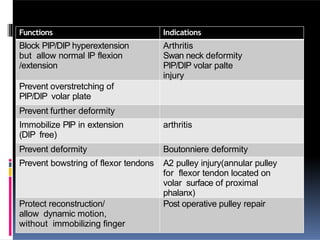
Functions Indications
Block PIP/DIP hyperextension
but allow normal IP flexion
/extension
Arthritis
Swan neck deformity
PIP/DIP volar palte
injury
Prevent overstretching of
PIP/DIP volar plate
Prevent further deformity
Immobilize PIP in extension
(DIP free)
arthritis
Prevent deformity Boutonniere deformity
Prevent bowstring of flexor tendons A2 pulley injury(annular pulley
for flexor tendon located on
volar surface of proximal
phalanx)
Protect reconstruction/
allow dynamic motion,
without immobilizing finger
Post operative pulley repair
 Biomechanical efficacy:
-Rings are custom fitted and worn at all
time. swan neck splint:
- Prevent IP hyperextension via three points
of pressure but allows full IP flexion.
- Lateral or distal supports may be added
for stability.
boutonniere splint:
- Immobilize the IP in extension via three points
of pressure. Needs to remove several times in
a day.
 A2 pulley ring:
- Fits firmly around the proximal phalanx from
the PIP volar crease to the MP volar crease.
 Materials :
- Metal
- thermoplastics
Recent advances:
1) Ibrahim M et al. did study on Efficacy
of a static progressive stretch device
as an adjunct to physical therapy in
treating adhesive capsulitis of the
shoulder: a prospective, randomised
study
 To compare a static progressive stretch
device plus traditional therapy with
traditional therapy alone for the treatment
of adhesive capsulitis of the shoulder
 CONCLUSION:
 Use of a static progressive stretch device in
combination with traditional therapy
appears to have beneficial long-term effects
onshoulder range of motion, pain and
functional outcomes in patients with
adhesive capsulitis of the shoulder. At 12-
month follow-up, the experimental group
had continued to improve, while the control
group had relapsed.
 Physiotherapy. 2013 Oct 3. pii:
S0031- 9406(13)00085-0.
2) Merolla G et al.did study on Efficacy,
usability and tolerability of a dynamic
elbow orthosis after collateral ligament
reconstruction: a prospective
randomized study.
 To assess the efficacy, usability and
tolerability of a dynamic orthosis
compared with a standard plaster splint
after the reconstruction of elbow medial
or lateral collateral ligaments (MCL, LCL).
 CONCLUSIONS:
 The dynamic orthosis and the plaster splint
both provided effective and safe elbow
immobilization after MCL or LCL
reconstruction. The orthosis provided
greater pain reduction, faster recovery of
muscle trophism and grip strength, and was
better tolerated.
 Musculoskelet Surg. 2013 Oct 25.
3) Garg R et al.did study on A prospective
randomized study comparing a
forearm strap brace versus a wrist
splint for the treatment of lateral
epicondylitis.
 To compare the clinical outcomes of a
wrist splint with that of a counterforce
forearm strap for the management of
acute lateral epicondylitis.
 CONCLUSION:
 The wrist extension splint allows a
greater degree of pain relief than does
the forearm strap brace for patients with
lateral epicondylitis.
 JShoulder Elbow Surg. 2010
Jun;19(4):508- 12.
4) Woo Y et al.did study on Kinematics
variations after spring-assisted orthosis
training in persons with stroke.
 To evaluate the efficacy of training
using kinematic parameters after a
SaeboFlex orthosis training on chronic
stroke patients.
 CONCLUSION:
 The results of this study indicate that a
SaeboFlex training is effective in recovering
the movement of the hemiparetic upper
extremity of patients after stroke.
 Prosthet Orthot Int. 2013 Aug;37(4):311-6.
5) Forogh B et al.did study on The effects
of a new designed forearm orthosis in
treatment of lateral epicondylitis.
 on the design and testing of a new
designed forearm orthosis and explores its
efficacious in comparison to the standard
counterforce orthosis in patients with
lateral epicondylitis.
 CONCLUSIONS:
 The new-designed orthosis can significantly
relieve pain, improve function, increase pain
threshold and grip strength after
application. This orthosis seemed to be
more effective than counterforce orthosis
in relieving pain and increasing the pain
threshold probably due to the limitation of
forearm supination.
 Disabil Rehabil Assist Technol.
2012 Jul;7(4):336-9.
6) Chang M et al. did study on Comparison of
Task Performance, Hand Power, and
Dexterity with and without a Cock-up
Splint.
 Men's grip power with the cock-up splint was
found to be significantly decreased compared
to without the splint. Women's grip and
palmar pinch strength with the splint
decreased significantly compared to without
the splint. In the grooved pegboard test, the
dexterity of both men and women with the
cock-up splint decreased significantly
compared to without the splint
 Conclusion:
 To assist patients to make wise decisions
regarding the use of splints, occupational
therapists must have empirical knowledge
of the topic as well as an understanding of
the theoretical, technical, and related
research evidence.
 J Phys Ther Sci. 2013 Nov;25(11):1429-31
7) Whelan DB et al did study on External
Rotation Immobilization for Primary
Shoulder Dislocation: A Randomized
Controlled Trial.
 To compare the (1) frequency of recurrent
instability and (2) disease-specific quality-
of- life scores after treatment of first-time
shoulder dislocation using either
immobilization in external rotation or
immobilization in internal rotation in a
group of young patients.
 CONCLUSIONS:
 Despite previous published findings, our
results show immobilization in external
rotation did not confer a significant benefit
versus sling immobilization in the
prevention of recurrent instability after
primary anterior shoulder dislocation.
 Clin Orthop Relat Res. 2014 Jan 3.
References:
 S Sunder; Text book of rehabilitation;
second edition ; pg no:103-130
 Orthotics: a complete clinical
approach SLACK
 P
. Bowker; biomechanical basis of
othotic management; pg no: 27-37
 John B. Redford, John V. Basmajian,
Paul Trautman orthotics: clinical
practice and rehabilitation technology;
pg no: 103- 130
 Randall L.Braddom ; physical medicine
and rehabilitation: third edition; pg no:
325-341
 Joel A. Delisa ; rehabilitation medicine
principles and practice; third edition; pg
no: 635-651
 Jan stephen tecklin ; pediatric
physical therapy; second edition
 ) Whelan DB et al. External Rotation
Immobilization for Primary Shoulder
Dislocation: A Randomized Controlled
Trial Clin Orthop Relat Res. 2014 Jan 3
 Ibrahim M et al. ; Efficacy of a static
progressive stretch device as an adjunct
to physical therapy in treating adhesive
capsulitis of the shoulder: a prospective,
randomised study ; Physiotherapy. 2013
Oct 3. pii: S0031-9406(13)00085-0.
 ) Merolla G et al.; Efficacy, usability
and tolerability of a dynamic
elbow orthosis after collateral ligament
reconstruction: a prospective
randomized study; Musculoskelet Surg.
2013 Oct 25.
 Garg R et al.; A prospective
randomized study comparing a
forearm strap brace versus a wrist
splint for the treatment of lateral
epicondylitis ; JShoulder Elbow Surg.
2010 Jun;19(4):508-12.
 Woo Y et al.; Kinematics variations after
spring-assisted orthosis training in
persons with stroke; Prosthet Orthot Int.
2013 Aug;37(4):311-6.
 Forogh B et al.The effects of a new
designed forearm orthosis in treatment of
lateral epicondylitis; Disabil Rehabil Assist
Technol. 2012 Jul;7(4):336-9.
 Chang M et al. ;Comparison of Task
Performance, Hand Power, and
Dexterity with and without a Cock-up
Splint ; J Phys Ther Sci. 2013
Nov;25(11):1429-31
 www.ottobock.com
Thank
you

516042491-upper-limb-orthosis000000.pptx

  • 1.
  • 2.
    Contents:  Introduction  Objectivesof upper limb orthosis  Nomenclature  Classification  Biomechanics of orthosis  General principles  Special principles  Assessment of upper limb orthosis  Description of upper limb orthosis  Recent advances
  • 3.
    Introduction  Mechanical device-anatomical and functional position  Orthos – to correct or maintain straight  Any externally device used to modify structural and functional characteristics of the neuromuscular skeletal system  Physiotherapist + orthotist
  • 4.
     Categorized : -Upper limb orthosis - Trunk orthosis - Lower limb orthosis
  • 5.
     Objectives ofupper limb orthosis: 1) Protection : - stabilization - Dynamic control 2)Correction 3)Assistance
  • 6.
     To immobilizea body part to promote tissue healing  Prevent contractures  Increase ROM  Correct deformities  Strengthen muscles  Reduce tone  Reduce pain  Restrict motion to prevent harmful postures
  • 7.
    Nomenclature :  Onbasis of - joint they cover - the function they provide - condition they treat - by appearance - name of the person who designed them
  • 8.
     Mainly threesystems: 1)International Organization for Standards(ISO) which gives anatomic region wise names 2)1992, American Society of Hand Therapists published ASHT splint classification system (SCS) which gives function and body part wise. In that, numbering system – ‘type’ 3)McKee and Morgan
  • 9.
    Common name ASHTsplint classificatio n system IOS McKee and Morgan Humeral fracture brace Non articular splints- humerus Not applicable Circumferential non-articular humerus stabilizing Tennis elbow splints or brace 45 degree elbow flexion immobilization type 1[1] Shoulder- elbow – wrist – hand orthosis Circumferential non-articular proximal forearm strap Duran splint, post operative flexor tendon splint Wrist and finger flexion immobilization; type 0[4] WHO Dorsal forearm based static MCP- IP protective flexion and MCP extension blocking orthosis Thumb spica splint Thumb MCP extension immobilizatio n type 2[3] WHFO Volar forearm- based static wrist thumb orthosis
  • 10.
    Classification :  Onbasis of anatomical regions: - Shoulder and arm orthosis - Elbow orthosis - Wrist orthosis - Hand orthosis
  • 11.
     Based onfunction: - Supportive - Functional - Corrective - Protective - Prevent substitution of function - Prevent weight bearing - Relief of pain
  • 12.
     Based ondesign: - non-articular - Static - Serial static - Static motion-blocking - Static progressive - Dynamic - Dynamic motion-blocking - Dynamic traction splints - Tenodesis - Continuous passive motion orthoses - Adaptive or functional usage
  • 13.
     Non-articular splint– gel shell splint
  • 14.
     Static –wrist splint for carpal tunnel syndrome, with the wrist position 0-5 degree of extension, distal palmar crease free to allow MCP motion
  • 15.
     Static motion– blocking – swan neck splint
  • 16.
     Static progressive– forearm based splint with both static line pull and MERIT component for increasing MCP flexion
  • 17.
     Dynamic –capener splint for increasing joint extension in the proximal IP joint of the finger
  • 18.
     Dynamic motion-blocking– Kleinert post operative splint for flexor tendon repairs
  • 19.
     Dynamic tractionsplints- schenck splint for intraarticular fracture
  • 20.
     Tenodesis –Rehabilitation Institute of Chicago tenodesis splint to achieve functional pinch
  • 21.
    Description of orthoses: 1)Calvicular orthoses:  Regional name: shoulder orthosis  Common names: figure of four harness, clavicular brace/ harness
  • 22.
    Functions Indications - Restrictmotion to promote tissue healing Clavicular fractures - Improve posture - Forward shoulder posture - TOS - Reduced scapular myofascial pain - Cumulative trauma disorder - Increase/maintain PROM - Pectoral contractures
  • 23.
     Placement : -Material goes over clavicles, under arms and crosses over high thoracic spinous processes.  Biomechanical efficacy: - Restrict movement of the clavicle and to some extent inhibit scapular protraction while allowing free movement at the GH joint.  Materials : -Webbing straps - Padding and velcro - Prefabricated orthoses often used.
  • 24.
    2) Arm sling Regional name: shoulder orthosis  Common names:  figure of eight slings  universal sling  Nothern ring sling  Cuff sling  Hemi sling  Orthopaedic sling  Flail arm sling  Homemade Bandanna- Type sling  Glenohumeral support  Hook hemiharness  Rolyan hemi Arm sling(vertical arm sling)
  • 26.
    Functions indications - Immobilizeto promote tissue healing - AC joint injury - Scapular, humeral fractures - PO shoulder repair/arthroplasty - PO tendon,artery, or nerve repairs - Rotator cuff injury - Bicipital tendinitis - Prevent overstretching of GH musculature/ligaments - Brachial plexus lesion - Decreased shoulder pain related to arm distraction and shoulder- hand syndrome - Upper motor neuron lesion: hemiparesis with subluxation - Keep hand and forearm elevated to reduce oedema
  • 27.
     Placement : Most slings support the forearm with the elbow flexed, shoulder internally rotated and arm adducted. -The Rolyan hemi arm sling supports the humerus and allows the elbow and forearm to be free by using a humeral cuff with figure of eight suspension. -The hook hemiharness has two humeral cuffs connected by a posterior yoke and abduct each arm slightly while allowing the elbow and forearm to be free.
  • 28.
     Biomechanical efficacy: - Slings may be static or dynamic. - Dynamic slings use elastic straps and are designed to allow some motion of the forearm while supporting the arm. -The wrist should be supported by the sling to prevent wrist drop if there is distal weakness. - Hand should be higher than the elbow to decrease the oedema. - Care must be taken to mobilize the shoulder SOS possible to prevent adhesive capsulitis.
  • 29.
     Materials : -Cloth -Webbing -Elastic - Metal ring/ fastners -Velcro - Prefabricated slings are often used.
  • 30.
     Contraindications: - Slingshave fallen over out of favour with a neurodevelopment treatment approach to UMN lesion because they are thought to encourage flexion synergy, increase flexor tone, and promote contractures. -The Rolyan hemi arm slings or the hook hemiharness may not approximate the GH joint in a large patient.
  • 31.
    3) Arm abductionorthosis: - Regional name: shoulder elbow wrist hand orthosis - Common name: airplane splint
  • 32.
    Functions Indications - Immobilizeto promote tissue healing - Axilary burns - Post operative shoulder fusion - Post operative scar release - Shoulder dislocation - Increase PROM by soft tissue elongation via low load prolonged stretch( serial static splinting) - Burns - contractures
  • 33.
     Placement : -Medial arm and lateral trunk with weight of arm borne primarily on the iliac crest or lateral trunk. - May be one piece or separate waist piece with arm attachment.  Biomechanical efficacy: -The shoulder should be positioned in abduction with the degree determined by pathology. - Care should be taken not to overstretch skin, nerves or vascular structure.  Material : -Casting -Thermoplastic -Metal -Pillow - Padding -Strapping -Velcro
  • 34.
    Functional arm orthosis Arm suspensionsling – deltoid aid Balanced forearm orthosis- gun Arm supports- wheelchair arm
  • 35.
  • 36.
    4) Elbow- forearmwrist othosis:  Regional name : elbow wrist hand orthosis  Common name: sugar-tong splint
  • 37.
    Functions Indications - Immobilizeelbow/forearm/wrist to promote tissue healing - CTD - Forearm fractures - Post operative elbow arthroplasty - Post operative ulnar nerve transposition • Placement : - Circumferential with elbow in 900 of flexion and forearm/wrist in neutral. • Biomechanical efficacy: - Orthosis should totally restrict elbow, wrist and forearm AROM yet should allow full active use of all digits. • Materials : -Thermoplastics - Strapping
  • 38.
    5) Elbow orwrist mobilization orthoses:  Regional name: elbow orthoses or wrist orthoses  Common name: - Dynamic elbow -Wrist flexion/extension splint - Dynasplint -Ultraflex splint -Static progressive splint - Phoenix wrist hinge -Turn buckle splint
  • 40.
    Functions Indications - IncreasedPROM by soft tissue - Contracture elongation via low-load prolonged - Post operative scar release stretch - Burns - Fracture (late phase) - Replace or assist weak wrist - Radial nerve lesion extensors to enhance ADL - Spinal cord injury - Brachial plexus lesion - polio Placement : •Dorsal (posterior), volar (anterior) or circumferential
  • 41.
     Biomechanical efficacy: Two distinct methods can be used to stretch soft tissue, thereby encouraging tissue elongation and increased PROM. 1) Serial splinting: - With low temperature thermoplastics (progressive static splinting) or serial casting.  Advantages: good conformity, little shifting  Disadvantage : potential skin breakdown 2) Traction :  (via elastics, coils, or springs) is applied across the joint(often a hinged joint)  Advantage : amount of load can be adjusted  Disadvantage: forces can cause shifting of orthosis such splints are more difficult to fabricate unless prefabrications are used.  Non compliant patients can remove the orthosis.
  • 42.
     Materials: -Casting -Thermoplastics - Elastics -Neoprene - Metal -Strapping -Velcro -Springs  Contraindications: - Dynamic traction put on muscles with high tone may increase tone.
  • 43.
  • 44.
    6) Forearm-wrist orthosis: Regional name: wrist-hand orthosis  common name: - Thumb whole wrist cock up splint - Wrist extension splint - Static wrist splint - Bunnell dorsal wrist splint - Bunnell spring cock up splint - Serpentine splint - Neoprene or leather prefabricated wrist extension splint - Gutter splint
  • 45.
    Dynamic cock up splint Halfcock up splint Spring cock up splint
  • 46.
    Functions Indications Immobilize topromote tissue healing CTD CTS Flexor/extensor tendinitis Lateral/medial epicondylitis Wrist sprain/contusion Arthritis Forearm/wrist fractures Post operative extensor tendon repair Post operative wrist fusion Post operative skin grafting Substitute for weak wrist extension SCI BPL Prevent overstretching of wrist extensors Stabilize the wrist for maximal grasp and pinch prehension/strength ALS Radial nerve lesion Polio GBS Arthrogryposis UMN lesion: CVA, TBI, CP ,MS
  • 47.
    Immobilize wrist /forearm to maintain PROM Restrict motion to prevent harmful wrist postures during activities -Burns -Post operative scar release -CTD - arthritis Elongate soft tissue via low- load prolonged stretch( serial static splinting) -Burns - wrist contractures
  • 48.
     Placement: - Thisorthoses are volar, dorsal, circumferential, or gutter based, extending from the proximal MP to 2/3rd of the distal forearm. - If volar based, palmar material should end 1/4th inch proximal to the distal palmar crease to allow unrestricted MP flexion  Biomechanical efficacy: - The wrist can be positioned in flexion or extension but for optimal hand function, it should be in 15-30 degrees of dorsiflexion. - For CTS, wrist should be neutral.
  • 49.
     Materials: - Rigid:metal, thermoplastics, casting, straping, velcro - Flexible: neoprene leather, plastics, fabric, strapping, velcro
  • 50.
    7) Forearm-wrist- thumborthosis:  Regional name: wrist-hand-forearm orthosis  Common names: - Long opponens splint - Thumb spica
  • 51.
    Functions Indications Immobilize thumb/wristto promote tissue healing -CMC/MP synovitis/ arthritis -CTD - de Queryain’s disease -Tenosynovitis -Thenar tendinitis -Thumb sprain -CMC/MP collatral ligament injury( gamekeeper’s thumb) -Scaphoid/ thumb fracture -Post operative thumb - ORIF - Surgical CMC/MP fusion - arthroplasty or reconstruction - tendon transfer - tendon/ligament repair - nerve repair - postoperative trapeziumectomy Substitute for weak thumb muscles, stabilize thumb in opposition for three jaw chuck Median/ ulnar nerve lesion UMN lesion: CVA, TBI, CP
  • 52.
    Maintain thumb promburns Restrict motion to prevent harmful thumb positions during activities CTD Arthritis Athletes or performing artists Elongate soft tissues via low-load, prolonged stretch (serial static splinting) -Burns -Thumb contractures • Placement : - The orthotic material usually cover 2/3rd of the distal radial forearm and surrounds the thumb to the IP ( but can extend to tip)
  • 53.
     Biomechanical efficacy: -In most cases, the thumb should be positioned in palmar abduction so that three jaw chuck prehension is easily achieved , unless pathology dictates otherwise. - Material should not restrict motion of digits 2- 5.
  • 54.
     Materials : -rigid: thermoplastics, metal, strapping, velcro, casting, padding - Flexible: neoprene, elastics, fabric, leather, strapping, velcro
  • 55.
  • 56.
    Dynamic finger flexion splint RICtenodesis othosis Resting pan splint
  • 57.
    Bobath splint Kleinert flexor tendonrepair splint Short opponens splint Ulnar deviation correction splint
  • 58.
  • 59.
  • 60.
    8) Ring orthosis:  Regional name: finger orthosis  Common name: - Silver ring splint - Swan neck splint - Figure eight splint - PIP hyperextension block splint - Murphy ring splint - Boutonnaire splint - Pulley ring - PIP extension stop
  • 61.
  • 62.
    Functions Indications Block PIP/DIPhyperextension but allow normal IP flexion /extension Arthritis Swan neck deformity PIP/DIP volar palte injury Prevent overstretching of PIP/DIP volar plate Prevent further deformity Immobilize PIP in extension (DIP free) arthritis Prevent deformity Boutonniere deformity Prevent bowstring of flexor tendons A2 pulley injury(annular pulley for flexor tendon located on volar surface of proximal phalanx) Protect reconstruction/ allow dynamic motion, without immobilizing finger Post operative pulley repair
  • 63.
     Biomechanical efficacy: -Ringsare custom fitted and worn at all time. swan neck splint: - Prevent IP hyperextension via three points of pressure but allows full IP flexion. - Lateral or distal supports may be added for stability. boutonniere splint: - Immobilize the IP in extension via three points of pressure. Needs to remove several times in a day.
  • 64.
     A2 pulleyring: - Fits firmly around the proximal phalanx from the PIP volar crease to the MP volar crease.  Materials : - Metal - thermoplastics
  • 65.
    Recent advances: 1) IbrahimM et al. did study on Efficacy of a static progressive stretch device as an adjunct to physical therapy in treating adhesive capsulitis of the shoulder: a prospective, randomised study  To compare a static progressive stretch device plus traditional therapy with traditional therapy alone for the treatment of adhesive capsulitis of the shoulder
  • 66.
     CONCLUSION:  Useof a static progressive stretch device in combination with traditional therapy appears to have beneficial long-term effects onshoulder range of motion, pain and functional outcomes in patients with adhesive capsulitis of the shoulder. At 12- month follow-up, the experimental group had continued to improve, while the control group had relapsed.  Physiotherapy. 2013 Oct 3. pii: S0031- 9406(13)00085-0.
  • 67.
    2) Merolla Get al.did study on Efficacy, usability and tolerability of a dynamic elbow orthosis after collateral ligament reconstruction: a prospective randomized study.  To assess the efficacy, usability and tolerability of a dynamic orthosis compared with a standard plaster splint after the reconstruction of elbow medial or lateral collateral ligaments (MCL, LCL).
  • 68.
     CONCLUSIONS:  Thedynamic orthosis and the plaster splint both provided effective and safe elbow immobilization after MCL or LCL reconstruction. The orthosis provided greater pain reduction, faster recovery of muscle trophism and grip strength, and was better tolerated.  Musculoskelet Surg. 2013 Oct 25.
  • 69.
    3) Garg Ret al.did study on A prospective randomized study comparing a forearm strap brace versus a wrist splint for the treatment of lateral epicondylitis.  To compare the clinical outcomes of a wrist splint with that of a counterforce forearm strap for the management of acute lateral epicondylitis.
  • 70.
     CONCLUSION:  Thewrist extension splint allows a greater degree of pain relief than does the forearm strap brace for patients with lateral epicondylitis.  JShoulder Elbow Surg. 2010 Jun;19(4):508- 12.
  • 71.
    4) Woo Yet al.did study on Kinematics variations after spring-assisted orthosis training in persons with stroke.  To evaluate the efficacy of training using kinematic parameters after a SaeboFlex orthosis training on chronic stroke patients.  CONCLUSION:  The results of this study indicate that a SaeboFlex training is effective in recovering the movement of the hemiparetic upper extremity of patients after stroke.  Prosthet Orthot Int. 2013 Aug;37(4):311-6.
  • 72.
    5) Forogh Bet al.did study on The effects of a new designed forearm orthosis in treatment of lateral epicondylitis.  on the design and testing of a new designed forearm orthosis and explores its efficacious in comparison to the standard counterforce orthosis in patients with lateral epicondylitis.
  • 73.
     CONCLUSIONS:  Thenew-designed orthosis can significantly relieve pain, improve function, increase pain threshold and grip strength after application. This orthosis seemed to be more effective than counterforce orthosis in relieving pain and increasing the pain threshold probably due to the limitation of forearm supination.  Disabil Rehabil Assist Technol. 2012 Jul;7(4):336-9.
  • 74.
    6) Chang Met al. did study on Comparison of Task Performance, Hand Power, and Dexterity with and without a Cock-up Splint.  Men's grip power with the cock-up splint was found to be significantly decreased compared to without the splint. Women's grip and palmar pinch strength with the splint decreased significantly compared to without the splint. In the grooved pegboard test, the dexterity of both men and women with the cock-up splint decreased significantly compared to without the splint
  • 75.
     Conclusion:  Toassist patients to make wise decisions regarding the use of splints, occupational therapists must have empirical knowledge of the topic as well as an understanding of the theoretical, technical, and related research evidence.  J Phys Ther Sci. 2013 Nov;25(11):1429-31
  • 76.
    7) Whelan DBet al did study on External Rotation Immobilization for Primary Shoulder Dislocation: A Randomized Controlled Trial.  To compare the (1) frequency of recurrent instability and (2) disease-specific quality- of- life scores after treatment of first-time shoulder dislocation using either immobilization in external rotation or immobilization in internal rotation in a group of young patients.
  • 77.
     CONCLUSIONS:  Despiteprevious published findings, our results show immobilization in external rotation did not confer a significant benefit versus sling immobilization in the prevention of recurrent instability after primary anterior shoulder dislocation.  Clin Orthop Relat Res. 2014 Jan 3.
  • 78.
    References:  S Sunder;Text book of rehabilitation; second edition ; pg no:103-130  Orthotics: a complete clinical approach SLACK  P . Bowker; biomechanical basis of othotic management; pg no: 27-37  John B. Redford, John V. Basmajian, Paul Trautman orthotics: clinical practice and rehabilitation technology; pg no: 103- 130
  • 79.
     Randall L.Braddom; physical medicine and rehabilitation: third edition; pg no: 325-341  Joel A. Delisa ; rehabilitation medicine principles and practice; third edition; pg no: 635-651  Jan stephen tecklin ; pediatric physical therapy; second edition  ) Whelan DB et al. External Rotation Immobilization for Primary Shoulder Dislocation: A Randomized Controlled Trial Clin Orthop Relat Res. 2014 Jan 3
  • 80.
     Ibrahim Met al. ; Efficacy of a static progressive stretch device as an adjunct to physical therapy in treating adhesive capsulitis of the shoulder: a prospective, randomised study ; Physiotherapy. 2013 Oct 3. pii: S0031-9406(13)00085-0.  ) Merolla G et al.; Efficacy, usability and tolerability of a dynamic elbow orthosis after collateral ligament reconstruction: a prospective randomized study; Musculoskelet Surg. 2013 Oct 25.
  • 81.
     Garg Ret al.; A prospective randomized study comparing a forearm strap brace versus a wrist splint for the treatment of lateral epicondylitis ; JShoulder Elbow Surg. 2010 Jun;19(4):508-12.  Woo Y et al.; Kinematics variations after spring-assisted orthosis training in persons with stroke; Prosthet Orthot Int. 2013 Aug;37(4):311-6.  Forogh B et al.The effects of a new designed forearm orthosis in treatment of lateral epicondylitis; Disabil Rehabil Assist Technol. 2012 Jul;7(4):336-9.
  • 82.
     Chang Met al. ;Comparison of Task Performance, Hand Power, and Dexterity with and without a Cock-up Splint ; J Phys Ther Sci. 2013 Nov;25(11):1429-31  www.ottobock.com
  • 83.