FIRST
ORIENTATION WORKSHOP ON RABINDRIK
PSYCHOTHERAPY
Organized by
Ms. Gopa Das and her team
Venue: Vidyasagar Bhawan, Kolkata
19.12.15
PRAYER
 অন্তর মম বিকবিত কররো
অন্তরতর হে-- বিমমল কররো,
উজ্জ্বল কররো, সুন্দর কররো হে ॥
জোগ্রত কররো, উদ্যত কররো,
বির্ম য় কররো হে। মঙ্গল কররো,
বিরলস বিিঃসংিয় কররো হে ॥
যুক্ত কররো হে সিোর সরঙ্গ, মুক্ত
কররো হে িন্ধ। সঞ্চোর কররো
সকল করমম িোন্ত হতোমোর ছন্দ।
চরণপরে মম বচত বিষ্পবন্দত
কররো হে। িবন্দত কররো, িবন্দত
কররো, িবন্দত কররো হে ॥
 Help me thrive and upgrade my
core, O my innermost one –
Cleanse, brighten, and make it
adorable one. Awaken, prepare,
and make me audacious. Bless,
energise, and make me
unambiguous. Unite me with all
others, break all closures. Inflict
your mellow rhythm in all
endeavours. Affix my mind on
your lotus feet, if you please.
Bliss, Bliss, make my life a Bliss.
Translated by Anjan Ganguly
Rabindrik Psychotherapy aims at awakening the self
http://www.geetabitan.com/lyrics/A/antor-mamo-bikoshito-kar.html
INTRODUCTION TO
RABINDRIK PSYCHOTHERAPY
Dr. D. Dutta Roy, Ph.D. (Psy.)
Psychology Research Unit
INDIAN STATISTICAL INSTITUTE
19th December, 2015
Kolkata, INDIA
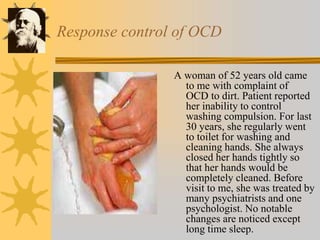
E-mail:ddroy@isical.ac.in
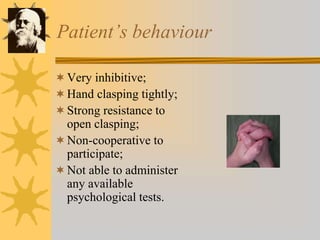
Psychiatric illness acts as risk factor
for adult mortality and morbidity
Psychiatric illness is associated
with an increased risk of
premature death.
Out of 100 people aged 15-89
years , 33 died per day in India.
It is assumed that out of 33, at
least 8 people died due to
psychiatric disorders (2.5%
rate).
Common causes of death are
suicide, accident,
cardiovascular diseases,
schizophrenia and depression.
Psychiatric illness is also associated
with morbidity and Co-morbidity
of several general diseases like
diabetes, CHD, skin disorder,
respiratory diseases, peptic ulcer,
cancer etc.
In people with schizophrenia, the risk
of dying of respiratory disease s
like bronchial asthma, pneumonia
was almost 10 times than others.
Suicide and cardiovascular diseases
are associated with neurotic
depression.
Psychiatric illness affects DALYs and Economic
health of country.
WHO reports that mental illnesses are the leading causes of disability
adjusted life years (DALYs) worldwide accounting for 37% of
healthy years lost from NCDs (Non communicable diseases).
Loss of employment, productive human resources
Depression alone accounts for one third of this disability.
The new report estimates the global cost of mental illness at nearly 2.5
trillion dollars in 2010 with a projected increase to over $6T in 2015.
The economic health of both developing and developed nations will
depend on controlling the staggering growth in costs from NCDs.
Ref: www.nimh.nih.gov
Psychological Counselling and Psychotherapy as
antidotes of psychiatric illness
Psychotropic drug is a
chemical substance
that changes brain
function and results in
alterations in
perception, mood and
consciousness.
 Like psychotropic drugs,
psychological counselling
and psychotherapy can
decrease severity level of
psychiatric disorders.
 They can change
perception of self and of
the surroundings. They
can develop the abilities
to withstand threats.
What is Psychotherapy ?
 The term psychotherapy
refers to the treatment of
psychological disorders
through the use of
psychological theories,
the postulates, techniques
and tools rather than
physical means like
administration of drugs or
surgery
Some therapies
– Psychoanalysis
– Behaviour
modification
– Cognitive therapy
– Cognitive behaviour
therapy
– Rabindrik
Psychotherapy
Paradigm shift in Psychotherapy
Classical psychotherapy
 Bounded consciousness
 Freedom is restricted by therapist
 Survival strategy is formulated by
therapist
 Objective is treatment as if pain
management
 Psychotherapy is guided by
labelling
 Insight occurs by the
interpretation of therapist
Rabindrik psychotherapy
 Unbounded consciousness
 Freedom is restricted by sufferer
 Survival strategy is formulated by
sufferer
 Objective is self-awakening
 No labelling
 Performing art based psychotherapy
 Insight occurs through performing arts
performed by sufferer and therapist.
Both therapist and sufferers are
performers.
Dr. Debdulal Dutta Roy, Ph.D. (Psy.)
Indian Statistical Institute, Kolkata
13.12.15
Q & A about Rabindrik
Psychotherapy
Q. Is it necessary to learn Bengali for it’s
application ?
A. Tagore’s songs were translated into different
languages. So language is not bar. Again,
when music and language is synchronized,
music can create similar effect.
Q & A about Rabindrik
Psychotherapy
Q. Is it necessary to be specialist in Rabindra
sangeet ?
A. This is not required if lyrics can affect layers
of consciousness properly.
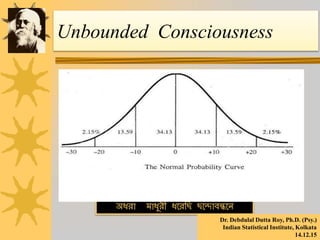
Unbounded Consciousness
অধরো মোধুরী ধররবছ ছরন্দোিন্ধরি
Dr. Debdulal Dutta Roy, Ph.D. (Psy.)
Indian Statistical Institute, Kolkata
14.12.15
CONSCIOUSNESS IS NEVER
ENDING MULTI-LAYERED
WAVES OF AWARENESS
"....Tare dola diye duliye
geche kato dheuer chando,
O tar anto nai go nai."
Puja, 332
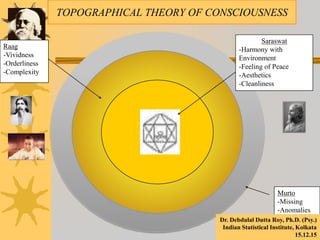
Murto
-Missing
-Anomalies
Raag
-Vividness
-Orderliness
-Complexity
Saraswat
-Harmony with
Environment
-Feeling of Peace
-Aesthetics
-Cleanliness
TOPOGRAPHICAL THEORY OF CONSCIOUSNESS
Dr. Debdulal Dutta Roy, Ph.D. (Psy.)
Indian Statistical Institute, Kolkata
15.12.15
Functions of Murto
Assignment: Draw circle closing and non-
closing eyes. Find out difference.
Murta layer is the locus of sensation and
perception. It is the first layer where in
individual senses the attributes of
stimulus through five sensory organs.
হচোরের আরলোয় হদ্রেবছরলম হচোরের িোবেরর
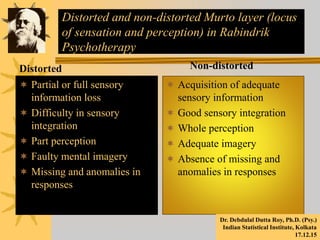
Distorted and non-distorted Murto layer (locus
of sensation and perception) in Rabindrik
Psychotherapy
Distorted
 Partial or full sensory
information loss
 Difficulty in sensory
integration
 Part perception
 Faulty mental imagery
 Missing and anomalies in
responses
Non-distorted
 Acquisition of adequate
sensory information
 Good sensory integration
 Whole perception
 Adequate imagery
 Absence of missing and
anomalies in responses
Dr. Debdulal Dutta Roy, Ph.D. (Psy.)
Indian Statistical Institute, Kolkata
17.12.15
Functions of Raaga
 It is the seat of feeling and emotion.
 It changes meaning of stimulus.
 It is filled with different flows.
 Flow creates and resolves the conflict by changing
perception of the characteristics of stimulus.
Functions of Saraswat
When information comes to Saraswat
layer, individual experiences total
harmony.
It provides experience of aesthetics
One finds no difference between self and
surroundings.
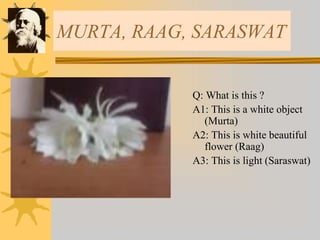
MURTA, RAAG, SARASWAT
Q: What is this ?
A1: This is a white object
(Murta)
A2: This is white beautiful
flower (Raag)
A3: This is light (Saraswat)
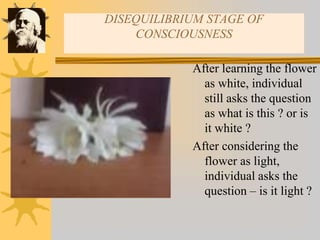
DISEQUILIBRIUM STAGE OF
CONSCIOUSNESS
After learning the flower
as white, individual
still asks the question
as what is this ? or is
it white ?
After considering the
flower as light,
individual asks the
question – is it light ?
Flow on Consciousness Stream
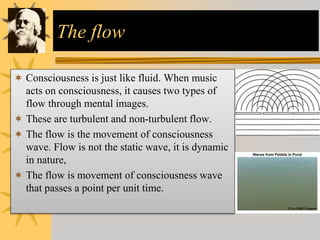
The flow
 Consciousness is just like fluid. When music
acts on consciousness, it causes two types of
flow through mental images.
 These are turbulent and non-turbulent flow.
 The flow is the movement of consciousness
wave. Flow is not the static wave, it is dynamic
in nature,
 The flow is movement of consciousness wave
that passes a point per unit time.
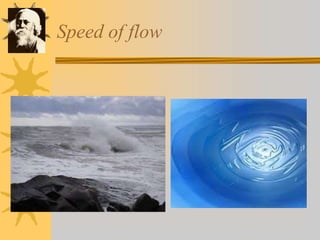
Speed of flow
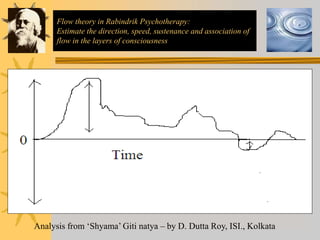
Flow theory in Rabindrik Psychotherapy:
Estimate the direction, speed, sustenance and association of
flow in the layers of consciousness
Analysis from ‘Shyama’ Giti natya – by D. Dutta Roy, ISI., Kolkata
Flow quotient
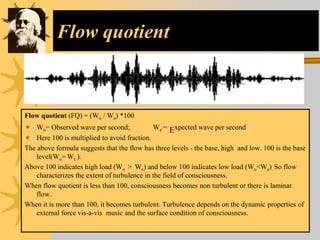
Flow quotient (FQ) = (Wo / We) *100
 Wo= Observed wave per second; We = Expected wave per second
 Here 100 is multiplied to avoid fraction.
The above formula suggests that the flow has three levels - the base, high and low. 100 is the base
level(Wo= We ).
Above 100 indicates high load (Wo > We) and below 100 indicates low load (Wo<We). So flow
characterizes the extent of turbulence in the field of consciousness.
When flow quotient is less than 100, consciousness becomes non turbulent or there is laminar
flow.
When it is more than 100, it becomes turbulent. Turbulence depends on the dynamic properties of
external force vis-a-vis music and the surface condition of consciousness.
Flow field
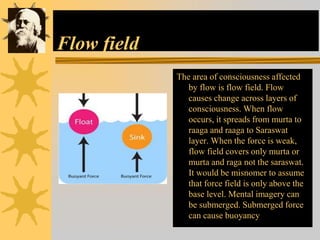
The area of consciousness affected
by flow is flow field. Flow
causes change across layers of
consciousness. When flow
occurs, it spreads from murta to
raaga and raaga to Saraswat
layer. When the force is weak,
flow field covers only murta or
murta and raga not the saraswat.
It would be misnomer to assume
that force field is only above the
base level. Mental imagery can
be submerged. Submerged force
can cause buoyancy
Buoyant force
 Archimedes (a Greek
mathematician) determined that a
body which is completely or
partially submerged in a fluid
experiences an
upward force called the Buoyant
Force. Just hearing the music, we
sometimes sing it repeatedly. This
may be due to buoyancy effect. As
discussed, music causes force on
consciousness. When strength of
force is very high it moves
downward
Downward pressure
Upward pressure
Buoyant force
 This is buoyant force. So when
flow moves from one layer to
another, buoyant force acts. Due to
buoyant force, some areas of
images are displaced and mental
images move across layers. The
buoyant force is due to the
difference between the pressure at
the bottom of the object pushing
up on it, and the pressure at the top
pushing down. Due to buoyant
force, mental images lasts on the
surface of consciousness. When
buoyant force is less, the image
sinks.
Upward pressure
Saturation
Saturation is the degree or extent to which
something is dissolved or absorbed. By
repetition of same song, sometimes we do
not want to sing again. This may be due to
saturation. Saturation can occur at any
layer of consciousness.
Flow enclosure
Each flow has the boundary. The mental
images within the specific enclosure may
not be same with another enclosure of
flow.
So many flows can occur on the same surface
of consciousness.
Number of flows determines extent of
turbulence in consciousness.
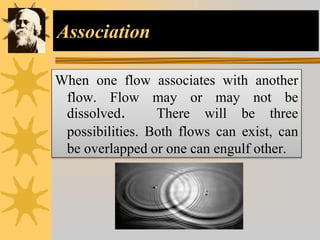
Association
When one flow associates with another
flow. Flow may or may not be
dissolved. There will be three
possibilities. Both flows can exist, can
be overlapped or one can engulf other.
Postulates extracted from
Rabindra Sangeet
Avoid labeling. Today’s label changes tomorrow
Today’s labeling one as mad or abnormal may not be appropriate in tomorrow.
Tagore in his song (“Je tore pagol bole tare tui bolis ne kichu”) prevents us from
labeling one as mad. Again he has given own reasoning for the prevention.
Do not say anything when one calls on you mad
Assuming you as abnormal, one can throw dust on you today.
Tomorrow he will come to you with garland
Today, due to self-pride, he sits on high chair.
Tomorrow, he will get down and bow his head.
 This suggests that Rabindrik psychotherapy possesses lot of cognitive resources
that guide individual toward positive life style.
Consciousness is free floating. Look at it as
detached being
Tagore conceptualized two beings -
free floated real being and
detached being. As detached
being, man can understand own
consciousness . Detachment helps
man to understand all the
incompleteness in consciousness
by removing all the emotions
intertwined with sensory images.
The ‘I’ that floats on the waves of
time under the sky, I am watching
at it.
That ‘I’ moves like moving picture
and I am watching at it as silent
poet.
This ‘I’ is not that ‘I’. I am within me.
I am not floating like dead.
I am free, satisfied, peaceful and
lighted. I am watching at it.
Make the consciousness unbounded
and experience it
 Consciousness is unbounded and
unlimited. One can roam and
experience its changes. The
experience gives feeling of
completeness. It is just like
journey from incomplete to
complete across three layers of
consciousness. Reaching at
Saraswat, one wants to stay there
for prolonged period. Such feeling
is described in the Tagore’s song
You are what I want.
Besides you, I have no one.
If you do not find happiness,
you move elsewhere.
I want to stay within you.
I want to be disappeared
within you for long time.
Man is the pursuer of completeness.
 Frustration and conflict occur when
consciousness is searching for
harmony around the Murta and Raag
layers due to faulty learning or
inability to learn.
 Man in his whole life, always pursue
saraswat, the locus of harmonization.
 Tagore wrote “Ami keboli swapan
karechi bapan batase”. When it is
translated into English, it appears as:
I only sow my dreams in air, so
I collect day-dreams in
despair.
Like shadow, it vanishes, I
cannot find its end.
My mental images are floating
in the air.
Man is the pursuer of newness
One’s feeling of completeness is transient. Today’s feeling changes with
new. Prolonged stay within saraswat layer does not provide variety.
This leads man to be creative and innovative. Tagore wrote - “
Tomay natun kare pabo bole harai khane khan”. It means that I want
to make you out of sight in order to see you in a new way.
Self-awakening is the key to
positive mental health
The word Self-awakening implies the meaning of
understanding the flows across layers of consciousness.
Flows occur through activity. Tagore in his song
“Antaro mamo bikashito karo antartaro he” suggests
five specific activities for self-awakening. These are (a)
auto suggestion for flourishing the self; (b) cleaning,
brightening and beautifying the self; (c) free self from
fear, laziness and doubt; (d) establish social network;
(e) spreading peace in all activities.
What is the advantage ?
 Rabindrik psychotherapy provides positive experience –
control on environment (Jadi tor dak shune keu na ase),
feeling of freedom (Tomar khola haoa), optimism, feeling of
harmony with the surroundings ;
 Client him/her self can customize situation using Rabindrik
tools to explore, understand and regulate flow across layers of
consciousness;
 It is free from labeling so client is free from identity crisis;
 It is less time consuming and less costly;
 It affects both right and left hemisphere of the brain.
What is the disadvantage ?
 Rabindrik art carries dual meaning. Due to highly loaded with negative
information, client may be prone to negative connotation.
 It can create positive transference.
 Therapist may not be able to come out from the improvised art.
 Performing art should be synchronized with the lyrics when it will be presented
to the client who can not understand language.
 Rigorous training is important specially in skill development on lyric and art
synchronization, improvisation of Rabindrik arts and in development of adequate
knowledge about four areas of Rabindrik psychotherapy – Layer dynamics, flow
theory, control theory and therapeutic postulates.
Therapeutic procedure
There are four major stages of Rabindrik
psychotherapy : (a) analysis of flow in
consciousness , (b) Rabindrik improvisation for
insight generation, (c) competency mapping and
goal-setting, (d) termination. Therapist will
follow certain precautions in therapy.
Case Study 1: Where all fail,
Rabindrasangeet acts
Response control of OCD
A woman of 52 years old came
to me with complaint of
OCD to dirt. Patient reported
her inability to control
washing compulsion. For last
30 years, she regularly went
to toilet for washing and
cleaning hands. She always
closed her hands tightly so
that her hands would be
completely cleaned. Before
visit to me, she was treated by
many psychiatrists and one
psychologist. No notable
changes are noticed except
long time sleep.
Patient’s behaviour
Very inhibitive;
Hand clasping tightly;
Strong resistance to
open clasping;
Non-cooperative to
participate;
Not able to administer
any available
psychological tests.
Analysis of patient
Patient is searching for dirt in the outer layer.
In the inner layer, dirt is perceived as threatening;
Patient wants to move away from inner to inner core
layer. For the same, she spends most of the time in
worshipping the God and keeping cleanliness.
She is not happy with soaping hands as this can not help
her to reach at the innercore layer of consciousness.
This results approach – avoidance conflict.
(Approaching to the soap in order to avoid dirt, again few
soaping is not sufficient, so more soaping is required ).
Analysis of family
Repeated soaping consumes more water;
Family assumes that it is unreasonable but
patient assumes it as reasonable ;
Family member is not aware of
consciousness dynamics playing inside the
patient.
Therpeautic analysis
 Target: Preventing clasping hands;
 Consciousness model:
– Outer layer : Dirt perception;
– Inner layer : Dirt as threat;
– Innercore : Feeling of cleanliness;
 Currently, patient is moving around outer and inner layers only.
 Therapeautic target: Providing her Feeling of cleanliness.
 Rabindrasangeet is non-dirt area;
 Explore the song suitable for feeling of non-dirt area;
Session-1
In the first session, patient was highly inhibitive
to reveal herself. Due to difficulty in rapport
establishment. I started singing - "Ananda loke,
mangala loke" (moving to spiritual land).
Suddenly, she started singing with me in very
low voice;
I paid my attention to her and started moving the
hands keeping with the rhythm and waves of the
song loudly. She participated into my hand
movement and sang the song loudly.
Session-2
In the 2nd session after 6 days, the client sang
with me same song by standing. She moved her
hands above head when she sang " Grahataraka
chandra tapana byakula drutabege" (the planets,
satellites are moving speedily). It is noted that her
hands now completely opened.
Session-3
In the 3rd sitting, patient reported that she alone
practiced two songs
– "Ektuku chona lage...." (feeling light touch), and
– "Eto din je bosechinu" (waiting for long days) at
home. Finally, she sang with me both songs alongwith
Ananda loke, danced and she never closed her hands.
Termination : Patient herself is able to prevent
stopping hand clasping.
Case Study 2: Geetbitan as
Projective test.
Projective test
Individual projects own feelings, conflict
and desires on others;
Psychologists use several tests for analysis
of projection of the patient;
Some widely used tests are : Rorschach,
TAT, Sentence completion test, Word
association test etc.
Analysis of Projection
 A neurotic depressed patient
came to me with complaints of
suicidal desires. She was co-
operative. In stead of using
common psychodiagnostic
test, I used Geetbitan She was
asked to select 10 songs from
Geetbitan, the famous Book of
songs composed by
Rabindranath Tagore.
 Patient selected following 10
songs:
 1. Akash bhara surya tara
2. Aloker ei jharna dharay
3. Ananda dhara bahiche
bhubane
4. Ananda loke mangala loke
5. Aji jato tara tabo
6. Amar mukti aloy aloy
7. Ami chini go chini
8. Aro aro prabhu aro aro
9. Alo amar alo ogo
10. E ki labonye punya
 Next, I told her to rank them. Her
rank was :First : 3, Second : 10,
Third : 4
 Finally, she sang the first rank
song (Ananda dhara bohiche
bhubane). I followed her in
singing.I have noticed that each
line of this song reflects her
current mental state and it is
interesting to note that the song
also provides the answer as how to
recover from such problems.
 Finally I have used that song for
her psychological
counseling.Therefore, I have
developed following assumptions:
1. Geetbitan as Psychological test;
2. The words of Geetbitan
advances knowledge of
psychotherapy.
“Anandadhara bahiche bhubane,
dinarajani kato amritarasa
uthali jay ananta gagane.
Pan kare rabi shashi anjali
bhariya- sada dipta rahe
akshyaya jyoti- nitya purna
dhara jibone kirane.
Bosiya acho keno apanmone,
swarthanimagana ki karane?
Chari dike dekho chahi hridaya
prasari, khudra dukhosab
tuchcha mani
Prem bhariya laho shunya jibone.
“
Case Study 3: Self-understanding
Complaints
 Over learning
 Poor academic
performance
 Apprehension of
danger
Analysis of client
 Layer dynamics:
– Outer layer : Perceiving the book;
– Inner layer : Book is perceived as source of completeness;
– Innercore : Feeling of completeness;
 Reason for over learning: He tends to be complete being.
 Problem lies on over study due to extrinsic reading
motivation
 Target of change : Study for intrinsic motivation
 Case history : He can play tabla and can sing
Rabindrasangeet. It is practiced in family.
Session
Requesting him to sing any song of Tagore;
He selected “Jadi tare nai chini go se ki amay
nebe chine ei naba falguner dine---- jani ne, jani
ne”.
I asked if your book asked you the same what
would be your answer ?
He: Jani ne (I do not know)….after brooding…he
said that from today I would study the lesson to
understand it.
Termination: Client is able to understand how to
be complete.
References
1. Dutta Roy,D. (2010).Rabindrik Psychotherapy in Stress
Management. PsyInsight. 1,3,10.
2. Dutta Roy,D. (2014). Rabindrik Psychotherapy, Journal of Social
science and welfare.
3. Shah, H. and Dutta Roy,D. (2014). Structure of Rabindrik human
values. Indian Journal of Positive Psychology, Vol.5, 4, p.368-375.
4.http://en.wikipedia.org/wiki/Flow_(psychology) , Mihaly
Csikszentmihalyi (1990). Flow: The Psychology of Optimal
Experience. Harper & Row. ISBN 978-0-06-016253-5. Retrieved
10 November 2013.
5. https://www.psychologytoday.com/blog/in-
practice/201212/cognitive-behavioral-therapy-techniques-work
PRANAM

Orientation workshop on Rabindrik Psychotherapy

  • 1.
    FIRST ORIENTATION WORKSHOP ONRABINDRIK PSYCHOTHERAPY Organized by Ms. Gopa Das and her team Venue: Vidyasagar Bhawan, Kolkata 19.12.15
  • 2.
    PRAYER  অন্তর মমবিকবিত কররো অন্তরতর হে-- বিমমল কররো, উজ্জ্বল কররো, সুন্দর কররো হে ॥ জোগ্রত কররো, উদ্যত কররো, বির্ম য় কররো হে। মঙ্গল কররো, বিরলস বিিঃসংিয় কররো হে ॥ যুক্ত কররো হে সিোর সরঙ্গ, মুক্ত কররো হে িন্ধ। সঞ্চোর কররো সকল করমম িোন্ত হতোমোর ছন্দ। চরণপরে মম বচত বিষ্পবন্দত কররো হে। িবন্দত কররো, িবন্দত কররো, িবন্দত কররো হে ॥  Help me thrive and upgrade my core, O my innermost one – Cleanse, brighten, and make it adorable one. Awaken, prepare, and make me audacious. Bless, energise, and make me unambiguous. Unite me with all others, break all closures. Inflict your mellow rhythm in all endeavours. Affix my mind on your lotus feet, if you please. Bliss, Bliss, make my life a Bliss. Translated by Anjan Ganguly Rabindrik Psychotherapy aims at awakening the self http://www.geetabitan.com/lyrics/A/antor-mamo-bikoshito-kar.html
  • 3.
    INTRODUCTION TO RABINDRIK PSYCHOTHERAPY Dr.D. Dutta Roy, Ph.D. (Psy.) Psychology Research Unit INDIAN STATISTICAL INSTITUTE 19th December, 2015 Kolkata, INDIA E-mail:ddroy@isical.ac.in
  • 4.
    Psychiatric illness actsas risk factor for adult mortality and morbidity Psychiatric illness is associated with an increased risk of premature death. Out of 100 people aged 15-89 years , 33 died per day in India. It is assumed that out of 33, at least 8 people died due to psychiatric disorders (2.5% rate). Common causes of death are suicide, accident, cardiovascular diseases, schizophrenia and depression. Psychiatric illness is also associated with morbidity and Co-morbidity of several general diseases like diabetes, CHD, skin disorder, respiratory diseases, peptic ulcer, cancer etc. In people with schizophrenia, the risk of dying of respiratory disease s like bronchial asthma, pneumonia was almost 10 times than others. Suicide and cardiovascular diseases are associated with neurotic depression.
  • 5.
    Psychiatric illness affectsDALYs and Economic health of country. WHO reports that mental illnesses are the leading causes of disability adjusted life years (DALYs) worldwide accounting for 37% of healthy years lost from NCDs (Non communicable diseases). Loss of employment, productive human resources Depression alone accounts for one third of this disability. The new report estimates the global cost of mental illness at nearly 2.5 trillion dollars in 2010 with a projected increase to over $6T in 2015. The economic health of both developing and developed nations will depend on controlling the staggering growth in costs from NCDs. Ref: www.nimh.nih.gov
  • 6.
    Psychological Counselling andPsychotherapy as antidotes of psychiatric illness Psychotropic drug is a chemical substance that changes brain function and results in alterations in perception, mood and consciousness.  Like psychotropic drugs, psychological counselling and psychotherapy can decrease severity level of psychiatric disorders.  They can change perception of self and of the surroundings. They can develop the abilities to withstand threats.
  • 7.
    What is Psychotherapy?  The term psychotherapy refers to the treatment of psychological disorders through the use of psychological theories, the postulates, techniques and tools rather than physical means like administration of drugs or surgery Some therapies – Psychoanalysis – Behaviour modification – Cognitive therapy – Cognitive behaviour therapy – Rabindrik Psychotherapy
  • 8.
    Paradigm shift inPsychotherapy Classical psychotherapy  Bounded consciousness  Freedom is restricted by therapist  Survival strategy is formulated by therapist  Objective is treatment as if pain management  Psychotherapy is guided by labelling  Insight occurs by the interpretation of therapist Rabindrik psychotherapy  Unbounded consciousness  Freedom is restricted by sufferer  Survival strategy is formulated by sufferer  Objective is self-awakening  No labelling  Performing art based psychotherapy  Insight occurs through performing arts performed by sufferer and therapist. Both therapist and sufferers are performers. Dr. Debdulal Dutta Roy, Ph.D. (Psy.) Indian Statistical Institute, Kolkata 13.12.15
  • 9.
    Q & Aabout Rabindrik Psychotherapy Q. Is it necessary to learn Bengali for it’s application ? A. Tagore’s songs were translated into different languages. So language is not bar. Again, when music and language is synchronized, music can create similar effect.
  • 10.
    Q & Aabout Rabindrik Psychotherapy Q. Is it necessary to be specialist in Rabindra sangeet ? A. This is not required if lyrics can affect layers of consciousness properly.
  • 11.
    Unbounded Consciousness অধরো মোধুরীধররবছ ছরন্দোিন্ধরি Dr. Debdulal Dutta Roy, Ph.D. (Psy.) Indian Statistical Institute, Kolkata 14.12.15
  • 12.
    CONSCIOUSNESS IS NEVER ENDINGMULTI-LAYERED WAVES OF AWARENESS "....Tare dola diye duliye geche kato dheuer chando, O tar anto nai go nai." Puja, 332
  • 13.
    Murto -Missing -Anomalies Raag -Vividness -Orderliness -Complexity Saraswat -Harmony with Environment -Feeling ofPeace -Aesthetics -Cleanliness TOPOGRAPHICAL THEORY OF CONSCIOUSNESS Dr. Debdulal Dutta Roy, Ph.D. (Psy.) Indian Statistical Institute, Kolkata 15.12.15
  • 14.
    Functions of Murto Assignment:Draw circle closing and non- closing eyes. Find out difference. Murta layer is the locus of sensation and perception. It is the first layer where in individual senses the attributes of stimulus through five sensory organs. হচোরের আরলোয় হদ্রেবছরলম হচোরের িোবেরর
  • 15.
    Distorted and non-distortedMurto layer (locus of sensation and perception) in Rabindrik Psychotherapy Distorted  Partial or full sensory information loss  Difficulty in sensory integration  Part perception  Faulty mental imagery  Missing and anomalies in responses Non-distorted  Acquisition of adequate sensory information  Good sensory integration  Whole perception  Adequate imagery  Absence of missing and anomalies in responses Dr. Debdulal Dutta Roy, Ph.D. (Psy.) Indian Statistical Institute, Kolkata 17.12.15
  • 16.
    Functions of Raaga It is the seat of feeling and emotion.  It changes meaning of stimulus.  It is filled with different flows.  Flow creates and resolves the conflict by changing perception of the characteristics of stimulus.
  • 17.
    Functions of Saraswat Wheninformation comes to Saraswat layer, individual experiences total harmony. It provides experience of aesthetics One finds no difference between self and surroundings.
  • 18.
    MURTA, RAAG, SARASWAT Q:What is this ? A1: This is a white object (Murta) A2: This is white beautiful flower (Raag) A3: This is light (Saraswat)
  • 19.
    DISEQUILIBRIUM STAGE OF CONSCIOUSNESS Afterlearning the flower as white, individual still asks the question as what is this ? or is it white ? After considering the flower as light, individual asks the question – is it light ?
  • 20.
  • 21.
    The flow  Consciousnessis just like fluid. When music acts on consciousness, it causes two types of flow through mental images.  These are turbulent and non-turbulent flow.  The flow is the movement of consciousness wave. Flow is not the static wave, it is dynamic in nature,  The flow is movement of consciousness wave that passes a point per unit time.
  • 22.
  • 23.
    Flow theory inRabindrik Psychotherapy: Estimate the direction, speed, sustenance and association of flow in the layers of consciousness Analysis from ‘Shyama’ Giti natya – by D. Dutta Roy, ISI., Kolkata
  • 24.
    Flow quotient Flow quotient(FQ) = (Wo / We) *100  Wo= Observed wave per second; We = Expected wave per second  Here 100 is multiplied to avoid fraction. The above formula suggests that the flow has three levels - the base, high and low. 100 is the base level(Wo= We ). Above 100 indicates high load (Wo > We) and below 100 indicates low load (Wo<We). So flow characterizes the extent of turbulence in the field of consciousness. When flow quotient is less than 100, consciousness becomes non turbulent or there is laminar flow. When it is more than 100, it becomes turbulent. Turbulence depends on the dynamic properties of external force vis-a-vis music and the surface condition of consciousness.
  • 25.
    Flow field The areaof consciousness affected by flow is flow field. Flow causes change across layers of consciousness. When flow occurs, it spreads from murta to raaga and raaga to Saraswat layer. When the force is weak, flow field covers only murta or murta and raga not the saraswat. It would be misnomer to assume that force field is only above the base level. Mental imagery can be submerged. Submerged force can cause buoyancy
  • 26.
    Buoyant force  Archimedes(a Greek mathematician) determined that a body which is completely or partially submerged in a fluid experiences an upward force called the Buoyant Force. Just hearing the music, we sometimes sing it repeatedly. This may be due to buoyancy effect. As discussed, music causes force on consciousness. When strength of force is very high it moves downward Downward pressure Upward pressure
  • 27.
    Buoyant force  Thisis buoyant force. So when flow moves from one layer to another, buoyant force acts. Due to buoyant force, some areas of images are displaced and mental images move across layers. The buoyant force is due to the difference between the pressure at the bottom of the object pushing up on it, and the pressure at the top pushing down. Due to buoyant force, mental images lasts on the surface of consciousness. When buoyant force is less, the image sinks. Upward pressure
  • 28.
    Saturation Saturation is thedegree or extent to which something is dissolved or absorbed. By repetition of same song, sometimes we do not want to sing again. This may be due to saturation. Saturation can occur at any layer of consciousness.
  • 29.
    Flow enclosure Each flowhas the boundary. The mental images within the specific enclosure may not be same with another enclosure of flow. So many flows can occur on the same surface of consciousness. Number of flows determines extent of turbulence in consciousness.
  • 30.
    Association When one flowassociates with another flow. Flow may or may not be dissolved. There will be three possibilities. Both flows can exist, can be overlapped or one can engulf other.
  • 31.
  • 32.
    Avoid labeling. Today’slabel changes tomorrow Today’s labeling one as mad or abnormal may not be appropriate in tomorrow. Tagore in his song (“Je tore pagol bole tare tui bolis ne kichu”) prevents us from labeling one as mad. Again he has given own reasoning for the prevention. Do not say anything when one calls on you mad Assuming you as abnormal, one can throw dust on you today. Tomorrow he will come to you with garland Today, due to self-pride, he sits on high chair. Tomorrow, he will get down and bow his head.  This suggests that Rabindrik psychotherapy possesses lot of cognitive resources that guide individual toward positive life style.
  • 33.
    Consciousness is freefloating. Look at it as detached being Tagore conceptualized two beings - free floated real being and detached being. As detached being, man can understand own consciousness . Detachment helps man to understand all the incompleteness in consciousness by removing all the emotions intertwined with sensory images. The ‘I’ that floats on the waves of time under the sky, I am watching at it. That ‘I’ moves like moving picture and I am watching at it as silent poet. This ‘I’ is not that ‘I’. I am within me. I am not floating like dead. I am free, satisfied, peaceful and lighted. I am watching at it.
  • 34.
    Make the consciousnessunbounded and experience it  Consciousness is unbounded and unlimited. One can roam and experience its changes. The experience gives feeling of completeness. It is just like journey from incomplete to complete across three layers of consciousness. Reaching at Saraswat, one wants to stay there for prolonged period. Such feeling is described in the Tagore’s song You are what I want. Besides you, I have no one. If you do not find happiness, you move elsewhere. I want to stay within you. I want to be disappeared within you for long time.
  • 35.
    Man is thepursuer of completeness.  Frustration and conflict occur when consciousness is searching for harmony around the Murta and Raag layers due to faulty learning or inability to learn.  Man in his whole life, always pursue saraswat, the locus of harmonization.  Tagore wrote “Ami keboli swapan karechi bapan batase”. When it is translated into English, it appears as: I only sow my dreams in air, so I collect day-dreams in despair. Like shadow, it vanishes, I cannot find its end. My mental images are floating in the air.
  • 36.
    Man is thepursuer of newness One’s feeling of completeness is transient. Today’s feeling changes with new. Prolonged stay within saraswat layer does not provide variety. This leads man to be creative and innovative. Tagore wrote - “ Tomay natun kare pabo bole harai khane khan”. It means that I want to make you out of sight in order to see you in a new way.
  • 37.
    Self-awakening is thekey to positive mental health The word Self-awakening implies the meaning of understanding the flows across layers of consciousness. Flows occur through activity. Tagore in his song “Antaro mamo bikashito karo antartaro he” suggests five specific activities for self-awakening. These are (a) auto suggestion for flourishing the self; (b) cleaning, brightening and beautifying the self; (c) free self from fear, laziness and doubt; (d) establish social network; (e) spreading peace in all activities.
  • 38.
    What is theadvantage ?  Rabindrik psychotherapy provides positive experience – control on environment (Jadi tor dak shune keu na ase), feeling of freedom (Tomar khola haoa), optimism, feeling of harmony with the surroundings ;  Client him/her self can customize situation using Rabindrik tools to explore, understand and regulate flow across layers of consciousness;  It is free from labeling so client is free from identity crisis;  It is less time consuming and less costly;  It affects both right and left hemisphere of the brain.
  • 39.
    What is thedisadvantage ?  Rabindrik art carries dual meaning. Due to highly loaded with negative information, client may be prone to negative connotation.  It can create positive transference.  Therapist may not be able to come out from the improvised art.  Performing art should be synchronized with the lyrics when it will be presented to the client who can not understand language.  Rigorous training is important specially in skill development on lyric and art synchronization, improvisation of Rabindrik arts and in development of adequate knowledge about four areas of Rabindrik psychotherapy – Layer dynamics, flow theory, control theory and therapeutic postulates.
  • 40.
    Therapeutic procedure There arefour major stages of Rabindrik psychotherapy : (a) analysis of flow in consciousness , (b) Rabindrik improvisation for insight generation, (c) competency mapping and goal-setting, (d) termination. Therapist will follow certain precautions in therapy.
  • 41.
    Case Study 1:Where all fail, Rabindrasangeet acts
  • 42.
    Response control ofOCD A woman of 52 years old came to me with complaint of OCD to dirt. Patient reported her inability to control washing compulsion. For last 30 years, she regularly went to toilet for washing and cleaning hands. She always closed her hands tightly so that her hands would be completely cleaned. Before visit to me, she was treated by many psychiatrists and one psychologist. No notable changes are noticed except long time sleep.
  • 43.
    Patient’s behaviour Very inhibitive; Handclasping tightly; Strong resistance to open clasping; Non-cooperative to participate; Not able to administer any available psychological tests.
  • 44.
    Analysis of patient Patientis searching for dirt in the outer layer. In the inner layer, dirt is perceived as threatening; Patient wants to move away from inner to inner core layer. For the same, she spends most of the time in worshipping the God and keeping cleanliness. She is not happy with soaping hands as this can not help her to reach at the innercore layer of consciousness. This results approach – avoidance conflict. (Approaching to the soap in order to avoid dirt, again few soaping is not sufficient, so more soaping is required ).
  • 45.
    Analysis of family Repeatedsoaping consumes more water; Family assumes that it is unreasonable but patient assumes it as reasonable ; Family member is not aware of consciousness dynamics playing inside the patient.
  • 46.
    Therpeautic analysis  Target:Preventing clasping hands;  Consciousness model: – Outer layer : Dirt perception; – Inner layer : Dirt as threat; – Innercore : Feeling of cleanliness;  Currently, patient is moving around outer and inner layers only.  Therapeautic target: Providing her Feeling of cleanliness.  Rabindrasangeet is non-dirt area;  Explore the song suitable for feeling of non-dirt area;
  • 47.
    Session-1 In the firstsession, patient was highly inhibitive to reveal herself. Due to difficulty in rapport establishment. I started singing - "Ananda loke, mangala loke" (moving to spiritual land). Suddenly, she started singing with me in very low voice; I paid my attention to her and started moving the hands keeping with the rhythm and waves of the song loudly. She participated into my hand movement and sang the song loudly.
  • 48.
    Session-2 In the 2ndsession after 6 days, the client sang with me same song by standing. She moved her hands above head when she sang " Grahataraka chandra tapana byakula drutabege" (the planets, satellites are moving speedily). It is noted that her hands now completely opened.
  • 49.
    Session-3 In the 3rdsitting, patient reported that she alone practiced two songs – "Ektuku chona lage...." (feeling light touch), and – "Eto din je bosechinu" (waiting for long days) at home. Finally, she sang with me both songs alongwith Ananda loke, danced and she never closed her hands. Termination : Patient herself is able to prevent stopping hand clasping.
  • 50.
    Case Study 2:Geetbitan as Projective test.
  • 51.
    Projective test Individual projectsown feelings, conflict and desires on others; Psychologists use several tests for analysis of projection of the patient; Some widely used tests are : Rorschach, TAT, Sentence completion test, Word association test etc.
  • 52.
    Analysis of Projection A neurotic depressed patient came to me with complaints of suicidal desires. She was co- operative. In stead of using common psychodiagnostic test, I used Geetbitan She was asked to select 10 songs from Geetbitan, the famous Book of songs composed by Rabindranath Tagore.  Patient selected following 10 songs:  1. Akash bhara surya tara 2. Aloker ei jharna dharay 3. Ananda dhara bahiche bhubane 4. Ananda loke mangala loke 5. Aji jato tara tabo 6. Amar mukti aloy aloy 7. Ami chini go chini 8. Aro aro prabhu aro aro 9. Alo amar alo ogo 10. E ki labonye punya  Next, I told her to rank them. Her rank was :First : 3, Second : 10, Third : 4
  • 53.
     Finally, shesang the first rank song (Ananda dhara bohiche bhubane). I followed her in singing.I have noticed that each line of this song reflects her current mental state and it is interesting to note that the song also provides the answer as how to recover from such problems.  Finally I have used that song for her psychological counseling.Therefore, I have developed following assumptions: 1. Geetbitan as Psychological test; 2. The words of Geetbitan advances knowledge of psychotherapy. “Anandadhara bahiche bhubane, dinarajani kato amritarasa uthali jay ananta gagane. Pan kare rabi shashi anjali bhariya- sada dipta rahe akshyaya jyoti- nitya purna dhara jibone kirane. Bosiya acho keno apanmone, swarthanimagana ki karane? Chari dike dekho chahi hridaya prasari, khudra dukhosab tuchcha mani Prem bhariya laho shunya jibone. “
  • 54.
    Case Study 3:Self-understanding
  • 55.
    Complaints  Over learning Poor academic performance  Apprehension of danger
  • 56.
    Analysis of client Layer dynamics: – Outer layer : Perceiving the book; – Inner layer : Book is perceived as source of completeness; – Innercore : Feeling of completeness;  Reason for over learning: He tends to be complete being.  Problem lies on over study due to extrinsic reading motivation  Target of change : Study for intrinsic motivation  Case history : He can play tabla and can sing Rabindrasangeet. It is practiced in family.
  • 57.
    Session Requesting him tosing any song of Tagore; He selected “Jadi tare nai chini go se ki amay nebe chine ei naba falguner dine---- jani ne, jani ne”. I asked if your book asked you the same what would be your answer ? He: Jani ne (I do not know)….after brooding…he said that from today I would study the lesson to understand it. Termination: Client is able to understand how to be complete.
  • 58.
    References 1. Dutta Roy,D.(2010).Rabindrik Psychotherapy in Stress Management. PsyInsight. 1,3,10. 2. Dutta Roy,D. (2014). Rabindrik Psychotherapy, Journal of Social science and welfare. 3. Shah, H. and Dutta Roy,D. (2014). Structure of Rabindrik human values. Indian Journal of Positive Psychology, Vol.5, 4, p.368-375. 4.http://en.wikipedia.org/wiki/Flow_(psychology) , Mihaly Csikszentmihalyi (1990). Flow: The Psychology of Optimal Experience. Harper & Row. ISBN 978-0-06-016253-5. Retrieved 10 November 2013. 5. https://www.psychologytoday.com/blog/in- practice/201212/cognitive-behavioral-therapy-techniques-work
  • 59.