A STUDY ON
IMPACT ASSESSMENT OF
WORKERS EDUCATION
Prepared by
Debdulal Dutta Roy
CBWE & Psychology Research Unit of the
Indian Statistical Institute, Kolkata
Prepared for

Presentation in the Governing Body Meeting of CBWE
Delhi, 15.9.2005
OVERVIEW

















What is Workers Education? , Perspectives of Impact Assessment
SETTING OBJECTIVES : Company Profile, Interviewing President,
Management, Workers ,Trade union leaders, Trainers, Studying course
contents, training manual, observing training program. Content
analysis, Departments under study
OBJECTIVES
Model of the study
Subjective Data collection : instrument development, Studying the
constraints and collection of data, Sampling criteria and Characteristics
of Samples
DATA ANALYSIS
Results of Subjective data : Achievement test and training process
satisfaction
Objective Data collection :Constraints, Study periods
RESULTS : Productivity- 1, 2, 3 , Wastage - 1, 2, 3, 4 Quality control 1, 2 Accident - 1, 2 and Absenteeism - 1, 2
CONCLUSION & FUTURE RESEARCH
THANK YOU
What is Workers Education ?








Workers Education is humanized training process to
change in knowledge and skills required for on and off the
job life.
So it makes a balance between on and off the job life in
designing training inputs.
It assumes that worker is a total man with complex
adaptive open system. They have own reasoning for self
direction and self control.
Workers education affects the reasoning level so that
workers feel inner urge to learn new knowledge and skills.
PERSPECTIVES OF IMPACT ASSESSMENT


Workers Perspective







Acquiring knowledge about working operations, self control
(faulty habits).
Satisfaction with training process
Job Satisfaction or Employee Satisfaction

Organizational Perspective








Improvement in productivity
Reduction of wastage
Improving quality
Reduction of accidents
Reduction of absenteeism
Change in Return of Investment
Change in Organizational Climate or Organizational health
STUDY LOCATION

Situated on the West bank of river Ganges near Belur
Math, Howrah, West Bengal
Company Profile
Name : Ambica Jute Mill
Established : Pre-independence
Location : At the bank of River Hooghly
Machines : 100 years old and periodical
overhauling
Training : No training other than CBWE
Workers : Multilingual, multi culture, most
of them were below class VIII.
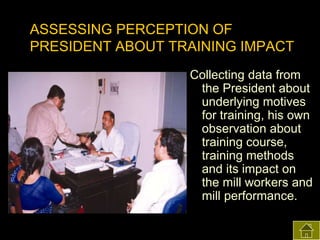
ASSESSING PERCEPTION OF
PRESIDENT ABOUT TRAINING IMPACT
Collecting data from
the President about
underlying motives
for training, his own
observation about
training course,
training methods
and its impact on
the mill workers and
mill performance.
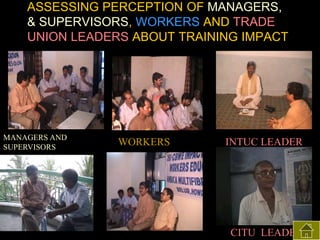
ASSESSING PERCEPTION OF MANAGERS,
& SUPERVISORS, WORKERS AND TRADE
UNION LEADERS ABOUT TRAINING IMPACT

MANAGERS AND
SUPERVISORS

WORKERS

INTUC LEADER

CITU LEADER
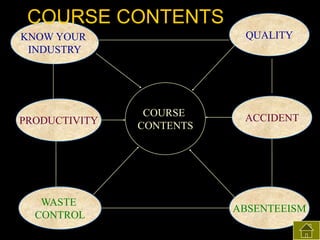
COURSE CONTENTS
QUALITY

KNOW YOUR
INDUSTRY

PRODUCTIVITY

WASTE
CONTROL

COURSE
CONTENTS

ACCIDENT

ABSENTEEISM
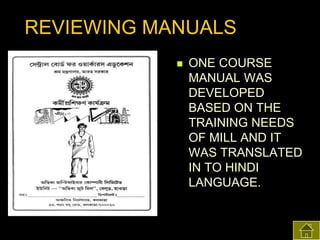
REVIEWING MANUALS


ONE COURSE
MANUAL WAS
DEVELOPED
BASED ON THE
TRAINING NEEDS
OF MILL AND IT
WAS TRANSLATED
IN TO HINDI
LANGUAGE.
OBSERVING TRAINING
PROGRAMME

USED DIFFERENT TRAINING AIDS LIKE LECTURE,ROLE PLAY,
GROUP DISCUSSION, EXHIBITS, QUESTION ANSWER SESSION,
EXERCISES, AUDIO-VISUAL AIDS, DEMONSTRATION
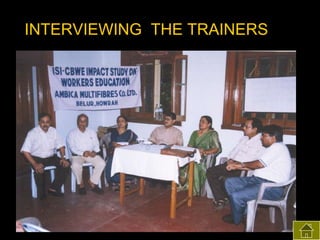
INTERVIEWING THE TRAINERS
18


16

16

16
13

14

13

12
9

10

9
7

8

5

6

4

4

3

4

1

2

M
ec
h.
Pr
es
id
en
t
El
ec
tri
ca
Q
l
lty
Cn
tro
l

0
Sp
in
ni
ng
W
ea
vi
ng
Ba
tc
hi
ng
Fi
ni
sh
in
g
Pe
rs
on
ne
l
Se
cu
rit
y
G
od
ow
n
Fi
na
nc
e

% Distribution of Training Impact statements

Preliminary investigation and Content Analysis in
Setting Objectives



% Distribution of Training Im pact
Pr
od
uc
W
tiv
as
ity
te
co
nt
ro
l
Qu
ali
ty
Ac
c id
Ab
en
se
t
nt
ee
is m
Co
-o
pn
Ot
he
Te
r
am s
w
or
MC k
Mn
tn

Department wise
25%
20%
15%

21% 20%

16%

13% 12%

10%

5%

4%

4%

3%

3%

3%
1%

Area wise

W
P

in

TU

IPR

0%

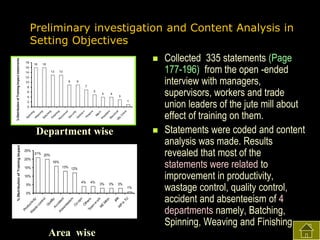
Collected 335 statements (Page
177-196) from the open -ended
interview with managers,
supervisors, workers and trade
union leaders of the jute mill about
effect of training on them.
Statements were coded and content
analysis was made. Results
revealed that most of the
statements were related to
improvement in productivity,
wastage control, quality control,
accident and absenteeism of 4
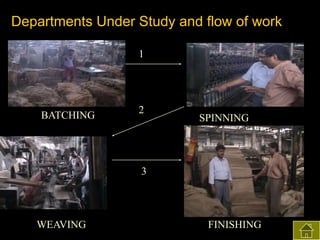
departments namely, Batching,
Spinning, Weaving and Finishing.
Departments Under Study and flow of work
1

BATCHING

2

SPINNING

3

WEAVING

FINISHING
OBJECTIVES





To determine extent of difference in knowledge
(achievement) about course contents between the
trained and non-trained employees of the mill
To determine extent of Training process
Satisfaction of trainees
To determine extent of difference in Productivity,
Waste control, Quality control, Rate of accidents
and Absenteeism between before and during
training periods
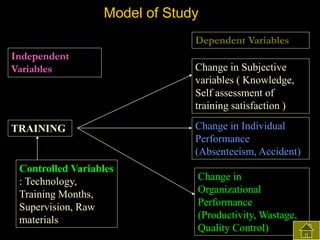
Model of Study
Dependent Variables
Independent
Variables

TRAINING

Controlled Variables
: Technology,
Training Months,
Supervision, Raw
materials

Change in Subjective
variables ( Knowledge,
Self assessment of
training satisfaction )
Change in Individual
Performance
(Absenteeism, Accident)
Change in
Organizational
Performance
(Productivity, Wastage,
Quality Control)
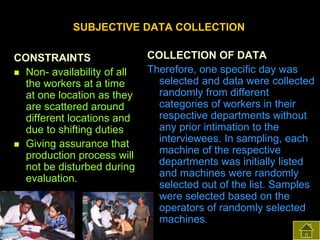
SUBJECTIVE DATA COLLECTION
CONSTRAINTS
 Non- availability of all
the workers at a time
at one location as they
are scattered around
different locations and
due to shifting duties
 Giving assurance that
production process will
not be disturbed during
evaluation.

COLLECTION OF DATA
Therefore, one specific day was
selected and data were collected
randomly from different
categories of workers in their
respective departments without
any prior intimation to the
interviewees. In sampling, each
machine of the respective
departments was initially listed
and machines were randomly
selected out of the list. Samples
were selected based on the
operators of randomly selected
machines.
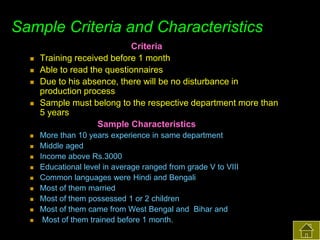
Sample Criteria and Characteristics
















Criteria
Training received before 1 month
Able to read the questionnaires
Due to his absence, there will be no disturbance in
production process
Sample must belong to the respective department more than
5 years
Sample Characteristics
More than 10 years experience in same department
Middle aged
Income above Rs.3000
Educational level in average ranged from grade V to VIII
Common languages were Hindi and Bengali
Most of them married
Most of them possessed 1 or 2 children
Most of them came from West Bengal and Bihar and
Most of them trained before 1 month.
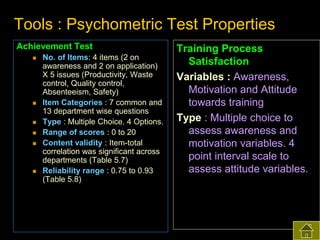
Tools : Psychometric Test Properties
Achievement Test










No. of Items: 4 items (2 on
awareness and 2 on application)
X 5 issues (Productivity, Waste
control, Quality control,
Absenteeism, Safety)
Item Categories : 7 common and
13 department wise questions
Type : Multiple Choice. 4 Options.
Range of scores : 0 to 20
Content validity : Item-total
correlation was significant across
departments (Table 5.7)
Reliability range : 0.75 to 0.93
(Table 5.8)

Training Process
Satisfaction
Variables : Awareness,
Motivation and Attitude
towards training
Type : Multiple choice to
assess awareness and
motivation variables. 4
point interval scale to
assess attitude variables.
Statistics Used for Analysis
Pearson Product Moment Correlation
t-test
Chi-square test
Correspondence Analysis
Wilcoxon Matched Paired Signed Rank test
Item discrimination
Item total correlation
Kuder Richardson Coefficient
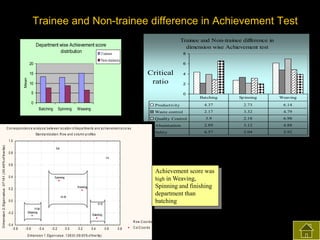
Trainee and Non-trainee difference in Achievement Test
Trainee and Non-trainee difference in
dimension wise Achievement test

Department wise Achievement score
distribution
Trainees

8

Non-trainees

20

Critical
ratio

15
Mean

6

10
5

4
2
0

Batching

Batching

Spinning

Weaving

4.37

2.73

6.14

Waste control

2.17

3.32

4.79

3.9

2.18

6.98

Absenteeism

2.89

3.12

4.88

Safety

Weaving

Sp inning

Productivity

0

6.57

2.04

3.92

Quality Control
C o r r e s p o n d e n c e a n a ly s is b e tw e e n lo c a tio n o f d e p a r tme n ts a n d a c h ie v e me n t s c o r e s
Sta n d a r d iz a tio n : R o w a n d c o lu mn p r o file s

D imension 2; Eigenvalue: .07161 (30.49% of Inertia)

1 .0
5-8

0 .8
1-4

0 .6
0 .4

Achievement score was
high in Weaving,
Spinning and finishing
department than
batching

Spinning
Finishing

0 .2
13-16

0 .0
9-12

- 0 .2
- 0 .4
- 0 .8

17-20
Weaving

Batching

R o w .C o o r d s
- 0 .6

- 0 .4

- 0 .2

0 .0

0 .2

0 .4

D ime n s io n 1 ; Eig e n v a lu e : .1 3 8 3 5 ( 5 8 .9 0 % o f In e r tia )

0 .6

0 .8

C o l.C o o r d s
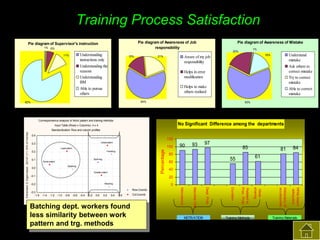
Training Process Satisfaction
Pie diagram of Awareness of Job
responsibility

Pie diagram of Supervisor's instruction
1% 6%

Pie diagram of Awareness of Mistake
1%

20%

Understanding
instructions only
Understanding the
reasons
Understanding
BM
Able to pursue
others

11%

15%

Understand
mistake
Ask others to
correct mistake
Try to correct
mistake
Able to correct
mistake

16%

Aware of my job
responsibility

21%

Helps in error
modification
Helps to make
others realized
64%

82%

63%

Correspondence analysis of Work pattern and training methods

No Significant Difference among the departments

Input Table (Rows x Columns): 4 x 4

0.4

120
Great extent

0.3

Percentage

0.1

Spinning
Some extent
Batching

0.0

Greater extent

-0.1

97

85

80

84

61

55

60

81

40
20

Weaving

-0.2

0

-0.8

-0.6

-0.4

-0.2

0.0

0.2

0.4

0.6

Dimension 1; Eigenvalue: .16533 (85.84% of Inertia)

Batching dept. workers found
less similarity between work
pattern and trg. methods

Col.Coords

MOTIVATION

Training Methods

Ideas
sharing

-1.0

Related to
Prac. Prob.

-1.2

Duration

-1.4

Dept. Prob.

Row.Coords

Machine Chk

-0.3
-1.6

93

White board
adequacy

Finishing

0.2

90

Adequacy of
accessories

100

Least extent

Attendance

Dimension 2; Eigenvalue: .02147 (11.15% of Inertia)

Standardization: Row and column profiles

Training Materials
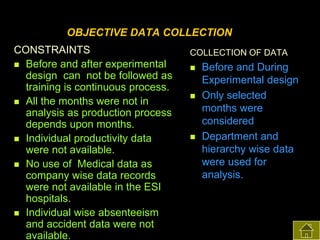
OBJECTIVE DATA COLLECTION
CONSTRAINTS
 Before and after experimental
design can not be followed as
training is continuous process.
 All the months were not in
analysis as production process
depends upon months.
 Individual productivity data
were not available.
 No use of Medical data as
company wise data records
were not available in the ESI
hospitals.
 Individual wise absenteeism
and accident data were not
available.

COLLECTION OF DATA






Before and During
Experimental design
Only selected
months were
considered
Department and
hierarchy wise data
were used for
analysis.
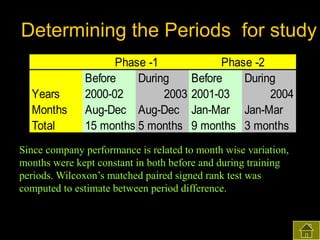
Determining the Periods for study
Years
Months
Total

Phase -1
Before
During
2000-02
2003
Aug-Dec Aug-Dec
15 months 5 months

Phase -2
Before
During
2001-03
2004
Jan-Mar Jan-Mar
9 months 3 months

Since company performance is related to month wise variation,
months were kept constant in both before and during training
periods. Wilcoxon’s matched paired signed rank test was
computed to estimate between period difference.
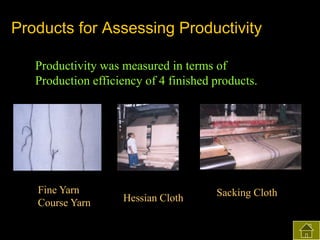
Products for Assessing Productivity
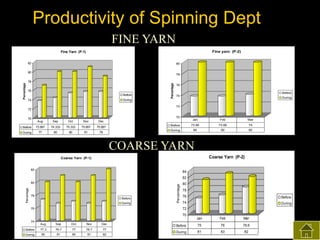
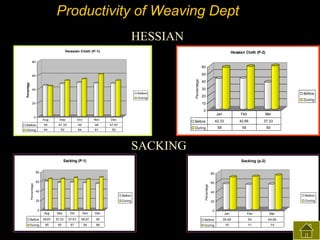
Productivity was measured in terms of
Production efficiency of 4 finished products.

Fine Yarn
Course Yarn

Hessian Cloth

Sacking Cloth
Productivity of Spinning Dept
FINE YARN
Fine yarn (P-2)

Fine Yarn (P-1)
82

80

78

78
76
Before

Percentage

Percentage

80

76
Before
74

During

During

74

72

72
70
Before
During

70

Aug
73.667
77

Sep

Oct

74.333

75.333

80

80

Nov
75.667
81

Jan

Feb

Mar

Before

73.66

73.66

74

During

80

80

80

Dec
75.667
79

COARSE YARN
Coarse Yarn (P-2)

Coarse Yarn (P-1)

82

84

Percentage

78

Before
During

Percentage

82
80

80
78
76

Before

74

During

72

76

70
74

Aug

Sep

Oct

Nov

Dec

Before

77.3

76.7

77

76.7

77

During

80

81

80

81

82

Jan

Feb

Mar

Before

75

76

78.6

During

81

83

82
Productivity of Weaving Dept
HESSIAN
Hessian Cloth (P-1)

Hessian Cloth (P-2)

80

60
50

40
Before
During

Percentage

Percentage

60

40
30
Before

20

During
10

20

0
0

Aug

Sep

Oct

Nov

Before

45

47.33

49

48

44

52

54

61

Mar

42.33

42.66

37.33

During

52

Feb

58

59

60

47.67

During

Jan

Before

Dec

SACKING
Sacking (P-1)

Sacking (p-2)
80

60

60

40
Before
20
0

During

Aug

Sep

Oct

Nov

Dec

Before

59.67

57.33

57.67

56.67

55

During

65

65

67

64

68

Percentage

Percentage

80

40
Before
During

20
0

Jan

Feb

Mar

Before

55.66

54

54.66

During

70

71

74
Wastage
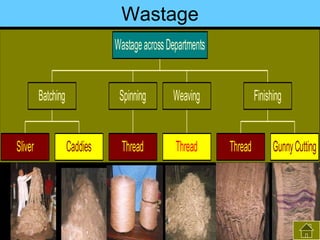
Wastage across Departments

Batching

Sliver

Spinning

Caddies

Weaving

Thread

Thread

Finishing

Thread

Gunny Cutting
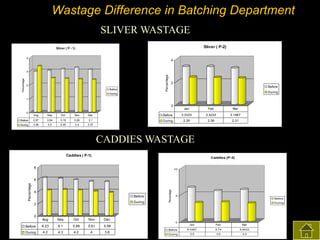
Wastage Difference in Batching Department
SLIVER WASTAGE
Sliver ( P-2)

Sliver ( P - 1)
4

4

Percentage

Percentage

3

2
Before

2
Before
During

During
1

0
0

Jan

Feb

Mar

Aug

Sep

Oct

Nov

Dec

Before

3.3333

3.3233

3.1967

Before

2.97

3.04

3.15

3.26

3.1

During

2.39

2.36

2.31

During

3.36

2.5

2.45

2.4

2.37

CADDIES WASTAGE
Caddies ( P-1)

Caddies (P-2)

8

10

4
Before
During

2

0

Aug

Sep

Oct

Nov

6.1

5.88

5.61

5
Before
During

Dec

6.23

Percentage

Percentage

6

5.58

0

Before
During

4.2

4.3

4.2

4

3.8

Jan

Feb

Mar

Before

6.3467

5.74

5.9433

During

3.5

3.6

3.4
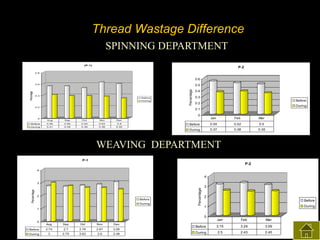
Thread Wastage Difference
SPINNING DEPARTMENT
(P-1)

P-2

0.8

0.6
0.5

0.4
Before
During

0.2

Percentage

Percentage

0.6

0.4
0.3
Before

0.2

During

0.1
0
Aug

Sep

Oct

Nov

0.56

0.56

0.53

0.63

0.6

During

0.41

0.39

0.39

0.38

Jan

Feb

0.55

0.52

0.5

0.37

0.38

0.35

Dec

Before

Before
During

0

Mar

0.35

WEAVING DEPARTMENT
P-1

P-2
4

4

2
Before
During
1

Percentage

Percentage

3

3
2
Before

0
0

Aug

Sep

Oct

Nov

Dec

Before

2.74

2.7

2.78

2.87

3.06

During

3

2.75

2.62

2.6

2.48

During

1

Jan

Feb

Mar

Before

3.15

3.29

3.09

During

2.5

2.43

2.45
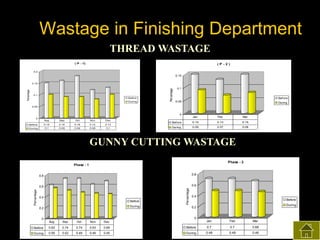
Wastage in Finishing Department
THREAD WASTAGE
( P - 1)

(P-2)

0.2

0.15

0.1
Before
During

Percentage

Percentage

0.15

0.1

Bef ore
0.05

During

0.05

0
0

Aug

Sep

Oct

Nov

Before

0.15

0.16

0.18

0.12

0.1

0.09

0.09

0.08

0.1

Feb

Mar

0.15

0.13

0.15

During

0.13

During

Jan

Bef ore

Dec

0.09

0.07

0.08

GUNNY CUTTING WASTAGE
Phase - 2

Phase - 1

0.6

0.4
Before
During

0.2

0

Percentage

0.8

0.6
Percentage

0.8

0.4
Before
During

0.2
0

Aug

Sep

Oct

Nov

Dec

Before

0.62

0.74

0.74

0.63

0.69

Before

During

0.56

0.52

0.48

0.46

0.45

During

Jan

Feb

Mar

0.7

0.7

0.66

0.48

0.48

0.46
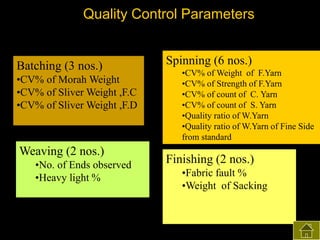
Quality Control Parameters

Batching (3 nos.)
•CV% of Morah Weight
•CV% of Sliver Weight ,F.C
•CV% of Sliver Weight ,F.D

Weaving (2 nos.)
•No. of Ends observed
•Heavy light %

Spinning (6 nos.)
•CV% of Weight of F.Yarn
•CV% of Strength of F.Yarn
•CV% of count of C. Yarn
•CV% of count of S. Yarn
•Quality ratio of W.Yarn
•Quality ratio of W.Yarn of Fine Side
from standard

Finishing (2 nos.)
•Fabric fault %
•Weight of Sacking
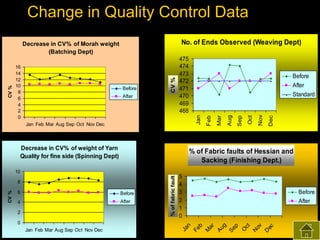
Change in Quality Control Data
No. of Ends Observed (Weaving Dept)

Decrease in CV% of weight of Yarn
Quality for fine side (Spinning Dept)

4

After

Jan Feb Mar Aug Sep Oct Nov Dec

Ja

n

Dec

Nov

Oct

Before
After

M
ar
Au
g
Se
p
O
ct
N
ov
D
ec

Before

5
4
3
2
1
0
b

6

% of fabric fault

CV %

8

0

Sep

% of Fabric faults of Hessian and
Sacking (Finishing Dept.)

10

2

Aug

Jan Feb Mar Aug Sep Oct Nov Dec

Mar

Jan

After

Before
After
Standard

Feb

Before

475
474
473
472
471
470
469
468

Fe

16
14
12
10
8
6
4
2
0

CV %

CV %

Decrease in CV% of Morah weight
(Batching Dept)
Accident Pattern Analysis








Accident due to human error
was used for analysis - unsafe
act.
Only minor injury due to unsafe
act was taken into
consideration.
Difference in incidence of
accident across the years
before and during training
period was assessed.
Department and hierarchy
wise difference was studied.
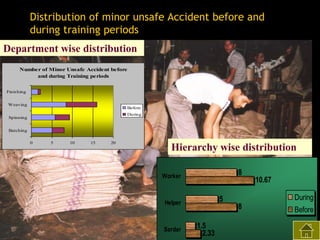
Distribution of minor unsafe Accident before and
during training periods
Department wise distribution
Number of Minor Unsafe Accident before
and during Training periods
Finishing
Weaving

Before
During

Spinning
Batching
0

5

10

15

20

Hierarchy wise distribution
8

Worker

10.67

Sardar

During

5

Helper

8
1.5
2.33

Before
Analysis of Absenteeism Pattern


The database is supposed to have 420 data
(4 years ((2000-03) X 8 months X 4
departments X 3 hierarchies) + (1 year
(2004) X 3 months X 4 departments X 3
hierarchies)). Expected data set will be
140 data for each category of employees
for the purpose of comparison of
absenteeism rate between before and during
training periods. But the actual data set
includes 57 data of Sardars, 50 data of
helpers and 140 data of workers.
Therefore, current analysis was limited to
change in absenteeism pattern of workers
only
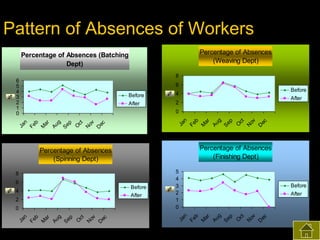
Pattern of Absences of Workers
Percentage of Absences
(Weaving Dept)
8

6
5
4
3
2
1
0

Before
After

%

6
Before
After

4
2

O
ct
N
ov
D
ec

p
Se

g

O
ct
N
ov
D
ec

p
Se

g
Au

M
ar

Fe

b

Before
After

n

O
ct
N
ov
D
ec

p
Se

g
Au

M
ar

b
Fe

n

0

%

Before
After

Ja

%

6

5
4
3
2
1
0
Ja

8

2

Au

Percentage of Absences
(Finishing Dept)

Percentage of Absences
(Spinning Dept)

4

M
ar

b
Fe

n
Ja

O
ct
N
ov
D
ec

g

p
Se

Au

M
ar

b

Ja

n

0
Fe

%

Percentage of Absences (Batching
Dept)
Conclusion
1.

Results revealed significant impact of
Workers Education program conducted by
CBWE at Ambica Jute Mill, Howrah on both
subjective and objective criteria of
Organizational Effectiveness.
Future Research
1.

2.

3.

4.

5.

Comparison between trainees and non trainees
in their individual productivity level, level of
absenteeism and of the accident.
Impact of workers education on the Quality of
working life ( Job satisfaction, Health and Off-the
job life) of workers.
Impact of workers education on the
organizational climate or interpersonal trust
among the employees;
Impact of workers education on the Return of
investment;
Current model may be used in other Industries
and diverse sectors like Education , health,
service, etc.
THANK YOU
THANK YOU

Workers Education

  • 1.
    A STUDY ON IMPACTASSESSMENT OF WORKERS EDUCATION Prepared by Debdulal Dutta Roy CBWE & Psychology Research Unit of the Indian Statistical Institute, Kolkata Prepared for Presentation in the Governing Body Meeting of CBWE Delhi, 15.9.2005
  • 2.
    OVERVIEW            What is WorkersEducation? , Perspectives of Impact Assessment SETTING OBJECTIVES : Company Profile, Interviewing President, Management, Workers ,Trade union leaders, Trainers, Studying course contents, training manual, observing training program. Content analysis, Departments under study OBJECTIVES Model of the study Subjective Data collection : instrument development, Studying the constraints and collection of data, Sampling criteria and Characteristics of Samples DATA ANALYSIS Results of Subjective data : Achievement test and training process satisfaction Objective Data collection :Constraints, Study periods RESULTS : Productivity- 1, 2, 3 , Wastage - 1, 2, 3, 4 Quality control 1, 2 Accident - 1, 2 and Absenteeism - 1, 2 CONCLUSION & FUTURE RESEARCH THANK YOU
  • 3.
    What is WorkersEducation ?     Workers Education is humanized training process to change in knowledge and skills required for on and off the job life. So it makes a balance between on and off the job life in designing training inputs. It assumes that worker is a total man with complex adaptive open system. They have own reasoning for self direction and self control. Workers education affects the reasoning level so that workers feel inner urge to learn new knowledge and skills.
  • 4.
    PERSPECTIVES OF IMPACTASSESSMENT  Workers Perspective     Acquiring knowledge about working operations, self control (faulty habits). Satisfaction with training process Job Satisfaction or Employee Satisfaction Organizational Perspective        Improvement in productivity Reduction of wastage Improving quality Reduction of accidents Reduction of absenteeism Change in Return of Investment Change in Organizational Climate or Organizational health
  • 5.
    STUDY LOCATION Situated onthe West bank of river Ganges near Belur Math, Howrah, West Bengal
  • 6.
    Company Profile Name :Ambica Jute Mill Established : Pre-independence Location : At the bank of River Hooghly Machines : 100 years old and periodical overhauling Training : No training other than CBWE Workers : Multilingual, multi culture, most of them were below class VIII.
  • 7.
    ASSESSING PERCEPTION OF PRESIDENTABOUT TRAINING IMPACT Collecting data from the President about underlying motives for training, his own observation about training course, training methods and its impact on the mill workers and mill performance.
  • 8.
    ASSESSING PERCEPTION OFMANAGERS, & SUPERVISORS, WORKERS AND TRADE UNION LEADERS ABOUT TRAINING IMPACT MANAGERS AND SUPERVISORS WORKERS INTUC LEADER CITU LEADER
  • 9.
  • 10.
    REVIEWING MANUALS  ONE COURSE MANUALWAS DEVELOPED BASED ON THE TRAINING NEEDS OF MILL AND IT WAS TRANSLATED IN TO HINDI LANGUAGE.
  • 11.
    OBSERVING TRAINING PROGRAMME USED DIFFERENTTRAINING AIDS LIKE LECTURE,ROLE PLAY, GROUP DISCUSSION, EXHIBITS, QUESTION ANSWER SESSION, EXERCISES, AUDIO-VISUAL AIDS, DEMONSTRATION
  • 12.
  • 13.
    18  16 16 16 13 14 13 12 9 10 9 7 8 5 6 4 4 3 4 1 2 M ec h. Pr es id en t El ec tri ca Q l lty Cn tro l 0 Sp in ni ng W ea vi ng Ba tc hi ng Fi ni sh in g Pe rs on ne l Se cu rit y G od ow n Fi na nc e % Distribution ofTraining Impact statements Preliminary investigation and Content Analysis in Setting Objectives  % Distribution of Training Im pact Pr od uc W tiv as ity te co nt ro l Qu ali ty Ac c id Ab en se t nt ee is m Co -o pn Ot he Te r am s w or MC k Mn tn Department wise 25% 20% 15% 21% 20% 16% 13% 12% 10% 5% 4% 4% 3% 3% 3% 1% Area wise W P in TU IPR 0% Collected 335 statements (Page 177-196) from the open -ended interview with managers, supervisors, workers and trade union leaders of the jute mill about effect of training on them. Statements were coded and content analysis was made. Results revealed that most of the statements were related to improvement in productivity, wastage control, quality control, accident and absenteeism of 4 departments namely, Batching, Spinning, Weaving and Finishing.
  • 14.
    Departments Under Studyand flow of work 1 BATCHING 2 SPINNING 3 WEAVING FINISHING
  • 15.
    OBJECTIVES    To determine extentof difference in knowledge (achievement) about course contents between the trained and non-trained employees of the mill To determine extent of Training process Satisfaction of trainees To determine extent of difference in Productivity, Waste control, Quality control, Rate of accidents and Absenteeism between before and during training periods
  • 16.
    Model of Study DependentVariables Independent Variables TRAINING Controlled Variables : Technology, Training Months, Supervision, Raw materials Change in Subjective variables ( Knowledge, Self assessment of training satisfaction ) Change in Individual Performance (Absenteeism, Accident) Change in Organizational Performance (Productivity, Wastage, Quality Control)
  • 17.
    SUBJECTIVE DATA COLLECTION CONSTRAINTS Non- availability of all the workers at a time at one location as they are scattered around different locations and due to shifting duties  Giving assurance that production process will not be disturbed during evaluation. COLLECTION OF DATA Therefore, one specific day was selected and data were collected randomly from different categories of workers in their respective departments without any prior intimation to the interviewees. In sampling, each machine of the respective departments was initially listed and machines were randomly selected out of the list. Samples were selected based on the operators of randomly selected machines.
  • 18.
    Sample Criteria andCharacteristics              Criteria Training received before 1 month Able to read the questionnaires Due to his absence, there will be no disturbance in production process Sample must belong to the respective department more than 5 years Sample Characteristics More than 10 years experience in same department Middle aged Income above Rs.3000 Educational level in average ranged from grade V to VIII Common languages were Hindi and Bengali Most of them married Most of them possessed 1 or 2 children Most of them came from West Bengal and Bihar and Most of them trained before 1 month.
  • 19.
    Tools : PsychometricTest Properties Achievement Test       No. of Items: 4 items (2 on awareness and 2 on application) X 5 issues (Productivity, Waste control, Quality control, Absenteeism, Safety) Item Categories : 7 common and 13 department wise questions Type : Multiple Choice. 4 Options. Range of scores : 0 to 20 Content validity : Item-total correlation was significant across departments (Table 5.7) Reliability range : 0.75 to 0.93 (Table 5.8) Training Process Satisfaction Variables : Awareness, Motivation and Attitude towards training Type : Multiple choice to assess awareness and motivation variables. 4 point interval scale to assess attitude variables.
  • 20.
    Statistics Used forAnalysis Pearson Product Moment Correlation t-test Chi-square test Correspondence Analysis Wilcoxon Matched Paired Signed Rank test Item discrimination Item total correlation Kuder Richardson Coefficient
  • 21.
    Trainee and Non-traineedifference in Achievement Test Trainee and Non-trainee difference in dimension wise Achievement test Department wise Achievement score distribution Trainees 8 Non-trainees 20 Critical ratio 15 Mean 6 10 5 4 2 0 Batching Batching Spinning Weaving 4.37 2.73 6.14 Waste control 2.17 3.32 4.79 3.9 2.18 6.98 Absenteeism 2.89 3.12 4.88 Safety Weaving Sp inning Productivity 0 6.57 2.04 3.92 Quality Control C o r r e s p o n d e n c e a n a ly s is b e tw e e n lo c a tio n o f d e p a r tme n ts a n d a c h ie v e me n t s c o r e s Sta n d a r d iz a tio n : R o w a n d c o lu mn p r o file s D imension 2; Eigenvalue: .07161 (30.49% of Inertia) 1 .0 5-8 0 .8 1-4 0 .6 0 .4 Achievement score was high in Weaving, Spinning and finishing department than batching Spinning Finishing 0 .2 13-16 0 .0 9-12 - 0 .2 - 0 .4 - 0 .8 17-20 Weaving Batching R o w .C o o r d s - 0 .6 - 0 .4 - 0 .2 0 .0 0 .2 0 .4 D ime n s io n 1 ; Eig e n v a lu e : .1 3 8 3 5 ( 5 8 .9 0 % o f In e r tia ) 0 .6 0 .8 C o l.C o o r d s
  • 22.
    Training Process Satisfaction Piediagram of Awareness of Job responsibility Pie diagram of Supervisor's instruction 1% 6% Pie diagram of Awareness of Mistake 1% 20% Understanding instructions only Understanding the reasons Understanding BM Able to pursue others 11% 15% Understand mistake Ask others to correct mistake Try to correct mistake Able to correct mistake 16% Aware of my job responsibility 21% Helps in error modification Helps to make others realized 64% 82% 63% Correspondence analysis of Work pattern and training methods No Significant Difference among the departments Input Table (Rows x Columns): 4 x 4 0.4 120 Great extent 0.3 Percentage 0.1 Spinning Some extent Batching 0.0 Greater extent -0.1 97 85 80 84 61 55 60 81 40 20 Weaving -0.2 0 -0.8 -0.6 -0.4 -0.2 0.0 0.2 0.4 0.6 Dimension 1; Eigenvalue: .16533 (85.84% of Inertia) Batching dept. workers found less similarity between work pattern and trg. methods Col.Coords MOTIVATION Training Methods Ideas sharing -1.0 Related to Prac. Prob. -1.2 Duration -1.4 Dept. Prob. Row.Coords Machine Chk -0.3 -1.6 93 White board adequacy Finishing 0.2 90 Adequacy of accessories 100 Least extent Attendance Dimension 2; Eigenvalue: .02147 (11.15% of Inertia) Standardization: Row and column profiles Training Materials
  • 23.
    OBJECTIVE DATA COLLECTION CONSTRAINTS Before and after experimental design can not be followed as training is continuous process.  All the months were not in analysis as production process depends upon months.  Individual productivity data were not available.  No use of Medical data as company wise data records were not available in the ESI hospitals.  Individual wise absenteeism and accident data were not available. COLLECTION OF DATA    Before and During Experimental design Only selected months were considered Department and hierarchy wise data were used for analysis.
  • 24.
    Determining the Periodsfor study Years Months Total Phase -1 Before During 2000-02 2003 Aug-Dec Aug-Dec 15 months 5 months Phase -2 Before During 2001-03 2004 Jan-Mar Jan-Mar 9 months 3 months Since company performance is related to month wise variation, months were kept constant in both before and during training periods. Wilcoxon’s matched paired signed rank test was computed to estimate between period difference.
  • 25.
    Products for AssessingProductivity Productivity was measured in terms of Production efficiency of 4 finished products. Fine Yarn Course Yarn Hessian Cloth Sacking Cloth
  • 26.
    Productivity of SpinningDept FINE YARN Fine yarn (P-2) Fine Yarn (P-1) 82 80 78 78 76 Before Percentage Percentage 80 76 Before 74 During During 74 72 72 70 Before During 70 Aug 73.667 77 Sep Oct 74.333 75.333 80 80 Nov 75.667 81 Jan Feb Mar Before 73.66 73.66 74 During 80 80 80 Dec 75.667 79 COARSE YARN Coarse Yarn (P-2) Coarse Yarn (P-1) 82 84 Percentage 78 Before During Percentage 82 80 80 78 76 Before 74 During 72 76 70 74 Aug Sep Oct Nov Dec Before 77.3 76.7 77 76.7 77 During 80 81 80 81 82 Jan Feb Mar Before 75 76 78.6 During 81 83 82
  • 27.
    Productivity of WeavingDept HESSIAN Hessian Cloth (P-1) Hessian Cloth (P-2) 80 60 50 40 Before During Percentage Percentage 60 40 30 Before 20 During 10 20 0 0 Aug Sep Oct Nov Before 45 47.33 49 48 44 52 54 61 Mar 42.33 42.66 37.33 During 52 Feb 58 59 60 47.67 During Jan Before Dec SACKING Sacking (P-1) Sacking (p-2) 80 60 60 40 Before 20 0 During Aug Sep Oct Nov Dec Before 59.67 57.33 57.67 56.67 55 During 65 65 67 64 68 Percentage Percentage 80 40 Before During 20 0 Jan Feb Mar Before 55.66 54 54.66 During 70 71 74
  • 28.
  • 29.
    Wastage Difference inBatching Department SLIVER WASTAGE Sliver ( P-2) Sliver ( P - 1) 4 4 Percentage Percentage 3 2 Before 2 Before During During 1 0 0 Jan Feb Mar Aug Sep Oct Nov Dec Before 3.3333 3.3233 3.1967 Before 2.97 3.04 3.15 3.26 3.1 During 2.39 2.36 2.31 During 3.36 2.5 2.45 2.4 2.37 CADDIES WASTAGE Caddies ( P-1) Caddies (P-2) 8 10 4 Before During 2 0 Aug Sep Oct Nov 6.1 5.88 5.61 5 Before During Dec 6.23 Percentage Percentage 6 5.58 0 Before During 4.2 4.3 4.2 4 3.8 Jan Feb Mar Before 6.3467 5.74 5.9433 During 3.5 3.6 3.4
  • 30.
    Thread Wastage Difference SPINNINGDEPARTMENT (P-1) P-2 0.8 0.6 0.5 0.4 Before During 0.2 Percentage Percentage 0.6 0.4 0.3 Before 0.2 During 0.1 0 Aug Sep Oct Nov 0.56 0.56 0.53 0.63 0.6 During 0.41 0.39 0.39 0.38 Jan Feb 0.55 0.52 0.5 0.37 0.38 0.35 Dec Before Before During 0 Mar 0.35 WEAVING DEPARTMENT P-1 P-2 4 4 2 Before During 1 Percentage Percentage 3 3 2 Before 0 0 Aug Sep Oct Nov Dec Before 2.74 2.7 2.78 2.87 3.06 During 3 2.75 2.62 2.6 2.48 During 1 Jan Feb Mar Before 3.15 3.29 3.09 During 2.5 2.43 2.45
  • 31.
    Wastage in FinishingDepartment THREAD WASTAGE ( P - 1) (P-2) 0.2 0.15 0.1 Before During Percentage Percentage 0.15 0.1 Bef ore 0.05 During 0.05 0 0 Aug Sep Oct Nov Before 0.15 0.16 0.18 0.12 0.1 0.09 0.09 0.08 0.1 Feb Mar 0.15 0.13 0.15 During 0.13 During Jan Bef ore Dec 0.09 0.07 0.08 GUNNY CUTTING WASTAGE Phase - 2 Phase - 1 0.6 0.4 Before During 0.2 0 Percentage 0.8 0.6 Percentage 0.8 0.4 Before During 0.2 0 Aug Sep Oct Nov Dec Before 0.62 0.74 0.74 0.63 0.69 Before During 0.56 0.52 0.48 0.46 0.45 During Jan Feb Mar 0.7 0.7 0.66 0.48 0.48 0.46
  • 32.
    Quality Control Parameters Batching(3 nos.) •CV% of Morah Weight •CV% of Sliver Weight ,F.C •CV% of Sliver Weight ,F.D Weaving (2 nos.) •No. of Ends observed •Heavy light % Spinning (6 nos.) •CV% of Weight of F.Yarn •CV% of Strength of F.Yarn •CV% of count of C. Yarn •CV% of count of S. Yarn •Quality ratio of W.Yarn •Quality ratio of W.Yarn of Fine Side from standard Finishing (2 nos.) •Fabric fault % •Weight of Sacking
  • 33.
    Change in QualityControl Data No. of Ends Observed (Weaving Dept) Decrease in CV% of weight of Yarn Quality for fine side (Spinning Dept) 4 After Jan Feb Mar Aug Sep Oct Nov Dec Ja n Dec Nov Oct Before After M ar Au g Se p O ct N ov D ec Before 5 4 3 2 1 0 b 6 % of fabric fault CV % 8 0 Sep % of Fabric faults of Hessian and Sacking (Finishing Dept.) 10 2 Aug Jan Feb Mar Aug Sep Oct Nov Dec Mar Jan After Before After Standard Feb Before 475 474 473 472 471 470 469 468 Fe 16 14 12 10 8 6 4 2 0 CV % CV % Decrease in CV% of Morah weight (Batching Dept)
  • 34.
    Accident Pattern Analysis     Accidentdue to human error was used for analysis - unsafe act. Only minor injury due to unsafe act was taken into consideration. Difference in incidence of accident across the years before and during training period was assessed. Department and hierarchy wise difference was studied.
  • 35.
    Distribution of minorunsafe Accident before and during training periods Department wise distribution Number of Minor Unsafe Accident before and during Training periods Finishing Weaving Before During Spinning Batching 0 5 10 15 20 Hierarchy wise distribution 8 Worker 10.67 Sardar During 5 Helper 8 1.5 2.33 Before
  • 36.
    Analysis of AbsenteeismPattern  The database is supposed to have 420 data (4 years ((2000-03) X 8 months X 4 departments X 3 hierarchies) + (1 year (2004) X 3 months X 4 departments X 3 hierarchies)). Expected data set will be 140 data for each category of employees for the purpose of comparison of absenteeism rate between before and during training periods. But the actual data set includes 57 data of Sardars, 50 data of helpers and 140 data of workers. Therefore, current analysis was limited to change in absenteeism pattern of workers only
  • 37.
    Pattern of Absencesof Workers Percentage of Absences (Weaving Dept) 8 6 5 4 3 2 1 0 Before After % 6 Before After 4 2 O ct N ov D ec p Se g O ct N ov D ec p Se g Au M ar Fe b Before After n O ct N ov D ec p Se g Au M ar b Fe n 0 % Before After Ja % 6 5 4 3 2 1 0 Ja 8 2 Au Percentage of Absences (Finishing Dept) Percentage of Absences (Spinning Dept) 4 M ar b Fe n Ja O ct N ov D ec g p Se Au M ar b Ja n 0 Fe % Percentage of Absences (Batching Dept)
  • 38.
    Conclusion 1. Results revealed significantimpact of Workers Education program conducted by CBWE at Ambica Jute Mill, Howrah on both subjective and objective criteria of Organizational Effectiveness.
  • 39.
    Future Research 1. 2. 3. 4. 5. Comparison betweentrainees and non trainees in their individual productivity level, level of absenteeism and of the accident. Impact of workers education on the Quality of working life ( Job satisfaction, Health and Off-the job life) of workers. Impact of workers education on the organizational climate or interpersonal trust among the employees; Impact of workers education on the Return of investment; Current model may be used in other Industries and diverse sectors like Education , health, service, etc.
  • 40.