CLUSTERING HUMAN VALUES: A 
HIERARCHICAL CLUSTER 
ANALYSIS OF THE RABINDRIK 
HUMAN VALUE SURVEY 
Debdulal Dutta Roy 
Psychology Research Unit 
Indian Statistical Institute 
203, B.T. Road 
Kolkata, India – 700108 
Venue: Asia Pacific Social Sciences Conference 
8.11.2014
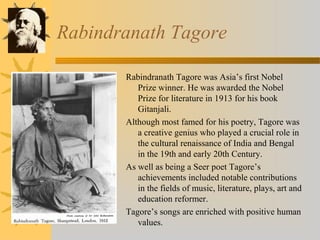
Rabindranath Tagore 
Rabindranath Tagore was Asia’s first Nobel 
Prize winner. He was awarded the Nobel 
Prize for literature in 1913 for his book 
Gitanjali. 
Although most famed for his poetry, Tagore was 
a creative genius who played a crucial role in 
the cultural renaissance of India and Bengal 
in the 19th and early 20th Century. 
As well as being a Seer poet Tagore’s 
achievements included notable contributions 
in the fields of music, literature, plays, art and 
education reformer. 
Tagore’s songs are enriched with positive human 
values.
Rabindrik human values and 
Positive psychology 
Rabidrik human values focus on positive side of human existence like 
self-awakening, peace, resolute etc. They are not the antonym of 
negative information but the guiding principles to overcome threat 
from the negatives like fear, unknown danger etc. 
Tagore wrote “ This is not my prayer to rescue me in fear” (Bipode 
more rakkha karo e nohe more prarthana, bipode jeno na kori kono 
bhoy) : 
“ Hey, I am not afraid of unknown, my life will be flourished by 
understanding the unknown” (Achenake bhoy ki amar ore, 
achenakei chine chine uthbe jibon bhore).
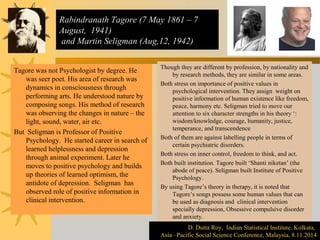
Rabindranath Tagore (7 May 1861 – 7 
August, 1941) 
and Martin Seligman (Aug,12, 1942) 
Tagore was not Psychologist by degree. He 
was seer poet. His area of research was 
dynamics in consciousness through 
performing arts. He understood nature by 
composing songs. His method of research 
was observing the changes in nature – the 
light, sound, water, air etc. 
But Seligman is Professor of Positive 
Psychology. He started career in search of 
learned helplessness and depression 
through animal experiment. Later he 
moves to positive psychology and builds 
up theories of learned optimism, the 
antidote of depression. Seligman has 
observed role of positive information in 
clinical intervention. 
Though they are different by profession, by nationality and 
by research methods, they are similar in some areas. 
Both stress on importance of positive values in 
psychological intervention. They assign weight on 
positive information of human existence like freedom, 
peace, harmony etc. Seligman tried to move our 
attention to six character strengths in his theory ‘: 
wisdom/knowledge, courage, humanity, justice, 
temperance, and transcendence 
Both of them are against labelling people in terms of 
certain psychiatric disorders. 
Both stress on inner control, freedom to think, and act. 
Both built institution. Tagore built ‘Shanti niketan’ (the 
abode of peace). Seligman built Institute of Positive 
Psychology. 
By using Tagore’s theory in therapy, it is noted that 
Tagore’s songs possess some human values that can 
be used as diagnosis and clinical intervention 
specially depression, Obsessive compulsive disorder 
and anxiety. 
D. Dutta Roy, Indian Statistical Institute, Kolkata, 
Asia –Pacific Social Science Conference, Malaysia, 8.11.2014 
Asia –Pacific Social Science Conference, Malaysia, 8.11.2014
Characteristics of Rabindrik Human Values 
Core concept: Rabindrik human values are the core concept of human existence. Values are the 
expressions of worth. 
Universality: Rabindrik human values are free from any religions, cultures, gender differences. All 
the values are the core values of human existence. 
Guiding principles: Rabindrik human values have the guiding principles in peaceful life. The values 
played major roles in guiding the behavior of freedom fighters in the British era. Freedom fighters 
being inspired by the values imbibed in the Rabindrasangeet were not afraid of the inhuman 
torture of British people. 
Positive : All the values are positive in nature. The values stress on the positive flow in 
consciousness. 
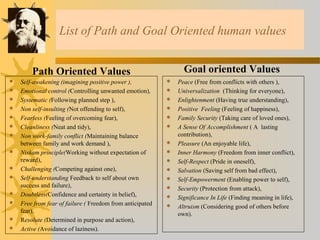
Types : The values are of two types – path oriented and goal oriented. This is in relation to 
instrumental and terminal value types of Rokeach. 
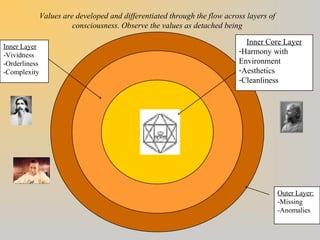
Source : The values are originated and differentiated by the changes in consciousness layers. 
Way to explore the values: Observing flow in consciousness as detached being. 
Uses : In Psychological counseling and therapy. The values can change the interpretation of fear, the 
unknown, the threat. 
D. Dutta Roy, Indian Statistical Institute, Kolkata, 
Asia –Pacific Social Science Conference, Malaysia, 8.11.2014 
Asia –Pacific Social Science Conference, Malaysia, 8.11.2014
Outer Layer: 
-Missing 
-Anomalies 
Inner Layer 
-Vividness 
-Orderliness 
-Complexity 
Values are developed and differentiated through the flow across layers of 
consciousness. Observe the values as detached being 
Inner Core Layer 
-Harmony with 
Environment 
-Aesthetics 
-Cleanliness
List of Path and Goal Oriented human values 
Path Oriented Values 
 Self-awakening (imagining positive power ), 
 Emotional control (Controlling unwanted emotion), 
 Systematic (Following planned step ), 
 Non self-insulting (Not offending to self), 
 Fearless (Feeling of overcoming fear), 
 Cleanliness (Neat and tidy), 
 Non work-family conflict (Maintaining balance 
between family and work demand ), 
 Niskam principle(Working without expectation of 
reward), 
 Challenging (Competing against one), 
 Self-understanding Feedback to self about own 
success and failure), 
 Doubtless(Confidence and certainty in belief), 
 Free from fear of failure ( Freedom from anticipated 
fear), 
 Resolute (Determined in purpose and action), 
 Active (Avoidance of laziness). 
Goal oriented Values 
 Peace (Free from conflicts with others ), 
 Universalization (Thinking for everyone), 
 Enlightenment (Having true understanding), 
 Positive Feeling (Feeling of happiness), 
 Family Security (Taking care of loved ones), 
 A Sense Of Accomplishment ( A lasting 
contribution), 
 Pleasure (An enjoyable life), 
 Inner Harmony (Freedom from inner conflict), 
 Self-Respect (Pride in oneself), 
 Salvation (Saving self from bad effect), 
 Self-Empowerment (Enabling power to self), 
 Security (Protection from attack), 
 Significance In Life (Finding meaning in life), 
 Altruism (Considering good of others before 
own).
Overlapping of values form 
clusters 
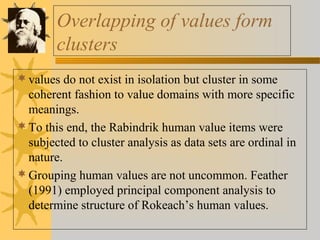
values do not exist in isolation but cluster in some 
coherent fashion to value domains with more specific 
meanings. 
To this end, the Rabindrik human value items were 
subjected to cluster analysis as data sets are ordinal in 
nature. 
Grouping human values are not uncommon. Feather 
(1991) employed principal component analysis to 
determine structure of Rokeach’s human values.
Objective 
To explore cluster of Path and goal oriented 
human values. 
To examine how the cluster of values is 
differentiated by gender and interests.
Participants 
Questionnaire was administered to 123 male and 88 female voluntary student and 
teacher participants of different disciplines – psychology, management, 
environmental science, performing arts, statistics and mathematics. 
Participants included all the major cities of India. 
Their mean age was 29.42 years with SD 11.28. Most of them were post-graduates 
and Ph.D fellows. The Inclusion criteria used in the study was the 
age range of the sample selected for the study which was between 23 years to 
41 years. The exclusion criteria for the study was that the sample should be 
devoid of any chronic psychiatric illness during the administration of the 
questionnaire. 
Respondents had interest in performing arts (n=21), statistics (n=44), 
management (n=63), environmental science (n=32) and psychology (n=27).
Instruments: 
a)Personal Information Schedule: Individual information specifically, 
name, age, sex, education, marital status etc. were collected through 
one information schedule. 
b) Value Survey Questionnaire- Value survey questionnaire was 
developed to assess relative importance of 14 path and 14 goal 
oriented human values. Each value is operationally defined like 
Rokeach’s value scale. Respondents were asked to rank the values in 
terms of relative importance in their everyday life. Most preferred 
value would get rank 1 and least one would get rank 14.
Path 
Relative preference to Path 
Values 
Media 
n 
Sorted 
Rank 
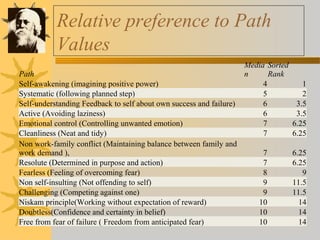
Self-awakening (imagining positive power) 4 1 
Systematic (following planned step) 5 2 
Self-understanding Feedback to self about own success and failure) 6 3.5 
Active (Avoiding laziness) 6 3.5 
Emotional control (Controlling unwanted emotion) 7 6.25 
Cleanliness (Neat and tidy) 7 6.25 
Non work-family conflict (Maintaining balance between family and 
work demand ), 7 6.25 
Resolute (Determined in purpose and action) 7 6.25 
Fearless (Feeling of overcoming fear) 8 9 
Non self-insulting (Not offending to self) 9 11.5 
Challenging (Competing against one) 9 11.5 
Niskam principle(Working without expectation of reward) 10 14 
Doubtless(Confidence and certainty in belief) 10 14 
Free from fear of failure ( Freedom from anticipated fear) 10 14
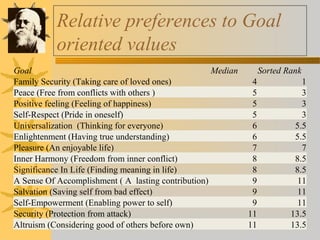
Relative preferences to Goal 
oriented values 
Goal Median Sorted Rank 
Family Security (Taking care of loved ones) 4 1 
Peace (Free from conflicts with others ) 5 3 
Positive feeling (Feeling of happiness) 5 3 
Self-Respect (Pride in oneself) 5 3 
Universalization (Thinking for everyone) 6 5.5 
Enlightenment (Having true understanding) 6 5.5 
Pleasure (An enjoyable life) 7 7 
Inner Harmony (Freedom from inner conflict) 8 8.5 
Significance In Life (Finding meaning in life) 8 8.5 
A Sense Of Accomplishment ( A lasting contribution) 9 11 
Salvation (Saving self from bad effect) 9 11 
Self-Empowerment (Enabling power to self) 9 11 
Security (Protection from attack) 11 13.5 
Altruism (Considering good of others before own) 11 13.5
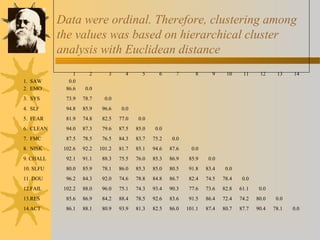
Data were ordinal. Therefore, clustering among 
the values was based on hierarchical cluster 
analysis with Euclidean distance 
1 2 3 4 5 6 7 8 9 10 11 12 13 14 
1. SAW 0.0 
2. EMO 86.6 0.0 
3. SYS 73.9 78.7 0.0 
4. SLF 94.8 85.9 96.6 0.0 
5. FEAR 81.9 74.8 82.5 77.0 0.0 
6. CLEAN 94.0 87.3 79.6 87.5 85.0 0.0 
7. FMC 87.5 78.5 76.5 84.3 83.7 75.2 0.0 
8. NISK 102.6 92.2 101.2 81.7 85.1 94.6 87.6 0.0 
9. CHALL 92.1 91.1 88.3 75.5 76.0 85.3 86.9 85.9 0.0 
10. SLFU 80.0 85.9 78.1 86.0 85.3 85.0 80.5 91.8 83.4 0.0 
11. DOU 96.2 84.3 92.0 74.6 78.8 84.8 86.7 82.4 74.5 78.4 0.0 
12.FAIL 102.2 88.0 96.0 75.1 74.3 93.4 90.3 77.6 73.6 82.8 61.1 0.0 
13.RES 85.6 86.9 84.2 88.4 78.5 92.6 83.6 91.5 86.4 72.4 74.2 80.0 0.0 
14.ACT 86.1 88.1 80.9 93.9 81.3 82.5 86.0 101.1 87.4 80.7 87.7 90.4 78.1 0.0
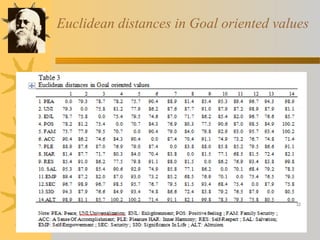
Euclidean distances in Goal oriented values
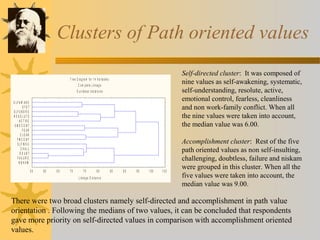
Clusters of Path oriented values 
T r e e D ia g r a m fo r 1 4 V a r ia b le s 
C o m p le te L in k a g e 
E u c lid e a n d is ta n c e s 
L in k a g e D is ta n c e 
S L F A W A K E 
S Y S T 
S L F U N D R S 
R E S O L U T E 
A C T IV E 
E M O C O N T 
F E A R 
C L E A N 
F M C O N F 
S L F IN S U 
C H A L L 
D O U B T 
F A IL U R E 
N IS K A M 
5 5 6 0 6 5 7 0 7 5 8 0 8 5 9 0 9 5 1 0 0 1 0 5 
Self-directed cluster: It was composed of 
nine values as self-awakening, systematic, 
self-understanding, resolute, active, 
emotional control, fearless, cleanliness 
and non work-family conflict. When all 
the nine values were taken into account, 
the median value was 6.00. 
Accomplishment cluster: Rest of the five 
path oriented values as non self-insulting, 
challenging, doubtless, failure and niskam 
were grouped in this cluster. When all the 
five values were taken into account, the 
median value was 9.00. 
There were two broad clusters namely self-directed and accomplishment in path value 
orientation . Following the medians of two values, it can be concluded that respondents 
gave more priority on self-directed values in comparison with accomplishment oriented 
values.
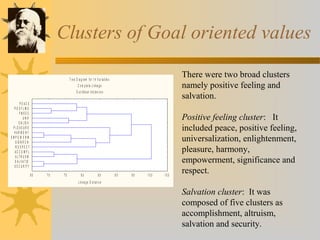
Clusters of Goal oriented values 
There were two broad clusters 
namely positive feeling and 
salvation. 
Positive feeling cluster: It 
included peace, positive feeling, 
universalization, enlightenment, 
pleasure, harmony, 
empowerment, significance and 
respect. 
Salvation cluster: It was 
composed of five clusters as 
accomplishment, altruism, 
salvation and security. 
T r e e D ia g r a m fo r 1 4 V a r ia b le s 
C o m p le te L in k a g e 
E u c lid e a n d is ta n c e s 
L in k a g e D is ta n c e 
P E A C E 
P O S F L IN G 
F M S E C 
U N IV 
E N L IG H 
P L E A S U R E 
H A R M O N Y 
E M P O W E R M 
S IG N IF C N 
R E S P E C T 
A C C O M P L 
A L T R U S M 
S A L V A T IO 
S E C U R IT Y 
6 5 7 0 7 5 8 0 8 5 9 0 9 5 1 0 0 1 0 5
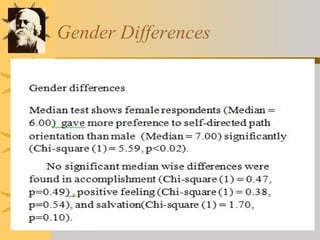
Gender Differences
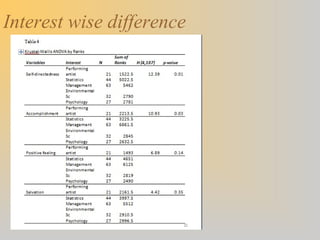
Interest wise difference
Conclusion 
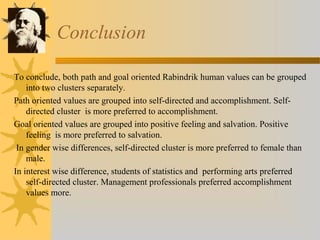
To conclude, both path and goal oriented Rabindrik human values can be grouped 
into two clusters separately. 
Path oriented values are grouped into self-directed and accomplishment. Self-directed 
cluster is more preferred to accomplishment. 
Goal oriented values are grouped into positive feeling and salvation. Positive 
feeling is more preferred to salvation. 
In gender wise differences, self-directed cluster is more preferred to female than 
male. 
In interest wise difference, students of statistics and performing arts preferred 
self-directed cluster. Management professionals preferred accomplishment 
values more.
References
NAMASKAR

Clustering of Rabindrik Human Values

  • 1.
    CLUSTERING HUMAN VALUES:A HIERARCHICAL CLUSTER ANALYSIS OF THE RABINDRIK HUMAN VALUE SURVEY Debdulal Dutta Roy Psychology Research Unit Indian Statistical Institute 203, B.T. Road Kolkata, India – 700108 Venue: Asia Pacific Social Sciences Conference 8.11.2014
  • 2.
    Rabindranath Tagore RabindranathTagore was Asia’s first Nobel Prize winner. He was awarded the Nobel Prize for literature in 1913 for his book Gitanjali. Although most famed for his poetry, Tagore was a creative genius who played a crucial role in the cultural renaissance of India and Bengal in the 19th and early 20th Century. As well as being a Seer poet Tagore’s achievements included notable contributions in the fields of music, literature, plays, art and education reformer. Tagore’s songs are enriched with positive human values.
  • 3.
    Rabindrik human valuesand Positive psychology Rabidrik human values focus on positive side of human existence like self-awakening, peace, resolute etc. They are not the antonym of negative information but the guiding principles to overcome threat from the negatives like fear, unknown danger etc. Tagore wrote “ This is not my prayer to rescue me in fear” (Bipode more rakkha karo e nohe more prarthana, bipode jeno na kori kono bhoy) : “ Hey, I am not afraid of unknown, my life will be flourished by understanding the unknown” (Achenake bhoy ki amar ore, achenakei chine chine uthbe jibon bhore).
  • 4.
    Rabindranath Tagore (7May 1861 – 7 August, 1941) and Martin Seligman (Aug,12, 1942) Tagore was not Psychologist by degree. He was seer poet. His area of research was dynamics in consciousness through performing arts. He understood nature by composing songs. His method of research was observing the changes in nature – the light, sound, water, air etc. But Seligman is Professor of Positive Psychology. He started career in search of learned helplessness and depression through animal experiment. Later he moves to positive psychology and builds up theories of learned optimism, the antidote of depression. Seligman has observed role of positive information in clinical intervention. Though they are different by profession, by nationality and by research methods, they are similar in some areas. Both stress on importance of positive values in psychological intervention. They assign weight on positive information of human existence like freedom, peace, harmony etc. Seligman tried to move our attention to six character strengths in his theory ‘: wisdom/knowledge, courage, humanity, justice, temperance, and transcendence Both of them are against labelling people in terms of certain psychiatric disorders. Both stress on inner control, freedom to think, and act. Both built institution. Tagore built ‘Shanti niketan’ (the abode of peace). Seligman built Institute of Positive Psychology. By using Tagore’s theory in therapy, it is noted that Tagore’s songs possess some human values that can be used as diagnosis and clinical intervention specially depression, Obsessive compulsive disorder and anxiety. D. Dutta Roy, Indian Statistical Institute, Kolkata, D. Dutta Roy, Indian Statistical Institute, Kolkata, Asia –Pacific Social Science Conference, Malaysia, 8.11.2014 Asia –Pacific Social Science Conference, Malaysia, 8.11.2014
  • 5.
    Characteristics of RabindrikHuman Values Core concept: Rabindrik human values are the core concept of human existence. Values are the expressions of worth. Universality: Rabindrik human values are free from any religions, cultures, gender differences. All the values are the core values of human existence. Guiding principles: Rabindrik human values have the guiding principles in peaceful life. The values played major roles in guiding the behavior of freedom fighters in the British era. Freedom fighters being inspired by the values imbibed in the Rabindrasangeet were not afraid of the inhuman torture of British people. Positive : All the values are positive in nature. The values stress on the positive flow in consciousness. Types : The values are of two types – path oriented and goal oriented. This is in relation to instrumental and terminal value types of Rokeach. Source : The values are originated and differentiated by the changes in consciousness layers. Way to explore the values: Observing flow in consciousness as detached being. Uses : In Psychological counseling and therapy. The values can change the interpretation of fear, the unknown, the threat. D. Dutta Roy, Indian Statistical Institute, Kolkata, D. Dutta Roy, Indian Statistical Institute, Kolkata, Asia –Pacific Social Science Conference, Malaysia, 8.11.2014 Asia –Pacific Social Science Conference, Malaysia, 8.11.2014
  • 6.
    Outer Layer: -Missing -Anomalies Inner Layer -Vividness -Orderliness -Complexity Values are developed and differentiated through the flow across layers of consciousness. Observe the values as detached being Inner Core Layer -Harmony with Environment -Aesthetics -Cleanliness
  • 7.
    List of Pathand Goal Oriented human values Path Oriented Values  Self-awakening (imagining positive power ),  Emotional control (Controlling unwanted emotion),  Systematic (Following planned step ),  Non self-insulting (Not offending to self),  Fearless (Feeling of overcoming fear),  Cleanliness (Neat and tidy),  Non work-family conflict (Maintaining balance between family and work demand ),  Niskam principle(Working without expectation of reward),  Challenging (Competing against one),  Self-understanding Feedback to self about own success and failure),  Doubtless(Confidence and certainty in belief),  Free from fear of failure ( Freedom from anticipated fear),  Resolute (Determined in purpose and action),  Active (Avoidance of laziness). Goal oriented Values  Peace (Free from conflicts with others ),  Universalization (Thinking for everyone),  Enlightenment (Having true understanding),  Positive Feeling (Feeling of happiness),  Family Security (Taking care of loved ones),  A Sense Of Accomplishment ( A lasting contribution),  Pleasure (An enjoyable life),  Inner Harmony (Freedom from inner conflict),  Self-Respect (Pride in oneself),  Salvation (Saving self from bad effect),  Self-Empowerment (Enabling power to self),  Security (Protection from attack),  Significance In Life (Finding meaning in life),  Altruism (Considering good of others before own).
  • 8.
    Overlapping of valuesform clusters values do not exist in isolation but cluster in some coherent fashion to value domains with more specific meanings. To this end, the Rabindrik human value items were subjected to cluster analysis as data sets are ordinal in nature. Grouping human values are not uncommon. Feather (1991) employed principal component analysis to determine structure of Rokeach’s human values.
  • 9.
    Objective To explorecluster of Path and goal oriented human values. To examine how the cluster of values is differentiated by gender and interests.
  • 10.
    Participants Questionnaire wasadministered to 123 male and 88 female voluntary student and teacher participants of different disciplines – psychology, management, environmental science, performing arts, statistics and mathematics. Participants included all the major cities of India. Their mean age was 29.42 years with SD 11.28. Most of them were post-graduates and Ph.D fellows. The Inclusion criteria used in the study was the age range of the sample selected for the study which was between 23 years to 41 years. The exclusion criteria for the study was that the sample should be devoid of any chronic psychiatric illness during the administration of the questionnaire. Respondents had interest in performing arts (n=21), statistics (n=44), management (n=63), environmental science (n=32) and psychology (n=27).
  • 11.
    Instruments: a)Personal InformationSchedule: Individual information specifically, name, age, sex, education, marital status etc. were collected through one information schedule. b) Value Survey Questionnaire- Value survey questionnaire was developed to assess relative importance of 14 path and 14 goal oriented human values. Each value is operationally defined like Rokeach’s value scale. Respondents were asked to rank the values in terms of relative importance in their everyday life. Most preferred value would get rank 1 and least one would get rank 14.
  • 12.
    Path Relative preferenceto Path Values Media n Sorted Rank Self-awakening (imagining positive power) 4 1 Systematic (following planned step) 5 2 Self-understanding Feedback to self about own success and failure) 6 3.5 Active (Avoiding laziness) 6 3.5 Emotional control (Controlling unwanted emotion) 7 6.25 Cleanliness (Neat and tidy) 7 6.25 Non work-family conflict (Maintaining balance between family and work demand ), 7 6.25 Resolute (Determined in purpose and action) 7 6.25 Fearless (Feeling of overcoming fear) 8 9 Non self-insulting (Not offending to self) 9 11.5 Challenging (Competing against one) 9 11.5 Niskam principle(Working without expectation of reward) 10 14 Doubtless(Confidence and certainty in belief) 10 14 Free from fear of failure ( Freedom from anticipated fear) 10 14
  • 13.
    Relative preferences toGoal oriented values Goal Median Sorted Rank Family Security (Taking care of loved ones) 4 1 Peace (Free from conflicts with others ) 5 3 Positive feeling (Feeling of happiness) 5 3 Self-Respect (Pride in oneself) 5 3 Universalization (Thinking for everyone) 6 5.5 Enlightenment (Having true understanding) 6 5.5 Pleasure (An enjoyable life) 7 7 Inner Harmony (Freedom from inner conflict) 8 8.5 Significance In Life (Finding meaning in life) 8 8.5 A Sense Of Accomplishment ( A lasting contribution) 9 11 Salvation (Saving self from bad effect) 9 11 Self-Empowerment (Enabling power to self) 9 11 Security (Protection from attack) 11 13.5 Altruism (Considering good of others before own) 11 13.5
  • 14.
    Data were ordinal.Therefore, clustering among the values was based on hierarchical cluster analysis with Euclidean distance 1 2 3 4 5 6 7 8 9 10 11 12 13 14 1. SAW 0.0 2. EMO 86.6 0.0 3. SYS 73.9 78.7 0.0 4. SLF 94.8 85.9 96.6 0.0 5. FEAR 81.9 74.8 82.5 77.0 0.0 6. CLEAN 94.0 87.3 79.6 87.5 85.0 0.0 7. FMC 87.5 78.5 76.5 84.3 83.7 75.2 0.0 8. NISK 102.6 92.2 101.2 81.7 85.1 94.6 87.6 0.0 9. CHALL 92.1 91.1 88.3 75.5 76.0 85.3 86.9 85.9 0.0 10. SLFU 80.0 85.9 78.1 86.0 85.3 85.0 80.5 91.8 83.4 0.0 11. DOU 96.2 84.3 92.0 74.6 78.8 84.8 86.7 82.4 74.5 78.4 0.0 12.FAIL 102.2 88.0 96.0 75.1 74.3 93.4 90.3 77.6 73.6 82.8 61.1 0.0 13.RES 85.6 86.9 84.2 88.4 78.5 92.6 83.6 91.5 86.4 72.4 74.2 80.0 0.0 14.ACT 86.1 88.1 80.9 93.9 81.3 82.5 86.0 101.1 87.4 80.7 87.7 90.4 78.1 0.0
  • 15.
    Euclidean distances inGoal oriented values
  • 16.
    Clusters of Pathoriented values T r e e D ia g r a m fo r 1 4 V a r ia b le s C o m p le te L in k a g e E u c lid e a n d is ta n c e s L in k a g e D is ta n c e S L F A W A K E S Y S T S L F U N D R S R E S O L U T E A C T IV E E M O C O N T F E A R C L E A N F M C O N F S L F IN S U C H A L L D O U B T F A IL U R E N IS K A M 5 5 6 0 6 5 7 0 7 5 8 0 8 5 9 0 9 5 1 0 0 1 0 5 Self-directed cluster: It was composed of nine values as self-awakening, systematic, self-understanding, resolute, active, emotional control, fearless, cleanliness and non work-family conflict. When all the nine values were taken into account, the median value was 6.00. Accomplishment cluster: Rest of the five path oriented values as non self-insulting, challenging, doubtless, failure and niskam were grouped in this cluster. When all the five values were taken into account, the median value was 9.00. There were two broad clusters namely self-directed and accomplishment in path value orientation . Following the medians of two values, it can be concluded that respondents gave more priority on self-directed values in comparison with accomplishment oriented values.
  • 17.
    Clusters of Goaloriented values There were two broad clusters namely positive feeling and salvation. Positive feeling cluster: It included peace, positive feeling, universalization, enlightenment, pleasure, harmony, empowerment, significance and respect. Salvation cluster: It was composed of five clusters as accomplishment, altruism, salvation and security. T r e e D ia g r a m fo r 1 4 V a r ia b le s C o m p le te L in k a g e E u c lid e a n d is ta n c e s L in k a g e D is ta n c e P E A C E P O S F L IN G F M S E C U N IV E N L IG H P L E A S U R E H A R M O N Y E M P O W E R M S IG N IF C N R E S P E C T A C C O M P L A L T R U S M S A L V A T IO S E C U R IT Y 6 5 7 0 7 5 8 0 8 5 9 0 9 5 1 0 0 1 0 5
  • 18.
  • 19.
  • 20.
    Conclusion To conclude,both path and goal oriented Rabindrik human values can be grouped into two clusters separately. Path oriented values are grouped into self-directed and accomplishment. Self-directed cluster is more preferred to accomplishment. Goal oriented values are grouped into positive feeling and salvation. Positive feeling is more preferred to salvation. In gender wise differences, self-directed cluster is more preferred to female than male. In interest wise difference, students of statistics and performing arts preferred self-directed cluster. Management professionals preferred accomplishment values more.
  • 21.
  • 22.