Paths Forward for
Diversity, Equity, and
Inclusion in Healthcare
Andrea Sikora, PharmD, MSCR, BCCCP, FCCM
Clinical Associate Professor,
University of Georgia College of Pharmacy
@AndreaSikora
PAGE 2
Learning Objectives
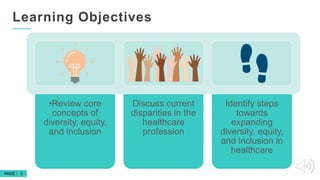
•Review core
concepts of
diversity, equity,
and inclusion
Discuss current
disparities in the
healthcare
profession
Identify steps
towards
expanding
diversity, equity,
and inclusion in
healthcare
PAGE
Diversity, Equity,
and Inclusion
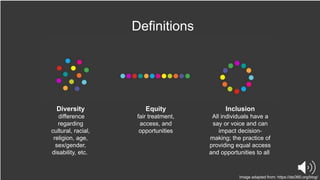
Definitions
Image adapted from: https://dei360.org/blog/
Diversity
difference
regarding
cultural, racial,
religion, age,
sex/gender,
disability, etc.
Equity
fair treatment,
access, and
opportunities
Inclusion
All individuals have a
say or voice and can
impact decision-
making; the practice of
providing equal access
and opportunities to all
Diversity
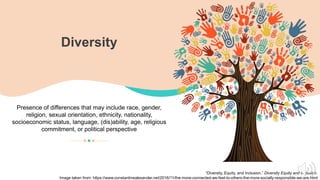
Presence of differences that may include race, gender,
religion, sexual orientation, ethnicity, nationality,
socioeconomic status, language, (dis)ability, age, religious
commitment, or political perspective
“Diversity, Equity, and Inclusion.” Diversity Equity and Inclusion.
Image taken from: https://www.constantinealexander.net/2016/11/the-more-connected-we-feel-to-others-the-more-socially-responsible-we-are.html
PAGE
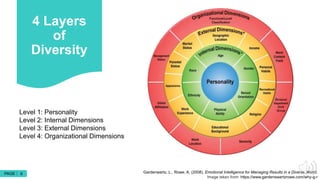
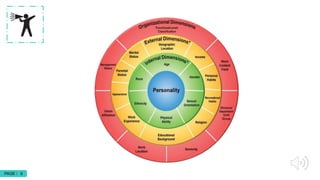
4 Layers
of
Diversity
6 Gardenwartz, L., Rowe, A. (2008). Emotional Intelligence for Managing Results in a Diverse World.
Image taken from: https://www.gardenswartzrowe.com/why-g-r
Level 1: Personality
Level 2: Internal Dimensions
Level 3: External Dimensions
Level 4: Organizational Dimensions
PAGE 7
What is an internal dimension of diversity?
A. Management Status
B. Physical Ability
C. Income
D. Appearance
Assessment Question
PAGE 8
What is an internal dimension of diversity?
A. Management Status
B. Physical Ability
C. Income
D. Appearance
Assessment Question
PAGE 9
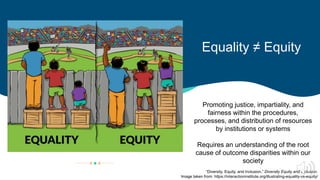
Promoting justice, impartiality, and
fairness within the procedures,
processes, and distribution of resources
by institutions or systems
Requires an understanding of the root
cause of outcome disparities within our
society
Equality ≠ Equity
“Diversity, Equity, and Inclusion.” Diversity Equity and Inclusion.
Image taken from: https://interactioninstitute.org/illustrating-equality-vs-equity/
PAGE
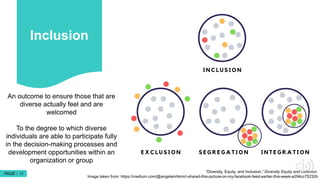
Inclusion
11
“Diversity, Equity, and Inclusion.” Diversity Equity and Inclusion.
Image taken from: https://medium.com/@angelamhkim/i-shared-this-picture-on-my-facebook-feed-earlier-this-week-e294cc75232b
An outcome to ensure those that are
diverse actually feel and are
welcomed
To the degree to which diverse
individuals are able to participate fully
in the decision-making processes and
development opportunities within an
organization or group
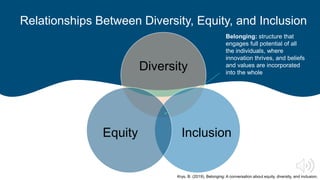
Relationships Between Diversity, Equity, and Inclusion
Krys, B. (2019). Belonging: A conversation about equity, diversity, and inclusion.
Diversity
Inclusion
Equity
Belonging: structure that
engages full potential of all
the individuals, where
innovation thrives, and beliefs
and values are incorporated
into the whole
PAGE 13
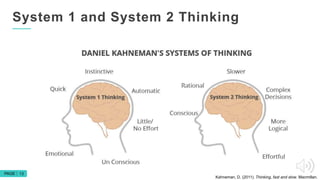
System 1 and System 2 Thinking
Kahneman, D. (2011). Thinking, fast and slow. Macmillan.
PAGE
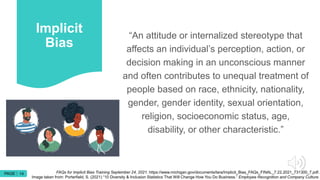
Implicit
Bias
“An attitude or internalized stereotype that
affects an individual’s perception, action, or
decision making in an unconscious manner
and often contributes to unequal treatment of
people based on race, ethnicity, nationality,
gender, gender identity, sexual orientation,
religion, socioeconomic status, age,
disability, or other characteristic.”
14 FAQs for Implicit Bias Training September 24, 2021. https://www.michigan.gov/documents/lara/Implicit_Bias_FAQs_FINAL_7.22.2021_731300_7.pdf.
Image taken from: Porterfield, S. (2021) “10 Diversity & Inclusion Statistics That Will Change How You Do Business.” Employee Recognition and Company Culture.
PAGE
Biases
15
Implicit Bias
• Attitudes and beliefs that occur outside of
our conscious awareness and control
• Example of System 1 thinking, such that we
are not even aware they exist
• May play a role in patient marginalization
Explicit Bias
• Biases we are aware of on a conscious level
• Example of System 2 thinking
• Implicit biases can become explicit bias
when you become consciously aware of the
prejudices and beliefs you possess
Greenwald, A., & Krieger, L. (2006). Implicit bias: Scientific foundations. California Law Review, 94(4), 945-967.
PAGE 16
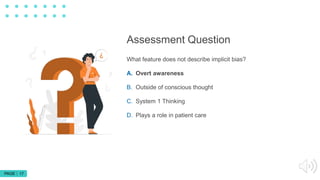
What feature does not describe implicit bias?
A. Overt awareness
B. Outside of conscious thought
C. System 1 Thinking
D. Plays a role in patient care
Assessment Question
PAGE 17
What feature does not describe implicit bias?
A. Overt awareness
B. Outside of conscious thought
C. System 1 Thinking
D. Plays a role in patient care
Assessment Question
PAGE
Disparities among
Healthcare Workers
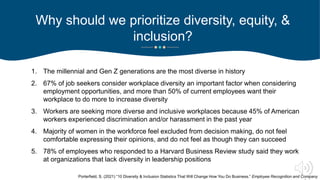
1. The millennial and Gen Z generations are the most diverse in history
2. 67% of job seekers consider workplace diversity an important factor when considering
employment opportunities, and more than 50% of current employees want their
workplace to do more to increase diversity
3. Workers are seeking more diverse and inclusive workplaces because 45% of American
workers experienced discrimination and/or harassment in the past year
4. Majority of women in the workforce feel excluded from decision making, do not feel
comfortable expressing their opinions, and do not feel as though they can succeed
5. 78% of employees who responded to a Harvard Business Review study said they work
at organizations that lack diversity in leadership positions
Why should we prioritize diversity, equity, &
inclusion?
Porterfield, S. (2021) “10 Diversity & Inclusion Statistics That Will Change How You Do Business.” Employee Recognition and Company
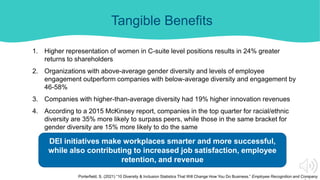
Tangible Benefits
Porterfield, S. (2021) “10 Diversity & Inclusion Statistics That Will Change How You Do Business.” Employee Recognition and Company
1. Higher representation of women in C-suite level positions results in 24% greater
returns to shareholders
2. Organizations with above-average gender diversity and levels of employee
engagement outperform companies with below-average diversity and engagement by
46-58%
3. Companies with higher-than-average diversity had 19% higher innovation revenues
4. According to a 2015 McKinsey report, companies in the top quarter for racial/ethnic
diversity are 35% more likely to surpass peers, while those in the same bracket for
gender diversity are 15% more likely to do the same
DEI initiatives make workplaces smarter and more successful,
while also contributing to increased job satisfaction, employee
retention, and revenue
PAGE
Fostering and
Managing
Diversity in
Schools of
Pharmacy
21
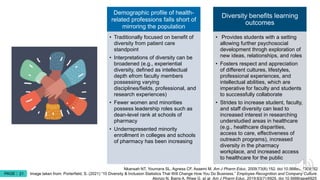
Demographic profile of health-
related professions falls short of
mirroring the population
• Traditionally focused on benefit of
diversity from patient care
standpoint
• Interpretations of diversity can be
broadened (e.g., experiential
diversity, defined as intellectual
depth efrom faculty members
possessing varying
disciplines/fields, professional, and
research experiences)
• Fewer women and minorities
possess leadership roles such as
dean-level rank at schools of
pharmacy
• Underrepresented minority
enrollment in colleges and schools
of pharmacy has been increasing
Diversity benefits learning
outcomes
• Provides students with a setting
allowing further psychosocial
development throgh exploration of
new ideas, relationships, and roles
• Fosters respect and appreciation
of different cultures, lifestyles,
professional experiences, and
intellectual abilities, which are
imperative for faculty and students
to successfully collaborate
• Strides to increase student, faculty,
and staff diversity can lead to
increased interest in researching
understudied areas in healthcare
(e.g., healthcare disparities,
access to care, effectiveness of
outreach programs), increased
diversity in the pharmacy
workplace, and increased access
to healthcare for the public
Nkansah NT, Youmans SL, Agness CF, Assemi M. Am J Pharm Educ. 2009;73(8):152. doi:10.5688/aj7308152
Image taken from: Porterfield, S. (2021) “10 Diversity & Inclusion Statistics That Will Change How You Do Business.” Employee Recognition and Company Culture.
Alonzo N, Bains A, Rhee G, et al. Am J Pharm Educ. 2019;83(7):6925. doi:10.5688/ajpe6925
PAGE
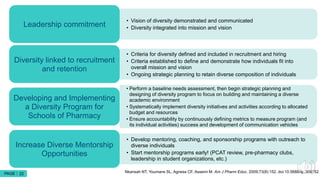
Developing
and
Implementing
Diversity in
Schools of
Pharmacy
22 Nkansah NT, Youmans SL, Agness CF, Assemi M. Am J Pharm Educ. 2009;73(8):152. doi:10.5688/aj7308152
• Vision of diversity demonstrated and communicated
• Diversity integrated into mission and vision
Leadership commitment
• Criteria for diversity defined and included in recruitment and hiring
• Criteria established to define and demonstrate how individuals fit into
overall mission and vision
• Ongoing strategic planning to retain diverse composition of individuals
Diversity linked to recruitment
and retention
• Perform a baseline needs assessment, then begin strategic planning and
designing of diversity program to focus on building and maintaining a diverse
academic environment
• Systematically implement diversity initiatives and activities according to allocated
budget and resources
• Ensure accountability by continuously defining metrics to measure program (and
its individual activities) success and development of communication vehicles
Developing and Implementing
a Diversity Program for
Schools of Pharmacy
• Develop mentoring, coaching, and sponsorship programs with outreach to
diverse individuals
• Start mentorship programs early! (PCAT review, pre-pharmacy clubs,
leadership in student organizations, etc.)
Increase Diverse Mentorship
Opportunities
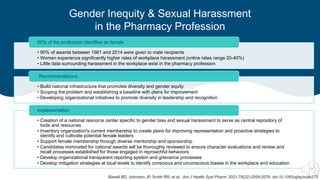
Gender Inequity & Sexual Harassment
in the Pharmacy Profession
Bissell BD, Johnston JP, Smith RR, et al. Am J Health Syst Pharm. 2021;78(22):2059-2076. doi:10.1093/ajhp/zxab275
• 90% of awards between 1981 and 2014 were given to male recipients
• Women experience significantly higher rates of workplace harassment (online rates range 20-40%)
• Little data surrounding harassment in the workplace exist in the pharmacy profession
60% of the profession identifies as female
• Build national infrastructure that promotes diversity and gender equity
• Scoping the problem and establishing a baseline with plans for improvement
• Developing organizational initiatives to promote diversity in leadership and recognition
Recommendations
• Creation of a national resource center specific to gender bias and sexual harassment to serve as central repository of
tools and resources
• Inventory organization's current membership to create plans for improving representation and proactive strategies to
identify and cultivate potential female leaders
• Support female membership through diverse mentorship and sponsorship
• Candidates nominated for national awards will be thoroughly reviewed to ensure character evaluations and review and
recall processes established for those engaged in reproachful behaviors
• Develop organizational transparent reporting system and grievance processes
• Develop mitigation strategies at local levels to identify conscious and unconscious biases in the workplace and education
Implementation
PAGE
Disparities in
Patient Outcomes
Chapman EN, Kaatz A, Carnes M. J Gen Intern Med. 2013;28(11):1504-1510. doi:10.1007/s11606-013-2441-1
Hoffman KM, Trawalter S, Axt JR, Oliver MN. Proc Natl Acad Sci U S A. 2016;113(16):4296-4301. doi:10.1073/pnas.1516047113
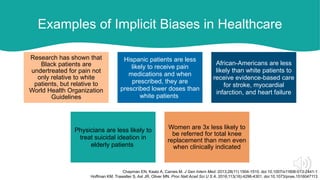
Examples of Implicit Biases in Healthcare
Research has shown that
Black patients are
undertreated for pain not
only relative to white
patients, but relative to
World Health Organization
Guidelines
Hispanic patients are less
likely to receive pain
medications and when
prescribed, they are
prescribed lower doses than
white patients
African-Americans are less
likely than white patients to
receive evidence-based care
for stroke, myocardial
infarction, and heart failure
Physicians are less likely to
treat suicidal ideation in
elderly patients
Women are 3x less likely to
be referred for total knee
replacement than men even
when clinically indicated
Cerdeña JP, Plaisime MV, Tsai J. Lancet. 2020;396(10257):1125-1128. doi:10.1016/S0140-6736(20)32076-6
Vyas DA, Eisenstein LG, Jones DS. N Engl J Med. 2020;383(9):874-882. doi:10.1056/NEJMms2004740
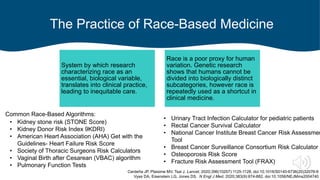
The Practice of Race-Based Medicine
System by which research
characterizing race as an
essential, biological variable,
translates into clinical practice,
leading to inequitable care.
Race is a poor proxy for human
variation. Genetic research
shows that humans cannot be
divided into biologically distinct
subcategories, however race is
repeatedly used as a shortcut in
clinical medicine.
Common Race-Based Algorithms:
• Kidney stone risk (STONE Score)
• Kidney Donor Risk Index 9KDRI)
• American Heart Association (AHA) Get with the
Guidelines- Heart Failure Risk Score
• Society of Thoracic Surgeons Risk Calculators
• Vaginal Birth after Cesarean (VBAC) algorithm
• Pulmonary Function Tests
• Urinary Tract Infection Calculator for pediatric patients
• Rectal Cancer Survival Calculator
• National Cancer Institute Breast Cancer Risk Assessmen
Tool
• Breast Cancer Surveillance Consortium Risk Calculator
• Osteoporosis Risk Score
• Fracture Risk Assessment Tool (FRAX)
Cerdeña JP, Plaisime MV, Tsai J. Lancet. 2020;396(10257):1125-1128. doi:10.1016/S0140-6736(20)32076-6
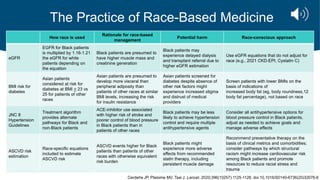
The Practice of Race-Based Medicine
How race is used
Rationale for race-based
management
Potential harm Race-conscious approach
eGFR
EGFR for Black patients
is multiplied by 1.16-1.21
the eGFR for white
patients depending on
the equation
Black patients are presumed to
have higher muscle mass and
creatinine generation
Black patients may
experience delayed dialysis
and transplant referral due to
higher eGFR estimation
Use eGFR equations that do not adjust for
race (e.g., 2021 CKD-EPI, Cystatin C)
BMI risk for
diabetes
Asian patients
considered at risk for
diabetes at BMI > 23 vs
25 for patients of other
races
Asian patients are presumed to
develop more visceral than
peripheral adiposity than
patients of other races at similar
BMI levels, increasing the risk
for insulin resistance
Asian patients screened for
diabetes despite absence of
other risk factors might
experience increased stigma
and distrust of medical
providers
Screen patients with lower BMIs on the
basis of indications of
increased body fat (eg, body roundness,12
body fat percentage), not based on race
JNC 8
Hypertension
Guidelines
Treatment algorithm
provides alternate
pathways for Black and
non-Black patients
ACE-inhibitor use associated
with higher risk of stroke and
poorer control of blood pressure
in Black patients than in
patients of other races
Black patients may be less
likely to achieve hypertension
control and require multiple
antihypertensive agents
Consider all antihypertensive options for
blood pressure control in Black patients,
adjust as needed to achieve goals and
manage adverse effects
ASCVD risk
estimation
Race-specific equations
included to estimate
ASCVD risk
ASCVD events higher for Black
patients than patients of other
races with otherwise equivalent
risk burden
Black patients might
experience more adverse
effects from recommended
statin therapy, including
persistent muscle damage
Recommend preventative therapy on the
basis of clinical metrics and comorbidities;
consider pathways by which structural
racism might increase cardiovascular risk
among Black patients and promote
resources to reduce racial stress and
trauma
PAGE
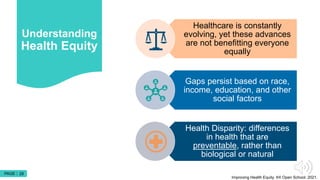
Understanding
Health Equity
28
Healthcare is constantly
evolving, yet these advances
are not benefitting everyone
equally
Gaps persist based on race,
income, education, and other
social factors
Health Disparity: differences
in health that are
preventable, rather than
biological or natural
Improving Health Equity. IHI Open School. 2021.
PAGE
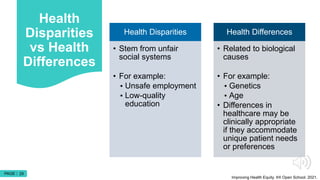
Health
Disparities
vs Health
Differences
29
Improving Health Equity. IHI Open School. 2021.
Health Disparities
• Stem from unfair
social systems
• For example:
•Unsafe employment
•Low-quality
education
Health Differences
• Related to biological
causes
• For example:
•Genetics
•Age
• Differences in
healthcare may be
clinically appropriate
if they accommodate
unique patient needs
or preferences
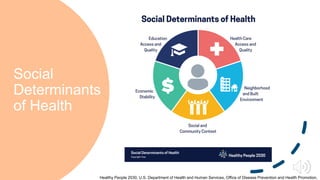
Social
Determinants
of Health
Healthy People 2030, U.S. Department of Health and Human Services, Office of Disease Prevention and Health Promotion.
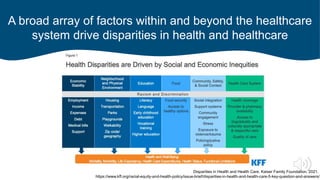
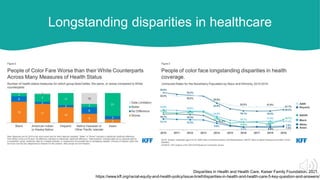
Disparities in Health and Health Care. Kaiser Family Foundation. 2021.
https://www.kff.org/racial-equity-and-health-policy/issue-brief/disparities-in-health-and-health-care-5-key-question-and-answers/
A broad array of factors within and beyond the healthcare
system drive disparities in health and healthcare
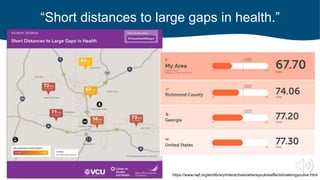
“Short distances to large gaps in health.”
https://www.rwjf.org/en/library/interactives/whereyouliveaffectshowlongyoulive.html
Disparities in Health and Health Care. Kaiser Family Foundation. 2021.
https://www.kff.org/racial-equity-and-health-policy/issue-brief/disparities-in-health-and-health-care-5-key-question-and-answers/
Longstanding disparities in healthcare
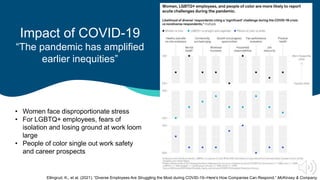
Impact of COVID-19
“The pandemic has amplified
earlier inequities”
• Women face disproportionate stress
• For LGBTQ+ employees, fears of
isolation and losing ground at work loom
large
• People of color single out work safety
and career prospects
Ellingrud, K., et al. (2021). “Diverse Employees Are Struggling the Most during COVID-19--Here's How Companies Can Respond.” McKinsey & Company.
PAGE
Racial
Disparities in
ICU
Outcomes
35
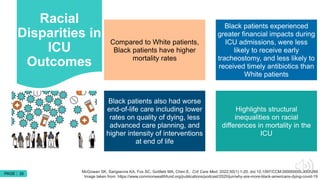
McGowan SK, Sarigiannis KA, Fox SC, Gottlieb MA, Chen E. Crit Care Med. 2022;50(1):1-20. doi:10.1097/CCM.0000000000005269
Image taken from: https://www.commonwealthfund.org/publications/podcast/2020/jun/why-are-more-black-americans-dying-covid-19
Compared to White patients,
Black patients have higher
mortality rates
Black patients experienced
greater financial impacts during
ICU admissions, were less
likely to receive early
tracheostomy, and less likely to
received timely antibiotics than
White patients
Black patients also had worse
end-of-life care including lower
rates on quality of dying, less
advanced care planning, and
higher intensity of interventions
at end of life
Highlights structural
inequalities on racial
differences in mortality in the
ICU
Racial/Ethnic
Differences in
Emergency
Department
Outcomes
Zhang X, Carabello M, Hill T, Bell SA, Stephenson R, Mahajan P. Front Med (Lausanne). 2020;7:300. Published 2020 Jun 25. doi:10.3389/fmed.2020.00300
Image taken from: https://www.youthventuresjpa.org/post/covid-19-racial-disparities-task-force
Upon arrival to the ED, minority populations have been found to receive
disparate treatment for a number of common symptoms including chest pain,
acute coronary events, trauma, stroke symptoms and brain injury, pain
management for bone fractures, migraines, and back pain as compared to
white patients.
Black patients were 10% less likely to receive immediate or emergent
(as opposed to semi- or non-urgent) ESI scores, while Hispanic
patients were 8% more likely to receive immediate or urgent scores
and Asian patients were 19% more likely to receive immediate and
emergent or urgent care compared to white patients.
Black and Hispanic patients were 10% less likely than white patients
to be admitted to the hospital. Black patients were 1.26 times more
likely to die in hospital. Hispanic patients were 1.12 times more likely
to die in hospital, and Asian patients were 1.64 times more likely to die
in hospital.
Black patients were 16% less likely to receive any imaging and 4% less likely
to have a blood test during an ED visit than white patients. Waiting times in
the ED were significantly longer for all minorities.
PAGE
Consequences
& Impact of
Race-Based
Medicine on
Learners
37
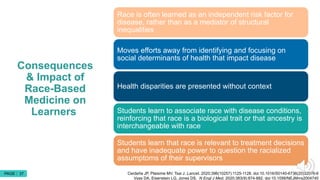
Race is often learned as an independent risk factor for
disease, rather than as a mediator of structural
inequalities
Moves efforts away from identifying and focusing on
social determinants of health that impact disease
Health disparities are presented without context
Students learn to associate race with disease conditions,
reinforcing that race is a biological trait or that ancestry is
interchangeable with race
Students learn that race is relevant to treatment decisions
and have inadequate power to question the racialized
assumptoms of their supervisors
Cerdeña JP, Plaisime MV, Tsai J. Lancet. 2020;396(10257):1125-1128. doi:10.1016/S0140-6736(20)32076-6
Vyas DA, Eisenstein LG, Jones DS. N Engl J Med. 2020;383(9):874-882. doi:10.1056/NEJMms2004740
PAGE 38
38
L G B T +
And more!
PAGE 39
39
L G B T +
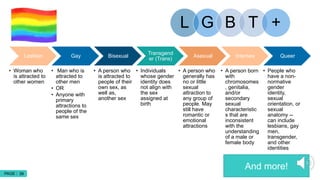
Lesbian
• Woman who
is attracted to
other women
Gay
• Man who is
attracted to
other men
• OR
• Anyone with
primary
attractions to
people of the
same sex
Bisexual
• A person who
is attracted to
people of their
own sex, as
well as,
another sex
Transgend
er (Trans)
• Individuals
whose gender
identity does
not align with
the sex
assigned at
birth
Asexual
• A person who
generally has
no or little
sexual
attraction to
any group of
people. May
still have
romantic or
emotional
attractions
Intersex
• A person born
with
chromosomes
, genitalia,
and/or
secondary
sexual
characteristic
s that are
inconsistent
with the
understanding
of a male or
female body
Queer
• People who
have a non-
normative
gender
identity,
sexual
orientation, or
sexual
anatomy --
can include
lesbians, gay
men,
transgender,
and other
identities
And more!
PAGE 40
40
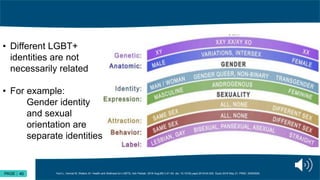
• Different LGBT+
identities are not
necessarily related
• For example:
Gender identity
and sexual
orientation are
separate identities
Hunt L, Vennat M, Waters JH. Health and Wellness for LGBTQ. Adv Pediatr. 2018 Aug;65(1):41-54. doi: 10.1016/j.yapd.2018.04.002. Epub 2018 May 21. PMID: 30053929.
PAGE 41
41
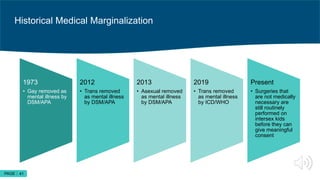
Historical Medical Marginalization
1973
• Gay removed as
mental illness by
DSM/APA
2012
• Trans removed
as mental illness
by DSM/APA
2013
• Asexual removed
as mental illness
by DSM/APA
2019
• Trans removed
as mental illness
by ICD/WHO
Present
• Surgeries that
are not medically
necessary are
still routinely
performed on
intersex kids
before they can
give meaningful
consent
PAGE 42
42
42
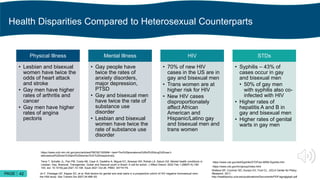
Health Disparities Compared to Heterosexual Counterparts
Physical Illness
• Lesbian and bisexual
women have twice the
odds of heart attack
and stroke
• Gay men have higher
rates of arthritis and
cancer
• Gay men have higher
rates of angina
pectoris
Mental Illness
• Gay people have
twice the rates of
anxiety disorders,
major depression,
PTSD
• Gay and bisexual men
have twice the rate of
substance use
disorder
• Lesbian and bisexual
women have twice the
rate of substance use
disorder
HIV
• 70% of new HIV
cases in the US are in
gay and bisexual men
• Trans women are at
higher risk for HIV
• New HIV cases
disproportionately
affect African
American and
Hispanic/Latino gay
and bisexual men and
trans women
STDs
• Syphilis – 43% of
cases occur in gay
and bisexual men
• 50% of gay men
with syphilis also co-
infected with HIV
• Higher rates of
hepatitis A and B in
gay and bisexual men
• Higher rates of genital
warts in gay men
https://www.cdc.gov/std/Syphilis/STDFact-MSM-Syphilis.htm
Jin F, Prestage GP, Kippax SC, et al. Risk factors for genital and anal warts in a prospective cohort of HIV-negative homosexual men:
the HIM study. Sex Transm Dis 2007;34:488–93.
Wallace SP, Cochran SD, Durazo EV, Ford CL. UCLA Center for Policy
Research. 2011.
http://healthpolicy.ucla.edu/publications/Documents/PDF/aginglgbpb.pdf
Terra T, Schafer JL, Pan PM, Costa AB, Caye A, Gadelha A, Miguel EC, Bressan RA, Rohde LA, Salum GA. Mental health conditions in
Lesbian, Gay, Bisexual, Transgender, Queer and Asexual youth in Brazil: A call for action. J Affect Disord. 2022 Feb 1;298(Pt A):190-
193. doi: 10.1016/j.jad.2021.10.108. Epub 2021 Oct 26. PMID: 34715179.
https://www.ncbi.nlm.nih.gov/pmc/articles/PMC8213009/#:~:text=The%20prevalence%20of%20drug%20use,h
eterosexual%20men%20and%20women%2C%20respectively.
https://www.cdc.gov/hiv/group/index.html
PAGE 43
43
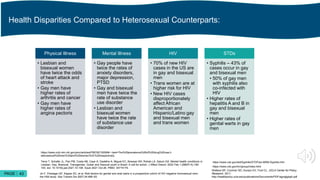
Health Disparities Compared to Heterosexual Counterparts:
Physical Illness
• Lesbian and
bisexual women
have twice the odds
of heart attack and
stroke
• Gay men have
higher rates of
arthritis and cancer
• Gay men have
higher rates of
angina pectoris
Mental Illness
• Gay people have
twice the rates of
anxiety disorders,
major depression,
PTSD
• Gay and bisexual
men have twice the
rate of substance
use disorder
• Lesbian and
bisexual women
have twice the rate
of substance use
disorder
HIV
• 70% of new HIV
cases in the US are
in gay and bisexual
men
• Trans women are at
higher risk for HIV
• New HIV cases
disproportionately
affect African
American and
Hispanic/Latino gay
and bisexual men
and trans women
STDs
• Syphilis – 43% of
cases occur in gay
and bisexual men
• 50% of gay men
with syphilis also
co-infected with
HIV
• Higher rates of
hepatitis A and B in
gay and bisexual
men
• Higher rates of
genital warts in gay
men
https://www.cdc.gov/std/Syphilis/STDFact-MSM-Syphilis.htm
Jin F, Prestage GP, Kippax SC, et al. Risk factors for genital and anal warts in a prospective cohort of HIV-negative homosexual men:
the HIM study. Sex Transm Dis 2007;34:488–93.
Wallace SP, Cochran SD, Durazo EV, Ford CL. UCLA Center for Policy
Research. 2011.
http://healthpolicy.ucla.edu/publications/Documents/PDF/aginglgbpb.pdf
Terra T, Schafer JL, Pan PM, Costa AB, Caye A, Gadelha A, Miguel EC, Bressan RA, Rohde LA, Salum GA. Mental health conditions in
Lesbian, Gay, Bisexual, Transgender, Queer and Asexual youth in Brazil: A call for action. J Affect Disord. 2022 Feb 1;298(Pt A):190-
193. doi: 10.1016/j.jad.2021.10.108. Epub 2021 Oct 26. PMID: 34715179.
https://www.ncbi.nlm.nih.gov/pmc/articles/PMC8213009/#:~:text=The%20prevalence%20of%20drug%20use,h
eterosexual%20men%20and%20women%2C%20respectively.
https://www.cdc.gov/hiv/group/index.html
PAGE 44
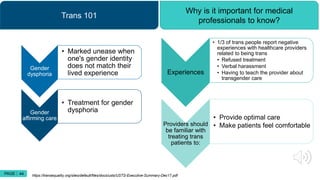
Trans 101
44
Why is it important for medical
professionals to know?
Gender
dysphoria
• Marked unease when
one's gender identity
does not match their
lived experience
Gender
affirming care
• Treatment for gender
dysphoria
Experiences
• 1/3 of trans people report negative
experiences with healthcare providers
related to being trans
• Refused treatment
• Verbal harassment
• Having to teach the provider about
transgender care
Providers should
be familiar with
treating trans
patients to:
• Provide optimal care
• Make patients feel comfortable
https://transequality.org/sites/default/files/docs/usts/USTS-Executive-Summary-Dec17.pdf
PAGE 45
45
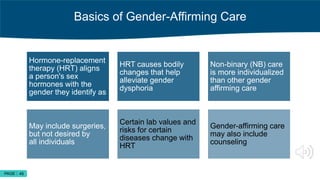
Basics of Gender-Affirming Care
Hormone-replacement
therapy (HRT) aligns
a person's sex
hormones with the
gender they identify as
HRT causes bodily
changes that help
alleviate gender
dysphoria
Non-binary (NB) care
is more individualized
than other gender
affirming care
May include surgeries,
but not desired by
all individuals
Certain lab values and
risks for certain
diseases change with
HRT
Gender-affirming care
may also include
counseling
PAGE 46
46
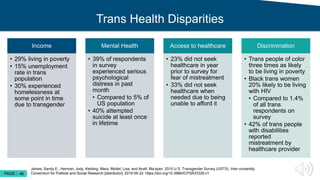
Trans Health Disparities
Income
• 29% living in poverty
• 15% unemployment
rate in trans
population
• 30% experienced
homelessness at
some point in time
due to transgender
Mental Health
• 39% of respondents
in survey
experienced serious
psychological
distress in past
month
• Compared to 5% of
US population
• 40% attempted
suicide at least once
in lifetime
Access to healthcare
• 23% did not seek
healthcare in year
prior to survey for
fear of mistreatment
• 33% did not seek
healthcare when
needed due to being
unable to afford it
Discrimination
• Trans people of color
three times as likely
to be living in poverty
• Black trans women
20% likely to be living
with HIV
• Compared to 1.4%
of all trans
respondents on
survey
• 42% of trans people
with disabilities
reported
mistreatment by
healthcare provider
James, Sandy E., Herman, Jody, Keisling, Mara, Mottet, Lisa, and Anafi, Ma’ayan. 2015 U.S. Transgender Survey (USTS). Inter-university
Consortium for Political and Social Research [distributor], 2019-05-22. https://doi.org/10.3886/ICPSR37229.v1
PAGE 47
47
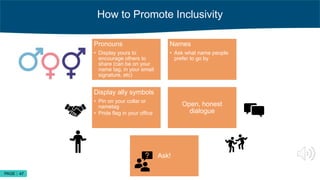
How to Promote Inclusivity
Pronouns
• Display yours to
encourage others to
share (can be on your
name tag, in your email
signature, etc)
Names
• Ask what name people
prefer to go by
Display ally symbols
• Pin on your collar or
nametag
• Pride flag in your office
Open, honest
dialogue
Ask!
PAGE 48
48
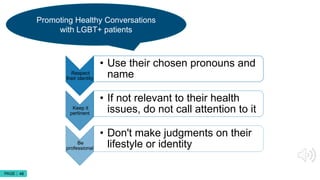
Promoting Healthy Conversations
with LGBT+ patients
Respect
their identity
• Use their chosen pronouns and
name
Keep it
pertinent
• If not relevant to their health
issues, do not call attention to it
Be
professional
• Don't make judgments on their
lifestyle or identity
PAGE 49
49
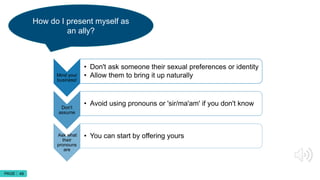
How do I present myself as
an ally?
Mind your
business!
• Don't ask someone their sexual preferences or identity
• Allow them to bring it up naturally
Don't
assume
• Avoid using pronouns or 'sir/ma'am' if you don't know
Ask what
their
pronouns
are
• You can start by offering yours
PAGE 50
50
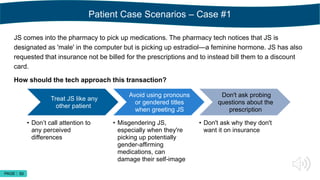
Patient Case Scenarios – Case #1
JS comes into the pharmacy to pick up medications. The pharmacy tech notices that JS is
designated as 'male' in the computer but is picking up estradiol—a feminine hormone. JS has also
requested that insurance not be billed for the prescriptions and to instead bill them to a discount
card.
How should the tech approach this transaction?
Treat JS like any
other patient
• Don’t call attention to
any perceived
differences
Avoid using pronouns
or gendered titles
when greeting JS
• Misgendering JS,
especially when they're
picking up potentially
gender-affirming
medications, can
damage their self-image
Don't ask probing
questions about the
prescription
• Don't ask why they don't
want it on insurance
PAGE 51
51
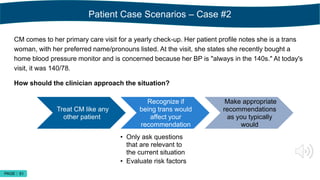
Patient Case Scenarios – Case #2
CM comes to her primary care visit for a yearly check-up. Her patient profile notes she is a trans
woman, with her preferred name/pronouns listed. At the visit, she states she recently bought a
home blood pressure monitor and is concerned because her BP is "always in the 140s." At today's
visit, it was 140/78.
How should the clinician approach the situation?
Treat CM like any
other patient
Recognize if
being trans would
affect your
recommendation
• Only ask questions
that are relevant to
the current situation
• Evaluate risk factors
Make appropriate
recommendations
as you typically
would
PAGE
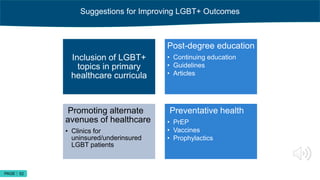
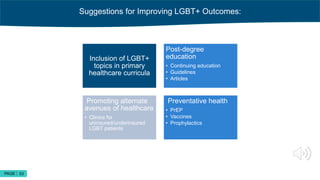
Suggestions for Improving LGBT+ Outcomes
52
Inclusion of LGBT+
topics in primary
healthcare curricula
Post-degree education
• Continuing education
• Guidelines
• Articles
Promoting alternate
avenues of healthcare
• Clinics for
uninsured/underinsured
LGBT patients
Preventative health
• PrEP
• Vaccines
• Prophylactics
PAGE
Suggestions for Improving LGBT+ Outcomes:
53
Inclusion of LGBT+
topics in primary
healthcare curricula
Post-degree
education
• Continuing education
• Guidelines
• Articles
Promoting alternate
avenues of healthcare
• Clinics for
uninsured/underinsured
LGBT patients
Preventative health
• PrEP
• Vaccines
• Prophylactics
PAGE
Expansion of
Diversity, Equity, and
Inclusion in
Healthcare
PAGE
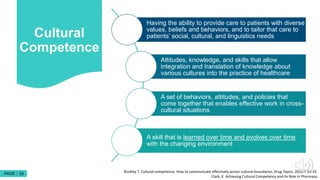
Cultural
Competence
55
Buckley T. Cultural competency: How to communicate effectively across cultural boundaries. Drug Topics. 2012;7:24‐33.
Clark, K. Achieving Cultural Competency and Its Role in Pharmacy.
Having the ability to provide care to patients with diverse
values, beliefs and behaviors, and to tailor that care to
patients’ social, cultural, and linguistics needs
Attitudes, knowledge, and skills that allow
integration and translation of knowledge about
various cultures into the practice of healthcare
A set of behaviors, attitudes, and policies that
come together that enables effective work in cross-
cultural situations
A skill that is learned over time and evolves over time
with the changing environment
PAGE 56
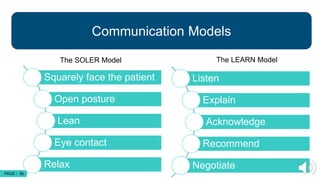
Communication Models
Squarely face the patient
Open posture
Lean
Eye contact
Relax
Listen
Explain
Acknowledge
Recommend
Negotiate
The SOLER Model The LEARN Model
PAGE 57
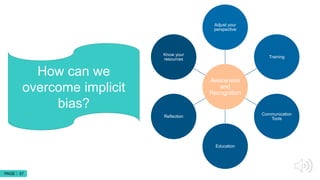
Awareness
and
Recognition
Adjust your
perspective
Training
Communication
Tools
Education
Reflection
Know your
resources
How can we
overcome implicit
bias?
PAGE 58
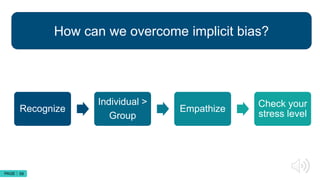
How can we overcome implicit bias?
Recognize
Individual >
Group
Empathize
Check your
stress level
PAGE
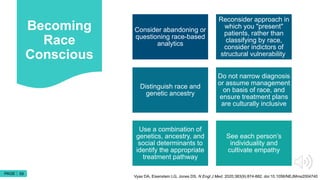
Becoming
Race
Conscious
59
Vyas DA, Eisenstein LG, Jones DS. N Engl J Med. 2020;383(9):874-882. doi:10.1056/NEJMms2004740
Consider abandoning or
questioning race-based
analytics
Reconsider approach in
which you "present"
patients, rather than
classifying by race,
consider indictors of
structural vulnerability
Distinguish race and
genetic ancestry
Do not narrow diagnosis
or assume management
on basis of race, and
ensure treatment plans
are culturally inclusive
Use a combination of
genetics, ancestry, and
social determinants to
identify the appropriate
treatment pathway
See each person’s
individuality and
cultivate empathy
PAGE 60
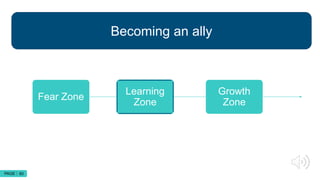
Fear Zone Fear Zone
Learning
Zone
Growth
Zone
Becoming an ally
PAGE 61
References
• “Diversity, Equity, and Inclusion.” Diversity Equity and Inclusion. Image taken from: https://www.constantinealexander.net/2016/11/the-more-
connected-we-feel-to-others-the-more-socially-responsible-we-are.html
• Gardenwartz, L., Rowe, A. (2008). Emotional Intelligence for Managing Results in a Diverse World. Image taken from:
https://www.gardenswartzrowe.com/why-g-r
• “Diversity, Equity, and Inclusion.” Diversity Equity and Inclusion. Image taken from: https://interactioninstitute.org/illustrating-equality-vs-equity/
• “Diversity, Equity, and Inclusion.” Diversity Equity and Inclusion. Image taken from: https://medium.com/@angelamhkim/i-shared-this-picture-
on-my-facebook-feed-earlier-this-week-e294cc75232b
• Krys, B. (2019). Belonging: A conversation about equity, diversity, and inclusion.
• Kahneman, D. (2011). Thinking, fast and slow. Macmillan.
• FAQs for Implicit Bias Training September 24, 2021.
https://www.michigan.gov/documents/lara/Implicit_Bias_FAQs_FINAL_7.22.2021_731300_7.pdf.
• Greenwald, A., & Krieger, L. (2006). Implicit bias: Scientific foundations. California Law Review, 94(4), 945-967.
• Porterfield, S. (2021) “10 Diversity & Inclusion Statistics That Will Change How You Do Business.” Employee Recognition and Company
Culture.
• Nkansah NT, Youmans SL, Agness CF, Assemi M. Am J Pharm Educ. 2009;73(8):152. doi:10.5688/aj7308152
• Porterfield, S. (2021) “10 Diversity & Inclusion Statistics That Will Change How You Do Business.” Employee Recognition and Company
Culture.
• Alonzo N, Bains A, Rhee G, et al. Am J Pharm Educ. 2019;83(7):6925. doi:10.5688/ajpe6925
• Bissell BD, Johnston JP, Smith RR, et al. Am J Health Syst Pharm. 2021;78(22):2059-2076. doi:10.1093/ajhp/zxab275
PAGE 62
References
• Chapman EN, Kaatz A, Carnes M. J Gen Intern Med. 2013;28(11):1504-1510. doi:10.1007/s11606-013-2441-1
• Hoffman KM, Trawalter S, Axt JR, Oliver MN. Proc Natl Acad Sci U S A. 2016;113(16):4296-4301. doi:10.1073/pnas.1516047113
• Cerdeña JP, Plaisime MV, Tsai J. Lancet. 2020;396(10257):1125-1128. doi:10.1016/S0140-6736(20)32076-6
• Vyas DA, Eisenstein LG, Jones DS. N Engl J Med. 2020;383(9):874-882. doi:10.1056/NEJMms2004740
• Improving Health Equity. IHI Open School. 2021.
• Healthy People 2030, U.S. Department of Health and Human Services, Office of Disease Prevention and Health Promotion.
• Disparities in Health and Health Care. Kaiser Family Foundation. 2021.
https://www.kff.org/racial-equity-and-health-policy/issue-brief/disparities-in-health-and-health-care-5-key-question-and-answers/
• Ellingrud, K., et al. (2021). “Diverse Employees Are Struggling the Most during COVID-19--Here's How Companies Can Respond.” McKinsey
& Company.
• McGowan SK, Sarigiannis KA, Fox SC, Gottlieb MA, Chen E. Crit Care Med. 2022;50(1):1-20. doi:10.1097/CCM.0000000000005269
• Image taken from: https://www.commonwealthfund.org/publications/podcast/2020/jun/why-are-more-black-americans-dying-covid-19
• Zhang X, Carabello M, Hill T, Bell SA, Stephenson R, Mahajan P. Front Med (Lausanne). 2020;7:300. Published 2020 Jun 25.
doi:10.3389/fmed.2020.00300
• Image taken from: https://www.youthventuresjpa.org/post/covid-19-racial-disparities-task-force
• Buckley T. Cultural competency: How to communicate effectively across cultural boundaries. Drug Topics. 2012;7:24‐33.
• Clark, K. Achieving Cultural Competency and Its Role in Pharmacy.
Thank you!
Paths Forward for Diversity, Equity, and Inclusion in Healthcare
Andrea Sikora, PharmD, MSCR, BCCCP, FCCM
Clinical Associate Professor,
University of Georgia College of Pharmacy
@AndreaSikora
Evaluation Access Code: 8126