External Adaptability of Higher Education Institutions: The Use of Diagnostic Interventions to Improve Agility 
Rana Zeine, MD, PhD, MBA 
Assistant Professor, 
Saint James School of Medicine 
Bonaire Caribbean Netherlands 
Michel Lukas, MS 
AgilityINsights 
Sphere Advisors AG, Zug, Switzerland
In Collaboration with 
Cheryl Boglarsky, PhD 
Director of Research, 
Human Synergistics International 
Patrick Blessinger, MS 
Founding Director, 
International Higher Education Teaching & Learning Association 
Survey of Higher Education Professionals on Organizational Effectiveness
Rationale 
To Cope with the Challenges of Unpredictability Requires: 
• 
Planning, Communication, Collaboration, Confidence, Cohesion, Knowledge Management & Organizational Learning that impact Performance (Dool, 2010; Nold III, 2012) 
• 
Regular Scanning of the External Environment (Morrison, Sargison & Francis, 1997) 
• 
Internal Organizational Effectiveness (Szumal, 2001) 
• 
Assuring Good Decision-Making at All Levels (Michel, 2007) 
• 
Excessive Passive/Defensive & Aggressive/Defensive Cultural Styles, and Insufficient Constructive Styles Found in Higher Education Institutions (Sanilippo, Bendapudi, Rucci & Schlesinger, 2008; Zeine, Boglarsky, Blessinger & Hamlet, 2011)
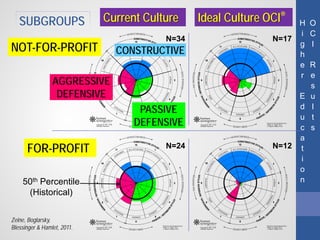
Current Culture 
Ideal Culture OCI® 
NOT-FOR-PROFIT 
FOR-PROFIT 
N=34 
N=24 
N=17 
N=12 
CONSTRUCTIVE 
AGGRESSIVE DEFENSIVE 
PASSIVE 
DEFENSIVE 
50th Percentile 
(Historical) 
Higher Education 
OCI Results 
Zeine, Boglarsky, Blessinger & Hamlet, 2011. 
SUBGROUPS
PRESENTATION 
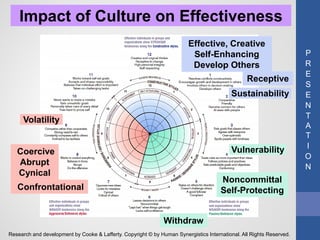
Impact of Culture on Effectiveness 
Effective, Creative Self-Enhancing Develop Others 
Coercive 
Abrupt 
Cynical 
Noncommittal 
Self-Protecting 
Volatility 
Vulnerability 
Sustainability 
Research and development by Cooke & Lafferty. Copyright © by Human Synergistics International. All Rights Reserved. 
Confrontational 
Withdraw 
Receptive
0 
2 
4 
6 
8 
10 
12 
14 
16 
18 
20 
22 
24 
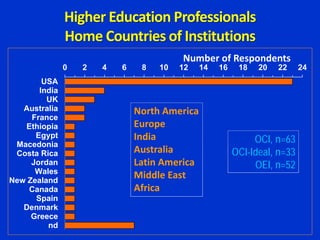
USA 
India 
UK 
Australia 
France 
Ethiopia 
Egypt 
Macedonia 
Costa Rica 
Jordan 
Wales 
New Zealand 
Canada 
Spain 
Denmark 
Greece 
nd 
Number of Respondents 
Higher Education Professionals Home Countries of Institutions 
North America 
Europe 
India 
Australia 
Latin America 
Middle East 
Africa 
OCI, n=63 
OCI-Ideal, n=33 
OEI, n=52
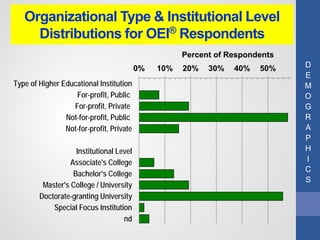
Organizational Type & Institutional Level Distributions for OEI® Respondents 
Percent of Respondents 
0% 
10% 
20% 
30% 
40% 
50% 
Type of Higher Educational Institution 
For-profit, Public 
For-profit, Private 
Not-for-profit, Public 
Not-for-profit, Private 
Institutional Level 
Associate's College 
Bachelor's College 
Master's College / University 
Doctorate-granting University 
Special Focus Institution 
nd 
DEMOGRAPHICS
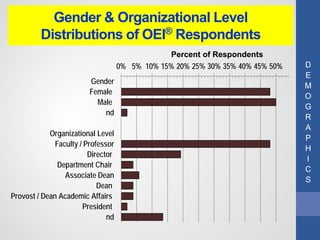
Gender & Organizational Level Distributions of OEI® Respondents 
0% 
5% 
10% 
15% 
20% 
25% 
30% 
35% 
40% 
45% 
50% 
Gender 
Female 
Male 
nd 
Organizational Level 
Faculty / Professor 
Director 
Department Chair 
Associate Dean 
Dean 
Provost / Dean Academic Affairs 
President 
nd 
Percent of Respondents 
DEMOGRAPHICS
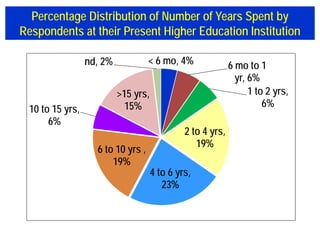
Percentage Distribution of Number of Years Spent by Respondents at their Present Higher Education Institution 
< 6 mo, 4% 
6 mo to 1 yr, 6% 
1 to 2 yrs, 6% 
2 to 4 yrs, 19% 
4 to 6 yrs, 23% 
6 to 10 yrs , 19% 
10 to 15 yrs, 6% 
>15 yrs, 15% 
nd, 2%
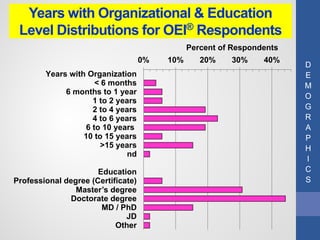
Years with Organizational & Education Level Distributions for OEI® Respondents 
Percent of Respondents 
0% 
10% 
20% 
30% 
40% 
Years with Organization 
< 6 months 
6 months to 1 year 
1 to 2 years 
2 to 4 years 
4 to 6 years 
6 to 10 years 
10 to 15 years 
>15 years 
nd 
Education 
Professional degree (Certificate) 
Master’s degree 
Doctorate degree 
MD / PhD 
JD 
Other 
DEMOGRAPHICS
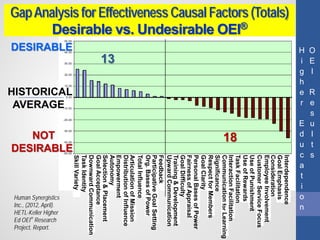
DESIRABLE 
NOT DESIRABLE 
HISTORICAL 
AVERAGE 
13 
18 
Skill Variety 
Task Identity 
Downward Communication 
Goal Acceptance 
Selection & Placement 
Autonomy 
Empowerment 
Distribution of Influence 
Articulation of Mission 
Total Influence 
Org. Bases of Power 
Participative Goal Setting 
Feedback 
Upward Communication 
Training & Development 
Goal Difficulty 
Fairness of Appraisal 
Personal Bases of Power 
Goal Clarity 
Respect for Members 
Significance 
Communication for Learning 
Interaction Facilitation 
Task Facilitation 
Use of Rewards 
Use of Punishment 
Customer Service Focus 
Employee Involvement 
Consideration 
Goal Emphasis 
Interdependence 
Gap Analysis for Effectiveness Causal Factors (Totals) Desirable vs. Undesirable OEI® 
Higher Education 
OEI Results 
Human Synergistics Inc., (2012, April). 
HETL-Keller Higher Ed OEI® Research Project, Report.
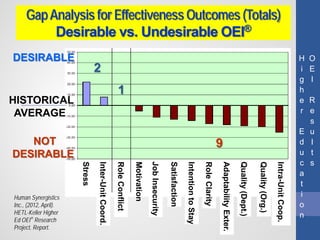
Gap Analysis for Effectiveness Outcomes (Totals) Desirable vs. Undesirable OEI® 
2 
1 
9 
DESIRABLE 
HISTORICAL 
AVERAGE 
NOT 
DESIRABLE 
Stress 
Inter-Unit Coord. 
Role Conflict 
Motivation 
Job Insecurity 
Satisfaction 
Intention to Stay 
Role Clarity 
Adaptability Exter. 
Quality (Dept.) 
Quality (Org.) 
Intra-Unit Coop. 
Higher Education 
OEI Results 
Human Synergistics Inc., (2012, April). 
HETL-Keller Higher Ed OEI® Research Project, Report.
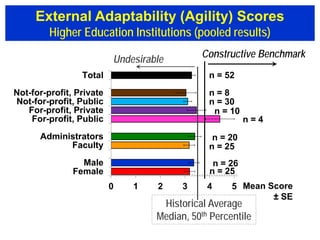
External Adaptability (Agility) Scores Higher Education Institutions (pooled results) 
0 
1 
2 
3 
4 
5 
Female 
Male 
Faculty 
Administrators 
For-profit, Public 
For-profit, Private 
Not-for-profit, Public 
Not-for-profit, Private 
Total 
Mean Score 
± SE 
Historical Average 
Median, 50th Percentile 
Constructive Benchmark 
n = 8 
n = 30 
n = 10 
n = 4 
n = 20 
n = 25 
n = 26 
n = 25 
n = 52 
Undesirable
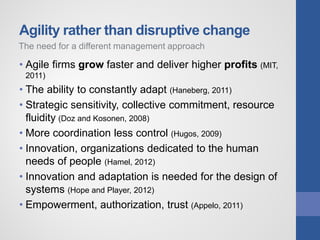
Agility rather than disruptive change 
• 
Agile firms grow faster and deliver higher profits (MIT, 2011) 
• 
The ability to constantly adapt (Haneberg, 2011) 
• 
Strategic sensitivity, collective commitment, resource fluidity (Doz and Kosonen, 2008) 
• 
More coordination less control (Hugos, 2009) 
• 
Innovation, organizations dedicated to the human needs of people (Hamel, 2012) 
• 
Innovation and adaptation is needed for the design of systems (Hope and Player, 2012) 
• 
Empowerment, authorization, trust (Appelo, 2011) 
The need for a different management approach
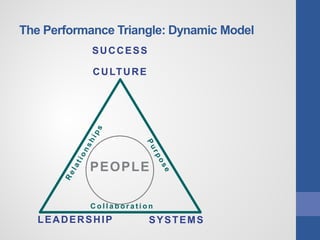
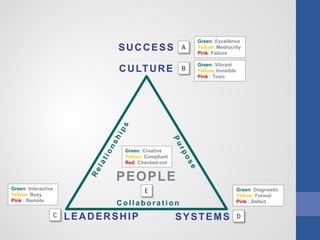
The Performance Triangle: Dynamic Model 
PEOPLE 
Collaboration 
LEADERSHIP 
SYSTEMS 
CULTURE 
SUCCESS
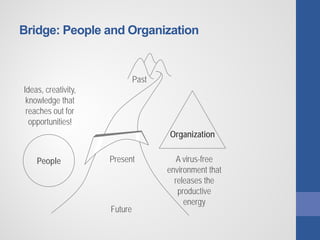
Bridge: People and Organization 
Ideas, creativity, knowledge that reaches out for opportunities! 
People 
Future 
Present 
Past 
A virus-free environment that releases the productive energy 
Organization
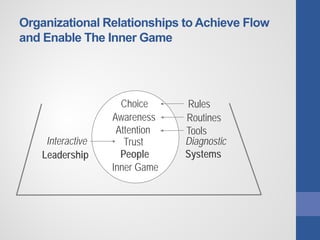
Organizational Relationships to Achieve Flow and Enable The Inner Game 
People 
Inner Game 
Diagnostic 
Systems 
Choice 
Rules 
Awareness 
Routines 
Attention 
Tools 
Leadership 
Trust 
Interactive
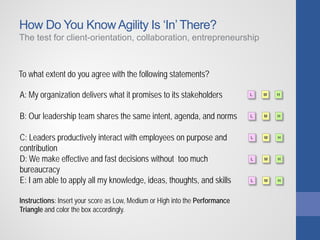
How Do You Know Agility Is ‘In’ There? The test for client-orientation, collaboration, entrepreneurship 
A: My organization delivers what it promises to its stakeholders 
B: Our leadership team shares the same intent, agenda, and norms 
C: Leaders productively interact with employees on purpose and contribution 
D: We make effective and fast decisions without too much bureaucracy 
E: I am able to apply all my knowledge, ideas, thoughts, and skills 
To what extent do you agree with the following statements? 
Instructions: Insert your score as Low, Medium or High into the Performance Triangle and color the box accordingly. 
L 
M 
H 
L 
M 
H 
L 
M 
H 
L 
M 
H 
L 
M 
H
E 
PEOPLE 
Collaboration 
LEADERSHIP 
C 
SYSTEMS 
D 
A 
CULTURE 
SUCCESS 
B 
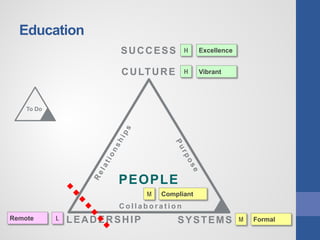
Green: Excellence 
Yellow: Mediocrity 
Pink: Failure 
Green: Vibrant Yellow: Invisible Pink : Toxic 
Green: Interactive Yellow: Busy Pink : Remote 
Green: Diagnostic Yellow: Formal Pink : Defect 
Green: Creative Yellow: Compliant Red: Checked-out
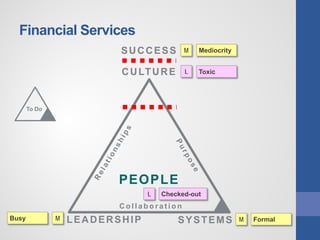
To Do 
L 
Collaboration 
LEADERSHIP 
M 
SYSTEMS 
M 
M 
CULTURE 
SUCCESS 
L 
PEOPLE 
Mediocrity 
Toxic 
Formal 
Busy 
Checked-out 
Financial Services
To Do 
M 
Collaboration 
LEADERSHIP 
L 
SYSTEMS 
M 
H 
CULTURE 
SUCCESS 
H 
PEOPLE 
Excellence 
Vibrant 
Formal 
Remote 
Compliant 
Education
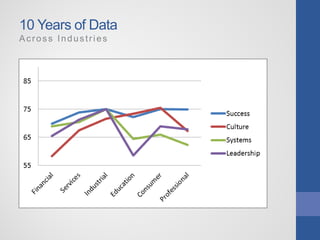
10 Years of Data Across Industries
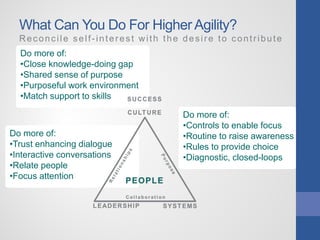
What Can You Do For Higher Agility? Reconcile self-interest with the desire to contribute 
Do more of: 
• 
Trust enhancing dialogue 
• 
Interactive conversations 
• 
Relate people 
• 
Focus attention 
Do more of: 
• 
Controls to enable focus 
• 
Routine to raise awareness 
• 
Rules to provide choice 
• 
Diagnostic, closed-loops 
Do more of: 
• 
Close knowledge-doing gap 
• 
Shared sense of purpose 
• 
Purposeful work environment 
• 
Match support to skills
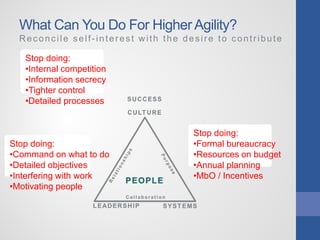
What Can You Do For Higher Agility? Reconcile self-interest with the desire to contribute 
Stop doing: 
• 
Command on what to do 
• 
Detailed objectives 
• 
Interfering with work 
• 
Motivating people 
Stop doing: 
• 
Formal bureaucracy 
• 
Resources on budget 
• 
Annual planning 
• 
MbO / Incentives 
Stop doing: 
• 
Internal competition 
• 
Information secrecy 
• 
Tighter control 
• 
Detailed processes