Kelly Soczka Steidinger
MSTC Communication Instructor
1. Get the attention of the audience
 By using an Attention Getting Device (AGD)
2. Reveal the topic & purpose of the
speech
 By using a Thesis Statement
3. Establish your credibility
4. Preview the main points of your speech
O’Hair, D., Stewart, R. & Rubenstein, H. (2012). A speaker’s guidebook: Text and
reference. (5th ed.). New York: Bedford/St. Martin’s
1. Use a statistic or example
2. Rhetorical question
3. Use a quote
4. Tell a story
5. Use an analogy/metaphor
6. Refer to the occasion
7. Address audience needs
A speaker’s credibility can come from:
 Personal experience
 Discuss your experience with the topic
 From research and reading
Provide an oral citation with information from your
research
 Expertise in the topic area
Refer to your from formal educational or occupational
experience
“Volunteering is something that has been
a huge part of my life for about 5 years.”
- From Personal Experience
“An article on global warming that
appeared in the February 22, 2018 issue
of USA Today sounded the alarm …”
- From Research and Reading
Examples of Establishing Credibility
How?
By listing the main points of the speech that
you will discuss
Why?
It tells the listener what to listen for during
the speech
It provides a smooth transition into the
body of the speech
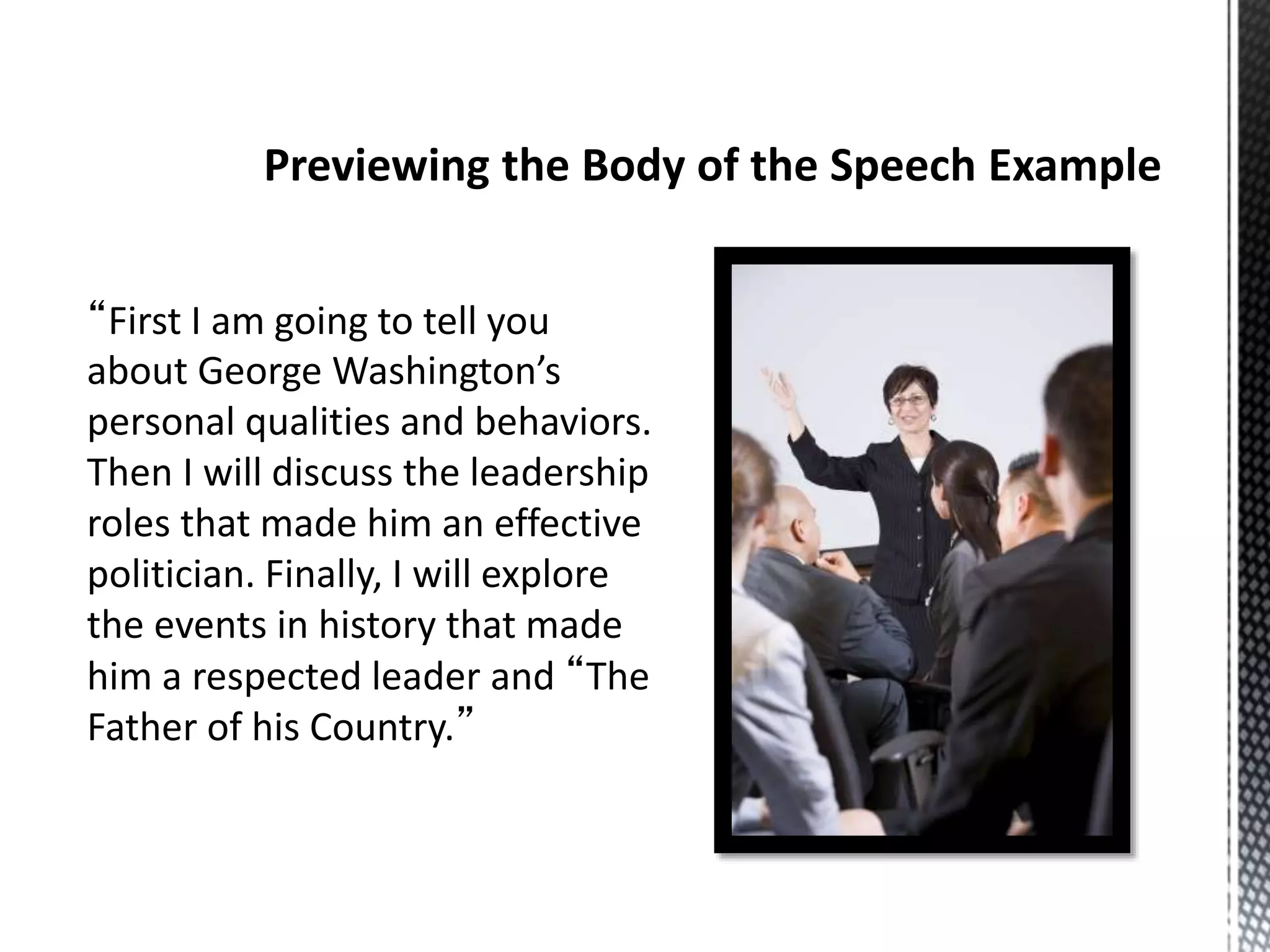
“First I am going to tell you
about George Washington’s
personal qualities and behaviors.
Then I will discuss the leadership
roles that made him an effective
politician. Finally, I will explore
the events in history that made
him a respected leader and “The
Father of his Country.”
1. While researching main points, look for
potential introduction information.
2. Be creative, but still stay on topic.
3. Write introduction & conclusion after the body
of your speech.
4. Write it out in detail for smooth delivery
5. Practice, practice, practice!
(AGD) One night Mary Ann Kanzius awoke to a horrendous clamor
coming from downstairs, upon investigation she found her husband
John sitting on the kitchen floor cutting up her good aluminum pie
pans with a pair of shears. When asked why he was wiring the pans
to his ham radio, he told her to go back to bed. So off she went
know that John wasn't kind of person to quit until he was satisfied,
but what she didn't know is that John was developing a way to use
radio waves to kill the cancer he'd recently been diagnosed with and
his midnight tinkering may soon give hope to the 1.4 million (Est.
Credibility) Americans diagnosed with cancer every year according
to the 2006 American Cancer Society facts and figures. (Thesis) For
John Kanzius inadvertently refined a current cancer treatment called
radio frequency ablation, he made it more effective and less
invasive. (Preview the Body) To understand how this came to be,
we will explore first the current procedure, second, John's new
approach and finally the implications of this new hope for treating
cancer. O’Hair, D., Stewart, R. & Rubenstein, H. (2012). A speaker’s guidebook: Text and
reference. (5th ed.). New York: Bedford/St. Martin’s

Writing an Effective Introduction for your Speech

  • 1.
    Kelly Soczka Steidinger MSTCCommunication Instructor
  • 2.
    1. Get theattention of the audience  By using an Attention Getting Device (AGD) 2. Reveal the topic & purpose of the speech  By using a Thesis Statement 3. Establish your credibility 4. Preview the main points of your speech O’Hair, D., Stewart, R. & Rubenstein, H. (2012). A speaker’s guidebook: Text and reference. (5th ed.). New York: Bedford/St. Martin’s
  • 4.
    1. Use astatistic or example 2. Rhetorical question 3. Use a quote 4. Tell a story 5. Use an analogy/metaphor 6. Refer to the occasion 7. Address audience needs
  • 5.
    A speaker’s credibilitycan come from:  Personal experience  Discuss your experience with the topic  From research and reading Provide an oral citation with information from your research  Expertise in the topic area Refer to your from formal educational or occupational experience
  • 6.
    “Volunteering is somethingthat has been a huge part of my life for about 5 years.” - From Personal Experience “An article on global warming that appeared in the February 22, 2018 issue of USA Today sounded the alarm …” - From Research and Reading Examples of Establishing Credibility
  • 7.
    How? By listing themain points of the speech that you will discuss Why? It tells the listener what to listen for during the speech It provides a smooth transition into the body of the speech
  • 8.
    “First I amgoing to tell you about George Washington’s personal qualities and behaviors. Then I will discuss the leadership roles that made him an effective politician. Finally, I will explore the events in history that made him a respected leader and “The Father of his Country.”
  • 9.
    1. While researchingmain points, look for potential introduction information. 2. Be creative, but still stay on topic. 3. Write introduction & conclusion after the body of your speech. 4. Write it out in detail for smooth delivery 5. Practice, practice, practice!
  • 10.
    (AGD) One nightMary Ann Kanzius awoke to a horrendous clamor coming from downstairs, upon investigation she found her husband John sitting on the kitchen floor cutting up her good aluminum pie pans with a pair of shears. When asked why he was wiring the pans to his ham radio, he told her to go back to bed. So off she went know that John wasn't kind of person to quit until he was satisfied, but what she didn't know is that John was developing a way to use radio waves to kill the cancer he'd recently been diagnosed with and his midnight tinkering may soon give hope to the 1.4 million (Est. Credibility) Americans diagnosed with cancer every year according to the 2006 American Cancer Society facts and figures. (Thesis) For John Kanzius inadvertently refined a current cancer treatment called radio frequency ablation, he made it more effective and less invasive. (Preview the Body) To understand how this came to be, we will explore first the current procedure, second, John's new approach and finally the implications of this new hope for treating cancer. O’Hair, D., Stewart, R. & Rubenstein, H. (2012). A speaker’s guidebook: Text and reference. (5th ed.). New York: Bedford/St. Martin’s