ORGANIZED RETAIL INDUSTRY
IN INDIA
presenter: Sreeraj. Salim
Introduction
• Retailing is the second largest industry in US in terms of
number of people employed.
• Retailing industry in US employs more than 22 million
Americans and generates more than $3 trillion in sales
annually.
• Indian retail industry is broadly divided into the organized and
unorganized sector.
• Indian retail industry comprised of large, medium and small
grocery stores and drug stores (unorganized retailing) .
• According to Global Retail Development Index of
2005conducted by AT Kearny, India was ranked #1 among 30
most attractive retailing destinations across the world.
Organized Retailing in India
The main factors which affect the changes in
spending for items other than foods
• Rising incomes and a consequent increase in
disposable incomes.
• Better infrastructure.
• Rise in consumer awareness.
• Consumer keenness to buy branded products.
• Consumer desire to purchase quality products and
services.
Organized retailing in India can be classified based on the products
or services offered. These include:
• Apparel retailing
• Food retailing
• Health and Beauty products retailing
• Footwear retailing
• Music and Entertainment retailing
• Book retailing
• Watches and jewelery retailing
• Petrol and Diesel retailing
• Home furniture
• Luggage
A PROFILE OF MAJOR INDIAN
RETAILERS
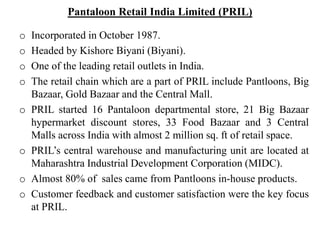
Pantaloon Retail India Limited (PRIL)
o Incorporated in October 1987.
o Headed by Kishore Biyani (Biyani).
o One of the leading retail outlets in India.
o The retail chain which are a part of PRIL include Pantloons, Big
Bazaar, Gold Bazaar and the Central Mall.
o PRIL started 16 Pantaloon departmental store, 21 Big Bazaar
hypermarket discount stores, 33 Food Bazaar and 3 Central
Malls across India with almost 2 million sq. ft of retail space.
o PRIL’s central warehouse and manufacturing unit are located at
Maharashtra Industrial Development Corporation (MIDC).
o Almost 80% of sales came from Pantloons in-house products.
o Customer feedback and customer satisfaction were the key focus
at PRIL.
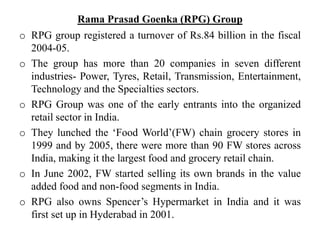
Rama Prasad Goenka (RPG) Group
o RPG group registered a turnover of Rs.84 billion in the fiscal
2004-05.
o The group has more than 20 companies in seven different
industries- Power, Tyres, Retail, Transmission, Entertainment,
Technology and the Specialties sectors.
o RPG Group was one of the early entrants into the organized
retail sector in India.
o They lunched the ‘Food World’(FW) chain grocery stores in
1999 and by 2005, there were more than 90 FW stores across
India, making it the largest food and grocery retail chain.
o In June 2002, FW started selling its own brands in the value
added food and non-food segments in India.
o RPG also owns Spencer’s Hypermarket in India and it was
first set up in Hyderabad in 2001.
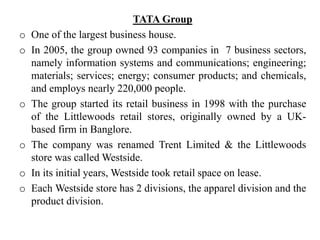
TATA Group
o One of the largest business house.
o In 2005, the group owned 93 companies in 7 business sectors,
namely information systems and communications; engineering;
materials; services; energy; consumer products; and chemicals,
and employs nearly 220,000 people.
o The group started its retail business in 1998 with the purchase
of the Littlewoods retail stores, originally owned by a UK-
based firm in Banglore.
o The company was renamed Trent Limited & the Littlewoods
store was called Westside.
o In its initial years, Westside took retail space on lease.
o Each Westside store has 2 divisions, the apparel division and the
product division.
o In addition to Westside, Trent launched a hypermarket “Starr
India Bazaar” in Ahmadabad in October 2004.
o Besides Trent, Titan Industries is another Tata company which
is in the retailing business.
o Titan markets its ranges of watches under the Titan & Sonata
brands.
RAHEJA GROUP
o K.Raheja group of companies is India's largest real estate
players.
o Shopper’s Stop is projected as a fashion and lifestyle store.
o Shopper’s Stop was among the first retailers in India.
o Shopper’s Stop is store to use ERP software.
o Shoppers Stop initiated India’s first loyalty program called
“The First Citizen”.
o This program offers exclusive privileges, benefits and rewards
to regular customers.
RETAIL IN INDIA- A CHALLENGE
The retail industry in India is growing at a significant pace. The
major challenges for the organized sector include:
o Taxation laws that favor small retailers
o Different structure of sales tax in different states
o Multi-point octroi collection
o Lack of trained work force
o High cost of real estate
o Limited land available at prime locations
THE ROAD AHEAD
o According to the 2005 Global retail development index a report
by AT Kearney
o India tipped Russia from the #1 spot as the most attractive
destination for retail investment.
o Retailers believe that there is a felt need for supermarkets and
department stores in small towns
o There are some advantages that may arise from the entry of big
global and domestic players. India consumers will have more
choice and price benefits as these players compete with each
other to garner market share.
o The quality of real estate, good retail management practices like
better documentation, use of information technology and a
strong supply chain will be the critical
THANK YOU

Organized retail industry in india

  • 1.
    ORGANIZED RETAIL INDUSTRY ININDIA presenter: Sreeraj. Salim
  • 2.
    Introduction • Retailing isthe second largest industry in US in terms of number of people employed. • Retailing industry in US employs more than 22 million Americans and generates more than $3 trillion in sales annually. • Indian retail industry is broadly divided into the organized and unorganized sector. • Indian retail industry comprised of large, medium and small grocery stores and drug stores (unorganized retailing) . • According to Global Retail Development Index of 2005conducted by AT Kearny, India was ranked #1 among 30 most attractive retailing destinations across the world.
  • 3.
    Organized Retailing inIndia The main factors which affect the changes in spending for items other than foods • Rising incomes and a consequent increase in disposable incomes. • Better infrastructure. • Rise in consumer awareness. • Consumer keenness to buy branded products. • Consumer desire to purchase quality products and services.
  • 4.
    Organized retailing inIndia can be classified based on the products or services offered. These include: • Apparel retailing • Food retailing • Health and Beauty products retailing • Footwear retailing • Music and Entertainment retailing • Book retailing • Watches and jewelery retailing • Petrol and Diesel retailing • Home furniture • Luggage
  • 5.
    A PROFILE OFMAJOR INDIAN RETAILERS
  • 6.
    Pantaloon Retail IndiaLimited (PRIL) o Incorporated in October 1987. o Headed by Kishore Biyani (Biyani). o One of the leading retail outlets in India. o The retail chain which are a part of PRIL include Pantloons, Big Bazaar, Gold Bazaar and the Central Mall. o PRIL started 16 Pantaloon departmental store, 21 Big Bazaar hypermarket discount stores, 33 Food Bazaar and 3 Central Malls across India with almost 2 million sq. ft of retail space. o PRIL’s central warehouse and manufacturing unit are located at Maharashtra Industrial Development Corporation (MIDC). o Almost 80% of sales came from Pantloons in-house products. o Customer feedback and customer satisfaction were the key focus at PRIL.
  • 7.
    Rama Prasad Goenka(RPG) Group o RPG group registered a turnover of Rs.84 billion in the fiscal 2004-05. o The group has more than 20 companies in seven different industries- Power, Tyres, Retail, Transmission, Entertainment, Technology and the Specialties sectors. o RPG Group was one of the early entrants into the organized retail sector in India. o They lunched the ‘Food World’(FW) chain grocery stores in 1999 and by 2005, there were more than 90 FW stores across India, making it the largest food and grocery retail chain. o In June 2002, FW started selling its own brands in the value added food and non-food segments in India. o RPG also owns Spencer’s Hypermarket in India and it was first set up in Hyderabad in 2001.
  • 8.
    TATA Group o Oneof the largest business house. o In 2005, the group owned 93 companies in 7 business sectors, namely information systems and communications; engineering; materials; services; energy; consumer products; and chemicals, and employs nearly 220,000 people. o The group started its retail business in 1998 with the purchase of the Littlewoods retail stores, originally owned by a UK- based firm in Banglore. o The company was renamed Trent Limited & the Littlewoods store was called Westside. o In its initial years, Westside took retail space on lease. o Each Westside store has 2 divisions, the apparel division and the product division.
  • 9.
    o In additionto Westside, Trent launched a hypermarket “Starr India Bazaar” in Ahmadabad in October 2004. o Besides Trent, Titan Industries is another Tata company which is in the retailing business. o Titan markets its ranges of watches under the Titan & Sonata brands.
  • 10.
    RAHEJA GROUP o K.Rahejagroup of companies is India's largest real estate players. o Shopper’s Stop is projected as a fashion and lifestyle store. o Shopper’s Stop was among the first retailers in India. o Shopper’s Stop is store to use ERP software. o Shoppers Stop initiated India’s first loyalty program called “The First Citizen”. o This program offers exclusive privileges, benefits and rewards to regular customers.
  • 11.
    RETAIL IN INDIA-A CHALLENGE The retail industry in India is growing at a significant pace. The major challenges for the organized sector include: o Taxation laws that favor small retailers o Different structure of sales tax in different states o Multi-point octroi collection o Lack of trained work force o High cost of real estate o Limited land available at prime locations
  • 12.
    THE ROAD AHEAD oAccording to the 2005 Global retail development index a report by AT Kearney o India tipped Russia from the #1 spot as the most attractive destination for retail investment. o Retailers believe that there is a felt need for supermarkets and department stores in small towns o There are some advantages that may arise from the entry of big global and domestic players. India consumers will have more choice and price benefits as these players compete with each other to garner market share. o The quality of real estate, good retail management practices like better documentation, use of information technology and a strong supply chain will be the critical
  • 13.