Case Study
Submitted On

“Cost Volume Profit Analysis”
By

Sagar Sharma
(BBA 3rd Year)

106/10 civil lines,
Ajmer 305001
Website: www.dezyneecole.com
Cost Volume Profit Analysis

About MRF
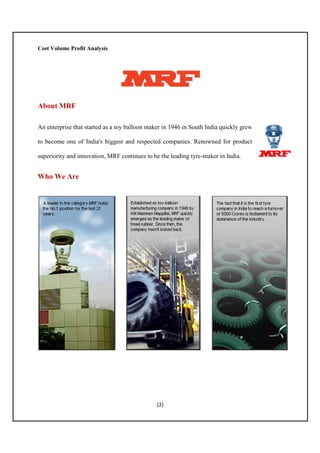
An enterprise that started as a toy balloon maker in 1946 in South India quickly grew
to become one of India's biggest and respected companies. Renowned for product
superiority and innovation, MRF continues to be the leading tyre-maker in India.

Who We Are

(2)
Cost Volume Profit Analysis

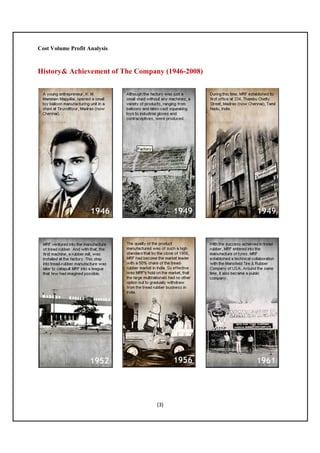
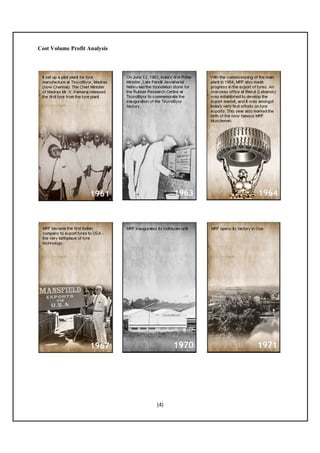
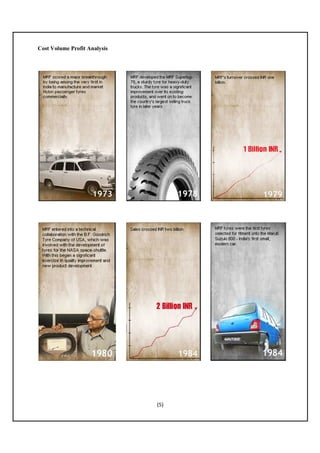
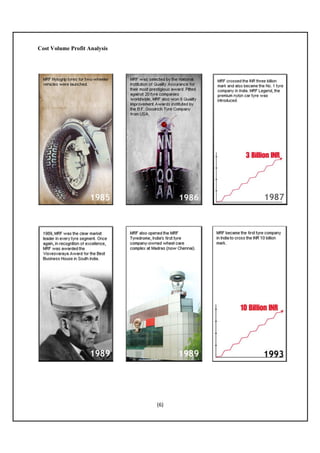
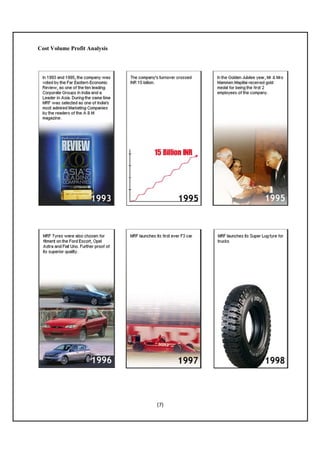
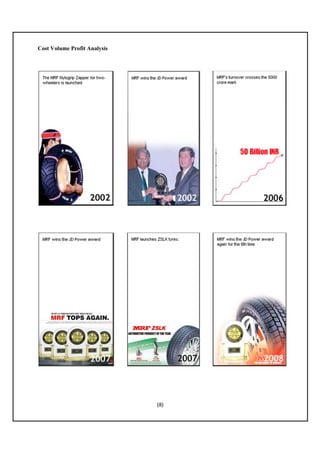
History& Achievement of The Company (1946-2008)

(3)
Cost Volume Profit Analysis

(4)
Cost Volume Profit Analysis

(5)
Cost Volume Profit Analysis

(6)
Cost Volume Profit Analysis

(7)
Cost Volume Profit Analysis

(8)
Cost Volume Profit Analysis

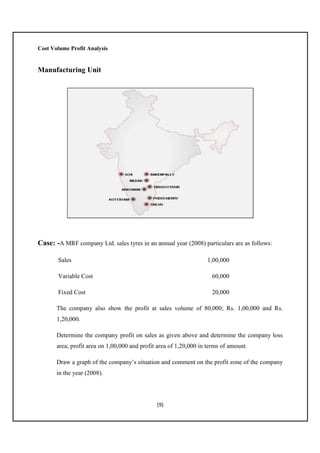
Manufacturing Unit

Case: -A MRF company Ltd. sales tyres in an annual year (2008) particulars are as follows:
Sales

1,00,000

Variable Cost

60,000

Fixed Cost

20,000

The company also show the profit at sales volume of 80,000; Rs. 1,00,000 and Rs.
1,20,000.
Determine the company profit on sales as given above and determine the company loss
area; profit area on 1,00,000 and profit area of 1,20,000 in terms of amount.
Draw a graph of the company’s situation and comment on the profit zone of the company
in the year (2008).

(9)
Cost Volume Profit Analysis

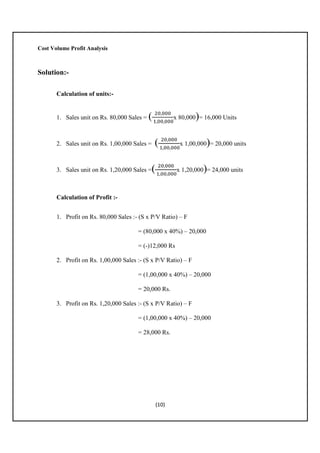
Solution:Calculation of units:-

1. Sales unit on Rs. 80,000 Sales =

ଶ଴,଴଴଴
( ଵ,଴଴,଴଴଴x 80,000)= 16,000 Units

2. Sales unit on Rs. 1,00,000 Sales =

3. Sales unit on Rs. 1,20,000 Sales =

ଶ଴,଴଴଴
( ଵ,଴଴,଴଴଴x 1,00,000)= 20,000 units

ଶ଴,଴଴଴
( ଵ,଴଴,଴଴଴x 1,20,000)= 24,000 units

Calculation of Profit :1. Profit on Rs. 80,000 Sales :- (S x P/V Ratio) – F
= (80,000 x 40%) – 20,000
= (-)12,000 Rs
2. Profit on Rs. 1,00,000 Sales :- (S x P/V Ratio) – F
= (1,00,000 x 40%) – 20,000
= 20,000 Rs.
3. Profit on Rs. 1,20,000 Sales :- (S x P/V Ratio) – F
= (1,00,000 x 40%) – 20,000
= 28,000 Rs.

(10)
Cost Volume Profit Analysis

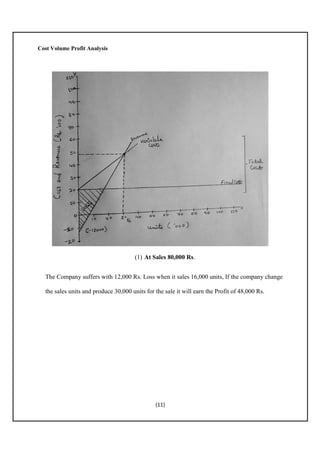
(1) At Sales 80,000 Rs.
The Company suffers with 12,000 Rs. Loss when it sales 16,000 units, If the company change
the sales units and produce 30,000 units for the sale it will earn the Profit of 48,000 Rs.

(11)
Cost Volume Profit Analysis

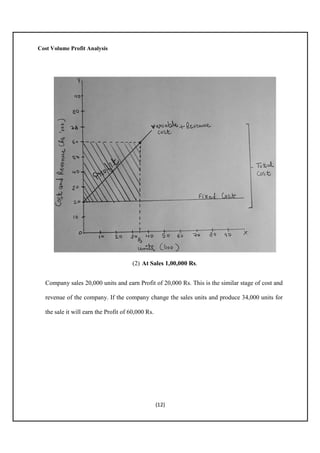
(2) At Sales 1,00,000 Rs.
Company sales 20,000 units and earn Profit of 20,000 Rs. This is the similar stage of cost and
revenue of the company. If the company change the sales units and produce 34,000 units for
the sale it will earn the Profit of 60,000 Rs.

(12)
Cost Volume Profit Analysis

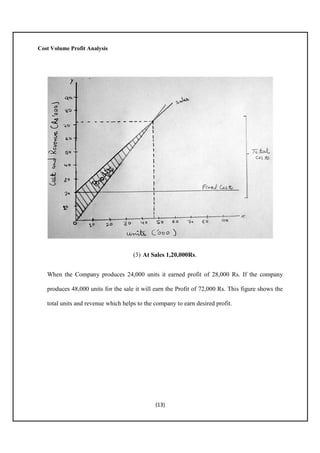
(3) At Sales 1,20,000Rs.
When the Company produces 24,000 units it earned profit of 28,000 Rs. If the company
produces 48,000 units for the sale it will earn the Profit of 72,000 Rs. This figure shows the
total units and revenue which helps to the company to earn desired profit.

(13)

Case study on MRF Tyre (cost volume profit analysis)

  • 1.
    Case Study Submitted On “CostVolume Profit Analysis” By Sagar Sharma (BBA 3rd Year) 106/10 civil lines, Ajmer 305001 Website: www.dezyneecole.com
  • 2.
    Cost Volume ProfitAnalysis About MRF An enterprise that started as a toy balloon maker in 1946 in South India quickly grew to become one of India's biggest and respected companies. Renowned for product superiority and innovation, MRF continues to be the leading tyre-maker in India. Who We Are (2)
  • 3.
    Cost Volume ProfitAnalysis History& Achievement of The Company (1946-2008) (3)
  • 4.
    Cost Volume ProfitAnalysis (4)
  • 5.
    Cost Volume ProfitAnalysis (5)
  • 6.
    Cost Volume ProfitAnalysis (6)
  • 7.
    Cost Volume ProfitAnalysis (7)
  • 8.
    Cost Volume ProfitAnalysis (8)
  • 9.
    Cost Volume ProfitAnalysis Manufacturing Unit Case: -A MRF company Ltd. sales tyres in an annual year (2008) particulars are as follows: Sales 1,00,000 Variable Cost 60,000 Fixed Cost 20,000 The company also show the profit at sales volume of 80,000; Rs. 1,00,000 and Rs. 1,20,000. Determine the company profit on sales as given above and determine the company loss area; profit area on 1,00,000 and profit area of 1,20,000 in terms of amount. Draw a graph of the company’s situation and comment on the profit zone of the company in the year (2008). (9)
  • 10.
    Cost Volume ProfitAnalysis Solution:Calculation of units:- 1. Sales unit on Rs. 80,000 Sales = ଶ଴,଴଴଴ ( ଵ,଴଴,଴଴଴x 80,000)= 16,000 Units 2. Sales unit on Rs. 1,00,000 Sales = 3. Sales unit on Rs. 1,20,000 Sales = ଶ଴,଴଴଴ ( ଵ,଴଴,଴଴଴x 1,00,000)= 20,000 units ଶ଴,଴଴଴ ( ଵ,଴଴,଴଴଴x 1,20,000)= 24,000 units Calculation of Profit :1. Profit on Rs. 80,000 Sales :- (S x P/V Ratio) – F = (80,000 x 40%) – 20,000 = (-)12,000 Rs 2. Profit on Rs. 1,00,000 Sales :- (S x P/V Ratio) – F = (1,00,000 x 40%) – 20,000 = 20,000 Rs. 3. Profit on Rs. 1,20,000 Sales :- (S x P/V Ratio) – F = (1,00,000 x 40%) – 20,000 = 28,000 Rs. (10)
  • 11.
    Cost Volume ProfitAnalysis (1) At Sales 80,000 Rs. The Company suffers with 12,000 Rs. Loss when it sales 16,000 units, If the company change the sales units and produce 30,000 units for the sale it will earn the Profit of 48,000 Rs. (11)
  • 12.
    Cost Volume ProfitAnalysis (2) At Sales 1,00,000 Rs. Company sales 20,000 units and earn Profit of 20,000 Rs. This is the similar stage of cost and revenue of the company. If the company change the sales units and produce 34,000 units for the sale it will earn the Profit of 60,000 Rs. (12)
  • 13.
    Cost Volume ProfitAnalysis (3) At Sales 1,20,000Rs. When the Company produces 24,000 units it earned profit of 28,000 Rs. If the company produces 48,000 units for the sale it will earn the Profit of 72,000 Rs. This figure shows the total units and revenue which helps to the company to earn desired profit. (13)