Indian Organized Retail Sector 
Issues & Predictions 
1
 India is the fifth largest retail market globally, with a size of INR 16 
trillion, and has been growing at 15% per annum. 
 Organized retail accounts for just 5% of total retail sales and has been 
growing at 35% CAGR. 
 India’s robust macro- and microeconomic fundamentals, such as 
robust GDP growth, higher incomes, increasing personal consumption, 
favourable demographics and supportive government policies, surely 
increased the growth in the retail sector but it all couldn’t helped in 
stopping the operational costs thus reducing in the overall margins. 
2
We have structured the report broadly into three 
categories: 
(1)Learning from the past 
(2) Consolidation 
(3) Critical issues 
(4) View on future 
3
During 2005-2007, the sector was in a hyper growth phase. In pursuit to capture market, 
companies made strategic as well as operational errors which has been broadly 
classified as follows: 
 Race for increasing retail space resulting in haphazard growth. 
 Unviable formats. 
 High lease rentals. 
 Manpower costs and productivity issues. 
 Poor backend infrastructure. 
 Entry of too many new players. 
4
1) Race for increasing retail space resulting in haphazard growth: Organized 
retailers entered the race of adding retail space without proper due diligence 
on the catchment area, mall density and acceptability of organized retail. 
2) Unviable formats: Large players entered numerous formats, some of which 
proved to be unviable. 
3) High lease rentals: Retail is a tough business to operate, PAT margins are 
as low as 2-3%. Indian organized retail follows the lease rental model due to 
high real estate costs and paucity of quality malls. Lease rentals should ideally 
be 3-6% of sales depending upon the format. 
However, rentals in a few specialty stores touched Rs 300/sq feet/month 
during the heydays - in a period of two years, lease rentals in general 
increased 50-70%. The increase was more evident in FY08 and FY09 due to 
decline in same store sales growth. Currently, the price/sq feet can reach in 
thousands. 
5
4) Manpower costs and productivity issues: As trained manpower was scarce, 
salaries of experienced retailing professionals went through the roof. 
5) Poor Backend infrastructure: Retailers focused all their energies on store 
openings and neglected the backend. 
6) Entry of too many new players: Viewing it as a sunrise sector, too many 
players entered organized retail and some have perished. 
6
In the global slowdown phase starting from 2007, the Indian retail players paused, 
to realize their past mistakes and took time and efforts to re-organize themselves: 
 Focus on profitable growth 
 Exit from unprofitable stores/formats 
 Rental renegotiation/revenue sharing arrangements 
 Reduction in salaries/ higher manpower productivity 
 Significant investments in backend 
 Exit of unsuccessful new entrants 
7
1) Focus on profitable growth: Retailers paused and realized their errors and started 
using analytics for insights into the business, but analytics used was only 
concentrated towards the finding of most feasible location to open a new store. 
2)Exit from unprofitable stores/formats: whole new set of formats and store sizes, with a 
view to capture consumption and increase share in consumer wallet. The industry has 
tried to control costs and address the issue by way of store closure, exit from formats, 
restructuring of format, Change of location. 
3)Rental renegotiation/revenue sharing arrangements: After touching the unprecedented 
highs, lease rentals softened, revenue sharing arrangements came into picture. 
4) Reduction in salaries/ higher manpower productivity: stopped paying fancy salaries to 
attract the top talent. 
5) Significant investments in backend: Post the slowdown, retailers have been making 
huge investments to strengthen their backend systems. 
6) Exit of unsuccessful new entrants 
8
 Soaring real estate prices. 
 Intense competition : customers, now have the option to select any of the 
stores they want. 
 Reduction in customer loyalty: customers, are now smart enough in saving 
their time and money, only increase in per capita income or GDP doesn’t 
always help. 
 No cheap labor. 
 Exponential increase in operating costs like electricity bills, salary for the 
staff, vendor management costs, relationship building costs and other 
miscellaneous but mandatory costs. 
9
Standard Cost reduction scenario: 
Air India used silver spoon from 1948 to 1962, gradually they came down to stainless steel and finally a 
plastic spoon. 
Transformational Change: 
Apple changed the way people used to think about music, with proper planning they are the leaders in the 
market now. 
Retail industry should now have to act smart and move towards the transformational changes. 
10
Since, the fixed operating costs can’t be reduced for any retail, hence this research 
revolves around the following questions: 
 How to achieve the maximum positive footfalls? 
 What is the buying behavioral pattern of a customer? 
 What is the customers’ psychology while going to any retail store? 
 What if, the cost can be reduced through following a eco-green building 
model? 
This research will aim at attracting new customers as well as retaining old ones, and 
suggest possible future models to increase profit and provide better value to a 
customer 
So we started this project to help reduce operating cost of existing retail business 
and suggest possible future model to increase profit and provide better value to 
customer 
11
 Questionnaire: Prepared to meet our objective. 
 Pilot testing: Data collection to validate and verify the research objective. 
 Survey: Data collected using offline and online methods. 
 Data Validation: Cleaning and extracting useful data. 
 Data Exploration: To analyze which store has maximum footfalls based on 
gender, age group and marital status. 
 Clustering and Segmentation: To understand the shopping behavior of 
customers, like the preferable time and which day of the week they shop. 
 Regression Analysis: For the SWOT analysis of the retail stores, based on 
the parameters in the questionnaire. 
 Correlation Analysis: Finding the relationship between the variables. 
 Summarizing the results. 
12
Tools used: 
 Microsoft Office Excel 2007 
 Bas SAS 9.1 
 SAS Enterprise Miner 6.1 
 SAS Enterprise Guide 4.2 
13
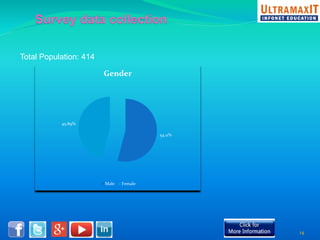
Total Population: 414 
54.11% 
45.89% 
Gender 
Male Female 
14
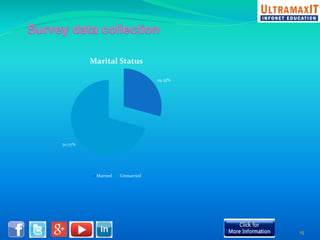
29.23% 
70.77% 
Marital Status 
Married Unmarried 
15
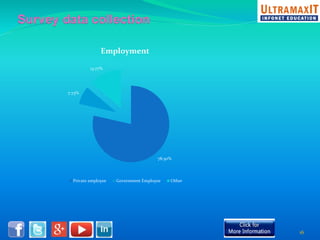
78.50% 
7.73% 
Employment 
13.77% 
Private employee Government Employee Other 
16
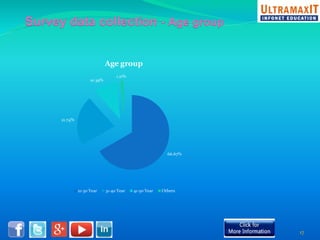
66.67% 
21.74% 
10.39% 
Age group 
1.21% 
21-30 Year 31-40 Year 41-50 Year Others 
17
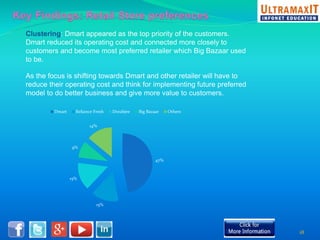
Clustering: Dmart appeared as the top priority of the customers. 
Dmart reduced its operating cost and connected more closely to 
customers and become most preferred retailer which Big Bazaar used 
to be. 
As the focus is shifting towards Dmart and other retailer will have to 
reduce their operating cost and think for implementing future preferred 
model to do better business and give more value to customers. 
Dmart Reliance Fresh Dorabjee Big Bazaar Others 
47% 
15% 
9% 
15% 
14% 
18
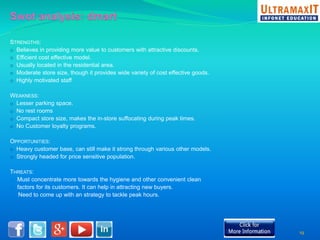
STRENGTHS: 
o Believes in providing more value to customers with attractive discounts. 
o Efficient cost effective model. 
o Usually located in the residential area. 
o Moderate store size, though it provides wide variety of cost effective goods. 
o Highly motivated staff 
WEAKNESS: 
o Lesser parking space. 
o No rest rooms 
o Compact store size, makes the in-store suffocating during peak times. 
o No Customer loyalty programs. 
OPPORTUNITIES: 
o Heavy customer base, can still make it strong through various other models. 
o Strongly headed for price sensitive population. 
THREATS: 
o Must concentrate more towards the hygiene and other convenient clean 
o factors for its customers. It can help in attracting new buyers. 
o Need to come up with an strategy to tackle peak hours. 
19
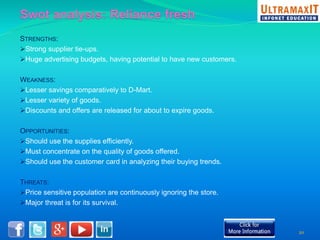
STRENGTHS: 
Strong supplier tie-ups. 
Huge advertising budgets, having potential to have new customers. 
WEAKNESS: 
Lesser savings comparatively to D-Mart. 
Lesser variety of goods. 
Discounts and offers are released for about to expire goods. 
OPPORTUNITIES: 
Should use the supplies efficiently. 
Must concentrate on the quality of goods offered. 
Should use the customer card in analyzing their buying trends. 
THREATS: 
Price sensitive population are continuously ignoring the store. 
Major threat is for its survival. 
20
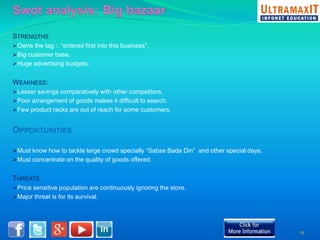
STRENGTHS 
Owns the tag :: “entered first into this business”. 
Big customer base. 
Huge advertising budgets. 
WEAKNESS: 
Lesser savings comparatively with other competitors. 
Poor arrangement of goods makes it difficult to search. 
Few product racks are out of reach for some customers. 
OPPORTUNITIES 
Must know how to tackle large crowd specially “Sabse Bada Din” and other special days. 
Must concentrate on the quality of goods offered. 
THREATS 
Price sensitive population are continuously ignoring the store. 
Major threat is for its survival. 
21
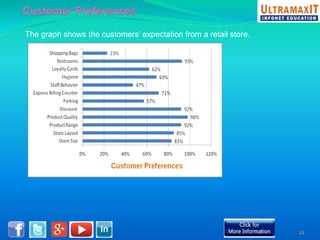
The graph shows the customers’ expectation from a retail store. 
22
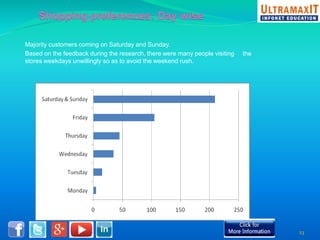
Majority customers coming on Saturday and Sunday. 
Based on the feedback during the research, there were many people visiting the 
stores weekdays unwillingly so as to avoid the weekend rush. 
23
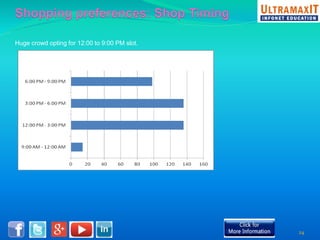
Huge crowd opting for 12:00 to 9:00 PM slot. 
24
Based on day and time preference by most of customers we have suggested below solutions to retain 
customers more happily coming on weekend and can reduce their operating cost. 
HAPPY HOURS: Since the majority customers visit during weekends, after 3:00 PM, so the concept of happy 
hours might help, which retailers can introduce from morning to 12:00 Noon and can start store little early in 
morning on weekend or holidays. 
EXPRESS COUNTERS: Increase the minimum items in express counters. In this way more customer will be 
handled in express counter. 
REDUCE MANPOWER AND ENERGY ON LEAST SHOPPED DAY: Retailer can return to old working style. 
Keep store close on least shopping day and give more value to existing customers and can build long 
relationship. So saving in operating cost and retaining customers. 
CUSTOMER LOYALTY PROGRAM: Introducing customer loyalty programs to study the buying behavior of the 
customers. Retail companies should work more towards customer satisfaction, e.g. wishing them on their 
special days, offer special discounts to them on those days. 
TOKEN SYSTEM: Retailers can introduce token system, to the customers standing in queue. Customers can 
hang the token in their trolley and collect their goods later when they are called. In this way customer would 
be happily retained. 
25
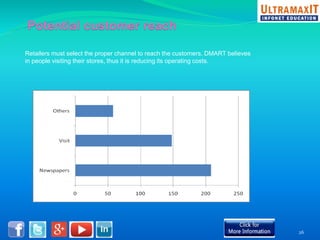
Retailers must select the proper channel to reach the customers. DMART believes 
in people visiting their stores, thus it is reducing its operating costs. 
26
Below future models will help retailers utilize their existing space and 
resources to attract more customers and better satisfy existing customers. 
Based on our research, we conclude that people are interested for: 
Mobile Application Home Delivery: 88.04% 
Mobile Application Order and Pick-up: 92.39% 
Shop and Drop: 97.82% 
Online Home Delivery: 55.6% 
Home Delivery Extra pay: 78.3% 
Hence, we can assume that people are more interested towards the 
online model, moreover they are also willing to pay some extra for the 
same. Above model can help increasing customers and also retaining 
customers happily for longer time. 
27
 Order-Pick-up and Online model is the top preference for married couples. Married have prime 
responsibility for grocery so retailer should think to act for such segment. 
 Lesser working days preferred by many married males if better offers are made available. While 
unmarried has no such priority whether a store is functioning for all 7 days or 6 days. 
 Females influence more instead of males for shopping the grocery items, So retailers should think 
whom to focus more. 
 Online model found to be more preferred among the population. Still, females were in favour of 
rejecting the online model for the grocery item as they can’t look and feel the items online, but at the 
same time they wish branded products can be home delivered. 
 Based on our research, people are also even ready to pay extra for the home delivery. 
28
ORDER AND PICK UP: A process in which people can call and block their 
order, the goods can be collected while returning on their way home. This 
process can be implemented through online, mobile application or a small 
call centre. 
SHOP AND DROP: A process in which people visits the store, shops and in 
turn has the option of delivering the goods at their doorstep. 
ONLINE MODEL: This model can include both website and the mobile 
application. Based on the analysis major population is even interested in 
paying extra for home delivery. 
29
Green building can help reducing operating cost primarily in air conditioning and light. 
Retailer can also opt for carbon credit too. Below building consume very little electricity in 
lighting but it is without air conditioning but feel like centrally air conditioned.id retailers 
can opt for carbon credit too. 
30
 We have covered only operating cost and future option but many analytic 
area is there in retailing which should also be taken care for better 
business: 
 ASSORTMENT OPTIMIZATION AND SHELF SPACE ALLOCATION - Using analytics 
to determine what products to offer in what quantities. 
 CUSTOMER DRIVEN MARKETING - Use of customer data to segment, target, 
and personalize offerings. 
 INTEGRATED FORECASTING - The use of statistical forecasting to support 
multiple functions. 
 LOCALIZATION AND CLUSTERING - Tailoring multiple aspects of retailing to 
local stores or similar clusters 
31
 MARKETING MIX MODELLING - Determining which marketing investments 
work, and which are less effective. 
 PRICING OPTIMIZATION - Using analytics to determine the optimal pricing 
of products and services through their lifecycles. 
 PRODUCT RECOMMENDATION - Using analytical approaches to recommend 
product offerings for particular customers. 
 WORKFORCE ANALYTICS - Optimization of staffing with regard to cost, 
customer shopping patterns, and locations 
32
 STORE LEVEL EMPOWERMENT - Giving store managers and employees 
the ability to analyze their businesses. 
 ANALYTICAL PERFORMANCE MANAGEMENT - Predicting financial 
performance from nonfinancial and intangible performance factors 
 MULTI CHANNEL ANALYTICS AND DATA INTEGRATION - 
 Integration of data and analytics across multiple customer channels or 
touch points. 
33
 Clientling analytics 
 Demand shaping analytics 
 Sentiment analysis 
34
 Given the current retail environment, it may take a bit longer for retailers to 
transform themselves into precision analytical machines. 
 However, the overall trends are clear: retail is a data-intensive industry, and 
taking advantage of all that data to operate and manage the business better 
requires analytics. 
 The good news—and the bad—for retail analytics is that most retailers have 
only scratched the surface of what is possible. 
 The food on the analytical table for retailers is both bounteous and delicious; all 
that remains is for retail executives to revive their appetites, and eat heartily! 
35
Ultramaxit 
A Wing 601 & 602 Vertex Vikas 
Building, 
S. Radha Krishna Road, 
Andheri East Mumbai – 400069 
Phone: +91-22- 
61398700/01/02/03/04/99 
Make Your Learning More Powerful with Ultramax 
2Floor,Shan Hira Building , Above 
Titan Showroom, 
M.G. Road ,Camp,Pune – 411001 
Phone: +91-20-41463502/05/06/07 
36

Retail analytics (SAS programming,big data analytics)

  • 1.
    Indian Organized RetailSector Issues & Predictions 1
  • 2.
     India isthe fifth largest retail market globally, with a size of INR 16 trillion, and has been growing at 15% per annum.  Organized retail accounts for just 5% of total retail sales and has been growing at 35% CAGR.  India’s robust macro- and microeconomic fundamentals, such as robust GDP growth, higher incomes, increasing personal consumption, favourable demographics and supportive government policies, surely increased the growth in the retail sector but it all couldn’t helped in stopping the operational costs thus reducing in the overall margins. 2
  • 3.
    We have structuredthe report broadly into three categories: (1)Learning from the past (2) Consolidation (3) Critical issues (4) View on future 3
  • 4.
    During 2005-2007, thesector was in a hyper growth phase. In pursuit to capture market, companies made strategic as well as operational errors which has been broadly classified as follows:  Race for increasing retail space resulting in haphazard growth.  Unviable formats.  High lease rentals.  Manpower costs and productivity issues.  Poor backend infrastructure.  Entry of too many new players. 4
  • 5.
    1) Race forincreasing retail space resulting in haphazard growth: Organized retailers entered the race of adding retail space without proper due diligence on the catchment area, mall density and acceptability of organized retail. 2) Unviable formats: Large players entered numerous formats, some of which proved to be unviable. 3) High lease rentals: Retail is a tough business to operate, PAT margins are as low as 2-3%. Indian organized retail follows the lease rental model due to high real estate costs and paucity of quality malls. Lease rentals should ideally be 3-6% of sales depending upon the format. However, rentals in a few specialty stores touched Rs 300/sq feet/month during the heydays - in a period of two years, lease rentals in general increased 50-70%. The increase was more evident in FY08 and FY09 due to decline in same store sales growth. Currently, the price/sq feet can reach in thousands. 5
  • 6.
    4) Manpower costsand productivity issues: As trained manpower was scarce, salaries of experienced retailing professionals went through the roof. 5) Poor Backend infrastructure: Retailers focused all their energies on store openings and neglected the backend. 6) Entry of too many new players: Viewing it as a sunrise sector, too many players entered organized retail and some have perished. 6
  • 7.
    In the globalslowdown phase starting from 2007, the Indian retail players paused, to realize their past mistakes and took time and efforts to re-organize themselves:  Focus on profitable growth  Exit from unprofitable stores/formats  Rental renegotiation/revenue sharing arrangements  Reduction in salaries/ higher manpower productivity  Significant investments in backend  Exit of unsuccessful new entrants 7
  • 8.
    1) Focus onprofitable growth: Retailers paused and realized their errors and started using analytics for insights into the business, but analytics used was only concentrated towards the finding of most feasible location to open a new store. 2)Exit from unprofitable stores/formats: whole new set of formats and store sizes, with a view to capture consumption and increase share in consumer wallet. The industry has tried to control costs and address the issue by way of store closure, exit from formats, restructuring of format, Change of location. 3)Rental renegotiation/revenue sharing arrangements: After touching the unprecedented highs, lease rentals softened, revenue sharing arrangements came into picture. 4) Reduction in salaries/ higher manpower productivity: stopped paying fancy salaries to attract the top talent. 5) Significant investments in backend: Post the slowdown, retailers have been making huge investments to strengthen their backend systems. 6) Exit of unsuccessful new entrants 8
  • 9.
     Soaring realestate prices.  Intense competition : customers, now have the option to select any of the stores they want.  Reduction in customer loyalty: customers, are now smart enough in saving their time and money, only increase in per capita income or GDP doesn’t always help.  No cheap labor.  Exponential increase in operating costs like electricity bills, salary for the staff, vendor management costs, relationship building costs and other miscellaneous but mandatory costs. 9
  • 10.
    Standard Cost reductionscenario: Air India used silver spoon from 1948 to 1962, gradually they came down to stainless steel and finally a plastic spoon. Transformational Change: Apple changed the way people used to think about music, with proper planning they are the leaders in the market now. Retail industry should now have to act smart and move towards the transformational changes. 10
  • 11.
    Since, the fixedoperating costs can’t be reduced for any retail, hence this research revolves around the following questions:  How to achieve the maximum positive footfalls?  What is the buying behavioral pattern of a customer?  What is the customers’ psychology while going to any retail store?  What if, the cost can be reduced through following a eco-green building model? This research will aim at attracting new customers as well as retaining old ones, and suggest possible future models to increase profit and provide better value to a customer So we started this project to help reduce operating cost of existing retail business and suggest possible future model to increase profit and provide better value to customer 11
  • 12.
     Questionnaire: Preparedto meet our objective.  Pilot testing: Data collection to validate and verify the research objective.  Survey: Data collected using offline and online methods.  Data Validation: Cleaning and extracting useful data.  Data Exploration: To analyze which store has maximum footfalls based on gender, age group and marital status.  Clustering and Segmentation: To understand the shopping behavior of customers, like the preferable time and which day of the week they shop.  Regression Analysis: For the SWOT analysis of the retail stores, based on the parameters in the questionnaire.  Correlation Analysis: Finding the relationship between the variables.  Summarizing the results. 12
  • 13.
    Tools used: Microsoft Office Excel 2007  Bas SAS 9.1  SAS Enterprise Miner 6.1  SAS Enterprise Guide 4.2 13
  • 14.
    Total Population: 414 54.11% 45.89% Gender Male Female 14
  • 15.
    29.23% 70.77% MaritalStatus Married Unmarried 15
  • 16.
    78.50% 7.73% Employment 13.77% Private employee Government Employee Other 16
  • 17.
    66.67% 21.74% 10.39% Age group 1.21% 21-30 Year 31-40 Year 41-50 Year Others 17
  • 18.
    Clustering: Dmart appearedas the top priority of the customers. Dmart reduced its operating cost and connected more closely to customers and become most preferred retailer which Big Bazaar used to be. As the focus is shifting towards Dmart and other retailer will have to reduce their operating cost and think for implementing future preferred model to do better business and give more value to customers. Dmart Reliance Fresh Dorabjee Big Bazaar Others 47% 15% 9% 15% 14% 18
  • 19.
    STRENGTHS: o Believesin providing more value to customers with attractive discounts. o Efficient cost effective model. o Usually located in the residential area. o Moderate store size, though it provides wide variety of cost effective goods. o Highly motivated staff WEAKNESS: o Lesser parking space. o No rest rooms o Compact store size, makes the in-store suffocating during peak times. o No Customer loyalty programs. OPPORTUNITIES: o Heavy customer base, can still make it strong through various other models. o Strongly headed for price sensitive population. THREATS: o Must concentrate more towards the hygiene and other convenient clean o factors for its customers. It can help in attracting new buyers. o Need to come up with an strategy to tackle peak hours. 19
  • 20.
    STRENGTHS: Strong suppliertie-ups. Huge advertising budgets, having potential to have new customers. WEAKNESS: Lesser savings comparatively to D-Mart. Lesser variety of goods. Discounts and offers are released for about to expire goods. OPPORTUNITIES: Should use the supplies efficiently. Must concentrate on the quality of goods offered. Should use the customer card in analyzing their buying trends. THREATS: Price sensitive population are continuously ignoring the store. Major threat is for its survival. 20
  • 21.
    STRENGTHS Owns thetag :: “entered first into this business”. Big customer base. Huge advertising budgets. WEAKNESS: Lesser savings comparatively with other competitors. Poor arrangement of goods makes it difficult to search. Few product racks are out of reach for some customers. OPPORTUNITIES Must know how to tackle large crowd specially “Sabse Bada Din” and other special days. Must concentrate on the quality of goods offered. THREATS Price sensitive population are continuously ignoring the store. Major threat is for its survival. 21
  • 22.
    The graph showsthe customers’ expectation from a retail store. 22
  • 23.
    Majority customers comingon Saturday and Sunday. Based on the feedback during the research, there were many people visiting the stores weekdays unwillingly so as to avoid the weekend rush. 23
  • 24.
    Huge crowd optingfor 12:00 to 9:00 PM slot. 24
  • 25.
    Based on dayand time preference by most of customers we have suggested below solutions to retain customers more happily coming on weekend and can reduce their operating cost. HAPPY HOURS: Since the majority customers visit during weekends, after 3:00 PM, so the concept of happy hours might help, which retailers can introduce from morning to 12:00 Noon and can start store little early in morning on weekend or holidays. EXPRESS COUNTERS: Increase the minimum items in express counters. In this way more customer will be handled in express counter. REDUCE MANPOWER AND ENERGY ON LEAST SHOPPED DAY: Retailer can return to old working style. Keep store close on least shopping day and give more value to existing customers and can build long relationship. So saving in operating cost and retaining customers. CUSTOMER LOYALTY PROGRAM: Introducing customer loyalty programs to study the buying behavior of the customers. Retail companies should work more towards customer satisfaction, e.g. wishing them on their special days, offer special discounts to them on those days. TOKEN SYSTEM: Retailers can introduce token system, to the customers standing in queue. Customers can hang the token in their trolley and collect their goods later when they are called. In this way customer would be happily retained. 25
  • 26.
    Retailers must selectthe proper channel to reach the customers. DMART believes in people visiting their stores, thus it is reducing its operating costs. 26
  • 27.
    Below future modelswill help retailers utilize their existing space and resources to attract more customers and better satisfy existing customers. Based on our research, we conclude that people are interested for: Mobile Application Home Delivery: 88.04% Mobile Application Order and Pick-up: 92.39% Shop and Drop: 97.82% Online Home Delivery: 55.6% Home Delivery Extra pay: 78.3% Hence, we can assume that people are more interested towards the online model, moreover they are also willing to pay some extra for the same. Above model can help increasing customers and also retaining customers happily for longer time. 27
  • 28.
     Order-Pick-up andOnline model is the top preference for married couples. Married have prime responsibility for grocery so retailer should think to act for such segment.  Lesser working days preferred by many married males if better offers are made available. While unmarried has no such priority whether a store is functioning for all 7 days or 6 days.  Females influence more instead of males for shopping the grocery items, So retailers should think whom to focus more.  Online model found to be more preferred among the population. Still, females were in favour of rejecting the online model for the grocery item as they can’t look and feel the items online, but at the same time they wish branded products can be home delivered.  Based on our research, people are also even ready to pay extra for the home delivery. 28
  • 29.
    ORDER AND PICKUP: A process in which people can call and block their order, the goods can be collected while returning on their way home. This process can be implemented through online, mobile application or a small call centre. SHOP AND DROP: A process in which people visits the store, shops and in turn has the option of delivering the goods at their doorstep. ONLINE MODEL: This model can include both website and the mobile application. Based on the analysis major population is even interested in paying extra for home delivery. 29
  • 30.
    Green building canhelp reducing operating cost primarily in air conditioning and light. Retailer can also opt for carbon credit too. Below building consume very little electricity in lighting but it is without air conditioning but feel like centrally air conditioned.id retailers can opt for carbon credit too. 30
  • 31.
     We havecovered only operating cost and future option but many analytic area is there in retailing which should also be taken care for better business:  ASSORTMENT OPTIMIZATION AND SHELF SPACE ALLOCATION - Using analytics to determine what products to offer in what quantities.  CUSTOMER DRIVEN MARKETING - Use of customer data to segment, target, and personalize offerings.  INTEGRATED FORECASTING - The use of statistical forecasting to support multiple functions.  LOCALIZATION AND CLUSTERING - Tailoring multiple aspects of retailing to local stores or similar clusters 31
  • 32.
     MARKETING MIXMODELLING - Determining which marketing investments work, and which are less effective.  PRICING OPTIMIZATION - Using analytics to determine the optimal pricing of products and services through their lifecycles.  PRODUCT RECOMMENDATION - Using analytical approaches to recommend product offerings for particular customers.  WORKFORCE ANALYTICS - Optimization of staffing with regard to cost, customer shopping patterns, and locations 32
  • 33.
     STORE LEVELEMPOWERMENT - Giving store managers and employees the ability to analyze their businesses.  ANALYTICAL PERFORMANCE MANAGEMENT - Predicting financial performance from nonfinancial and intangible performance factors  MULTI CHANNEL ANALYTICS AND DATA INTEGRATION -  Integration of data and analytics across multiple customer channels or touch points. 33

  • 34.
     Clientling analytics  Demand shaping analytics  Sentiment analysis 34
  • 35.
     Given thecurrent retail environment, it may take a bit longer for retailers to transform themselves into precision analytical machines.  However, the overall trends are clear: retail is a data-intensive industry, and taking advantage of all that data to operate and manage the business better requires analytics.  The good news—and the bad—for retail analytics is that most retailers have only scratched the surface of what is possible.  The food on the analytical table for retailers is both bounteous and delicious; all that remains is for retail executives to revive their appetites, and eat heartily! 35
  • 36.
    Ultramaxit A Wing601 & 602 Vertex Vikas Building, S. Radha Krishna Road, Andheri East Mumbai – 400069 Phone: +91-22- 61398700/01/02/03/04/99 Make Your Learning More Powerful with Ultramax 2Floor,Shan Hira Building , Above Titan Showroom, M.G. Road ,Camp,Pune – 411001 Phone: +91-20-41463502/05/06/07 36

Editor's Notes

  • #15 Club graphs from 14 to 18
  • #26 Reduce manpower : Retailers have change habit by keeping store opened for all 7 days and providing luxury to attract customers. But now this habit is becoming burden on retailers. So retailer will have to build old habit by providing comparatively less luxury and more value for log relationship with customer.
  • #28 Mobile application is on top instead of internet orders. Both are online but seems growth of high end mobile, low cost mobile internet and its portability have put mobile application on top. So retailers should take action based on current most preferred technology to grow in online orders.