Contents :
 What is a Plan?
 Levels of Plans
 Purpose of Planning
 Types of Organizational Plan
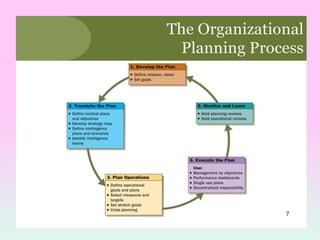
 Organizational Planning Process
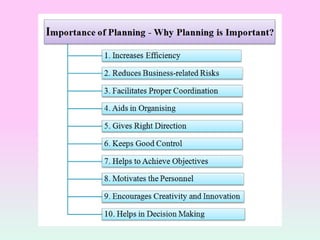
 Importance of Planning
what is a plan ?
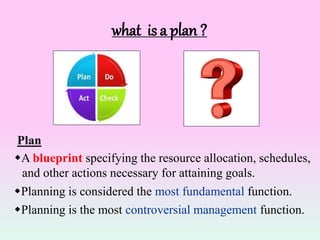
A blueprint specifying the resource allocation, schedules,
and other actions necessary for attaining goals.
Planning is considered the most fundamental function.
Planning is the most controversial management function.
Plan
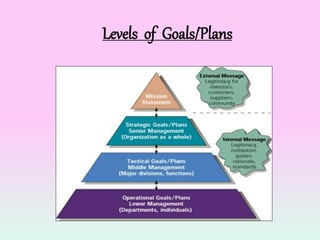
Levels of Goals/Plans
Purposes of Planning
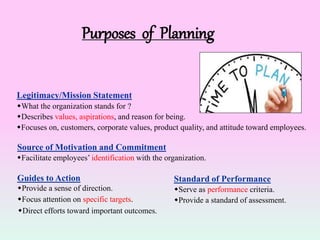
Legitimacy/Mission Statement
Describes values, aspirations, and reason for being.
Focuses on, customers, corporate values, product quality, and attitude toward employees.
Source of Motivation and Commitment
Facilitate employees’ identification with the organization.
Guides to Action
Provide a sense of direction.
Focus attention on specific targets.
Direct efforts toward important outcomes.
What the organization stands for ?
Standard of Performance
Serve as performance criteria.
Provide a standard of assessment.
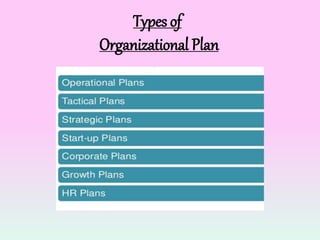
Types of
Organizational Plan
Strategic Plan
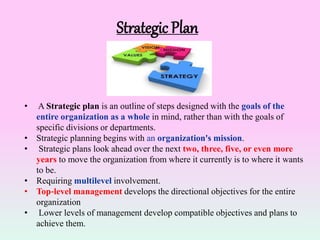
• A Strategic plan is an outline of steps designed with the goals of the
entire organization as a whole in mind, rather than with the goals of
specific divisions or departments.
• Strategic planning begins with an organization's mission.
• Strategic plans look ahead over the next two, three, five, or even more
years to move the organization from where it currently is to where it wants
to be.
• Requiring multilevel involvement.
• Top‐level management develops the directional objectives for the entire
organization
• Lower levels of management develop compatible objectives and plans to
achieve them.
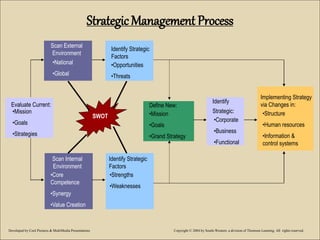
StrategicManagement Process
Identify Strategic
Factors
•Strengths
•Weaknesses
Scan Internal
Environment
•Core
Competence
•Synergy
•Value Creation
Identify
Strategic:
•Corporate
•Business
•Functional
Define New:
•Mission
•Goals
•Grand Strategy
Evaluate Current:
•Mission
•Goals
•Strategies
Scan External
Environment
•National
•Global
•Opportunities
•Threats
Identify Strategic
Factors
SWOT
Implementing Strategy
via Changes in:
•Structure
•Human resources
•Information &
control systems
Developed by Cool Pictures & MultiMedia Presentations Copyright © 2004 by South-Western, a division of Thomson Learning. All rights reserved.
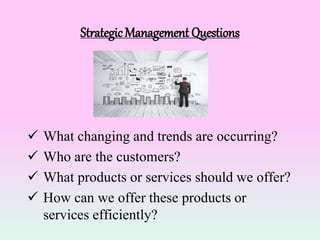
StrategicManagement Questions
 What changing and trends are occurring?
 Who are the customers?
 What products or services should we offer?
 How can we offer these products or
services efficiently?
Tactical plans
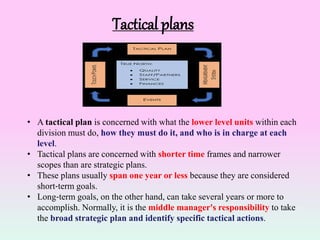
• A tactical plan is concerned with what the lower level units within each
division must do, how they must do it, and who is in charge at each
level.
• Tactical plans are concerned with shorter time frames and narrower
scopes than are strategic plans.

• These plans usually span one year or less because they are considered
short‐term goals.
• Long‐term goals, on the other hand, can take several years or more to
accomplish. Normally, it is the middle manager's responsibility to take
the broad strategic plan and identify specific tactical actions.
Operational plans
The specific results expected from departments, work groups, and individuals
are the operational goals. They are developed by Lower level managers.
These goals should be precise and measurable.
◦ “Publish 20 books this quarter” are examples of operational goals.
An operational plan is one that a manager uses to accomplish his or her job
responsibilities. Supervisors, team leaders, and facilitators develop operational
plans to support tactical plans.
Start-up Plans
The start-up plan is the stepping stone of the business. In this plan,
the incorporator of the business analyzes the financial viability of his
proposed venture.
Startup Plans Include:
• The proposed product
• Its market of operation
• The team of individuals who would assist him in his venture
• The finances of the business and their mode of procurement
Corporate Plans
These plans are also known as Strategic plans. These plans are drawn
with the intent of analyzing whether or not the company’s resources are
being utilized optimally. As there are often several ways in which a
chore can be performed corporate plans highlight the most feasible and
profitable one.
• These plans are chalked out by the Human Resources Department to
obtain the right number of employees with the right skills for the
right places at the right time.
• Through the implementation of this plan, all the departments of the
company should have the optimum number of personnel required.
HR Plans
Growth plans
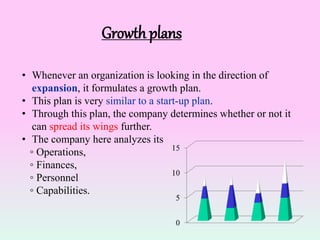
• Whenever an organization is looking in the direction of
expansion, it formulates a growth plan.
• This plan is very similar to a start-up plan.
• Through this plan, the company determines whether or not it
can spread its wings further.
• The company here analyzes its
◦ Operations,
◦ Finances,
◦ Personnel
◦ Capabilities.
Overall Planning Process
Begins With:  Mission statement
 Strategic goals
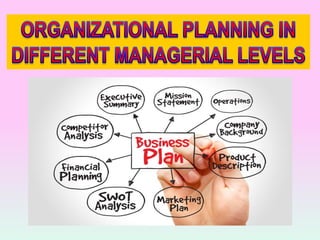
ORGANIZATIONAL PLANNING AT DIFFERENT MANAGERIAL LEVELS

ORGANIZATIONAL PLANNING AT DIFFERENT MANAGERIAL LEVELS

  • 4.
    Contents :  Whatis a Plan?  Levels of Plans  Purpose of Planning  Types of Organizational Plan  Organizational Planning Process  Importance of Planning
  • 5.
    what is aplan ? A blueprint specifying the resource allocation, schedules, and other actions necessary for attaining goals. Planning is considered the most fundamental function. Planning is the most controversial management function. Plan
  • 6.
  • 7.
    Purposes of Planning Legitimacy/MissionStatement Describes values, aspirations, and reason for being. Focuses on, customers, corporate values, product quality, and attitude toward employees. Source of Motivation and Commitment Facilitate employees’ identification with the organization. Guides to Action Provide a sense of direction. Focus attention on specific targets. Direct efforts toward important outcomes. What the organization stands for ? Standard of Performance Serve as performance criteria. Provide a standard of assessment.
  • 8.
  • 9.
    Strategic Plan • AStrategic plan is an outline of steps designed with the goals of the entire organization as a whole in mind, rather than with the goals of specific divisions or departments. • Strategic planning begins with an organization's mission. • Strategic plans look ahead over the next two, three, five, or even more years to move the organization from where it currently is to where it wants to be. • Requiring multilevel involvement. • Top‐level management develops the directional objectives for the entire organization • Lower levels of management develop compatible objectives and plans to achieve them.
  • 10.
    StrategicManagement Process Identify Strategic Factors •Strengths •Weaknesses ScanInternal Environment •Core Competence •Synergy •Value Creation Identify Strategic: •Corporate •Business •Functional Define New: •Mission •Goals •Grand Strategy Evaluate Current: •Mission •Goals •Strategies Scan External Environment •National •Global •Opportunities •Threats Identify Strategic Factors SWOT Implementing Strategy via Changes in: •Structure •Human resources •Information & control systems Developed by Cool Pictures & MultiMedia Presentations Copyright © 2004 by South-Western, a division of Thomson Learning. All rights reserved.
  • 11.
    StrategicManagement Questions  Whatchanging and trends are occurring?  Who are the customers?  What products or services should we offer?  How can we offer these products or services efficiently?
  • 12.
    Tactical plans • Atactical plan is concerned with what the lower level units within each division must do, how they must do it, and who is in charge at each level. • Tactical plans are concerned with shorter time frames and narrower scopes than are strategic plans. • These plans usually span one year or less because they are considered short‐term goals. • Long‐term goals, on the other hand, can take several years or more to accomplish. Normally, it is the middle manager's responsibility to take the broad strategic plan and identify specific tactical actions.
  • 13.
    Operational plans The specificresults expected from departments, work groups, and individuals are the operational goals. They are developed by Lower level managers. These goals should be precise and measurable. ◦ “Publish 20 books this quarter” are examples of operational goals. An operational plan is one that a manager uses to accomplish his or her job responsibilities. Supervisors, team leaders, and facilitators develop operational plans to support tactical plans.
  • 14.
    Start-up Plans The start-upplan is the stepping stone of the business. In this plan, the incorporator of the business analyzes the financial viability of his proposed venture. Startup Plans Include: • The proposed product • Its market of operation • The team of individuals who would assist him in his venture • The finances of the business and their mode of procurement
  • 15.
    Corporate Plans These plansare also known as Strategic plans. These plans are drawn with the intent of analyzing whether or not the company’s resources are being utilized optimally. As there are often several ways in which a chore can be performed corporate plans highlight the most feasible and profitable one. • These plans are chalked out by the Human Resources Department to obtain the right number of employees with the right skills for the right places at the right time. • Through the implementation of this plan, all the departments of the company should have the optimum number of personnel required. HR Plans
  • 16.
    Growth plans • Wheneveran organization is looking in the direction of expansion, it formulates a growth plan. • This plan is very similar to a start-up plan. • Through this plan, the company determines whether or not it can spread its wings further. • The company here analyzes its ◦ Operations, ◦ Finances, ◦ Personnel ◦ Capabilities.
  • 17.
    Overall Planning Process BeginsWith:  Mission statement  Strategic goals