Accountability, Transparency, Anti-
corruption Measures
&
Their Impact on Public Administration
By
Dr. Md. Shamsul Arefin
A member of Bangladesh Civil Service
Belongs to 84 Batch (Admin)
A class note for the SSC
23 April 2014 at 7.30 pm
BPATC, Savar, Dhaka.
Why Transparency & Accountability
in public administration is essential
 Citizens expect public servants to serve the public interest with fairness and to
manage public resources properly on a daily basis.
Fair and reliable public services and predictable decision-making inspire
public trust
 Transparency and accountability in public administration are prerequisites to
public trust.
 Non transparent system invites corruption in public office
 Corruption and maladministration in this context could be seen as not only
individual acts but also the results of systemic failure of governance.
Why transparency & accountability
in public office is essential
Construction infrastructure involves a high percentage of
government investment budgets in all countries. If this
sector is not transparent, corruption may damage this
sector.
People have right to know their tax money is utilized
properly.
Transparency
• Transparency- making public service delivery
processes & procedures open and visible
• Transparency – Information to citizens on:
▫ Reasons [in writing] why an application is rejected
or a service delayed or denied
▫ Right to know status of Applications
Major Initiatives to Enhance Transparency
• Transparency is about the sharing of information about government
decisions and activities and access to information etc.
• Right to Information Act
• Citizens Charters
• e-Government
• e-procurement
• Protection of whistle-blowers
• Anti corruption act
Accountability
• Accountability - by identifying the responsible
authorities within the system
• Accountability - Penalizing willful non-
performance
• Accountability - Put Citizen First: mechanism for
redress of grievance; compensation
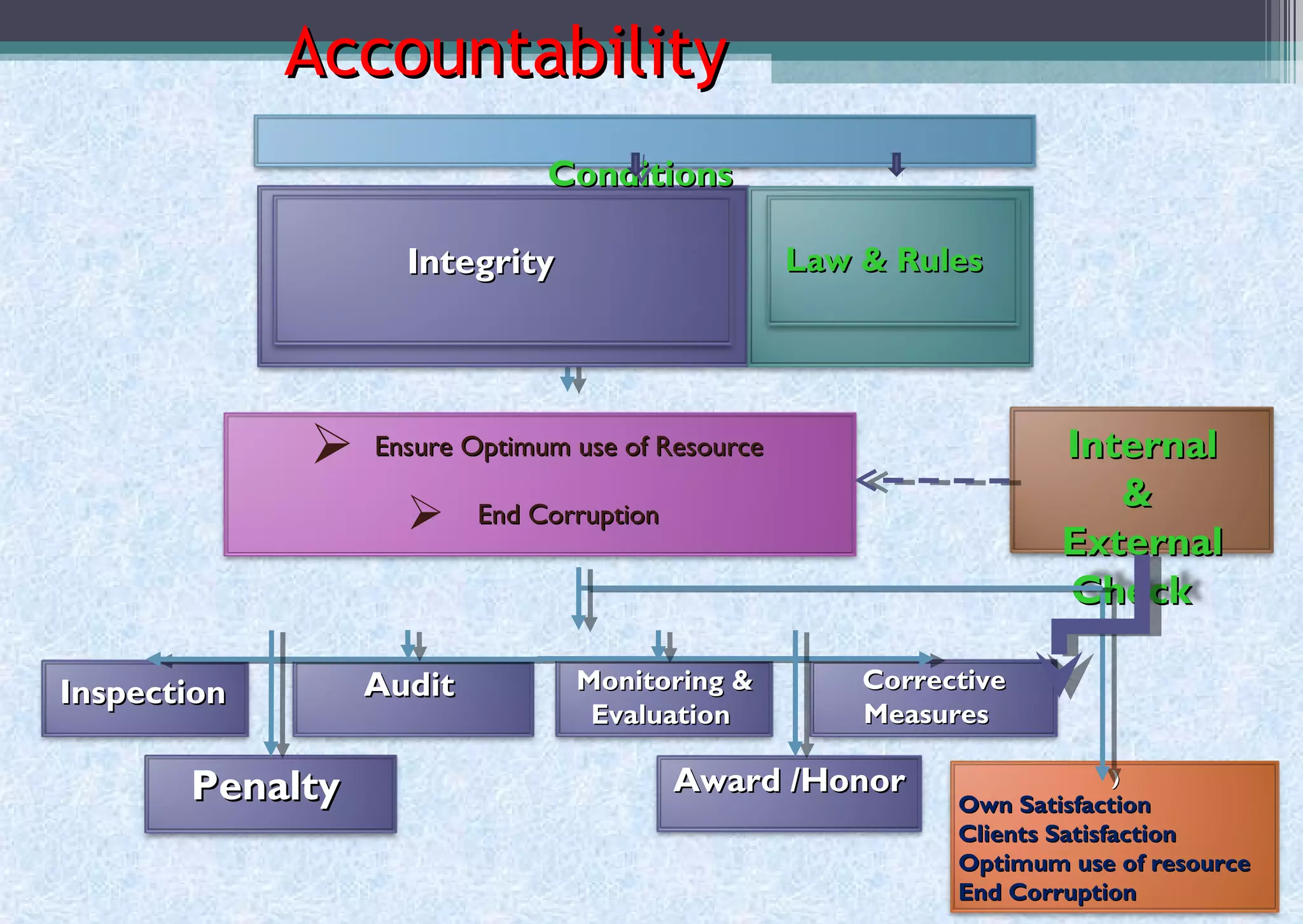
AccountabilityAccountability
 Ensure Optimum use of ResourceEnsure Optimum use of Resource
 End CorruptionEnd Corruption
InternalInternal
&&
ExternalExternal
CheckCheck
InspectionInspection AuditAudit Monitoring &Monitoring &
EvaluationEvaluation
))
Own SatisfactionOwn Satisfaction
Clients SatisfactionClients Satisfaction
Optimum use of resourceOptimum use of resource
End CorruptionEnd Corruption
CorrectiveCorrective
MeasuresMeasures
Award /HonorAward /Honor
CInInCInIn
ConditionsConditions
Own answer
PenaltyPenalty
IntegrityIntegrity Law & RulesLaw & Rules
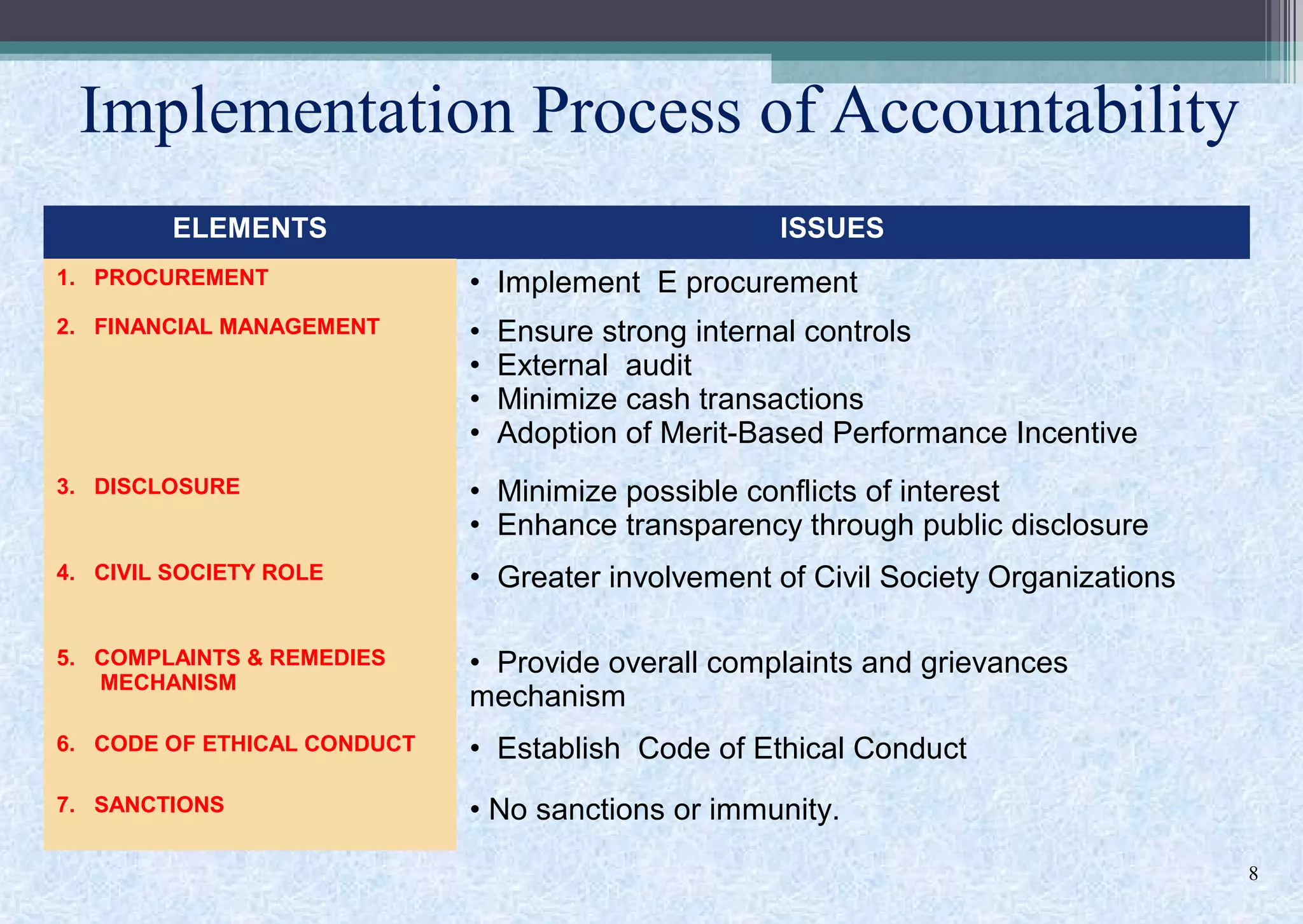
Implementation Process of Accountability
ELEMENTS ISSUES
1. PROCUREMENT • Implement E procurement
2. FINANCIAL MANAGEMENT • Ensure strong internal controls
• External audit
• Minimize cash transactions
• Adoption of Merit-Based Performance Incentive
3. DISCLOSURE • Minimize possible conflicts of interest
• Enhance transparency through public disclosure
4. CIVIL SOCIETY ROLE • Greater involvement of Civil Society Organizations
5. COMPLAINTS & REMEDIES
MECHANISM
• Provide overall complaints and grievances
mechanism
6. CODE OF ETHICAL CONDUCT • Establish Code of Ethical Conduct
7. SANCTIONS • No sanctions or immunity.
8
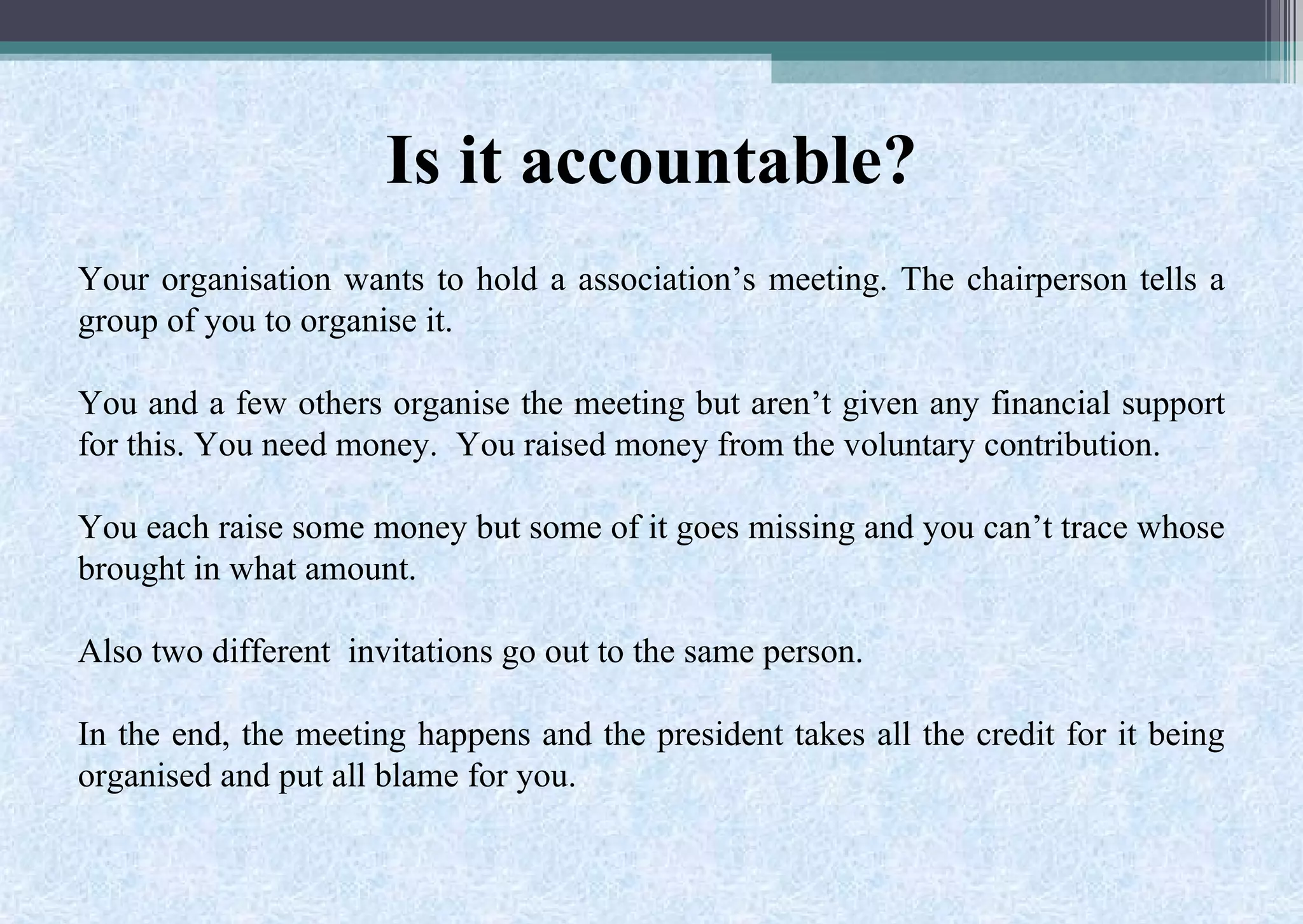
Is it accountable?
Your organisation wants to hold a association’s meeting. The chairperson tells a
group of you to organise it.
You and a few others organise the meeting but aren’t given any financial support
for this. You need money. You raised money from the voluntary contribution.
You each raise some money but some of it goes missing and you can’t trace whose
brought in what amount.
Also two different invitations go out to the same person.
In the end, the meeting happens and the president takes all the credit for it being
organised and put all blame for you.
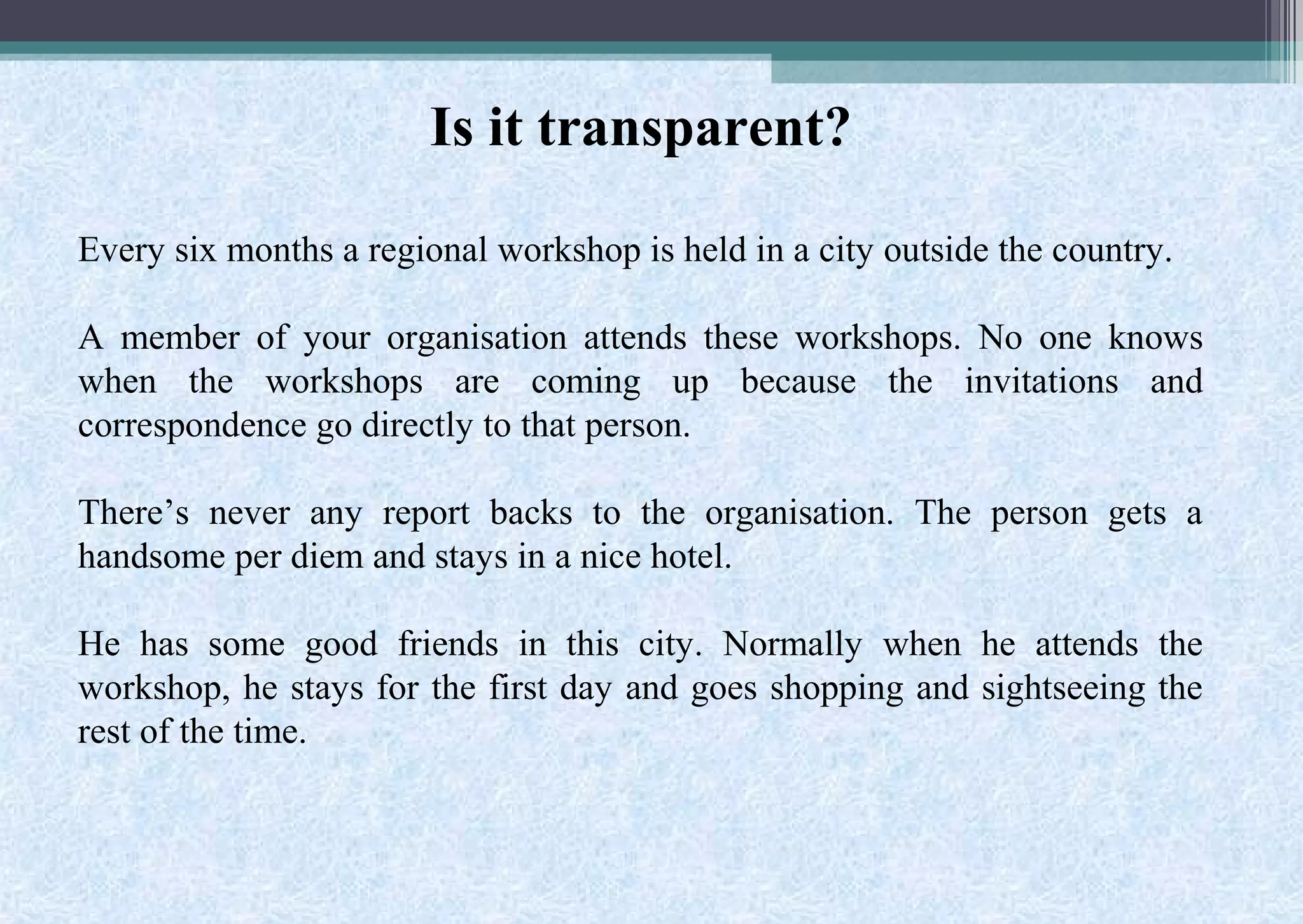
Is it transparent?
Every six months a regional workshop is held in a city outside the country.
A member of your organisation attends these workshops. No one knows
when the workshops are coming up because the invitations and
correspondence go directly to that person.
There’s never any report backs to the organisation. The person gets a
handsome per diem and stays in a nice hotel.
He has some good friends in this city. Normally when he attends the
workshop, he stays for the first day and goes shopping and sightseeing the
rest of the time.
01/04/18 Md. Shamsul Arefin 14
Please indicate how much do you agree
with the following statements
 I would feel comfortable helping my
relative to get promotion in my office,
though he is not qualified.
 I would feel comfortable helping my family members to get a
job in my govt office even if they were not as
qualified as another candidate.
 I would feel obligated to use my influence
as a civil servant to help my friend / relative
January 4, 2018
Historical Development of Anti
Corruption in Bangladesh
• Bureau of Anti- Corruption was formed in 1943.
• Since its inception in 1943 until 1983 the organization
functioned as a branch of the Police
• In 1983 a separate employment charter was provided to the
Bureau curtailing its dependency on the police for manpower.
• The Anti Corruption Commission (ACC) Bangladesh was
created under section 3 of Anti Corruption Commission Act,
2004. The first set of office bearers were appointed on 21
November 2004.
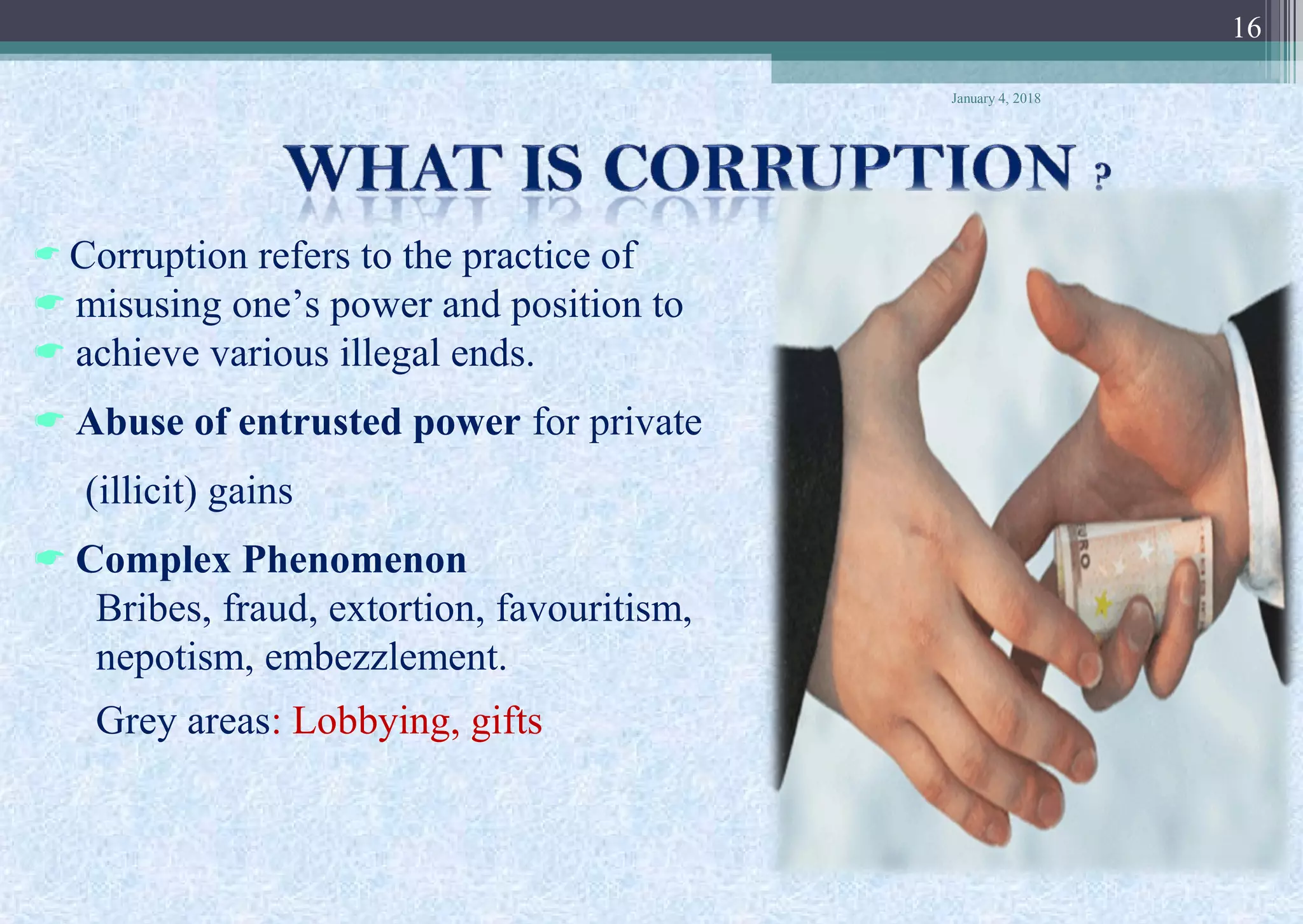
 Corruption refers to the practice of
 misusing one’s power and position to
 achieve various illegal ends.
 Abuse of entrusted power for private
(illicit) gains
 Complex Phenomenon
Bribes, fraud, extortion, favouritism,
nepotism, embezzlement.
Grey areas: Lobbying, gifts
January 4, 2018
16
Impact of Corruption on Public Administration
It is unfair and harms those who without power
It results in a loss of values and morality which values are a
trust in Public Service
It results in financial loss in Public Service
It results in loss of confidence in government, justice and
public services
It creates an inefficient Public service
It impedes investment, employment and economic development
through poor governance.
17
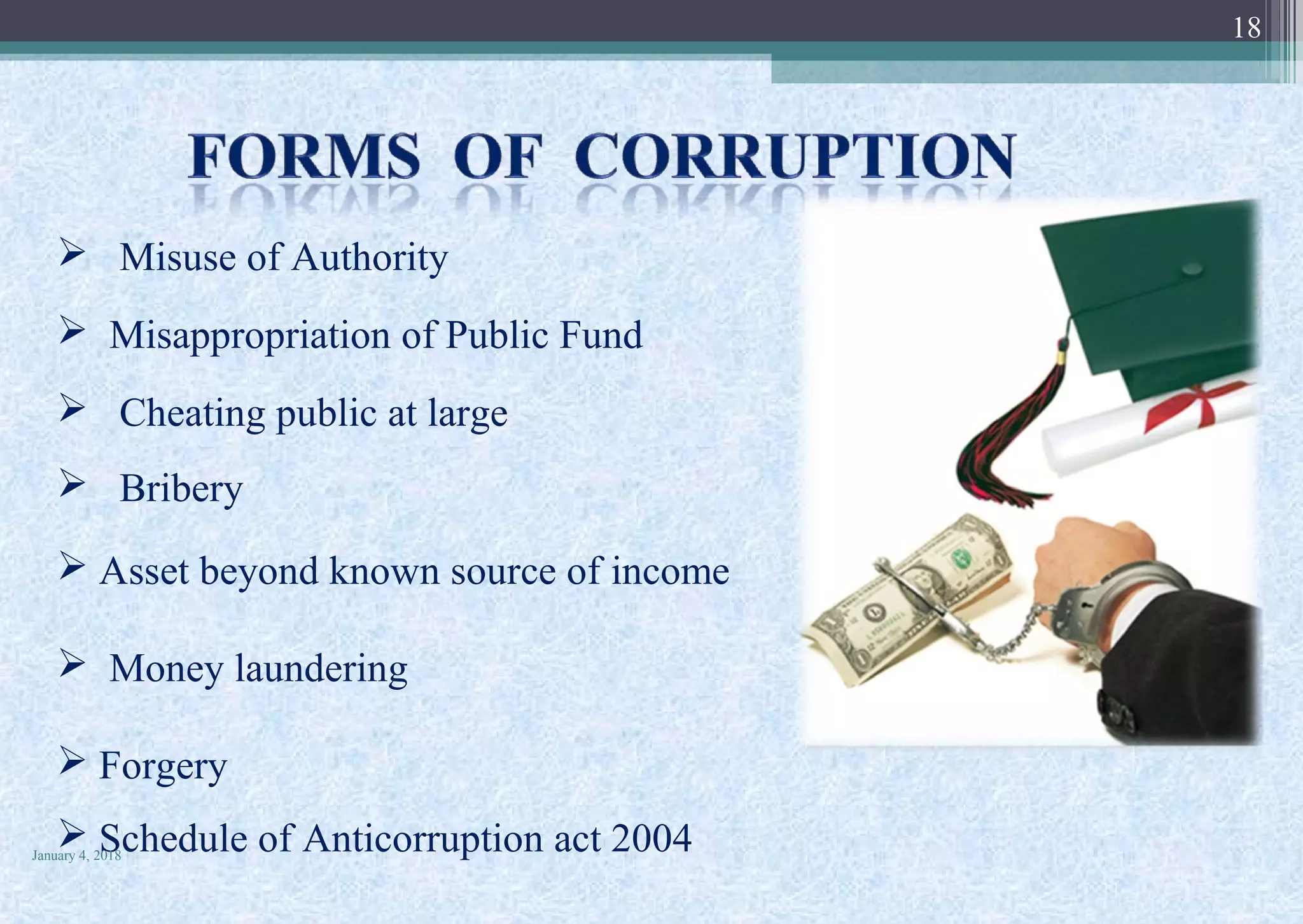
 Misuse of Authority
 Misappropriation of Public Fund
 Cheating public at large
 Bribery
 Asset beyond known source of income
 Money laundering
 Forgery
 Schedule of Anticorruption act 2004January 4, 2018
18
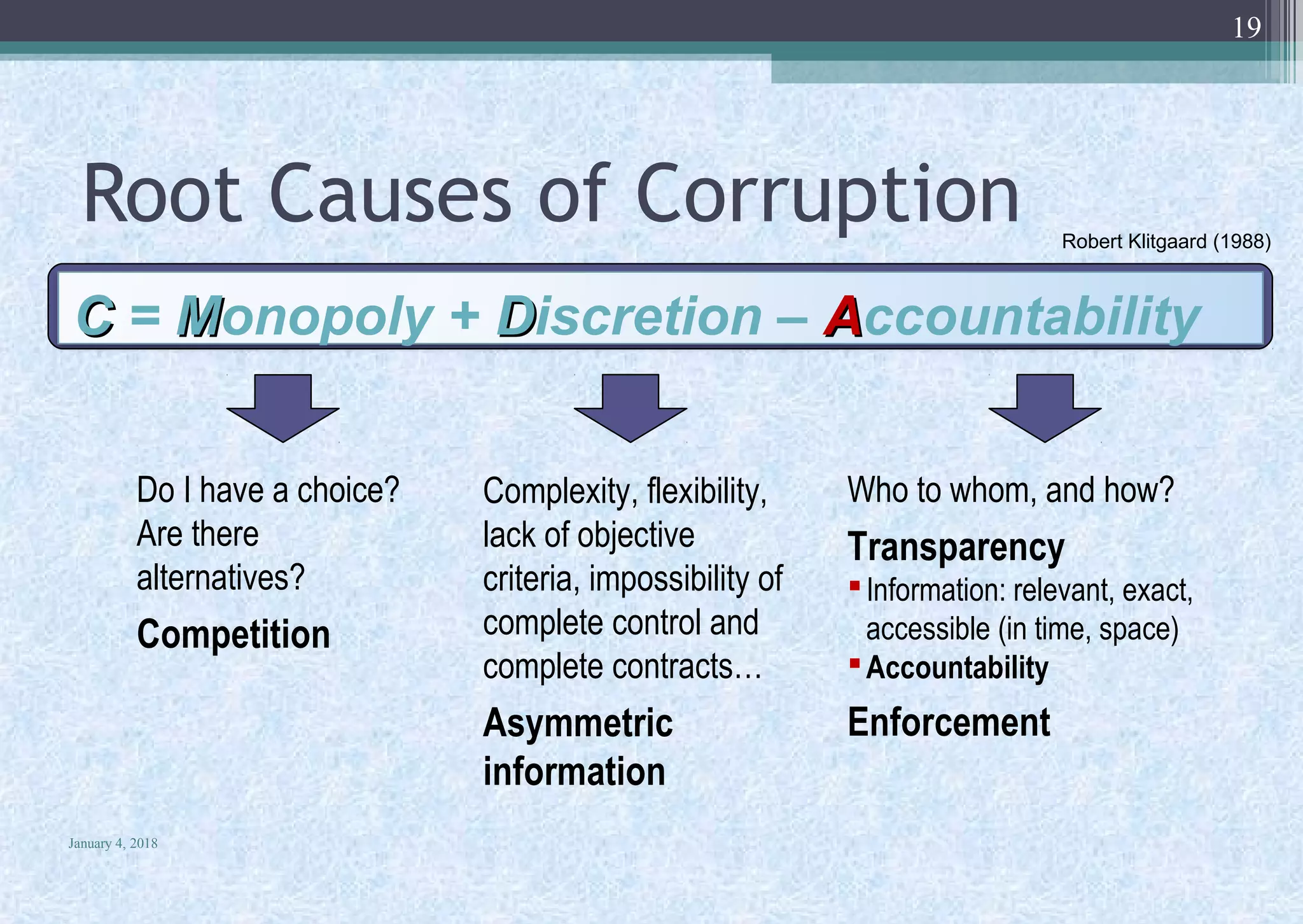
Root Causes of Corruption Robert Klitgaard (1988)
CC = MMonopoly + DDiscretion – AAccountability
Do I have a choice?
Are there
alternatives?
Competition
Complexity, flexibility,
lack of objective
criteria, impossibility of
complete control and
complete contracts…
Asymmetric
information
Who to whom, and how?
Transparency
Information: relevant, exact,
accessible (in time, space)
Accountability
Enforcement
January 4, 2018
19
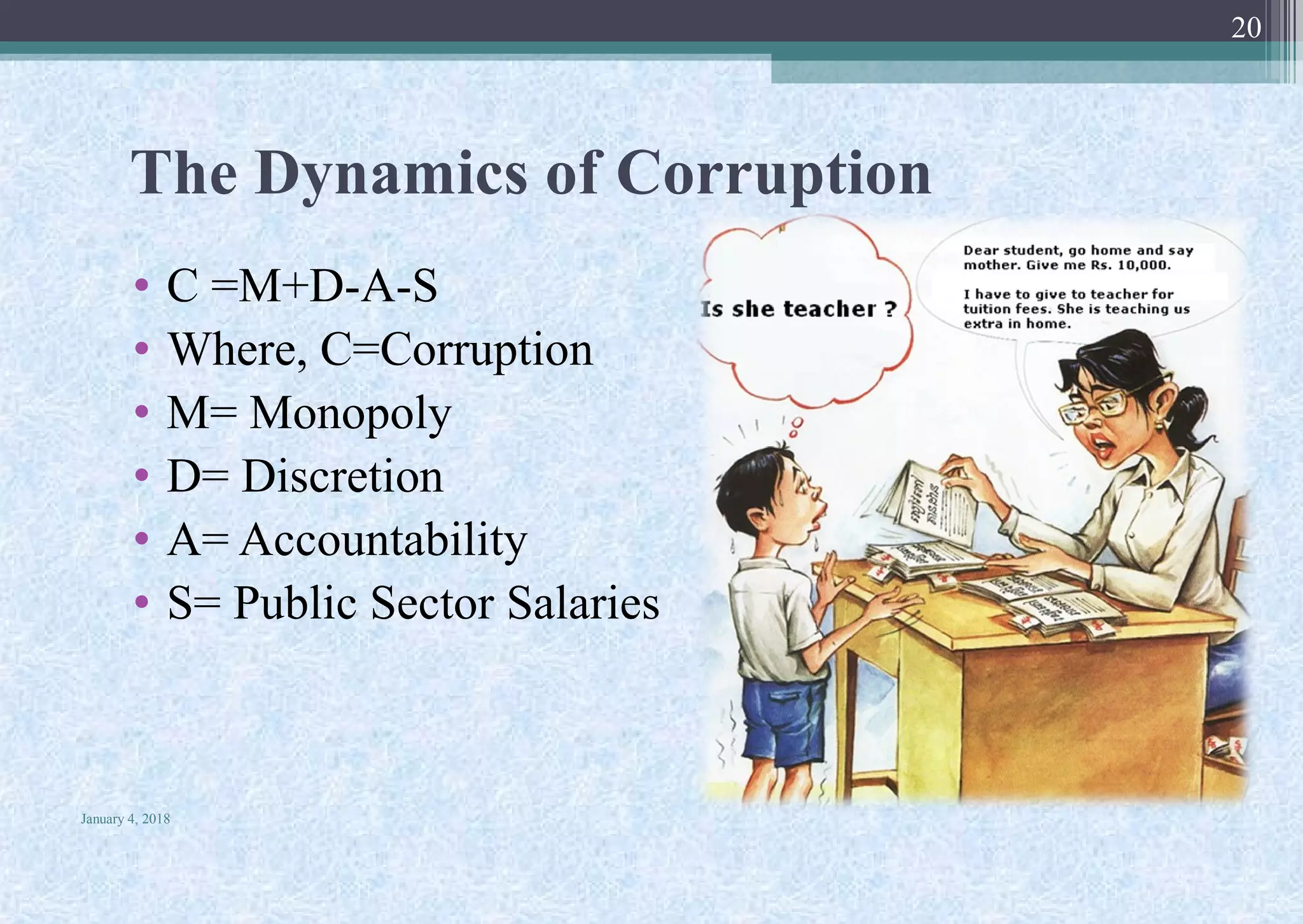
The Dynamics of Corruption
• C =M+D-A-S
• Where, C=Corruption
• M= Monopoly
• D= Discretion
• A= Accountability
• S= Public Sector Salaries
January 4, 2018
20
January 4, 2018
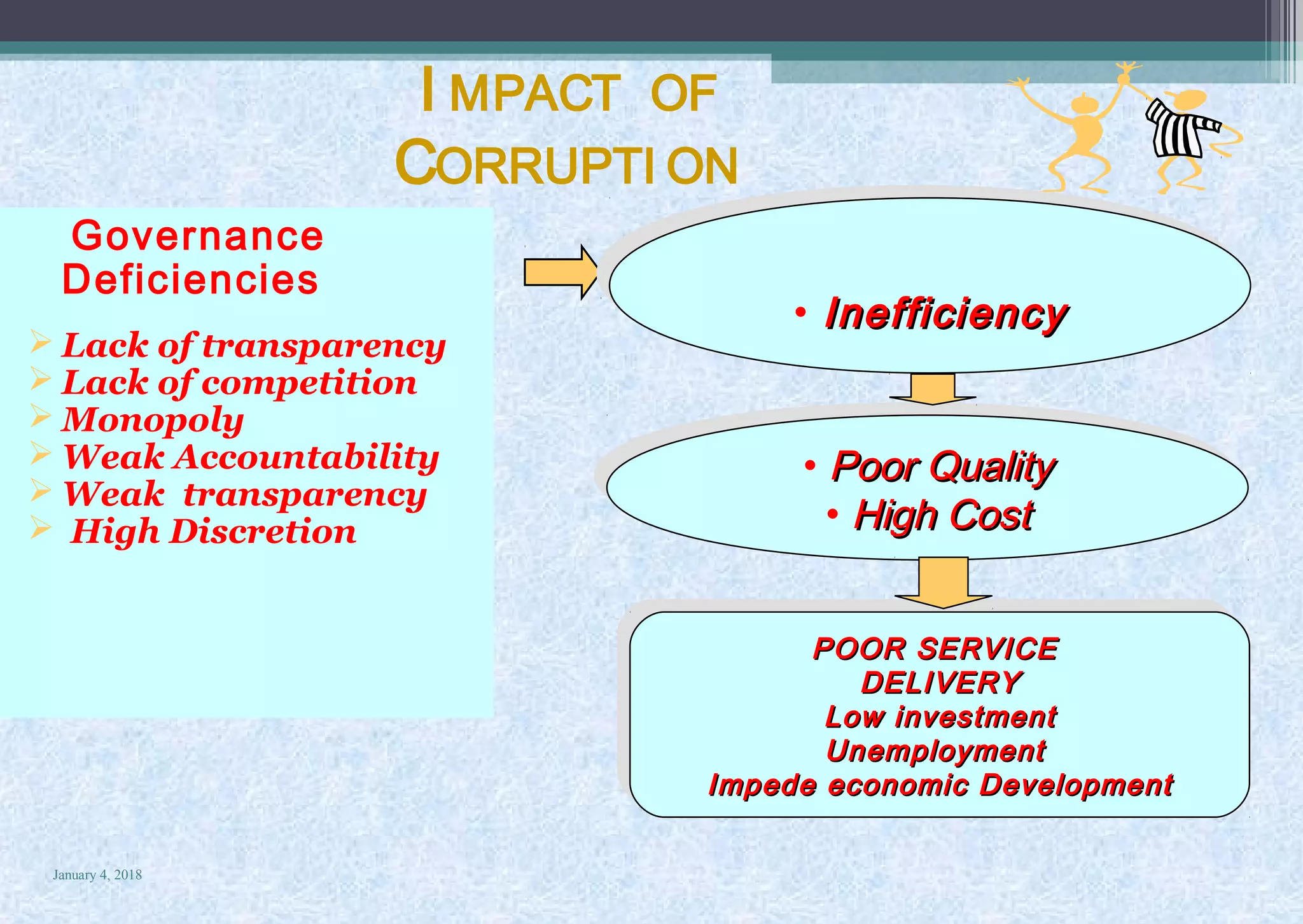
Governance
Deficiencies
 Lack of transparency
 Lack of competition
 Monopoly
 Weak Accountability
 Weak transparency
 High Discretion
I MPACT OF
CORRUPTI ON
• InefficiencyInefficiency• InefficiencyInefficiency
• Poor QualityPoor Quality
• High CostHigh Cost
• Poor QualityPoor Quality
• High CostHigh Cost
POOR SERVICEPOOR SERVICE
DELIVERYDELIVERY
Low investmentLow investment
UnemploymentUnemployment
Impede economic DevelopmentImpede economic Development
POOR SERVICEPOOR SERVICE
DELIVERYDELIVERY
Low investmentLow investment
UnemploymentUnemployment
Impede economic DevelopmentImpede economic Development
January 4, 2018
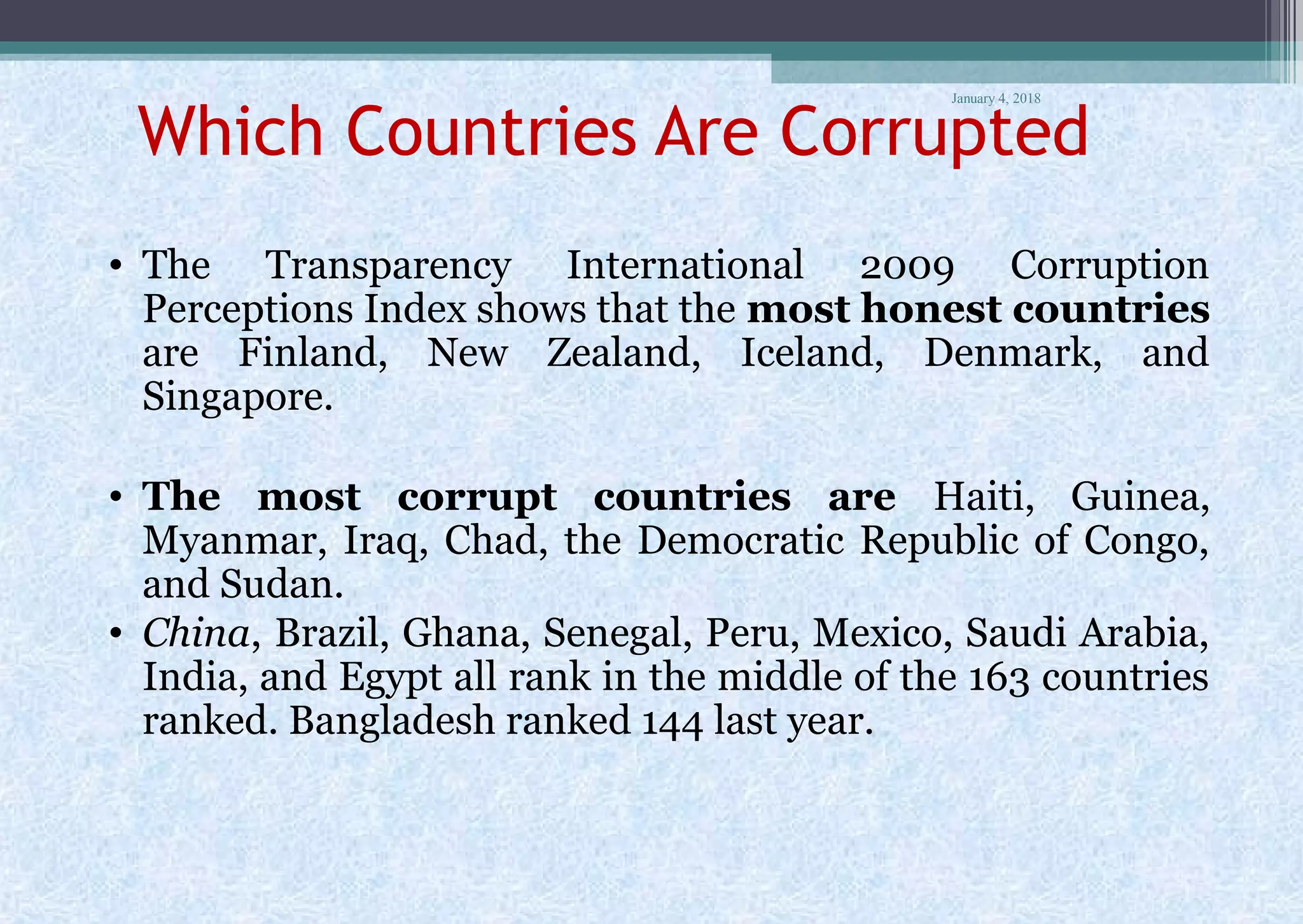
Which Countries Are Corrupted
• The Transparency International 2009 Corruption
Perceptions Index shows that the most honest countries
are Finland, New Zealand, Iceland, Denmark, and
Singapore.
• The most corrupt countries are Haiti, Guinea,
Myanmar, Iraq, Chad, the Democratic Republic of Congo,
and Sudan.
• China, Brazil, Ghana, Senegal, Peru, Mexico, Saudi Arabia,
India, and Egypt all rank in the middle of the 163 countries
ranked. Bangladesh ranked 144 last year.
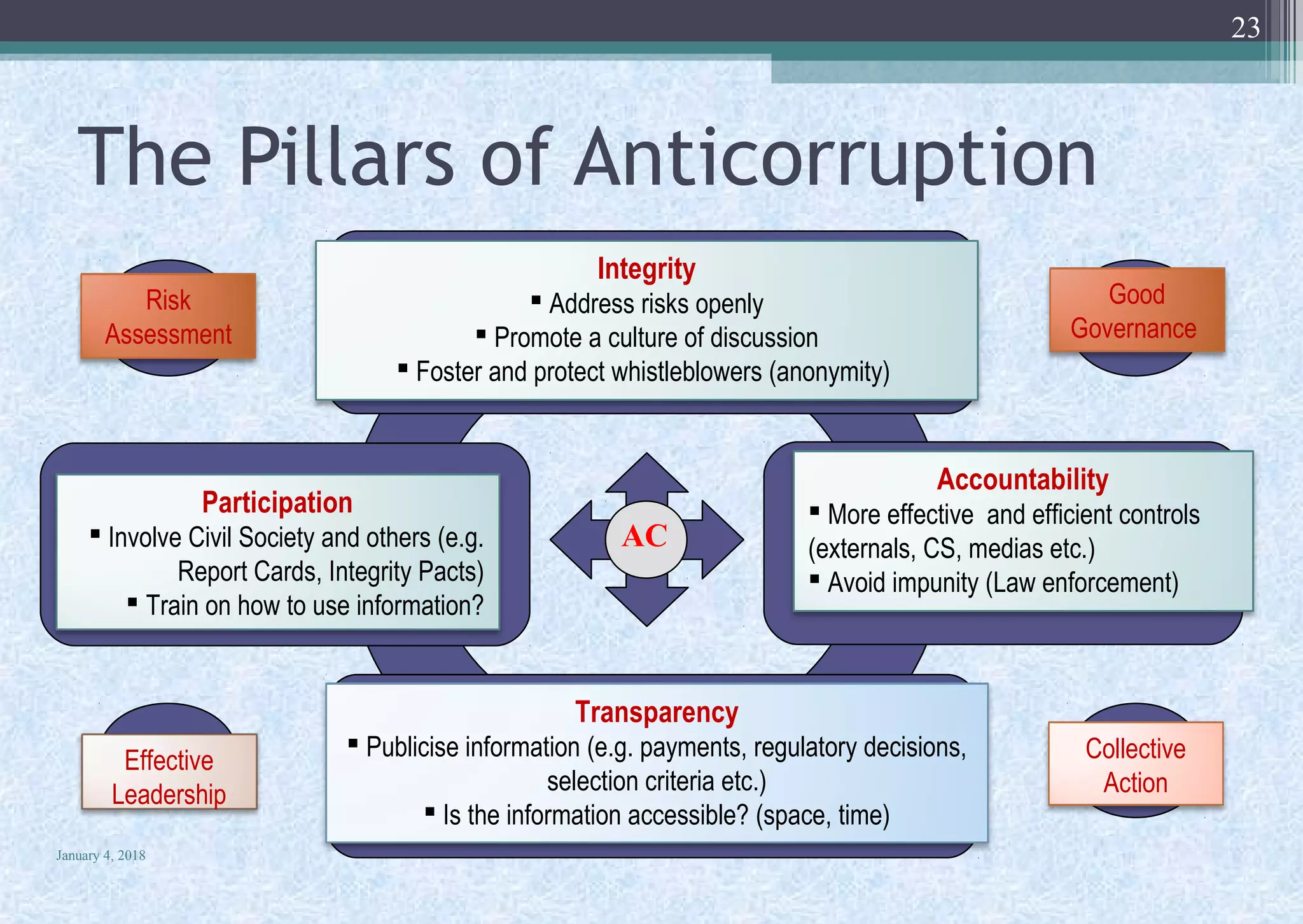
The Pillars of Anticorruption
Integrity
 Address risks openly
 Promote a culture of discussion
 Foster and protect whistleblowers (anonymity)
Transparency
 Publicise information (e.g. payments, regulatory decisions,
selection criteria etc.)
 Is the information accessible? (space, time)
Accountability
 More effective and efficient controls
(externals, CS, medias etc.)
 Avoid impunity (Law enforcement)
Participation
 Involve Civil Society and others (e.g.
Report Cards, Integrity Pacts)
 Train on how to use information?
AC
Risk
Assessment
Collective
Action
Effective
Leadership
Good
Governance
January 4, 2018
23
Protection of Values
 Now in many cases, people do not feel any hesitation to take
paper, pen or ink from the office to home for personal use. But
once taking pen or pencil or ink from office to home for personal
use was considered as a serious offence.
 Mr Mohammad Ali Ex, Chief Minister of Pakistan after
submitting resignation letter from his office, he took pen of
Bangabhaban with him beyond his knowledge. But when he had
seen the pen in his pocket, he came back and returned it to
Bangabhaban. If this is happened now a days, people might say it is
done just as a administrative standbazi.
January 4, 2018
24
6 January 2013
Teaching of Hazrat Muhammed SA (Peace be upon him)
 Prophet Hazrat Muhammed SA (Peace be upon him) once appointed Abdullah-
bin –Laithai as Amil (tax collector). At the time of depositing the collected zakat
before the Prophet Muhammad (Peace be upon him), Abdullah had divided that
into two parts and said one part of this is zakat money from people, and the other
is the gift presented by people to me.”
 Hearing this, the Prophet (Peace be upon him) said, “Would the people have
given the gifts to you if you had not been given the responsibility of collecting
zakat?” Saying this, the Prophet of Islam instructed Abdullah to deposit the gifted
amount along with the collected revenue to Baitulmal, and the following morning
issued an official circular prohibiting officials to receive any gift from people.
Another related Hadith is that:
“He who receives bribe, he who offers bribe and the mediator between the
two, are all equally doers of punishable offence”.
25
January 4, 2018
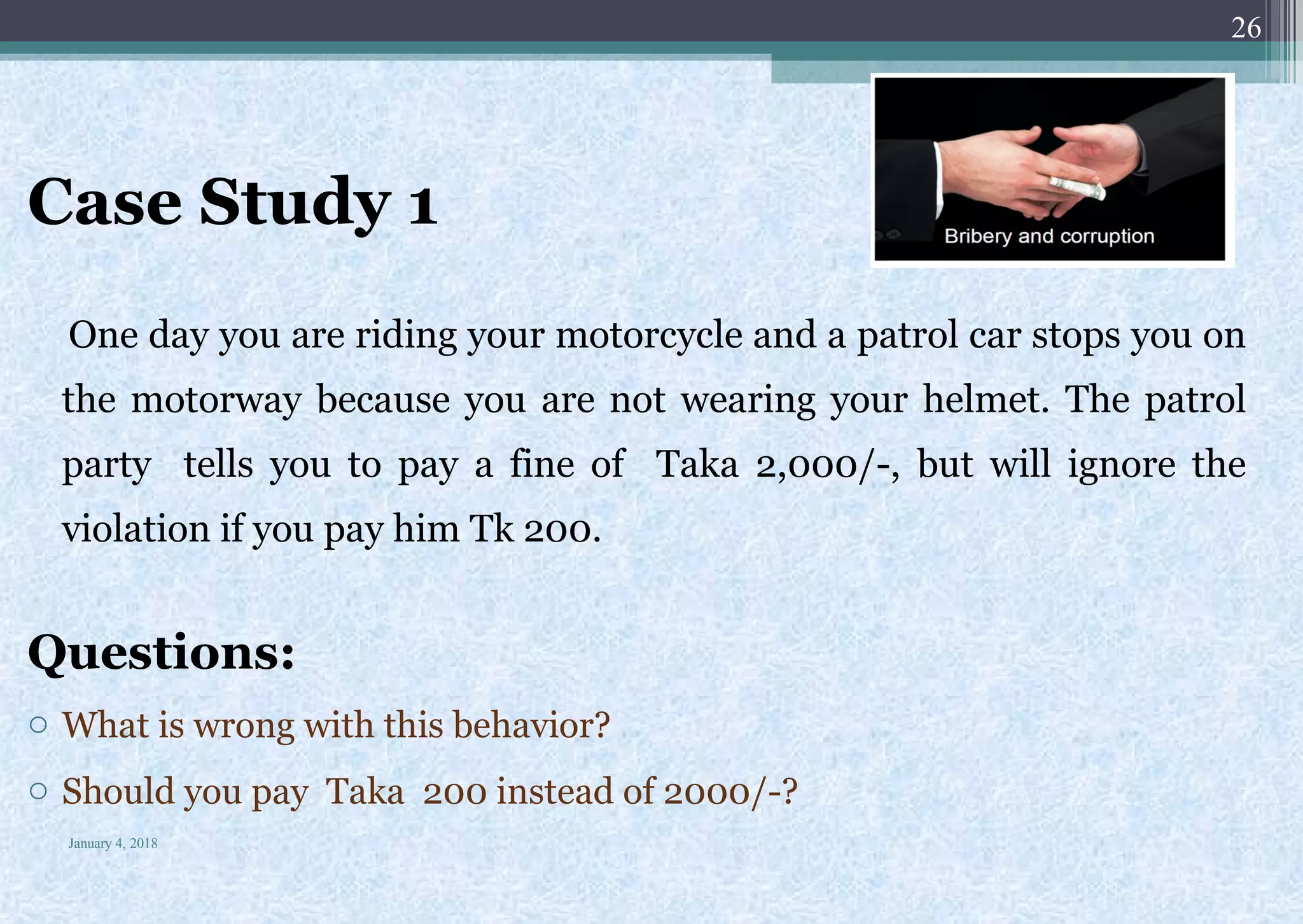
Case Study 1
One day you are riding your motorcycle and a patrol car stops you on
the motorway because you are not wearing your helmet. The patrol
party tells you to pay a fine of Taka 2,000/-, but will ignore the
violation if you pay him Tk 200.
Questions:
o What is wrong with this behavior?
o Should you pay Taka 200 instead of 2000/-?
January 4, 2018
26
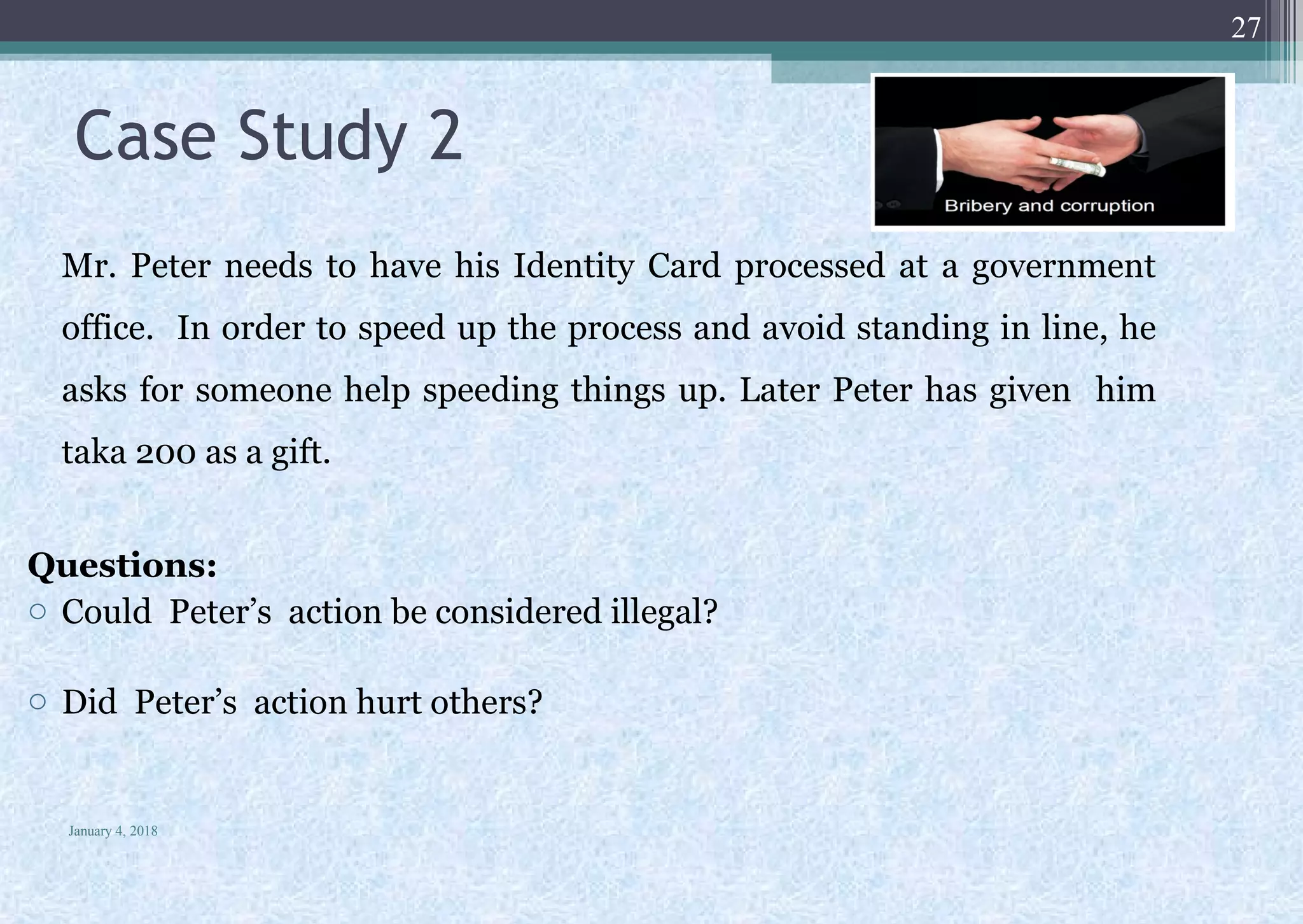
Case Study 2
Mr. Peter needs to have his Identity Card processed at a government
office. In order to speed up the process and avoid standing in line, he
asks for someone help speeding things up. Later Peter has given him
taka 200 as a gift.
Questions:
o Could Peter’s action be considered illegal?
o Did Peter’s action hurt others?
January 4, 2018
27
Case Study 3
A young girl has failed her exam twice. She has one more opportunity to
retake the exam. Her parents are afraid she will fail again, which will
drastically reduce her opportunities to find a good job, a good husband, or
to study further. In order to increase her chances of passing, the girl’s
parents try to give an expensive reception to her teacher.
Questions:
o Would it make any difference if the gift was a book or flowers?
o Can you tell a policy option to prevent this kind of situation?
January 4, 2018
28
Case Study 4
You are an Executive Engineer and you receive a fund for
building a bridge in your project. Your nephew happens to
run a construction company and he makes it very clear that
he expects you to give him the contract because you are
family. You realize that if you decide not to give him the
contract, problems could arise within your family .
Question:
o What do you do?
o Tell a policy option that prevents this from happening again.
January 4, 2018
29
Anti-Corruption Code of Conduct
o We shall not offer, promise, solicit or accept any advantage,
either directly or indirectly, in connection with work, without
express permission of the employer. This does not include
conventional hospitality or once-only minor gifts as long as
these will not lead to a position of obligation to the gift giver.
o We will avoid any real and potential conflict between private
and office interests. We will directly report any occurrence of
such a conflict to the responsible supervisor.
o We will not misuse our official position for personal gains or
to favour relatives and friends.
January 4, 2018
30
Anti-Corruption Code of Conduct
o We will not misuse any office resources or property of the organization
like time, equipment, stationery, etc.
o We will report incidents, risks and issues of corruption committed by
colleagues or others to the responsible supervisor.
o We will treat everyone fairly and equally and will not discriminate with
respect to gender, skin, colour, religion, culture, education, ethnic
affiliation or nationality.
o We ensure transparent, ethical and accountable use of financial and
other resources.
o We commit ourselves to this code of conduct.
o We will make our code of conduct public to our professional partners
and associates, and expect them to respect this policy.
January 4, 2018
31
Conclusion
Corruption is widespread in some countries because of
 First, the motivation to earn income is extremely strong, aggravated by
poverty and by low and declining civil service salaries and the absence of
risk-spreading Mechanisms.
 Second, opportunities to engage in corruption are numerous. Monopoly rents
seeking behavior.
 The discretion of many public officials is broad in developing and transition
economies, and this systemic weakness is exacerbated by poorly defined, ever
changing, and poorly disseminated rules and regulations.
 Third, accountability is typically weak. Competition are not perfect often
restricted.
 The two parties to a bribe often both benefit, bribery can be extremely difficult to
detect.
 The watchdog institutions are weak
January 4, 2018
32
January 4, 2018

Accountability & transparency 26 05-2014

  • 1.
    Accountability, Transparency, Anti- corruptionMeasures & Their Impact on Public Administration By Dr. Md. Shamsul Arefin A member of Bangladesh Civil Service Belongs to 84 Batch (Admin) A class note for the SSC 23 April 2014 at 7.30 pm BPATC, Savar, Dhaka.
  • 2.
    Why Transparency &Accountability in public administration is essential  Citizens expect public servants to serve the public interest with fairness and to manage public resources properly on a daily basis. Fair and reliable public services and predictable decision-making inspire public trust  Transparency and accountability in public administration are prerequisites to public trust.  Non transparent system invites corruption in public office  Corruption and maladministration in this context could be seen as not only individual acts but also the results of systemic failure of governance.
  • 3.
    Why transparency &accountability in public office is essential Construction infrastructure involves a high percentage of government investment budgets in all countries. If this sector is not transparent, corruption may damage this sector. People have right to know their tax money is utilized properly.
  • 4.
    Transparency • Transparency- makingpublic service delivery processes & procedures open and visible • Transparency – Information to citizens on: ▫ Reasons [in writing] why an application is rejected or a service delayed or denied ▫ Right to know status of Applications
  • 8.
    Major Initiatives toEnhance Transparency • Transparency is about the sharing of information about government decisions and activities and access to information etc. • Right to Information Act • Citizens Charters • e-Government • e-procurement • Protection of whistle-blowers • Anti corruption act
  • 9.
    Accountability • Accountability -by identifying the responsible authorities within the system • Accountability - Penalizing willful non- performance • Accountability - Put Citizen First: mechanism for redress of grievance; compensation
  • 10.
    AccountabilityAccountability  Ensure Optimumuse of ResourceEnsure Optimum use of Resource  End CorruptionEnd Corruption InternalInternal && ExternalExternal CheckCheck InspectionInspection AuditAudit Monitoring &Monitoring & EvaluationEvaluation )) Own SatisfactionOwn Satisfaction Clients SatisfactionClients Satisfaction Optimum use of resourceOptimum use of resource End CorruptionEnd Corruption CorrectiveCorrective MeasuresMeasures Award /HonorAward /Honor CInInCInIn ConditionsConditions Own answer PenaltyPenalty IntegrityIntegrity Law & RulesLaw & Rules
  • 11.
    Implementation Process ofAccountability ELEMENTS ISSUES 1. PROCUREMENT • Implement E procurement 2. FINANCIAL MANAGEMENT • Ensure strong internal controls • External audit • Minimize cash transactions • Adoption of Merit-Based Performance Incentive 3. DISCLOSURE • Minimize possible conflicts of interest • Enhance transparency through public disclosure 4. CIVIL SOCIETY ROLE • Greater involvement of Civil Society Organizations 5. COMPLAINTS & REMEDIES MECHANISM • Provide overall complaints and grievances mechanism 6. CODE OF ETHICAL CONDUCT • Establish Code of Ethical Conduct 7. SANCTIONS • No sanctions or immunity. 8
  • 12.
    Is it accountable? Yourorganisation wants to hold a association’s meeting. The chairperson tells a group of you to organise it. You and a few others organise the meeting but aren’t given any financial support for this. You need money. You raised money from the voluntary contribution. You each raise some money but some of it goes missing and you can’t trace whose brought in what amount. Also two different invitations go out to the same person. In the end, the meeting happens and the president takes all the credit for it being organised and put all blame for you.
  • 13.
    Is it transparent? Everysix months a regional workshop is held in a city outside the country. A member of your organisation attends these workshops. No one knows when the workshops are coming up because the invitations and correspondence go directly to that person. There’s never any report backs to the organisation. The person gets a handsome per diem and stays in a nice hotel. He has some good friends in this city. Normally when he attends the workshop, he stays for the first day and goes shopping and sightseeing the rest of the time.
  • 14.
    01/04/18 Md. ShamsulArefin 14 Please indicate how much do you agree with the following statements  I would feel comfortable helping my relative to get promotion in my office, though he is not qualified.  I would feel comfortable helping my family members to get a job in my govt office even if they were not as qualified as another candidate.  I would feel obligated to use my influence as a civil servant to help my friend / relative
  • 15.
    January 4, 2018 HistoricalDevelopment of Anti Corruption in Bangladesh • Bureau of Anti- Corruption was formed in 1943. • Since its inception in 1943 until 1983 the organization functioned as a branch of the Police • In 1983 a separate employment charter was provided to the Bureau curtailing its dependency on the police for manpower. • The Anti Corruption Commission (ACC) Bangladesh was created under section 3 of Anti Corruption Commission Act, 2004. The first set of office bearers were appointed on 21 November 2004.
  • 16.
     Corruption refersto the practice of  misusing one’s power and position to  achieve various illegal ends.  Abuse of entrusted power for private (illicit) gains  Complex Phenomenon Bribes, fraud, extortion, favouritism, nepotism, embezzlement. Grey areas: Lobbying, gifts January 4, 2018 16
  • 17.
    Impact of Corruptionon Public Administration It is unfair and harms those who without power It results in a loss of values and morality which values are a trust in Public Service It results in financial loss in Public Service It results in loss of confidence in government, justice and public services It creates an inefficient Public service It impedes investment, employment and economic development through poor governance. 17
  • 18.
     Misuse ofAuthority  Misappropriation of Public Fund  Cheating public at large  Bribery  Asset beyond known source of income  Money laundering  Forgery  Schedule of Anticorruption act 2004January 4, 2018 18
  • 19.
    Root Causes ofCorruption Robert Klitgaard (1988) CC = MMonopoly + DDiscretion – AAccountability Do I have a choice? Are there alternatives? Competition Complexity, flexibility, lack of objective criteria, impossibility of complete control and complete contracts… Asymmetric information Who to whom, and how? Transparency Information: relevant, exact, accessible (in time, space) Accountability Enforcement January 4, 2018 19
  • 20.
    The Dynamics ofCorruption • C =M+D-A-S • Where, C=Corruption • M= Monopoly • D= Discretion • A= Accountability • S= Public Sector Salaries January 4, 2018 20
  • 21.
    January 4, 2018 Governance Deficiencies Lack of transparency  Lack of competition  Monopoly  Weak Accountability  Weak transparency  High Discretion I MPACT OF CORRUPTI ON • InefficiencyInefficiency• InefficiencyInefficiency • Poor QualityPoor Quality • High CostHigh Cost • Poor QualityPoor Quality • High CostHigh Cost POOR SERVICEPOOR SERVICE DELIVERYDELIVERY Low investmentLow investment UnemploymentUnemployment Impede economic DevelopmentImpede economic Development POOR SERVICEPOOR SERVICE DELIVERYDELIVERY Low investmentLow investment UnemploymentUnemployment Impede economic DevelopmentImpede economic Development
  • 22.
    January 4, 2018 WhichCountries Are Corrupted • The Transparency International 2009 Corruption Perceptions Index shows that the most honest countries are Finland, New Zealand, Iceland, Denmark, and Singapore. • The most corrupt countries are Haiti, Guinea, Myanmar, Iraq, Chad, the Democratic Republic of Congo, and Sudan. • China, Brazil, Ghana, Senegal, Peru, Mexico, Saudi Arabia, India, and Egypt all rank in the middle of the 163 countries ranked. Bangladesh ranked 144 last year.
  • 23.
    The Pillars ofAnticorruption Integrity  Address risks openly  Promote a culture of discussion  Foster and protect whistleblowers (anonymity) Transparency  Publicise information (e.g. payments, regulatory decisions, selection criteria etc.)  Is the information accessible? (space, time) Accountability  More effective and efficient controls (externals, CS, medias etc.)  Avoid impunity (Law enforcement) Participation  Involve Civil Society and others (e.g. Report Cards, Integrity Pacts)  Train on how to use information? AC Risk Assessment Collective Action Effective Leadership Good Governance January 4, 2018 23
  • 24.
    Protection of Values Now in many cases, people do not feel any hesitation to take paper, pen or ink from the office to home for personal use. But once taking pen or pencil or ink from office to home for personal use was considered as a serious offence.  Mr Mohammad Ali Ex, Chief Minister of Pakistan after submitting resignation letter from his office, he took pen of Bangabhaban with him beyond his knowledge. But when he had seen the pen in his pocket, he came back and returned it to Bangabhaban. If this is happened now a days, people might say it is done just as a administrative standbazi. January 4, 2018 24
  • 25.
    6 January 2013 Teachingof Hazrat Muhammed SA (Peace be upon him)  Prophet Hazrat Muhammed SA (Peace be upon him) once appointed Abdullah- bin –Laithai as Amil (tax collector). At the time of depositing the collected zakat before the Prophet Muhammad (Peace be upon him), Abdullah had divided that into two parts and said one part of this is zakat money from people, and the other is the gift presented by people to me.”  Hearing this, the Prophet (Peace be upon him) said, “Would the people have given the gifts to you if you had not been given the responsibility of collecting zakat?” Saying this, the Prophet of Islam instructed Abdullah to deposit the gifted amount along with the collected revenue to Baitulmal, and the following morning issued an official circular prohibiting officials to receive any gift from people. Another related Hadith is that: “He who receives bribe, he who offers bribe and the mediator between the two, are all equally doers of punishable offence”. 25 January 4, 2018
  • 26.
    Case Study 1 Oneday you are riding your motorcycle and a patrol car stops you on the motorway because you are not wearing your helmet. The patrol party tells you to pay a fine of Taka 2,000/-, but will ignore the violation if you pay him Tk 200. Questions: o What is wrong with this behavior? o Should you pay Taka 200 instead of 2000/-? January 4, 2018 26
  • 27.
    Case Study 2 Mr.Peter needs to have his Identity Card processed at a government office. In order to speed up the process and avoid standing in line, he asks for someone help speeding things up. Later Peter has given him taka 200 as a gift. Questions: o Could Peter’s action be considered illegal? o Did Peter’s action hurt others? January 4, 2018 27
  • 28.
    Case Study 3 Ayoung girl has failed her exam twice. She has one more opportunity to retake the exam. Her parents are afraid she will fail again, which will drastically reduce her opportunities to find a good job, a good husband, or to study further. In order to increase her chances of passing, the girl’s parents try to give an expensive reception to her teacher. Questions: o Would it make any difference if the gift was a book or flowers? o Can you tell a policy option to prevent this kind of situation? January 4, 2018 28
  • 29.
    Case Study 4 Youare an Executive Engineer and you receive a fund for building a bridge in your project. Your nephew happens to run a construction company and he makes it very clear that he expects you to give him the contract because you are family. You realize that if you decide not to give him the contract, problems could arise within your family . Question: o What do you do? o Tell a policy option that prevents this from happening again. January 4, 2018 29
  • 30.
    Anti-Corruption Code ofConduct o We shall not offer, promise, solicit or accept any advantage, either directly or indirectly, in connection with work, without express permission of the employer. This does not include conventional hospitality or once-only minor gifts as long as these will not lead to a position of obligation to the gift giver. o We will avoid any real and potential conflict between private and office interests. We will directly report any occurrence of such a conflict to the responsible supervisor. o We will not misuse our official position for personal gains or to favour relatives and friends. January 4, 2018 30
  • 31.
    Anti-Corruption Code ofConduct o We will not misuse any office resources or property of the organization like time, equipment, stationery, etc. o We will report incidents, risks and issues of corruption committed by colleagues or others to the responsible supervisor. o We will treat everyone fairly and equally and will not discriminate with respect to gender, skin, colour, religion, culture, education, ethnic affiliation or nationality. o We ensure transparent, ethical and accountable use of financial and other resources. o We commit ourselves to this code of conduct. o We will make our code of conduct public to our professional partners and associates, and expect them to respect this policy. January 4, 2018 31
  • 32.
    Conclusion Corruption is widespreadin some countries because of  First, the motivation to earn income is extremely strong, aggravated by poverty and by low and declining civil service salaries and the absence of risk-spreading Mechanisms.  Second, opportunities to engage in corruption are numerous. Monopoly rents seeking behavior.  The discretion of many public officials is broad in developing and transition economies, and this systemic weakness is exacerbated by poorly defined, ever changing, and poorly disseminated rules and regulations.  Third, accountability is typically weak. Competition are not perfect often restricted.  The two parties to a bribe often both benefit, bribery can be extremely difficult to detect.  The watchdog institutions are weak January 4, 2018 32
  • 33.