INTRODUCTION TO ORGANIZATIONAL
BEHAVIOUR
By
Dr.MALATHI SELVAKKUMAR
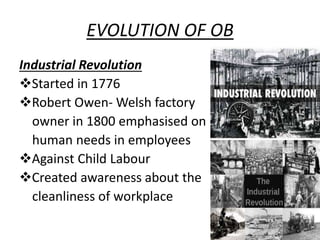
EVOLUTION OF OB
Industrial Revolution
Started in 1776
Robert Owen- Welsh factory
owner in 1800 emphasised on
human needs in employees
Against Child Labour
Created awareness about the
cleanliness of workplace
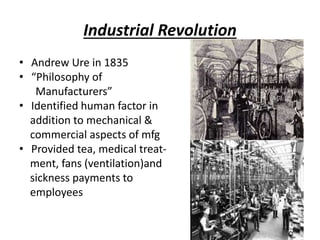
Industrial Revolution
• Andrew Ure in 1835
• “Philosophy of
Manufacturers”
• Identified human factor in
addition to mechanical &
commercial aspects of mfg
• Provided tea, medical treat-
ment, fans (ventilation)and
sickness payments to
employees
Industrial Revolution
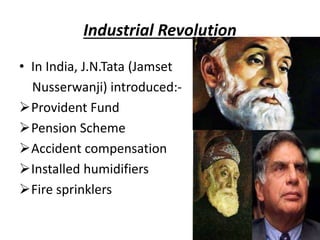
• In India, J.N.Tata (Jamset
Nusserwanji) introduced:-
Provident Fund
Pension Scheme
Accident compensation
Installed humidifiers
Fire sprinklers
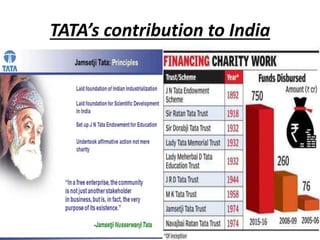
TATA’s contribution to India
Scientific Management
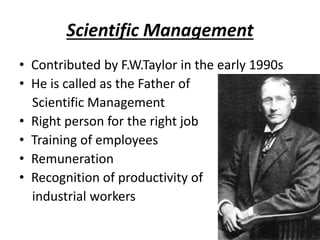
• Contributed by F.W.Taylor in the early 1990s
• He is called as the Father of
Scientific Management
• Right person for the right job
• Training of employees
• Remuneration
• Recognition of productivity of
industrial workers
Scientific Management - Principles
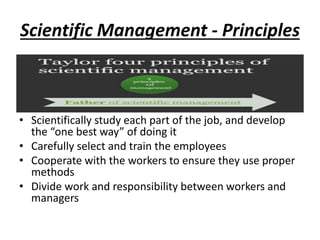
• Scientifically study each part of the job, and develop
the “one best way” of doing it
• Carefully select and train the employees
• Cooperate with the workers to ensure they use proper
methods
• Divide work and responsibility between workers and
managers
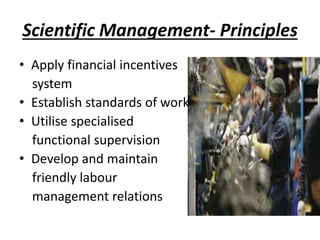
Scientific Management- Principles
• Apply financial incentives
system
• Establish standards of work
• Utilise specialised
functional supervision
• Develop and maintain
friendly labour
management relations
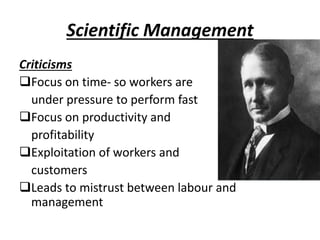
Scientific Management
Criticisms
Focus on time- so workers are
under pressure to perform fast
Focus on productivity and
profitability
Exploitation of workers and
customers
Leads to mistrust between labour and
management
Criticisms
• RABBLE HYPOTHESIS
He was widely criticised for
considering the society as
unorganised, and the
individual worker for working
with self interest
HR MOVEMENT
• Because of the Great Depression in 1929, HR
became an important aspect of management
• Decent hours of work
• Fair wages
• Good working conditions
• Employee relations
• Worker cooperation and morale
• Human element - capital
HR MOVEMENT
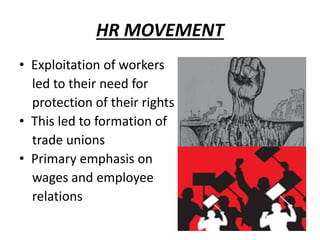
• Exploitation of workers
led to their need for
protection of their rights
• This led to formation of
trade unions
• Primary emphasis on
wages and employee
relations
OB- Definition
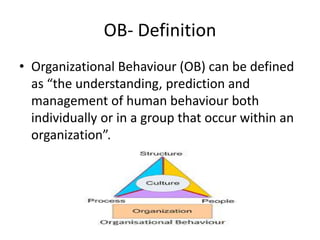
• Organizational Behaviour (OB) can be defined
as “the understanding, prediction and
management of human behaviour both
individually or in a group that occur within an
organization”.
OB - Meaning
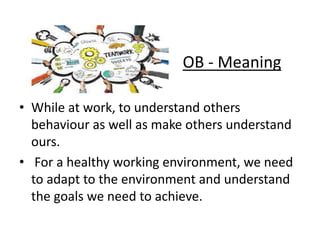
• While at work, to understand others
behaviour as well as make others understand
ours.
• For a healthy working environment, we need
to adapt to the environment and understand
the goals we need to achieve.
Management Skills
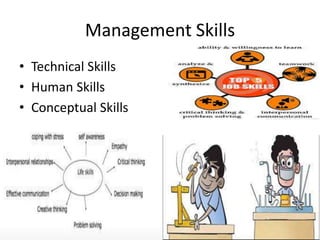
• Technical Skills
• Human Skills
• Conceptual Skills
Disciplines that contribute to OB
• Psychology – motivation, personality, perception,
emotions, work stress, job satisfaction
• Social Psychology – attitude & behavioural change,
communication
• Sociology – power, conflict,
intergroup behaviour,
organisational change and
culture
• Anthropology – cross cultural
analysis, comparative values and attitudes
Importance of OB
• It helps in explaining the interpersonal
relationships employees share - peers, higher
and subordinates.
• The individual behaviour can be predicted.
• It balances relationship in
an enterprise through
effective communication.
Importance of OB
• It assists in marketing.
• It helps managers to encourage their sub-
ordinates.
• Any change within the organization can be
made easier.
• It helps in predicting human behavior & their
application to achieve organizational goals.
• It helps in making the organization more
effective.
Challenges of OB
• Responding to economic pressures
• Responding to globalisation
• Increased foreign assignments
• Working with people from different cultures
Challenges of OB
• Stimulating innovation and change
• Managing workforce diversity
• Improving customer service
• Improving people skills
• Creating a positive
environment
• Helping employees balance
work life conflicts
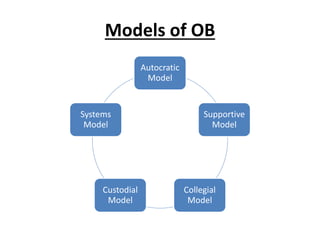
Models of OB
Autocratic
Model
Supportive
Model
Collegial
Model
Custodial
Model
Systems
Model
Approaches/Models of OB
• Supportive Model – HR Approach – leadership
based
• Autocratic Model – Theory X
• Custodial Model –
employee welfare based
• Collegial Model – team work
based on self-discipline
• Systems Model – holistic
approach to management
Autocratic Model
• Power of the BOSS
• Penalty is the motivator
• Tight control over the
employees at work
• Ideal when employees are lazy
• Has a negative impact as employees are
uninformed, insecure and afraid
• Not applicable in the present global work culture
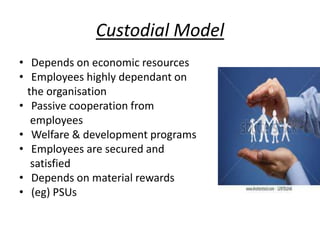
Custodial Model
• Depends on economic resources
• Employees highly dependant on
the organisation
• Passive cooperation from
employees
• Welfare & development programs
• Employees are secured and
satisfied
• Depends on material rewards
• (eg) PSUs
Supportive Model
• Depends on leadership instead
of power/money
• Self directed and creative
team
• Supports employee
performance
• Cares for psychological needs
of employees
• Better superior- subordinate
relationship
• Confidence and trust(eg) S/W
firms
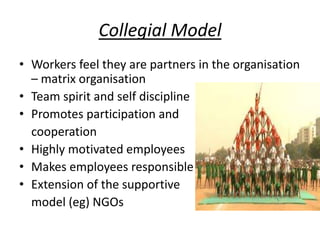
Collegial Model
• Workers feel they are partners in the organisation
– matrix organisation
• Team spirit and self discipline
• Promotes participation and
cooperation
• Highly motivated employees
• Makes employees responsible
• Extension of the supportive
model (eg) NGOs
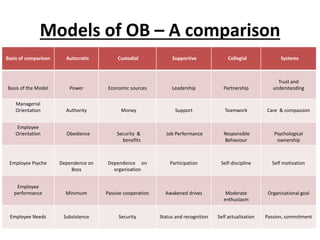
Models of OB – A comparison
Basis of comparison Autocratic Custodial Supportive Collegial Systems
Basis of the Model Power Economic sources Leadership Partnership
Trust and
understanding
Managerial
Orientation Authority Money Support Teamwork Care & compassion
Employee
Orientation Obedience Security &
benefits
Job Performance Responsible
Behaviour
Psychological
ownership
Employee Psyche Dependence on
Boss
Dependence on
organisation
Participation Self-discipline Self motivation
Employee
performance Minimum Passive cooperation Awakened drives Moderate
enthusiasm
Organisational goal
Employee Needs Subsistence Security Status and recognition Self actualisation Passion, commitment
FOUNDATIONS OF INDIVIDUAL
BEHAVIOUR
• According to Lewin “ a person’s behaviour is
the product of the person and his/her
environment.
• B= ∑ (P, E), where B= Behaviour; P= Person;
and E= Environment
FOUNDATIONS OF INDIVIDUAL
BEHAVIOUR
• Personal Factors
• Psychological Factors
• Environmental Factors
• Organisational systems and resources
Foundations of Individual Behaviour
Personal Factors
 Age
 Sex
 Education
 Abilities
 Marital Status
 No. of dependants
 Creativity
 Emotional Intelligence
 Identity
Ability
It is an individual’s capacity to perform various
tasks in a job.
The ability of an individual is
made up of 2 types of skills :-
Intellectual skills –skills
required to perform mental
activities
Physical skills – are the abilities
required to perform a task
Dimensions of Intellectual Ability
• Number aptitude – the ability to do speedy and
accurate calculations
• Verbal comprehension – the
ability to understand what is read
or heard, and the relationship of
words to each other
• Inductive reasoning– the ability to
identify the logical sequence in a
problem and then solve it
Dimensions of Intellectual Ability
• Perceptual speed – ability to identify visual similarities
and differences
quickly and accurately
• Deductive reasoning – Ability to
use logic and assess the implications
of an argument
• Spatial visualisation - ability to
imagine how an object would look, if
its position in space were changed
• Memory – ability to retain and recall
past experiences
Nine basic physical abilities
strength factors
• Dynamic strength – ability to exert muscular
strength continuously over time
• Trunk Strength - ability to
exert using trunk muscles
• Static strength – ability to exert
force against external objects
• Explosive strength - ability to
expand a maximum of energy
Nine basic physical abilities
flexibility factors
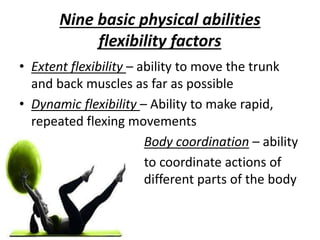
• Extent flexibility – ability to move the trunk
and back muscles as far as possible
• Dynamic flexibility – Ability to make rapid,
repeated flexing movements
• Body coordination – ability
• to coordinate actions of
diff different parts of the body
Nine basic physical abilities
flexibility factors
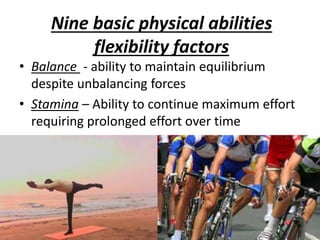
• Balance - ability to maintain equilibrium
despite unbalancing forces
• Stamina – Ability to continue maximum effort
requiring prolonged effort over time
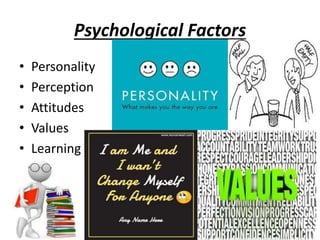
Psychological Factors
• Personality
• Perception
• Attitudes
• Values
• Learning
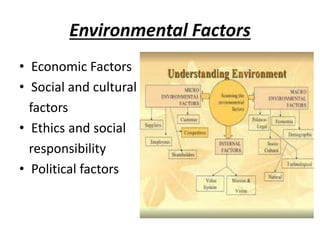
Environmental Factors
• Economic Factors
• Social and cultural
factors
• Ethics and social
responsibility
• Political factors
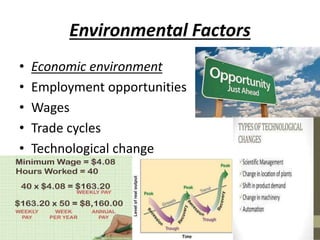
Environmental Factors
• Economic environment
• Employment opportunities
• Wages
• Trade cycles
• Technological change
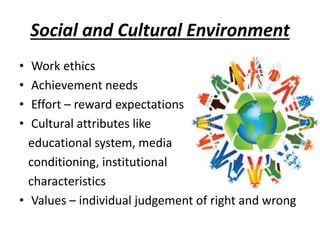
Social and Cultural Environment
• Work ethics
• Achievement needs
• Effort – reward expectations
• Cultural attributes like
educational system, media
conditioning, institutional
characteristics
• Values – individual judgement of right and wrong
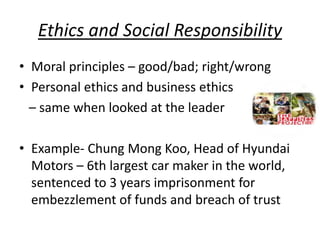
Ethics and Social Responsibility
• Moral principles – good/bad; right/wrong
• Personal ethics and business ethics
– same when looked at the leader
• Example- Chung Mong Koo, Head of Hyundai
Motors – 6th largest car maker in the world,
sentenced to 3 years imprisonment for
embezzlement of funds and breach of trust
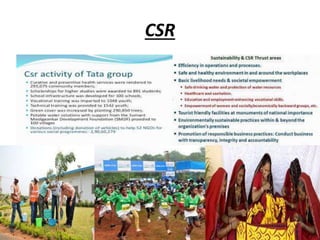
CSR
•
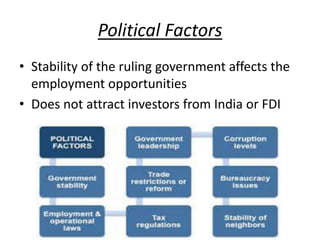
Political Factors
• Stability of the ruling government affects the
employment opportunities
• Does not attract investors from India or FDI
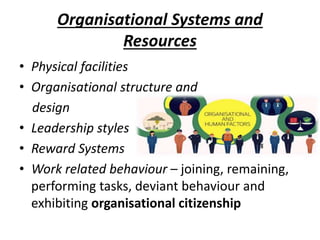
Organisational Systems and
Resources
• Physical facilities
• Organisational structure and
design
• Leadership styles
• Reward Systems
• Work related behaviour – joining, remaining,
performing tasks, deviant behaviour and
exhibiting organisational citizenship
Organisational Citizenship Behaviour
Forms
Altruism – helping co-workers, volunteering
Conscientiousness
Civic Virtue – attending meetings voluntarily,
keeping up with new information
Sportsmanship – not finding fault with the
organisation
Courtesy- not creating problems
Forms of Organisational Behaviour
• Deviant behaviour – 2 forms
Constructive behaviour – whistle blowing
Destructive behaviour – workplace violence
• Cyber loafing – using office internet and e-mails
for personal purposes
• Employee theft – 2 reasons
“Others are doing, why not me”?
To settle scores if they believe they are ill -treated
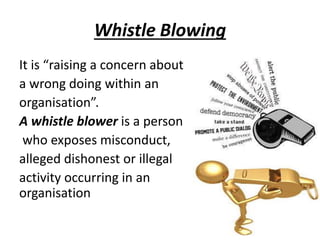
Whistle Blowing
It is “raising a concern about
a wrong doing within an
organisation”.
A whistle blower is a person
who exposes misconduct,
alleged dishonest or illegal
activity occurring in an
organisation
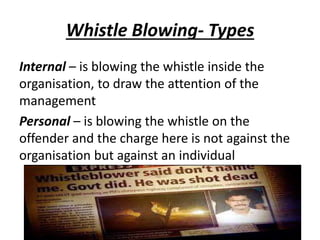
Whistle Blowing- Types
Internal – is blowing the whistle inside the
organisation, to draw the attention of the
management
Personal – is blowing the whistle on the
offender and the charge here is not against the
organisation but against an individual
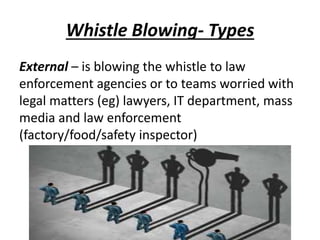
Whistle Blowing- Types
External – is blowing the whistle to law
enforcement agencies or to teams worried with
legal matters (eg) lawyers, IT department, mass
media and law enforcement
(factory/food/safety inspector)
Components of WB Policy
 An effective communicated statement of responsibility
 A clear defined procedure
of reports
 Well trained personnel to
receive and investigate
reports
 A commitment to take
appropriate action
 A guarantee against retaliation
reports in good faith
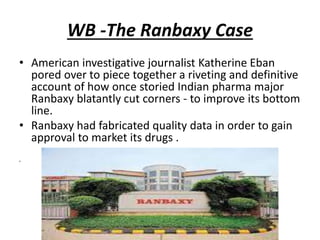
WB -The Ranbaxy Case
• American investigative journalist Katherine Eban
pored over to piece together a riveting and definitive
account of how once storied Indian pharma major
Ranbaxy blatantly cut corners - to improve its bottom
line.
• Ranbaxy had fabricated quality data in order to gain
approval to market its drugs .
•
WB -The Ranbaxy Case
• The allegations had first been made by a company
whistle blower who had contacted the agency (FDA)
• The whistle blower in question is Dinesh Thakur,
then Ranbaxy's Director and Global Head
of Research, Information and Portfolio Management,
who, in 2004 put together a team to study a deadly
secret he had come across: that the company was
fudging data.
• He blew the lid off illegal practices by Indian pharma
companies compromising on quality
WB -The Ranbaxy Case
The team gathered bits of information and
stumbled into Ranbaxy’s secret: the company
manipulated almost every aspect of its
manufacturing process to produce impressive
data to improve its bottom line
The company’s scientists at the behest of its
managers substituted lower purity ingredients
for higher ones to reduce cost
WB -The Ranbaxy Case
 They altered test parameters so that formulations with higher
impurities could be approved
 They faked dissolution studies
 They superimposed brand-name test results onto their own in
applications
 The company forged its own Standard Operating Procedures
(SOP) that is relied upon by FDA investigators
 Employees backdated documents and artificially aged them in a
steamy room overnight to fool regulators
WB -The Ranbaxy Case
Takur worked for 14 hour days for several
weeks doing exhaustive research and finally
brought his team’s preliminary findings to the
notice of his boss Raj Kumar
It was then the team realised that the
company was committing fraud and
potentially harming patients on a global scale
WB -The Ranbaxy Case
He escalated it into a 4 page report to the CEO
Brian Tempest, and still no action was taken
He was accused of downloading pornography
on his office computer
When no action was taken for 2 weeks, he
masked his identity and sent a message
directly to FDA Commissioner Lester Crawford
on August 15, 2005
The rest is history
WB -The Ranbaxy Case
It was found that adulterated drugs were
manufactured and distribution in 2 Indian
facilities misrepresenting clinical generic drug
data
These included drugs destined for treatment of
HIV/AIDS in Africa
They were fined $150 million to settle civil claims
and $350 million for state laws
Refer example of good relations
Japanese example- taxi
Psychological Factors
• Individual mental characteristics
• Personality
• Attitudes
• Values
• Perception
• Learning
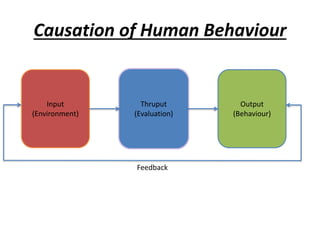
Causation of Human Behaviour
Input
(Environment)
Output
(Behaviour)
Thruput
(Evaluation)
Feedback
MODELS OF MAN
Based on individual differences, individuals are
classified as under:-
Rational Economic Man
Self- Actualising Man
Complex Man
Social Man
Organization Man
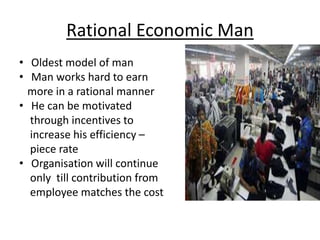
Rational Economic Man
• Oldest model of man
• Man works hard to earn
more in a rational manner
• He can be motivated
through incentives to
increase his efficiency –
piece rate
• Organisation will continue
only till contribution from
employee matches the cost
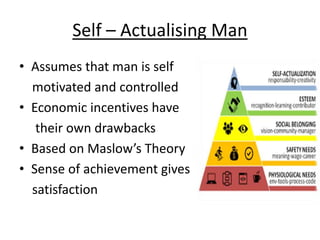
Self – Actualising Man
• Assumes that man is self
motivated and controlled
• Economic incentives have
their own drawbacks
• Based on Maslow’s Theory
• Sense of achievement gives
satisfaction
Complex Man
• Behaviour of individuals is caused
due to individual differences,
making them unpredictable
• Hence human behaviour is complex
• Managerial actions should consider the
complex variables affecting human behaviour
Social Man
• Based on the assumption that man is
influenced by social variables
• Social relationships more
important than economic
motives
• HR approach
• Concerned with people’s
feelings in the organisation
Organisation Man
• Concept developed by Whyte
• He is an extension of the social
man
• Importance to loyalty
• Cordial relationship with
co-workers
• Organisation takes care of
employee needs
MODELS OF INDIVIDUAL BEHAVIOUR
• Theory X and Theory Y
• Economic (scientific management) & Self-
actualising Model (self fulfilment, personal
growth and job competence)
• Behaviouristic (observable behaviour) and
Humanistic ( conscious reasoning) Model
• Rational (collecting relevant information and
then analysing it) & Emotional ( unconscious
responses guided by emotions) Model
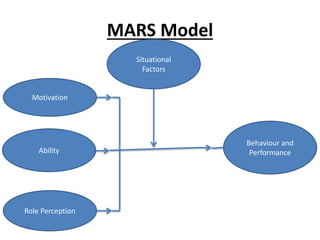
MARS Model
Behaviour and
Performance
Situational
Factors
Role Perception
Ability
Motivation

Ob intro

  • 1.
  • 2.
    EVOLUTION OF OB IndustrialRevolution Started in 1776 Robert Owen- Welsh factory owner in 1800 emphasised on human needs in employees Against Child Labour Created awareness about the cleanliness of workplace
  • 3.
    Industrial Revolution • AndrewUre in 1835 • “Philosophy of Manufacturers” • Identified human factor in addition to mechanical & commercial aspects of mfg • Provided tea, medical treat- ment, fans (ventilation)and sickness payments to employees
  • 4.
    Industrial Revolution • InIndia, J.N.Tata (Jamset Nusserwanji) introduced:- Provident Fund Pension Scheme Accident compensation Installed humidifiers Fire sprinklers
  • 5.
  • 6.
    Scientific Management • Contributedby F.W.Taylor in the early 1990s • He is called as the Father of Scientific Management • Right person for the right job • Training of employees • Remuneration • Recognition of productivity of industrial workers
  • 7.
    Scientific Management -Principles • Scientifically study each part of the job, and develop the “one best way” of doing it • Carefully select and train the employees • Cooperate with the workers to ensure they use proper methods • Divide work and responsibility between workers and managers
  • 8.
    Scientific Management- Principles •Apply financial incentives system • Establish standards of work • Utilise specialised functional supervision • Develop and maintain friendly labour management relations
  • 9.
    Scientific Management Criticisms Focus ontime- so workers are under pressure to perform fast Focus on productivity and profitability Exploitation of workers and customers Leads to mistrust between labour and management
  • 10.
    Criticisms • RABBLE HYPOTHESIS Hewas widely criticised for considering the society as unorganised, and the individual worker for working with self interest
  • 11.
    HR MOVEMENT • Becauseof the Great Depression in 1929, HR became an important aspect of management • Decent hours of work • Fair wages • Good working conditions • Employee relations • Worker cooperation and morale • Human element - capital
  • 12.
    HR MOVEMENT • Exploitationof workers led to their need for protection of their rights • This led to formation of trade unions • Primary emphasis on wages and employee relations
  • 13.
    OB- Definition • OrganizationalBehaviour (OB) can be defined as “the understanding, prediction and management of human behaviour both individually or in a group that occur within an organization”.
  • 14.
    OB - Meaning •While at work, to understand others behaviour as well as make others understand ours. • For a healthy working environment, we need to adapt to the environment and understand the goals we need to achieve.
  • 15.
    Management Skills • TechnicalSkills • Human Skills • Conceptual Skills
  • 16.
    Disciplines that contributeto OB • Psychology – motivation, personality, perception, emotions, work stress, job satisfaction • Social Psychology – attitude & behavioural change, communication • Sociology – power, conflict, intergroup behaviour, organisational change and culture • Anthropology – cross cultural analysis, comparative values and attitudes
  • 17.
    Importance of OB •It helps in explaining the interpersonal relationships employees share - peers, higher and subordinates. • The individual behaviour can be predicted. • It balances relationship in an enterprise through effective communication.
  • 18.
    Importance of OB •It assists in marketing. • It helps managers to encourage their sub- ordinates. • Any change within the organization can be made easier. • It helps in predicting human behavior & their application to achieve organizational goals. • It helps in making the organization more effective.
  • 19.
    Challenges of OB •Responding to economic pressures • Responding to globalisation • Increased foreign assignments • Working with people from different cultures
  • 20.
    Challenges of OB •Stimulating innovation and change • Managing workforce diversity • Improving customer service • Improving people skills • Creating a positive environment • Helping employees balance work life conflicts
  • 21.
  • 22.
    Approaches/Models of OB •Supportive Model – HR Approach – leadership based • Autocratic Model – Theory X • Custodial Model – employee welfare based • Collegial Model – team work based on self-discipline • Systems Model – holistic approach to management
  • 23.
    Autocratic Model • Powerof the BOSS • Penalty is the motivator • Tight control over the employees at work • Ideal when employees are lazy • Has a negative impact as employees are uninformed, insecure and afraid • Not applicable in the present global work culture
  • 24.
    Custodial Model • Dependson economic resources • Employees highly dependant on the organisation • Passive cooperation from employees • Welfare & development programs • Employees are secured and satisfied • Depends on material rewards • (eg) PSUs
  • 25.
    Supportive Model • Dependson leadership instead of power/money • Self directed and creative team • Supports employee performance • Cares for psychological needs of employees • Better superior- subordinate relationship • Confidence and trust(eg) S/W firms
  • 26.
    Collegial Model • Workersfeel they are partners in the organisation – matrix organisation • Team spirit and self discipline • Promotes participation and cooperation • Highly motivated employees • Makes employees responsible • Extension of the supportive model (eg) NGOs
  • 27.
    Models of OB– A comparison Basis of comparison Autocratic Custodial Supportive Collegial Systems Basis of the Model Power Economic sources Leadership Partnership Trust and understanding Managerial Orientation Authority Money Support Teamwork Care & compassion Employee Orientation Obedience Security & benefits Job Performance Responsible Behaviour Psychological ownership Employee Psyche Dependence on Boss Dependence on organisation Participation Self-discipline Self motivation Employee performance Minimum Passive cooperation Awakened drives Moderate enthusiasm Organisational goal Employee Needs Subsistence Security Status and recognition Self actualisation Passion, commitment
  • 28.
    FOUNDATIONS OF INDIVIDUAL BEHAVIOUR •According to Lewin “ a person’s behaviour is the product of the person and his/her environment. • B= ∑ (P, E), where B= Behaviour; P= Person; and E= Environment
  • 29.
    FOUNDATIONS OF INDIVIDUAL BEHAVIOUR •Personal Factors • Psychological Factors • Environmental Factors • Organisational systems and resources
  • 30.
    Foundations of IndividualBehaviour Personal Factors  Age  Sex  Education  Abilities  Marital Status  No. of dependants  Creativity  Emotional Intelligence  Identity
  • 31.
    Ability It is anindividual’s capacity to perform various tasks in a job. The ability of an individual is made up of 2 types of skills :- Intellectual skills –skills required to perform mental activities Physical skills – are the abilities required to perform a task
  • 32.
    Dimensions of IntellectualAbility • Number aptitude – the ability to do speedy and accurate calculations • Verbal comprehension – the ability to understand what is read or heard, and the relationship of words to each other • Inductive reasoning– the ability to identify the logical sequence in a problem and then solve it
  • 33.
    Dimensions of IntellectualAbility • Perceptual speed – ability to identify visual similarities and differences quickly and accurately • Deductive reasoning – Ability to use logic and assess the implications of an argument • Spatial visualisation - ability to imagine how an object would look, if its position in space were changed • Memory – ability to retain and recall past experiences
  • 34.
    Nine basic physicalabilities strength factors • Dynamic strength – ability to exert muscular strength continuously over time • Trunk Strength - ability to exert using trunk muscles • Static strength – ability to exert force against external objects • Explosive strength - ability to expand a maximum of energy
  • 35.
    Nine basic physicalabilities flexibility factors • Extent flexibility – ability to move the trunk and back muscles as far as possible • Dynamic flexibility – Ability to make rapid, repeated flexing movements • Body coordination – ability • to coordinate actions of diff different parts of the body
  • 36.
    Nine basic physicalabilities flexibility factors • Balance - ability to maintain equilibrium despite unbalancing forces • Stamina – Ability to continue maximum effort requiring prolonged effort over time
  • 37.
    Psychological Factors • Personality •Perception • Attitudes • Values • Learning
  • 38.
    Environmental Factors • EconomicFactors • Social and cultural factors • Ethics and social responsibility • Political factors
  • 39.
    Environmental Factors • Economicenvironment • Employment opportunities • Wages • Trade cycles • Technological change
  • 40.
    Social and CulturalEnvironment • Work ethics • Achievement needs • Effort – reward expectations • Cultural attributes like educational system, media conditioning, institutional characteristics • Values – individual judgement of right and wrong
  • 41.
    Ethics and SocialResponsibility • Moral principles – good/bad; right/wrong • Personal ethics and business ethics – same when looked at the leader • Example- Chung Mong Koo, Head of Hyundai Motors – 6th largest car maker in the world, sentenced to 3 years imprisonment for embezzlement of funds and breach of trust
  • 42.
  • 43.
    Political Factors • Stabilityof the ruling government affects the employment opportunities • Does not attract investors from India or FDI
  • 44.
    Organisational Systems and Resources •Physical facilities • Organisational structure and design • Leadership styles • Reward Systems • Work related behaviour – joining, remaining, performing tasks, deviant behaviour and exhibiting organisational citizenship
  • 45.
    Organisational Citizenship Behaviour Forms Altruism– helping co-workers, volunteering Conscientiousness Civic Virtue – attending meetings voluntarily, keeping up with new information Sportsmanship – not finding fault with the organisation Courtesy- not creating problems
  • 46.
    Forms of OrganisationalBehaviour • Deviant behaviour – 2 forms Constructive behaviour – whistle blowing Destructive behaviour – workplace violence • Cyber loafing – using office internet and e-mails for personal purposes • Employee theft – 2 reasons “Others are doing, why not me”? To settle scores if they believe they are ill -treated
  • 47.
    Whistle Blowing It is“raising a concern about a wrong doing within an organisation”. A whistle blower is a person who exposes misconduct, alleged dishonest or illegal activity occurring in an organisation
  • 48.
    Whistle Blowing- Types Internal– is blowing the whistle inside the organisation, to draw the attention of the management Personal – is blowing the whistle on the offender and the charge here is not against the organisation but against an individual
  • 49.
    Whistle Blowing- Types External– is blowing the whistle to law enforcement agencies or to teams worried with legal matters (eg) lawyers, IT department, mass media and law enforcement (factory/food/safety inspector)
  • 50.
    Components of WBPolicy  An effective communicated statement of responsibility  A clear defined procedure of reports  Well trained personnel to receive and investigate reports  A commitment to take appropriate action  A guarantee against retaliation reports in good faith
  • 52.
    WB -The RanbaxyCase • American investigative journalist Katherine Eban pored over to piece together a riveting and definitive account of how once storied Indian pharma major Ranbaxy blatantly cut corners - to improve its bottom line. • Ranbaxy had fabricated quality data in order to gain approval to market its drugs . •
  • 53.
    WB -The RanbaxyCase • The allegations had first been made by a company whistle blower who had contacted the agency (FDA) • The whistle blower in question is Dinesh Thakur, then Ranbaxy's Director and Global Head of Research, Information and Portfolio Management, who, in 2004 put together a team to study a deadly secret he had come across: that the company was fudging data. • He blew the lid off illegal practices by Indian pharma companies compromising on quality
  • 54.
    WB -The RanbaxyCase The team gathered bits of information and stumbled into Ranbaxy’s secret: the company manipulated almost every aspect of its manufacturing process to produce impressive data to improve its bottom line The company’s scientists at the behest of its managers substituted lower purity ingredients for higher ones to reduce cost
  • 55.
    WB -The RanbaxyCase  They altered test parameters so that formulations with higher impurities could be approved  They faked dissolution studies  They superimposed brand-name test results onto their own in applications  The company forged its own Standard Operating Procedures (SOP) that is relied upon by FDA investigators  Employees backdated documents and artificially aged them in a steamy room overnight to fool regulators
  • 56.
    WB -The RanbaxyCase Takur worked for 14 hour days for several weeks doing exhaustive research and finally brought his team’s preliminary findings to the notice of his boss Raj Kumar It was then the team realised that the company was committing fraud and potentially harming patients on a global scale
  • 57.
    WB -The RanbaxyCase He escalated it into a 4 page report to the CEO Brian Tempest, and still no action was taken He was accused of downloading pornography on his office computer When no action was taken for 2 weeks, he masked his identity and sent a message directly to FDA Commissioner Lester Crawford on August 15, 2005 The rest is history
  • 58.
    WB -The RanbaxyCase It was found that adulterated drugs were manufactured and distribution in 2 Indian facilities misrepresenting clinical generic drug data These included drugs destined for treatment of HIV/AIDS in Africa They were fined $150 million to settle civil claims and $350 million for state laws
  • 59.
    Refer example ofgood relations Japanese example- taxi
  • 60.
    Psychological Factors • Individualmental characteristics • Personality • Attitudes • Values • Perception • Learning
  • 61.
    Causation of HumanBehaviour Input (Environment) Output (Behaviour) Thruput (Evaluation) Feedback
  • 62.
    MODELS OF MAN Basedon individual differences, individuals are classified as under:- Rational Economic Man Self- Actualising Man Complex Man Social Man Organization Man
  • 63.
    Rational Economic Man •Oldest model of man • Man works hard to earn more in a rational manner • He can be motivated through incentives to increase his efficiency – piece rate • Organisation will continue only till contribution from employee matches the cost
  • 64.
    Self – ActualisingMan • Assumes that man is self motivated and controlled • Economic incentives have their own drawbacks • Based on Maslow’s Theory • Sense of achievement gives satisfaction
  • 65.
    Complex Man • Behaviourof individuals is caused due to individual differences, making them unpredictable • Hence human behaviour is complex • Managerial actions should consider the complex variables affecting human behaviour
  • 66.
    Social Man • Basedon the assumption that man is influenced by social variables • Social relationships more important than economic motives • HR approach • Concerned with people’s feelings in the organisation
  • 67.
    Organisation Man • Conceptdeveloped by Whyte • He is an extension of the social man • Importance to loyalty • Cordial relationship with co-workers • Organisation takes care of employee needs
  • 68.
    MODELS OF INDIVIDUALBEHAVIOUR • Theory X and Theory Y • Economic (scientific management) & Self- actualising Model (self fulfilment, personal growth and job competence) • Behaviouristic (observable behaviour) and Humanistic ( conscious reasoning) Model • Rational (collecting relevant information and then analysing it) & Emotional ( unconscious responses guided by emotions) Model
  • 69.