Organizational
Topic- Learning and Reinforcement
Behaviour
Group Members:
•Abhinandan
•Shubham
•Manish
•Kartik
•Rewa
•Preeti
•Shaifali
Introduction
Various Approaches To Learning
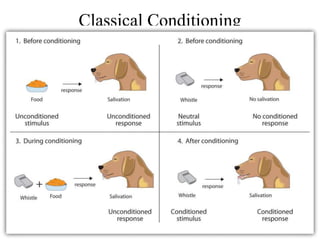
Classical Conditioning
•Individuals learn reflex behaviours
•Person associated is “ IVAN PAVLOV ”
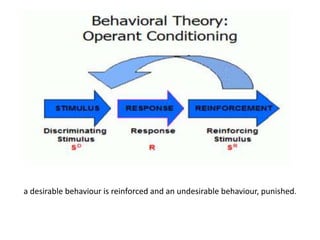
Operant Conditioning
•Individuals learn voluntary behaviour
•Person associated is “ B.F. SKINNER “
Social Learning
•Individuals learn new behaviour by watching others
•Person associated is “ ALBERT BANDURA”
Cognitive Learning
This includes INSIGHT, DISCRIMINATION, GENERALIZATION
Programmed Learning
This involves learner’s active role and small successive steps .
Linear Programming
Little information is presented to learner step by step on the basis of understanding and
competence.
INDIVIDUAL
• Individuals by their temperament are averse to learning.
• Dislike unfamiliar situations.
• Unwilling to take risks.
TEAMS AND GROUPS
•Groups may not open to any learning and development process.
•Groups may want to stick with the old methods and techniques.
•Deter learning in group.
ORGANIZATIONS
•Very strong barrier to learning.
•There may be a culture in organization which discourages people
from looking at situation in a new way, or trying new ideas.
Classical Conditioning
a desirable behaviour is reinforced and an undesirable behaviour, punished.
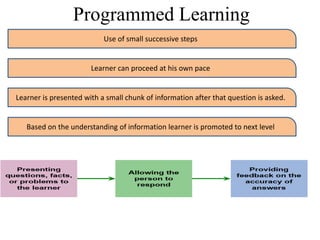
Programmed Learning
Use of small successive steps
Learner is presented with a small chunk of information after that question is asked.
Based on the understanding of information learner is promoted to next level
Learner can proceed at his own pace
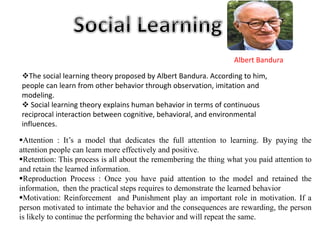
Albert Bandura
The social learning theory proposed by Albert Bandura. According to him,
people can learn from other behavior through observation, imitation and
modeling.
 Social learning theory explains human behavior in terms of continuous
reciprocal interaction between cognitive, behavioral, and environmental
influences.
Attention : It’s a model that dedicates the full attention to learning. By paying the
attention people can learn more effectively and positive.
Retention: This process is all about the remembering the thing what you paid attention to
and retain the learned information.
Reproduction Process : Once you have paid attention to the model and retained the
information, then the practical steps requires to demonstrate the learned behavior
Motivation: Reinforcement and Punishment play an important role in motivation. If a
person motivated to intimate the behavior and the consequences are rewarding, the person
is likely to continue the performing the behavior and will repeat the same.
Cognitive Learning Theory involves selective interpretation of perceptual data into new
pattern of thoughts.
Learning that is concerned with acquisition of problem solving abilities.
This defines learning as a behavioral change based on the acquisition of information
about environment.
COGNITIVE LEARNING INCLUDES:
•INSIGHT --- sudden discovery of the answer to a problem.
•DISCRIMINATION ---elements are placed into more specific structures.
•GENERALIZATION --events, problems, objects are organized.
Only the requisite amount of information is to be given which would aid the
learner to move on to the next step
There is continuous reinforcement during the learning stage to retain the
interest level of learner
It is one of the method in which programmed learning is implemented in
organization
Learner remain motivated throughout the process
No scope of error
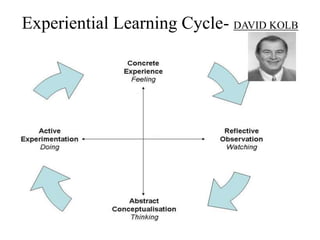
Experiential Learning Cycle- DAVID KOLB
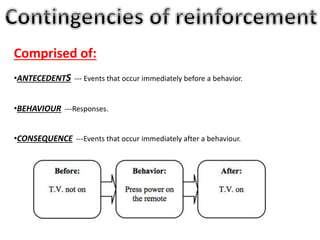
Comprised of:
•ANTECEDENTS --- Events that occur immediately before a behavior.
•BEHAVIOUR ---Responses.
•CONSEQUENCE ---Events that occur immediately after a behaviour.
Schedules Forms of reward and
example
Influence on
performance
Effects on behaviour
Fixed interval Reward on fixed time
basis
Leads to average &
irregular performance
Fast extinction of
behaviour
Fixed ratio Reward tied to
specific number of
responses
Leads quickly to very
high and stable
performance
Moderately fast
extinction of
behaviour
Variable interval Reward given after
varying periods of
time: unannounced
inspection, reward
given randomly each
month
Leads to moderately
high and stable
performance
Slow extinction of
behaviour
Variable ratio Rewards given for
some behaviour
Leads to very high
performance
Very slow extinction
of behaviour
Organizational Behaviour

Organizational Behaviour

  • 1.
    Organizational Topic- Learning andReinforcement Behaviour Group Members: •Abhinandan •Shubham •Manish •Kartik •Rewa •Preeti •Shaifali
  • 2.
  • 3.
    Various Approaches ToLearning Classical Conditioning •Individuals learn reflex behaviours •Person associated is “ IVAN PAVLOV ” Operant Conditioning •Individuals learn voluntary behaviour •Person associated is “ B.F. SKINNER “ Social Learning •Individuals learn new behaviour by watching others •Person associated is “ ALBERT BANDURA” Cognitive Learning This includes INSIGHT, DISCRIMINATION, GENERALIZATION Programmed Learning This involves learner’s active role and small successive steps . Linear Programming Little information is presented to learner step by step on the basis of understanding and competence.
  • 4.
    INDIVIDUAL • Individuals bytheir temperament are averse to learning. • Dislike unfamiliar situations. • Unwilling to take risks. TEAMS AND GROUPS •Groups may not open to any learning and development process. •Groups may want to stick with the old methods and techniques. •Deter learning in group. ORGANIZATIONS •Very strong barrier to learning. •There may be a culture in organization which discourages people from looking at situation in a new way, or trying new ideas.
  • 5.
  • 6.
    a desirable behaviouris reinforced and an undesirable behaviour, punished.
  • 7.
    Programmed Learning Use ofsmall successive steps Learner is presented with a small chunk of information after that question is asked. Based on the understanding of information learner is promoted to next level Learner can proceed at his own pace
  • 8.
    Albert Bandura The sociallearning theory proposed by Albert Bandura. According to him, people can learn from other behavior through observation, imitation and modeling.  Social learning theory explains human behavior in terms of continuous reciprocal interaction between cognitive, behavioral, and environmental influences. Attention : It’s a model that dedicates the full attention to learning. By paying the attention people can learn more effectively and positive. Retention: This process is all about the remembering the thing what you paid attention to and retain the learned information. Reproduction Process : Once you have paid attention to the model and retained the information, then the practical steps requires to demonstrate the learned behavior Motivation: Reinforcement and Punishment play an important role in motivation. If a person motivated to intimate the behavior and the consequences are rewarding, the person is likely to continue the performing the behavior and will repeat the same.
  • 9.
    Cognitive Learning Theoryinvolves selective interpretation of perceptual data into new pattern of thoughts. Learning that is concerned with acquisition of problem solving abilities. This defines learning as a behavioral change based on the acquisition of information about environment. COGNITIVE LEARNING INCLUDES: •INSIGHT --- sudden discovery of the answer to a problem. •DISCRIMINATION ---elements are placed into more specific structures. •GENERALIZATION --events, problems, objects are organized.
  • 11.
    Only the requisiteamount of information is to be given which would aid the learner to move on to the next step There is continuous reinforcement during the learning stage to retain the interest level of learner It is one of the method in which programmed learning is implemented in organization Learner remain motivated throughout the process No scope of error
  • 12.
  • 13.
    Comprised of: •ANTECEDENTS ---Events that occur immediately before a behavior. •BEHAVIOUR ---Responses. •CONSEQUENCE ---Events that occur immediately after a behaviour.
  • 15.
    Schedules Forms ofreward and example Influence on performance Effects on behaviour Fixed interval Reward on fixed time basis Leads to average & irregular performance Fast extinction of behaviour Fixed ratio Reward tied to specific number of responses Leads quickly to very high and stable performance Moderately fast extinction of behaviour Variable interval Reward given after varying periods of time: unannounced inspection, reward given randomly each month Leads to moderately high and stable performance Slow extinction of behaviour Variable ratio Rewards given for some behaviour Leads to very high performance Very slow extinction of behaviour