LEARNING
Introduction
 Learning is involved in a broad spectrum of OB ranging
from developing new vocational skills through changing
the way people do their jobs.
 Learning has vital role in organization as learning
becomes important ingredient in humans, behavior so
it becomes important tool for managers to know about
learning because many things are to be learned by
employees in the course of time for effective working to
achieve goals of the organization.
Concept of Learning
 According to social scientist that learning can defined
as relatively permanent change in behavior that occurs
as a result of experience or reinforced practice.
 According to Watson and Skimmer learning is a
relation or an association between two types of
incidents. Learning may be defined as the process of
acquiring, assimilating, and internalizing cognitive,
motor, or behavioral inputs for their effective and varied
use when required, leading to an enhanced capability
for further self-monitored learning.
Definitions
 According to Mitchell learning is being defined as
“Learning is the process by which new behaviors are
acquired. It is generally agreed that learning involves
changes in behavior, practicing new behaviors, and
establishing permanency in the change”.
 Learning may be defined as the process of acquiring,
assimilating, and internalizing cognitive, motor, or
behavioral inputs for their effective and varied use
when required, leading to an enhanced capability for
further self-monitored learning.
Cont.
 According to W. Mcirehee “Learning has taken place if
an individual behaves, reacts, responds as a result of
experience in a manner different from the way he
formerly behaved.
 Learning is change in behavior through education and
training, practice and experience. It is accompanied by
acquisition of knowledge skills and expertise which are
relatively permanent.
 Learning may be described as the process of acquiring
the ability to respond adequately to a situation which
may or may not have been previously encountered.
Characteristics of
Learning
 Learning involves a change, though this change is not
necessarily an improvement over previous behavior.
 Change taking place during learning must be
comparatively permanent. Temporary change in
behavior due to fatigue or any reason is not a part of
learning.
 Learning in based on some kind of practice or
experience. Experience may be direct or indirect,
personal or through observation or through reading.
Thus any behavioral change because of physical
maturation is not learning.
Contd.
 The practice or experience of learning must be
reinforced in order for learning to take place. If
reinforcement does not accompany the practice the
changed behavior will disappear gradually.
 During learning the change in the knowledge and
wisdom should produce different attitude, beliefs and
values. These new attitude and values should change
the behavior, then only it would be termed as learning, in
other words if attitude and values are not changed with
behavior then they are not termed as learning
Components of Learning
Process
 Drive
 Cue Stimuli
 Responses
 Reinforcement
 Retention
 Extinction
 Spontaneous Recovery
Factors Effecting Learning
 Motivation
 Mental Set
 Nature of Learning Material
 Practice
 Environment
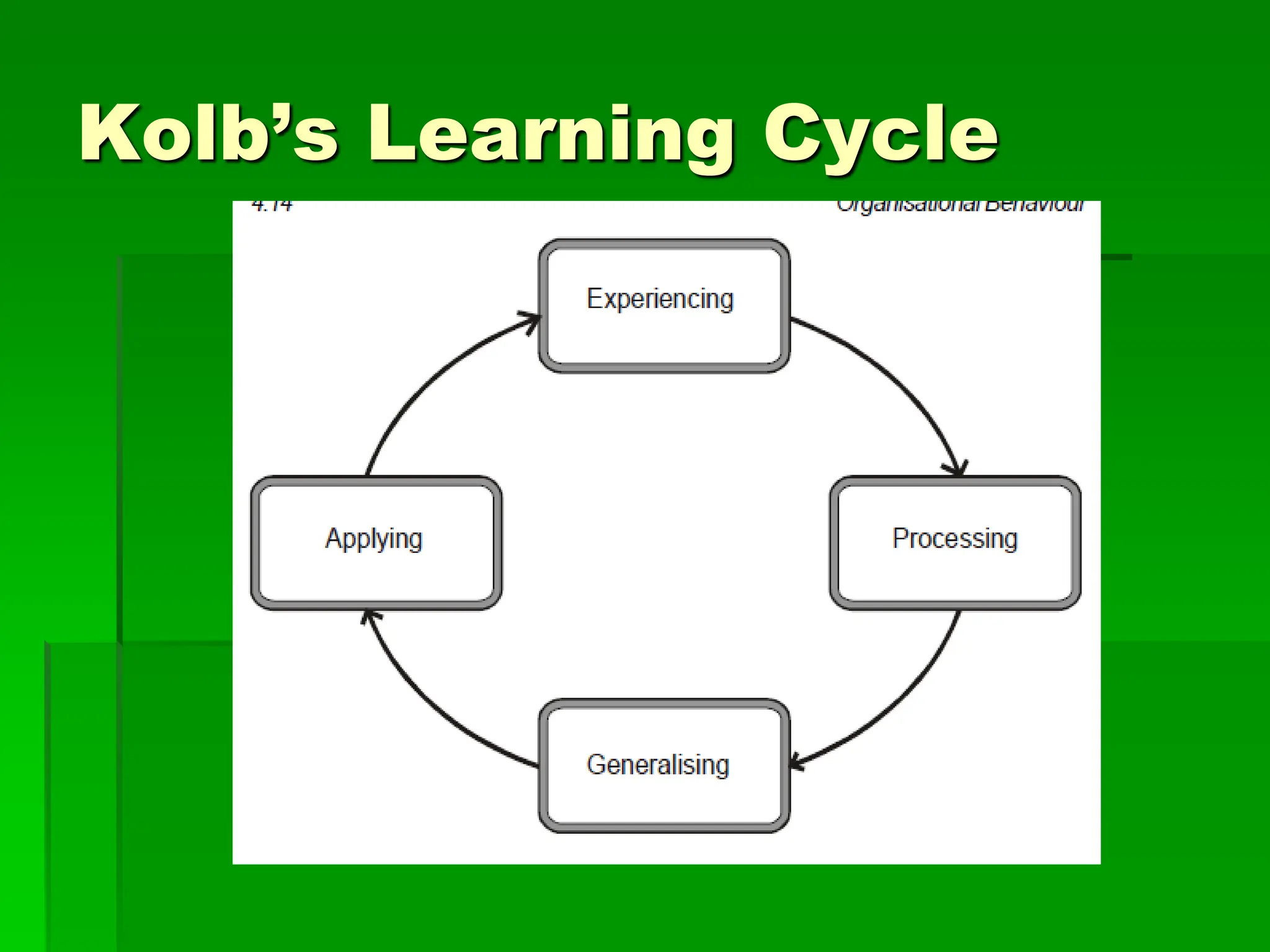
The Learning Cycle
 Kolb gave the cycle of experiential learning in adults
with the name “The Learning Cycle”. This cycle
includes four stages which continuously keep on
changing step by step similar to life cycle.
 Experiencing
 Processing
 Generalizing
 Implementation
Cont.
 The first phase of cycle is experiencing which means
that learner has some concrete experience or is going
to have experience during a training program.
 The second phase of cycle is processing which
means reflecting and analyzing of experience at
individual or group level.
 The third phase is generalizing which means abstract
conceptualization of learning on basis of experience
and then formation of tentative theory or method to
explain data.
Cont.
 The fourth and final phase is applying i.e. the
implementation whatever is being done in
previous phases is tried out or experimented
by using this new behavior in day-to-day work.
Kolb’s Learning Cycle
Theories of Learning
Learning means acquisition of new behavior, people
acquire a new behavior frequently but there has to be a
process through which new behavior can acquired.
There are three major theories offered to explain the
process by which we acquire pattern of behavior.
(1) Conditioning/Behaviorist Theory
(2) Operant Conditioning
(3) Cognitive Theory
(4) Social Learning Theory
Application of Learning in
Organization Behavior
 Learning plays a vital role in organization behavior
because the aspects of learning take place in every
stage of life. Though individuals who join the
organization are highly qualified, educated but then to
time changes professionals require training time to time
to update themselves. As we have discussed learning
is the permanent change in behavior which shows that
learning is a behavioral prospective. So it becomes
essential part of the organization behavior. As
organization behavior helps in understanding behavior
of individuals so learning becomes an integral part of
organization behavior.

Unit IV Learning.ppt in mba is vjs hha j

  • 1.
  • 2.
    Introduction  Learning isinvolved in a broad spectrum of OB ranging from developing new vocational skills through changing the way people do their jobs.  Learning has vital role in organization as learning becomes important ingredient in humans, behavior so it becomes important tool for managers to know about learning because many things are to be learned by employees in the course of time for effective working to achieve goals of the organization.
  • 3.
    Concept of Learning According to social scientist that learning can defined as relatively permanent change in behavior that occurs as a result of experience or reinforced practice.  According to Watson and Skimmer learning is a relation or an association between two types of incidents. Learning may be defined as the process of acquiring, assimilating, and internalizing cognitive, motor, or behavioral inputs for their effective and varied use when required, leading to an enhanced capability for further self-monitored learning.
  • 4.
    Definitions  According toMitchell learning is being defined as “Learning is the process by which new behaviors are acquired. It is generally agreed that learning involves changes in behavior, practicing new behaviors, and establishing permanency in the change”.  Learning may be defined as the process of acquiring, assimilating, and internalizing cognitive, motor, or behavioral inputs for their effective and varied use when required, leading to an enhanced capability for further self-monitored learning.
  • 5.
    Cont.  According toW. Mcirehee “Learning has taken place if an individual behaves, reacts, responds as a result of experience in a manner different from the way he formerly behaved.  Learning is change in behavior through education and training, practice and experience. It is accompanied by acquisition of knowledge skills and expertise which are relatively permanent.  Learning may be described as the process of acquiring the ability to respond adequately to a situation which may or may not have been previously encountered.
  • 6.
    Characteristics of Learning  Learninginvolves a change, though this change is not necessarily an improvement over previous behavior.  Change taking place during learning must be comparatively permanent. Temporary change in behavior due to fatigue or any reason is not a part of learning.  Learning in based on some kind of practice or experience. Experience may be direct or indirect, personal or through observation or through reading. Thus any behavioral change because of physical maturation is not learning.
  • 7.
    Contd.  The practiceor experience of learning must be reinforced in order for learning to take place. If reinforcement does not accompany the practice the changed behavior will disappear gradually.  During learning the change in the knowledge and wisdom should produce different attitude, beliefs and values. These new attitude and values should change the behavior, then only it would be termed as learning, in other words if attitude and values are not changed with behavior then they are not termed as learning
  • 8.
    Components of Learning Process Drive  Cue Stimuli  Responses  Reinforcement  Retention  Extinction  Spontaneous Recovery
  • 9.
    Factors Effecting Learning Motivation  Mental Set  Nature of Learning Material  Practice  Environment
  • 10.
    The Learning Cycle Kolb gave the cycle of experiential learning in adults with the name “The Learning Cycle”. This cycle includes four stages which continuously keep on changing step by step similar to life cycle.  Experiencing  Processing  Generalizing  Implementation
  • 11.
    Cont.  The firstphase of cycle is experiencing which means that learner has some concrete experience or is going to have experience during a training program.  The second phase of cycle is processing which means reflecting and analyzing of experience at individual or group level.  The third phase is generalizing which means abstract conceptualization of learning on basis of experience and then formation of tentative theory or method to explain data.
  • 12.
    Cont.  The fourthand final phase is applying i.e. the implementation whatever is being done in previous phases is tried out or experimented by using this new behavior in day-to-day work.
  • 13.
  • 14.
    Theories of Learning Learningmeans acquisition of new behavior, people acquire a new behavior frequently but there has to be a process through which new behavior can acquired. There are three major theories offered to explain the process by which we acquire pattern of behavior. (1) Conditioning/Behaviorist Theory (2) Operant Conditioning (3) Cognitive Theory (4) Social Learning Theory
  • 15.
    Application of Learningin Organization Behavior  Learning plays a vital role in organization behavior because the aspects of learning take place in every stage of life. Though individuals who join the organization are highly qualified, educated but then to time changes professionals require training time to time to update themselves. As we have discussed learning is the permanent change in behavior which shows that learning is a behavioral prospective. So it becomes essential part of the organization behavior. As organization behavior helps in understanding behavior of individuals so learning becomes an integral part of organization behavior.