3.1 The meaningof
organization structure
Organization's structure:
The established pattern of relationships between the
component part of an organization, outlining both
communication, control and authority patterns. Structure
distinguishes the parts of an organization and defines the
relationship between them.
• Organizational design is the process of constructing and
adjusting an organization's structure to achieve its goals.
3.
3.2 The dimensionsof
structure
Organization structure can vary along a number of dimensions.
An early, but influential, piece of research by Pugh, Hickson,
Hinings and Turner (1969) iden tified the following six primary
dimensions of organization structure:
• Specialization
• Standardization
• Formalization
• Centralization
• Configuration
• Traditionalism
4.
3.2 The dimensionsof
structure
• Specialization – The number and distribution of specialized
roles.
• Standardization – Fixed procedures and rules followed
regularly.
• Formalization – The extent of written rules, instructions, and
communication.
• Centralization – The level at which decisions are made in the
hierarchy.
• Configuration – The organization’s shape, including hierarchy
levels and reporting lines.
• Traditionalism – Unwritten rules and accepted ways of doing
things.
5.
3.3 Models ofstructure
1. Bureaucratic structure
2. Flatter structure
3. Multifunctional structure
4. Multidivisional structure
5. Matrix structure
6. New organizational form (structures) :
• Networks
• The virtual organization
6.
3.3 Models ofstructure
1-Bureaucratic structure
Bureaucracy is a system of management that follows strict rules,
procedures, and a clear hierarchy to ensure efficiency and
consistency in large organizations.
• Bureaucratic structures have a certain degree of
standardization.
• They are better suited for more complex or larger scale
organizations.
• They usually adopt a tall structure.
• It is very much complex and useful for hierarchical structures
organization
7.
3.3 Models ofstructure
2- Flatter structure:
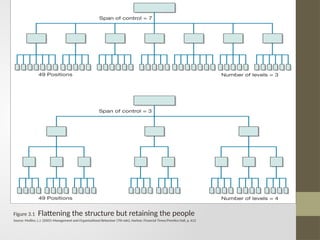
• Figure 3.1 is of interest in demonstrating how widening the
span of control (the number of people reporting to any one
superior) reduces the number of levels in the structure, while
retaining all the staff
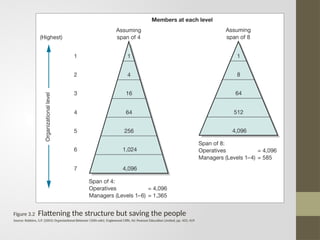
• Figure 3.2 shows how flattening the structure through
doubling the span of control can ‘save’ 780 managers, that is
57 per cent of the number of management positions, while
retaining the number of lower-level positions.
8.
Figure 3.1 Flatteningthe structure but retaining the people
Source: Mullins, L.J. (2005) Management and Organisational Behaviour (7th edn), Harlow: Financial Times/Prentice Hall, p. 612
9.
Figure 3.2 Flatteningthe structure but saving the people
Source: Robbins, S.P. (2003) Organizational Behavior (10th edn), Englewood Cliffs, NJ: Pearson Education Limited, pp. 433, 419
10.
3.3 Horizontal differentiation– the
departmentalization of work
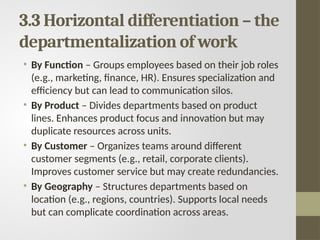
• By Function – Groups employees based on their job roles
(e.g., marketing, finance, HR). Ensures specialization and
efficiency but can lead to communication silos.
• By Product – Divides departments based on product
lines. Enhances product focus and innovation but may
duplicate resources across units.
• By Customer – Organizes teams around different
customer segments (e.g., retail, corporate clients).
Improves customer service but may create redundancies.
• By Geography – Structures departments based on
location (e.g., regions, countries). Supports local needs
but can complicate coordination across areas.
11.
3.3 Models ofstructure
Matrix structure:
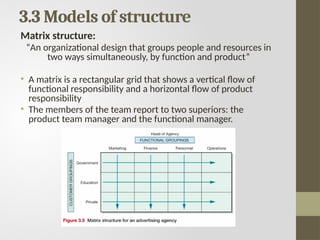
“An organizational design that groups people and resources in
two ways simultaneously, by function and product”
• A matrix is a rectangular grid that shows a vertical flow of
functional responsibility and a horizontal flow of product
responsibility
• The members of the team report to two superiors: the
product team manager and the functional manager.
12.
3.3 Models ofstructure
Network Organization : A flexible and decentralized
organizational structure where different entities (companies,
teams, or individuals) collaborate to achieve a common goal.”
Instead of relying on a rigid hierarchy, it operates through
partnerships, outsourcing, and digital communication.
Example:
A tech startup may focus on product design while outsourcing
manufacturing, marketing, and customer service to specialized
firms. This allows it to stay agile and competitive in a fast-
changing market.
Virtual organization : is a temporary network of companies that
collaborate to seize fast-changing opportunities by sharing costs,
skills, and market access.
13.
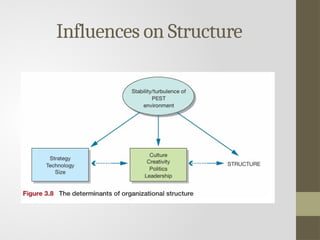
Influences on Structure
Choosinga structure is complex and depends on various elements.
Strategy and Structure Relationship – An organization’s structure
should align with its strategy, adapting to political, economic,
technological, and sociocultural changes.
Technology’s Role – External technological advancements and
internal use of technology (especially IT) impact organizational
structure.
Organizational Size – As an organization grows, its structure is likely
to change.
Culture and Politics – Organizational culture and politics influence
structure indirectly, making decisions on structuring more complex.
The consequences ofdeficient
organizational structures
Structural deficiencies can be a major cause of
organizational inefficiency.
• Employee Motivation and moral may be depressed.
• Decision making may be delayed and lacking in quality.
• There may be a conflict and a lack of co-ordination.
• An organization may not respond innovatively to
changing circumstances.
• Costs may be rise rapidly, particularly in the
administrative area.
16.
The strategy–structure ‘fit’
•A well-aligned strategy and structure are key to
success. Strategy sets direction, while structure
enables execution.
• Strategic decisions are complex and require
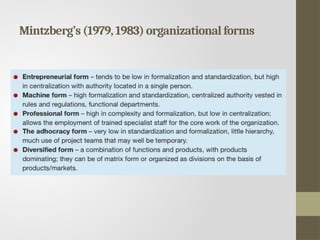
adaptability (Mintzberg, 1994).
• A strong fit between strategy, structure, and
management ensures efficiency and
competitiveness.
#4 Specialization: e,g it could be – Horizontal specialization refers to the division of work according to the type of work at various levels within the organization, from top to bottom and vice versa.
– Vertical specialization refers to the division of work into departments