ORGANIZATION
DEVELOPMENT
TEAM AND INTERTEAM
LEVELS
By : MohamedAbdulbasetGraisa
DIALOGUE SESSION
 Dialogue session is a structured conversation designed to
explore a topic with the potential for being conflictual,
with the desired outcome resulting from a deeper
understanding rather than front persuasion (Lindahl,
1996).
TEAM BUILDING
 Team building has long been a core intervention for OD
and continues to be widely used.
 Objectives of team building :
1. Establish and/or clarify goals and objectives.
2. Determine and/or clarify roles and responsibilities.
3. Establish and/or clarify policies and procedures.
4. Improve interpersonal relations.
GROUND RULES
 Ground rules can be established by a team early in the forming
process. These are often put on flipchart paper and posted
whenever the team meets.
 Sample Ground Rules :
 Come prepared - Begin on time - End meeting when the business is
over - Use an agenda with times for each item - Review the agenda
at the beginning of each meeting; modify by consensus - Distribute
agenda with the purpose of the meeting - Take minutes of all
meetings to record actions taken - Use personal statements such as
"I think," "I feel," "I want,“ - Wait until others are finished before
speaking - Acknowledge what others have contributed .
PROCESS CONSULTATION
 Process consultation is also a keystone of the OD profession.
Its primary purpose, also consistent with the objectives of team
building, is to improve team effectiveness.
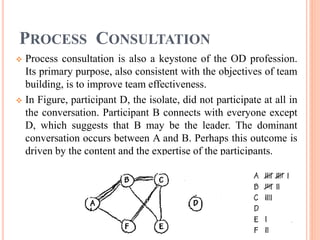
 In Figure, participant D, the isolate, did not participate at all in
the conversation. Participant B connects with everyone except
D, which suggests that B may be the leader. The dominant
conversation occurs between A and B. Perhaps this outcome is
driven by the content and the expertise of the participants.
MEETING FACILITATION
 Reference has already been made to some tools to improve the
effective functioning of a team.
 Another process that can be used to improve effectiveness is to
identify ongoing role identification and description. A sample
document of how role identification and descriptions might appear,
based on the PDCA model.
FISHBOWLS
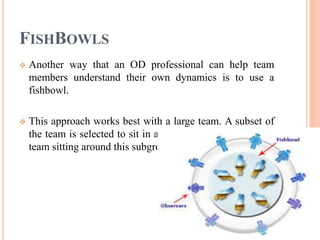
 Another way that an OD professional can help team
members understand their own dynamics is to use a
fishbowl.
 This approach works best with a large team. A subset of
the team is selected to sit in a circle, with the rest of the
team sitting around this subgroup.
BRAINSTORMING
 A very common process used in teams to generate ideas is
brainstorming.
 Brainstorming Rules :
 Everyone participates in generating ideas. - Spontaneous,
freewheeling responses are encouraged. Be creative! - Build on
others' ideas. - Quantity, not quality, is desired. - No discussion
or critique of ideas is allowed until all ideas are listed. - Negative
nonverbal responses are discouraged. - All responses arc written
down on the flipchart by the facilitator.
INTERTERM CONFLICT
MANAGEMENT
 At times, unhealthy conflict can arise between task
forces, functional areas, or teams. If these groups need to
work together, the unhealthy conflict can interfere with
productivity and creativity.
 Mirroring Process
Objectives
1. To develop better mutual relationships between teams.
2. To explore the perceptions teams or work groups have of
each other.
3. To develop plans for improving the relationships.
STRATEGIC ALIGNMENT ASSESSMENT
 Any part of an organization must be aligned (consistent
with) the organization itself to be effective.
 Thus, any team must share with the organization certain
components. Semler suggested that these components are
vision, values, and purpose; strategy; culture; rewards;
structure; practices; systems; and behaviors. Thus, the
task of the OD professional is to work with the team to
determine any discrepancies in any of these areas
between the team and the organization in other words, to
conduct a strategy alignment assessment.
SUMMARY
 Much of the work in today's organizations is done by
teams or work groups.
 The more effectively teams operate together, the more
they can contribute to the objectives of the organization.
 Many processes/interventions can be used to improve
team functioning in an organization.
Organization Development Team and Interteam Levels

Organization Development Team and Interteam Levels

  • 1.
  • 2.
    DIALOGUE SESSION  Dialoguesession is a structured conversation designed to explore a topic with the potential for being conflictual, with the desired outcome resulting from a deeper understanding rather than front persuasion (Lindahl, 1996).
  • 3.
    TEAM BUILDING  Teambuilding has long been a core intervention for OD and continues to be widely used.  Objectives of team building : 1. Establish and/or clarify goals and objectives. 2. Determine and/or clarify roles and responsibilities. 3. Establish and/or clarify policies and procedures. 4. Improve interpersonal relations.
  • 4.
    GROUND RULES  Groundrules can be established by a team early in the forming process. These are often put on flipchart paper and posted whenever the team meets.  Sample Ground Rules :  Come prepared - Begin on time - End meeting when the business is over - Use an agenda with times for each item - Review the agenda at the beginning of each meeting; modify by consensus - Distribute agenda with the purpose of the meeting - Take minutes of all meetings to record actions taken - Use personal statements such as "I think," "I feel," "I want,“ - Wait until others are finished before speaking - Acknowledge what others have contributed .
  • 5.
    PROCESS CONSULTATION  Processconsultation is also a keystone of the OD profession. Its primary purpose, also consistent with the objectives of team building, is to improve team effectiveness.  In Figure, participant D, the isolate, did not participate at all in the conversation. Participant B connects with everyone except D, which suggests that B may be the leader. The dominant conversation occurs between A and B. Perhaps this outcome is driven by the content and the expertise of the participants.
  • 6.
    MEETING FACILITATION  Referencehas already been made to some tools to improve the effective functioning of a team.  Another process that can be used to improve effectiveness is to identify ongoing role identification and description. A sample document of how role identification and descriptions might appear, based on the PDCA model.
  • 7.
    FISHBOWLS  Another waythat an OD professional can help team members understand their own dynamics is to use a fishbowl.  This approach works best with a large team. A subset of the team is selected to sit in a circle, with the rest of the team sitting around this subgroup.
  • 8.
    BRAINSTORMING  A verycommon process used in teams to generate ideas is brainstorming.  Brainstorming Rules :  Everyone participates in generating ideas. - Spontaneous, freewheeling responses are encouraged. Be creative! - Build on others' ideas. - Quantity, not quality, is desired. - No discussion or critique of ideas is allowed until all ideas are listed. - Negative nonverbal responses are discouraged. - All responses arc written down on the flipchart by the facilitator.
  • 9.
    INTERTERM CONFLICT MANAGEMENT  Attimes, unhealthy conflict can arise between task forces, functional areas, or teams. If these groups need to work together, the unhealthy conflict can interfere with productivity and creativity.  Mirroring Process Objectives 1. To develop better mutual relationships between teams. 2. To explore the perceptions teams or work groups have of each other. 3. To develop plans for improving the relationships.
  • 10.
    STRATEGIC ALIGNMENT ASSESSMENT Any part of an organization must be aligned (consistent with) the organization itself to be effective.  Thus, any team must share with the organization certain components. Semler suggested that these components are vision, values, and purpose; strategy; culture; rewards; structure; practices; systems; and behaviors. Thus, the task of the OD professional is to work with the team to determine any discrepancies in any of these areas between the team and the organization in other words, to conduct a strategy alignment assessment.
  • 11.
    SUMMARY  Much ofthe work in today's organizations is done by teams or work groups.  The more effectively teams operate together, the more they can contribute to the objectives of the organization.  Many processes/interventions can be used to improve team functioning in an organization.