
Analyzing
Business Markets
Marketing Management, 13th
ed
7
Copyright © 2009 Pearson Education, Inc. Publishing as Prentice Hall
Chapter Questions
• What is the business market, and how
does it differ from the consumer
market?
• What buying situations do
organizational buyers face?
• Who participates in the business-to-
business buying process?
Copyright © 2009 Pearson Education, Inc. Publishing as Prentice Hall
Chapter Questions
• How do business buyers make their
decisions?
• How can companies build strong
relationships with business customers?
• How do institutional buyers and
government agencies do their buying?
Copyright © 2009 Pearson Education, Inc. Publishing as Prentice Hall
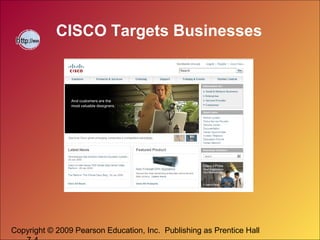
CISCO Targets Businesses
Copyright © 2009 Pearson Education, Inc. Publishing as Prentice Hall
What is Organizational Buying?
Organizational buying refers
to the decision-making process by
which formal organizations establish
the need for purchased products and
services, and identify, evaluate, and
choose among alternative brands
and suppliers.
Copyright © 2009 Pearson Education, Inc. Publishing as Prentice Hall
Top Business Marketing Challenges
• Expand understanding of customer needs
• Compete globally as China and India
reshape markets
• Master analytical tools and improve
quantitative skills
• Reinstate innovation as an engine of growth
• Create new organizational models and
linkages
Copyright © 2009 Pearson Education, Inc. Publishing as Prentice Hall
Characteristics of Business Markets
• Fewer, larger
buyers
• Close supplier-
customer
relationships
• Professional
purchasing
• Many buying
influences
• Multiple sales calls
• Derived demand
• Inelastic demand
• Fluctuating demand
• Geographically
concentrated buyers
• Direct purchasing
Copyright © 2009 Pearson Education, Inc. Publishing as Prentice Hall
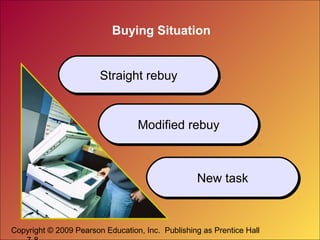
Buying Situation
Straight rebuyStraight rebuy
Modified rebuyModified rebuy
New taskNew task
Copyright © 2009 Pearson Education, Inc. Publishing as Prentice Hall
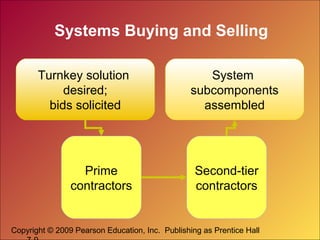
Systems Buying and Selling
Turnkey solution
desired;
bids solicited
Prime
contractors
Second-tier
contractors
System
subcomponents
assembled
Copyright © 2009 Pearson Education, Inc. Publishing as Prentice Hall
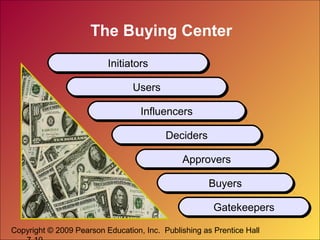
The Buying Center
InitiatorsInitiators
UsersUsers
InfluencersInfluencers
DecidersDeciders
ApproversApprovers
BuyersBuyers
GatekeepersGatekeepers
Copyright © 2009 Pearson Education, Inc. Publishing as Prentice Hall
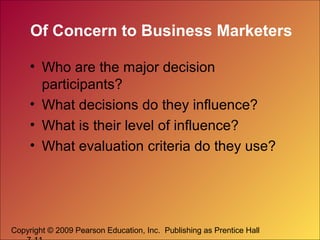
Of Concern to Business Marketers
• Who are the major decision
participants?
• What decisions do they influence?
• What is their level of influence?
• What evaluation criteria do they use?
Copyright © 2009 Pearson Education, Inc. Publishing as Prentice Hall
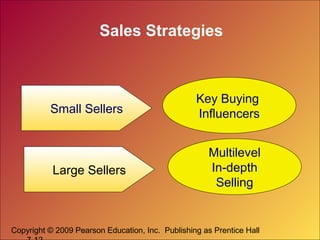
Sales Strategies
Small Sellers
Large Sellers
Key Buying
Influencers
Multilevel
In-depth
Selling
Copyright © 2009 Pearson Education, Inc. Publishing as Prentice Hall
Stages in the Buying Process:
Buyphases
• Problem recognition
• General need description
• Product specification
• Supplier search
• Proposal solicitation
• Supplier selection
• Order-routine specification
• Performance review
Copyright © 2009 Pearson Education, Inc. Publishing as Prentice Hall
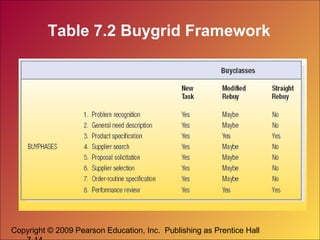
Table 7.2 Buygrid Framework
Copyright © 2009 Pearson Education, Inc. Publishing as Prentice Hall
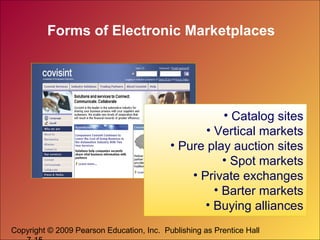
Forms of Electronic Marketplaces
• Catalog sites
• Vertical markets
• Pure play auction sites
• Spot markets
• Private exchanges
• Barter markets
• Buying alliances
Copyright © 2009 Pearson Education, Inc. Publishing as Prentice Hall
Methods of e-Procurement
• Websites organized using vertical hubs
• Websites organized using functional
hubs
• Direct extranet links to major suppliers
• Buying alliances
• Company buying sites
Copyright © 2009 Pearson Education, Inc. Publishing as Prentice Hall
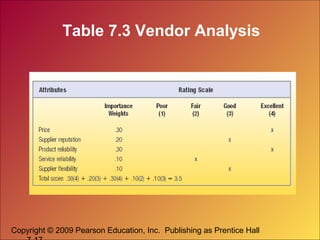
Table 7.3 Vendor Analysis
Copyright © 2009 Pearson Education, Inc. Publishing as Prentice Hall
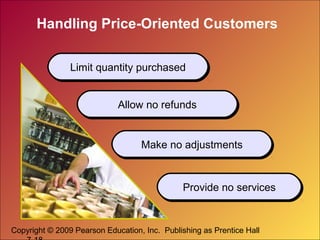
Handling Price-Oriented Customers
Limit quantity purchasedLimit quantity purchased
Allow no refundsAllow no refunds
Make no adjustmentsMake no adjustments
Provide no servicesProvide no services
Copyright © 2009 Pearson Education, Inc. Publishing as Prentice Hall
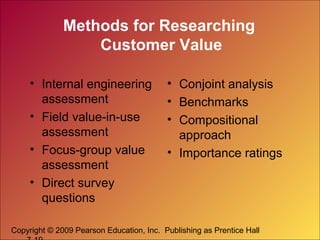
Methods for Researching
Customer Value
• Internal engineering
assessment
• Field value-in-use
assessment
• Focus-group value
assessment
• Direct survey
questions
• Conjoint analysis
• Benchmarks
• Compositional
approach
• Importance ratings
Copyright © 2009 Pearson Education, Inc. Publishing as Prentice Hall
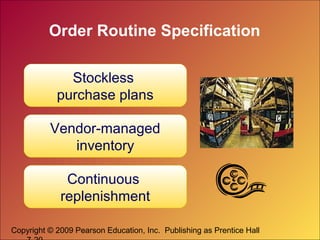
Order Routine Specification
Stockless
purchase plans
Vendor-managed
inventory
Continuous
replenishment
Copyright © 2009 Pearson Education, Inc. Publishing as Prentice Hall
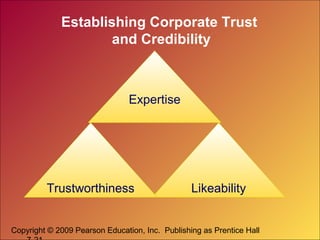
Establishing Corporate Trust
and Credibility
Expertise
LikeabilityTrustworthiness
Copyright © 2009 Pearson Education, Inc. Publishing as Prentice Hall
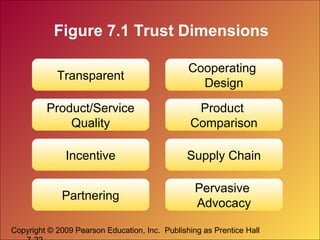
Figure 7.1 Trust Dimensions
Transparent
Product/Service
Quality
Incentive
Partnering
Cooperating
Design
Product
Comparison
Supply Chain
Pervasive
Advocacy
Copyright © 2009 Pearson Education, Inc. Publishing as Prentice Hall
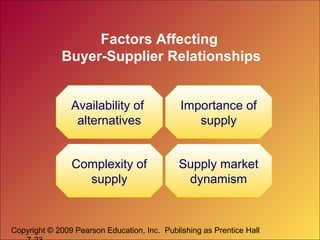
Factors Affecting
Buyer-Supplier Relationships
Availability of
alternatives
Supply market
dynamism
Complexity of
supply
Importance of
supply
Copyright © 2009 Pearson Education, Inc. Publishing as Prentice Hall
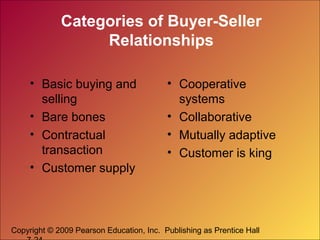
Categories of Buyer-Seller
Relationships
• Basic buying and
selling
• Bare bones
• Contractual
transaction
• Customer supply
• Cooperative
systems
• Collaborative
• Mutually adaptive
• Customer is king
Copyright © 2009 Pearson Education, Inc. Publishing as Prentice Hall
What is Opportunism?
Opportunism is some form of
cheating or undersupply relative to
an implicit or explicit contract.
Copyright © 2009 Pearson Education, Inc. Publishing as Prentice Hall
Aramark Successfully Services Institutional
and Government Markets
Copyright © 2009 Pearson Education, Inc. Publishing as Prentice Hall
Marketing Debate
 how different is B-to-B marketing?
Take a position:
1. Business-to-business marketing
requires a special, unique set of marketing
concepts and principles.
or
2. Business-to-business marketing is really
not that different and the basic marketing
principles apply.
Copyright © 2009 Pearson Education, Inc. Publishing as Prentice Hall
Marketing Discussion
 Consider some of the consumer
behavior topics from Chapter 6.
 How might you apply them to business-
to-business settings?

Kotlermm13 chapter 07

  • 1.
  • 2.
    Copyright © 2009Pearson Education, Inc. Publishing as Prentice Hall Chapter Questions • What is the business market, and how does it differ from the consumer market? • What buying situations do organizational buyers face? • Who participates in the business-to- business buying process?
  • 3.
    Copyright © 2009Pearson Education, Inc. Publishing as Prentice Hall Chapter Questions • How do business buyers make their decisions? • How can companies build strong relationships with business customers? • How do institutional buyers and government agencies do their buying?
  • 4.
    Copyright © 2009Pearson Education, Inc. Publishing as Prentice Hall CISCO Targets Businesses
  • 5.
    Copyright © 2009Pearson Education, Inc. Publishing as Prentice Hall What is Organizational Buying? Organizational buying refers to the decision-making process by which formal organizations establish the need for purchased products and services, and identify, evaluate, and choose among alternative brands and suppliers.
  • 6.
    Copyright © 2009Pearson Education, Inc. Publishing as Prentice Hall Top Business Marketing Challenges • Expand understanding of customer needs • Compete globally as China and India reshape markets • Master analytical tools and improve quantitative skills • Reinstate innovation as an engine of growth • Create new organizational models and linkages
  • 7.
    Copyright © 2009Pearson Education, Inc. Publishing as Prentice Hall Characteristics of Business Markets • Fewer, larger buyers • Close supplier- customer relationships • Professional purchasing • Many buying influences • Multiple sales calls • Derived demand • Inelastic demand • Fluctuating demand • Geographically concentrated buyers • Direct purchasing
  • 8.
    Copyright © 2009Pearson Education, Inc. Publishing as Prentice Hall Buying Situation Straight rebuyStraight rebuy Modified rebuyModified rebuy New taskNew task
  • 9.
    Copyright © 2009Pearson Education, Inc. Publishing as Prentice Hall Systems Buying and Selling Turnkey solution desired; bids solicited Prime contractors Second-tier contractors System subcomponents assembled
  • 10.
    Copyright © 2009Pearson Education, Inc. Publishing as Prentice Hall The Buying Center InitiatorsInitiators UsersUsers InfluencersInfluencers DecidersDeciders ApproversApprovers BuyersBuyers GatekeepersGatekeepers
  • 11.
    Copyright © 2009Pearson Education, Inc. Publishing as Prentice Hall Of Concern to Business Marketers • Who are the major decision participants? • What decisions do they influence? • What is their level of influence? • What evaluation criteria do they use?
  • 12.
    Copyright © 2009Pearson Education, Inc. Publishing as Prentice Hall Sales Strategies Small Sellers Large Sellers Key Buying Influencers Multilevel In-depth Selling
  • 13.
    Copyright © 2009Pearson Education, Inc. Publishing as Prentice Hall Stages in the Buying Process: Buyphases • Problem recognition • General need description • Product specification • Supplier search • Proposal solicitation • Supplier selection • Order-routine specification • Performance review
  • 14.
    Copyright © 2009Pearson Education, Inc. Publishing as Prentice Hall Table 7.2 Buygrid Framework
  • 15.
    Copyright © 2009Pearson Education, Inc. Publishing as Prentice Hall Forms of Electronic Marketplaces • Catalog sites • Vertical markets • Pure play auction sites • Spot markets • Private exchanges • Barter markets • Buying alliances
  • 16.
    Copyright © 2009Pearson Education, Inc. Publishing as Prentice Hall Methods of e-Procurement • Websites organized using vertical hubs • Websites organized using functional hubs • Direct extranet links to major suppliers • Buying alliances • Company buying sites
  • 17.
    Copyright © 2009Pearson Education, Inc. Publishing as Prentice Hall Table 7.3 Vendor Analysis
  • 18.
    Copyright © 2009Pearson Education, Inc. Publishing as Prentice Hall Handling Price-Oriented Customers Limit quantity purchasedLimit quantity purchased Allow no refundsAllow no refunds Make no adjustmentsMake no adjustments Provide no servicesProvide no services
  • 19.
    Copyright © 2009Pearson Education, Inc. Publishing as Prentice Hall Methods for Researching Customer Value • Internal engineering assessment • Field value-in-use assessment • Focus-group value assessment • Direct survey questions • Conjoint analysis • Benchmarks • Compositional approach • Importance ratings
  • 20.
    Copyright © 2009Pearson Education, Inc. Publishing as Prentice Hall Order Routine Specification Stockless purchase plans Vendor-managed inventory Continuous replenishment
  • 21.
    Copyright © 2009Pearson Education, Inc. Publishing as Prentice Hall Establishing Corporate Trust and Credibility Expertise LikeabilityTrustworthiness
  • 22.
    Copyright © 2009Pearson Education, Inc. Publishing as Prentice Hall Figure 7.1 Trust Dimensions Transparent Product/Service Quality Incentive Partnering Cooperating Design Product Comparison Supply Chain Pervasive Advocacy
  • 23.
    Copyright © 2009Pearson Education, Inc. Publishing as Prentice Hall Factors Affecting Buyer-Supplier Relationships Availability of alternatives Supply market dynamism Complexity of supply Importance of supply
  • 24.
    Copyright © 2009Pearson Education, Inc. Publishing as Prentice Hall Categories of Buyer-Seller Relationships • Basic buying and selling • Bare bones • Contractual transaction • Customer supply • Cooperative systems • Collaborative • Mutually adaptive • Customer is king
  • 25.
    Copyright © 2009Pearson Education, Inc. Publishing as Prentice Hall What is Opportunism? Opportunism is some form of cheating or undersupply relative to an implicit or explicit contract.
  • 26.
    Copyright © 2009Pearson Education, Inc. Publishing as Prentice Hall Aramark Successfully Services Institutional and Government Markets
  • 27.
    Copyright © 2009Pearson Education, Inc. Publishing as Prentice Hall Marketing Debate  how different is B-to-B marketing? Take a position: 1. Business-to-business marketing requires a special, unique set of marketing concepts and principles. or 2. Business-to-business marketing is really not that different and the basic marketing principles apply.
  • 28.
    Copyright © 2009Pearson Education, Inc. Publishing as Prentice Hall Marketing Discussion  Consider some of the consumer behavior topics from Chapter 6.  How might you apply them to business- to-business settings?

Editor's Notes

  • #21 Video icon links to video snippet on Hasbro’s meeting the inventory needs of its retail customers.