



Organisational
Surveying
A waste of time (and money)
or a powerful strategic tool?
Content
• Why surveying is so important to organisational success
• The features shared by robust survey designs
• Risks associated with survey delivery
• Three options for organisational surveying will be
discussed:
• 360 Survey
• Exit Interviewing
• Culture Survey
Why survey?
By collating survey data we can:
• Confirm whether results are due to chance, or some genuine
differences
• Evaluate the link between different areas of interest (e.g., culture
ratings versus performance, exit ratings versus satisfaction)
• Identify the most powerful sub-set of items
• Rank-order issues in terms of priority
• Understand the unique themes that shape data
Conducting organisational surveys is becoming an increasingly popular part
of an organisation’s annual review.
Robust surveys share….
• What is your rationale for undertaking a survey…. what are the
expected outcomes? How else could we achieve these outcomes?
• What research methodologies are to be used (interviews, focus
groups + survey?)
• How will quantitative and qualitative ingredients be blended. Will
consideration go beyond simple descriptive statistics?
• Who is being surveyed – a sample or the whole population?
• How can survey output be linked to, and add value to other HR-
related considerations (exit + culture surveys; post-appointment +
culture)?
Good survey outputs requires a quality input
Remember: You can’t make a silk purse out of a
sow’s ear…
Organisational
Culture Surveys
The concept of culture
• Late nineteenth and early twentieth century
studies of social anthropology gave us the term
“culture.”
• The concept of culture represents, in an holistic
sense, the qualities of any specific human group
that are passed from one generation to the next
because they are believed to be useful for
survival and adaptation.
A clear definition of culture
• Every organisation has its own way of doing things
that influences virtually every aspect of working life.
• Culture is the ‘social glue’ that holds an organisation
together.
• Culture gives an organisation its distinct personality.
When we talk about culture, we are referring to the
organisation’s dominant culture; that is, the values
shared by most of its members.
A clear definition of culture
• Some aspects of culture are very visible.
“Working hard” or “being friendly to customers“.
Other aspects of culture are harder to observe
such as “doing things right the first time”.
• Organisational culture may not be easily seen -
yet may be the strongest facilitator of
commitment to something larger than oneself.
Why culture is NOT a focus
“It is highly natural that leaders would be
resistant to focusing on organisational
culture. They have routinely been confused
by the conversation and disappointed by
unfulfilled promises”.
Fisher & Allford, 2000
Why culture be a focus
“We have the same ingredients and use the same ovens, but it’s the skills,
attitude and experience of the workforce that differentiates the brands.”
David Brandon
Chief Executive of Dominos Pizza
“Bureaucratic control can only buy employees’ bodies but not their
hearts. A strong organisational culture, however, can be a primary
generator of real motivation and commitment”.
Daniel Denison,
Founder of Denison Consulting, USA
Why culture surveys fail to deliver
• Often designed and created within the academic
environment –results are not replicable
• Use non-business language which must be converted
through interpretation to the business context
Why culture surveys fail to deliver
• Are often unclear about specific links to business
results; little if any research
• Often require extensive time to implement assessment
and/or interpret results in the business context
• The results do not lead to measurable actions and a ROI
The Denison Culture Survey
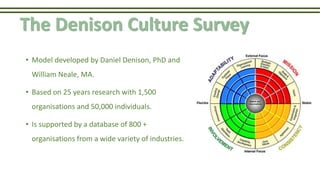
• Model developed by Daniel Denison, PhD and
William Neale, MA.
• Based on 25 years research with 1,500
organisations and 50,000 individuals.
• Is supported by a database of 800 +
organisations from a wide variety of industries.
The Denison Culture Survey
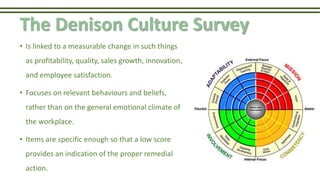
• Is linked to a measurable change in such things
as profitability, quality, sales growth, innovation,
and employee satisfaction.
• Focuses on relevant behaviours and beliefs,
rather than on the general emotional climate of
the workplace.
• Items are specific enough so that a low score
provides an indication of the proper remedial
action.
What counts…
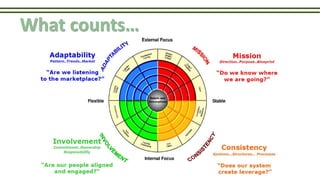
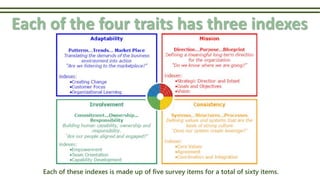
Each of the four traits has three indexes
Each of these indexes is made up of five survey items for a total of sixty items.
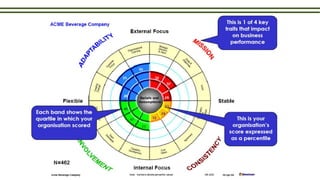
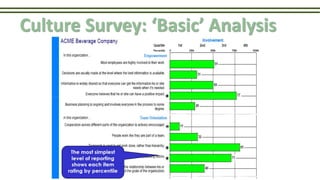
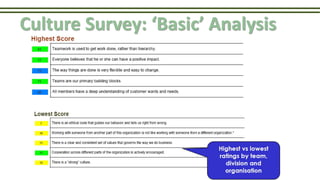
Culture Survey: ‘Basic’ Analysis
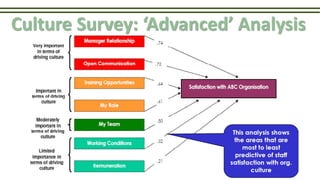
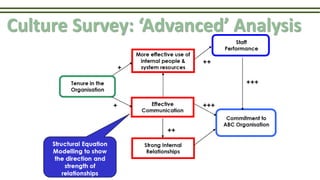
Culture Survey: ‘Advanced’ Analysis
Exit Surveys
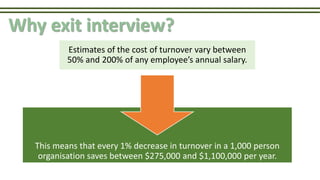
This means that every 1% decrease in turnover in a 1,000 person
organisation saves between $275,000 and $1,100,000 per year.
Why exit interview?
Estimates of the cost of turnover vary between
50% and 200% of any employee’s annual salary.
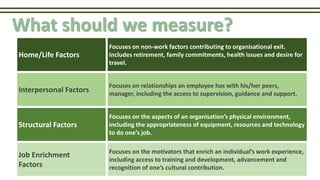
What should we measure?
Home/Life Factors
Focuses on non-work factors contributing to organisational exit.
Includes retirement, family commitments, health issues and desire for
travel.
Interpersonal Factors
Focuses on relationships an employee has with his/her peers,
manager, including the access to supervision, guidance and support.
Structural Factors
Focuses on the aspects of an organisation’s physical environment,
including the appropriateness of equipment, resources and technology
to do one’s job.
Job Enrichment
Factors
Focuses on the motivators that enrich an individual’s work experience,
including access to training and development, advancement and
recognition of one’s cultural contribution.
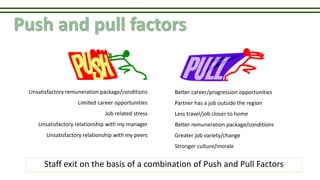
Push and pull factors
Staff exit on the basis of a combination of Push and Pull Factors
Unsatisfactory remuneration package/conditions
Limited career opportunities
Job related stress
Unsatisfactory relationship with my manager
Unsatisfactory relationship with my peers
Better career/progression opportunities
Partner has a job outside the region
Less travel/job closer to home
Better remuneration package/conditions
Greater job variety/change
Stronger culture/morale
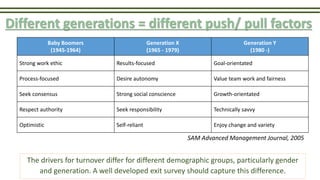
Different generations = different push/ pull factors
Baby Boomers
(1945-1964)
Generation X
(1965 - 1979)
Generation Y
(1980 -)
Strong work ethic Results-focused Goal-orientated
Process-focused Desire autonomy Value team work and fairness
Seek consensus Strong social conscience Growth-orientated
Respect authority Seek responsibility Technically savvy
Optimistic Self-reliant Enjoy change and variety
The drivers for turnover differ for different demographic groups, particularly gender
and generation. A well developed exit survey should capture this difference.
SAM Advanced Management Journal, 2005
Retaining the ‘Baby Boomers’
Over the next 20 years, we are predicted to see
a mass exodus of ‘baby boomers’ from the
workforce…draining organisations of
considerable institutional skills and knowledge.
In a Australian Federal Government report
(2007), it was predicted that economic growth
will slow as the population ages.
Retaining the ‘Baby Boomers’
Smart organisations are already:
using exit data to improve flexibility in
organisational systems for aged employees (job
sharing, project work, phased retirement)
Encouraging a balance between work and non-
work commitments
Incorporating the ageing workforce into their
talent management strategies
Wining Generation Y
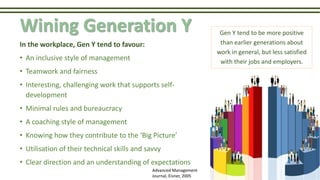
In the workplace, Gen Y tend to favour:
• An inclusive style of management
• Teamwork and fairness
• Interesting, challenging work that supports self-
development
• Minimal rules and bureaucracy
• A coaching style of management
• Knowing how they contribute to the ‘Big Picture’
• Utilisation of their technical skills and savvy
• Clear direction and an understanding of expectations
Gen Y tend to be more positive
than earlier generations about
work in general, but less satisfied
with their jobs and employers.
Advanced Management
Journal, Eisner, 2005
Based on our analysis….
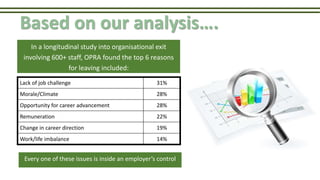
In a longitudinal study into organisational exit
involving 600+ staff, OPRA found the top 6 reasons
for leaving included:
Every one of these issues is inside an employer’s control
Lack of job challenge 31%
Morale/Climate 28%
Opportunity for career advancement 28%
Remuneration 22%
Change in career direction 19%
Work/life imbalance 14%
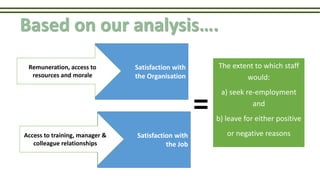
Satisfaction with
the Organisation
Based on our analysis….
The extent to which staff
would:
a) seek re-employment
and
b) leave for either positive
or negative reasons
Remuneration, access to
resources and morale
Satisfaction with
the Job
Access to training, manager &
colleague relationships
=
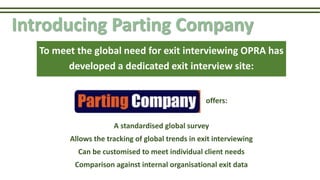
Introducing Parting Company
A standardised global survey
Allows the tracking of global trends in exit interviewing
Can be customised to meet individual client needs
Comparison against internal organisational exit data
To meet the global need for exit interviewing OPRA has
developed a dedicated exit interview site:
offers:
Benefits of Exit
Interviewing
• A standardised process which is cost and
time effective for you and the exiting
employee.
• Customised reporting around key areas of
organisational interest.
• Online survey delivery eliminates human
bias or error, and significantly lifts the rate
of responding.
Benefits of Exit
Interviewing
• Comparison against other organisations,
together with the tracking of your own
longitudinal trends by team, division and
organisation-wide.
• Options for the end-user to complete the
survey anywhere, at any time.
360 Degree
Survey
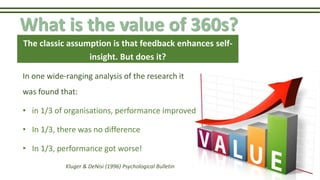
What is the value of 360s?
In one wide-ranging analysis of the research it
was found that:
• in 1/3 of organisations, performance improved
• In 1/3, there was no difference
• In 1/3, performance got worse!
The classic assumption is that feedback enhances self-
insight. But does it?
Kluger & DeNisi (1996) Psychological Bulletin
Organisational challenge
To be in the ‘one third’ of organisations
that see positive gains from the
introduction and implementation of a
360 feedback system……
Powerful 360 items…
• Address the ‘big’ issues that offer the most
leverage for improvement.
• Are only asked of raters who can give a
meaningful response. There is no need to ask
the same questions of all respondents.
• Are based on activities that offer a high
likelihood of change.
Powerful 360 items…
• Generate ratings across the full range of
effectiveness.
• Tap into the ‘derailers’ as well as all the
positive stuff. Our analysis shows that raters
are more willing to express issues posed as a
‘derailer’ than rate down a positive statement.
• Provide the option for qualitative, open-
ended comment.
Maximising the impact of 360
• Individuals are more likely to respond
positively to credible feedback from a number
of respected raters.
• Specific and descriptive feedback
helps…generalised and vague reports don’t.
• Get the manager involved in the feedback
process as a starting point to developing
dialogue for change.
Maximising the impact of 360
• Don’t be afraid as an organisation to face
up to counterproductive behaviours that
are blocking progress.
• Link to realistic, measurable actions for
change…track frequently and provide
feedback often.
• Focus only on 1 or 2 big gains at a
time…together with a few quick wins.
What are they doing differently?
 Gather end-user feedback…was the survey easy to fill out? What do
we need to retain or let go?
 Keep analysing the data to determine what questions can be dropped.
 Reduce the survey to a set of ‘power items’ that link to your survey
drivers.
 Track trends…what themes are emerging as potential strengths?
developmental needs?
 Use technology smartly to deliver 360 feedback with speed, efficiency
and sophistication.
Organisation’s
who cite the
greatest benefits
from 360 typically:
Introducing 360develop.com
Set-Up
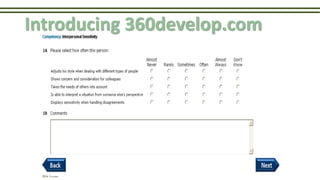
• Provides the option to pick and chose from ready-
to-use competency and question sets for general
staff, team leaders, managers, and senior
management.
• Customise your own survey using your unique
competencies, questions, rating scales and free
text questions.
• Include your own logo and branding.
• Define your own rater categories (‘manager’ ,
‘colleagues’, ‘direct reports’ etc).
• Create your own welcome email or use OPRA’s
standard text.
Introducing 360develop.com
Delivery
• Track response rates over time, send
reminder emails, and check the
completion status of any survey.
• Send reminder emails with whatever
frequency you wish.
• Roll the survey out all at once, or in
stages.
Introducing 360develop.com
Delivery
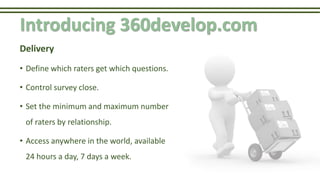
• Define which raters get which questions.
• Control survey close.
• Set the minimum and maximum number
of raters by relationship.
• Access anywhere in the world, available
24 hours a day, 7 days a week.
Introducing 360develop.com
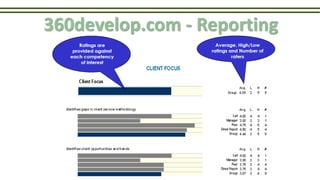
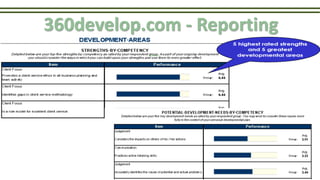
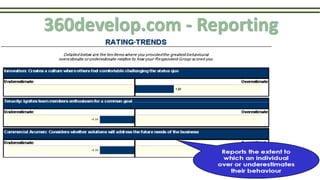
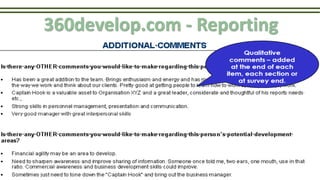
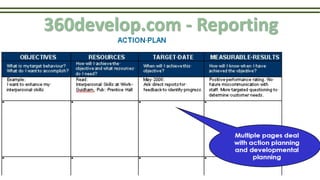
360develop.com - Reporting
And still there is more….
• Additional fully customisable survey options also
delivered via OPRA survey technology include:
• Stakeholder surveying
• Applied Research
• customer Satisfaction
• In-house evaluation
• Post-appointment interviews
• All survey solutions are bespoke
• Individual organisations, individual issues,
individual solutions.
So where to
from here?
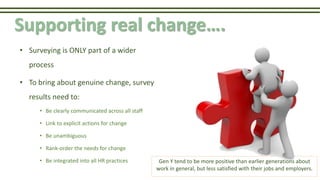
Supporting real change….
• Surveying is ONLY part of a wider
process
• To bring about genuine change, survey
results need to:
• Be clearly communicated across all staff
• Link to explicit actions for change
• Be unambiguous
• Rank-order the needs for change
• Be integrated into all HR practices Gen Y tend to be more positive than earlier generations about
work in general, but less satisfied with their jobs and employers.
Best practice survey design
• Use designs that balance cost with return
• Measure what is worth measuring
• Pretest questionnaires and procedures
• Check quality at each stage
• Maximize cooperation or response rates within ethnical limits
• Use appropriate analysis and reporting techniques
• Fulfil pledge of confidentiality to respondents
• Disclose all methods of the survey design and delivery to allow
for evaluation and replication
General survey guidelines
DON’T
• Ask too many questions
• Contribute to the SPAM problem
• Take responses for granted
• Substitute data for analysis
• Underestimate the value of data
DO
Keep surveys simple and focused on the
‘big issues’
Invite respondents with care
Balance qualitative with quantitative
questions
Present a compelling story using results
Measure shifts in data over time
As practitioners, we need to think in terms
of real utility and return on investment
(ROI). However this must be demonstrated
in a complete systems approach, rather
than an intermittent transactional exchange.
The ideal survey solution
Is integrated
Solutions need to be individualised through
quality consulting. There is no ‘one size fits
all’ panacea to all organisational ills.
Individualised
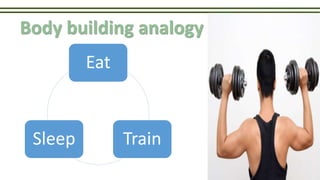
Body building analogy
Eat
TrainSleep
Some last thoughts…
Organisational surveying will not succeed
where……
• Staff are uncertain about what the survey
means for them at a practical, day-to-day level
(i.e. what does this mean in terms of doing my
job differently?)’.
• HR practitioners work on one element of the
business in isolation of all others.
Some last thoughts…
Organisational surveying will not succeed
where……
• Leaders do not ‘walk the talk’. The willingness and
enthusiasm of leaders to embrace new ways of
operating is the single most effective means of
communicating commitment to survey outcomes.
• Organisational surveys are implemented in the
absence of regular and ongoing monitoring of
successes, and blocks and re-focusing of effort.
In summary
• Practitioners need to create solutions that work
within the context of a specific organisation.
• Solutions need to be fully integrated with the vision
and strategic direction of the organisation.
• We need to ensure buy-in across levels in the
organisation, and from business leaders.
• We need to demonstrate our usefulness in dollar-
terms.

Organisational surveying

  • 1.
    Organisational Surveying A waste oftime (and money) or a powerful strategic tool?
  • 2.
    Content • Why surveyingis so important to organisational success • The features shared by robust survey designs • Risks associated with survey delivery • Three options for organisational surveying will be discussed: • 360 Survey • Exit Interviewing • Culture Survey
  • 3.
  • 4.
    By collating surveydata we can: • Confirm whether results are due to chance, or some genuine differences • Evaluate the link between different areas of interest (e.g., culture ratings versus performance, exit ratings versus satisfaction) • Identify the most powerful sub-set of items • Rank-order issues in terms of priority • Understand the unique themes that shape data Conducting organisational surveys is becoming an increasingly popular part of an organisation’s annual review.
  • 5.
    Robust surveys share…. •What is your rationale for undertaking a survey…. what are the expected outcomes? How else could we achieve these outcomes? • What research methodologies are to be used (interviews, focus groups + survey?) • How will quantitative and qualitative ingredients be blended. Will consideration go beyond simple descriptive statistics? • Who is being surveyed – a sample or the whole population? • How can survey output be linked to, and add value to other HR- related considerations (exit + culture surveys; post-appointment + culture)? Good survey outputs requires a quality input Remember: You can’t make a silk purse out of a sow’s ear…
  • 6.
  • 7.
    The concept ofculture • Late nineteenth and early twentieth century studies of social anthropology gave us the term “culture.” • The concept of culture represents, in an holistic sense, the qualities of any specific human group that are passed from one generation to the next because they are believed to be useful for survival and adaptation.
  • 8.
    A clear definitionof culture • Every organisation has its own way of doing things that influences virtually every aspect of working life. • Culture is the ‘social glue’ that holds an organisation together. • Culture gives an organisation its distinct personality. When we talk about culture, we are referring to the organisation’s dominant culture; that is, the values shared by most of its members.
  • 9.
    A clear definitionof culture • Some aspects of culture are very visible. “Working hard” or “being friendly to customers“. Other aspects of culture are harder to observe such as “doing things right the first time”. • Organisational culture may not be easily seen - yet may be the strongest facilitator of commitment to something larger than oneself.
  • 10.
    Why culture isNOT a focus “It is highly natural that leaders would be resistant to focusing on organisational culture. They have routinely been confused by the conversation and disappointed by unfulfilled promises”. Fisher & Allford, 2000
  • 11.
    Why culture bea focus “We have the same ingredients and use the same ovens, but it’s the skills, attitude and experience of the workforce that differentiates the brands.” David Brandon Chief Executive of Dominos Pizza “Bureaucratic control can only buy employees’ bodies but not their hearts. A strong organisational culture, however, can be a primary generator of real motivation and commitment”. Daniel Denison, Founder of Denison Consulting, USA
  • 12.
    Why culture surveysfail to deliver • Often designed and created within the academic environment –results are not replicable • Use non-business language which must be converted through interpretation to the business context
  • 13.
    Why culture surveysfail to deliver • Are often unclear about specific links to business results; little if any research • Often require extensive time to implement assessment and/or interpret results in the business context • The results do not lead to measurable actions and a ROI
  • 14.
    The Denison CultureSurvey • Model developed by Daniel Denison, PhD and William Neale, MA. • Based on 25 years research with 1,500 organisations and 50,000 individuals. • Is supported by a database of 800 + organisations from a wide variety of industries.
  • 15.
    The Denison CultureSurvey • Is linked to a measurable change in such things as profitability, quality, sales growth, innovation, and employee satisfaction. • Focuses on relevant behaviours and beliefs, rather than on the general emotional climate of the workplace. • Items are specific enough so that a low score provides an indication of the proper remedial action.
  • 16.
  • 17.
    Each of thefour traits has three indexes Each of these indexes is made up of five survey items for a total of sixty items.
  • 19.
  • 20.
  • 21.
  • 22.
  • 23.
  • 24.
    This means thatevery 1% decrease in turnover in a 1,000 person organisation saves between $275,000 and $1,100,000 per year. Why exit interview? Estimates of the cost of turnover vary between 50% and 200% of any employee’s annual salary.
  • 25.
    What should wemeasure? Home/Life Factors Focuses on non-work factors contributing to organisational exit. Includes retirement, family commitments, health issues and desire for travel. Interpersonal Factors Focuses on relationships an employee has with his/her peers, manager, including the access to supervision, guidance and support. Structural Factors Focuses on the aspects of an organisation’s physical environment, including the appropriateness of equipment, resources and technology to do one’s job. Job Enrichment Factors Focuses on the motivators that enrich an individual’s work experience, including access to training and development, advancement and recognition of one’s cultural contribution.
  • 26.
    Push and pullfactors Staff exit on the basis of a combination of Push and Pull Factors Unsatisfactory remuneration package/conditions Limited career opportunities Job related stress Unsatisfactory relationship with my manager Unsatisfactory relationship with my peers Better career/progression opportunities Partner has a job outside the region Less travel/job closer to home Better remuneration package/conditions Greater job variety/change Stronger culture/morale
  • 27.
    Different generations =different push/ pull factors Baby Boomers (1945-1964) Generation X (1965 - 1979) Generation Y (1980 -) Strong work ethic Results-focused Goal-orientated Process-focused Desire autonomy Value team work and fairness Seek consensus Strong social conscience Growth-orientated Respect authority Seek responsibility Technically savvy Optimistic Self-reliant Enjoy change and variety The drivers for turnover differ for different demographic groups, particularly gender and generation. A well developed exit survey should capture this difference. SAM Advanced Management Journal, 2005
  • 28.
    Retaining the ‘BabyBoomers’ Over the next 20 years, we are predicted to see a mass exodus of ‘baby boomers’ from the workforce…draining organisations of considerable institutional skills and knowledge. In a Australian Federal Government report (2007), it was predicted that economic growth will slow as the population ages.
  • 29.
    Retaining the ‘BabyBoomers’ Smart organisations are already: using exit data to improve flexibility in organisational systems for aged employees (job sharing, project work, phased retirement) Encouraging a balance between work and non- work commitments Incorporating the ageing workforce into their talent management strategies
  • 30.
    Wining Generation Y Inthe workplace, Gen Y tend to favour: • An inclusive style of management • Teamwork and fairness • Interesting, challenging work that supports self- development • Minimal rules and bureaucracy • A coaching style of management • Knowing how they contribute to the ‘Big Picture’ • Utilisation of their technical skills and savvy • Clear direction and an understanding of expectations Gen Y tend to be more positive than earlier generations about work in general, but less satisfied with their jobs and employers. Advanced Management Journal, Eisner, 2005
  • 31.
    Based on ouranalysis…. In a longitudinal study into organisational exit involving 600+ staff, OPRA found the top 6 reasons for leaving included: Every one of these issues is inside an employer’s control Lack of job challenge 31% Morale/Climate 28% Opportunity for career advancement 28% Remuneration 22% Change in career direction 19% Work/life imbalance 14%
  • 32.
    Satisfaction with the Organisation Basedon our analysis…. The extent to which staff would: a) seek re-employment and b) leave for either positive or negative reasons Remuneration, access to resources and morale Satisfaction with the Job Access to training, manager & colleague relationships =
  • 34.
    Introducing Parting Company Astandardised global survey Allows the tracking of global trends in exit interviewing Can be customised to meet individual client needs Comparison against internal organisational exit data To meet the global need for exit interviewing OPRA has developed a dedicated exit interview site: offers:
  • 35.
    Benefits of Exit Interviewing •A standardised process which is cost and time effective for you and the exiting employee. • Customised reporting around key areas of organisational interest. • Online survey delivery eliminates human bias or error, and significantly lifts the rate of responding.
  • 36.
    Benefits of Exit Interviewing •Comparison against other organisations, together with the tracking of your own longitudinal trends by team, division and organisation-wide. • Options for the end-user to complete the survey anywhere, at any time.
  • 37.
  • 38.
    What is thevalue of 360s? In one wide-ranging analysis of the research it was found that: • in 1/3 of organisations, performance improved • In 1/3, there was no difference • In 1/3, performance got worse! The classic assumption is that feedback enhances self- insight. But does it? Kluger & DeNisi (1996) Psychological Bulletin
  • 39.
    Organisational challenge To bein the ‘one third’ of organisations that see positive gains from the introduction and implementation of a 360 feedback system……
  • 40.
    Powerful 360 items… •Address the ‘big’ issues that offer the most leverage for improvement. • Are only asked of raters who can give a meaningful response. There is no need to ask the same questions of all respondents. • Are based on activities that offer a high likelihood of change.
  • 41.
    Powerful 360 items… •Generate ratings across the full range of effectiveness. • Tap into the ‘derailers’ as well as all the positive stuff. Our analysis shows that raters are more willing to express issues posed as a ‘derailer’ than rate down a positive statement. • Provide the option for qualitative, open- ended comment.
  • 42.
    Maximising the impactof 360 • Individuals are more likely to respond positively to credible feedback from a number of respected raters. • Specific and descriptive feedback helps…generalised and vague reports don’t. • Get the manager involved in the feedback process as a starting point to developing dialogue for change.
  • 43.
    Maximising the impactof 360 • Don’t be afraid as an organisation to face up to counterproductive behaviours that are blocking progress. • Link to realistic, measurable actions for change…track frequently and provide feedback often. • Focus only on 1 or 2 big gains at a time…together with a few quick wins.
  • 44.
    What are theydoing differently?  Gather end-user feedback…was the survey easy to fill out? What do we need to retain or let go?  Keep analysing the data to determine what questions can be dropped.  Reduce the survey to a set of ‘power items’ that link to your survey drivers.  Track trends…what themes are emerging as potential strengths? developmental needs?  Use technology smartly to deliver 360 feedback with speed, efficiency and sophistication. Organisation’s who cite the greatest benefits from 360 typically:
  • 46.
    Introducing 360develop.com Set-Up • Providesthe option to pick and chose from ready- to-use competency and question sets for general staff, team leaders, managers, and senior management. • Customise your own survey using your unique competencies, questions, rating scales and free text questions. • Include your own logo and branding. • Define your own rater categories (‘manager’ , ‘colleagues’, ‘direct reports’ etc). • Create your own welcome email or use OPRA’s standard text.
  • 47.
    Introducing 360develop.com Delivery • Trackresponse rates over time, send reminder emails, and check the completion status of any survey. • Send reminder emails with whatever frequency you wish. • Roll the survey out all at once, or in stages.
  • 48.
    Introducing 360develop.com Delivery • Definewhich raters get which questions. • Control survey close. • Set the minimum and maximum number of raters by relationship. • Access anywhere in the world, available 24 hours a day, 7 days a week.
  • 49.
  • 50.
  • 51.
  • 52.
  • 53.
  • 54.
  • 55.
    And still thereis more…. • Additional fully customisable survey options also delivered via OPRA survey technology include: • Stakeholder surveying • Applied Research • customer Satisfaction • In-house evaluation • Post-appointment interviews • All survey solutions are bespoke • Individual organisations, individual issues, individual solutions.
  • 56.
  • 57.
    Supporting real change…. •Surveying is ONLY part of a wider process • To bring about genuine change, survey results need to: • Be clearly communicated across all staff • Link to explicit actions for change • Be unambiguous • Rank-order the needs for change • Be integrated into all HR practices Gen Y tend to be more positive than earlier generations about work in general, but less satisfied with their jobs and employers.
  • 58.
    Best practice surveydesign • Use designs that balance cost with return • Measure what is worth measuring • Pretest questionnaires and procedures • Check quality at each stage • Maximize cooperation or response rates within ethnical limits • Use appropriate analysis and reporting techniques • Fulfil pledge of confidentiality to respondents • Disclose all methods of the survey design and delivery to allow for evaluation and replication
  • 59.
    General survey guidelines DON’T •Ask too many questions • Contribute to the SPAM problem • Take responses for granted • Substitute data for analysis • Underestimate the value of data DO Keep surveys simple and focused on the ‘big issues’ Invite respondents with care Balance qualitative with quantitative questions Present a compelling story using results Measure shifts in data over time
  • 60.
    As practitioners, weneed to think in terms of real utility and return on investment (ROI). However this must be demonstrated in a complete systems approach, rather than an intermittent transactional exchange. The ideal survey solution Is integrated Solutions need to be individualised through quality consulting. There is no ‘one size fits all’ panacea to all organisational ills. Individualised
  • 61.
  • 62.
    Some last thoughts… Organisationalsurveying will not succeed where…… • Staff are uncertain about what the survey means for them at a practical, day-to-day level (i.e. what does this mean in terms of doing my job differently?)’. • HR practitioners work on one element of the business in isolation of all others.
  • 63.
    Some last thoughts… Organisationalsurveying will not succeed where…… • Leaders do not ‘walk the talk’. The willingness and enthusiasm of leaders to embrace new ways of operating is the single most effective means of communicating commitment to survey outcomes. • Organisational surveys are implemented in the absence of regular and ongoing monitoring of successes, and blocks and re-focusing of effort.
  • 64.
    In summary • Practitionersneed to create solutions that work within the context of a specific organisation. • Solutions need to be fully integrated with the vision and strategic direction of the organisation. • We need to ensure buy-in across levels in the organisation, and from business leaders. • We need to demonstrate our usefulness in dollar- terms.