

ORGANIZATIONAL BEHAVIOR FINAL
  PROJECT
Topic:      Job satisfaction, organizational justice, citizenship behavior

Submitted to:
                                     Mr. Aly Raza Syed

Submitted by:
                                            M.Burhan Ali
                                           Zayed Saleem
                                           Fakhar Tayyab
                                           Saboor Ahmed
                                           Uzair Nawaz
PURPOSE OF RESEARCH

To find relationship of:

   Job satisfaction

   Organizational justice

   Organizational citizenship behaviors
TARGET POPULATION


   Private sector:   Crescent Bahuman LTD.


   Public sector:    Pakistan International Airline
THEORIES OF JOB SATISFACTION
   Affect Theory by Edwin A. Locke’s in 1976

   Dispositional Theory by Timothy A. Judge, Edwin
    A. Locke in 1997

   Two-Factor Theory by Frederick Herzberg in1968
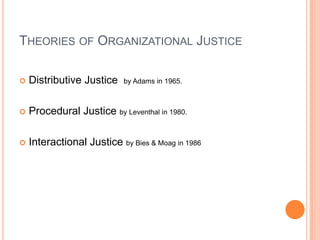
THEORIES OF ORGANIZATIONAL JUSTICE

   Distributive Justice    by Adams in 1965.


   Procedural Justice by Leventhal in 1980.

   Interactional Justice by Bies & Moag in 1986
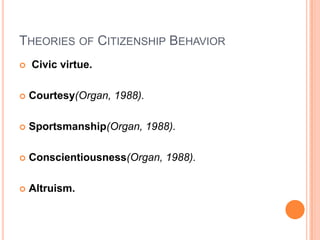
THEORIES OF CITIZENSHIP BEHAVIOR
   Civic virtue.

   Courtesy(Organ, 1988).

   Sportsmanship(Organ, 1988).

   Conscientiousness(Organ, 1988).

   Altruism.
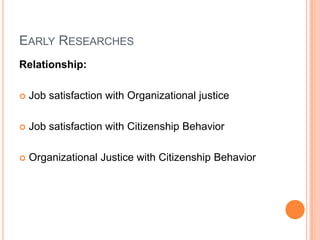
EARLY RESEARCHES
Relationship:

   Job satisfaction with Organizational justice

   Job satisfaction with Citizenship Behavior

   Organizational Justice with Citizenship Behavior
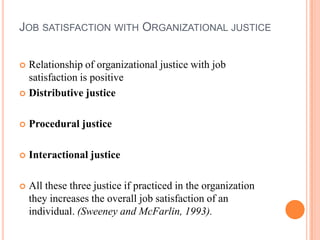
JOB SATISFACTION WITH ORGANIZATIONAL JUSTICE


 Relationship of organizational justice with job
  satisfaction is positive
 Distributive justice


   Procedural justice

   Interactional justice

   All these three justice if practiced in the organization
    they increases the overall job satisfaction of an
    individual. (Sweeney and McFarlin, 1993).
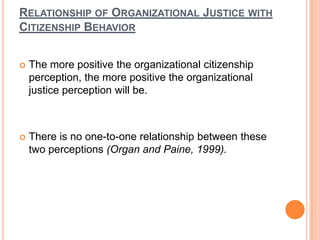
RELATIONSHIP OF ORGANIZATIONAL JUSTICE WITH
CITIZENSHIP BEHAVIOR


   The more positive the organizational citizenship
    perception, the more positive the organizational
    justice perception will be.


   There is no one-to-one relationship between these
    two perceptions (Organ and Paine, 1999).
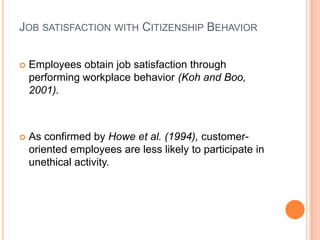
JOB SATISFACTION WITH CITIZENSHIP BEHAVIOR


   Employees obtain job satisfaction through
    performing workplace behavior (Koh and Boo,
    2001).


   As confirmed by Howe et al. (1994), customer-
    oriented employees are less likely to participate in
    unethical activity.
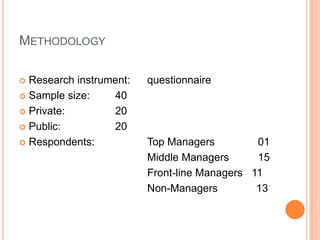
METHODOLOGY

 Research instrument:   questionnaire
 Sample size:    40
 Private:        20
 Public:         20
 Respondents:           Top Managers         01
                         Middle Managers      15
                         Front-line Managers 11
                         Non-Managers         13
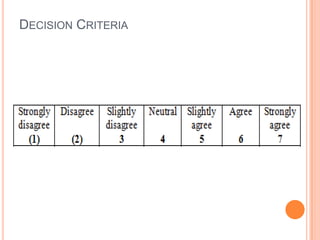
DECISION CRITERIA
FINDINGS

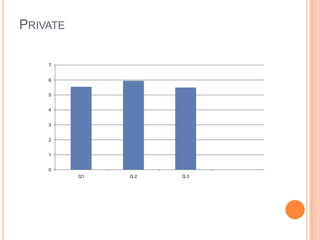
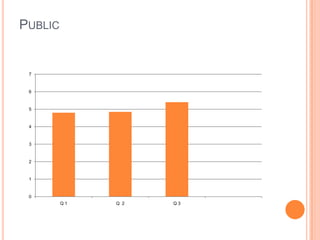
   Job satisfaction

   For Private the Job satisfaction average comes out
    to be 5.67

   For Public the job satisfaction Comes out to be 5.02
PRIVATE

    7


    6


    5


    4


    3


    2


    1


    0
          Q1   Q2   Q3
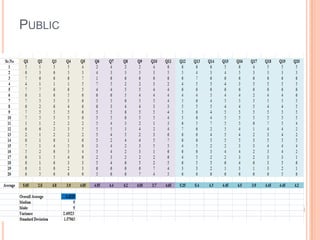
PUBLIC


 7


 6


 5


 4


 3


 2


 1


 0
         Q1   Q 2   Q3
FINDINGS CONTD.

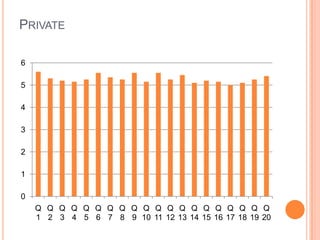
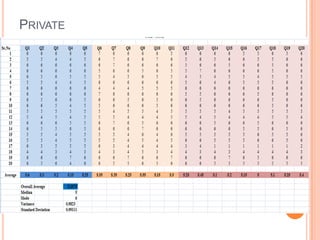
   Organizational Justice   (Private)

1) Distributed justice
           Average comes out to be 5.3 (S.Agree)

2) Procedural Justice
          Average comes out to be 5.4 (S.Agree)

3) Interactional Justice
            Average comes out to be 5.2 (S.Agree)
PRIVATE

6

5

4

3

2

1

0
    Q Q Q Q Q Q Q Q Q Q Q Q Q Q Q Q Q Q Q Q
    1 2 3 4 5 6 7 8 9 10 11 12 13 14 15 16 17 18 19 20
PRIVATE
FINDINGS CONTD.

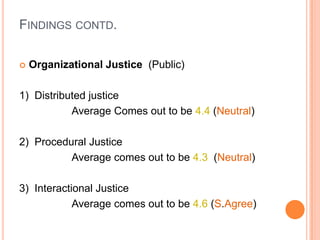
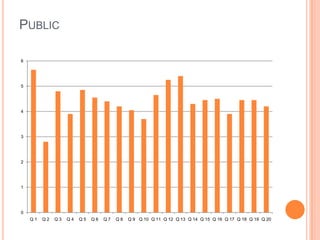
   Organizational Justice (Public)

1) Distributed justice
           Average Comes out to be 4.4 (Neutral)

2) Procedural Justice
          Average comes out to be 4.3 (Neutral)

3) Interactional Justice
            Average comes out to be 4.6 (S.Agree)
PUBLIC

6


5


4


3


2


1


0
    Q1   Q2   Q3   Q4   Q5   Q6   Q7   Q8   Q 9 Q 10 Q 11 Q 12 Q 13 Q 14 Q 15 Q 16 Q 17 Q 18 Q 19 Q 20
PUBLIC
FINDINGS CONTD.

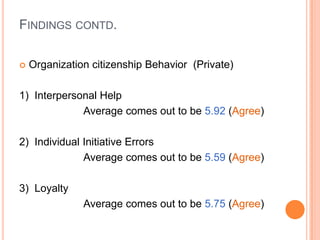
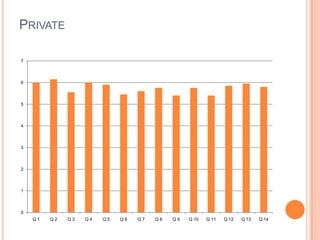
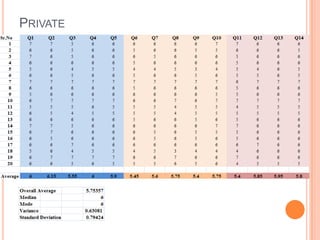
   Organization citizenship Behavior (Private)

1) Interpersonal Help
             Average comes out to be 5.92 (Agree)

2) Individual Initiative Errors
              Average comes out to be 5.59 (Agree)

3) Loyalty
               Average comes out to be 5.75 (Agree)
PRIVATE

7


6


5


4


3


2


1


0
    Q1   Q2   Q3   Q4   Q5   Q6   Q7   Q8   Q9   Q 10   Q 11   Q 12   Q 13   Q 14
PRIVATE
FINDINGS CONTD.

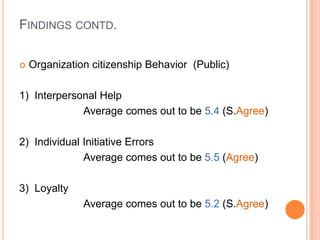
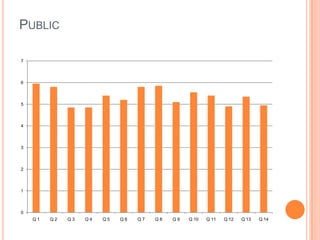
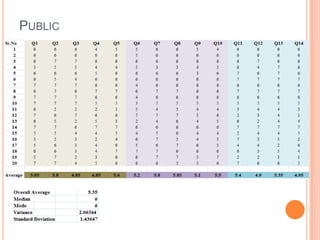
   Organization citizenship Behavior (Public)

1) Interpersonal Help
             Average comes out to be 5.4 (S.Agree)

2) Individual Initiative Errors
              Average comes out to be 5.5 (Agree)

3) Loyalty
               Average comes out to be 5.2 (S.Agree)
PUBLIC

7


6


5


4


3


2


1


0
    Q1   Q2   Q3   Q4   Q5   Q6   Q7   Q8   Q9   Q 10   Q 11   Q 12   Q 13   Q 14
PUBLIC
CONCLUSION….
QUESTIONS???

Organizational Behavior

  • 1.
    ORGANIZATIONAL BEHAVIOR FINAL PROJECT Topic: Job satisfaction, organizational justice, citizenship behavior Submitted to: Mr. Aly Raza Syed Submitted by: M.Burhan Ali Zayed Saleem Fakhar Tayyab Saboor Ahmed Uzair Nawaz
  • 2.
    PURPOSE OF RESEARCH Tofind relationship of:  Job satisfaction  Organizational justice  Organizational citizenship behaviors
  • 3.
    TARGET POPULATION  Private sector: Crescent Bahuman LTD.  Public sector: Pakistan International Airline
  • 4.
    THEORIES OF JOBSATISFACTION  Affect Theory by Edwin A. Locke’s in 1976  Dispositional Theory by Timothy A. Judge, Edwin A. Locke in 1997  Two-Factor Theory by Frederick Herzberg in1968
  • 5.
    THEORIES OF ORGANIZATIONALJUSTICE  Distributive Justice by Adams in 1965.  Procedural Justice by Leventhal in 1980.  Interactional Justice by Bies & Moag in 1986
  • 6.
    THEORIES OF CITIZENSHIPBEHAVIOR  Civic virtue.  Courtesy(Organ, 1988).  Sportsmanship(Organ, 1988).  Conscientiousness(Organ, 1988).  Altruism.
  • 7.
    EARLY RESEARCHES Relationship:  Job satisfaction with Organizational justice  Job satisfaction with Citizenship Behavior  Organizational Justice with Citizenship Behavior
  • 8.
    JOB SATISFACTION WITHORGANIZATIONAL JUSTICE  Relationship of organizational justice with job satisfaction is positive  Distributive justice  Procedural justice  Interactional justice  All these three justice if practiced in the organization they increases the overall job satisfaction of an individual. (Sweeney and McFarlin, 1993).
  • 9.
    RELATIONSHIP OF ORGANIZATIONALJUSTICE WITH CITIZENSHIP BEHAVIOR  The more positive the organizational citizenship perception, the more positive the organizational justice perception will be.  There is no one-to-one relationship between these two perceptions (Organ and Paine, 1999).
  • 10.
    JOB SATISFACTION WITHCITIZENSHIP BEHAVIOR  Employees obtain job satisfaction through performing workplace behavior (Koh and Boo, 2001).  As confirmed by Howe et al. (1994), customer- oriented employees are less likely to participate in unethical activity.
  • 11.
    METHODOLOGY  Research instrument: questionnaire  Sample size: 40  Private: 20  Public: 20  Respondents: Top Managers 01 Middle Managers 15 Front-line Managers 11 Non-Managers 13
  • 12.
  • 13.
    FINDINGS  Job satisfaction  For Private the Job satisfaction average comes out to be 5.67  For Public the job satisfaction Comes out to be 5.02
  • 14.
    PRIVATE 7 6 5 4 3 2 1 0 Q1 Q2 Q3
  • 15.
    PUBLIC 7 6 5 4 3 2 1 0 Q1 Q 2 Q3
  • 16.
    FINDINGS CONTD.  Organizational Justice (Private) 1) Distributed justice Average comes out to be 5.3 (S.Agree) 2) Procedural Justice Average comes out to be 5.4 (S.Agree) 3) Interactional Justice Average comes out to be 5.2 (S.Agree)
  • 17.
    PRIVATE 6 5 4 3 2 1 0 Q Q Q Q Q Q Q Q Q Q Q Q Q Q Q Q Q Q Q Q 1 2 3 4 5 6 7 8 9 10 11 12 13 14 15 16 17 18 19 20
  • 18.
  • 19.
    FINDINGS CONTD.  Organizational Justice (Public) 1) Distributed justice Average Comes out to be 4.4 (Neutral) 2) Procedural Justice Average comes out to be 4.3 (Neutral) 3) Interactional Justice Average comes out to be 4.6 (S.Agree)
  • 20.
    PUBLIC 6 5 4 3 2 1 0 Q1 Q2 Q3 Q4 Q5 Q6 Q7 Q8 Q 9 Q 10 Q 11 Q 12 Q 13 Q 14 Q 15 Q 16 Q 17 Q 18 Q 19 Q 20
  • 21.
  • 22.
    FINDINGS CONTD.  Organization citizenship Behavior (Private) 1) Interpersonal Help Average comes out to be 5.92 (Agree) 2) Individual Initiative Errors Average comes out to be 5.59 (Agree) 3) Loyalty Average comes out to be 5.75 (Agree)
  • 23.
    PRIVATE 7 6 5 4 3 2 1 0 Q1 Q2 Q3 Q4 Q5 Q6 Q7 Q8 Q9 Q 10 Q 11 Q 12 Q 13 Q 14
  • 24.
  • 25.
    FINDINGS CONTD.  Organization citizenship Behavior (Public) 1) Interpersonal Help Average comes out to be 5.4 (S.Agree) 2) Individual Initiative Errors Average comes out to be 5.5 (Agree) 3) Loyalty Average comes out to be 5.2 (S.Agree)
  • 26.
    PUBLIC 7 6 5 4 3 2 1 0 Q1 Q2 Q3 Q4 Q5 Q6 Q7 Q8 Q9 Q 10 Q 11 Q 12 Q 13 Q 14
  • 27.
  • 28.
  • 29.