Employee Satisfaction
& Commitment
Presented by:
Abhijit Paul - 1201
Shazzad Hossain - 1203
Rupali Tasnim Samad - 1208
Tashfia Jannath - 1223
Mehzabin Haque - 1233
Important employee attitudes:
â—Ź Job Satisfaction
â—Ź Organizational Commitment
â—‹ Affective
â—‹ Continuance
â—‹ Normative
Organizational Attitudes
Satisfied employees are more:
â—Ź Committed to the organization
â—Ź Reduced absenteeism
â—Ź Reduced tardiness
â—Ź Higher performance
â—Ź Lower turnover rate
Importance of having satisfied employees
Facets that affect job satisfaction
â—Ź What individual differences affect job satisfaction?
â—‹ Genetic Predisposition
â—‹ Core Self-Evaluation
â—‹ Intelligence
â—‹ Culture
â—Ź Satisfied with all aspects of life
â—‹ Family, friends, location etc
â—‹ John Travolta Method
â–  Nonwork activities
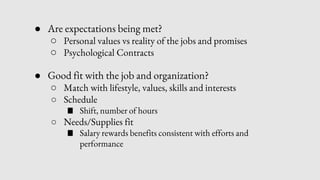
â—Ź Are expectations being met?
â—‹ Personal values vs reality of the jobs and promises
â—‹ Psychological Contracts
â—Ź Good fit with the job and organization?
â—‹ Match with lifestyle, values, skills and interests
â—‹ Schedule
â–  Shift, number of hours
â—‹ Needs/Supplies fit
â–  Salary rewards benefits consistent with efforts and
performance
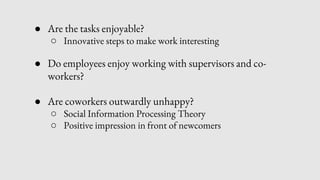
â—Ź Are the tasks enjoyable?
â—‹ Innovative steps to make work interesting
â—Ź Do employees enjoy working with supervisors and co-
workers?
â—Ź Are coworkers outwardly unhappy?
â—‹ Social Information Processing Theory
â—‹ Positive impression in front of newcomers
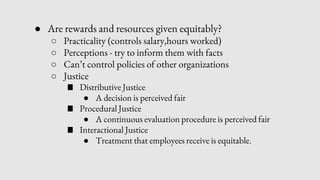
â—Ź Are rewards and resources given equitably?
â—‹ Practicality (controls salary,hours worked)
â—‹ Perceptions - try to inform them with facts
○ Can’t control policies of other organizations
â—‹ Justice
â–  Distributive Justice
â—Ź A decision is perceived fair
â–  Procedural Justice
â—Ź A continuous evaluation procedure is perceived fair
â–  Interactional Justice
â—Ź Treatment that employees receive is equitable.
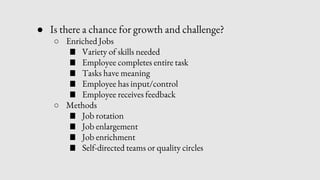
â—Ź Is there a chance for growth and challenge?
â—‹ Enriched Jobs
â–  Variety of skills needed
â–  Employee completes entire task
â–  Tasks have meaning
â–  Employee has input/control
â–  Employee receives feedback
â—‹ Methods
â–  Job rotation
â–  Job enlargement
â–  Job enrichment
â–  Self-directed teams or quality circles
Increasing Job Satisfaction
● Hire “satisfied” Employees
â—Ź Eliminate Dissatisfiers
â—Ź Increase Opportunities to socialize
â—Ź Express Appreciation
â—Ź Provide Proper Feedback
â—Ź Assign the right tasks to the right person
Measures of Commitment
● Affective commitment
â—Ź Continuance commitment
â—Ź Normative commitment
Measuring Job Satisfaction
â—Ź Standard job satisfaction inventories
â—‹ Faces scale
â—‹ Job descriptive index
â—‹ Minnesota satisfaction Questionnaire
â—‹ Nagy survey
â—Ź Custom designed satisfaction inventories
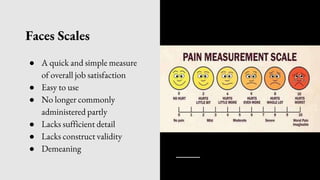
Faces Scales
â—Ź A quick and simple measure
of overall job satisfaction
â—Ź Easy to use
â—Ź No longer commonly
administered partly
â—Ź Lacks sufficient detail
â—Ź Lacks construct validity
â—Ź Demeaning
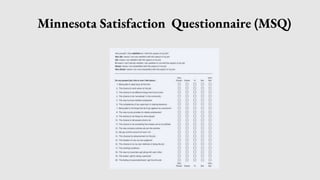
Minnesota Satisfaction Questionnaire (MSQ)
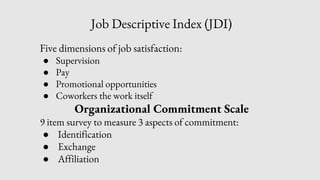
Job Descriptive Index (JDI)
Five dimensions of job satisfaction:
â—Ź Supervision
â—Ź Pay
â—Ź Promotional opportunities
â—Ź Coworkers the work itself
Organizational Commitment Scale
9 item survey to measure 3 aspects of commitment:
â—Ź Identification
â—Ź Exchange
â—Ź Affiliation
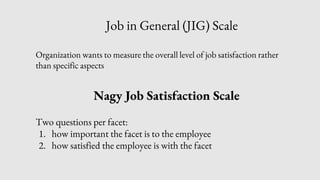
Job in General (JIG) Scale
Organization wants to measure the overall level of job satisfaction rather
than specific aspects
Nagy Job Satisfaction Scale
Two questions per facet:
1. how important the facet is to the employee
2. how satisfied the employee is with the facet
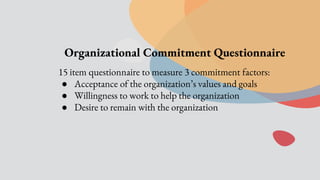
Organizational Commitment Questionnaire
15 item questionnaire to measure 3 commitment factors:
● Acceptance of the organization’s values and goals
â—Ź Willingness to work to help the organization
â—Ź Desire to remain with the organization
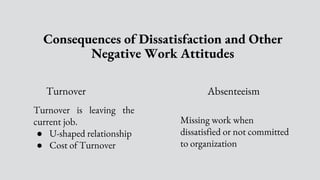
Consequences of Dissatisfaction and Other
Negative Work Attitudes
Turnover Absenteeism
Missing work when
dissatisfied or not committed
to organization.
Turnover is leaving the
current job.
â—Ź U-shaped relationship
â—Ź Cost of Turnover
Why employees are absent?
â—Ź No consequences for attending or missing work
â—Ź Illness and personal problems
â—Ź Individual differences
â—Ź Unique events
How can we reduce absenteeism?
â—Ź Rewards for attending
â—‹ Financial Incentives
â–  Well Pay
â–  Financial Bonus
â–  Games
â—‹ Time Off
â—‹ Recognition Programs
â—Ź Discipline for not attending
â—Ź Clear policies and better record keeping
â—Ź Reducing Employee Stress & illness
● Not Hiring “Absence-Prone” Employees
â—Ź Uncontrollable Absenteeism Caused by Unique Events
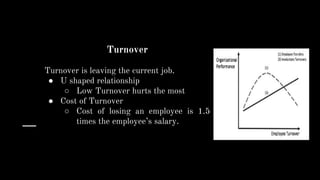
Turnover
Turnover is leaving the current job.
â—Ź U shaped relationship
â—‹ Low Turnover hurts the most
â—Ź Cost of Turnover
â—‹ Cost of losing an employee is 1.5
times the employee’s salary.
Reducing Turnover
â—Ź Unavoidable Reasons
â—‹ Death of co-worker, illness, family issues
â—Ź Advancement
â—‹ Changing company for better pay
â—Ź Unmet Needs
â—‹ Employee loves social interaction but his job has low social
interaction.
â—Ź Escape
â—‹ Conflict with co-workers
â—Ź Unmet Expectations
â—‹ Pay, working conditions, opportunities, organization culture
Counterproductive Behavior
1. Individual
a. Gossip
b. Playing Negative Politics
c. Harassment
d. Incivility
e. Workplace Violence
f. Bullying
2. Organizational
a. Theft
b. Sabotage
To get back at the company or individuals
Organizational Citizenship
Behavior
“Little things that one is not required to do.”
For example,
â—Ź Staying late to get a project done.
â—Ź Helping a coworker who is behind in their job
â—Ź Mentoring a new employee
â—Ź Volunteering for committees.
â—Ź Flying in a coach when the employee might be entitled to a first class.
Thank You!

Employee Satisfaction.pptx

  • 1.
    Employee Satisfaction & Commitment Presentedby: Abhijit Paul - 1201 Shazzad Hossain - 1203 Rupali Tasnim Samad - 1208 Tashfia Jannath - 1223 Mehzabin Haque - 1233
  • 2.
    Important employee attitudes: â—ŹJob Satisfaction â—Ź Organizational Commitment â—‹ Affective â—‹ Continuance â—‹ Normative Organizational Attitudes
  • 3.
    Satisfied employees aremore: â—Ź Committed to the organization â—Ź Reduced absenteeism â—Ź Reduced tardiness â—Ź Higher performance â—Ź Lower turnover rate Importance of having satisfied employees
  • 4.
    Facets that affectjob satisfaction â—Ź What individual differences affect job satisfaction? â—‹ Genetic Predisposition â—‹ Core Self-Evaluation â—‹ Intelligence â—‹ Culture â—Ź Satisfied with all aspects of life â—‹ Family, friends, location etc â—‹ John Travolta Method â–  Nonwork activities
  • 5.
    â—Ź Are expectationsbeing met? â—‹ Personal values vs reality of the jobs and promises â—‹ Psychological Contracts â—Ź Good fit with the job and organization? â—‹ Match with lifestyle, values, skills and interests â—‹ Schedule â–  Shift, number of hours â—‹ Needs/Supplies fit â–  Salary rewards benefits consistent with efforts and performance
  • 6.
    â—Ź Are thetasks enjoyable? â—‹ Innovative steps to make work interesting â—Ź Do employees enjoy working with supervisors and co- workers? â—Ź Are coworkers outwardly unhappy? â—‹ Social Information Processing Theory â—‹ Positive impression in front of newcomers
  • 7.
    ● Are rewardsand resources given equitably? ○ Practicality (controls salary,hours worked) ○ Perceptions - try to inform them with facts ○ Can’t control policies of other organizations ○ Justice ■ Distributive Justice ● A decision is perceived fair ■ Procedural Justice ● A continuous evaluation procedure is perceived fair ■ Interactional Justice ● Treatment that employees receive is equitable.
  • 8.
    â—Ź Is therea chance for growth and challenge? â—‹ Enriched Jobs â–  Variety of skills needed â–  Employee completes entire task â–  Tasks have meaning â–  Employee has input/control â–  Employee receives feedback â—‹ Methods â–  Job rotation â–  Job enlargement â–  Job enrichment â–  Self-directed teams or quality circles
  • 9.
    Increasing Job Satisfaction ●Hire “satisfied” Employees ● Eliminate Dissatisfiers ● Increase Opportunities to socialize ● Express Appreciation ● Provide Proper Feedback ● Assign the right tasks to the right person
  • 10.
    Measures of Commitment ●Affective commitment ● Continuance commitment ● Normative commitment Measuring Job Satisfaction ● Standard job satisfaction inventories ○ Faces scale ○ Job descriptive index ○ Minnesota satisfaction Questionnaire ○ Nagy survey ● Custom designed satisfaction inventories
  • 11.
    Faces Scales â—Ź Aquick and simple measure of overall job satisfaction â—Ź Easy to use â—Ź No longer commonly administered partly â—Ź Lacks sufficient detail â—Ź Lacks construct validity â—Ź Demeaning
  • 12.
  • 13.
    Job Descriptive Index(JDI) Five dimensions of job satisfaction: â—Ź Supervision â—Ź Pay â—Ź Promotional opportunities â—Ź Coworkers the work itself Organizational Commitment Scale 9 item survey to measure 3 aspects of commitment: â—Ź Identification â—Ź Exchange â—Ź Affiliation
  • 14.
    Job in General(JIG) Scale Organization wants to measure the overall level of job satisfaction rather than specific aspects Nagy Job Satisfaction Scale Two questions per facet: 1. how important the facet is to the employee 2. how satisfied the employee is with the facet
  • 15.
    Organizational Commitment Questionnaire 15item questionnaire to measure 3 commitment factors: ● Acceptance of the organization’s values and goals ● Willingness to work to help the organization ● Desire to remain with the organization
  • 16.
    Consequences of Dissatisfactionand Other Negative Work Attitudes Turnover Absenteeism Missing work when dissatisfied or not committed to organization. Turnover is leaving the current job. â—Ź U-shaped relationship â—Ź Cost of Turnover
  • 17.
    Why employees areabsent? â—Ź No consequences for attending or missing work â—Ź Illness and personal problems â—Ź Individual differences â—Ź Unique events
  • 18.
    How can wereduce absenteeism? ● Rewards for attending ○ Financial Incentives ■ Well Pay ■ Financial Bonus ■ Games ○ Time Off ○ Recognition Programs ● Discipline for not attending ● Clear policies and better record keeping ● Reducing Employee Stress & illness ● Not Hiring “Absence-Prone” Employees ● Uncontrollable Absenteeism Caused by Unique Events
  • 19.
    Turnover Turnover is leavingthe current job. ● U shaped relationship ○ Low Turnover hurts the most ● Cost of Turnover ○ Cost of losing an employee is 1.5 times the employee’s salary.
  • 20.
    Reducing Turnover â—Ź UnavoidableReasons â—‹ Death of co-worker, illness, family issues â—Ź Advancement â—‹ Changing company for better pay â—Ź Unmet Needs â—‹ Employee loves social interaction but his job has low social interaction. â—Ź Escape â—‹ Conflict with co-workers â—Ź Unmet Expectations â—‹ Pay, working conditions, opportunities, organization culture
  • 21.
    Counterproductive Behavior 1. Individual a.Gossip b. Playing Negative Politics c. Harassment d. Incivility e. Workplace Violence f. Bullying 2. Organizational a. Theft b. Sabotage To get back at the company or individuals
  • 22.
    Organizational Citizenship Behavior “Little thingsthat one is not required to do.” For example, ● Staying late to get a project done. ● Helping a coworker who is behind in their job ● Mentoring a new employee ● Volunteering for committees. ● Flying in a coach when the employee might be entitled to a first class.
  • 23.