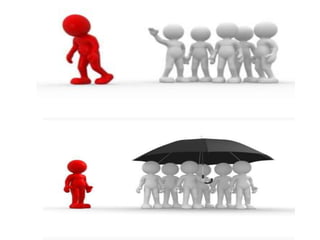
‱ Effective diversity management increases an
organization’s access to widest possible pool of
skills, abilities and ideas.
‱ Surface Level Diversity:
Differences in easily perceived characteristics, such as gender, race,
ethnicity, age, or disability, that do not necessarily reflect the
ways people think or feel but that may activate certain
stereotypes.
‱ Deep Level Diversity:
Difference in values, personality, and work preferences that become
progressively more important for determining similarity as
people get to know one another better.
Diversity
2-2
‱ Noting of differences between things; often we
refer to unfair discrimination, which means
making judgments about individuals based on
stereotypes regarding their demographic group.
‱ Discriminatory policies or practices
‱ Intimidation
‱ Mockery & insults
‱ Exclusion
‱ Incivility
‱ Harassments
Discrimination
2-4
Objective and easily obtained personal
characteristics.
‱Age
– Older workers bring experience, judgment, a strong work
ethic, and commitment to quality.
‱Gender
– Few differences between men and women that affect job
performance.
‱Race (the biological heritage used to identify
oneself)
– Contentious issue: differences exist, but could be more
culture-based than race-based.
2-6
Biographical Characteristics
‱ Tenure
– People with job tenure (seniority at a job) are more
productive, absent less frequently, have lower turnover, and
are more satisfied.
‱ Religion
– Islam is especially problematic in the workplace in this post-
9/11 world.
‱ Sexual Orientation
– Federal law does not protect against discrimination (but state
or local laws may).
– Domestic partner benefits are important considerations.
‱ Gender Identity
– Relatively new issue – transgendered employees.
2-7
Other Biographical Characteristics
‱ The process and programs by which managers
make everyone more aware of and sensitive
to the needs and differences of others.
‱ Attracting,
‱ Selecting,
‱ Developing and
‱ Retaining Diverse Employees.
Diversity Management Strategies
2-8
‱ When people work in groups they need to
establish a common way of looking at and
accomplishing the major tasks, and they need to
communicate with one another often.
‱ Regardless of the composition of group,
differences can be leveraged to achieve superior
performance.
‱ Groups of diverse individuals will be much more
effective if leaders can show how members have a
common interest in the group’s success.
Diversity in Groups
2-9
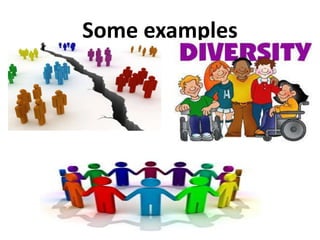
Some examples
‱ Effective, comprehensive workforce programs
encouraging diversity have three distinct
components:
‱ First they teach managers about the legal framework
for equal employment opportunity and encourage
fair treatment of all employees.
‱ Second, they teach managers how a diverse
workforce will be better able to serve a diverse
market of customers and clients.
‱ Third, they foster personal development practices
that bring out the skills and abilities of all workers.
Effective Diversity Programs
2-11
Diversity and biological characteristics

Diversity and biological characteristics

  • 2.
    ‱ Effective diversitymanagement increases an organization’s access to widest possible pool of skills, abilities and ideas. ‱ Surface Level Diversity: Differences in easily perceived characteristics, such as gender, race, ethnicity, age, or disability, that do not necessarily reflect the ways people think or feel but that may activate certain stereotypes. ‱ Deep Level Diversity: Difference in values, personality, and work preferences that become progressively more important for determining similarity as people get to know one another better. Diversity 2-2
  • 4.
    ‱ Noting ofdifferences between things; often we refer to unfair discrimination, which means making judgments about individuals based on stereotypes regarding their demographic group. ‱ Discriminatory policies or practices ‱ Intimidation ‱ Mockery & insults ‱ Exclusion ‱ Incivility ‱ Harassments Discrimination 2-4
  • 6.
    Objective and easilyobtained personal characteristics. ‱Age – Older workers bring experience, judgment, a strong work ethic, and commitment to quality. ‱Gender – Few differences between men and women that affect job performance. ‱Race (the biological heritage used to identify oneself) – Contentious issue: differences exist, but could be more culture-based than race-based. 2-6 Biographical Characteristics
  • 7.
    ‱ Tenure – Peoplewith job tenure (seniority at a job) are more productive, absent less frequently, have lower turnover, and are more satisfied. ‱ Religion – Islam is especially problematic in the workplace in this post- 9/11 world. ‱ Sexual Orientation – Federal law does not protect against discrimination (but state or local laws may). – Domestic partner benefits are important considerations. ‱ Gender Identity – Relatively new issue – transgendered employees. 2-7 Other Biographical Characteristics
  • 8.
    ‱ The processand programs by which managers make everyone more aware of and sensitive to the needs and differences of others. ‱ Attracting, ‱ Selecting, ‱ Developing and ‱ Retaining Diverse Employees. Diversity Management Strategies 2-8
  • 9.
    ‱ When peoplework in groups they need to establish a common way of looking at and accomplishing the major tasks, and they need to communicate with one another often. ‱ Regardless of the composition of group, differences can be leveraged to achieve superior performance. ‱ Groups of diverse individuals will be much more effective if leaders can show how members have a common interest in the group’s success. Diversity in Groups 2-9
  • 10.
  • 11.
    ‱ Effective, comprehensiveworkforce programs encouraging diversity have three distinct components: ‱ First they teach managers about the legal framework for equal employment opportunity and encourage fair treatment of all employees. ‱ Second, they teach managers how a diverse workforce will be better able to serve a diverse market of customers and clients. ‱ Third, they foster personal development practices that bring out the skills and abilities of all workers. Effective Diversity Programs 2-11