RELATIONSHIP EXIST BETWEEN
BIOGRAPHICAL CHARATERISTICS AND
       EMPLOYEE BEHAVIOR

              GROUP NO : 10
            ASSIGNMENT NO : 01
 DEPATMENT OF HUMAN RESOURCE MANAGEMENT


                                          1
"Organizational behavior is a field of study that investigates the impact that individuals, groups and
structure have on behavior within organization for the purpose of applying such knowledge toward
improving an organization's effectiveness."
- Stephen P. Robbins


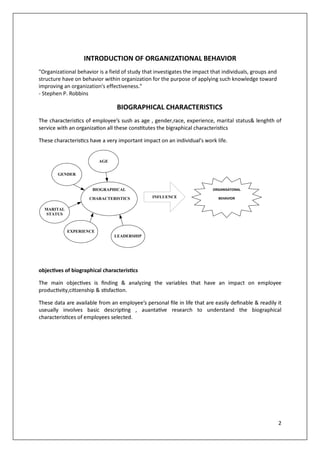
                                                               experience, marital status


                                                                     's work life.


                         AGE


        GENDER


                       BIOGRAPHICAL                                        ORGANISATONAL

                     CHARACTERISTICS            INFLUENCE                    BEHAVIOR

  MARITAL
  STATUS


            EXPERIENCE
                                LEADERSHIP


                                                                                                         2
RELATIONSHIP EXIST BETWEEN BIOGRAPHICAL CHARACTERISTICS AND
                            EMPLOYEES BEHAVIOUR
AGE AND PRODUCTIVITY
Study: Waldman and Aviolo(1986)
Group Analysed :Meta-analysis of 40 studies
findings : No clear association between age and performance.

Study: McEvoy and Cascio(1989)
Group Analysed :Meta-analysis of 96 studies
findings :No clear association between age and performance (results vary in individual studies). This
conclusion holds when a separate division of studies is made according to performance and type of
work (professional vs. non-professional)

Study: Bureau of Labour Statistics (1957)
Group Analysed :Employees in large plants in men’s footwear and household furniture industries
Findings : Decline in output per hour at older ages(starting seriously after about 45 years of age)

Study: Kutscher and Walker(1960)
Group Analysed :Office workers, US
Very little differences in output per hour between age groups

Study: Walker (1964)
Group Analysed :Mail sorters, US
Very little differences in output per hour between age groups

Study: Stephan and Levin(1988)
Group Analysed :Researchers within Physics, Geology, Physiology and Biochemistry
Negative association with age

Study: Oster and Hamermesh(1998)
Group Analysed :Researchers in Economics
Negative association with age

Study: Oliviera, Cohn and Kiker (1989)
Group Analysed :Self-employed in US(compared with employees)
Productivity increases strongly at younger age, but declines at older age (parabolic). Earnings tend to
stabilize at older age for employees in similar functions


Study: Van der Heijden (2003)
Employees in middle or higher level functions in Dutch SMEs
No relationship with age for selfperceptions, while at the same time superiors are somewhat more
negative about the oldest age group

Study: Gelderblom, de Koningen Kroes (2004)
Group Analysed :Dutch private and public companies/ organizations


                                                                                                      3
A large group of managers and HR managers does not see differences in the average productivity of
those 55 and older compared to younger workers.

Study: Gelderblom and de Koning (1996)
Group Analysed :Civil servants in the Netherlands
Older workers have more problems with work-pressure, but perform well on social skills

Study: Simoens and Denys(1997)
Group Analysed :Employees in Belgium
Older workers have more problems with work-pressure, but perform well on social skills

Study: Haegeland and Klette(1999)
Group Analysed :Manufacturing companies in Norway
Decline for those with more than 15 years experience (late 30s and over)

Study: Crépon et al. (2002)
Group Analysed :Manufacturing and nonmanufacturing companies in France
Lowest for those over the age of 50.

Study: Gelderblom, de Koningen Kroes (2004)
Group Analysed :Manufacturing and nonmanufacturing companies in the Netherlands
Productivity is rising until the age of around 50, after which a strong decline occurs

AGE AND SATISFACTION
Conference Board Survey
A 2010 survey of 2,900 people commissioned by the Conference Board research firm indicates that
all Americans are increasingly unhappy with their jobs no matter their age. However, "Washington
Post" writer Carol Morella reported that some pollsters question Conference Board surveys,
asserting that the phrasings of questions about job satisfaction are open to interpretation. The
respondents were asked to rate their job satisfaction on a scale of 1 to 5, with 1 indicating the least
satisfaction. According to Morella, just 45 percent of respondents marked a 4 or 5 in their response.

Gallup-Health ways Survey
A 2011 survey done as part of the Gallup-Health ways Well-Being Index found that 87.5 percent of
nearly 62,000 respondents are satisfied with their jobs. Senior citizens have the highest level of job
satisfaction among U.S. workers, with nearly 95 percent of seniors reporting that they're satisfied
with their work. Job satisfaction generally increases with age, according to the survey. For example,
84 percent of survey respondents 18 to 29 reported being satisfied with their jobs. However, 87.5
percent of respondents 30 to 44 reported being satisfied with their employment.

Older Workers' Satisfaction
Links between job satisfaction and age may still be valid despite differences in survey results. For
example, Morella noted that the head of the University of Chicago polling center asserted that age is
the best measure of job satisfaction among employees, considering that people in their 50s are
usually the most satisfied with their jobs. People in their 50s have usually discovered which field they
excel in and they've had a history of good work in their field that has led to promotions and respect
from their bosses. As a result, people who are 50 and older often have more autonomy at work and
earn higher salaries than younger workers do.

Younger Workers' Dissatisfaction


                                                                                                      4
"Los Angeles Times" writer Tiffany Hsu reported the Conference Board survey showed that only
about 36 percent of people under age 25 are satisfied with their jobs. Hsu reported that a workplace
consultant tied the high job dissatisfaction among younger employees to unrealistic expectations
due to their desire to work in an engaging, fast-paced environment. Their dissatisfaction with their
work may result from discovering that many companies are resistant to change. Furthermore,
younger workers may get frustrated with co-workers who are satisfied with mediocrity.


GENDER AND SATISFACTION

There has been a impossibility in female labour market participation. On the one hand, an
overwhelming body of literature has focused on gender inequality in the labour market and urged
changes in policies to improve women’s working conditions (e.g., Anderson,        ; Darity and Mason,
      ; Duncan and Loretto,         On the other hand, studies of working attitudes have consistently
found that female workers’ self reported job satisfaction levels are higher than their male
counterpart. There have been arguments suggesting that this could be well caused by systematic
difference in occupations and work content experienced by women and men and, therefore,
controlling for such difference would eliminates much of this gender satisfaction gap e.g., Dex,
         The empirical evidence, however, does not seem to support this view (e.g., Clark,           ;
Sloane and Williams,        ; Sousa-Poza and Sousa-Poza,        One of the most recent studies of job
satisfaction conducted by Asadullah and Fernandez (          has shown that in the UK, the gender
satisfaction differential remains robust even after controlling for a wide range of individual and
organizational variable

Serious academic inquiry into this paradox has started since the early      s. Hakim         has first
termed the paradox ‘grateful slaves’ and provided a hypothetical explanation to this puzzle from the
perspective of employment commitment. She argues that women’s disproportionate satisfaction
with their jobs can be explained by the different life goals between women and men. In this
explanation, the majority of women view themselves as homemakers and participating in the labour
market is of secondary importance. When these women are engaged in paid work, their job
preferences are often associated with flexibility factors over some other job rewards such as pay,
promotion and security) conventionally favored by men. Hakim suggests that this is the key to
answering why women’s high satisfaction with nonstandard and low-paid jobs as these jobs provides
an ideal match to what they seek in the labor market.

Clark (       , an economist, is the first researcher who has explicitly attempted to address this issue
with empirical rigor and his work remains one of the sophisticated studies on this topic. Clark has
proposed four explanations to the observed gender satisfaction gap. The first explanation offered is
that the gap in satisfaction between women and men reflects the overall difference in personal and
job characteristics between the two sexes. Second, similar to Hakim’s idea that women and men
differ in life goals, he suggests that self-reported job satisfaction levels may be associated with
individuals’ orientations or values in the work setting and different work incentives may play a role
in shaping the gender difference. Third, the fact that fewer women than men work suggests that
there might be a selection bias behind the puzzle. That is, women who are not happy with their jobs
may have already withdrawn from the labour market, leaving solely happy women in the employee
samples. Finally, Clark points out that not only absolute income but relative income (which can be
defined as the difference between absolute income and expected income) also matters in
determining job satisfaction and the latter form of income is probably more useful in explaining the
gender satisfaction differential as women may have lower expectation of income. Using data from
the       BPHS survey, he has tested those hypotheses and found the first three explanations cannot

                                                                                                      5
account for the gender gap in satisfaction. Only the last relative income hypothesis has gained
partial support by the finding that the satisfaction difference disappears for the young, the higher-
educated, professionals and those in male-dominated workplaces.

More recently, another two economists, Sloane and Williams (            have extended Hakim’s and
Clark’s work by exploring the relationships between job satisfaction, comparison earnings and
gender. One of the major contributions of their work is that they have first tested whether there is
any difference in ‘taste’, which can be seen as a form of preferences, in shaping job satisfaction
differential between the two sexes. Based on the           Social Change and Economic Life Initiative
(SCELI) data, they have empirically assessed the gender difference in how eight particular job
satisfaction facets determine the overall satisfaction level and found significant ‘taste
‘heterogeneities between men and women. The authors suggest that the higher satisfaction of
women is partly caused by the fact that women tend to self-select themselves into jobs with highly
valued attributes according to their ‘taste’. Moreover, Sloane and Williams have also analyzed the
effects of both absolute income and objective and subjective relative income on job satisfaction and
the results suggest that both absolute and relative income matter in determining job satisfaction.
But, once again, although the coefficient of the gender variable shrinks after taking all these factors
into account, they still cannot completely explain the observed gender difference in job satisfaction.


                                                                                                     6
T
                                             .meanwhile older workers have higher level job
satisfaction than younger workers and female workers have less job satisfaction than male workers.


                                                                                                7
http://www.scribd.com/doc/43530917/Biographical-Characteristics

http://news.stanford.edu/news/1998/november4/wagegap114.html

http://www.equalsoc.org/uploaded_files/publications/form[1].pdf


                Thank you for your evaluation


                                                                  8
9

Relationship between biographical characteristics and employee behaviour

  • 1.
    RELATIONSHIP EXIST BETWEEN BIOGRAPHICALCHARATERISTICS AND EMPLOYEE BEHAVIOR GROUP NO : 10 ASSIGNMENT NO : 01 DEPATMENT OF HUMAN RESOURCE MANAGEMENT 1
  • 2.
    "Organizational behavior isa field of study that investigates the impact that individuals, groups and structure have on behavior within organization for the purpose of applying such knowledge toward improving an organization's effectiveness." - Stephen P. Robbins experience, marital status 's work life. AGE GENDER BIOGRAPHICAL ORGANISATONAL CHARACTERISTICS INFLUENCE BEHAVIOR MARITAL STATUS EXPERIENCE LEADERSHIP 2
  • 3.
    RELATIONSHIP EXIST BETWEENBIOGRAPHICAL CHARACTERISTICS AND EMPLOYEES BEHAVIOUR AGE AND PRODUCTIVITY Study: Waldman and Aviolo(1986) Group Analysed :Meta-analysis of 40 studies findings : No clear association between age and performance. Study: McEvoy and Cascio(1989) Group Analysed :Meta-analysis of 96 studies findings :No clear association between age and performance (results vary in individual studies). This conclusion holds when a separate division of studies is made according to performance and type of work (professional vs. non-professional) Study: Bureau of Labour Statistics (1957) Group Analysed :Employees in large plants in men’s footwear and household furniture industries Findings : Decline in output per hour at older ages(starting seriously after about 45 years of age) Study: Kutscher and Walker(1960) Group Analysed :Office workers, US Very little differences in output per hour between age groups Study: Walker (1964) Group Analysed :Mail sorters, US Very little differences in output per hour between age groups Study: Stephan and Levin(1988) Group Analysed :Researchers within Physics, Geology, Physiology and Biochemistry Negative association with age Study: Oster and Hamermesh(1998) Group Analysed :Researchers in Economics Negative association with age Study: Oliviera, Cohn and Kiker (1989) Group Analysed :Self-employed in US(compared with employees) Productivity increases strongly at younger age, but declines at older age (parabolic). Earnings tend to stabilize at older age for employees in similar functions Study: Van der Heijden (2003) Employees in middle or higher level functions in Dutch SMEs No relationship with age for selfperceptions, while at the same time superiors are somewhat more negative about the oldest age group Study: Gelderblom, de Koningen Kroes (2004) Group Analysed :Dutch private and public companies/ organizations 3
  • 4.
    A large groupof managers and HR managers does not see differences in the average productivity of those 55 and older compared to younger workers. Study: Gelderblom and de Koning (1996) Group Analysed :Civil servants in the Netherlands Older workers have more problems with work-pressure, but perform well on social skills Study: Simoens and Denys(1997) Group Analysed :Employees in Belgium Older workers have more problems with work-pressure, but perform well on social skills Study: Haegeland and Klette(1999) Group Analysed :Manufacturing companies in Norway Decline for those with more than 15 years experience (late 30s and over) Study: Crépon et al. (2002) Group Analysed :Manufacturing and nonmanufacturing companies in France Lowest for those over the age of 50. Study: Gelderblom, de Koningen Kroes (2004) Group Analysed :Manufacturing and nonmanufacturing companies in the Netherlands Productivity is rising until the age of around 50, after which a strong decline occurs AGE AND SATISFACTION Conference Board Survey A 2010 survey of 2,900 people commissioned by the Conference Board research firm indicates that all Americans are increasingly unhappy with their jobs no matter their age. However, "Washington Post" writer Carol Morella reported that some pollsters question Conference Board surveys, asserting that the phrasings of questions about job satisfaction are open to interpretation. The respondents were asked to rate their job satisfaction on a scale of 1 to 5, with 1 indicating the least satisfaction. According to Morella, just 45 percent of respondents marked a 4 or 5 in their response. Gallup-Health ways Survey A 2011 survey done as part of the Gallup-Health ways Well-Being Index found that 87.5 percent of nearly 62,000 respondents are satisfied with their jobs. Senior citizens have the highest level of job satisfaction among U.S. workers, with nearly 95 percent of seniors reporting that they're satisfied with their work. Job satisfaction generally increases with age, according to the survey. For example, 84 percent of survey respondents 18 to 29 reported being satisfied with their jobs. However, 87.5 percent of respondents 30 to 44 reported being satisfied with their employment. Older Workers' Satisfaction Links between job satisfaction and age may still be valid despite differences in survey results. For example, Morella noted that the head of the University of Chicago polling center asserted that age is the best measure of job satisfaction among employees, considering that people in their 50s are usually the most satisfied with their jobs. People in their 50s have usually discovered which field they excel in and they've had a history of good work in their field that has led to promotions and respect from their bosses. As a result, people who are 50 and older often have more autonomy at work and earn higher salaries than younger workers do. Younger Workers' Dissatisfaction 4
  • 5.
    "Los Angeles Times"writer Tiffany Hsu reported the Conference Board survey showed that only about 36 percent of people under age 25 are satisfied with their jobs. Hsu reported that a workplace consultant tied the high job dissatisfaction among younger employees to unrealistic expectations due to their desire to work in an engaging, fast-paced environment. Their dissatisfaction with their work may result from discovering that many companies are resistant to change. Furthermore, younger workers may get frustrated with co-workers who are satisfied with mediocrity. GENDER AND SATISFACTION There has been a impossibility in female labour market participation. On the one hand, an overwhelming body of literature has focused on gender inequality in the labour market and urged changes in policies to improve women’s working conditions (e.g., Anderson, ; Darity and Mason, ; Duncan and Loretto, On the other hand, studies of working attitudes have consistently found that female workers’ self reported job satisfaction levels are higher than their male counterpart. There have been arguments suggesting that this could be well caused by systematic difference in occupations and work content experienced by women and men and, therefore, controlling for such difference would eliminates much of this gender satisfaction gap e.g., Dex, The empirical evidence, however, does not seem to support this view (e.g., Clark, ; Sloane and Williams, ; Sousa-Poza and Sousa-Poza, One of the most recent studies of job satisfaction conducted by Asadullah and Fernandez ( has shown that in the UK, the gender satisfaction differential remains robust even after controlling for a wide range of individual and organizational variable Serious academic inquiry into this paradox has started since the early s. Hakim has first termed the paradox ‘grateful slaves’ and provided a hypothetical explanation to this puzzle from the perspective of employment commitment. She argues that women’s disproportionate satisfaction with their jobs can be explained by the different life goals between women and men. In this explanation, the majority of women view themselves as homemakers and participating in the labour market is of secondary importance. When these women are engaged in paid work, their job preferences are often associated with flexibility factors over some other job rewards such as pay, promotion and security) conventionally favored by men. Hakim suggests that this is the key to answering why women’s high satisfaction with nonstandard and low-paid jobs as these jobs provides an ideal match to what they seek in the labor market. Clark ( , an economist, is the first researcher who has explicitly attempted to address this issue with empirical rigor and his work remains one of the sophisticated studies on this topic. Clark has proposed four explanations to the observed gender satisfaction gap. The first explanation offered is that the gap in satisfaction between women and men reflects the overall difference in personal and job characteristics between the two sexes. Second, similar to Hakim’s idea that women and men differ in life goals, he suggests that self-reported job satisfaction levels may be associated with individuals’ orientations or values in the work setting and different work incentives may play a role in shaping the gender difference. Third, the fact that fewer women than men work suggests that there might be a selection bias behind the puzzle. That is, women who are not happy with their jobs may have already withdrawn from the labour market, leaving solely happy women in the employee samples. Finally, Clark points out that not only absolute income but relative income (which can be defined as the difference between absolute income and expected income) also matters in determining job satisfaction and the latter form of income is probably more useful in explaining the gender satisfaction differential as women may have lower expectation of income. Using data from the BPHS survey, he has tested those hypotheses and found the first three explanations cannot 5
  • 6.
    account for thegender gap in satisfaction. Only the last relative income hypothesis has gained partial support by the finding that the satisfaction difference disappears for the young, the higher- educated, professionals and those in male-dominated workplaces. More recently, another two economists, Sloane and Williams ( have extended Hakim’s and Clark’s work by exploring the relationships between job satisfaction, comparison earnings and gender. One of the major contributions of their work is that they have first tested whether there is any difference in ‘taste’, which can be seen as a form of preferences, in shaping job satisfaction differential between the two sexes. Based on the Social Change and Economic Life Initiative (SCELI) data, they have empirically assessed the gender difference in how eight particular job satisfaction facets determine the overall satisfaction level and found significant ‘taste ‘heterogeneities between men and women. The authors suggest that the higher satisfaction of women is partly caused by the fact that women tend to self-select themselves into jobs with highly valued attributes according to their ‘taste’. Moreover, Sloane and Williams have also analyzed the effects of both absolute income and objective and subjective relative income on job satisfaction and the results suggest that both absolute and relative income matter in determining job satisfaction. But, once again, although the coefficient of the gender variable shrinks after taking all these factors into account, they still cannot completely explain the observed gender difference in job satisfaction. 6
  • 7.
    T .meanwhile older workers have higher level job satisfaction than younger workers and female workers have less job satisfaction than male workers. 7
  • 8.
  • 9.