INTRODUCTION TO HRD
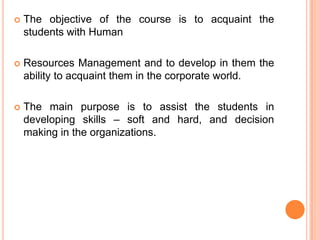
   The objective of the course is to acquaint the
    students with Human

   Resources Management and to develop in them the
    ability to acquaint them in the corporate world.

   The main purpose is to assist the students in
    developing skills – soft and hard, and decision
    making in the organizations.
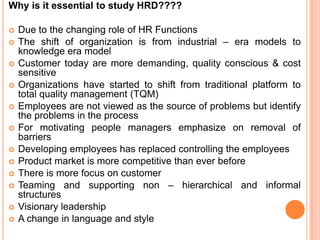
Why is it essential to study HRD????

   Due to the changing role of HR Functions
   The shift of organization is from industrial – era models to
    knowledge era model
   Customer today are more demanding, quality conscious & cost
    sensitive
   Organizations have started to shift from traditional platform to
    total quality management (TQM)
   Employees are not viewed as the source of problems but identify
    the problems in the process
   For motivating people managers emphasize on removal of
    barriers
   Developing employees has replaced controlling the employees
   Product market is more competitive than ever before
   There is more focus on customer
   Teaming and supporting non – hierarchical and informal
    structures
   Visionary leadership
   A change in language and style
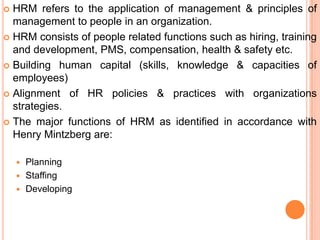
 HRM refers to the application of management & principles of
  management to people in an organization.
 HRM consists of people related functions such as hiring, training
  and development, PMS, compensation, health & safety etc.
 Building human capital (skills, knowledge & capacities of
  employees)
 Alignment of HR policies & practices with organizations
  strategies.
 The major functions of HRM as identified in accordance with
  Henry Mintzberg are:

     Planning
     Staffing
     Developing
   Monitoring
   Maintaining
   Managing Relationships
   Managing Change
   Evaluation


 HRM is a broad concept. PM & HRD are a part of HRM
 HRS (Human resource system) assumes that human beings
  are a great asset to organization
 Thy contribute a great deal to the achievement of
  organizational goals
 People are treated as assets with unlimited potential is the
  core of the concept of the HRS
 Investing in Humans is necessary. Investment for increasing
  the resource is important
DEFINITION OF HRD

   Human Resource Development (HRD) is the framework for
    helping employees develop their personal and organizational
    skills, knowledge, and abilities. Human Resource Development
    includes such opportunities as employee training, employee
    career     development,     performance     management   and
    development, coaching, mentoring, succession planning, key
    employee identification, and organization development.
   The focus of all aspects of Human Resource Development
    is on developing the most superior workforce so that the
    organization and individual employees can accomplish their
    work goals in service to customers.

   Human Resource Development can be formal such as in
    classroom training, a college course, or an organizational
    planned change effort. Or, Human Resource Development
    can be informal as in employee coaching by a manager.
    Healthy organizations believe in Human Resource
    Development and cover all of these bases.
DEVELOPMENT AS A CONCEPT OF HRS
 The core concept of HRS is development of Human beings, i.e.
  HRD
 Along with developing the individuals, attempts should be made
  to develop stronger dyads i.e. a group of 2 (employee & his
  boss). These are the basic units of working in the organization
 Several groups and committees require attention &
  development. Groups like task groups & command groups
  should be developed from the point of view of increasing
  collaboration amongst people working in the organization, thus
  making for an effective decision making
 Development of organizations involve developing self –
  renewing mechanisms in the organization so that they are able
  to adjust & develop relevant process for effectiveness
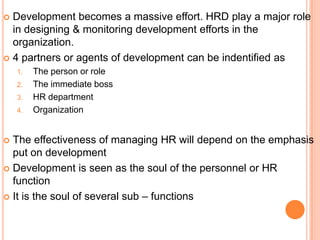
 Development becomes a massive effort. HRD play a major role
  in designing & monitoring development efforts in the
  organization.
 4 partners or agents of development can be indentified as
    1.   The person or role
    2.   The immediate boss
    3.   HR department
    4.   Organization


 The effectiveness of managing HR will depend on the emphasis
  put on development
 Development is seen as the soul of the personnel or HR
  function
 It is the soul of several sub – functions
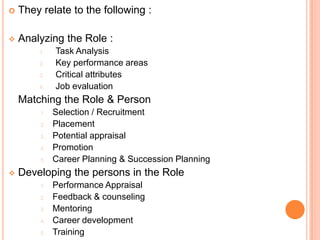
   They relate to the following :

   Analyzing the Role :
        1.    Task Analysis
        2.    Key performance areas
        3.    Critical attributes
        4.    Job evaluation
    Matching the Role & Person
         1.   Selection / Recruitment
         2.   Placement
         3.   Potential appraisal
         4.   Promotion
         5.   Career Planning & Succession Planning
   Developing the persons in the Role
         1.   Performance Appraisal
         2.   Feedback & counseling
         3.   Mentoring
         4.   Career development
         5.   Training
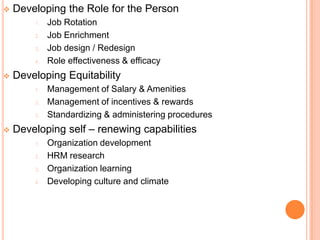
   Developing the Role for the Person
        1.   Job Rotation
        2.   Job Enrichment
        3.   Job design / Redesign
        4.   Role effectiveness & efficacy
   Developing Equitability
        1.   Management of Salary & Amenities
        2.   Management of incentives & rewards
        3.   Standardizing & administering procedures
   Developing self – renewing capabilities
        1.   Organization development
        2.   HRM research
        3.   Organization learning
        4.   Developing culture and climate
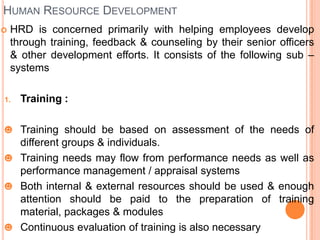
HUMAN RESOURCE DEVELOPMENT
   HRD is concerned primarily with helping employees develop
    through training, feedback & counseling by their senior officers
    & other development efforts. It consists of the following sub –
    systems

1.    Training :

☻ Training should be based on assessment of the needs of
  different groups & individuals.
☻ Training needs may flow from performance needs as well as
  performance management / appraisal systems
☻ Both internal & external resources should be used & enough
  attention should be paid to the preparation of training
  material, packages & modules
☻ Continuous evaluation of training is also necessary
2. Organization Development :
☻ OD is now playing an increasing important role in helping the
  diagnosis of problems of HR in the company, in taking steps for
  team building at various levels, in improving general morale and
  motivation of people & in developing healthy values & trying out
  various ways of solving problems

3. Performance Feedback & Counseling :
 ☻ Performance & potential appraisals are likely to remain a
    ritual if a climate for & skills for providing critical & supportive
    feedback to the employees by the boss is not properly
    developed
 ☻ Differences in self – assessment & assessment by the boss
    can be discussed & a program for further growth of the
    employees can be jointly worked out
4. System Development & Research :
☻ Various systems for HRS need to be continuously designed,
    tested and reviewed
☻ Data needs to be collected & analyzed to develop
    interventions


5. 360⁰ feedback :
☻ Multisource Feedback for development has become a useful
  tool
☻ Leadership competencies have been developed in many
  corporations successfully using 360⁰ feedback
☻ 360⁰ is a very popular tool.
   A set of systematic & planned activities, designed by an
    organization to provide its members with the opportunities to
    learn necessary skills to meet current & future job demands

   Learning is at the core of all HRD efforts

   HRD activities should begin when employees join
    organization & continue throughout his / her career,
    regardless of whether that employees is an executive or
    worker

   HRD programs must respond to job changes & integrate long
    term plans & strategies of the organization to ensure efficient
    & effective us of resources

Introduction to hrd

  • 1.
  • 2.
    The objective of the course is to acquaint the students with Human  Resources Management and to develop in them the ability to acquaint them in the corporate world.  The main purpose is to assist the students in developing skills – soft and hard, and decision making in the organizations.
  • 3.
    Why is itessential to study HRD????  Due to the changing role of HR Functions  The shift of organization is from industrial – era models to knowledge era model  Customer today are more demanding, quality conscious & cost sensitive  Organizations have started to shift from traditional platform to total quality management (TQM)  Employees are not viewed as the source of problems but identify the problems in the process  For motivating people managers emphasize on removal of barriers  Developing employees has replaced controlling the employees  Product market is more competitive than ever before  There is more focus on customer  Teaming and supporting non – hierarchical and informal structures  Visionary leadership  A change in language and style
  • 4.
     HRM refersto the application of management & principles of management to people in an organization.  HRM consists of people related functions such as hiring, training and development, PMS, compensation, health & safety etc.  Building human capital (skills, knowledge & capacities of employees)  Alignment of HR policies & practices with organizations strategies.  The major functions of HRM as identified in accordance with Henry Mintzberg are:  Planning  Staffing  Developing
  • 5.
    Monitoring  Maintaining  Managing Relationships  Managing Change  Evaluation  HRM is a broad concept. PM & HRD are a part of HRM  HRS (Human resource system) assumes that human beings are a great asset to organization  Thy contribute a great deal to the achievement of organizational goals  People are treated as assets with unlimited potential is the core of the concept of the HRS  Investing in Humans is necessary. Investment for increasing the resource is important
  • 6.
    DEFINITION OF HRD  Human Resource Development (HRD) is the framework for helping employees develop their personal and organizational skills, knowledge, and abilities. Human Resource Development includes such opportunities as employee training, employee career development, performance management and development, coaching, mentoring, succession planning, key employee identification, and organization development.
  • 7.
    The focus of all aspects of Human Resource Development is on developing the most superior workforce so that the organization and individual employees can accomplish their work goals in service to customers.  Human Resource Development can be formal such as in classroom training, a college course, or an organizational planned change effort. Or, Human Resource Development can be informal as in employee coaching by a manager. Healthy organizations believe in Human Resource Development and cover all of these bases.
  • 8.
    DEVELOPMENT AS ACONCEPT OF HRS  The core concept of HRS is development of Human beings, i.e. HRD  Along with developing the individuals, attempts should be made to develop stronger dyads i.e. a group of 2 (employee & his boss). These are the basic units of working in the organization  Several groups and committees require attention & development. Groups like task groups & command groups should be developed from the point of view of increasing collaboration amongst people working in the organization, thus making for an effective decision making  Development of organizations involve developing self – renewing mechanisms in the organization so that they are able to adjust & develop relevant process for effectiveness
  • 9.
     Development becomesa massive effort. HRD play a major role in designing & monitoring development efforts in the organization.  4 partners or agents of development can be indentified as 1. The person or role 2. The immediate boss 3. HR department 4. Organization  The effectiveness of managing HR will depend on the emphasis put on development  Development is seen as the soul of the personnel or HR function  It is the soul of several sub – functions
  • 10.
    They relate to the following :  Analyzing the Role : 1. Task Analysis 2. Key performance areas 3. Critical attributes 4. Job evaluation Matching the Role & Person 1. Selection / Recruitment 2. Placement 3. Potential appraisal 4. Promotion 5. Career Planning & Succession Planning  Developing the persons in the Role 1. Performance Appraisal 2. Feedback & counseling 3. Mentoring 4. Career development 5. Training
  • 11.
    Developing the Role for the Person 1. Job Rotation 2. Job Enrichment 3. Job design / Redesign 4. Role effectiveness & efficacy  Developing Equitability 1. Management of Salary & Amenities 2. Management of incentives & rewards 3. Standardizing & administering procedures  Developing self – renewing capabilities 1. Organization development 2. HRM research 3. Organization learning 4. Developing culture and climate
  • 12.
    HUMAN RESOURCE DEVELOPMENT  HRD is concerned primarily with helping employees develop through training, feedback & counseling by their senior officers & other development efforts. It consists of the following sub – systems 1. Training : ☻ Training should be based on assessment of the needs of different groups & individuals. ☻ Training needs may flow from performance needs as well as performance management / appraisal systems ☻ Both internal & external resources should be used & enough attention should be paid to the preparation of training material, packages & modules ☻ Continuous evaluation of training is also necessary
  • 13.
    2. Organization Development: ☻ OD is now playing an increasing important role in helping the diagnosis of problems of HR in the company, in taking steps for team building at various levels, in improving general morale and motivation of people & in developing healthy values & trying out various ways of solving problems 3. Performance Feedback & Counseling : ☻ Performance & potential appraisals are likely to remain a ritual if a climate for & skills for providing critical & supportive feedback to the employees by the boss is not properly developed ☻ Differences in self – assessment & assessment by the boss can be discussed & a program for further growth of the employees can be jointly worked out
  • 14.
    4. System Development& Research : ☻ Various systems for HRS need to be continuously designed, tested and reviewed ☻ Data needs to be collected & analyzed to develop interventions 5. 360⁰ feedback : ☻ Multisource Feedback for development has become a useful tool ☻ Leadership competencies have been developed in many corporations successfully using 360⁰ feedback ☻ 360⁰ is a very popular tool.
  • 15.
    A set of systematic & planned activities, designed by an organization to provide its members with the opportunities to learn necessary skills to meet current & future job demands  Learning is at the core of all HRD efforts  HRD activities should begin when employees join organization & continue throughout his / her career, regardless of whether that employees is an executive or worker  HRD programs must respond to job changes & integrate long term plans & strategies of the organization to ensure efficient & effective us of resources