Curriculum Design Models&
Approaches in Biology/ICT
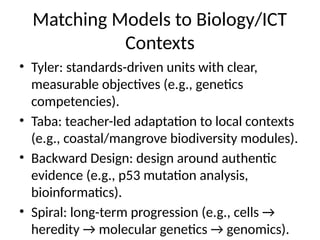
Tyler • Taba • Backward Design •
Spiral Curriculum
with published case studies in
science/biology teaching
2.
Purpose & Scope
•Provide a clear overview of classical and
modern curriculum design models.
• Apply models to Biology teaching enhanced by
ICT (e.g., virtual labs, bioinformatics).
• Offer published case studies and practical
recommendations.
– Visual: Simple roadmap graphic showing the 4
models leading to applications and case studies
3.
Why Curriculum DesignMatters for
Biology/ICT
• Ensures alignment among learning goals,
assessments, and learning activities.
• Supports integration of ICT (simulations, data
analysis tools, CUREs) for deeper learning.
• Improves transfer and retention in concept-
dense subjects like Biology.
– Visual: Icons: target (goals), checklist
(assessment), laptop/molecule (ICT)
4.
Tyler’s Rationale —Overview
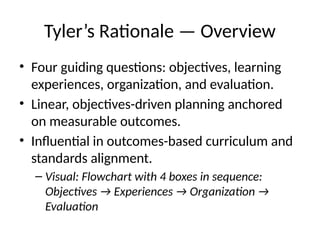
• Four guiding questions: objectives, learning
experiences, organization, and evaluation.
• Linear, objectives-driven planning anchored
on measurable outcomes.
• Influential in outcomes-based curriculum and
standards alignment.
– Visual: Flowchart with 4 boxes in sequence:
Objectives → Experiences → Organization →
Evaluation
5.
Tyler’s Rationale —Strengths &
Caveats
• Strengths: clarity of aims; systematic
alignment; evaluability of outcomes.
• Caveats: can be overly linear; may narrow
curriculum to what is measurable; less
responsive to emergent learner needs.
– Visual: Two-column pros/cons graphic
6.
Taba Model —Overview
(Inductive/Grassroots)
• Teacher-centered, inductive development
beginning with diagnosing learners’ needs.
• Seven steps: diagnose needs → formulate
objectives → select content → organize
content → select learning experiences →
organize learning experiences → evaluate.
• Stresses iterative refinement with teacher
input.
– Visual: Seven-step cycle diagram
7.
Taba Model —Strengths & Caveats
• Strengths: context-responsive; elevates
teacher expertise; supports iterative
improvement.
• Caveats: time/resource intensive; requires
capacity-building for design and evaluation.
– Visual: Stakeholder map highlighting teachers at
the center
8.
Backward Design (Understanding
byDesign) — Overview
• Three stages: Identify desired results →
Determine acceptable evidence → Plan
learning experiences.
• Emphasizes authentic performance tasks and
transfer of learning.
• Useful for integrating ICT as evidence of
understanding (e.g., data analyses,
simulations).
– Visual: Three-stage arrow diagram; add the 'Six
Facets' as callout
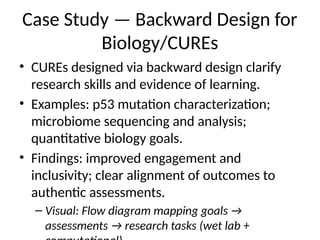
Case Study —Backward Design for
Biology/CUREs
• CUREs designed via backward design clarify
research skills and evidence of learning.
• Examples: p53 mutation characterization;
microbiome sequencing and analysis;
quantitative biology goals.
• Findings: improved engagement and
inclusivity; clear alignment of outcomes to
authentic assessments.
– Visual: Flow diagram mapping goals →
assessments → research tasks (wet lab +
15.
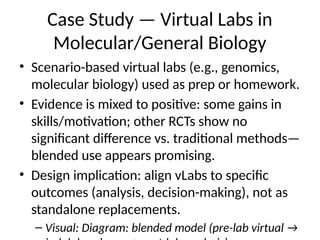
Case Study —Virtual Labs in
Molecular/General Biology
• Scenario-based virtual labs (e.g., genomics,
molecular biology) used as prep or homework.
• Evidence is mixed to positive: some gains in
skills/motivation; other RCTs show no
significant difference vs. traditional methods—
blended use appears promising.
• Design implication: align vLabs to specific
outcomes (analysis, decision-making), not as
standalone replacements.
– Visual: Diagram: blended model (pre-lab virtual →
16.
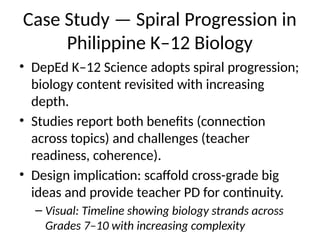
Case Study —Spiral Progression in
Philippine K–12 Biology
• DepEd K–12 Science adopts spiral progression;
biology content revisited with increasing
depth.
• Studies report both benefits (connection
across topics) and challenges (teacher
readiness, coherence).
• Design implication: scaffold cross-grade big
ideas and provide teacher PD for continuity.
– Visual: Timeline showing biology strands across
Grades 7–10 with increasing complexity
17.
Case Study —Spiral in Higher Ed
Science
• Spiral organic chemistry curriculum showed
improved integration across semesters.
• Biological Systems Engineering implemented
spiral instrumentation competencies across
the program.
• Design implication: map competencies
vertically and revisit with higher-level tasks.
– Visual: Competency ladder graphic (intro →
intermediate → advanced)
18.
Practical Toolkit —Templates &
Diagrams
• Backward Design template: Goals → Evidence
→ Activities (with ICT tasks).
• Spiral mapping template: Big ideas x
grade/course with increasing complexity.
• Taba needs assessment checklist and rapid
iteration cycle.
– Visual: Icons: template sheets; add simple
flowchart placeholders
19.
Recommendations for Your
Context(Biology + ICT)
• Combine Backward Design (unit level) with
Spiral planning (program level).
• Leverage ICT authentically: virtual labs for
preparation/extension; bioinformatics for
data-rich tasks; collaborative platforms for
portfolios.
• Use clear rubrics aligned to outcomes; include
reflection and metacognition.
– Visual: Strategy map: combine models; align tools;
assess authentically
20.
Key References (Seenotes for full
details/links)
• Tyler, R. W. (1949). Basic Principles of
Curriculum and Instruction. Univ. of Chicago
Press.
• Taba, H. (1962). Curriculum Development:
Theory and Practice. Harcourt Brace.
• Wiggins, G., & McTighe, J. (2005).
Understanding by Design (Expanded 2nd ed.).
ASCD.
• Bruner, J. S. (1960). The Process of Education.
Harvard Univ. Press.