Understanding growth of
Organic Farming in India
D. Narasimha Reddy
Member, IFOAM-Asia Board
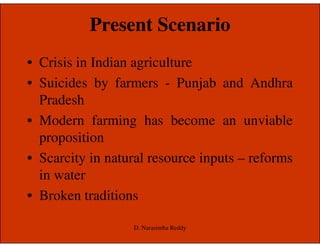
Present Scenario
• Crisis in Indian agriculture
• Suicides by farmers - Punjab and Andhra
Pradesh
• Modern farming has become an unviable• Modern farming has become an unviable
proposition
• Scarcity in natural resource inputs – reforms
in water
• Broken traditions
D. Narasimha Reddy
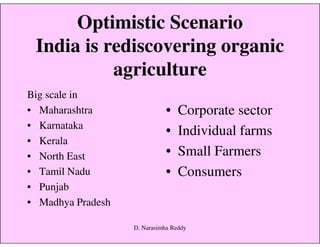
Optimistic Scenario
India is rediscovering organic
agriculture
Big scale in
• Maharashtra
• Karnataka
• Corporate sector
• Individual farms• Karnataka
• Kerala
• North East
• Tamil Nadu
• Punjab
• Madhya Pradesh
• Individual farms
• Small Farmers
• Consumers
D. Narasimha Reddy
Organic production
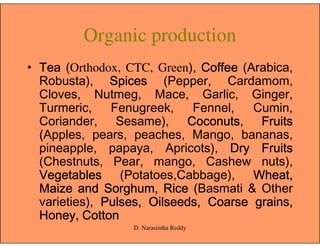
• TeaTeaTeaTea (Orthodox, CTC, Green), CoffeeCoffeeCoffeeCoffee (Arabica,
Robusta), SpicesSpicesSpicesSpices (Pepper, Cardamom,
Cloves, Nutmeg, Mace, Garlic, Ginger,
Turmeric, Fenugreek, Fennel, Cumin,
Coriander, Sesame), CoconutsCoconutsCoconutsCoconuts, FruitsFruitsFruitsFruitsCoriander, Sesame), CoconutsCoconutsCoconutsCoconuts, FruitsFruitsFruitsFruits
((((Apples, pears, peaches, Mango, bananas,
pineapple, papaya, Apricots), DryDryDryDry FruitsFruitsFruitsFruits
(Chestnuts, Pear, mango, Cashew nuts),
VegetablesVegetablesVegetablesVegetables (Potatoes,Cabbage), Wheat,Wheat,Wheat,Wheat,
MaizeMaizeMaizeMaize andandandand Sorghum,Sorghum,Sorghum,Sorghum, RiceRiceRiceRice (Basmati & Other
varieties), Pulses,Pulses,Pulses,Pulses, Oilseeds,Oilseeds,Oilseeds,Oilseeds, CoarseCoarseCoarseCoarse grains,grains,grains,grains,
Honey,Honey,Honey,Honey, CottonCottonCottonCotton
D. Narasimha Reddy
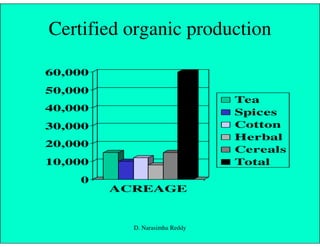
Certified organic production
30,000
40,000
50,000
60,000
Tea
Spices
Cotton
0
10,000
20,000
30,000
ACREAGE
Cotton
Herbal
Cereals
Total
D. Narasimha Reddy
Organic Potential
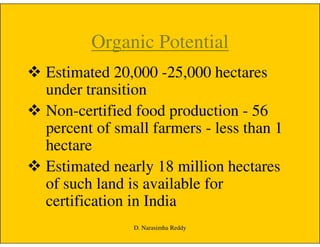
Estimated 20,000 -25,000 hectares
under transition
Non-certified food production - 56
percent of small farmers - less than 1percent of small farmers - less than 1
hectare
Estimated nearly 18 million hectares
of such land is available for
certification in India
D. Narasimha Reddy
Challenges
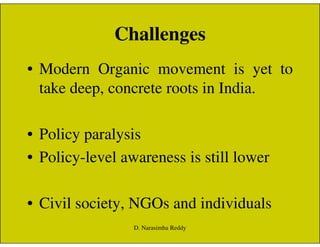
• Modern Organic movement is yet to
take deep, concrete roots in India.
• Policy paralysis
• Policy-level awareness is still lower
• Civil society, NGOs and individuals
D. Narasimha Reddy
Challenges
• No encouragement from
consumers
• Insufficient and inadequately• Insufficient and inadequately
developed market infrastructure
• Inherent structural deficiencies in
international organic product
market
D. Narasimha Reddy
Challenges
• No proper institutional framework
• Large-scale environmental
degradationdegradation
• There is huge shortage of organic
inputs
D. Narasimha Reddy
Indian Organic Movement
High potential for growth
Indian Freedom movementIndian Freedom movement
Bangalore Declaration – women as
focus
D. Narasimha Reddy
Indian Organic Movement
“Road to Solidarity”
Stakeholders
Collective thinking
Joint-action programme
D. Narasimha Reddy
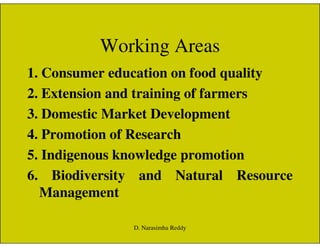
Working Areas
1. Consumer education on food quality
2. Extension and training of farmers
3. Domestic Market Development
4. Promotion of Research
5. Indigenous knowledge promotion
6. Biodiversity and Natural Resource
Management
D. Narasimha Reddy
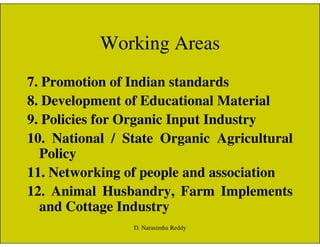
Working Areas
7. Promotion of Indian standards
8. Development of Educational Material
9. Policies for Organic Input Industry9. Policies for Organic Input Industry
10. National / State Organic Agricultural
Policy
11. Networking of people and association
12. Animal Husbandry, Farm Implements
and Cottage Industry
D. Narasimha Reddy
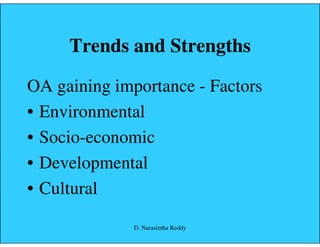
Trends and Strengths
OA gaining importance - Factors
• Environmental
• Socio-economic
• Developmental
• Cultural
D. Narasimha Reddy
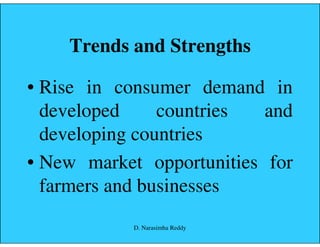
Trends and Strengths
• Rise in consumer demand in
developed countries and
developing countriesdeveloping countries
• New market opportunities for
farmers and businesses
D. Narasimha Reddy
Trends and Strengths
OA as a tradition
• Source for information
• Source for role models
D. Narasimha Reddy
Indian Standards
• Institute for
Integrated Rural
Development
Government bodies
• Spices Board
• Tea BoardDevelopment
• IFOAM
membership in
India
• Tea Board
• Coffee Board
• Union Ministry of
Commerce
D. Narasimha Reddy
Indian Certification Programme
In June 2001, under the NPOP, a set of 4 volumes,
concerning: Accreditation regulations,
Accreditation criteria, Accreditation procedure
and Application forms were published.
On 12 June 2001, by a Public notice No.19 (RE-On 12 June 2001, by a Public notice No.19 (RE-
2001/1997-2002 government regulation of export
of organic produce. “An agricultural product will
be allowed to be exported as organic product
only if it is produced, processed or packed under a
valid Organic Certificate issued by a certifying
agency duly accredited by one of the four
Accreditation Agencies.”
D. Narasimha Reddy
Appointed Accreditation
Agencies in India
• Agricultural & Processed Food Products
Export Development Authority (APEDA)Export Development Authority (APEDA)
• Coffee Board
• Tea Board
• Spices Board
D. Narasimha Reddy
Foreign certifying agencies in
India
IMO
SKALSKAL
ECOCERT
NATURLAND
SOIL ASSOCIATION
D. Narasimha Reddy
What is needed?
• National organic networks
• Targeting poor people
• Traditional knowledge systems
D. Narasimha Reddy
What is needed?
• Multifunctional rural development
strategies
• Widespread market development• Widespread market development
and avoid dependency
• Encouraging sustainable lifestyles
and technologies
D. Narasimha Reddy

Organic Farming in India 2003

  • 1.
    Understanding growth of OrganicFarming in India D. Narasimha Reddy Member, IFOAM-Asia Board
  • 2.
    Present Scenario • Crisisin Indian agriculture • Suicides by farmers - Punjab and Andhra Pradesh • Modern farming has become an unviable• Modern farming has become an unviable proposition • Scarcity in natural resource inputs – reforms in water • Broken traditions D. Narasimha Reddy
  • 3.
    Optimistic Scenario India isrediscovering organic agriculture Big scale in • Maharashtra • Karnataka • Corporate sector • Individual farms• Karnataka • Kerala • North East • Tamil Nadu • Punjab • Madhya Pradesh • Individual farms • Small Farmers • Consumers D. Narasimha Reddy
  • 4.
    Organic production • TeaTeaTeaTea(Orthodox, CTC, Green), CoffeeCoffeeCoffeeCoffee (Arabica, Robusta), SpicesSpicesSpicesSpices (Pepper, Cardamom, Cloves, Nutmeg, Mace, Garlic, Ginger, Turmeric, Fenugreek, Fennel, Cumin, Coriander, Sesame), CoconutsCoconutsCoconutsCoconuts, FruitsFruitsFruitsFruitsCoriander, Sesame), CoconutsCoconutsCoconutsCoconuts, FruitsFruitsFruitsFruits ((((Apples, pears, peaches, Mango, bananas, pineapple, papaya, Apricots), DryDryDryDry FruitsFruitsFruitsFruits (Chestnuts, Pear, mango, Cashew nuts), VegetablesVegetablesVegetablesVegetables (Potatoes,Cabbage), Wheat,Wheat,Wheat,Wheat, MaizeMaizeMaizeMaize andandandand Sorghum,Sorghum,Sorghum,Sorghum, RiceRiceRiceRice (Basmati & Other varieties), Pulses,Pulses,Pulses,Pulses, Oilseeds,Oilseeds,Oilseeds,Oilseeds, CoarseCoarseCoarseCoarse grains,grains,grains,grains, Honey,Honey,Honey,Honey, CottonCottonCottonCotton D. Narasimha Reddy
  • 5.
  • 6.
    Organic Potential Estimated 20,000-25,000 hectares under transition Non-certified food production - 56 percent of small farmers - less than 1percent of small farmers - less than 1 hectare Estimated nearly 18 million hectares of such land is available for certification in India D. Narasimha Reddy
  • 7.
    Challenges • Modern Organicmovement is yet to take deep, concrete roots in India. • Policy paralysis • Policy-level awareness is still lower • Civil society, NGOs and individuals D. Narasimha Reddy
  • 8.
    Challenges • No encouragementfrom consumers • Insufficient and inadequately• Insufficient and inadequately developed market infrastructure • Inherent structural deficiencies in international organic product market D. Narasimha Reddy
  • 9.
    Challenges • No properinstitutional framework • Large-scale environmental degradationdegradation • There is huge shortage of organic inputs D. Narasimha Reddy
  • 10.
    Indian Organic Movement Highpotential for growth Indian Freedom movementIndian Freedom movement Bangalore Declaration – women as focus D. Narasimha Reddy
  • 11.
    Indian Organic Movement “Roadto Solidarity” Stakeholders Collective thinking Joint-action programme D. Narasimha Reddy
  • 12.
    Working Areas 1. Consumereducation on food quality 2. Extension and training of farmers 3. Domestic Market Development 4. Promotion of Research 5. Indigenous knowledge promotion 6. Biodiversity and Natural Resource Management D. Narasimha Reddy
  • 13.
    Working Areas 7. Promotionof Indian standards 8. Development of Educational Material 9. Policies for Organic Input Industry9. Policies for Organic Input Industry 10. National / State Organic Agricultural Policy 11. Networking of people and association 12. Animal Husbandry, Farm Implements and Cottage Industry D. Narasimha Reddy
  • 14.
    Trends and Strengths OAgaining importance - Factors • Environmental • Socio-economic • Developmental • Cultural D. Narasimha Reddy
  • 15.
    Trends and Strengths •Rise in consumer demand in developed countries and developing countriesdeveloping countries • New market opportunities for farmers and businesses D. Narasimha Reddy
  • 16.
    Trends and Strengths OAas a tradition • Source for information • Source for role models D. Narasimha Reddy
  • 17.
    Indian Standards • Institutefor Integrated Rural Development Government bodies • Spices Board • Tea BoardDevelopment • IFOAM membership in India • Tea Board • Coffee Board • Union Ministry of Commerce D. Narasimha Reddy
  • 18.
    Indian Certification Programme InJune 2001, under the NPOP, a set of 4 volumes, concerning: Accreditation regulations, Accreditation criteria, Accreditation procedure and Application forms were published. On 12 June 2001, by a Public notice No.19 (RE-On 12 June 2001, by a Public notice No.19 (RE- 2001/1997-2002 government regulation of export of organic produce. “An agricultural product will be allowed to be exported as organic product only if it is produced, processed or packed under a valid Organic Certificate issued by a certifying agency duly accredited by one of the four Accreditation Agencies.” D. Narasimha Reddy
  • 19.
    Appointed Accreditation Agencies inIndia • Agricultural & Processed Food Products Export Development Authority (APEDA)Export Development Authority (APEDA) • Coffee Board • Tea Board • Spices Board D. Narasimha Reddy
  • 20.
    Foreign certifying agenciesin India IMO SKALSKAL ECOCERT NATURLAND SOIL ASSOCIATION D. Narasimha Reddy
  • 21.
    What is needed? •National organic networks • Targeting poor people • Traditional knowledge systems D. Narasimha Reddy
  • 22.
    What is needed? •Multifunctional rural development strategies • Widespread market development• Widespread market development and avoid dependency • Encouraging sustainable lifestyles and technologies D. Narasimha Reddy