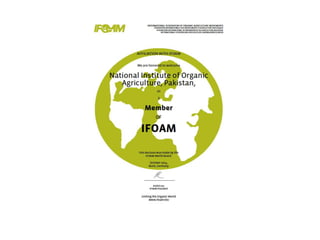
National Institute of Organic Agriculture
National Agricultural Research Centre
• Training activities leading to sustainable agro
eco-system and better livelihood of farming
community.
• Research and Development of cost effective
technology for alternate farming system
which is economical and suitable for different
eco-logical zones of Pakistan.
• Building organic standards to establish
organic certification system in Pakistan.
• To establish local organic certification facility in
collaboration with national and international
bodies.
• To develop organic product certification protocol
and standard in line with Europe i.e. IFOAM.
• Institutional development regarding future R&D
needs for promoting organic agriculture.
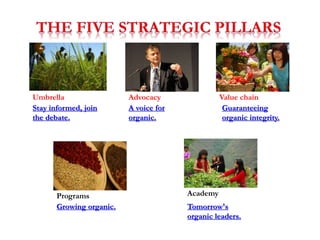
• The International Federation of Organic
Agriculture Movements is the worldwide
umbrella organization for the organic agriculture
movement, which represents close to 800
affiliates in 117 countries
Umbrella Advocacy Value chain
Programs Academy
Tomorrow's
organic leaders.
Growing organic.
Guaranteeing
organic integrity.
A voice for
organic.
Stay informed, join
the debate.
PRINCIPLES OF ORGANIC
AGRICULTURE
• 1. The Principle of Health
• Organic Agriculture should sustain and enhance the health of soil, plant,
animal, human and planet.
• 2. The Principle of Ecology
• Organic Agriculture should be based on living ecological systems and
cycles, work with them, emulate them and help sustain them.
• 3. The Principle of Fairness
• Organic Agriculture should build on relationships that ensure fairness
with regard to the common environment and life opportunities.
• 4. The Principle of Care
• Organic Agriculture should be managed in a precautionary and
responsible manner to protect the health and well-being of current and
future generations and the environment.
IFOAM Accreditation
The IFOAM Accreditation Program was launched in 1992. It has been operating on
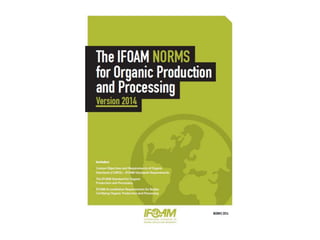
the basis of the IFOAM Norms composed, up to 2011, of the IFOAM Basic
Standards (IBS), and the IFOAM Accreditation Criteria (IAC). IFOAM accreditation
was awarded to certification bodies that complied with the IAC and that used
certification standards that meet the IBS. In the 2012 edition of the IFOAM Norms
the IAC have been renamed “IFOAM Accreditation Requirements” (IAR) and the IBS
has been replaced by the IFOAM Standards and the IFOAM Standards
Requirements (COROS). Starting from August 2012, IFOAM-Accredited certification
bodies have a 2-year period to bring their standard in compliance with the IFOAM
Standard.
Organic Certification
• NTWG after examining the farm and
information can issue the certification for
local use / conversion to organics. [Peer
reviewing certification]. Low Cost
• NTWG refer to 3rd party for certification after
signing the MOU with 3rd party for export.
High Cost
Organic Certification logo
Projects prepared & submitted
• ALP – Submitted PD PARC
• RADP – Submitted PD PARC
• PC-I – Submitted PD PARC
• MNFS&R – Final Stage
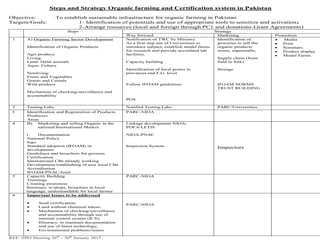
Steps and Strategy Organic farming and Certification system in Pakistan
Objective: To establish sustainable infrastructure for organic farming in Pakistan
Targets/Goals: 1- Identification of potentials and use of appropriate tools to sensitize and activation;
2-Arrange resources (local and foreign through PC1 and donations-Grant Agreements)
Steps Strategy
Way forward Marketing Promotion
1 A) Organic Farming Sector Development
Identification of Organic Products:
Agri produce
Living
Land: Halal animals
Aqua: Fishery
Nonliving:
Fruits and Vegetables
Grains and Cereals
Wild produce
Mechanism of checking/surveillance and
accountability
Notification of TWC by Ministry.
As a first step use of Universities to
introduce subject; establish model farms
for research and provide accredited lab
facilities.
Capacity building
Identification of focal points in
provinces and F.G. level
Follow IFOAM guidelines.
PGS
Identification of
groceries to sell the
organic products
stores, supermalls;
Supply chain (from
field to fork)
Storage
IFOAM NORMS
TRUST BUILDING
 Media
 Print
 Seminars.
 Product display
 Model Farms
2 Testing Labs Notified Testing Labs PARC/Universities
3 Identification and Registration of Products
Producers
Areas
PARC-NIOA
4 B) Marketing and selling Organic in the
national/International Market.
1. Documentation
National Policy
logo
Standard adoption (IFOAM) or
development
Guidelines and broachers for growers
Certification
International CBs already working
Development/establishing of new local CBs
Accreditation
IFOAM/PNAC/Joint
Linkage development NIOA-
POFA/LETIS
NIOA-PNAC
Inspection System
Inspectors
5 Capacity Building
Trainings
Creating awareness
Seminars, w/shops, broachers in local
language, understandable for local farmer
PARC-NIOA
6 Important Issues to be addressed
 Seed certification;
 Land without chemical traces;
 Mechanism of checking/surveillance
and accountability through use of
internal control system (ICS);
 Illiteracy, to maintain documentation
and use of latest technology;
 Environmental problems/issues
PARC-NIOA
REF: NPO Meeting 26th
– 30th
January 2015.
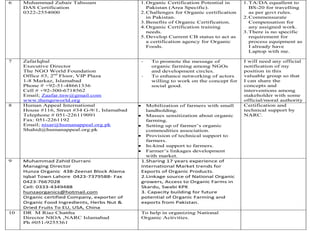
NTWG of Organic Certification in Pakistan
S # Members Responsibilities Requirements
1 Dr. Muhammad Aslam Gill
Commissioner
Ministry of Food Security & Research,
Islamabad
Email: aslamgill@yahoo.com
051-9204650
Funding and technical assistance at
Ministry level [NFS&R]
2 Younis Jacob, LETIS Asia Organic
Certification
Requirements for Agriculture
3-A, Foundation Corner, Gulberg-II Lahore
Pakistan
Email: asia 2letis.org
Website: www.letis.org
042-35958942
Contract Review
Review of documentation
Perform inspection
Report writing
Certification issuance
Initial information of
farms and allow access
to farms
3 Traiq-H-Cheema, MD
Convener Global Donors Forum
President World Congress of Muslim
Philanthropists
P.O Box#3645, Oak Brook, IL 60522,
United states
Phone #=1-630-889-9512 +1-630-89-6511
Global Text & Voucemail +1-312-715-8061
Tcheema@thewcmp.org
www.thewcp.org
Donor Funding
4 Khalid Masood
Dy. Director (Certification) PNAC,
Tel #9222311, 0336-9507777
kmasoodk@yahoo.com
To study and draft Policies, Technical
regulation and other legal
requirements in establishing,
developing and promoting Organic
Agri- Products Certification
infrastructure in the country and to
coordinate with similar organization
in other countries.
i) Study visits and
trainings to acquire the
information and update
knowledge to perform
the mentioned
responsibilities.
ii) Facilities, TA/DA
and other expenses
related to perform the
assigned jobs.
5 Dr. SohailFarooq
Head , Department of Economics,
Hazara University, Mansehra
Cell: +92 345 9242301
E-mail: thesohailfarooq@hotmail.com
To study and advise economic
viability of organic agriculture
certification scheme in the selected
area and crops.
1.TA/DA as per govt
rules.
2.Compensation for
any assigned work.
6 Muhammad Zubair Tabssum
DAS Certification
0322-2554000
1.Organic Certification Potential in
Pakistan (Area Specific).
2.Challenges for Organic certification
in Pakistan.
3.Benefits of Organic Certification.
4.Organic Certification training
needs.
5.Develop Current CB status to act as
a certification agency for Organic
Foods.
1.TA/DA equallent to
BS-20 for travelling
as per govt rules.
2.Commensurate
Compensation for
any assigned work.
3.There is no specific
requirement for
process equipment as
I already have
Laptop with me.
7 ZafarIqbal
Executive Director
The NGO World Foundation
Office #3, 2nd
Floor, VIP Plaza
1-8 Markaz, Islamabad
Phone # +92-51-48661336
Cell # +92-300-6718562
Email; Zaafar.tnw@gmail.com
www.thengoworld.org
- To promote the message of
organic farming among NGOs
and development circles.
- To enhance networking of actors
willing to work on the concept for
social good.
I will need any official
notification of my
position in this
valuable group so that
I can share the
concepts and
interventions among
stakeholder with some
official/moral authority
8 Human Appeal International
House #116, Street #34 G-9/1, Islamabad
Telephone # 051-226119091
Fax: 051-2261192
Email; nisar@humanappeal.org.pk
Shahid@humanappeal.org.pk
 Mobilization of farmers with small
landholding.
 Masses sensitization about organic
farming.
 Setting up of farmer’s organic
commodities association.
 Provision of technical support to
farmers.
 In-kind support to farmers.
 Farmer’s linkages development
with market.
Certification and
technical support by
NARC.
9 Muhammad Zahid Durrani
Managing Director
Hunza Organic 438-Zeenat Block Alama
Iqbal Town Lahore 0423-7379588- Fax
0423-7667028
Cell: 0333-4349488
hunzaorganics@hotmail.com
Organic certified Company, exporter of
Organic Food Ingredients, Herbs Nut &
Dried Fruits To EU, USA, China
1.Sharing 17 years experience of
International Market trends for
Exports of Organic Products.
2.Linkage source of National Organic
growers, Access to Organic Farms in
Skardu, Swabi KPK
3. Capacity building for future
potential of Organic Farming and
exports from Pakistan.
10 DR M Riaz Chattha
Director NIOA ,NARC Islamabad
Ph #051-9255361
To help in organizing National
Organic Activities.
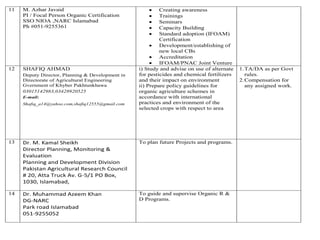
11 M. Azhar Javaid
PI / Focal Person Organic Certification
SSO NIOA ,NARC Islamabad
Ph #051-9255361
 Creating awareness
 Trainings
 Seminars
 Capacity Building
 Standard adoption (IFOAM)
Certification
 Development/establishing of
new local CBs
 Accreditation
 IFOAM/PNAC Joint Venture
12 SHAFIQ AHMAD
Deputy Director, Planning & Development in
Directorate of Agricultural Engineering
Gvernment of Khyber Pakhtunkhawa
03015142983,03428920525
E-mail:
Shafiq_a14@yahoo.com,shafiq12555@gmail.com
i) Study and advise on use of alternate
for pesticides and chemical fertilizers
and their impact on environment
ii) Prepare policy guidelines for
organic agriculture schemes in
accordance with international
practices and environment of the
selected crops with respect to area
1.TA/DA as per Govt
rules.
2.Compensation for
any assigned work.
13 Dr. M. Kamal Sheikh
Director Planning, Monitoring &
Evaluation
Planning and Development Division
Pakistan Agricultural Research Council
# 20, Atta Truck Av. G-5/1 PO Box,
1030, Islamabad,
To plan future Projects and programs.
14 Dr. Muhammad Azeem Khan
DG-NARC
Park road Islamabad
051-9255052
To guide and supervise Organic R &
D Programs.
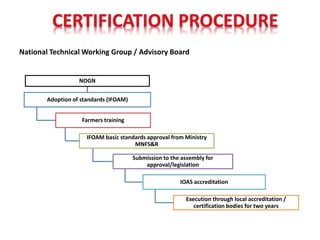
National Technical Working Group / Advisory Board
NOGN
Adoption of standards (IFOAM)
Farmers training
IFOAM basic standards approval from Ministry
MNFS&R
Submission to the assembly for
approval/legislation
IOAS accreditation
Execution through local accreditation /
certification bodies for two years
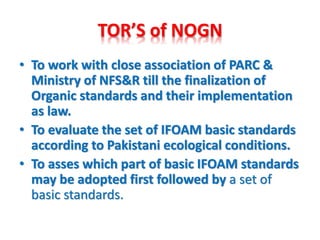
TOR’S of NOGN
• To work with close association of PARC &
Ministry of NFS&R till the finalization of
Organic standards and their implementation
as law.
• To evaluate the set of IFOAM basic standards
according to Pakistani ecological conditions.
• To asses which part of basic IFOAM standards
may be adopted first followed by a set of
basic standards.
TOR’s of NOGN
• To make contact with IFOAM and IOAS for
certification process and approval of
standards from IFOAM-IOAS.
• To decide modalities and implementation
procedure after approval from assembly.
Recommendations
 NIOA should Constitute a National Technical
working group (NOGN) or Advisory Board to
develop local organic standards in line with
IFOAM set of basic standards.
 MOU with 3rd Party Certification
 PARC-NIOA Provide Umbrella & Advocacy to
Organic Farmers for better future.
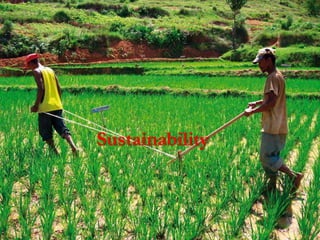
Sustainability

Organic Certification

  • 1.
    National Institute ofOrganic Agriculture National Agricultural Research Centre
  • 2.
    • Training activitiesleading to sustainable agro eco-system and better livelihood of farming community. • Research and Development of cost effective technology for alternate farming system which is economical and suitable for different eco-logical zones of Pakistan. • Building organic standards to establish organic certification system in Pakistan.
  • 3.
    • To establishlocal organic certification facility in collaboration with national and international bodies. • To develop organic product certification protocol and standard in line with Europe i.e. IFOAM. • Institutional development regarding future R&D needs for promoting organic agriculture.
  • 5.
    • The InternationalFederation of Organic Agriculture Movements is the worldwide umbrella organization for the organic agriculture movement, which represents close to 800 affiliates in 117 countries
  • 6.
    Umbrella Advocacy Valuechain Programs Academy Tomorrow's organic leaders. Growing organic. Guaranteeing organic integrity. A voice for organic. Stay informed, join the debate.
  • 7.
    PRINCIPLES OF ORGANIC AGRICULTURE •1. The Principle of Health • Organic Agriculture should sustain and enhance the health of soil, plant, animal, human and planet. • 2. The Principle of Ecology • Organic Agriculture should be based on living ecological systems and cycles, work with them, emulate them and help sustain them. • 3. The Principle of Fairness • Organic Agriculture should build on relationships that ensure fairness with regard to the common environment and life opportunities. • 4. The Principle of Care • Organic Agriculture should be managed in a precautionary and responsible manner to protect the health and well-being of current and future generations and the environment.
  • 8.
    IFOAM Accreditation The IFOAMAccreditation Program was launched in 1992. It has been operating on the basis of the IFOAM Norms composed, up to 2011, of the IFOAM Basic Standards (IBS), and the IFOAM Accreditation Criteria (IAC). IFOAM accreditation was awarded to certification bodies that complied with the IAC and that used certification standards that meet the IBS. In the 2012 edition of the IFOAM Norms the IAC have been renamed “IFOAM Accreditation Requirements” (IAR) and the IBS has been replaced by the IFOAM Standards and the IFOAM Standards Requirements (COROS). Starting from August 2012, IFOAM-Accredited certification bodies have a 2-year period to bring their standard in compliance with the IFOAM Standard.
  • 11.
    Organic Certification • NTWGafter examining the farm and information can issue the certification for local use / conversion to organics. [Peer reviewing certification]. Low Cost • NTWG refer to 3rd party for certification after signing the MOU with 3rd party for export. High Cost
  • 12.
  • 13.
    Projects prepared &submitted • ALP – Submitted PD PARC • RADP – Submitted PD PARC • PC-I – Submitted PD PARC • MNFS&R – Final Stage
  • 14.
    Steps and StrategyOrganic farming and Certification system in Pakistan Objective: To establish sustainable infrastructure for organic farming in Pakistan Targets/Goals: 1- Identification of potentials and use of appropriate tools to sensitize and activation; 2-Arrange resources (local and foreign through PC1 and donations-Grant Agreements) Steps Strategy Way forward Marketing Promotion 1 A) Organic Farming Sector Development Identification of Organic Products: Agri produce Living Land: Halal animals Aqua: Fishery Nonliving: Fruits and Vegetables Grains and Cereals Wild produce Mechanism of checking/surveillance and accountability Notification of TWC by Ministry. As a first step use of Universities to introduce subject; establish model farms for research and provide accredited lab facilities. Capacity building Identification of focal points in provinces and F.G. level Follow IFOAM guidelines. PGS Identification of groceries to sell the organic products stores, supermalls; Supply chain (from field to fork) Storage IFOAM NORMS TRUST BUILDING  Media  Print  Seminars.  Product display  Model Farms 2 Testing Labs Notified Testing Labs PARC/Universities 3 Identification and Registration of Products Producers Areas PARC-NIOA 4 B) Marketing and selling Organic in the national/International Market. 1. Documentation National Policy logo Standard adoption (IFOAM) or development Guidelines and broachers for growers Certification International CBs already working Development/establishing of new local CBs Accreditation IFOAM/PNAC/Joint Linkage development NIOA- POFA/LETIS NIOA-PNAC Inspection System Inspectors 5 Capacity Building Trainings Creating awareness Seminars, w/shops, broachers in local language, understandable for local farmer PARC-NIOA 6 Important Issues to be addressed  Seed certification;  Land without chemical traces;  Mechanism of checking/surveillance and accountability through use of internal control system (ICS);  Illiteracy, to maintain documentation and use of latest technology;  Environmental problems/issues PARC-NIOA REF: NPO Meeting 26th – 30th January 2015.
  • 15.
    NTWG of OrganicCertification in Pakistan S # Members Responsibilities Requirements 1 Dr. Muhammad Aslam Gill Commissioner Ministry of Food Security & Research, Islamabad Email: aslamgill@yahoo.com 051-9204650 Funding and technical assistance at Ministry level [NFS&R] 2 Younis Jacob, LETIS Asia Organic Certification Requirements for Agriculture 3-A, Foundation Corner, Gulberg-II Lahore Pakistan Email: asia 2letis.org Website: www.letis.org 042-35958942 Contract Review Review of documentation Perform inspection Report writing Certification issuance Initial information of farms and allow access to farms 3 Traiq-H-Cheema, MD Convener Global Donors Forum President World Congress of Muslim Philanthropists P.O Box#3645, Oak Brook, IL 60522, United states Phone #=1-630-889-9512 +1-630-89-6511 Global Text & Voucemail +1-312-715-8061 Tcheema@thewcmp.org www.thewcp.org Donor Funding 4 Khalid Masood Dy. Director (Certification) PNAC, Tel #9222311, 0336-9507777 kmasoodk@yahoo.com To study and draft Policies, Technical regulation and other legal requirements in establishing, developing and promoting Organic Agri- Products Certification infrastructure in the country and to coordinate with similar organization in other countries. i) Study visits and trainings to acquire the information and update knowledge to perform the mentioned responsibilities. ii) Facilities, TA/DA and other expenses related to perform the assigned jobs. 5 Dr. SohailFarooq Head , Department of Economics, Hazara University, Mansehra Cell: +92 345 9242301 E-mail: thesohailfarooq@hotmail.com To study and advise economic viability of organic agriculture certification scheme in the selected area and crops. 1.TA/DA as per govt rules. 2.Compensation for any assigned work.
  • 16.
    6 Muhammad ZubairTabssum DAS Certification 0322-2554000 1.Organic Certification Potential in Pakistan (Area Specific). 2.Challenges for Organic certification in Pakistan. 3.Benefits of Organic Certification. 4.Organic Certification training needs. 5.Develop Current CB status to act as a certification agency for Organic Foods. 1.TA/DA equallent to BS-20 for travelling as per govt rules. 2.Commensurate Compensation for any assigned work. 3.There is no specific requirement for process equipment as I already have Laptop with me. 7 ZafarIqbal Executive Director The NGO World Foundation Office #3, 2nd Floor, VIP Plaza 1-8 Markaz, Islamabad Phone # +92-51-48661336 Cell # +92-300-6718562 Email; Zaafar.tnw@gmail.com www.thengoworld.org - To promote the message of organic farming among NGOs and development circles. - To enhance networking of actors willing to work on the concept for social good. I will need any official notification of my position in this valuable group so that I can share the concepts and interventions among stakeholder with some official/moral authority 8 Human Appeal International House #116, Street #34 G-9/1, Islamabad Telephone # 051-226119091 Fax: 051-2261192 Email; nisar@humanappeal.org.pk Shahid@humanappeal.org.pk  Mobilization of farmers with small landholding.  Masses sensitization about organic farming.  Setting up of farmer’s organic commodities association.  Provision of technical support to farmers.  In-kind support to farmers.  Farmer’s linkages development with market. Certification and technical support by NARC. 9 Muhammad Zahid Durrani Managing Director Hunza Organic 438-Zeenat Block Alama Iqbal Town Lahore 0423-7379588- Fax 0423-7667028 Cell: 0333-4349488 hunzaorganics@hotmail.com Organic certified Company, exporter of Organic Food Ingredients, Herbs Nut & Dried Fruits To EU, USA, China 1.Sharing 17 years experience of International Market trends for Exports of Organic Products. 2.Linkage source of National Organic growers, Access to Organic Farms in Skardu, Swabi KPK 3. Capacity building for future potential of Organic Farming and exports from Pakistan. 10 DR M Riaz Chattha Director NIOA ,NARC Islamabad Ph #051-9255361 To help in organizing National Organic Activities.
  • 17.
    11 M. AzharJavaid PI / Focal Person Organic Certification SSO NIOA ,NARC Islamabad Ph #051-9255361  Creating awareness  Trainings  Seminars  Capacity Building  Standard adoption (IFOAM) Certification  Development/establishing of new local CBs  Accreditation  IFOAM/PNAC Joint Venture 12 SHAFIQ AHMAD Deputy Director, Planning & Development in Directorate of Agricultural Engineering Gvernment of Khyber Pakhtunkhawa 03015142983,03428920525 E-mail: Shafiq_a14@yahoo.com,shafiq12555@gmail.com i) Study and advise on use of alternate for pesticides and chemical fertilizers and their impact on environment ii) Prepare policy guidelines for organic agriculture schemes in accordance with international practices and environment of the selected crops with respect to area 1.TA/DA as per Govt rules. 2.Compensation for any assigned work. 13 Dr. M. Kamal Sheikh Director Planning, Monitoring & Evaluation Planning and Development Division Pakistan Agricultural Research Council # 20, Atta Truck Av. G-5/1 PO Box, 1030, Islamabad, To plan future Projects and programs. 14 Dr. Muhammad Azeem Khan DG-NARC Park road Islamabad 051-9255052 To guide and supervise Organic R & D Programs.
  • 18.
    National Technical WorkingGroup / Advisory Board NOGN Adoption of standards (IFOAM) Farmers training IFOAM basic standards approval from Ministry MNFS&R Submission to the assembly for approval/legislation IOAS accreditation Execution through local accreditation / certification bodies for two years
  • 19.
    TOR’S of NOGN •To work with close association of PARC & Ministry of NFS&R till the finalization of Organic standards and their implementation as law. • To evaluate the set of IFOAM basic standards according to Pakistani ecological conditions. • To asses which part of basic IFOAM standards may be adopted first followed by a set of basic standards.
  • 20.
    TOR’s of NOGN •To make contact with IFOAM and IOAS for certification process and approval of standards from IFOAM-IOAS. • To decide modalities and implementation procedure after approval from assembly.
  • 21.
    Recommendations  NIOA shouldConstitute a National Technical working group (NOGN) or Advisory Board to develop local organic standards in line with IFOAM set of basic standards.  MOU with 3rd Party Certification  PARC-NIOA Provide Umbrella & Advocacy to Organic Farmers for better future.
  • 22.