Project Report
On
CHALLENGES AND OPPORTUNITY OF
ORGANIC FOOD IN INDIA
Submitted to M.D University Rohtak in partial fulfillment of the requirement
for the award of degree of Master of Business Administration
Session: 2014 – 2016
Submitted by:
MANU BANSAL
Roll no. 160114015
PDM COLLEGE OF ENGINEERING
(Sarai Aurangabad, bahadurgarh-124507)
MAHARSHI DAYANAND UNIVERSITY, ROHTAK
DECLARATION
I, MANU BANSAL, ROLL NO. 4015 class MBA 4th SEM of PDM college of engineering,
bahadurgarh, hereby declare that the project entitled ‘CHALLENGES AND OPPORTUNIY OF
ORGANIC IN INDIA’ is an original work and same has not been submitted to any other institution
for the award of any other degree. The interim report was presented to the supervisor on__________
and the pre-submission was made on . The feasible suggestion has been duly incorporated
in consultation with the supervisor.
Countersigned
Signature of supervisor Signature of candidate
Forwarded by
Director/ Principal of the Institute
ACKNOWLEDGEMENT
I am using this opportunity to express my gratitude to everyone who supported me throughout the
course of this MBA project. I am thankful for their aspiring guidance, invaluably constructive
criticism and friendly advice during the project work. I am sincerely grateful to them for sharing
their truthful and illuminating views on a number of issues related to the project. I have no words
to express my immense gratitude to Dr. Nidhi Mishra who has all along been very kind to
researcher for not suggesting the topic of the project but also offering valuable guidance
particularly at the time of his personal appointments. I am also extremely thankful to the company
management, officers and staff for their cooperation during the study or survey and their responses
Dr. Nidhi Mishra and other faculty members of the institute for their continuous encouragement
and support. I am also indebted to my father, sister and friends for their immense love and
affection, care, concern, and consideration and unstinted support throughout.
MANU BANSAL
TABLE OF CONTENTS
 DECLARATION
 ACKNOWLEDGEMENT
1. INTRODUCTION
 Introduction of topic
 Overview of current organic food market in India
 Growth of organic food in India
 Challenges for Organic Farming
 Companies marketing strategies for organic food in India
2. Review of literature
3. Objectives of the study
4. Research Methodology
5. Data analysis and interpretation
6. Findings and recommendation
7. Conclusion
BIBLIOGRAPHY
ANNEXURE
CHAPTER 1
INTRODUCTION
INTRODUCTION OF TOPIC
Organic foods are foods produced by methods that comply with the standards of organic farming.
Standards vary worldwide; however, organic farming in general, features practices that strive to
foster cycling of resources, promote ecological balance, and conserve biodiversity. Organizations
regulating organic products may choose to restrict the use of certain pesticides and fertilizers in
farming. In general, organic foods are also usually not processed using irradiation, industrial
solvents or synthetic food additives.
Organic cultivation is particularly suitable for a country like India with a huge population of small
farmers who still use traditional methods of farming with few agricultural inputs. It is estimated
that 65% of the country’s cropped area is organic by default, as the small farmers have no choice
but to farm without chemical fertilizers and pesticides as they cannot afford. This default status
coupled with India’s inherent advantages, such as, its varied agro-climatic regions, local self-
sustaining agri-systems, sizeable number of progressive farmers and ready availability of
inexpensive manpower translate into the potential to cultivate a vast basket of products organically.
Organic food production is a self-regulated industry with government oversight in some countries,
distinct from private gardening. Currently, the European Union, the United States, Canada, Japan,
and many other countries require producers to obtain special certification based on government-
defined standards in order to market food as organic within their borders. In the context of these
regulations, foods marketed as organic are produced in a way that complies with organic standards
set by national governments and international organic industry trade organizations.
India, a country with a huge number of small farmers who still use traditional methods and do
farming with few agricultural inputs. NGOs that promote organic farming and other organizations
support farmers in these aspects. An organic movement is now emerging in India on different levels
(producer groups, trainers and advisors, certification bodies and processors and traders). So
dissemination of information about the opportunities and challenges for Indian organic products on
the domestic and international market is of fundamental concern in order to allow continued.
 AN OVERVIEW OF CURRENT ORGANIC FOOD MARKET IN INDIA
According to the Indian Competence Centre for Organic Agriculture, the global market for
organically produced foods is $26 billion and is estimated to increase to $102 billion by 2020.
As part of 10th Five Year Plan (2002-07), the government earmarked Rs 100 crore (Rs 1 billion)
for the promotion of sustainable agriculture in the country, but the main components of this
initiative have benefited exports, from the establishing of national organic standards under NPOP
(National Programme for Organic Production), putting in place a system of certification for
products, and establishing APEDA (Agricultural and Processed Food Export Development
Authority) as the nodal agency to promote exports opportunities.
The organic farming is an old concept in India in terms of the extensive farming carried out in the
country. The organic food market is worth USD 129.3 mn and shows huge potential for growth in
future.
Major products produced in India by organic farming
Type ofProduct Products
Commodity Tea,Coffee, Rice, Wheat
Spices Cardamom, Black pepper,White pepper,
Ginger, Turmeric, Vanilla, Tamarind,Clove,
Cinnamon,Nutmeg,Mace,Chili
Pulses Red gram, Black gram
Fruits Mango,Banana,Pineapple,Passion fruit,
Sugarcane,Orange,Cashewnut,Walnut
Vegetables Okra, Brinjal, Garlic, Onion, Tomato,
Potato
Oil seeds Mustard,Sesame,Castor,Sunflower
Others Cotton,Herbalextracts
Organic Food Consumption in India is on the Rise
Some people believe that organic food is only a “concept” popular in the developed countries.
They think that when it comes to organic food, India only exports organic food and very little is
consumed. However, this is not true.
Though 50% of the organic food production in India is targeted towards exports, there are many
who look towards organic food for domestic consumption.
Organic agricultural export market is one of the major drivers of organic agriculture in India. India
exports 31 organic products. It is estimated that more than 85% of total organic production,
excluding wild herbs from UP and MP, is exported. India is best known as an exporter of organic
tea and also has great export potential for many other products. Other organic products for which
India has a niche market are spices and fruits. There is also good response for organic rice,
vegetable, coffee, cashew, oil seed, wheat and pulses. Among the fruit crops bananas, mangos and
oranges are the most preferred organic products.
India’s organic export products include, tea, honey, cashew, cotton, processed fruits, coffee,
basmati rice, sesame, spices, walnuts, pulses and wheat. Key organic items of export importance
are fruits and vegetables, sesame, basmati rice, fruit pulp, fruit juices, spices, cashew, tea, coffee,
cotton and wheat. India has production advantages in most of these products.
The domestic market is nascent but has huge growth potential. Presently the domestic market for
organic products are estimated at 1,200 tonnes and there are around 2-3million potential customers
for organic agricultural produce and is growing.
Who are the organic consumers?
What consumer consider as the “organic consumer” is that person who is responsible for buying
food for the household and who buys organic food at least once or twice per month. So, if there
are people who buy randomly or less than once a month then they are not considered regular
organic consumers.
Values and behavior of organic consumers
What do organic consumers think, that is, what is in their minds concerning organic products, is a
determinant factor of consumer preference for organic food. In spite of taking cognizance, a change
in attitude and thinking about organic food is prerequisite, in order to feel confident and positive
about this new direction.
An organic consumer has more positive beliefs concerning organic products. For example, this
product tastes better, is more natural, is healthier-they believe that more than non-organic
consumers. They believe that the people who are important to them, people who are close to them,
also by organic products- they believe that it is a good thing that they buy organic products. The
other aspect of what the organic consumer think, as compared to non-organic consumers, is their
moral norms indicate they are doing a very good thing for the environment, the right thing for
society. This is something that differences them from non-organic consumers. Non-organic
purchases do not associate those beliefs to buy organic products.
Consumers’ values to make a choice for organic food can be seen in two terms-use values, such
as utility from taste, health and freshness, i.e., private good attributes which can only be enjoyed
by actually consuming the product. The other non-use values are public good values related to
improved environment and animal welfare. The majority of all consumers-acknowledges and
value organic goods for their non-use values (environmental or animal welfare attributes), as well
as for their use values (health, taste or freshness attributes). The group of consumers having use
values only is negligible. In the same way that most people agree exercise- is important; they also
agree that a sustainable, clean environment is important.
Contract farming for organic crop production in India
Indian agriculture is progressing in all spheres to keep up with the ever-increasing population. In
the Tenth Five-Year Plan (2002-07), the government envisaged at least 4% growth rate per annum,
so that food security is assured and employment opportunities in agriculture are created. The
National Agricultural Policy also aimed to strengthen the national economic growth through
efficient marketing to accelerate foreign exports by establishing Agri-Export Zones for various
crops in major crop-growing areas, where technical know-how and facilities for export will be
provided. Therefore, there is a shift from sustainable to commercial agriculture. Farmers can
increase their income from crop production. Similarly, in several developed countries, demand for
organic food and fibre, and by-products is increasing day-by-day. This change is mainly due to
overuse or misuse of chemicals, particularly synthetic insecticides, fungicides, herbicides,
fertilizers, plant growth regulators, etc. that resulted in undesirable side effects not only in the agro-
ecosystems, but also on human health and life systems of beneficial fauna and microorganisms.
These recent trends in consumerism have opened a new vista for agricultural production on large
scale by adopting contract farming, which can transform small farmers into viable commercial
producers by monitoring quality, quantity and cost of crop production, and can link production
with the consumption. This change can help develop markets and bring about changes in the
present conventional agriculture which is expected in India in near future. This note therefore
discusses the present situation and future strategies of community cultivation.
Needfor contract farming in organic agriculture
The organic agriculture includes growing of crops by a set of guidelines that prohibit the use of
synthetic products/chemicals such as fertilizers, pesticides, plant growth promoters and livestock
additives. Therefore, soil fertility and pest management is achieved through cropping patterns
(rotations, inter/mix-crops, pest and disease- resistant genotypes), manure (green manufacturing,
organic manures, compost), biofertilizers, cultural practices (weeding, planting, conventional
tillage) and biopesticides, including plant-derived products. At present, this system seems to be an
ideal and valid solution to produce food and fibre without chemicals and to protect the
environment. Further, consumers are becoming conscious and critical about the quality of food
and by-products that affect their health though the toxicity depends, to some extent, on the type of
food consumed. India being one of the signatories for the World Trade Organization, liberalization,
privatization and globalization has opened new grounds for agricultural marketing. The National
programme for Organic Production of the Commerce Ministry and the State Governments are
actively promoting investment in support of promising ventures in organic agriculture.
Considering the present socio-economic status of Indian farmers, contract farming seems to be an
ideal option because this system would have certain advantages over the present crop production
and marketing systems, such as:
1. Profit in produce sale is possible by capitalizing the scientific research in post-harvest
technologies.
2. Indian agriculture is becoming commercial due to global demand for a variety of foods and
fibre, and food products.
3. Any crop can be cultivated on a large area to obtain produce of uniform quality by adopting
appropriate technology. Crop production is also possible on small land-holdings through
cooperative/ corporate farming to enhance productivity and avoid admixture or inferior quality
produce.
4. Technology transfer becomes easier due to large-scale adoption.
5. Risk involved due to fluctuation in market price is minimized. This point is relevant to the
present strategy of farm economics as the Minimum Support Price is generally declared at the end
of crop season and it often remains ambiguous.
6. Commercial and nationalized banks are coming forward to finance contract farming through
soft loans and are revising prime lending rates.
7. Additional income from intercrops is certain due to crop diversification. Consolidation of small
and marginal lands can make farming economically viable, resulting in higher (>30%) net returns
than traditional/conventional farming systems.
 Growth of organic food in India
ACNielsen, a leading market research firm, recently surveyed about 21,000 regular Internet users
in 38 countries to find their preference for functional foods – foods that have additional health
benefits. The survey revealed that India was among the top ten countries where health food,
including organic food, was demanded by the consumers.
The most important reason for buying organic food was the concern for the health of children, with
over 66 percent parents preferring organic food to non organic food. Though organic food is priced
over 25 percent more than conventional food in India, many parents are willing to pay this higher
premium due to the perceived health benefits of organic food.
The increase in organic food consumption in India is evident from the fact that many organic food
stores are spurring up in India. Today (2006) every supermarket has an organic food store and
every large city in India has numerous organic food stores and restaurants. This is a huge change
considering that the first organic food store in Mumbai was started in 1997.
However, the Indian organic food consumer needs education. There are many consumers who are
unaware of the difference between natural and organic food. Many people purchase products
labeled as Natural thinking that they are Organic. Further, consumers are not aware of the
certification system. Since certification is not compulsory for domestic retail in India, many fake
organic products are available in the market.
 Challenges forOrganic Farming
(i) Organic farming on basis requires a long-term approach as it is based on the trust of farmers,
for which grass root intervention is critical for its success.
(ii) If it is not profitable to both parties, the written agreement becomes a useless effort. Thus,
responsibilities of both parties should be fulfilled. The agreements differ according to the
commodity produced by contracting farmers. Generally, farmers may not take cognizance at the
time of signing of the clauses that might be exploitative in short or long term; such agreements can
jeopardize investments and interest.
(iii) Although 44% of the country’s GDP comes from retailing, retail marketing of organic food
is limited compared to other countries, e.g. 85% in USA, 40% in Thailand, 35% in Brazil, 20%
in China and only 2% in India
.
(iv) Convincing farmers about the economic benefits of contract farming through field
demonstrations should be taken up urgently. This may consist of educating farmers about new
farming techniques, marketing skills for organic food and fibre, seeking cooperation from business
communities and firms, informing consumers about the ill-effects of chemicals, etc.
(v) Certification cost for organic produce is comparatively high and needs to be reduced
drastically.
(vi) Facilities for storing and verification of quality of agricultural commodities at village level
are lacking.
(vii) Participation of processing firms/ purchasers is limited, as they are not aware of the long-term
benefits and they also need large areas, which is difficult in regions where small and fragmented
land-holdings are common.
(viii) Banks are ready to finance contract farming in organic agriculture to only those farmers who
are not defaulters.
(ix) Under unfavorable climatic conditions, the quality of farm produce cannot be maintained or
the whole crop may fail. Crop insurance initiated by the Government needs to be implemented on
a large scale.
India can take advantage of the growing opportunities in this sector making use of its
varied agro-climatic conditions and traditional organic resources and farming practices. There are
certain challenges to be met before India takes on to the world organic markets. The Indian produce
has to create a competitive niche in global markets. The challenges in international marketing of
organic food are standardization of products according to the customers’ tastes and preferences,
certification, consumer education, branding and promotion. Production of organic products also
face challenges with regard to availability of right and quality inputs, research and dissemination
of appropriate technologies, processing, certification, production information and infrastructure
support and also policies of the government need to be revisited to fulfill its objectives to tap global
organic markets. Therefore, the study is based on the strategic analysis of Indian organic product
industry with respect to global markets.
 Companies marketing strategies for organic food in India
Organic food as a product is the most important marketing-mix variable. Before organic food
producers enter the organic product market, they should be prepared to correspond best to the
wishes of their consumers by the design, purpose and function. What organic food consumers are
most interested in are the following items: production program, product quality, packaging
material, packing, product labeling, and price setting. This is closely related to the product image
that implies everything a consumer creates about the product as an image, atmosphere or a feeling.
Orientation towards consumers intensifies problems regarding relevant factors in the design of the
production program as a means to satisfy consumers in a demanding and competitive battle on the
market and achieve goals in that way.
 Product
– High Quality Natural and Organic Food
– Offerings vary based on store size and tastes of local clientele
– Private label products
– Emphasis on daily foods
Price as marketing-mix of organic food
Price makes the second element of marketing-mix, which brings income, while other marketing-
mix elements represent costs. The product price must be in line with product’s basic characteristics
and features. Thus, it must closely correspond to product’s quality, design, packaging, etc.,
exemplifying at the same time the realized productivity.
 Price
– Goal is competitive price at highest quality
– Organic foods are 25 – 75% more costly to grow and market
– Price and Quality are competing forces
– Near2Nature chooses to focus on Quality, therefore prices are higher than
conventional grocers
 Place
– No standard store design. Layout customized for site and product mix.
– Presentation
• Highly regarded food displays, cleanliness, wide aisles
Promotion of organic food
Due to the easier and quicker access of potential consumers to the relevant information on organic
food entering the market, i.e. in order to help customers decide on the purchase of certain organic
products, producers advertise their products in media.
 Promotion
– Primarily rely on word-of-mouth recommendations
– 0.5% of revenue spent on advertising
– Most marketing spend is for in-store signage and events
– Store personnel is knowledgeable and personable
STRENGTHS AND WEAKNESSES OF ORGANIC FOOD COMPANIES IN INDIA
STRENGTHS
 Highest Quality Organic Foods Seller
 Huge selection/variety
 Free Home delivery
 First Mover in organic products
 Eco-Friendly
The export of Indian organic products is progressing. The Government support to organic
agriculture, awareness for healthy food harmful effects of pesticides and presence of their
residues. International and national certification bodies in India- these four facts are the
dominating strengths.
WEAKNESSES
 Price – up to 75% higher
 Locations – only in affluent areas
 Advertising Budget very low (WOM approach)
 Promotional Offers – no coupons
 Certification
Major weaknesses are on the level of information/awareness: most farmers have only small
holdings and quality consciousness is low besides lack of marketing skills (e.g. disjointed sector
for the domestic market). Another weakness to be noted is that the organic market is not consumer
demand -based, but supply driven. From this fact a lot of threats can be derived.
OPPORTUNITIES
 Expand private label selection – lower price for customers
 Advertise more, create coupons and promotions to get people in the store
 Hype right now is to eat healthier and protect the environment
 Rewards program – frequent buyer cards
 Back to Basics – buy more local products that people will pay more for.
To quantify the potential of the organic products is not simple because the fast development of the
Indian society and economy. For further progress, more information should be gathered on the
market opportunities. Nevertheless, the need assessment shows that on the level of the
opportunities, a considerable potential for the organic market exists, even though the size of the
potential cannot be quantified exactly.
THREATS
 Conventional Supermarkets
 Bad Economy
 Local Farmers Markets/Independent Retail Chains
Some of the major threats are really dangerous. The awareness about pesticide residues is to be
considered as strength. However, a bigger threat is that all kind of products are offered under
declarations like “without pesticides”, “eco-friendly” or even “organic”.
 HISTORICAL PROSPECTIVES
 In 1939, Lord North borne coined the term organic farming in his book Look to the Land
(1940), out of his conception of "the farm as organism.
 This is different from the scientific use of the term "organic," to refer to a class of
molecules that contain carbon, especially those involved in the chemistry of life.
 It was with the advent of the ‘green revolution’ that the natural way of growing crops
started becoming unpopular and economically less feasible.
 Organic food farming continued in small, mostly family-run, farms or kitchen gardens
where people grew food for their own requirements.
 The produce was sold in farmer’s markets. Large scale organic farming was begun by
farmers and scientists, as a mark of protest to the agriculture industrialization.
 Now, organic food is widely available and has become very popular, with soaring sales.
 LIST OF ORGANIC FOOD COMPANIES IN INDIA
1. Fabindia Overseas Ltd.
Address: New Delhi, Gurgaon
2. Sapthsathi organic agriculture project (Surendra Kumar Tiwari)
Manufacturers of Organic Food Grains
Address: 414, 5th Floor Onam Plaza A.b. Road Old Palasiya, Indore, Madhya Pradesh
3. Ishan herbotech international (Nidhi Maheshwari)
Manufacturers of Herbal Tea and all types of tea like Assam, Green, Organic, Black,
White, Organic Food.
Address: D-10, Export Promotion Industrial Park, Site-V, Kasna, Greater Noida, Gautam
Budh Nagar, Uttar Pradesh
4. Nblc stores (Arun Bagga)
Manufacturers of Fibre Biscuits, Herbs, Aloe Vera Juice, Roasted Namkeen, Organic
Foods.
Address: D-144 Shankar Rd. Mkt. New Rajinder Nr. New Delhi-60
5. Value plus (J.p.chauhan)
Manufacturer of Organic and Natural Food.
Address: G-92, Time Square, Vidhyadhar Nagar, JAIPUR, Rajasthan
6. Jayvin organic foods (Mr. Nitin Bhad)
Manufacturers of Organic Food, Wheat, Raw Cotton, Maize, Soya, Vegetable, Banana,
Orange, Pomegranate, Mango, Sugar and Jaggary.
Address: LG- 46, Orbit Mall, AB Road, Indore, Madhya Pradesh
7. A plus inc. (Manager)
Manufacturers of Straw Furniture, Terracotta Paintings, Wooden Carving, Spices, Pulses,
Organic Food, Tin Food and Pickle
Address: A-99, New Palam Vihar, Gurgaon, Haryana
8. Himalayan healthfood (Gutzeit)
Manufacturers of Organic Health Food.
Address: Main Road, Kullu, Himachal Pradesh
CHAPTER II
Review OF Literature
Literature review
Introduction
1. (Woese et al.1997) – Organic consumers demand and market issues
Interest in organically produced food is increasing throughout the world in response to concerns
about conventional agricultural practices, food safety and human health concerns important
organic consumer demand and marketing issues, including: (i) the implications of an economic
definition of organically grown food for consumer demand; (ii) attributes that shoppers consider
most when comparing organic with conventionally grown products; (iii) level and characteristics
of consumer knowledge and awareness about organic food; (iv) assessment methods and
characteristics of organic consumer attitudes and preferences; (v) size of organic price premium
and characteristics of consumers’ willingness-to-pay for organic products; and (vi) profile of
organic consumers. Such a comparison across studies, and for various countries, is not only
important in its own right, but also provides a better understanding of the economic and
noneconomic variables to include in organic consumer demand modeling and estimation. An
economic perspective of organic products as economic goods precedes a comparison of selected
consumer decision-making dimensions of organic product.
2. (Vindigni et. al, 2002) - Comparison of Organic and Conventionally-Produced Food
Although the attributes associated with organic foods may be difficult to identify by visual
inspection alone, most consumers purchase organic products because of a perception that these
products have unique (and in some cases superior) attributes compared to conventionally grown
alternatives. On the other hand, a major reason why some consumers do not purchase organic foods
is linked to a perception that such foods are not better than their conventionally produced
alternatives. There is, thus, a continuing debate about whether organically produced products are
superior to and/or different from conventionally produced alternatives and, if so, in terms of what
characteristics. Several studies have assessed whether there are differences between organic and
conventional foods from the perspective of both the producer (or supply-side) and the consumer
(or demand-side). Supply-side evaluations have generally focused on yield, producer price, and
profitability comparisons. In contrast, demand-side studies have investigated the differences in
terms of biophysical and chemical (e.g., nutritive, sensory, and food safety) characteristics, as well
as consumer preferences and retail prices. An assessment of key findings from various studies is
provided in this section.
3. (Gunter and Furnham, 1992) - Production, Producer Price, and Profitability Comparison
A supply side assessment of the differences between organic and conventional products is
important especially for environmentalists and humanists or for consumers who have an “external
orientation” and tend to respond to the social benefits or impacts of increased organic production.
Such consumers believe that conventional production systems can generate off-site effects, with
negative impacts on society. Other consumers choose to reward producers who such consumers
perceive to be using, environmentally friendly production methods. Increases in the supply of
organic products will, ceteris paribus, lower price premiums, thereby affecting consumer demand
and profitability of the organic industry.
4. (Bourn and Prescott, 2002) - Nutritive, Sensory and Food Safety Comparison
Nutritive, sensory and food safety attributes influence consumer choice between organic versus
conventionally produced foods. Several studies have therefore compared organic and
conventionally produced foods using such attributes. There are several noneconomic attributes that
shoppers consider when comparing organic produce with conventionally grown alternatives.
Although shoppers generally link produce quality with its appearance reported a relationship
between consumer willingness to accept blemishes and organic produce purchase behaviour. In
general, appearance tends to be less important among consumers with a high preference for organic
and pesticide-free products. Product taste (i.e. flavour), freshness and shelf life are other
characteristics that shoppers consider in their purchase decisions.
5. (MacEachern 1990) - Consumer Awareness and Knowledge about Organic Food
The environmental ethic that gained worldwide prominence with Earth Day 1990 placed emphasis
on individual responsibility (for personal health) and social action (on environmental quality and
animal welfare). Personal responsibilities include making informed consumer choices. This, in
turn, requires consumer knowledge and awareness about competing products. Knowledge and
awareness have other direct and indirect effects on attitudes toward consumer products, and the
willingness to pay a price premium.
6. (Grossman, 1972) - Willingness-To- Pay for Organic Products
The willingness-to-pay (WTP) for particular food attributes is linked to an observation that
consumers make trade-offs for improved attributes associated with consuming particular products.
A WTP also reflects an observation that individual preferences are unique. Given that yields are
generally lower for organic production than for conventional production, consumer willingness-
to-pay a price premium for organic products is an important determinant of organic farm
profitability and long-term financial sustainability. The magnitude of the price mark-up is also
important because it helps in assessing the value consumers place on particular product attributes.
A price premium on organic produce can signal differences in product attributes and characteristics
and, therefore, is an important search attribute for hedonists
REFERENCE
 Woese, K., Lange, D., Boess, C. and Bogl, K.W. 1997. A comparison of organically and
conventionally grown foods - results of a review of the Relevant Literature. Journal of Science
Food and Agriculture. 74: 281-293.
 Vindigni, G., Janssen, M.A. and Jager, W. 2002. Organic food consumption: A multi-
theoretical framework of consumer decision making. British Food Journal. 104(8): 624-642.
 Gunter, G., and A. Furnham. 1992. Consumer Profiles: An Introduction to Psychographics.
Routledge: London16 (1): 63-72.
 Bourn, D. and Prescott, J. 2002. A comparison of the nutritional value, sensory qualities and
food safety of organically and conventionally produced foods. Critical Reviews in Food
Science and Nutrition. 42(1): 1-34.
 MacEachern, D. 1990. Save Our Planet – 750 Everyday Ways You Can Help Clean Up the
Earth. New York: Dell Publishing Co. 10(3): 108-113.
 Grossman, M. 1972. On the concept of health capital and the demand for health. Journal of
Political Economy. 80(2): 223-255
CHAPTER III
OBJECTIVES OF STUDY
Objectives of the study
1. To analyze the potential for organic products in the Indian domestic market;
2. To identify the necessary steps to develop the Delhi domestic market
3. To assess demand and requirements in the international market and identify measures to
improve the quality of Indian organic products in line with international market
requirements.
4. To formulate strategies for both domestic and international market with the specific
purpose of market access for small and medium size farmers and enterprises.
CHAPTER - IV
RESEARCH METHODOLOGY
Since it is basically a market research project along with some marketing and selling of organic
products, various market research methods were used to accomplish its goals. I conducted a market
survey to know about the consumer behavior towards organic foods in India.
The stepwise methodology that was used is: RESEARCH DESIGN USED:
DESCRIPTIVE
SAMPLE SIZE USED: 100
SOURCES OF DATA: PRIMARY (Questionnaire & Interview method)
SECONDARY (Newspapers, Brochures, Manual report)
EVALUATION & ANALYSIS PROCESS: Studying the company’s process of job
satisfaction of employees, questionnaire is designed for that purpose. Analysis is done graphically
& evaluated in terms of percentage.
The findings, conclusion, suggestion, analysis of the report is based on the primary data collected
through survey method and the secondary data collected by me.
For the survey of “job satisfaction to employees in the methodology adopted is of “Personal
Interview ”.For the purpose of survey, interviews were taken personally of the employees both on
the basis of structures & unstructured from. Then further analysis & interpretation of collected
data were made & finally report is being prepared.
The secondary data is collected through various magazines, books, company’s personnel manual, annual
reports and the calendar of event published by the various training agencies
 A pilot survey was conducted before finalizing the questionnaire.
 Data collection was also done with the help of personal observation.
 After completion of survey the data was analyzed and conclusion was drawn.
 At the end all information was compiled to complete the project report.
SAMPLE AREA: at Delhi.
Secondary Research: Company description was obtained through websites, business
magazines, and journals and from the organization itself
Sampling:
Selecting the sample: Population that was taken as a sample included randomly selected
customers of organic foods.
Sampling Technique: Simple Random Sampling
Primary Research: Primary research was conducted through surveys via:
a. Interaction with customers at Malls and other market places.
b. Interaction with customers at their homes.
Preparation and tabulation of data: After the data has been collected, it was entered into
Microsoft Excel and was prepared for analysis.
Data Analysis: The data so collected was analyzed in Microsoft Excel with the help of bar
diagrams, pie charts, etc.
Finally, the information thus obtained from the survey was used to discover the potential segment
for generating new business for the organization and thereby devise strategies to generate new
business from that potential segment.
CHAPTER - V
DATA ANALYSIS AND INTERPRETATION
PART A: General Information
AGE GROUPS
Particular Percentage
Below 20 yrs. 20%
20 yrs. to 50 yrs. 60%
Above 50 yrs. 20%
Analysis
In this survey I found that 60% of population age between 20 yrs.to 50 yrs., 20% of population
age between 20 yrs. to 50 yrs. and 20% of population age above 50 yrs.
20%
60%
20%
AGE GROUP
Below 20 yrs.
20 yrs. to 50 yrs.
Above 50 yrs.
OCCUPATION
Particular Percentage
House wife 25%
Business man 25%
Doctors 20%
Others 30%
Analysis
In this survey 25% of House-wife, 25% of Businessman, 20% of Doctors, 25% of Employers and
30% others fill-up the questionnaires.
25%
25%20%
30%
OCCUPATION
House-wife
Businessman
Doctors
Others
MONTHLY HOUSE-HOUSE INCOME
Particular Percentage
Below 40,000 32%
40,000-80,000 36%
Above 80,000 32%
Analysis
In this survey Below 40000 income earning is 32%, 40000-80000 income is 36% and above
80000 is 32% monthly house hold income person fill up the questioners.
32%
36%
32%
MONTHLY HOUSE -HOLD INCOME
Below 40000
40000 -80000
Above 80000
PART B: Information about Organic food
Q.1 Have you heard about organic food?
Particular Percentage
Yes 60%
No 40%
Analysis
In this survey Researcher founded 60% of population are heard about organic food, only 40% of
population not heard about organic food. In this way Researcher say that most of population heard
about organic food.
60%
40%
YES
NO
Q.2 If YES, then what do you perceive /think about organic food?
particular Percentage
1. More nutritious 43%
2. Pesticides/chemical free 40%
3.Eco friendly 11%
4. Costly 6%
Analysis
In this survey 43% perceive the organic food is more nutritious , 40% perceive the organic food
for pesticides/chemical free , 11% for ecofriendly, 6% think its costly, overall the researcher have
to say that 94% population knows organic food good for our body.
43%
40%
11%
6%
More nutritious
pesticides/chmical free
Eco friendly
costly
Q.3 Do you purchase organic food?
Particular Percentage
Yes 41%
No 59%
Analysis
In this survey 59% population purchased organic food, 41% not purchase organic food yet its
costly or many reasons. Overall researcher can say that 59% population purchased organic food
and its increase day by day.
41%
59%
Yes
No
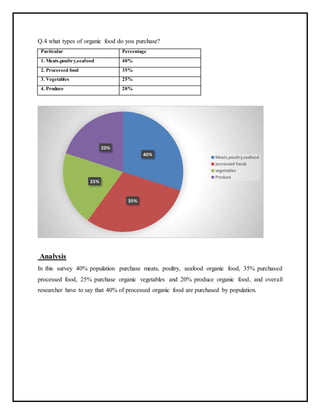
Q.4 what types of organic food do you purchase?
Particular Percentage
1. Meats,poultry,seafood 40%
2. Processed food 35%
3. Vegetables 25%
4. Produce 20%
Analysis
In this survey 40% population purchase meats, poultry, seafood organic food, 35% purchased
processed food, 25% purchase organic vegetables and 20% produce organic food, and overall
researcher have to say that 40% of processed organic food are purchased by population.
40%
35%
25%
20%
Meats,poultry,seafood
processed foods
vegetables
Produce
Q.5 How long have you been interested in organic foods?
Particular Percentage
1. 0 to 6 months 0%
2. 6 to 12 months 11%
3. 1 to 3 yrs. 22%
4. More than 3 year 67%
Analysis
In this survey 67% population are interested in organic food is More than 3 yrs. , 22% are interested
1 to 3 yrs., 11% interested 6 to 12 months only , overall researcher can say that in this survey 67
% population interested inorganic food for life time .
0% 11%
22%
67%
0 to 6 Months
6 to 12 Months
1 to 3 yr.
More than 3 year
Q.6 How did you first hear about organic foods?
particular Percentage
1. Magazine 24%
2. Friends 20%
3. Newspaper 15%
4. Advertisement 4%
5. Internet 22%
6. others 15%
Analysis
In this survey, Most of population heard about organic foods from magazine 24%, 20% from
friends , 15% from newspaper, 22% from internet,15% from others source and only 4% from
advertisement , overall, 46% of population are heard from magazine and internet its good but
further ways like advertisement increase its useful for organic food .
24%
20%
15%
4%
22%
15%
Magazine
Friends
Newspaper
advertisement
Internet
Others
7. In your opinion, what are the most important motivations that will persuade you to buy organic
foods instead of non-organic foods?
1. Most
important
2. Important 3. Neutral 4. least important 5. Not
important
(A) Benefits (52) (23) (13) (12) ( 0 )
(B) Packaging ( 0 ) ( 0 ) (10) (80) (10)
(C) Price (55 ) ( 30 ) ( 15 ) (10 ) ( 0 )
(D) Taste/quality (80 ) (10 ) ( 10) ( 0 ) ( 0 )
(E) Concern about health ( 70 ) ( 30) ( 0 ) ( 0 ) (0 )
Analysis
A. Benefits
In this survey, 51% prefer most important benefits of organic food , 23% population prefer benefits
at 2 no., same 13% prefer benefits at 3 no or 4 no. , % from newspaper, only 4% from advertisement
overall, 51% of population are most important motivations that will persuade to buy organic foods
instead of non-organic foods a benefits.
B. Packaging
In this survey, 100% of population prefer organic food not for packaging.
0%
10%
20%
30%
40%
50%
60%
70%
80%
90%
Benefits Packaging Price Taste/quality Concern about
health
1. Most imp. 2. Important 3. Netrual 4 Least imp. Not important
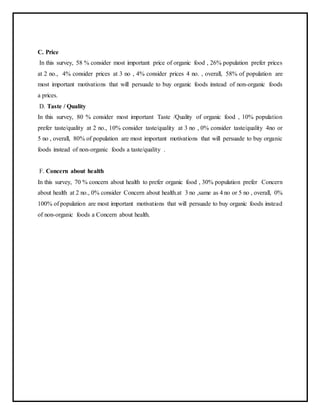
C. Price
In this survey, 58 % consider most important price of organic food , 26% population prefer prices
at 2 no., 4% consider prices at 3 no , 4% consider prices 4 no. , overall, 58% of population are
most important motivations that will persuade to buy organic foods instead of non-organic foods
a prices.
D. Taste / Quality
In this survey, 80 % consider most important Taste /Quality of organic food , 10% population
prefer taste/quality at 2 no., 10% consider taste/quality at 3 no , 0% consider taste/quality 4no or
5 no , overall, 80% of population are most important motivations that will persuade to buy organic
foods instead of non-organic foods a taste/quality .
F. Concern about health
In this survey, 70 % concern about health to prefer organic food , 30% population prefer Concern
about health at 2 no., 0% consider Concern about health.at 3 no ,same as 4 no or 5 no , overall, 0%
100% of population are most important motivations that will persuade to buy organic foods instead
of non-organic foods a Concern about health.
8. Primary reasons you do not purchase organic foods?
1. Most
important
2. Important 3. Neutral 4. least important 5. Not
important
(A) High price (70 ) ( 22 ) ( 6 ) ( 2 ) ( 0 )
(B) Taste is not good (0 ) ( 0 ) ( 0 ) ( 8 ) ( 92 )
(C) Availability ( 50 ) ( 38 ) ( 6 ) ( 6 ) ( 0 )
(D) Low trust ( 0 ) ( 0 ) ( 20 ) ( 35 ) ( 45 )
(E) Poor appearance ( 10 ) ( 5 ) ( 40 ) ( 40 ) ( 5 )
Analysis
A. High price
In this survey, 70% do not purchase organic food for their high prices, 25% population not
purchase organic food for their prices at 2 no., 5% at 3 no, overall, 95% of population are does
not purchase organic food for high price .
B. Taste is not good
In this survey, 90% take a least important at 5no. Taste is not good, 8% at 4 no., 0% at 3 no, overall,
98% of population taste of organic food not good not considered.
0%
10%
20%
30%
40%
50%
60%
70%
80%
90%
100%
High price Taste is not good Availability Low trust Poor appearance
1 Most imp. 2. important 3. netural 4. least imp. 5. Not imp.
C. Availability
In this survey, 50% do not purchase organic food for their no availability, 38% population not
purchase organic food for their availability at 2 no. , 6% at 3 no, overall, 75% of population are
does not purchase organic food for no availability.
D. Low Trust
In this survey, 45% do not purchase organic food for their low trust, 35% population not purchase
organic food for their low trust at 2 no. , 20% at 3 no, overall, 60% of population are does not
purchase organic food for no availability.
E. Poor appearance
In this survey, 40% do not purchase organic food for their poor appearance, 40% population not
purchase organic food for their poor appearance at 3 no. , 10 % at 1 no, overall, 80% of population
are does not consider poor appearance of organic food.
Q.9 How would you describe your overall opinion of organic brands?
particular Percentage
1. Very favorable 60%
2. Somewhat favourable 15%
3. Neutral 15%
4. Somewhat unfavourable 10%
5. Unfavourable 0%
Analysis
In this survey, 60% very favourable overall opinion of organic brand,15% population somewhat
favourable,15 % is neutral ,10% population somewhat unfavarourable their overall opinion of
organic food brands, overall, 60% of population are very favourable opinion of organic brands.
60%
15%
15%
10% 0%
Very favourable
Somewhat favourable
Neutral
Somewhat unfavourable
unfavourable
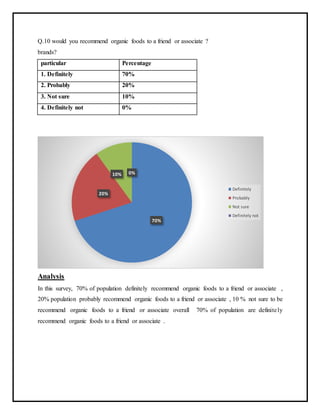
Q.10 would you recommend organic foods to a friend or associate ?
brands?
particular Percentage
1. Definitely 70%
2. Probably 20%
3. Not sure 10%
4. Definitely not 0%
Analysis
In this survey, 70% of population definitely recommend organic foods to a friend or associate ,
20% population probably recommend organic foods to a friend or associate , 10 % not sure to be
recommend organic foods to a friend or associate overall 70% of population are definitely
recommend organic foods to a friend or associate .
70%
20%
10% 0%
Definitely
Probably
Not sure
Definitely not
CHAPTER – VI
FINDING AND RECOMMENDATION
FINDINGS
1. India is strong in high quality production of organic food.
2. Indian population are highly motivation from magazines that will persuade to buy an organic
foods it’s good for health and more beneficial instead of non-organic food.
3. India is high production of organic food but their high prices, no availability as compare to non-
organic food.
4. India has no organic food famous company in the market by which same population has not
heard about organic food through their vast advertisement.
5. In future India’s becomes strongly high quality production and consumption country in the
world.
RECOMMENDATION
The Indian organic market is a typical example for a market in the pre-growth-phase. There will
be soon some relevant players on the domestic market. Those players (individual farmers, framer
groups, middleman, supermarkets, traders and exporters) will certainly try to earn better income
as quickly as possible from the organic market. This fact has to be considered positively. In the
pre-growth-phase, there is already some awareness about food quality and pesticides residues
among consumers. The expression “Organic” is still not protected and the awareness is diffused.
It will be a difficult task to find the right approach to transform this improper awareness in the
correct way among Indian consumers. So it is a very important task at the beginning itself to define
what organic products are, how are they different from conventional products and also to describe
the USP (Unique Selling Position) of organic products.
• Lower Price to Compete with Grocery Stores
– Add a customer rewards program for frequent buyers
– Coupons to customers
• Catering
– Offer catering to local businesses & events
• Expand Private Label Selection
– Lowers manufacturing costs, could offer discounts to customer for using organic
brand products
CHAPTER – VII
CONCLUSION
CONCLUSION
The Indian domestic market there are potential for more and more development in organic food
and become a most important factor of national and international economic system development.
In Delhi domestic market enables producers for better understanding of customers’ needs, serving
the purpose of better meeting their needs and it also enables consumers to realize better organic
products supply.
In international market and domestic market the organic food quality guarantee of organic food
products directly influences consumption intensity, absorption power of the market, packaging
material design, advertising messages, choice of the distribution channel.
BIBLIOGRAPHY
Books
• David Miliband 2002“The organic farming manual”
• Alex avery 2006“The Truth about organic food”
Articles/Newspapers
 “Hafed to market organic products”may,13,2008
 “New tools help developing nations mkt organic products abroad”oct,12,2008
 “Increase in consumption of organic food products” Madhvi sally, may,23,2013
Internet Sites:
 http://www.economictimes.com/news/news-reviews/organic food opportunities
study/article42315.ete
 www.near2nature.com
 www.thedailygreen.com/home/a19703/the-daily-green/
 www.dmoz.org/Business/food_and_realtes.../organic/
 www.naturalnews.com/organic_foodgs.html
Annexure
QUESTIONNAIRE
Age: Above 15yrs 21yrs-50yrs 50yrs above
Monthly Household Income: Below Rs.40,000 Rs.40,000-Rs.80,000 Rs.80,000 above
1. Have you heard about organic food?
Yes No
2. If YES, then what do you perceive/think about organic food?
Pesticides/Chemical free Eco-Friendly
More Nutritious Costly
3. Do you purchase organic food?
Yes No
4. What types of organic food do you purchase? (You can tick more than one)
Produce Processed foods (cereal, etc.)
Meats, Eggs, poultry, seafood Vegetables
5. How long have you been interested in organic foods?
0 to 6 Months 6 to 12 Months 1 to 3 years
More than 3 years
Name: Mobile:
e-mail: Occupation:
6. How did you first hear about organic foods?
Advertisement Magazine Newspaper
Internet Friends Others
7. In your opinion, what are the most important motivations that will persuade you to
buy organic foods instead of non-organic foods?
1(Most Important) 2 3 4 5(Least important)
Benefits
Packaging
Price
Taste/quality
Friends
Concern about health
8. Primary reasons you do not purchase organic foods.
1(Most important) 2 3 4 5(Least import.)
High price
Taste is not good
Low availability
Low trust
Poor appearance
9. How would you describe your overall opinion of organic food brands?
Very favourable somewhat favourable Neutral
Somewhat Unfavorable Unfavorable
10. Would you recommend organic foods to a friend or associate?
Definitely Probably Not sure
Definitely not

excellent project report

  • 1.
    Project Report On CHALLENGES ANDOPPORTUNITY OF ORGANIC FOOD IN INDIA Submitted to M.D University Rohtak in partial fulfillment of the requirement for the award of degree of Master of Business Administration Session: 2014 – 2016 Submitted by: MANU BANSAL Roll no. 160114015 PDM COLLEGE OF ENGINEERING (Sarai Aurangabad, bahadurgarh-124507) MAHARSHI DAYANAND UNIVERSITY, ROHTAK
  • 2.
    DECLARATION I, MANU BANSAL,ROLL NO. 4015 class MBA 4th SEM of PDM college of engineering, bahadurgarh, hereby declare that the project entitled ‘CHALLENGES AND OPPORTUNIY OF ORGANIC IN INDIA’ is an original work and same has not been submitted to any other institution for the award of any other degree. The interim report was presented to the supervisor on__________ and the pre-submission was made on . The feasible suggestion has been duly incorporated in consultation with the supervisor. Countersigned Signature of supervisor Signature of candidate Forwarded by Director/ Principal of the Institute
  • 3.
    ACKNOWLEDGEMENT I am usingthis opportunity to express my gratitude to everyone who supported me throughout the course of this MBA project. I am thankful for their aspiring guidance, invaluably constructive criticism and friendly advice during the project work. I am sincerely grateful to them for sharing their truthful and illuminating views on a number of issues related to the project. I have no words to express my immense gratitude to Dr. Nidhi Mishra who has all along been very kind to researcher for not suggesting the topic of the project but also offering valuable guidance particularly at the time of his personal appointments. I am also extremely thankful to the company management, officers and staff for their cooperation during the study or survey and their responses Dr. Nidhi Mishra and other faculty members of the institute for their continuous encouragement and support. I am also indebted to my father, sister and friends for their immense love and affection, care, concern, and consideration and unstinted support throughout. MANU BANSAL
  • 4.
    TABLE OF CONTENTS DECLARATION  ACKNOWLEDGEMENT 1. INTRODUCTION  Introduction of topic  Overview of current organic food market in India  Growth of organic food in India  Challenges for Organic Farming  Companies marketing strategies for organic food in India 2. Review of literature 3. Objectives of the study 4. Research Methodology 5. Data analysis and interpretation 6. Findings and recommendation 7. Conclusion BIBLIOGRAPHY ANNEXURE
  • 5.
  • 6.
    INTRODUCTION OF TOPIC Organicfoods are foods produced by methods that comply with the standards of organic farming. Standards vary worldwide; however, organic farming in general, features practices that strive to foster cycling of resources, promote ecological balance, and conserve biodiversity. Organizations regulating organic products may choose to restrict the use of certain pesticides and fertilizers in farming. In general, organic foods are also usually not processed using irradiation, industrial solvents or synthetic food additives. Organic cultivation is particularly suitable for a country like India with a huge population of small farmers who still use traditional methods of farming with few agricultural inputs. It is estimated that 65% of the country’s cropped area is organic by default, as the small farmers have no choice but to farm without chemical fertilizers and pesticides as they cannot afford. This default status coupled with India’s inherent advantages, such as, its varied agro-climatic regions, local self- sustaining agri-systems, sizeable number of progressive farmers and ready availability of inexpensive manpower translate into the potential to cultivate a vast basket of products organically. Organic food production is a self-regulated industry with government oversight in some countries, distinct from private gardening. Currently, the European Union, the United States, Canada, Japan, and many other countries require producers to obtain special certification based on government- defined standards in order to market food as organic within their borders. In the context of these regulations, foods marketed as organic are produced in a way that complies with organic standards set by national governments and international organic industry trade organizations. India, a country with a huge number of small farmers who still use traditional methods and do farming with few agricultural inputs. NGOs that promote organic farming and other organizations support farmers in these aspects. An organic movement is now emerging in India on different levels (producer groups, trainers and advisors, certification bodies and processors and traders). So dissemination of information about the opportunities and challenges for Indian organic products on the domestic and international market is of fundamental concern in order to allow continued.
  • 7.
     AN OVERVIEWOF CURRENT ORGANIC FOOD MARKET IN INDIA According to the Indian Competence Centre for Organic Agriculture, the global market for organically produced foods is $26 billion and is estimated to increase to $102 billion by 2020. As part of 10th Five Year Plan (2002-07), the government earmarked Rs 100 crore (Rs 1 billion) for the promotion of sustainable agriculture in the country, but the main components of this initiative have benefited exports, from the establishing of national organic standards under NPOP (National Programme for Organic Production), putting in place a system of certification for products, and establishing APEDA (Agricultural and Processed Food Export Development Authority) as the nodal agency to promote exports opportunities. The organic farming is an old concept in India in terms of the extensive farming carried out in the country. The organic food market is worth USD 129.3 mn and shows huge potential for growth in future. Major products produced in India by organic farming Type ofProduct Products Commodity Tea,Coffee, Rice, Wheat Spices Cardamom, Black pepper,White pepper, Ginger, Turmeric, Vanilla, Tamarind,Clove, Cinnamon,Nutmeg,Mace,Chili Pulses Red gram, Black gram Fruits Mango,Banana,Pineapple,Passion fruit, Sugarcane,Orange,Cashewnut,Walnut Vegetables Okra, Brinjal, Garlic, Onion, Tomato, Potato Oil seeds Mustard,Sesame,Castor,Sunflower Others Cotton,Herbalextracts
  • 8.
    Organic Food Consumptionin India is on the Rise Some people believe that organic food is only a “concept” popular in the developed countries. They think that when it comes to organic food, India only exports organic food and very little is consumed. However, this is not true. Though 50% of the organic food production in India is targeted towards exports, there are many who look towards organic food for domestic consumption. Organic agricultural export market is one of the major drivers of organic agriculture in India. India exports 31 organic products. It is estimated that more than 85% of total organic production, excluding wild herbs from UP and MP, is exported. India is best known as an exporter of organic tea and also has great export potential for many other products. Other organic products for which India has a niche market are spices and fruits. There is also good response for organic rice, vegetable, coffee, cashew, oil seed, wheat and pulses. Among the fruit crops bananas, mangos and oranges are the most preferred organic products. India’s organic export products include, tea, honey, cashew, cotton, processed fruits, coffee, basmati rice, sesame, spices, walnuts, pulses and wheat. Key organic items of export importance are fruits and vegetables, sesame, basmati rice, fruit pulp, fruit juices, spices, cashew, tea, coffee, cotton and wheat. India has production advantages in most of these products. The domestic market is nascent but has huge growth potential. Presently the domestic market for organic products are estimated at 1,200 tonnes and there are around 2-3million potential customers for organic agricultural produce and is growing. Who are the organic consumers? What consumer consider as the “organic consumer” is that person who is responsible for buying food for the household and who buys organic food at least once or twice per month. So, if there are people who buy randomly or less than once a month then they are not considered regular organic consumers.
  • 9.
    Values and behaviorof organic consumers What do organic consumers think, that is, what is in their minds concerning organic products, is a determinant factor of consumer preference for organic food. In spite of taking cognizance, a change in attitude and thinking about organic food is prerequisite, in order to feel confident and positive about this new direction. An organic consumer has more positive beliefs concerning organic products. For example, this product tastes better, is more natural, is healthier-they believe that more than non-organic consumers. They believe that the people who are important to them, people who are close to them, also by organic products- they believe that it is a good thing that they buy organic products. The other aspect of what the organic consumer think, as compared to non-organic consumers, is their moral norms indicate they are doing a very good thing for the environment, the right thing for society. This is something that differences them from non-organic consumers. Non-organic purchases do not associate those beliefs to buy organic products. Consumers’ values to make a choice for organic food can be seen in two terms-use values, such as utility from taste, health and freshness, i.e., private good attributes which can only be enjoyed by actually consuming the product. The other non-use values are public good values related to improved environment and animal welfare. The majority of all consumers-acknowledges and value organic goods for their non-use values (environmental or animal welfare attributes), as well as for their use values (health, taste or freshness attributes). The group of consumers having use values only is negligible. In the same way that most people agree exercise- is important; they also agree that a sustainable, clean environment is important. Contract farming for organic crop production in India Indian agriculture is progressing in all spheres to keep up with the ever-increasing population. In the Tenth Five-Year Plan (2002-07), the government envisaged at least 4% growth rate per annum, so that food security is assured and employment opportunities in agriculture are created. The
  • 10.
    National Agricultural Policyalso aimed to strengthen the national economic growth through efficient marketing to accelerate foreign exports by establishing Agri-Export Zones for various crops in major crop-growing areas, where technical know-how and facilities for export will be provided. Therefore, there is a shift from sustainable to commercial agriculture. Farmers can increase their income from crop production. Similarly, in several developed countries, demand for organic food and fibre, and by-products is increasing day-by-day. This change is mainly due to overuse or misuse of chemicals, particularly synthetic insecticides, fungicides, herbicides, fertilizers, plant growth regulators, etc. that resulted in undesirable side effects not only in the agro- ecosystems, but also on human health and life systems of beneficial fauna and microorganisms. These recent trends in consumerism have opened a new vista for agricultural production on large scale by adopting contract farming, which can transform small farmers into viable commercial producers by monitoring quality, quantity and cost of crop production, and can link production with the consumption. This change can help develop markets and bring about changes in the present conventional agriculture which is expected in India in near future. This note therefore discusses the present situation and future strategies of community cultivation. Needfor contract farming in organic agriculture The organic agriculture includes growing of crops by a set of guidelines that prohibit the use of synthetic products/chemicals such as fertilizers, pesticides, plant growth promoters and livestock additives. Therefore, soil fertility and pest management is achieved through cropping patterns (rotations, inter/mix-crops, pest and disease- resistant genotypes), manure (green manufacturing, organic manures, compost), biofertilizers, cultural practices (weeding, planting, conventional tillage) and biopesticides, including plant-derived products. At present, this system seems to be an ideal and valid solution to produce food and fibre without chemicals and to protect the environment. Further, consumers are becoming conscious and critical about the quality of food and by-products that affect their health though the toxicity depends, to some extent, on the type of food consumed. India being one of the signatories for the World Trade Organization, liberalization, privatization and globalization has opened new grounds for agricultural marketing. The National programme for Organic Production of the Commerce Ministry and the State Governments are actively promoting investment in support of promising ventures in organic agriculture.
  • 11.
    Considering the presentsocio-economic status of Indian farmers, contract farming seems to be an ideal option because this system would have certain advantages over the present crop production and marketing systems, such as: 1. Profit in produce sale is possible by capitalizing the scientific research in post-harvest technologies. 2. Indian agriculture is becoming commercial due to global demand for a variety of foods and fibre, and food products. 3. Any crop can be cultivated on a large area to obtain produce of uniform quality by adopting appropriate technology. Crop production is also possible on small land-holdings through cooperative/ corporate farming to enhance productivity and avoid admixture or inferior quality produce. 4. Technology transfer becomes easier due to large-scale adoption. 5. Risk involved due to fluctuation in market price is minimized. This point is relevant to the present strategy of farm economics as the Minimum Support Price is generally declared at the end of crop season and it often remains ambiguous. 6. Commercial and nationalized banks are coming forward to finance contract farming through soft loans and are revising prime lending rates. 7. Additional income from intercrops is certain due to crop diversification. Consolidation of small and marginal lands can make farming economically viable, resulting in higher (>30%) net returns than traditional/conventional farming systems.
  • 12.
     Growth oforganic food in India ACNielsen, a leading market research firm, recently surveyed about 21,000 regular Internet users in 38 countries to find their preference for functional foods – foods that have additional health benefits. The survey revealed that India was among the top ten countries where health food, including organic food, was demanded by the consumers. The most important reason for buying organic food was the concern for the health of children, with over 66 percent parents preferring organic food to non organic food. Though organic food is priced over 25 percent more than conventional food in India, many parents are willing to pay this higher premium due to the perceived health benefits of organic food. The increase in organic food consumption in India is evident from the fact that many organic food stores are spurring up in India. Today (2006) every supermarket has an organic food store and every large city in India has numerous organic food stores and restaurants. This is a huge change considering that the first organic food store in Mumbai was started in 1997. However, the Indian organic food consumer needs education. There are many consumers who are unaware of the difference between natural and organic food. Many people purchase products labeled as Natural thinking that they are Organic. Further, consumers are not aware of the certification system. Since certification is not compulsory for domestic retail in India, many fake organic products are available in the market.  Challenges forOrganic Farming (i) Organic farming on basis requires a long-term approach as it is based on the trust of farmers, for which grass root intervention is critical for its success. (ii) If it is not profitable to both parties, the written agreement becomes a useless effort. Thus, responsibilities of both parties should be fulfilled. The agreements differ according to the commodity produced by contracting farmers. Generally, farmers may not take cognizance at the
  • 13.
    time of signingof the clauses that might be exploitative in short or long term; such agreements can jeopardize investments and interest. (iii) Although 44% of the country’s GDP comes from retailing, retail marketing of organic food is limited compared to other countries, e.g. 85% in USA, 40% in Thailand, 35% in Brazil, 20% in China and only 2% in India . (iv) Convincing farmers about the economic benefits of contract farming through field demonstrations should be taken up urgently. This may consist of educating farmers about new farming techniques, marketing skills for organic food and fibre, seeking cooperation from business communities and firms, informing consumers about the ill-effects of chemicals, etc. (v) Certification cost for organic produce is comparatively high and needs to be reduced drastically. (vi) Facilities for storing and verification of quality of agricultural commodities at village level are lacking. (vii) Participation of processing firms/ purchasers is limited, as they are not aware of the long-term benefits and they also need large areas, which is difficult in regions where small and fragmented land-holdings are common. (viii) Banks are ready to finance contract farming in organic agriculture to only those farmers who are not defaulters. (ix) Under unfavorable climatic conditions, the quality of farm produce cannot be maintained or the whole crop may fail. Crop insurance initiated by the Government needs to be implemented on a large scale. India can take advantage of the growing opportunities in this sector making use of its varied agro-climatic conditions and traditional organic resources and farming practices. There are
  • 14.
    certain challenges tobe met before India takes on to the world organic markets. The Indian produce has to create a competitive niche in global markets. The challenges in international marketing of organic food are standardization of products according to the customers’ tastes and preferences, certification, consumer education, branding and promotion. Production of organic products also face challenges with regard to availability of right and quality inputs, research and dissemination of appropriate technologies, processing, certification, production information and infrastructure support and also policies of the government need to be revisited to fulfill its objectives to tap global organic markets. Therefore, the study is based on the strategic analysis of Indian organic product industry with respect to global markets.  Companies marketing strategies for organic food in India
  • 15.
    Organic food asa product is the most important marketing-mix variable. Before organic food producers enter the organic product market, they should be prepared to correspond best to the wishes of their consumers by the design, purpose and function. What organic food consumers are most interested in are the following items: production program, product quality, packaging material, packing, product labeling, and price setting. This is closely related to the product image that implies everything a consumer creates about the product as an image, atmosphere or a feeling. Orientation towards consumers intensifies problems regarding relevant factors in the design of the production program as a means to satisfy consumers in a demanding and competitive battle on the market and achieve goals in that way.  Product – High Quality Natural and Organic Food – Offerings vary based on store size and tastes of local clientele – Private label products – Emphasis on daily foods Price as marketing-mix of organic food Price makes the second element of marketing-mix, which brings income, while other marketing- mix elements represent costs. The product price must be in line with product’s basic characteristics and features. Thus, it must closely correspond to product’s quality, design, packaging, etc., exemplifying at the same time the realized productivity.  Price – Goal is competitive price at highest quality – Organic foods are 25 – 75% more costly to grow and market – Price and Quality are competing forces – Near2Nature chooses to focus on Quality, therefore prices are higher than conventional grocers
  • 16.
     Place – Nostandard store design. Layout customized for site and product mix. – Presentation • Highly regarded food displays, cleanliness, wide aisles Promotion of organic food Due to the easier and quicker access of potential consumers to the relevant information on organic food entering the market, i.e. in order to help customers decide on the purchase of certain organic products, producers advertise their products in media.  Promotion – Primarily rely on word-of-mouth recommendations – 0.5% of revenue spent on advertising – Most marketing spend is for in-store signage and events – Store personnel is knowledgeable and personable STRENGTHS AND WEAKNESSES OF ORGANIC FOOD COMPANIES IN INDIA STRENGTHS  Highest Quality Organic Foods Seller  Huge selection/variety  Free Home delivery  First Mover in organic products  Eco-Friendly The export of Indian organic products is progressing. The Government support to organic agriculture, awareness for healthy food harmful effects of pesticides and presence of their
  • 17.
    residues. International andnational certification bodies in India- these four facts are the dominating strengths. WEAKNESSES  Price – up to 75% higher  Locations – only in affluent areas  Advertising Budget very low (WOM approach)  Promotional Offers – no coupons  Certification Major weaknesses are on the level of information/awareness: most farmers have only small holdings and quality consciousness is low besides lack of marketing skills (e.g. disjointed sector for the domestic market). Another weakness to be noted is that the organic market is not consumer demand -based, but supply driven. From this fact a lot of threats can be derived. OPPORTUNITIES  Expand private label selection – lower price for customers  Advertise more, create coupons and promotions to get people in the store  Hype right now is to eat healthier and protect the environment  Rewards program – frequent buyer cards  Back to Basics – buy more local products that people will pay more for. To quantify the potential of the organic products is not simple because the fast development of the Indian society and economy. For further progress, more information should be gathered on the market opportunities. Nevertheless, the need assessment shows that on the level of the opportunities, a considerable potential for the organic market exists, even though the size of the potential cannot be quantified exactly.
  • 18.
    THREATS  Conventional Supermarkets Bad Economy  Local Farmers Markets/Independent Retail Chains Some of the major threats are really dangerous. The awareness about pesticide residues is to be considered as strength. However, a bigger threat is that all kind of products are offered under declarations like “without pesticides”, “eco-friendly” or even “organic”.  HISTORICAL PROSPECTIVES  In 1939, Lord North borne coined the term organic farming in his book Look to the Land (1940), out of his conception of "the farm as organism.  This is different from the scientific use of the term "organic," to refer to a class of molecules that contain carbon, especially those involved in the chemistry of life.  It was with the advent of the ‘green revolution’ that the natural way of growing crops started becoming unpopular and economically less feasible.  Organic food farming continued in small, mostly family-run, farms or kitchen gardens where people grew food for their own requirements.  The produce was sold in farmer’s markets. Large scale organic farming was begun by farmers and scientists, as a mark of protest to the agriculture industrialization.  Now, organic food is widely available and has become very popular, with soaring sales.
  • 19.
     LIST OFORGANIC FOOD COMPANIES IN INDIA 1. Fabindia Overseas Ltd. Address: New Delhi, Gurgaon 2. Sapthsathi organic agriculture project (Surendra Kumar Tiwari) Manufacturers of Organic Food Grains Address: 414, 5th Floor Onam Plaza A.b. Road Old Palasiya, Indore, Madhya Pradesh 3. Ishan herbotech international (Nidhi Maheshwari) Manufacturers of Herbal Tea and all types of tea like Assam, Green, Organic, Black, White, Organic Food. Address: D-10, Export Promotion Industrial Park, Site-V, Kasna, Greater Noida, Gautam Budh Nagar, Uttar Pradesh 4. Nblc stores (Arun Bagga) Manufacturers of Fibre Biscuits, Herbs, Aloe Vera Juice, Roasted Namkeen, Organic Foods. Address: D-144 Shankar Rd. Mkt. New Rajinder Nr. New Delhi-60
  • 20.
    5. Value plus(J.p.chauhan) Manufacturer of Organic and Natural Food. Address: G-92, Time Square, Vidhyadhar Nagar, JAIPUR, Rajasthan 6. Jayvin organic foods (Mr. Nitin Bhad) Manufacturers of Organic Food, Wheat, Raw Cotton, Maize, Soya, Vegetable, Banana, Orange, Pomegranate, Mango, Sugar and Jaggary. Address: LG- 46, Orbit Mall, AB Road, Indore, Madhya Pradesh 7. A plus inc. (Manager) Manufacturers of Straw Furniture, Terracotta Paintings, Wooden Carving, Spices, Pulses, Organic Food, Tin Food and Pickle Address: A-99, New Palam Vihar, Gurgaon, Haryana 8. Himalayan healthfood (Gutzeit) Manufacturers of Organic Health Food. Address: Main Road, Kullu, Himachal Pradesh
  • 21.
  • 22.
    Literature review Introduction 1. (Woeseet al.1997) – Organic consumers demand and market issues Interest in organically produced food is increasing throughout the world in response to concerns about conventional agricultural practices, food safety and human health concerns important organic consumer demand and marketing issues, including: (i) the implications of an economic definition of organically grown food for consumer demand; (ii) attributes that shoppers consider most when comparing organic with conventionally grown products; (iii) level and characteristics of consumer knowledge and awareness about organic food; (iv) assessment methods and characteristics of organic consumer attitudes and preferences; (v) size of organic price premium and characteristics of consumers’ willingness-to-pay for organic products; and (vi) profile of organic consumers. Such a comparison across studies, and for various countries, is not only important in its own right, but also provides a better understanding of the economic and noneconomic variables to include in organic consumer demand modeling and estimation. An economic perspective of organic products as economic goods precedes a comparison of selected consumer decision-making dimensions of organic product. 2. (Vindigni et. al, 2002) - Comparison of Organic and Conventionally-Produced Food Although the attributes associated with organic foods may be difficult to identify by visual inspection alone, most consumers purchase organic products because of a perception that these products have unique (and in some cases superior) attributes compared to conventionally grown alternatives. On the other hand, a major reason why some consumers do not purchase organic foods is linked to a perception that such foods are not better than their conventionally produced alternatives. There is, thus, a continuing debate about whether organically produced products are superior to and/or different from conventionally produced alternatives and, if so, in terms of what characteristics. Several studies have assessed whether there are differences between organic and conventional foods from the perspective of both the producer (or supply-side) and the consumer (or demand-side). Supply-side evaluations have generally focused on yield, producer price, and profitability comparisons. In contrast, demand-side studies have investigated the differences in terms of biophysical and chemical (e.g., nutritive, sensory, and food safety) characteristics, as well as consumer preferences and retail prices. An assessment of key findings from various studies is
  • 23.
    provided in thissection. 3. (Gunter and Furnham, 1992) - Production, Producer Price, and Profitability Comparison A supply side assessment of the differences between organic and conventional products is important especially for environmentalists and humanists or for consumers who have an “external orientation” and tend to respond to the social benefits or impacts of increased organic production. Such consumers believe that conventional production systems can generate off-site effects, with negative impacts on society. Other consumers choose to reward producers who such consumers perceive to be using, environmentally friendly production methods. Increases in the supply of organic products will, ceteris paribus, lower price premiums, thereby affecting consumer demand and profitability of the organic industry. 4. (Bourn and Prescott, 2002) - Nutritive, Sensory and Food Safety Comparison Nutritive, sensory and food safety attributes influence consumer choice between organic versus conventionally produced foods. Several studies have therefore compared organic and conventionally produced foods using such attributes. There are several noneconomic attributes that shoppers consider when comparing organic produce with conventionally grown alternatives. Although shoppers generally link produce quality with its appearance reported a relationship between consumer willingness to accept blemishes and organic produce purchase behaviour. In general, appearance tends to be less important among consumers with a high preference for organic and pesticide-free products. Product taste (i.e. flavour), freshness and shelf life are other characteristics that shoppers consider in their purchase decisions. 5. (MacEachern 1990) - Consumer Awareness and Knowledge about Organic Food The environmental ethic that gained worldwide prominence with Earth Day 1990 placed emphasis on individual responsibility (for personal health) and social action (on environmental quality and animal welfare). Personal responsibilities include making informed consumer choices. This, in turn, requires consumer knowledge and awareness about competing products. Knowledge and awareness have other direct and indirect effects on attitudes toward consumer products, and the willingness to pay a price premium.
  • 24.
    6. (Grossman, 1972)- Willingness-To- Pay for Organic Products The willingness-to-pay (WTP) for particular food attributes is linked to an observation that consumers make trade-offs for improved attributes associated with consuming particular products. A WTP also reflects an observation that individual preferences are unique. Given that yields are generally lower for organic production than for conventional production, consumer willingness- to-pay a price premium for organic products is an important determinant of organic farm profitability and long-term financial sustainability. The magnitude of the price mark-up is also important because it helps in assessing the value consumers place on particular product attributes. A price premium on organic produce can signal differences in product attributes and characteristics and, therefore, is an important search attribute for hedonists REFERENCE  Woese, K., Lange, D., Boess, C. and Bogl, K.W. 1997. A comparison of organically and conventionally grown foods - results of a review of the Relevant Literature. Journal of Science Food and Agriculture. 74: 281-293.  Vindigni, G., Janssen, M.A. and Jager, W. 2002. Organic food consumption: A multi- theoretical framework of consumer decision making. British Food Journal. 104(8): 624-642.  Gunter, G., and A. Furnham. 1992. Consumer Profiles: An Introduction to Psychographics. Routledge: London16 (1): 63-72.  Bourn, D. and Prescott, J. 2002. A comparison of the nutritional value, sensory qualities and food safety of organically and conventionally produced foods. Critical Reviews in Food Science and Nutrition. 42(1): 1-34.  MacEachern, D. 1990. Save Our Planet – 750 Everyday Ways You Can Help Clean Up the Earth. New York: Dell Publishing Co. 10(3): 108-113.  Grossman, M. 1972. On the concept of health capital and the demand for health. Journal of Political Economy. 80(2): 223-255
  • 25.
  • 26.
    Objectives of thestudy 1. To analyze the potential for organic products in the Indian domestic market; 2. To identify the necessary steps to develop the Delhi domestic market 3. To assess demand and requirements in the international market and identify measures to improve the quality of Indian organic products in line with international market requirements. 4. To formulate strategies for both domestic and international market with the specific purpose of market access for small and medium size farmers and enterprises.
  • 27.
  • 28.
    RESEARCH METHODOLOGY Since itis basically a market research project along with some marketing and selling of organic products, various market research methods were used to accomplish its goals. I conducted a market survey to know about the consumer behavior towards organic foods in India. The stepwise methodology that was used is: RESEARCH DESIGN USED: DESCRIPTIVE SAMPLE SIZE USED: 100 SOURCES OF DATA: PRIMARY (Questionnaire & Interview method) SECONDARY (Newspapers, Brochures, Manual report) EVALUATION & ANALYSIS PROCESS: Studying the company’s process of job satisfaction of employees, questionnaire is designed for that purpose. Analysis is done graphically & evaluated in terms of percentage. The findings, conclusion, suggestion, analysis of the report is based on the primary data collected through survey method and the secondary data collected by me. For the survey of “job satisfaction to employees in the methodology adopted is of “Personal Interview ”.For the purpose of survey, interviews were taken personally of the employees both on the basis of structures & unstructured from. Then further analysis & interpretation of collected data were made & finally report is being prepared. The secondary data is collected through various magazines, books, company’s personnel manual, annual reports and the calendar of event published by the various training agencies  A pilot survey was conducted before finalizing the questionnaire.  Data collection was also done with the help of personal observation.  After completion of survey the data was analyzed and conclusion was drawn.  At the end all information was compiled to complete the project report.
  • 29.
    SAMPLE AREA: atDelhi. Secondary Research: Company description was obtained through websites, business magazines, and journals and from the organization itself Sampling: Selecting the sample: Population that was taken as a sample included randomly selected customers of organic foods. Sampling Technique: Simple Random Sampling Primary Research: Primary research was conducted through surveys via: a. Interaction with customers at Malls and other market places. b. Interaction with customers at their homes. Preparation and tabulation of data: After the data has been collected, it was entered into Microsoft Excel and was prepared for analysis. Data Analysis: The data so collected was analyzed in Microsoft Excel with the help of bar diagrams, pie charts, etc. Finally, the information thus obtained from the survey was used to discover the potential segment for generating new business for the organization and thereby devise strategies to generate new business from that potential segment.
  • 30.
    CHAPTER - V DATAANALYSIS AND INTERPRETATION
  • 31.
    DATA ANALYSIS ANDINTERPRETATION PART A: General Information AGE GROUPS Particular Percentage Below 20 yrs. 20% 20 yrs. to 50 yrs. 60% Above 50 yrs. 20% Analysis In this survey I found that 60% of population age between 20 yrs.to 50 yrs., 20% of population age between 20 yrs. to 50 yrs. and 20% of population age above 50 yrs. 20% 60% 20% AGE GROUP Below 20 yrs. 20 yrs. to 50 yrs. Above 50 yrs.
  • 32.
    OCCUPATION Particular Percentage House wife25% Business man 25% Doctors 20% Others 30% Analysis In this survey 25% of House-wife, 25% of Businessman, 20% of Doctors, 25% of Employers and 30% others fill-up the questionnaires. 25% 25%20% 30% OCCUPATION House-wife Businessman Doctors Others
  • 33.
    MONTHLY HOUSE-HOUSE INCOME ParticularPercentage Below 40,000 32% 40,000-80,000 36% Above 80,000 32% Analysis In this survey Below 40000 income earning is 32%, 40000-80000 income is 36% and above 80000 is 32% monthly house hold income person fill up the questioners. 32% 36% 32% MONTHLY HOUSE -HOLD INCOME Below 40000 40000 -80000 Above 80000
  • 34.
    PART B: Informationabout Organic food Q.1 Have you heard about organic food? Particular Percentage Yes 60% No 40% Analysis In this survey Researcher founded 60% of population are heard about organic food, only 40% of population not heard about organic food. In this way Researcher say that most of population heard about organic food. 60% 40% YES NO
  • 35.
    Q.2 If YES,then what do you perceive /think about organic food? particular Percentage 1. More nutritious 43% 2. Pesticides/chemical free 40% 3.Eco friendly 11% 4. Costly 6% Analysis In this survey 43% perceive the organic food is more nutritious , 40% perceive the organic food for pesticides/chemical free , 11% for ecofriendly, 6% think its costly, overall the researcher have to say that 94% population knows organic food good for our body. 43% 40% 11% 6% More nutritious pesticides/chmical free Eco friendly costly
  • 36.
    Q.3 Do youpurchase organic food? Particular Percentage Yes 41% No 59% Analysis In this survey 59% population purchased organic food, 41% not purchase organic food yet its costly or many reasons. Overall researcher can say that 59% population purchased organic food and its increase day by day. 41% 59% Yes No
  • 37.
    Q.4 what typesof organic food do you purchase? Particular Percentage 1. Meats,poultry,seafood 40% 2. Processed food 35% 3. Vegetables 25% 4. Produce 20% Analysis In this survey 40% population purchase meats, poultry, seafood organic food, 35% purchased processed food, 25% purchase organic vegetables and 20% produce organic food, and overall researcher have to say that 40% of processed organic food are purchased by population. 40% 35% 25% 20% Meats,poultry,seafood processed foods vegetables Produce
  • 38.
    Q.5 How longhave you been interested in organic foods? Particular Percentage 1. 0 to 6 months 0% 2. 6 to 12 months 11% 3. 1 to 3 yrs. 22% 4. More than 3 year 67% Analysis In this survey 67% population are interested in organic food is More than 3 yrs. , 22% are interested 1 to 3 yrs., 11% interested 6 to 12 months only , overall researcher can say that in this survey 67 % population interested inorganic food for life time . 0% 11% 22% 67% 0 to 6 Months 6 to 12 Months 1 to 3 yr. More than 3 year
  • 39.
    Q.6 How didyou first hear about organic foods? particular Percentage 1. Magazine 24% 2. Friends 20% 3. Newspaper 15% 4. Advertisement 4% 5. Internet 22% 6. others 15% Analysis In this survey, Most of population heard about organic foods from magazine 24%, 20% from friends , 15% from newspaper, 22% from internet,15% from others source and only 4% from advertisement , overall, 46% of population are heard from magazine and internet its good but further ways like advertisement increase its useful for organic food . 24% 20% 15% 4% 22% 15% Magazine Friends Newspaper advertisement Internet Others
  • 40.
    7. In youropinion, what are the most important motivations that will persuade you to buy organic foods instead of non-organic foods? 1. Most important 2. Important 3. Neutral 4. least important 5. Not important (A) Benefits (52) (23) (13) (12) ( 0 ) (B) Packaging ( 0 ) ( 0 ) (10) (80) (10) (C) Price (55 ) ( 30 ) ( 15 ) (10 ) ( 0 ) (D) Taste/quality (80 ) (10 ) ( 10) ( 0 ) ( 0 ) (E) Concern about health ( 70 ) ( 30) ( 0 ) ( 0 ) (0 ) Analysis A. Benefits In this survey, 51% prefer most important benefits of organic food , 23% population prefer benefits at 2 no., same 13% prefer benefits at 3 no or 4 no. , % from newspaper, only 4% from advertisement overall, 51% of population are most important motivations that will persuade to buy organic foods instead of non-organic foods a benefits. B. Packaging In this survey, 100% of population prefer organic food not for packaging. 0% 10% 20% 30% 40% 50% 60% 70% 80% 90% Benefits Packaging Price Taste/quality Concern about health 1. Most imp. 2. Important 3. Netrual 4 Least imp. Not important
  • 41.
    C. Price In thissurvey, 58 % consider most important price of organic food , 26% population prefer prices at 2 no., 4% consider prices at 3 no , 4% consider prices 4 no. , overall, 58% of population are most important motivations that will persuade to buy organic foods instead of non-organic foods a prices. D. Taste / Quality In this survey, 80 % consider most important Taste /Quality of organic food , 10% population prefer taste/quality at 2 no., 10% consider taste/quality at 3 no , 0% consider taste/quality 4no or 5 no , overall, 80% of population are most important motivations that will persuade to buy organic foods instead of non-organic foods a taste/quality . F. Concern about health In this survey, 70 % concern about health to prefer organic food , 30% population prefer Concern about health at 2 no., 0% consider Concern about health.at 3 no ,same as 4 no or 5 no , overall, 0% 100% of population are most important motivations that will persuade to buy organic foods instead of non-organic foods a Concern about health.
  • 42.
    8. Primary reasonsyou do not purchase organic foods? 1. Most important 2. Important 3. Neutral 4. least important 5. Not important (A) High price (70 ) ( 22 ) ( 6 ) ( 2 ) ( 0 ) (B) Taste is not good (0 ) ( 0 ) ( 0 ) ( 8 ) ( 92 ) (C) Availability ( 50 ) ( 38 ) ( 6 ) ( 6 ) ( 0 ) (D) Low trust ( 0 ) ( 0 ) ( 20 ) ( 35 ) ( 45 ) (E) Poor appearance ( 10 ) ( 5 ) ( 40 ) ( 40 ) ( 5 ) Analysis A. High price In this survey, 70% do not purchase organic food for their high prices, 25% population not purchase organic food for their prices at 2 no., 5% at 3 no, overall, 95% of population are does not purchase organic food for high price . B. Taste is not good In this survey, 90% take a least important at 5no. Taste is not good, 8% at 4 no., 0% at 3 no, overall, 98% of population taste of organic food not good not considered. 0% 10% 20% 30% 40% 50% 60% 70% 80% 90% 100% High price Taste is not good Availability Low trust Poor appearance 1 Most imp. 2. important 3. netural 4. least imp. 5. Not imp.
  • 43.
    C. Availability In thissurvey, 50% do not purchase organic food for their no availability, 38% population not purchase organic food for their availability at 2 no. , 6% at 3 no, overall, 75% of population are does not purchase organic food for no availability. D. Low Trust In this survey, 45% do not purchase organic food for their low trust, 35% population not purchase organic food for their low trust at 2 no. , 20% at 3 no, overall, 60% of population are does not purchase organic food for no availability. E. Poor appearance In this survey, 40% do not purchase organic food for their poor appearance, 40% population not purchase organic food for their poor appearance at 3 no. , 10 % at 1 no, overall, 80% of population are does not consider poor appearance of organic food.
  • 44.
    Q.9 How wouldyou describe your overall opinion of organic brands? particular Percentage 1. Very favorable 60% 2. Somewhat favourable 15% 3. Neutral 15% 4. Somewhat unfavourable 10% 5. Unfavourable 0% Analysis In this survey, 60% very favourable overall opinion of organic brand,15% population somewhat favourable,15 % is neutral ,10% population somewhat unfavarourable their overall opinion of organic food brands, overall, 60% of population are very favourable opinion of organic brands. 60% 15% 15% 10% 0% Very favourable Somewhat favourable Neutral Somewhat unfavourable unfavourable
  • 45.
    Q.10 would yourecommend organic foods to a friend or associate ? brands? particular Percentage 1. Definitely 70% 2. Probably 20% 3. Not sure 10% 4. Definitely not 0% Analysis In this survey, 70% of population definitely recommend organic foods to a friend or associate , 20% population probably recommend organic foods to a friend or associate , 10 % not sure to be recommend organic foods to a friend or associate overall 70% of population are definitely recommend organic foods to a friend or associate . 70% 20% 10% 0% Definitely Probably Not sure Definitely not
  • 46.
    CHAPTER – VI FINDINGAND RECOMMENDATION
  • 47.
    FINDINGS 1. India isstrong in high quality production of organic food. 2. Indian population are highly motivation from magazines that will persuade to buy an organic foods it’s good for health and more beneficial instead of non-organic food. 3. India is high production of organic food but their high prices, no availability as compare to non- organic food. 4. India has no organic food famous company in the market by which same population has not heard about organic food through their vast advertisement. 5. In future India’s becomes strongly high quality production and consumption country in the world.
  • 48.
    RECOMMENDATION The Indian organicmarket is a typical example for a market in the pre-growth-phase. There will be soon some relevant players on the domestic market. Those players (individual farmers, framer groups, middleman, supermarkets, traders and exporters) will certainly try to earn better income as quickly as possible from the organic market. This fact has to be considered positively. In the pre-growth-phase, there is already some awareness about food quality and pesticides residues among consumers. The expression “Organic” is still not protected and the awareness is diffused. It will be a difficult task to find the right approach to transform this improper awareness in the correct way among Indian consumers. So it is a very important task at the beginning itself to define what organic products are, how are they different from conventional products and also to describe the USP (Unique Selling Position) of organic products. • Lower Price to Compete with Grocery Stores – Add a customer rewards program for frequent buyers – Coupons to customers • Catering – Offer catering to local businesses & events • Expand Private Label Selection – Lowers manufacturing costs, could offer discounts to customer for using organic brand products
  • 49.
  • 50.
    CONCLUSION The Indian domesticmarket there are potential for more and more development in organic food and become a most important factor of national and international economic system development. In Delhi domestic market enables producers for better understanding of customers’ needs, serving the purpose of better meeting their needs and it also enables consumers to realize better organic products supply. In international market and domestic market the organic food quality guarantee of organic food products directly influences consumption intensity, absorption power of the market, packaging material design, advertising messages, choice of the distribution channel.
  • 51.
    BIBLIOGRAPHY Books • David Miliband2002“The organic farming manual” • Alex avery 2006“The Truth about organic food” Articles/Newspapers  “Hafed to market organic products”may,13,2008  “New tools help developing nations mkt organic products abroad”oct,12,2008  “Increase in consumption of organic food products” Madhvi sally, may,23,2013 Internet Sites:  http://www.economictimes.com/news/news-reviews/organic food opportunities study/article42315.ete  www.near2nature.com  www.thedailygreen.com/home/a19703/the-daily-green/  www.dmoz.org/Business/food_and_realtes.../organic/  www.naturalnews.com/organic_foodgs.html Annexure QUESTIONNAIRE
  • 52.
    Age: Above 15yrs21yrs-50yrs 50yrs above Monthly Household Income: Below Rs.40,000 Rs.40,000-Rs.80,000 Rs.80,000 above 1. Have you heard about organic food? Yes No 2. If YES, then what do you perceive/think about organic food? Pesticides/Chemical free Eco-Friendly More Nutritious Costly 3. Do you purchase organic food? Yes No 4. What types of organic food do you purchase? (You can tick more than one) Produce Processed foods (cereal, etc.) Meats, Eggs, poultry, seafood Vegetables 5. How long have you been interested in organic foods? 0 to 6 Months 6 to 12 Months 1 to 3 years More than 3 years Name: Mobile: e-mail: Occupation:
  • 53.
    6. How didyou first hear about organic foods? Advertisement Magazine Newspaper Internet Friends Others 7. In your opinion, what are the most important motivations that will persuade you to buy organic foods instead of non-organic foods? 1(Most Important) 2 3 4 5(Least important) Benefits Packaging Price Taste/quality Friends Concern about health 8. Primary reasons you do not purchase organic foods. 1(Most important) 2 3 4 5(Least import.)
  • 54.
    High price Taste isnot good Low availability Low trust Poor appearance 9. How would you describe your overall opinion of organic food brands? Very favourable somewhat favourable Neutral Somewhat Unfavorable Unfavorable 10. Would you recommend organic foods to a friend or associate? Definitely Probably Not sure Definitely not