Dr. Narasimha Reddy Donthi
Public Policy Reviewer
3 AGRI-MARKET REFORM
BILLS :TRISHUL EFFECT
ON 3
Market Support by Government
Regulation of markets
Input subsidies
Minimum Support Price
Food subsidies
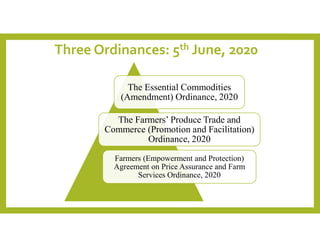
Three Ordinances: 5th June, 2020
The Essential Commodities
(Amendment) Ordinance, 2020
The Farmers’ Produce Trade and
Commerce (Promotion and Facilitation)
Ordinance, 2020
Farmers (Empowerment and Protection)
Agreement on Price Assurance and Farm
Services Ordinance, 2020
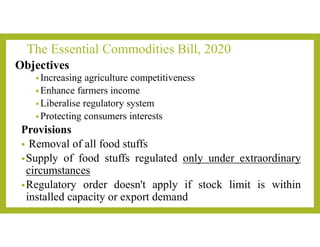
The Essential Commodities Bill, 2020
Objectives
• Increasing agriculture competitiveness
• Enhance farmers income
• Liberalise regulatory system
• Protecting consumers interests
Provisions
• Removal of all food stuffs
•Supply of food stuffs regulated only under extraordinary
circumstances
•Regulatory order doesn't apply if stock limit is within
installed capacity or export demand
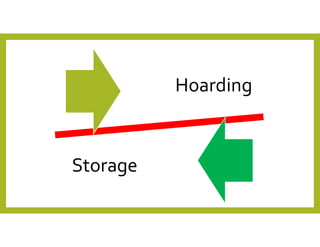
Hoarding
Storage
PreviousAmendments to EC
• 67 control orders between 1972 and 2020
• 5 orders from 1972-78
• 0 orders from 1978-2002
• 8 orders in 2009 alone
• With effect from 15 February 2002, 11 classes of commodities in full and one in part
removed from the list of essential commodities declared earlier.
• Removal of Licensing requirements, Stock limits and Movement Restrictions on
Specified Foodstuffs Order, 2002
• Dealers allowed to freely buy, stock, sell, transport, distribute, dispose, etc., any
quantity
• Wheat, paddy/rice, coarse grains, sugar, edible oilseeds and edible oils, without
requiring any license or permit under any order issued under the Act.
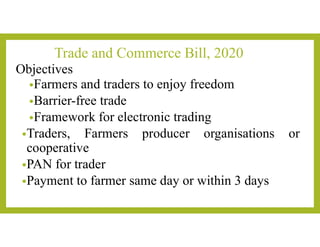
Trade and Commerce Bill, 2020
Objectives
•Farmers and traders to enjoy freedom
•Barrier-free trade
•Framework for electronic trading
•Traders, Farmers producer organisations or
cooperative
•PAN for trader
•Payment to farmer same day or within 3 days
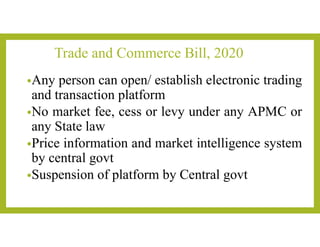
Trade and Commerce Bill, 2020
•Any person can open/ establish electronic trading
and transaction platform
•No market fee, cess or levy under any APMC or
any State law
•Price information and market intelligence system
by central govt
•Suspension of platform by Central govt
Trade and Commerce Bill, 2020
•Dispute Settlement
•Settlement within 30 days by designated authority
•Sub-Divisional Authority for DS, Collector as
Appellate Authority
•Bar on jurisdiction of civil court
•Not to apply for Stock Exchanges and Clearing
Corporations
•Central government has powers to give directions
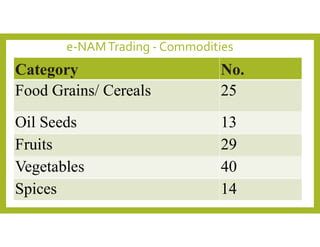
e-NAMTrading - Commodities
Category No.
Food Grains/ Cereals 25
Oil Seeds 13
Fruits 29
Vegetables 40
Spices 14
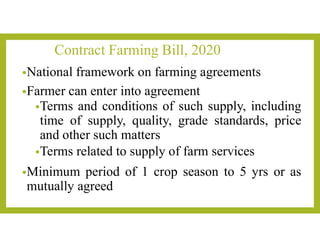
Contract Farming Bill, 2020
•National framework on farming agreements
•Farmer can enter into agreement
•Terms and conditions of such supply, including
time of supply, quality, grade standards, price
and other such matters
•Terms related to supply of farm services
•Minimum period of 1 crop season to 5 yrs or as
mutually agreed
Contract Farming Bill, 2020
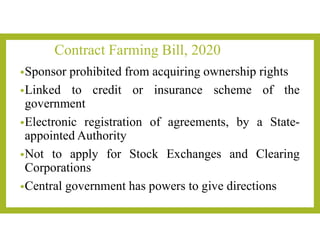
•Sponsor prohibited from acquiring ownership rights
•Linked to credit or insurance scheme of the
government
•Electronic registration of agreements, by a State-
appointed Authority
•Not to apply for Stock Exchanges and Clearing
Corporations
•Central government has powers to give directions
Contract Farming Bill, 2020
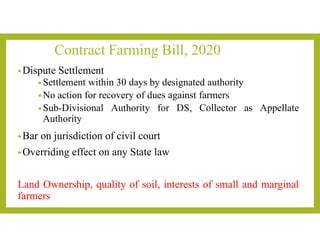
•Dispute Settlement
• Settlement within 30 days by designated authority
• No action for recovery of dues against farmers
• Sub-Divisional Authority for DS, Collector as Appellate
Authority
•Bar on jurisdiction of civil court
•Overriding effect on any State law
Land Ownership, quality of soil, interests of small and marginal
farmers
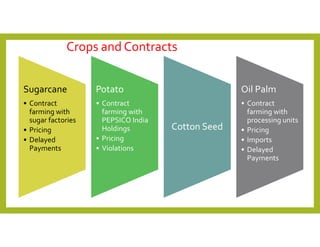
Crops and Contracts
Sugarcane
• Contract
farming with
sugar factories
• Pricing
• Delayed
Payments
Potato
• Contract
farming with
PEPSICO India
Holdings
• Pricing
• Violations
Cotton Seed
Oil Palm
• Contract
farming with
processing units
• Pricing
• Imports
• Delayed
Payments
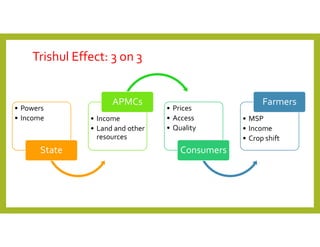
Trishul Effect: 3 on 3
• Powers
• Income
State
• Income
• Land and other
resources
APMCs
• Prices
• Access
• Quality
Consumers
• MSP
• Income
• Crop shift
Farmers
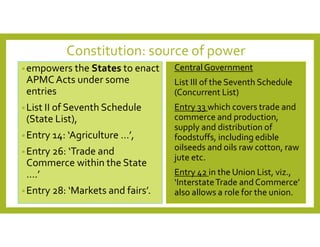
Constitution: source of power
•empowers the States to enact
APMC Acts under some
entries
•List II of Seventh Schedule
(State List),
•Entry 14: ‘Agriculture …’,
•Entry 26: ‘Trade and
Commerce within the State
….’
•Entry 28: ‘Markets and fairs’.
• CentralGovernment
• List III of the Seventh Schedule
(Concurrent List)
• Entry 33 which covers trade and
commerce and production,
supply and distribution of
foodstuffs, including edible
oilseeds and oils raw cotton, raw
jute etc.
• Entry 42 in the Union List, viz.,
‘InterstateTrade and Commerce’
also allows a role for the union.
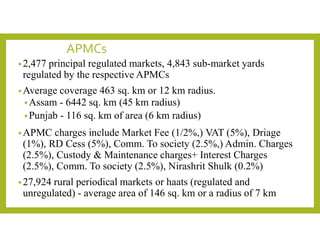
APMCs
•2,477 principal regulated markets, 4,843 sub-market yards
regulated by the respective APMCs
•Average coverage 463 sq. km or 12 km radius.
•Assam - 6442 sq. km (45 km radius)
•Punjab - 116 sq. km of area (6 km radius)
•APMC charges include Market Fee (1/2%,) VAT (5%), Driage
(1%), RD Cess (5%), Comm. To society (2.5%,) Admin. Charges
(2.5%), Custody & Maintenance charges+ Interest Charges
(2.5%), Comm. To society (2.5%), Nirashrit Shulk (0.2%)
•27,924 rural periodical markets or haats (regulated and
unregulated) - average area of 146 sq. km or a radius of 7 km
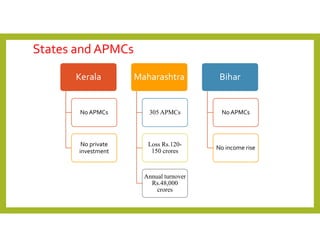
States and APMCs
Kerala
No APMCs
No private
investment
Maharashtra
305 APMCs
Loss Rs.120-
150 crores
Annual turnover
Rs.48,000
crores
Bihar
No APMCs
No income rise
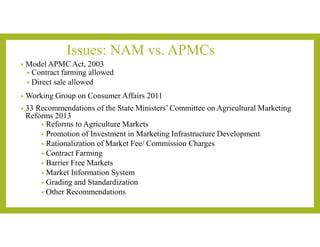
Issues: NAM vs. APMCs
• Model APMC Act, 2003
• Contract farming allowed
• Direct sale allowed
• Working Group on Consumer Affairs 2011
• 33 Recommendations of the State Ministers’ Committee on Agricultural Marketing
Reforms 2013
• Reforms to Agriculture Markets
• Promotion of Investment in Marketing Infrastructure Development
• Rationalization of Market Fee/ Commission Charges
• Contract Farming
• Barrier Free Markets
• Market Information System
• Grading and Standardization
• Other Recommendations
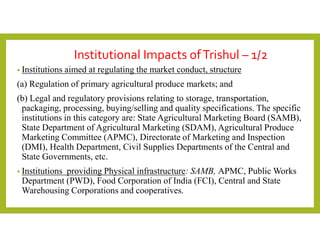
Institutional Impacts ofTrishul – 1/2
• Institutions aimed at regulating the market conduct, structure
(a) Regulation of primary agricultural produce markets; and
(b) Legal and regulatory provisions relating to storage, transportation,
packaging, processing, buying/selling and quality specifications. The specific
institutions in this category are: State Agricultural Marketing Board (SAMB),
State Department of Agricultural Marketing (SDAM), Agricultural Produce
Marketing Committee (APMC), Directorate of Marketing and Inspection
(DMI), Health Department, Civil Supplies Departments of the Central and
State Governments, etc.
• Institutions providing Physical infrastructure: SAMB, APMC, Public Works
Department (PWD), Food Corporation of India (FCI), Central and State
Warehousing Corporations and cooperatives.
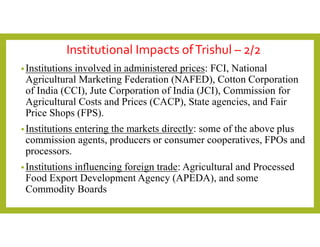
Institutional Impacts ofTrishul – 2/2
•Institutions involved in administered prices: FCI, National
Agricultural Marketing Federation (NAFED), Cotton Corporation
of India (CCI), Jute Corporation of India (JCI), Commission for
Agricultural Costs and Prices (CACP), State agencies, and Fair
Price Shops (FPS).
•Institutions entering the markets directly: some of the above plus
commission agents, producers or consumer cooperatives, FPOs and
processors.
•Institutions influencing foreign trade: Agricultural and Processed
Food Export Development Agency (APEDA), and some
Commodity Boards
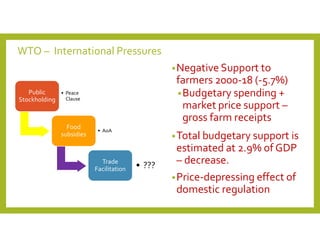
WTO – International Pressures
•Negative Support to
farmers 2000-18 (-5.7%)
•Budgetary spending +
market price support –
gross farm receipts
•Total budgetary support is
estimated at 2.9% of GDP
– decrease.
•Price-depressing effect of
domestic regulation
Public
Stockholding
• Peace
Clause
Food
subsidies
• AoA
Trade
Facilitation • ???
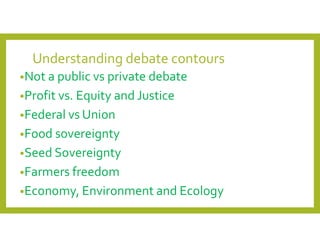
Understanding debate contours
•Not a public vs private debate
•Profit vs. Equity and Justice
•Federal vs Union
•Food sovereignty
•Seed Sovereignty
•Farmers freedom
•Economy, Environment and Ecology
nreddy.donthi20@gmail.com
THANKYOU

Thrishul Farm Bills in India

  • 1.
    Dr. Narasimha ReddyDonthi Public Policy Reviewer 3 AGRI-MARKET REFORM BILLS :TRISHUL EFFECT ON 3
  • 2.
    Market Support byGovernment Regulation of markets Input subsidies Minimum Support Price Food subsidies
  • 3.
    Three Ordinances: 5thJune, 2020 The Essential Commodities (Amendment) Ordinance, 2020 The Farmers’ Produce Trade and Commerce (Promotion and Facilitation) Ordinance, 2020 Farmers (Empowerment and Protection) Agreement on Price Assurance and Farm Services Ordinance, 2020
  • 4.
    The Essential CommoditiesBill, 2020 Objectives • Increasing agriculture competitiveness • Enhance farmers income • Liberalise regulatory system • Protecting consumers interests Provisions • Removal of all food stuffs •Supply of food stuffs regulated only under extraordinary circumstances •Regulatory order doesn't apply if stock limit is within installed capacity or export demand
  • 5.
  • 6.
    PreviousAmendments to EC •67 control orders between 1972 and 2020 • 5 orders from 1972-78 • 0 orders from 1978-2002 • 8 orders in 2009 alone • With effect from 15 February 2002, 11 classes of commodities in full and one in part removed from the list of essential commodities declared earlier. • Removal of Licensing requirements, Stock limits and Movement Restrictions on Specified Foodstuffs Order, 2002 • Dealers allowed to freely buy, stock, sell, transport, distribute, dispose, etc., any quantity • Wheat, paddy/rice, coarse grains, sugar, edible oilseeds and edible oils, without requiring any license or permit under any order issued under the Act.
  • 7.
    Trade and CommerceBill, 2020 Objectives •Farmers and traders to enjoy freedom •Barrier-free trade •Framework for electronic trading •Traders, Farmers producer organisations or cooperative •PAN for trader •Payment to farmer same day or within 3 days
  • 8.
    Trade and CommerceBill, 2020 •Any person can open/ establish electronic trading and transaction platform •No market fee, cess or levy under any APMC or any State law •Price information and market intelligence system by central govt •Suspension of platform by Central govt
  • 9.
    Trade and CommerceBill, 2020 •Dispute Settlement •Settlement within 30 days by designated authority •Sub-Divisional Authority for DS, Collector as Appellate Authority •Bar on jurisdiction of civil court •Not to apply for Stock Exchanges and Clearing Corporations •Central government has powers to give directions
  • 10.
    e-NAMTrading - Commodities CategoryNo. Food Grains/ Cereals 25 Oil Seeds 13 Fruits 29 Vegetables 40 Spices 14
  • 11.
    Contract Farming Bill,2020 •National framework on farming agreements •Farmer can enter into agreement •Terms and conditions of such supply, including time of supply, quality, grade standards, price and other such matters •Terms related to supply of farm services •Minimum period of 1 crop season to 5 yrs or as mutually agreed
  • 12.
    Contract Farming Bill,2020 •Sponsor prohibited from acquiring ownership rights •Linked to credit or insurance scheme of the government •Electronic registration of agreements, by a State- appointed Authority •Not to apply for Stock Exchanges and Clearing Corporations •Central government has powers to give directions
  • 13.
    Contract Farming Bill,2020 •Dispute Settlement • Settlement within 30 days by designated authority • No action for recovery of dues against farmers • Sub-Divisional Authority for DS, Collector as Appellate Authority •Bar on jurisdiction of civil court •Overriding effect on any State law Land Ownership, quality of soil, interests of small and marginal farmers
  • 14.
    Crops and Contracts Sugarcane •Contract farming with sugar factories • Pricing • Delayed Payments Potato • Contract farming with PEPSICO India Holdings • Pricing • Violations Cotton Seed Oil Palm • Contract farming with processing units • Pricing • Imports • Delayed Payments
  • 15.
    Trishul Effect: 3on 3 • Powers • Income State • Income • Land and other resources APMCs • Prices • Access • Quality Consumers • MSP • Income • Crop shift Farmers
  • 16.
    Constitution: source ofpower •empowers the States to enact APMC Acts under some entries •List II of Seventh Schedule (State List), •Entry 14: ‘Agriculture …’, •Entry 26: ‘Trade and Commerce within the State ….’ •Entry 28: ‘Markets and fairs’. • CentralGovernment • List III of the Seventh Schedule (Concurrent List) • Entry 33 which covers trade and commerce and production, supply and distribution of foodstuffs, including edible oilseeds and oils raw cotton, raw jute etc. • Entry 42 in the Union List, viz., ‘InterstateTrade and Commerce’ also allows a role for the union.
  • 17.
    APMCs •2,477 principal regulatedmarkets, 4,843 sub-market yards regulated by the respective APMCs •Average coverage 463 sq. km or 12 km radius. •Assam - 6442 sq. km (45 km radius) •Punjab - 116 sq. km of area (6 km radius) •APMC charges include Market Fee (1/2%,) VAT (5%), Driage (1%), RD Cess (5%), Comm. To society (2.5%,) Admin. Charges (2.5%), Custody & Maintenance charges+ Interest Charges (2.5%), Comm. To society (2.5%), Nirashrit Shulk (0.2%) •27,924 rural periodical markets or haats (regulated and unregulated) - average area of 146 sq. km or a radius of 7 km
  • 18.
    States and APMCs Kerala NoAPMCs No private investment Maharashtra 305 APMCs Loss Rs.120- 150 crores Annual turnover Rs.48,000 crores Bihar No APMCs No income rise
  • 19.
    Issues: NAM vs.APMCs • Model APMC Act, 2003 • Contract farming allowed • Direct sale allowed • Working Group on Consumer Affairs 2011 • 33 Recommendations of the State Ministers’ Committee on Agricultural Marketing Reforms 2013 • Reforms to Agriculture Markets • Promotion of Investment in Marketing Infrastructure Development • Rationalization of Market Fee/ Commission Charges • Contract Farming • Barrier Free Markets • Market Information System • Grading and Standardization • Other Recommendations
  • 20.
    Institutional Impacts ofTrishul– 1/2 • Institutions aimed at regulating the market conduct, structure (a) Regulation of primary agricultural produce markets; and (b) Legal and regulatory provisions relating to storage, transportation, packaging, processing, buying/selling and quality specifications. The specific institutions in this category are: State Agricultural Marketing Board (SAMB), State Department of Agricultural Marketing (SDAM), Agricultural Produce Marketing Committee (APMC), Directorate of Marketing and Inspection (DMI), Health Department, Civil Supplies Departments of the Central and State Governments, etc. • Institutions providing Physical infrastructure: SAMB, APMC, Public Works Department (PWD), Food Corporation of India (FCI), Central and State Warehousing Corporations and cooperatives.
  • 21.
    Institutional Impacts ofTrishul– 2/2 •Institutions involved in administered prices: FCI, National Agricultural Marketing Federation (NAFED), Cotton Corporation of India (CCI), Jute Corporation of India (JCI), Commission for Agricultural Costs and Prices (CACP), State agencies, and Fair Price Shops (FPS). •Institutions entering the markets directly: some of the above plus commission agents, producers or consumer cooperatives, FPOs and processors. •Institutions influencing foreign trade: Agricultural and Processed Food Export Development Agency (APEDA), and some Commodity Boards
  • 22.
    WTO – InternationalPressures •Negative Support to farmers 2000-18 (-5.7%) •Budgetary spending + market price support – gross farm receipts •Total budgetary support is estimated at 2.9% of GDP – decrease. •Price-depressing effect of domestic regulation Public Stockholding • Peace Clause Food subsidies • AoA Trade Facilitation • ???
  • 23.
    Understanding debate contours •Nota public vs private debate •Profit vs. Equity and Justice •Federal vs Union •Food sovereignty •Seed Sovereignty •Farmers freedom •Economy, Environment and Ecology
  • 24.