PLASTIC:
UNDERSTANDING THE
Dr. Donthi Narasimha Reddy
UNDERSTANDING THE
ISSUES
Swamped by plastic
approximately 707 million metric tons/year plastic
products are manufactured
majority of the plastics material goes to packagingmajority of the plastics material goes to packaging
applications (Annual Report: 2015-16, MoC&F).
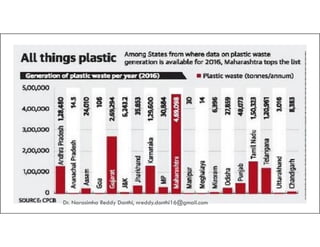
25,940 T/day of plastic waste is generated in India
(CPCB, 2018) – 685.4 T/Day in TS urban
Dr. Narasimha Reddy Donthi, nreddy.donthi16@gmail.com
Swamped by plastic
25,940 T/day of plastic waste is generated in India
(CPCB, 2018)
out of total plastic waste, around 94% waste comprises
of thermoplastic content, which is recyclable such as PET,
out of total plastic waste, around 94% waste comprises
of thermoplastic content, which is recyclable such as PET,
LDPE, HDPE, PVC etc.
remaining 6% belongs to the family of Thermoset and
other categories of plastics such as SMC, FRP, multi-
layered, thermocol etc., which is non-recyclable.
Dr. Narasimha Reddy Donthi, nreddy.donthi16@gmail.com
Life Cycle Analysis
Production
ProcessingReuse
Use
Disposal
Recycling
Dr. Narasimha Reddy Donthi, nreddy.donthi16@gmail.com
Geographical Impacts
Local State National International Planet
Dr. Narasimha Reddy Donthi, nreddy.donthi16@gmail.com
Plastic Impacts
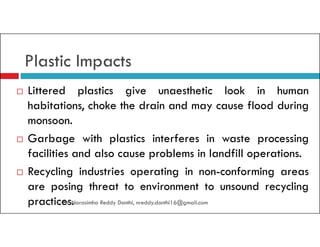
Littered plastics give unaesthetic look in human
habitations, choke the drain and may cause flood during
monsoon.monsoon.
Garbage with plastics interferes in waste processing
facilities and also cause problems in landfill operations.
Recycling industries operating in non-conforming areas
are posing threat to environment to unsound recycling
practices.Dr. Narasimha Reddy Donthi, nreddy.donthi16@gmail.com
In 2019, the production and incineration of plastic will produce more than 850 million metric tons
of greenhouse gases—equal to the emissions from 189 five-hundred-megawatt coal power
plants.
Dr. Narasimha Reddy Donthi, nreddy.donthi16@gmail.com
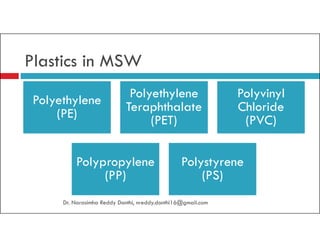
Plastics in MSW
Polyethylene
(PE)
Polyethylene
Teraphthalate
(PET)
Polyvinyl
Chloride
(PVC)(PET) (PVC)
Polypropylene
(PP)
Polystyrene
(PS)
Dr. Narasimha Reddy Donthi, nreddy.donthi16@gmail.com
Plastic Impacts
Impacts on wildlife and non-human life – birds, aquatic life
Indiscriminate dumping of plastic waste on land makes the land
infertile due to its barrier properties.infertile due to its barrier properties.
Fugitive emissions are released – polymerisation process.
Various types of gases are released - product manufacturing.
Burning of plastics generates toxic emissions such as Carbon
Monoxide, Chlorine, Hydrochloric Acid, Dioxin, Furans, Amines,
Nitrides, Styrene, Benzene, 1, 3- butadiene, CCl4, and
Acetaldehyde.Dr. Narasimha Reddy Donthi, nreddy.donthi16@gmail.com
Plastic Impacts
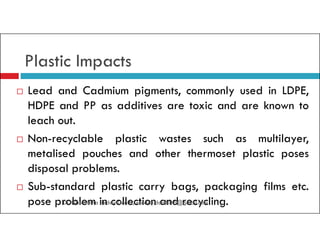
Lead and Cadmium pigments, commonly used in LDPE,
HDPE and PP as additives are toxic and are known to
leach out.leach out.
Non-recyclable plastic wastes such as multilayer,
metalised pouches and other thermoset plastic poses
disposal problems.
Sub-standard plastic carry bags, packaging films etc.
pose problem in collection and recycling.Dr. Narasimha Reddy Donthi, nreddy.donthi16@gmail.com
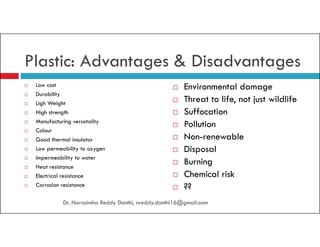
Plastic: Advantages & Disadvantages
Low cost
Durability
Ligh Weight
High strength
Manufacturing versatality
Environmental damage
Threat to life, not just wildlife
Suffocation
PollutionManufacturing versatality
Colour
Good thermal insulator
Low permeability to oxygen
Impermeability to water
Heat resistance
Electrical resistance
Corrosion resistance
Pollution
Non-renewable
Disposal
Burning
Chemical risk
??
Dr. Narasimha Reddy Donthi, nreddy.donthi16@gmail.com
Impact Analysis: Factors
Form and form conversion
Size (micro…)
Material (type)Material (type)
Quality of material
Location (wrong place at wrong time)
Volumes
Dr. Narasimha Reddy Donthi, nreddy.donthi16@gmail.com
Critical view: Segregated
Zero-use
Single use
Multiple-useMultiple-use
Reuse
Recycled
Hazardous use
Dr. Narasimha Reddy Donthi, nreddy.donthi16@gmail.com
Problems and Solutions
Disposal
• Land filling
Exports
• Outside city/
Imports
• Recycling• Land filling
• Burning
• Incinerators
• WTE plants
• Plasma Pyrolysis
• Outside city/
town/ village
• International trade
• Recycling
• Reuse
• Reprocessing
Dr. Narasimha Reddy Donthi, nreddy.donthi16@gmail.com
Waste Imports !!!
2013-14 2014-15 2015-16 2016-17 2017-18 2018-19 2019-20
Waste Parings and Scrap of Other Plastic HS391590 (in tonnes) (30 kinds of waste)Waste Parings and Scrap of Other Plastic HS391590 (in tonnes) (30 kinds of waste)
189,479.19 164,286.85 152,976.45 102,632.91
110,609.26
110,136.54 41,025.64
Municipal Waste HS382510 (Rs. In crores)
No data No data No data 31,487.04No data 0.01No data
No data No data No data 25,77,675.3730,01,033.4335,94,674.6117,25,210.56Dr. Narasimha Reddy Donthi, nreddy.donthi16@gmail.com
Dr. Narasimha Reddy Donthi, nreddy.donthi16@gmail.com
Plastic growth: Areas
Agriculture
• Industrial agriculture
• Distribution
• Storage
Packaging
• Food
• FMCG
• Packages and fast food
Infrastructure
• Building and construction
• Public utilities
• Highway projects
Transport
• Automotive appliances
Others
• Industrial
• Medical Appliances Fire Energy
Dr. Narasimha Reddy Donthi, nreddy.donthi16@gmail.com
Policy and Regulation
Encouraging Economic Policies
National Fibre Policy
Incentives (to refineries, processing, WTE)Incentives (to refineries, processing, WTE)
Ease of Business
Waste Imports
Plastic Waste Management Rules 2016
Circular Economy is the need of the hour
Dr. Narasimha Reddy Donthi, nreddy.donthi16@gmail.com
States – plastic ban
Partial ban
Andhra Pradesh, Goa, Gujarat, Jharkhand, Madhya Pradesh,
Maharashtra, Meghalaya, Tamilnadu, West Bengal
No ban – Manipur
Total Ban
Chattisgarh, Jammu and Kashmir, Mizoram, Nagaland,
Odisha, Punjab, Uttarakhand, Chandigarh
No data or information – all others
Dr. Narasimha Reddy Donthi, nreddy.donthi16@gmail.com
Roles: Expected and Performed
• Oversight
• Monitoring
• Reduce
• Reuse
• Recycle
Individuals Regulatory
bodies
• Sustainable
policies
• SDG
compliant
• Responsible
• Legal
• Discipline
bodies
GovernmentBusiness and
industry
Dr. Narasimha Reddy Donthi, nreddy.donthi16@gmail.com
Required
Comprehensive Plastic Regulation Act
Dedicated Institutional Architecture – jurisdictional issues are
clarifiedclarified
Declaration of Plastic product as hazardous (or a classification
based on its usage, quality)
Prevention policies – Review of National Fibre Policy
Review of GST on plastic products
Dr. Narasimha Reddy Donthi, nreddy.donthi16@gmail.com
Required
Stricter norms on virgin plastic production
Traceability and sustainability mechanisms established
Research on eco-friendly fibres and materialsResearch on eco-friendly fibres and materials
Incentives for non-plastic products, which can replace them
Brand Audits
Recycling and reuse standards
Dr. Narasimha Reddy Donthi, nreddy.donthi16@gmail.com
Zero Waste: Journey
Mind shift
Waste mgt to
sustainable
material practices
Community
responsiveness
Industrial
responsibilityLocal economySDGs
Dr. Narasimha Reddy Donthi, nreddy.donthi16@gmail.com
Thank You
Email: nreddy.donthi16@gmail.comEmail: nreddy.donthi16@gmail.com
Mobile: 90102-05742
Dr. Narasimha Reddy Donthi, nreddy.donthi16@gmail.com

Plastics: Understanding Issues and Challenges

  • 1.
    PLASTIC: UNDERSTANDING THE Dr. DonthiNarasimha Reddy UNDERSTANDING THE ISSUES
  • 2.
    Swamped by plastic approximately707 million metric tons/year plastic products are manufactured majority of the plastics material goes to packagingmajority of the plastics material goes to packaging applications (Annual Report: 2015-16, MoC&F). 25,940 T/day of plastic waste is generated in India (CPCB, 2018) – 685.4 T/Day in TS urban Dr. Narasimha Reddy Donthi, nreddy.donthi16@gmail.com
  • 3.
    Swamped by plastic 25,940T/day of plastic waste is generated in India (CPCB, 2018) out of total plastic waste, around 94% waste comprises of thermoplastic content, which is recyclable such as PET, out of total plastic waste, around 94% waste comprises of thermoplastic content, which is recyclable such as PET, LDPE, HDPE, PVC etc. remaining 6% belongs to the family of Thermoset and other categories of plastics such as SMC, FRP, multi- layered, thermocol etc., which is non-recyclable. Dr. Narasimha Reddy Donthi, nreddy.donthi16@gmail.com
  • 4.
    Dr. Narasimha ReddyDonthi, nreddy.donthi16@gmail.com
  • 5.
    Life Cycle Analysis Production ProcessingReuse Use Disposal Recycling Dr.Narasimha Reddy Donthi, nreddy.donthi16@gmail.com
  • 6.
    Geographical Impacts Local StateNational International Planet Dr. Narasimha Reddy Donthi, nreddy.donthi16@gmail.com
  • 7.
    Plastic Impacts Littered plasticsgive unaesthetic look in human habitations, choke the drain and may cause flood during monsoon.monsoon. Garbage with plastics interferes in waste processing facilities and also cause problems in landfill operations. Recycling industries operating in non-conforming areas are posing threat to environment to unsound recycling practices.Dr. Narasimha Reddy Donthi, nreddy.donthi16@gmail.com
  • 8.
    In 2019, theproduction and incineration of plastic will produce more than 850 million metric tons of greenhouse gases—equal to the emissions from 189 five-hundred-megawatt coal power plants. Dr. Narasimha Reddy Donthi, nreddy.donthi16@gmail.com
  • 9.
    Plastics in MSW Polyethylene (PE) Polyethylene Teraphthalate (PET) Polyvinyl Chloride (PVC)(PET)(PVC) Polypropylene (PP) Polystyrene (PS) Dr. Narasimha Reddy Donthi, nreddy.donthi16@gmail.com
  • 10.
    Plastic Impacts Impacts onwildlife and non-human life – birds, aquatic life Indiscriminate dumping of plastic waste on land makes the land infertile due to its barrier properties.infertile due to its barrier properties. Fugitive emissions are released – polymerisation process. Various types of gases are released - product manufacturing. Burning of plastics generates toxic emissions such as Carbon Monoxide, Chlorine, Hydrochloric Acid, Dioxin, Furans, Amines, Nitrides, Styrene, Benzene, 1, 3- butadiene, CCl4, and Acetaldehyde.Dr. Narasimha Reddy Donthi, nreddy.donthi16@gmail.com
  • 11.
    Plastic Impacts Lead andCadmium pigments, commonly used in LDPE, HDPE and PP as additives are toxic and are known to leach out.leach out. Non-recyclable plastic wastes such as multilayer, metalised pouches and other thermoset plastic poses disposal problems. Sub-standard plastic carry bags, packaging films etc. pose problem in collection and recycling.Dr. Narasimha Reddy Donthi, nreddy.donthi16@gmail.com
  • 12.
    Plastic: Advantages &Disadvantages Low cost Durability Ligh Weight High strength Manufacturing versatality Environmental damage Threat to life, not just wildlife Suffocation PollutionManufacturing versatality Colour Good thermal insulator Low permeability to oxygen Impermeability to water Heat resistance Electrical resistance Corrosion resistance Pollution Non-renewable Disposal Burning Chemical risk ?? Dr. Narasimha Reddy Donthi, nreddy.donthi16@gmail.com
  • 13.
    Impact Analysis: Factors Formand form conversion Size (micro…) Material (type)Material (type) Quality of material Location (wrong place at wrong time) Volumes Dr. Narasimha Reddy Donthi, nreddy.donthi16@gmail.com
  • 14.
    Dr. Narasimha ReddyDonthi, nreddy.donthi16@gmail.com
  • 15.
    Critical view: Segregated Zero-use Singleuse Multiple-useMultiple-use Reuse Recycled Hazardous use Dr. Narasimha Reddy Donthi, nreddy.donthi16@gmail.com
  • 16.
    Problems and Solutions Disposal •Land filling Exports • Outside city/ Imports • Recycling• Land filling • Burning • Incinerators • WTE plants • Plasma Pyrolysis • Outside city/ town/ village • International trade • Recycling • Reuse • Reprocessing Dr. Narasimha Reddy Donthi, nreddy.donthi16@gmail.com
  • 17.
    Waste Imports !!! 2013-142014-15 2015-16 2016-17 2017-18 2018-19 2019-20 Waste Parings and Scrap of Other Plastic HS391590 (in tonnes) (30 kinds of waste)Waste Parings and Scrap of Other Plastic HS391590 (in tonnes) (30 kinds of waste) 189,479.19 164,286.85 152,976.45 102,632.91 110,609.26 110,136.54 41,025.64 Municipal Waste HS382510 (Rs. In crores) No data No data No data 31,487.04No data 0.01No data No data No data No data 25,77,675.3730,01,033.4335,94,674.6117,25,210.56Dr. Narasimha Reddy Donthi, nreddy.donthi16@gmail.com
  • 18.
    Dr. Narasimha ReddyDonthi, nreddy.donthi16@gmail.com
  • 19.
    Dr. Narasimha ReddyDonthi, nreddy.donthi16@gmail.com
  • 20.
    Dr. Narasimha ReddyDonthi, nreddy.donthi16@gmail.com
  • 21.
    Plastic growth: Areas Agriculture •Industrial agriculture • Distribution • Storage Packaging • Food • FMCG • Packages and fast food Infrastructure • Building and construction • Public utilities • Highway projects Transport • Automotive appliances Others • Industrial • Medical Appliances Fire Energy Dr. Narasimha Reddy Donthi, nreddy.donthi16@gmail.com
  • 22.
    Policy and Regulation EncouragingEconomic Policies National Fibre Policy Incentives (to refineries, processing, WTE)Incentives (to refineries, processing, WTE) Ease of Business Waste Imports Plastic Waste Management Rules 2016 Circular Economy is the need of the hour Dr. Narasimha Reddy Donthi, nreddy.donthi16@gmail.com
  • 23.
    States – plasticban Partial ban Andhra Pradesh, Goa, Gujarat, Jharkhand, Madhya Pradesh, Maharashtra, Meghalaya, Tamilnadu, West Bengal No ban – Manipur Total Ban Chattisgarh, Jammu and Kashmir, Mizoram, Nagaland, Odisha, Punjab, Uttarakhand, Chandigarh No data or information – all others Dr. Narasimha Reddy Donthi, nreddy.donthi16@gmail.com
  • 24.
    Roles: Expected andPerformed • Oversight • Monitoring • Reduce • Reuse • Recycle Individuals Regulatory bodies • Sustainable policies • SDG compliant • Responsible • Legal • Discipline bodies GovernmentBusiness and industry Dr. Narasimha Reddy Donthi, nreddy.donthi16@gmail.com
  • 25.
    Required Comprehensive Plastic RegulationAct Dedicated Institutional Architecture – jurisdictional issues are clarifiedclarified Declaration of Plastic product as hazardous (or a classification based on its usage, quality) Prevention policies – Review of National Fibre Policy Review of GST on plastic products Dr. Narasimha Reddy Donthi, nreddy.donthi16@gmail.com
  • 26.
    Required Stricter norms onvirgin plastic production Traceability and sustainability mechanisms established Research on eco-friendly fibres and materialsResearch on eco-friendly fibres and materials Incentives for non-plastic products, which can replace them Brand Audits Recycling and reuse standards Dr. Narasimha Reddy Donthi, nreddy.donthi16@gmail.com
  • 27.
    Zero Waste: Journey Mindshift Waste mgt to sustainable material practices Community responsiveness Industrial responsibilityLocal economySDGs Dr. Narasimha Reddy Donthi, nreddy.donthi16@gmail.com
  • 28.
    Thank You Email: nreddy.donthi16@gmail.comEmail:nreddy.donthi16@gmail.com Mobile: 90102-05742 Dr. Narasimha Reddy Donthi, nreddy.donthi16@gmail.com