
Compost and composting
techniques
Presented to- CHF India
Foundation
Prepared by Haimanti
Kumar
What is
compost?
• Compost is organic matter that has been
decomposed and recycled as a fertilizer and soil
amendment
• Compost is a key ingredient in organic farming.
• End product of the decomposition of organic
matter
What is Composting?
• Composting is a natural process that turns
organic material into a dark rich substance
• It reduces the waste.
• It reclaims the energy from waste.
• Compost increases soil productivity.
• It saves methane production in landfills thus
global warming.
• By composting your organic waste you are
returning nutrients back into the soil
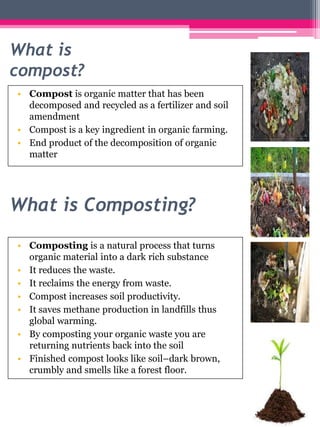
• Finished compost looks like soil–dark brown,
crumbly and smells like a forest floor.
Types of composting
Hot composting Cold Composting
• A hot pile requires enough
high-nitrogen materials to
get the pile to heat up.
• microbial activity within the
compost pile is at its
optimum level, which
results in finished compost
in a much shorter period of
time.
• It requires some special
equipment, as well as time
and diligence.
• Temperatures rising in a
hot-compost pile come from
the activity of numerous
organisms breaking down
organic matter
• Cold composting is one of
the easiest forms of
composting.
• Many beneficial nutrients
in cold compost remain
uncompromised by high
temperatures.
• The process is slower.
• once established, the cold
composting bins will
provide you with a
continuous supply of
lawn and garden food.
why should we compost?
Advantage of
Composting
• Adding organic materials to
the soil improves
moisture retention.
• Adding decomposed organic
material to the soil feeds
beneficial organisms.
• Compost provides a
balanced, slow–release
source of nutrients that
helps the soil hold nutrients
long enough for plants to use
them.
• Composting saves money–
you avoid the cost of buying
soil conditioners, bagged
manure etc.
• Improves water-holding
capacity resulting in
reduced dependency on
watering
The Yes and No of
Kitchen composting:
YES;
Green/Nit
rogen-
rich:
• Veggies,
fruit, &
peels
• Bread,
rice,
pasta,
grains
• Coffee
grounds,
paper
coffee
filters, tea
bags
• Egg shells
,Meat,
fish, bones
• Grass
clippings,
yard waste
NO; will
smell
and
attract
animals:
• Cheese,
dairy
• Fat, grease,
oils, ghee,
butter
• Cooked
foods with
lots of
sauces/
butter.
YES;
Brown/Car
bon-rich:
• Fall leaves
• Straw, hay
• Shredded
newspaper or
paper
• Chinet paper
plates (rip up)
•
•Egg cartons
(rip up)
• Wood chips
• Old potting
soil (dead
houseplants)
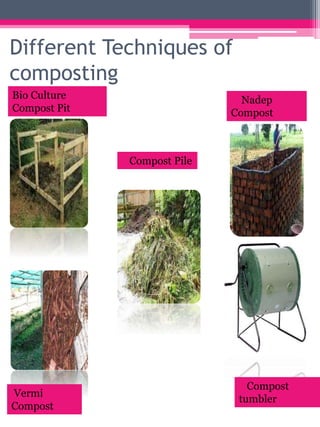
Different Techniques of
composting
Vermi
Compost
Bio Culture
Compost Pit
Compost Pile
Nadep
Compost
Compost
tumbler
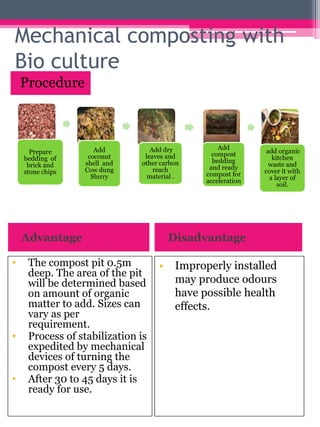
Mechanical composting with
Bio culture
Prepare
bedding of
brick and
stone chips
Add
coconut
shell and
Cow dung
Slurry
Add dry
leaves and
other carbon
reach
material .
Add
compost
bedding
and ready
compost for
acceleration
add organic
kitchen
waste and
cover it with
a layer of
soil.
Advantage
Procedure
• The compost pit 0.5m
deep. The area of the pit
will be determined based
on amount of organic
matter to add. Sizes can
vary as per
requirement.
• Process of stabilization is
expedited by mechanical
devices of turning the
compost every 5 days.
• After 30 to 45 days it is
ready for use.
Disadvantage
• Improperly installed
may produce odours
have possible health
effects.
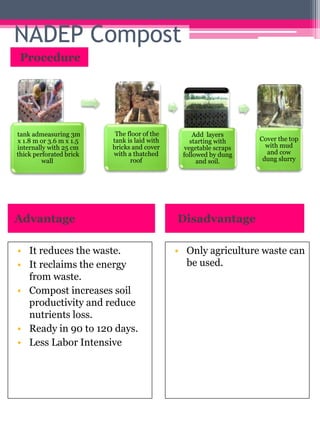
NADEP Compost
Advantage Disadvantage
tank admeasuring 3m
x 1.8 m or 3.6 m x 1.5
internally with 25 cm
thick perforated brick
wall
The floor of the
tank is laid with
bricks and cover
with a thatched
roof
Add layers
starting with
vegetable scraps
followed by dung
and soil.
Cover the top
with mud
and cow
dung slurry
Procedure
• It reduces the waste.
• It reclaims the energy
from waste.
• Compost increases soil
productivity and reduce
nutrients loss.
• Ready in 90 to 120 days.
• Less Labor Intensive
• Only agriculture waste can
be used.
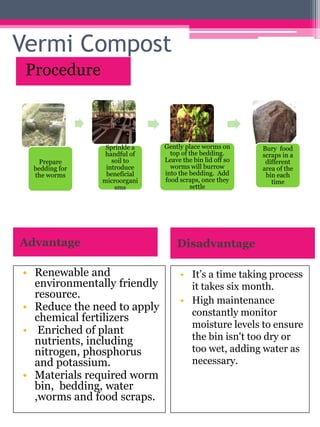
Vermi Compost
Advantage Disadvantage
• Renewable and
environmentally friendly
resource.
• Reduce the need to apply
chemical fertilizers
• Enriched of plant
nutrients, including
nitrogen, phosphorus
and potassium.
• Materials required worm
bin, bedding, water
,worms and food scraps.
• It’s a time taking process
it takes six month.
• High maintenance
constantly monitor
moisture levels to ensure
the bin isn't too dry or
too wet, adding water as
necessary.
Prepare
bedding for
the worms
Sprinkle a
handful of
soil to
introduce
beneficial
microorgani
sms
Gently place worms on
top of the bedding.
Leave the bin lid off so
worms will burrow
into the bedding. Add
food scraps, once they
settle
Bury food
scraps in a
different
area of the
bin each
time
Procedure
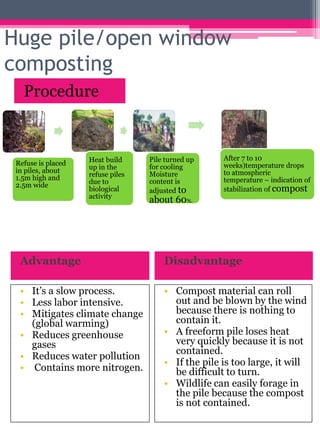
Huge pile/open window
composting
• It’s a slow process.
• Less labor intensive.
• Mitigates climate change
(global warming)
• Reduces greenhouse
gases
• Reduces water pollution
• Contains more nitrogen.
Advantage
• Compost material can roll
out and be blown by the wind
because there is nothing to
contain it.
• A freeform pile loses heat
very quickly because it is not
contained.
• If the pile is too large, it will
be difficult to turn.
• Wildlife can easily forage in
the pile because the compost
is not contained.
Disadvantage
Refuse is placed
in piles, about
1.5m high and
2.5m wide
Heat build
up in the
refuse piles
due to
biological
activity
Pile turned up
for cooling
Moisture
content is
adjusted to
about 60%.
After 7 to 10
weeks)temperature drops
to atmospheric
temperature – indication of
stabilization of compost
Procedure
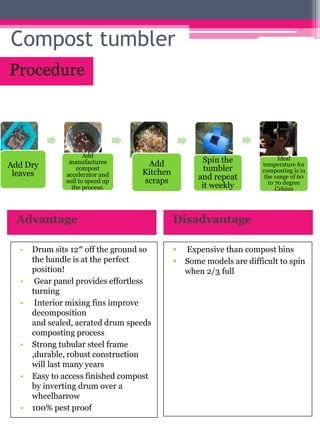
Add Dry
leaves
Add
manufactures
compost
accelerator and
soil to speed up
the process.
Add
Kitchen
scraps
Spin the
tumbler
and repeat
it weekly
Ideal
temperature for
composting is in
the range of 60
to 70 degree
Celsius
• Drum sits 12″ off the ground so
the handle is at the perfect
position!
• Gear panel provides effortless
turning
• Interior mixing fins improve
decomposition
and sealed, aerated drum speeds
composting process
• Strong tubular steel frame
,durable, robust construction
will last many years
• Easy to access finished compost
by inverting drum over a
wheelbarrow
• 100% pest proof
 Expensive than compost bins
 Some models are difficult to spin
when 2/3 full
Advantage
Procedure
Compost tumbler
Disadvantage
Thank you

Compost and composting techniques hk

  • 1.
    Compost and composting techniques Presentedto- CHF India Foundation Prepared by Haimanti Kumar
  • 2.
    What is compost? • Compostis organic matter that has been decomposed and recycled as a fertilizer and soil amendment • Compost is a key ingredient in organic farming. • End product of the decomposition of organic matter What is Composting? • Composting is a natural process that turns organic material into a dark rich substance • It reduces the waste. • It reclaims the energy from waste. • Compost increases soil productivity. • It saves methane production in landfills thus global warming. • By composting your organic waste you are returning nutrients back into the soil • Finished compost looks like soil–dark brown, crumbly and smells like a forest floor.
  • 3.
    Types of composting Hotcomposting Cold Composting • A hot pile requires enough high-nitrogen materials to get the pile to heat up. • microbial activity within the compost pile is at its optimum level, which results in finished compost in a much shorter period of time. • It requires some special equipment, as well as time and diligence. • Temperatures rising in a hot-compost pile come from the activity of numerous organisms breaking down organic matter • Cold composting is one of the easiest forms of composting. • Many beneficial nutrients in cold compost remain uncompromised by high temperatures. • The process is slower. • once established, the cold composting bins will provide you with a continuous supply of lawn and garden food.
  • 4.
    why should wecompost? Advantage of Composting • Adding organic materials to the soil improves moisture retention. • Adding decomposed organic material to the soil feeds beneficial organisms. • Compost provides a balanced, slow–release source of nutrients that helps the soil hold nutrients long enough for plants to use them. • Composting saves money– you avoid the cost of buying soil conditioners, bagged manure etc. • Improves water-holding capacity resulting in reduced dependency on watering
  • 5.
    The Yes andNo of Kitchen composting: YES; Green/Nit rogen- rich: • Veggies, fruit, & peels • Bread, rice, pasta, grains • Coffee grounds, paper coffee filters, tea bags • Egg shells ,Meat, fish, bones • Grass clippings, yard waste NO; will smell and attract animals: • Cheese, dairy • Fat, grease, oils, ghee, butter • Cooked foods with lots of sauces/ butter. YES; Brown/Car bon-rich: • Fall leaves • Straw, hay • Shredded newspaper or paper • Chinet paper plates (rip up) • •Egg cartons (rip up) • Wood chips • Old potting soil (dead houseplants)
  • 6.
    Different Techniques of composting Vermi Compost BioCulture Compost Pit Compost Pile Nadep Compost Compost tumbler
  • 7.
    Mechanical composting with Bioculture Prepare bedding of brick and stone chips Add coconut shell and Cow dung Slurry Add dry leaves and other carbon reach material . Add compost bedding and ready compost for acceleration add organic kitchen waste and cover it with a layer of soil. Advantage Procedure • The compost pit 0.5m deep. The area of the pit will be determined based on amount of organic matter to add. Sizes can vary as per requirement. • Process of stabilization is expedited by mechanical devices of turning the compost every 5 days. • After 30 to 45 days it is ready for use. Disadvantage • Improperly installed may produce odours have possible health effects.
  • 8.
    NADEP Compost Advantage Disadvantage tankadmeasuring 3m x 1.8 m or 3.6 m x 1.5 internally with 25 cm thick perforated brick wall The floor of the tank is laid with bricks and cover with a thatched roof Add layers starting with vegetable scraps followed by dung and soil. Cover the top with mud and cow dung slurry Procedure • It reduces the waste. • It reclaims the energy from waste. • Compost increases soil productivity and reduce nutrients loss. • Ready in 90 to 120 days. • Less Labor Intensive • Only agriculture waste can be used.
  • 9.
    Vermi Compost Advantage Disadvantage •Renewable and environmentally friendly resource. • Reduce the need to apply chemical fertilizers • Enriched of plant nutrients, including nitrogen, phosphorus and potassium. • Materials required worm bin, bedding, water ,worms and food scraps. • It’s a time taking process it takes six month. • High maintenance constantly monitor moisture levels to ensure the bin isn't too dry or too wet, adding water as necessary. Prepare bedding for the worms Sprinkle a handful of soil to introduce beneficial microorgani sms Gently place worms on top of the bedding. Leave the bin lid off so worms will burrow into the bedding. Add food scraps, once they settle Bury food scraps in a different area of the bin each time Procedure
  • 10.
    Huge pile/open window composting •It’s a slow process. • Less labor intensive. • Mitigates climate change (global warming) • Reduces greenhouse gases • Reduces water pollution • Contains more nitrogen. Advantage • Compost material can roll out and be blown by the wind because there is nothing to contain it. • A freeform pile loses heat very quickly because it is not contained. • If the pile is too large, it will be difficult to turn. • Wildlife can easily forage in the pile because the compost is not contained. Disadvantage Refuse is placed in piles, about 1.5m high and 2.5m wide Heat build up in the refuse piles due to biological activity Pile turned up for cooling Moisture content is adjusted to about 60%. After 7 to 10 weeks)temperature drops to atmospheric temperature – indication of stabilization of compost Procedure
  • 11.
    Add Dry leaves Add manufactures compost accelerator and soilto speed up the process. Add Kitchen scraps Spin the tumbler and repeat it weekly Ideal temperature for composting is in the range of 60 to 70 degree Celsius • Drum sits 12″ off the ground so the handle is at the perfect position! • Gear panel provides effortless turning • Interior mixing fins improve decomposition and sealed, aerated drum speeds composting process • Strong tubular steel frame ,durable, robust construction will last many years • Easy to access finished compost by inverting drum over a wheelbarrow • 100% pest proof  Expensive than compost bins  Some models are difficult to spin when 2/3 full Advantage Procedure Compost tumbler Disadvantage
  • 12.