Order of instrumentationDNHY 451Working smarter notharder!
Imagine you’ve just spend 2 hours scaling and root planing a quadrant of moderate sub-gingival calculus.  You feel you’ve done a great job and ask for a faculty evaluation.Your evaluation reveals that you have burnished the entire quadrant with your instruments. How can this be?  What do you think happened during instrumentation?
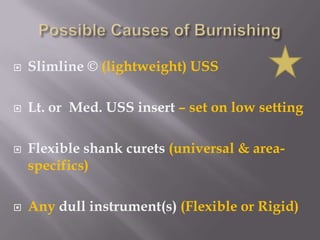
Possible Causes of BurnishingSlimline © (lightweight) USS Lt. or  Med. USS insert – set on low settingFlexible shank curets(universal & area-specifics) Any dull instrument(s) (Flexible or Rigid)
Effectual Instrument Sequencing“Instrument selection that maximizes periodontal instrument design in a strategic, methodical way.  Calculus removal is accomplished utilizing the most effective and efficient use of periodontal instruments.  Practical instrumentation involves a progressive pattern that is logical, chronological and systematic.”		         (Duff, 2009)
But first, a bit of review.Pre-requisite:  Knowledge of design characteristics of scaling and root planing instruments
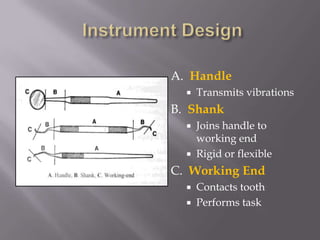
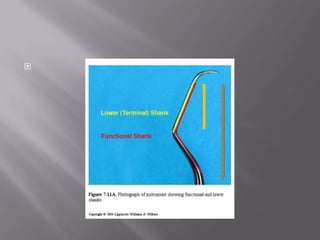
 Instrument DesignA.  HandleTransmits vibrationsB. ShankJoins handle to working endRigid or flexibleC.  Working EndContacts toothPerforms task
SHANK DESIGN	“Instruments are made with shanks of varying degrees of thickness and rigidity that relate to the purpose for which they are used.”(Wilkins, 2009)
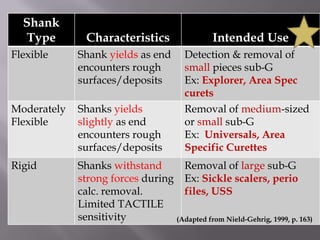
RIGID SHANKRigid Thick Shanks –A heavier shank is stronger and is able to withstand greater pressure w/o flexing when applied during instrumentation.Strong instruments are needed for removal of heavy calculus deposits.(Wilkins, 2009)T/F
FLEXIBLE SHANKLess Rigid (↑ Flexible) Shanks: A thinner shank may provide more tactile sensitivity and is used, for example, for removal of fine deposits of calculus and for maintenance root debridement.(Wilkins, 2009)T/F
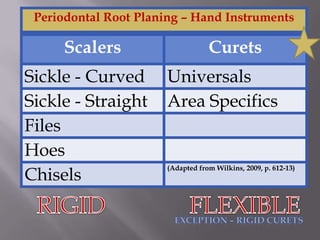
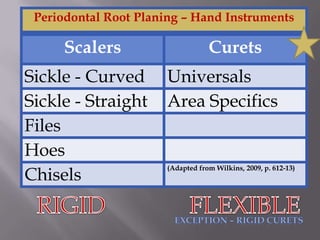
RIGIDFLEXIBLEException – Rigid curets
(Adapted from Nield-Gehrig, 1999, p. 163)
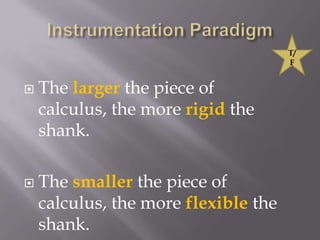
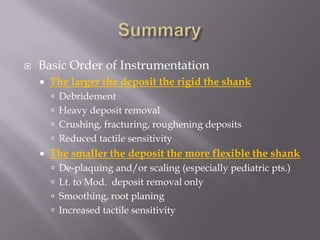
Instrumentation ParadigmThe larger the piece of calculus, the more rigid the shank.The smaller the piece of calculus, the more flexible the shank.T/F
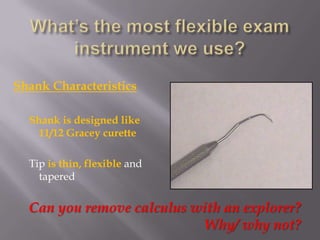
What’s the most flexible exam instrument we use?Shank CharacteristicsShank is designed like 11/12 Gracey curetteTip is thin, flexible and taperedCan you remove calculus with an explorer?       Why/ why not?
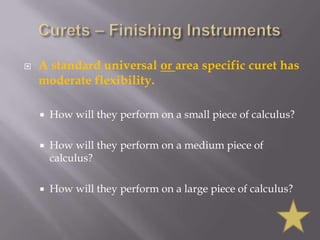
Curets – Finishing InstrumentsA standard universal or area specific curet has moderate flexibility.  How will they perform on a small piece of calculus?How will they perform on a medium piece of calculus?How will they perform on a large piece of calculus?
29 Palms – Common ErrorFrom Ultrasonic to Universal Curet:  A frustrating story…….Moral:  Work Smart NOT Hard, folks!
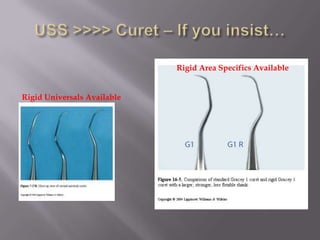
USS >>>> Curet – If you insist…Rigid Area Specifics AvailableRigid Universals Available
Instrument SequencingMaximize Instrument DesignStrategic and Methodical UseMost Effective Efficient UsePractical and Logical progressionLogical and Systematic sequence
Practical use of InstrumentsThe larger the piece of calculus the more _________the shank?The ________ the piece of calculus the more flexible the shank?
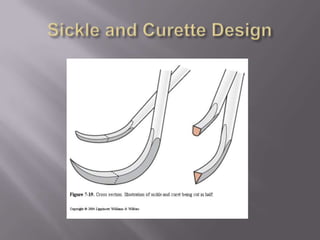
Sickle and Curette Design
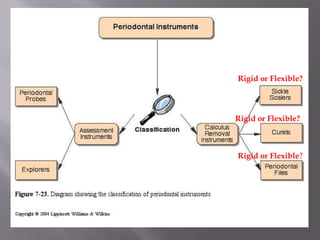
yRigid or Flexible?Rigid or Flexible?Rigid or Flexible?
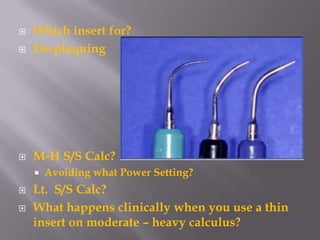
Which insert for?De-plaquingM-H S/S Calc?Avoiding what Power Setting?Lt.  S/S Calc?What happens clinically when you use a thin insert on moderate – heavy calculus?
The Scaler FamilyHoesFilesSicklesCurvedStraightChisels
HOES
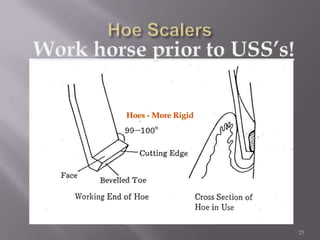
25Hoe ScalersWork horse prior to USS’s!Hoes - More Rigid
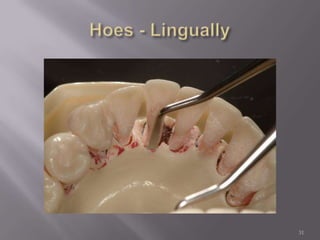
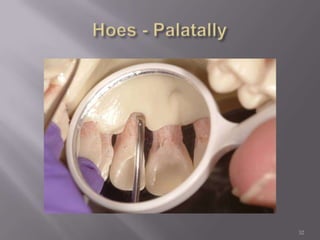
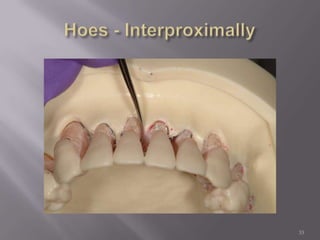
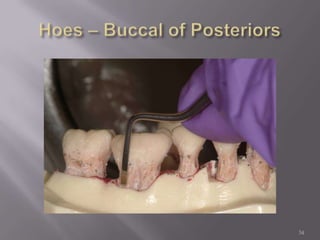
26Hoe Scalers - PurposePurposeGross calculus removal (especially large, accessible, tenacious pieces)Generally supragingivally,OR 2 - 3 mm sub if tissuedisplaces easilyMainly used on facial and lingual of anterior teeth, next to edentulous spaces, or areas with flaccid tissueReplaced by ultrasonic instrumentation and files
27Hoe Scalers - ContradindicationsNOT tight tissue due to trauma to pocket wallAdaptation to curved tooth problematicDecreased tactile sensitivity due to bulkVery easy to gouge tooth surfaces!
28Hoe Scalers - ApplicationsModified pen graspAppropriate fulcrumFull width of cutting edge adapted avoids trauma and gougingCutting edge to tooth angle= 90°Vertical coronal pull strokeFollow up with curets
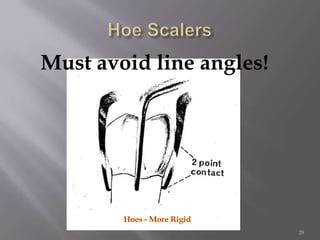
29Hoe ScalersMust avoid line angles!Hoes - More Rigid
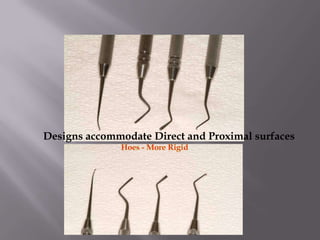
Hoes - More RigidDesigns accommodate Direct and Proximal surfaces
31Hoes - Lingually
32Hoes - Palatally
33Hoes - Interproximally
34Hoes – Buccal of Posteriors
Files
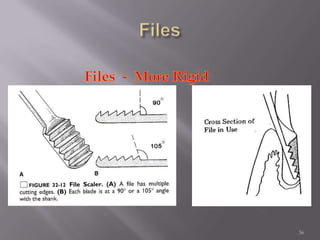
36FilesFiles  -  More Rigid
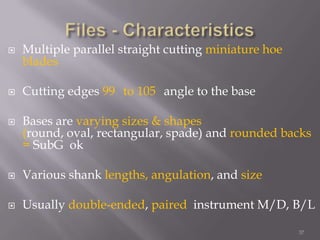
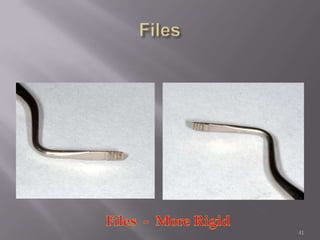
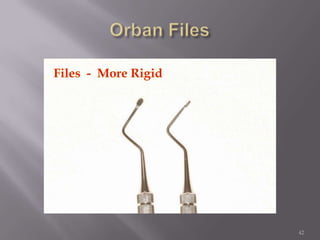
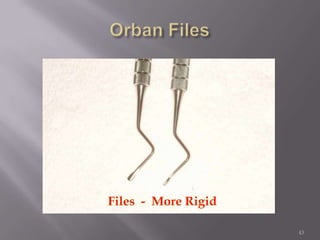
37Files - CharacteristicsMultiple parallel straight cutting miniature hoe blades Cutting edges 99° to 105°angle to the baseBases are varying sizes & shapes (round, oval, rectangular, spade) and rounded backs  = SubG  okVarious shank lengths, angulation, and sizeUsually double-ended, paired  instrument M/D, B/L
38Files - PurposeCrushing, fracturing or roughening  S/S Calc. Gross S/S removal or  burnished calculusDeep, narrow pockets where length/curve of curet blade will not fitPalatals of maxillary anteriorsM/D concavities of mandibular molars or cuspidsB/L of Molars or Bi’sSmooth rough CEJ’sRoot planing using “finishing files” challenging in deep areasSmoothing restoration margins or removing overhangs
39Files - ContraindicationsCannot be used tight tissue due to trauma to pocket (wide bulky base)Adapt flat working surfaces to curved tooth surfaces Straight, rigid terminal shank = limits in deep curved rootsDecreased tactile sensitivity because of bulk Very easy to gouge tooth surfaces!
40Files - ApplicationsModified pen graspAppropriate fulcrumFull working surface adapted flat to tooth avoid trauma/gougingVertical coronal pull strokeFollow up with curets
41FilesFiles  -  More Rigid
42Orban FilesFiles  -  More Rigid
43Orban FilesFiles  -  More Rigid
Chisels
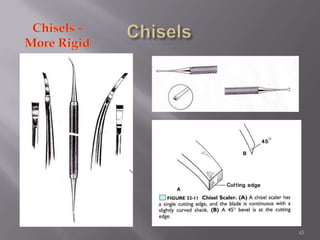
45ChiselsChisels -  More Rigid
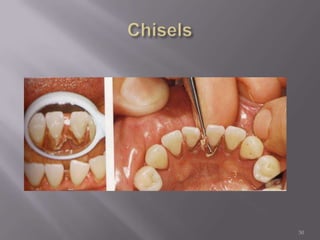
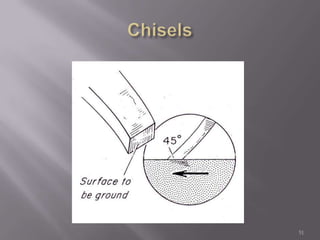
46Chisels - PurposeGross supragingivalcalculus removal no interdental papillaeRemoval of heavy “bridges” of interproximal calculus from lower anteriorsLimited application elsewhereNot in common use; replaced by ultrasonics
47Chisels - ContraindicationsContraindicated for Sub G. (NO)Difficult to adapt straight blade to curved tooth surfacesDecreased tactile sensitivity – bulky Very easy to gouge
48Chisels - ApplicationsModified pen grasp Palm-thumb grasp Appropriate fulcrumFull width adapted to tooth avoiding trauma /gouging
49ChiselsWorking stroke is horizontal “push” stroke onlyPerpendicularto long axis of toothInterproximally - Insert from facial aspect and activate push stroke towards lingualFollow up with curets
50Chisels
51Chisels
Sickles Scalers
Sickle Scalers – 3 designs
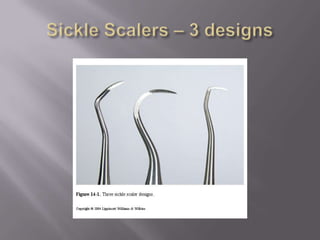
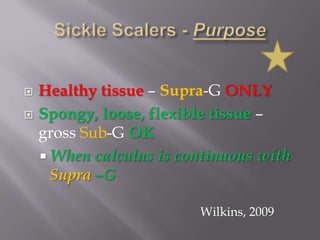
Sickle Scalers - PurposeHealthy tissue – Supra-G ONLYSpongy, loose, flexible tissue – gross Sub-G OKWhen calculus is continuous with Supra –GWilkins, 2009
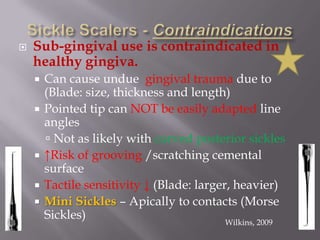
Sickle Scalers - ContraindicationsSub-gingival use is contraindicated in healthy gingiva.Can cause undue  gingival trauma due to (Blade: size, thickness and length)Pointed tip can NOT be easily adapted line anglesNot as likely with curved posterior sickles↑Risk of grooving /scratching cemental surfaceTactile sensitivity ↓ (Blade: larger, heavier)Mini Sickles – Apically to contacts (Morse Sickles)Wilkins, 2009
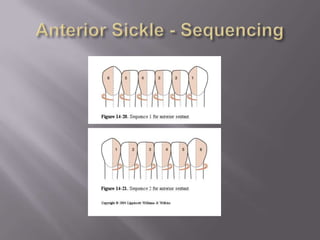
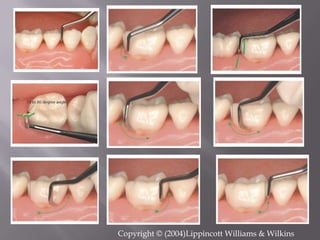
Anterior Sickle - Sequencing
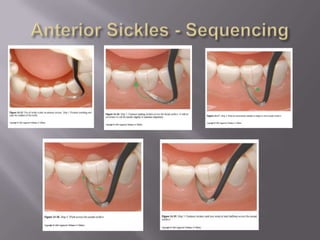
Anterior Sickles - Sequencing
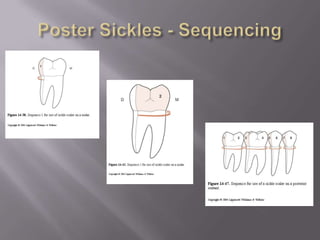
Poster Sickles - Sequencing
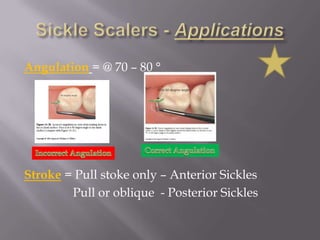
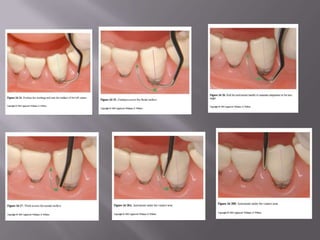
Sickle Scalers - ApplicationsAngulation= @ 70 – 80 °  Stroke = Pull stoke only – Anterior Sickles		       Pull or oblique  - Posterior SicklesCorrect AngulationIncorrect Angulation
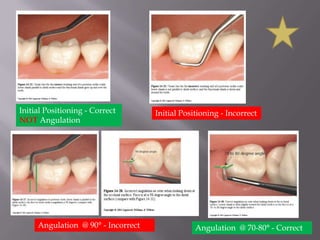
Initial Positioning - Correct NOT AngulationInitial Positioning - IncorrectAngulation  @ 90° - IncorrectAngulation  @ 70-80° - Correct
Copyright © (2004)Lippincott Williams & Wilkins
Curets
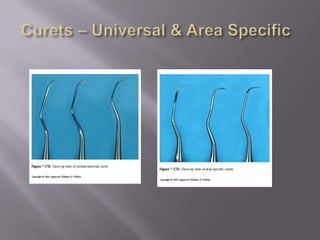
Curets – Universal & Area Specific
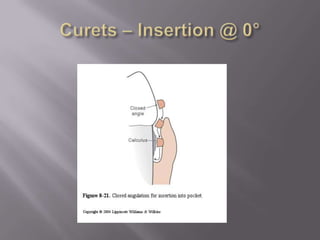
Curets – Insertion @ 0°
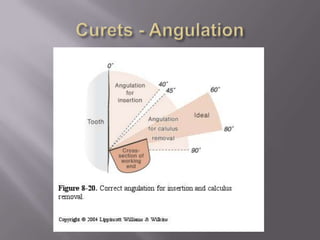
Curets - Angulation
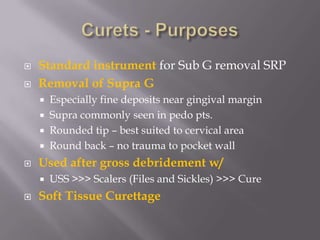
Curets - PurposesStandard instrument for Sub G removal SRPRemoval of Supra G Especially fine deposits near gingival marginSupra commonly seen in pedo pts.Rounded tip – best suited to cervical areaRound back – no trauma to pocket wallUsed after gross debridement w/ USS >>> Scalers (Files and Sickles) >>> CureSoft Tissue Curettage
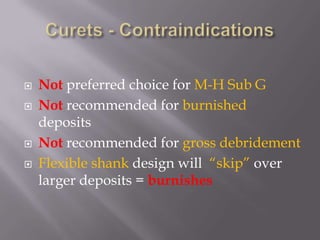
Curets - ContraindicationsNot preferred choice for M-H Sub GNot recommended for burnished depositsNot recommended for gross debridementFlexible shank design will  “skip” over larger deposits = burnishes
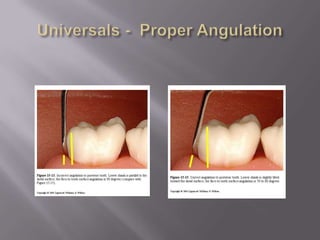
Curets - ApplicationsAngulationFace forms 70° angle with tooth surfaceAdaptationTerminal 1/3 of cutting edge stays on tooth surface
Avoid tissue trauma by keeping toe from turning out
Maintain safe contact with complex root morphology
Use only 1-2 mm of toe on line anglesCurets - ApplicationsCuret Selection – Used for fine scaling & SRPUniversals – Used sub-gingivally Lt. to Mod depositsAreas-specifics – Used sub-gingivally Lt. depositsDesignSlender, moderately flexible shank = allows easy pocket access w/ minimal traumaCurved blade = rounded end permits access to base of pocketRounded back = minimizes trauma at base of pocketStrokePull stoke only (Vertical, horizontal, or oblique)
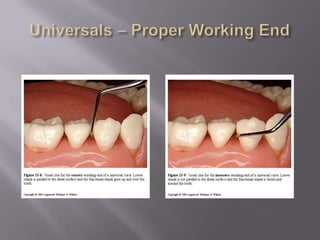
Universals – Proper Working End
Universals -  Proper Angulation
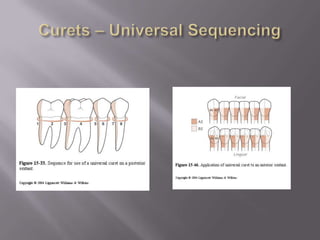
Curets – Universal Sequencing
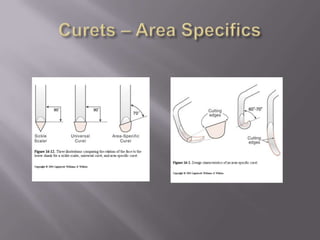
Curets – Area Specifics
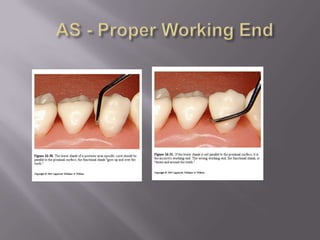
 AS - Proper Working End
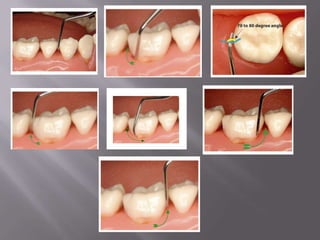
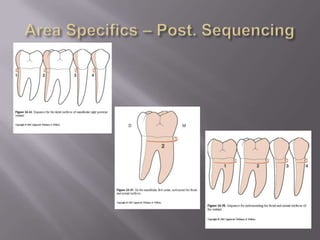
Area Specifics – Post. Sequencing
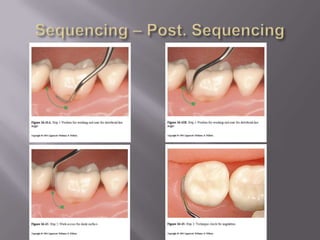
Sequencing – Post. Sequencing
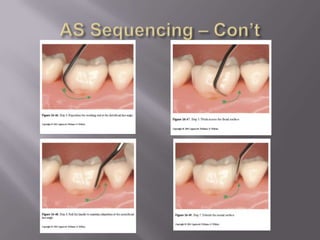
AS Sequencing – Con’t
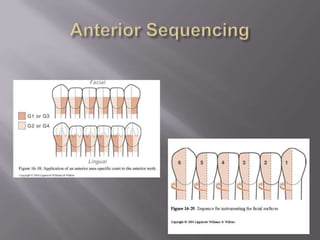
Anterior Sequencing
SummaryBasic Order of InstrumentationThe larger the deposit the rigid the shankDebridementHeavy deposit removalCrushing, fracturing, roughening depositsReduced tactile sensitivityThe smaller the deposit the more flexible the shankDe-plaquing and/or scaling (especially pediatric pts.)Lt. to Mod.  deposit removal onlySmoothing, root planingIncreased tactile sensitivity
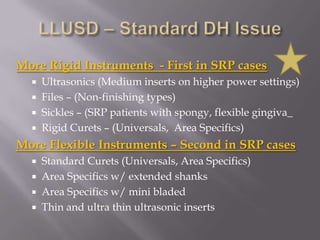
LLUSD – Standard DH IssueMore Rigid Instruments  - First in SRP casesUltrasonics (Medium inserts on higher power settings)Files – (Non-finishing types)Sickles – (SRP patients with spongy, flexible gingiva_Rigid Curets – (Universals,  Area Specifics)More Flexible Instruments – Second in SRP casesStandard Curets (Universals, Area Specifics)Area Specifics w/ extended shanksArea Specifics w/ mini bladedThin and ultra thin ultrasonic inserts
RIGIDFLEXIBLEException – Rigid curets
Possible Causes of BurnishingSlimline © (lightweight) USS Lt. or  Med. USS insert – set on low settingFlexible shank curets(universal & area-specifics) Any dull instrument(s) (Flexible or Rigid)
MORE ADVANCED CONCEPTS IN DIMENSIONS IN DENTAL HYGIENE
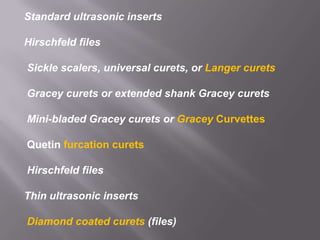
Standard ultrasonic insertsHirschfeld filesSickle scalers, universal curets, or Langer curetsGraceycurets or extended shank GraceycuretsMini-bladed Graceycurets or GraceyCurvettesQuetinfurcationcuretsHirschfeld filesThin ultrasonic insertsDiamond coated curets(files).

Order Of Instrumentation

  • 1.
    Order of instrumentationDNHY451Working smarter notharder!
  • 2.
    Imagine you’ve justspend 2 hours scaling and root planing a quadrant of moderate sub-gingival calculus. You feel you’ve done a great job and ask for a faculty evaluation.Your evaluation reveals that you have burnished the entire quadrant with your instruments. How can this be? What do you think happened during instrumentation?
  • 3.
    Possible Causes ofBurnishingSlimline © (lightweight) USS Lt. or Med. USS insert – set on low settingFlexible shank curets(universal & area-specifics) Any dull instrument(s) (Flexible or Rigid)
  • 4.
    Effectual Instrument Sequencing“Instrumentselection that maximizes periodontal instrument design in a strategic, methodical way. Calculus removal is accomplished utilizing the most effective and efficient use of periodontal instruments. Practical instrumentation involves a progressive pattern that is logical, chronological and systematic.” (Duff, 2009)
  • 5.
    But first, abit of review.Pre-requisite: Knowledge of design characteristics of scaling and root planing instruments
  • 6.
    Instrument DesignA. HandleTransmits vibrationsB. ShankJoins handle to working endRigid or flexibleC. Working EndContacts toothPerforms task
  • 8.
    SHANK DESIGN “Instruments aremade with shanks of varying degrees of thickness and rigidity that relate to the purpose for which they are used.”(Wilkins, 2009)
  • 9.
    RIGID SHANKRigid ThickShanks –A heavier shank is stronger and is able to withstand greater pressure w/o flexing when applied during instrumentation.Strong instruments are needed for removal of heavy calculus deposits.(Wilkins, 2009)T/F
  • 10.
    FLEXIBLE SHANKLess Rigid(↑ Flexible) Shanks: A thinner shank may provide more tactile sensitivity and is used, for example, for removal of fine deposits of calculus and for maintenance root debridement.(Wilkins, 2009)T/F
  • 11.
  • 12.
  • 13.
    Instrumentation ParadigmThe largerthe piece of calculus, the more rigid the shank.The smaller the piece of calculus, the more flexible the shank.T/F
  • 14.
    What’s the mostflexible exam instrument we use?Shank CharacteristicsShank is designed like 11/12 Gracey curetteTip is thin, flexible and taperedCan you remove calculus with an explorer? Why/ why not?
  • 15.
    Curets – FinishingInstrumentsA standard universal or area specific curet has moderate flexibility. How will they perform on a small piece of calculus?How will they perform on a medium piece of calculus?How will they perform on a large piece of calculus?
  • 16.
    29 Palms –Common ErrorFrom Ultrasonic to Universal Curet: A frustrating story…….Moral: Work Smart NOT Hard, folks!
  • 17.
    USS >>>> Curet– If you insist…Rigid Area Specifics AvailableRigid Universals Available
  • 18.
    Instrument SequencingMaximize InstrumentDesignStrategic and Methodical UseMost Effective Efficient UsePractical and Logical progressionLogical and Systematic sequence
  • 19.
    Practical use ofInstrumentsThe larger the piece of calculus the more _________the shank?The ________ the piece of calculus the more flexible the shank?
  • 20.
  • 21.
    yRigid or Flexible?Rigidor Flexible?Rigid or Flexible?
  • 22.
    Which insert for?De-plaquingM-HS/S Calc?Avoiding what Power Setting?Lt. S/S Calc?What happens clinically when you use a thin insert on moderate – heavy calculus?
  • 23.
  • 24.
  • 25.
    25Hoe ScalersWork horseprior to USS’s!Hoes - More Rigid
  • 26.
    26Hoe Scalers -PurposePurposeGross calculus removal (especially large, accessible, tenacious pieces)Generally supragingivally,OR 2 - 3 mm sub if tissuedisplaces easilyMainly used on facial and lingual of anterior teeth, next to edentulous spaces, or areas with flaccid tissueReplaced by ultrasonic instrumentation and files
  • 27.
    27Hoe Scalers -ContradindicationsNOT tight tissue due to trauma to pocket wallAdaptation to curved tooth problematicDecreased tactile sensitivity due to bulkVery easy to gouge tooth surfaces!
  • 28.
    28Hoe Scalers -ApplicationsModified pen graspAppropriate fulcrumFull width of cutting edge adapted avoids trauma and gougingCutting edge to tooth angle= 90°Vertical coronal pull strokeFollow up with curets
  • 29.
    29Hoe ScalersMust avoidline angles!Hoes - More Rigid
  • 30.
    Hoes - MoreRigidDesigns accommodate Direct and Proximal surfaces
  • 31.
  • 32.
  • 33.
  • 34.
    34Hoes – Buccalof Posteriors
  • 35.
  • 36.
    36FilesFiles - More Rigid
  • 37.
    37Files - CharacteristicsMultipleparallel straight cutting miniature hoe blades Cutting edges 99° to 105°angle to the baseBases are varying sizes & shapes (round, oval, rectangular, spade) and rounded backs = SubG okVarious shank lengths, angulation, and sizeUsually double-ended, paired instrument M/D, B/L
  • 38.
    38Files - PurposeCrushing,fracturing or roughening S/S Calc. Gross S/S removal or burnished calculusDeep, narrow pockets where length/curve of curet blade will not fitPalatals of maxillary anteriorsM/D concavities of mandibular molars or cuspidsB/L of Molars or Bi’sSmooth rough CEJ’sRoot planing using “finishing files” challenging in deep areasSmoothing restoration margins or removing overhangs
  • 39.
    39Files - ContraindicationsCannotbe used tight tissue due to trauma to pocket (wide bulky base)Adapt flat working surfaces to curved tooth surfaces Straight, rigid terminal shank = limits in deep curved rootsDecreased tactile sensitivity because of bulk Very easy to gouge tooth surfaces!
  • 40.
    40Files - ApplicationsModifiedpen graspAppropriate fulcrumFull working surface adapted flat to tooth avoid trauma/gougingVertical coronal pull strokeFollow up with curets
  • 41.
    41FilesFiles - More Rigid
  • 42.
  • 43.
  • 44.
  • 45.
  • 46.
    46Chisels - PurposeGrosssupragingivalcalculus removal no interdental papillaeRemoval of heavy “bridges” of interproximal calculus from lower anteriorsLimited application elsewhereNot in common use; replaced by ultrasonics
  • 47.
    47Chisels - ContraindicationsContraindicatedfor Sub G. (NO)Difficult to adapt straight blade to curved tooth surfacesDecreased tactile sensitivity – bulky Very easy to gouge
  • 48.
    48Chisels - ApplicationsModifiedpen grasp Palm-thumb grasp Appropriate fulcrumFull width adapted to tooth avoiding trauma /gouging
  • 49.
    49ChiselsWorking stroke ishorizontal “push” stroke onlyPerpendicularto long axis of toothInterproximally - Insert from facial aspect and activate push stroke towards lingualFollow up with curets
  • 50.
  • 51.
  • 52.
  • 53.
  • 54.
    Sickle Scalers -PurposeHealthy tissue – Supra-G ONLYSpongy, loose, flexible tissue – gross Sub-G OKWhen calculus is continuous with Supra –GWilkins, 2009
  • 55.
    Sickle Scalers -ContraindicationsSub-gingival use is contraindicated in healthy gingiva.Can cause undue gingival trauma due to (Blade: size, thickness and length)Pointed tip can NOT be easily adapted line anglesNot as likely with curved posterior sickles↑Risk of grooving /scratching cemental surfaceTactile sensitivity ↓ (Blade: larger, heavier)Mini Sickles – Apically to contacts (Morse Sickles)Wilkins, 2009
  • 56.
  • 57.
  • 58.
  • 59.
    Sickle Scalers -ApplicationsAngulation= @ 70 – 80 ° Stroke = Pull stoke only – Anterior Sickles Pull or oblique - Posterior SicklesCorrect AngulationIncorrect Angulation
  • 60.
    Initial Positioning -Correct NOT AngulationInitial Positioning - IncorrectAngulation @ 90° - IncorrectAngulation @ 70-80° - Correct
  • 61.
  • 62.
  • 63.
    Curets – Universal& Area Specific
  • 64.
  • 65.
  • 66.
    Curets - PurposesStandardinstrument for Sub G removal SRPRemoval of Supra G Especially fine deposits near gingival marginSupra commonly seen in pedo pts.Rounded tip – best suited to cervical areaRound back – no trauma to pocket wallUsed after gross debridement w/ USS >>> Scalers (Files and Sickles) >>> CureSoft Tissue Curettage
  • 67.
    Curets - ContraindicationsNotpreferred choice for M-H Sub GNot recommended for burnished depositsNot recommended for gross debridementFlexible shank design will “skip” over larger deposits = burnishes
  • 68.
    Curets - ApplicationsAngulationFaceforms 70° angle with tooth surfaceAdaptationTerminal 1/3 of cutting edge stays on tooth surface
  • 69.
    Avoid tissue traumaby keeping toe from turning out
  • 70.
    Maintain safe contactwith complex root morphology
  • 71.
    Use only 1-2mm of toe on line anglesCurets - ApplicationsCuret Selection – Used for fine scaling & SRPUniversals – Used sub-gingivally Lt. to Mod depositsAreas-specifics – Used sub-gingivally Lt. depositsDesignSlender, moderately flexible shank = allows easy pocket access w/ minimal traumaCurved blade = rounded end permits access to base of pocketRounded back = minimizes trauma at base of pocketStrokePull stoke only (Vertical, horizontal, or oblique)
  • 72.
  • 73.
    Universals - Proper Angulation
  • 74.
  • 76.
  • 77.
    AS -Proper Working End
  • 78.
    Area Specifics –Post. Sequencing
  • 79.
  • 80.
  • 81.
  • 83.
    SummaryBasic Order ofInstrumentationThe larger the deposit the rigid the shankDebridementHeavy deposit removalCrushing, fracturing, roughening depositsReduced tactile sensitivityThe smaller the deposit the more flexible the shankDe-plaquing and/or scaling (especially pediatric pts.)Lt. to Mod. deposit removal onlySmoothing, root planingIncreased tactile sensitivity
  • 84.
    LLUSD – StandardDH IssueMore Rigid Instruments - First in SRP casesUltrasonics (Medium inserts on higher power settings)Files – (Non-finishing types)Sickles – (SRP patients with spongy, flexible gingiva_Rigid Curets – (Universals, Area Specifics)More Flexible Instruments – Second in SRP casesStandard Curets (Universals, Area Specifics)Area Specifics w/ extended shanksArea Specifics w/ mini bladedThin and ultra thin ultrasonic inserts
  • 85.
  • 86.
    Possible Causes ofBurnishingSlimline © (lightweight) USS Lt. or Med. USS insert – set on low settingFlexible shank curets(universal & area-specifics) Any dull instrument(s) (Flexible or Rigid)
  • 87.
    MORE ADVANCED CONCEPTSIN DIMENSIONS IN DENTAL HYGIENE
  • 88.
    Standard ultrasonic insertsHirschfeldfilesSickle scalers, universal curets, or Langer curetsGraceycurets or extended shank GraceycuretsMini-bladed Graceycurets or GraceyCurvettesQuetinfurcationcuretsHirschfeld filesThin ultrasonic insertsDiamond coated curets(files).