Aesthetics
the philosophy of art
George Matthews
Spring 2016
What is art?
What is art?
! Representation: Art imitates, mimics, copies, or otherwise
represents something significant in reality.
What is art?
! Representation: Art imitates, mimics, copies, or otherwise
represents something significant in reality.
! Form: Art is an exploration of “significant form” – composition,
color, texture and other abstract elements of design regardless of
content.
What is art?
! Representation: Art imitates, mimics, copies, or otherwise
represents something significant in reality.
! Form: Art is an exploration of “significant form” – composition,
color, texture and other abstract elements of design regardless of
content.
! Expression: Art expresses emotions – our identification with this
emotional expression is the basis of the bonds that hold society
together.
What is art?
! Representation: Art imitates, mimics, copies, or otherwise
represents something significant in reality.
! Form: Art is an exploration of “significant form” – composition,
color, texture and other abstract elements of design regardless of
content.
! Expression: Art expresses emotions – our identification with this
emotional expression is the basis of the bonds that hold society
together.
! Anything goes: Anything and everything can be art, inside or
outside of the confines of the official institutions of culture.
Art is representation.
The aim of art is to represent not the
outward appearance of things, but
their inward significance.
Aristotle, Poetics
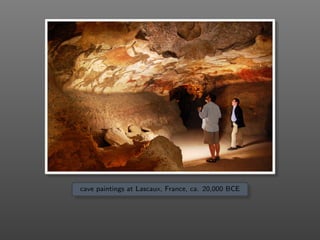
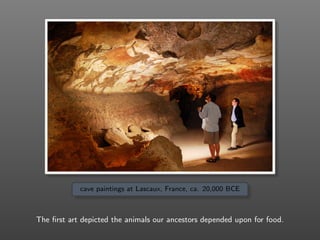
cave paintings at Lascaux, France, ca. 20,000 BCE
The first art depicted the animals our ancestors depended upon for food.
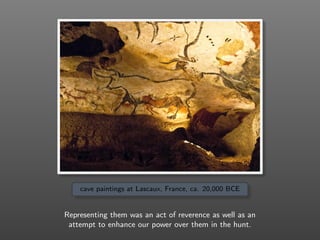
cave paintings at Lascaux, France, ca. 20,000 BCE
Representing them was an act of reverence as well as an
attempt to enhance our power over them in the hunt.
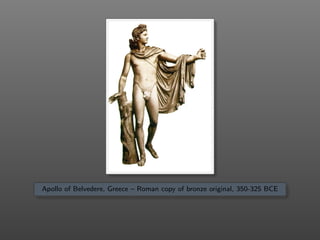
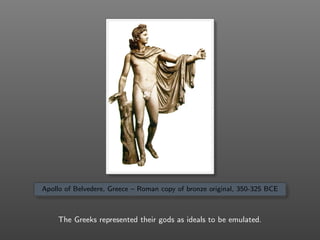
Apollo of Belvedere, Greece – Roman copy of bronze original, 350-325 BCE
The Greeks represented their gods as ideals to be emulated.
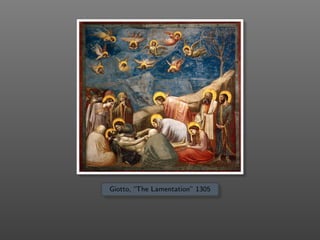
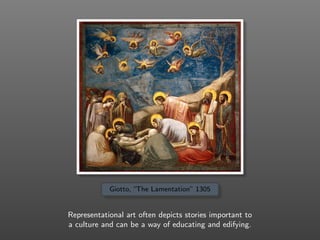
Giotto, “The Lamentation” 1305
Representational art often depicts stories important to
a culture and can be a way of educating and edifying.
[The purpose of drama is] to hold as
’twere the mirror up to nature: to
show virtue her feature, scorn her own
image, and the very age and body of
the time his form and pressure.
William Shakespeare, Hamlet
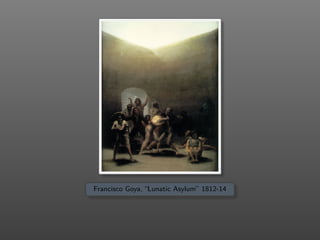
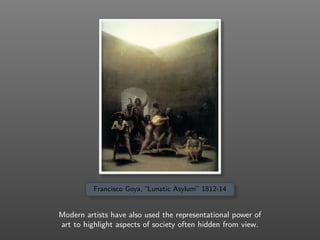
Francisco Goya, “Lunatic Asylum” 1812-14
Modern artists have also used the representational power of
art to highlight aspects of society often hidden from view.
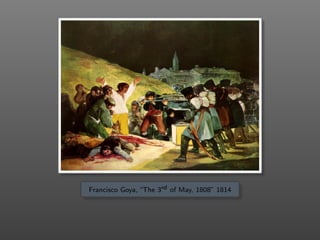
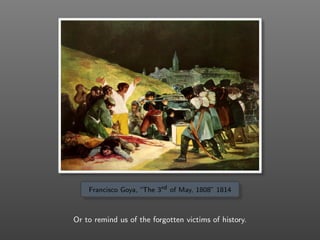
Francisco Goya, “The 3rd of May, 1808” 1814
Or to remind us of the forgotten victims of history.
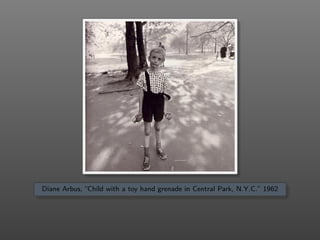
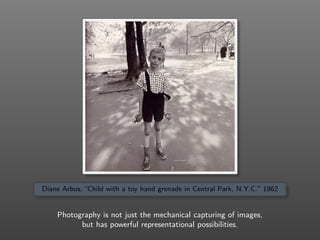
Diane Arbus, “Child with a toy hand grenade in Central Park, N.Y.C.” 1962
Photography is not just the mechanical capturing of images,
but has powerful representational possibilities.
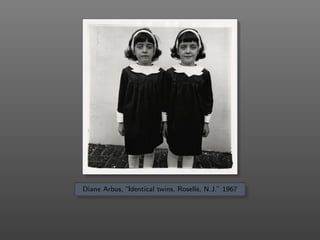
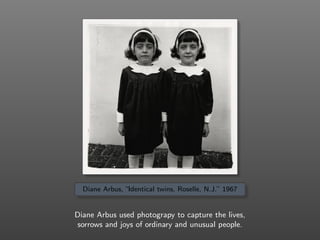
Diane Arbus, “Identical twins, Roselle, N.J.” 1967
Diane Arbus used photograpy to capture the lives,
sorrows and joys of ordinary and unusual people.
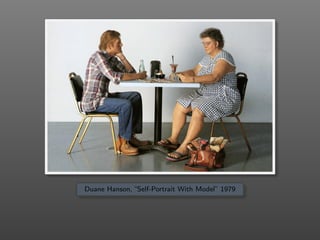
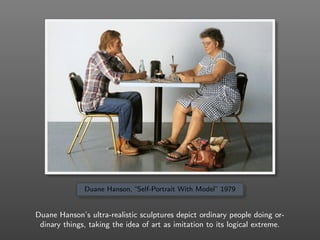
Duane Hanson, “Self-Portrait With Model” 1979
Duane Hanson’s ultra-realistic sculptures depict ordinary people doing or-
dinary things, taking the idea of art as imitation to its logical extreme.
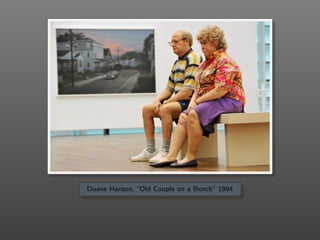
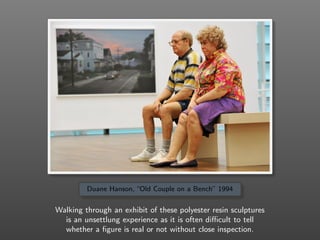
Duane Hanson, “Old Couple on a Bench” 1994
Walking through an exhibit of these polyester resin sculptures
is an unsettlung experience as it is often difficult to tell
whether a figure is real or not without close inspection.
Art is form.
I see only forms that are lit up and
forms that are not. There is only light
and shadow.
Francisco Goya, 1746-1828
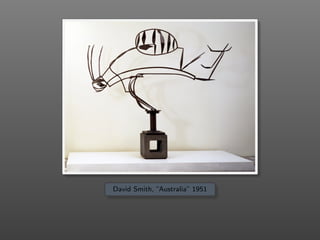
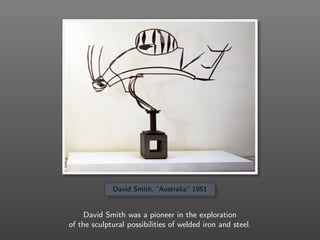
David Smith, “Australia” 1951
David Smith was a pioneer in the exploration
of the sculptural possibilities of welded iron and steel.
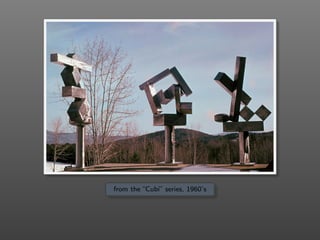
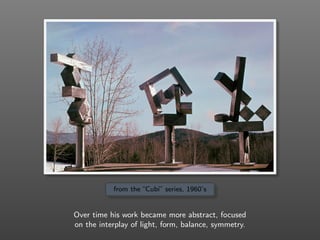
from the “Cubi” series, 1960’s
Over time his work became more abstract, focused
on the interplay of light, form, balance, symmetry.
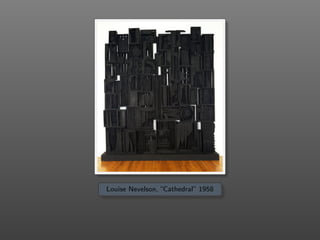
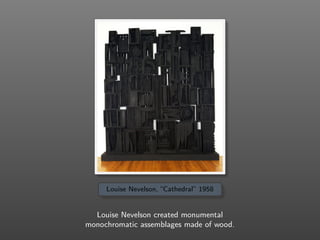
Louise Nevelson, “Cathedral” 1958
Louise Nevelson created monumental
monochromatic assemblages made of wood.
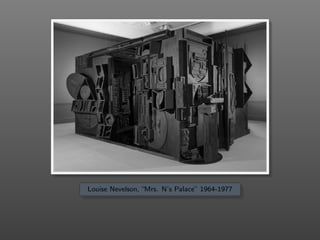
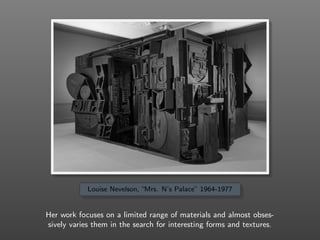
Louise Nevelson, “Mrs. N’s Palace” 1964-1977
Her work focuses on a limited range of materials and almost obses-
sively varies them in the search for interesting forms and textures.
My art is an attempt to reach beyond
the surface appearance. I want to see
growth in wood, time in stone, nature
in a city, and I do not mean its parks
but a deeper understanding that a
city is nature too-the ground upon
which it is built, the stone with which
it is made.
Andy Goldsworthy
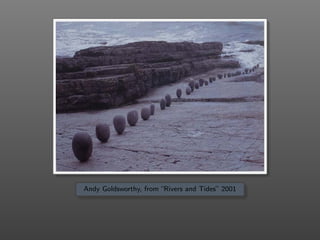
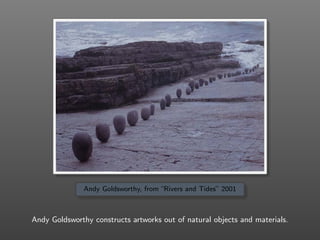
Andy Goldsworthy, from “Rivers and Tides” 2001
Andy Goldsworthy constructs artworks out of natural objects and materials.
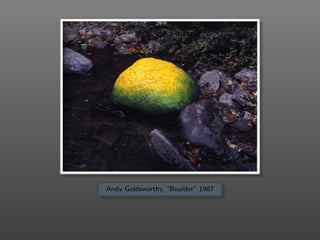
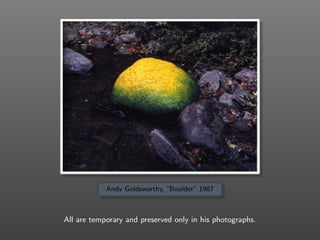
Andy Goldsworthy, “Boulder” 1987
All are temporary and preserved only in his photographs.
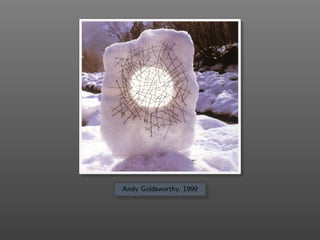
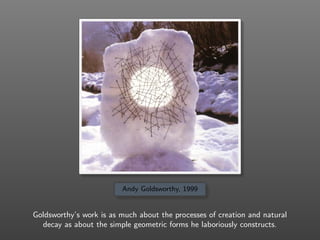
Andy Goldsworthy, 1999
Goldsworthy’s work is as much about the processes of creation and natural
decay as about the simple geometric forms he laboriously constructs.
Art is expression.
To evoke in oneself a feeling one has
once experienced, and having evoked
it in oneself, then by means of
movements, lines, colors, sounds, or
forms expressed in words, so to
transmit that feeling that others may
experience the same feeling – this is
the activity of art.
Leo Tolstoy, What is art?
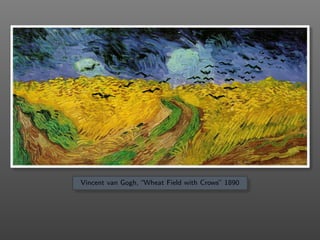
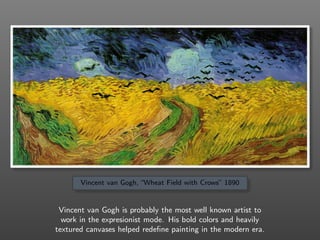
Vincent van Gogh, “Wheat Field with Crows” 1890
Vincent van Gogh is probably the most well known artist to
work in the expresionist mode. His bold colors and heavily
textured canvases helped redefine painting in the modern era.
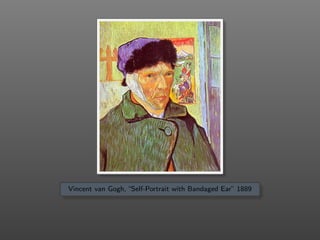
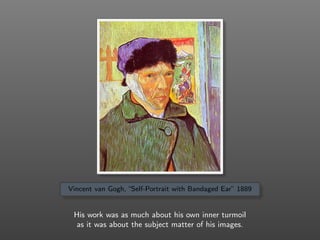
Vincent van Gogh, “Self-Portrait with Bandaged Ear” 1889
His work was as much about his own inner turmoil
as it was about the subject matter of his images.
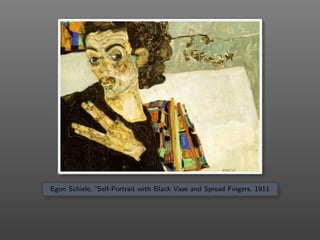
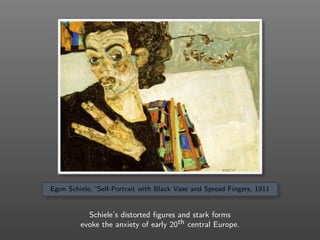
Egon Schiele, “Self-Portrait with Black Vase and Spread Fingers, 1911
Schiele’s distorted figures and stark forms
evoke the anxiety of early 20th central Europe.
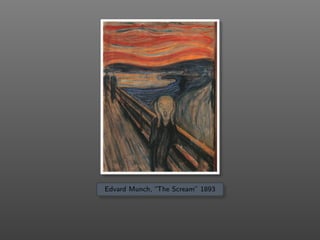
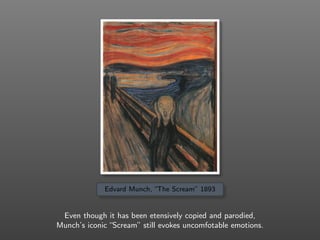
Edvard Munch, “The Scream” 1893
Even though it has been etensively copied and parodied,
Munch’s iconic “Scream” still evokes uncomfotable emotions.
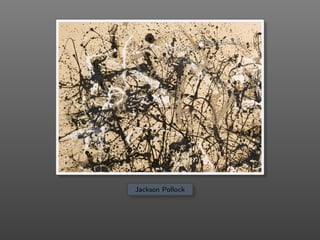
Jackson Pollock
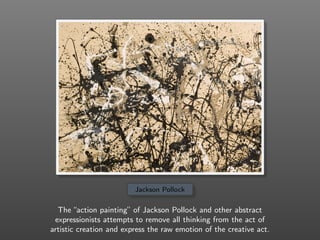
Jackson Pollock
The “action painting” of Jackson Pollock and other abstract
expressionists attempts to remove all thinking from the act of
artistic creation and express the raw emotion of the creative act.
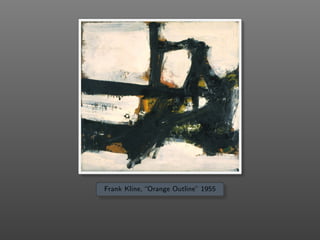
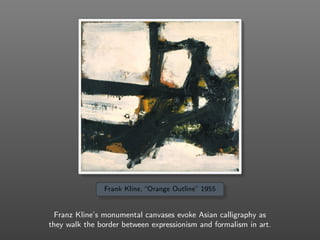
Frank Kline, “Orange Outline” 1955
Franz Kline’s monumental canvases evoke Asian calligraphy as
they walk the border between expressionism and formalism in art.
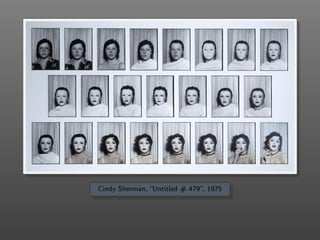
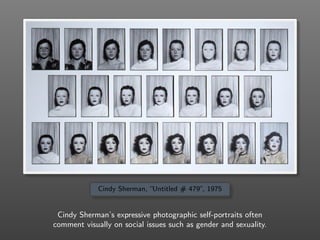
Cindy Sherman, “Untitled # 479”, 1975
Cindy Sherman’s expressive photographic self-portraits often
comment visually on social issues such as gender and sexuality.
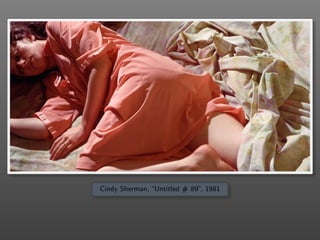
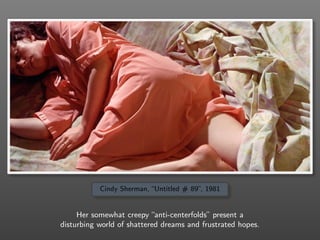
Cindy Sherman, “Untitled # 89”, 1981
Her somewhat creepy “anti-centerfolds” present a
disturbing world of shattered dreams and frustrated hopes.
Anything goes.
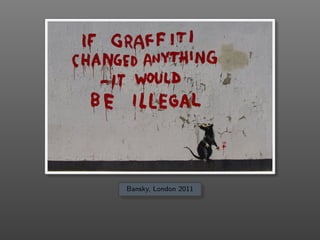
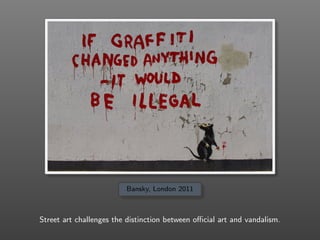
Bansky, London 2011
Bansky, London 2011
Street art challenges the distinction between official art and vandalism.
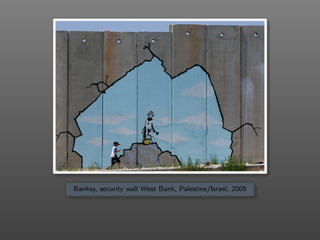
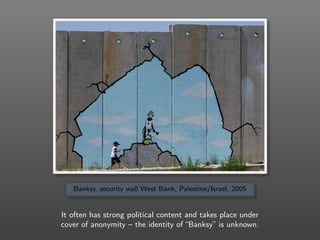
Banksy, security wall West Bank, Palestine/Israel, 2005
It often has strong political content and takes place under
cover of anonymity – the identity of “Banksy” is unknown.
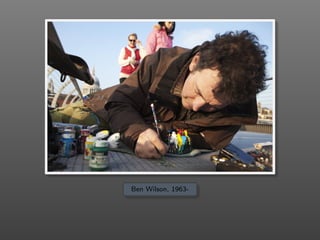
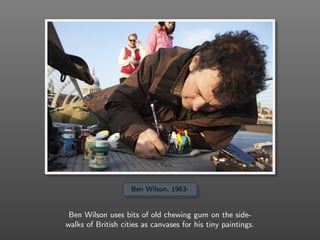
Ben Wilson, 1963-
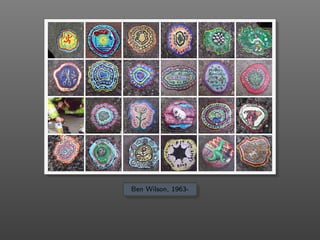
Ben Wilson, 1963-
Ben Wilson uses bits of old chewing gum on the side-
walks of British cities as canvases for his tiny paintings.
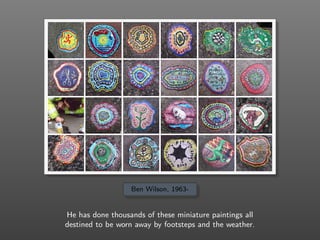
Ben Wilson, 1963-
Ben Wilson, 1963-
He has done thousands of these miniature paintings all
destined to be worn away by footsteps and the weather.
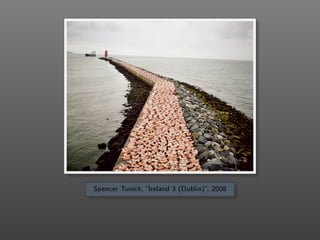
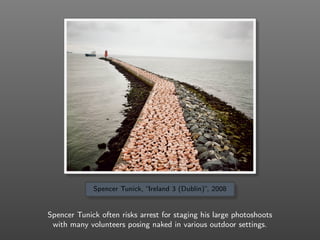
Spencer Tunick, “Ireland 3 (Dublin)”, 2008
Spencer Tunick often risks arrest for staging his large photoshoots
with many volunteers posing naked in various outdoor settings.
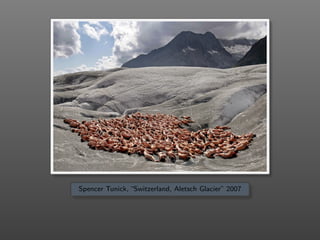
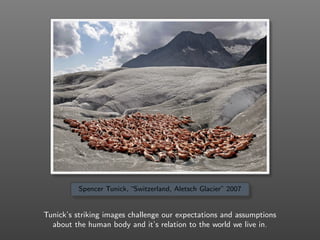
Spencer Tunick, “Switzerland, Aletsch Glacier” 2007
Tunick’s striking images challenge our expectations and assumptions
about the human body and it’s relation to the world we live in.
So what is art and why do we
make it?

07 art

  • 1.
    Aesthetics the philosophy ofart George Matthews Spring 2016
  • 2.
  • 3.
    What is art? !Representation: Art imitates, mimics, copies, or otherwise represents something significant in reality.
  • 4.
    What is art? !Representation: Art imitates, mimics, copies, or otherwise represents something significant in reality. ! Form: Art is an exploration of “significant form” – composition, color, texture and other abstract elements of design regardless of content.
  • 5.
    What is art? !Representation: Art imitates, mimics, copies, or otherwise represents something significant in reality. ! Form: Art is an exploration of “significant form” – composition, color, texture and other abstract elements of design regardless of content. ! Expression: Art expresses emotions – our identification with this emotional expression is the basis of the bonds that hold society together.
  • 6.
    What is art? !Representation: Art imitates, mimics, copies, or otherwise represents something significant in reality. ! Form: Art is an exploration of “significant form” – composition, color, texture and other abstract elements of design regardless of content. ! Expression: Art expresses emotions – our identification with this emotional expression is the basis of the bonds that hold society together. ! Anything goes: Anything and everything can be art, inside or outside of the confines of the official institutions of culture.
  • 7.
  • 8.
    The aim ofart is to represent not the outward appearance of things, but their inward significance. Aristotle, Poetics
  • 9.
    cave paintings atLascaux, France, ca. 20,000 BCE
  • 10.
    cave paintings atLascaux, France, ca. 20,000 BCE The first art depicted the animals our ancestors depended upon for food.
  • 11.
    cave paintings atLascaux, France, ca. 20,000 BCE Representing them was an act of reverence as well as an attempt to enhance our power over them in the hunt.
  • 12.
    Apollo of Belvedere,Greece – Roman copy of bronze original, 350-325 BCE
  • 13.
    Apollo of Belvedere,Greece – Roman copy of bronze original, 350-325 BCE The Greeks represented their gods as ideals to be emulated.
  • 14.
  • 15.
    Giotto, “The Lamentation”1305 Representational art often depicts stories important to a culture and can be a way of educating and edifying.
  • 16.
    [The purpose ofdrama is] to hold as ’twere the mirror up to nature: to show virtue her feature, scorn her own image, and the very age and body of the time his form and pressure. William Shakespeare, Hamlet
  • 17.
    Francisco Goya, “LunaticAsylum” 1812-14
  • 18.
    Francisco Goya, “LunaticAsylum” 1812-14 Modern artists have also used the representational power of art to highlight aspects of society often hidden from view.
  • 19.
    Francisco Goya, “The3rd of May, 1808” 1814
  • 20.
    Francisco Goya, “The3rd of May, 1808” 1814 Or to remind us of the forgotten victims of history.
  • 21.
    Diane Arbus, “Childwith a toy hand grenade in Central Park, N.Y.C.” 1962
  • 22.
    Diane Arbus, “Childwith a toy hand grenade in Central Park, N.Y.C.” 1962 Photography is not just the mechanical capturing of images, but has powerful representational possibilities.
  • 23.
    Diane Arbus, “Identicaltwins, Roselle, N.J.” 1967
  • 24.
    Diane Arbus, “Identicaltwins, Roselle, N.J.” 1967 Diane Arbus used photograpy to capture the lives, sorrows and joys of ordinary and unusual people.
  • 25.
  • 26.
    Duane Hanson, “Self-PortraitWith Model” 1979 Duane Hanson’s ultra-realistic sculptures depict ordinary people doing or- dinary things, taking the idea of art as imitation to its logical extreme.
  • 27.
    Duane Hanson, “OldCouple on a Bench” 1994
  • 28.
    Duane Hanson, “OldCouple on a Bench” 1994 Walking through an exhibit of these polyester resin sculptures is an unsettlung experience as it is often difficult to tell whether a figure is real or not without close inspection.
  • 29.
  • 30.
    I see onlyforms that are lit up and forms that are not. There is only light and shadow. Francisco Goya, 1746-1828
  • 31.
  • 32.
    David Smith, “Australia”1951 David Smith was a pioneer in the exploration of the sculptural possibilities of welded iron and steel.
  • 33.
    from the “Cubi”series, 1960’s
  • 34.
    from the “Cubi”series, 1960’s Over time his work became more abstract, focused on the interplay of light, form, balance, symmetry.
  • 35.
  • 36.
    Louise Nevelson, “Cathedral”1958 Louise Nevelson created monumental monochromatic assemblages made of wood.
  • 37.
    Louise Nevelson, “Mrs.N’s Palace” 1964-1977
  • 38.
    Louise Nevelson, “Mrs.N’s Palace” 1964-1977 Her work focuses on a limited range of materials and almost obses- sively varies them in the search for interesting forms and textures.
  • 39.
    My art isan attempt to reach beyond the surface appearance. I want to see growth in wood, time in stone, nature in a city, and I do not mean its parks but a deeper understanding that a city is nature too-the ground upon which it is built, the stone with which it is made. Andy Goldsworthy
  • 40.
    Andy Goldsworthy, from“Rivers and Tides” 2001
  • 41.
    Andy Goldsworthy, from“Rivers and Tides” 2001 Andy Goldsworthy constructs artworks out of natural objects and materials.
  • 42.
  • 43.
    Andy Goldsworthy, “Boulder”1987 All are temporary and preserved only in his photographs.
  • 44.
  • 45.
    Andy Goldsworthy, 1999 Goldsworthy’swork is as much about the processes of creation and natural decay as about the simple geometric forms he laboriously constructs.
  • 46.
  • 47.
    To evoke inoneself a feeling one has once experienced, and having evoked it in oneself, then by means of movements, lines, colors, sounds, or forms expressed in words, so to transmit that feeling that others may experience the same feeling – this is the activity of art. Leo Tolstoy, What is art?
  • 48.
    Vincent van Gogh,“Wheat Field with Crows” 1890
  • 49.
    Vincent van Gogh,“Wheat Field with Crows” 1890 Vincent van Gogh is probably the most well known artist to work in the expresionist mode. His bold colors and heavily textured canvases helped redefine painting in the modern era.
  • 50.
    Vincent van Gogh,“Self-Portrait with Bandaged Ear” 1889
  • 51.
    Vincent van Gogh,“Self-Portrait with Bandaged Ear” 1889 His work was as much about his own inner turmoil as it was about the subject matter of his images.
  • 52.
    Egon Schiele, “Self-Portraitwith Black Vase and Spread Fingers, 1911
  • 53.
    Egon Schiele, “Self-Portraitwith Black Vase and Spread Fingers, 1911 Schiele’s distorted figures and stark forms evoke the anxiety of early 20th central Europe.
  • 54.
    Edvard Munch, “TheScream” 1893
  • 55.
    Edvard Munch, “TheScream” 1893 Even though it has been etensively copied and parodied, Munch’s iconic “Scream” still evokes uncomfotable emotions.
  • 56.
  • 57.
    Jackson Pollock The “actionpainting” of Jackson Pollock and other abstract expressionists attempts to remove all thinking from the act of artistic creation and express the raw emotion of the creative act.
  • 58.
    Frank Kline, “OrangeOutline” 1955
  • 59.
    Frank Kline, “OrangeOutline” 1955 Franz Kline’s monumental canvases evoke Asian calligraphy as they walk the border between expressionism and formalism in art.
  • 60.
  • 61.
    Cindy Sherman, “Untitled# 479”, 1975 Cindy Sherman’s expressive photographic self-portraits often comment visually on social issues such as gender and sexuality.
  • 62.
  • 63.
    Cindy Sherman, “Untitled# 89”, 1981 Her somewhat creepy “anti-centerfolds” present a disturbing world of shattered dreams and frustrated hopes.
  • 64.
  • 65.
  • 66.
    Bansky, London 2011 Streetart challenges the distinction between official art and vandalism.
  • 67.
    Banksy, security wallWest Bank, Palestine/Israel, 2005
  • 68.
    Banksy, security wallWest Bank, Palestine/Israel, 2005 It often has strong political content and takes place under cover of anonymity – the identity of “Banksy” is unknown.
  • 69.
  • 70.
    Ben Wilson, 1963- BenWilson uses bits of old chewing gum on the side- walks of British cities as canvases for his tiny paintings.
  • 71.
  • 72.
    Ben Wilson, 1963- Hehas done thousands of these miniature paintings all destined to be worn away by footsteps and the weather.
  • 73.
    Spencer Tunick, “Ireland3 (Dublin)”, 2008
  • 74.
    Spencer Tunick, “Ireland3 (Dublin)”, 2008 Spencer Tunick often risks arrest for staging his large photoshoots with many volunteers posing naked in various outdoor settings.
  • 75.
    Spencer Tunick, “Switzerland,Aletsch Glacier” 2007
  • 76.
    Spencer Tunick, “Switzerland,Aletsch Glacier” 2007 Tunick’s striking images challenge our expectations and assumptions about the human body and it’s relation to the world we live in.
  • 77.
    So what isart and why do we make it?