orcid.org	

Contact Info: p. +1-301-922-9062 a. 10411 Motor City Drive, Suite 750, Bethesda, MD 20817 USA	

ORCID Adoption and Use by the
Research Community
SARIMA Workshop, 11 May 2015
Laurel L. Haak, PhD
Executive Director, ORCID
L.Haak@orcid.org
http://orcid.org/0000-0001-5109-3700
2
Digital scholarly communications require
information that is machine readable
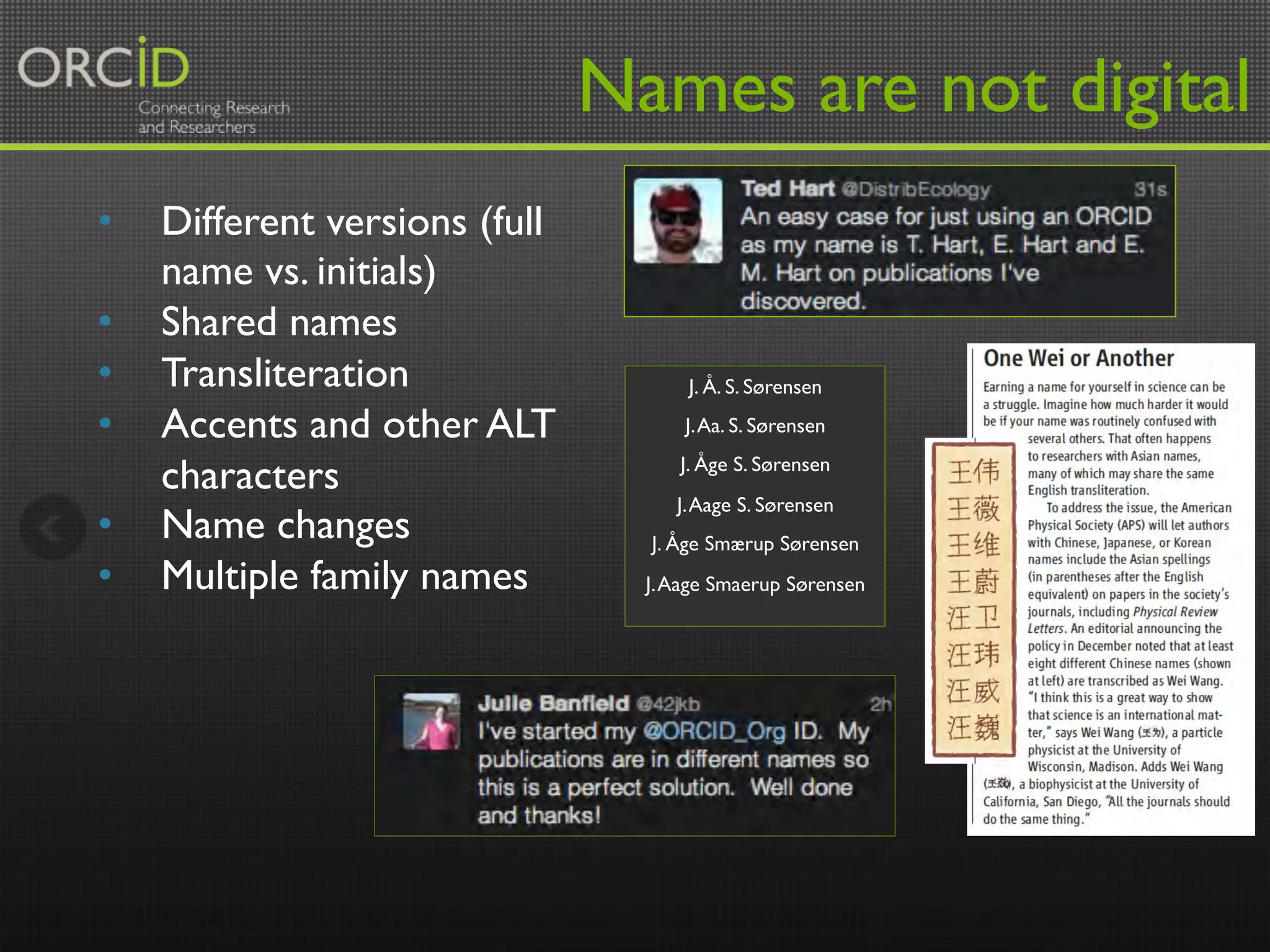
Names are not digital
•  Different versions (full
name vs. initials)
•  Shared names
•  Transliteration
•  Accents and other ALT
characters
•  Name changes
•  Multiple family names
J. Å. S. Sørensen
J.Aa. S. Sørensen
J. Åge S. Sørensen
J.Aage S. Sørensen
J. Åge Smærup Sørensen
J.Aage Smaerup Sørensen
4
What is ORCID?
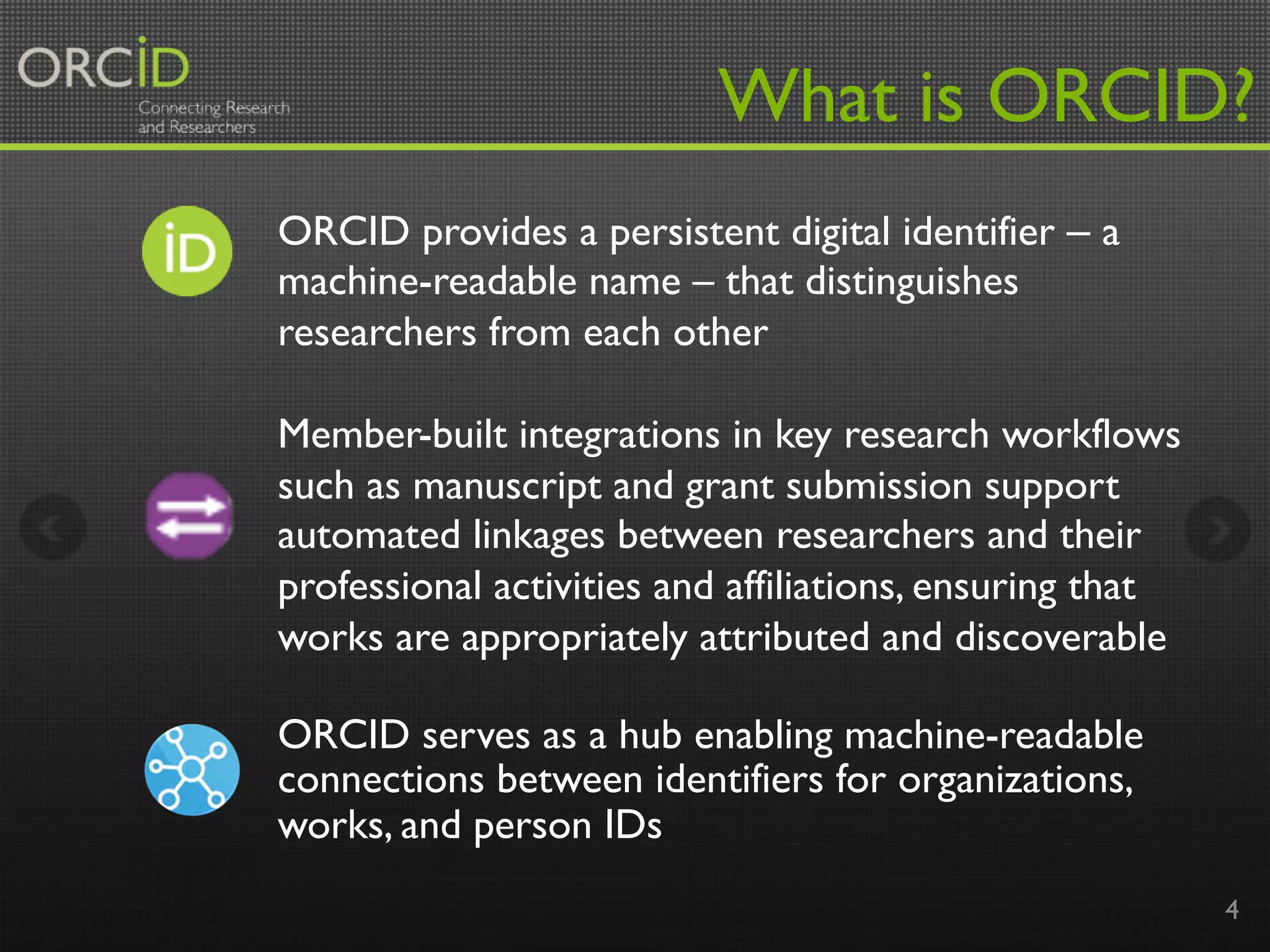
ORCID provides a persistent digital identifier – a
machine-readable name – that distinguishes
researchers from each other
Member-built integrations in key research workflows
such as manuscript and grant submission support
automated linkages between researchers and their
professional activities and affiliations, ensuring that
works are appropriately attributed and discoverable
ORCID serves as a hub enabling machine-readable
connections between identifiers for organizations,
works, and person IDs
ORCID provides plumbing for
research information – and the
tools to build trust in digital
information
10 May 2015 orcid.org	

 5
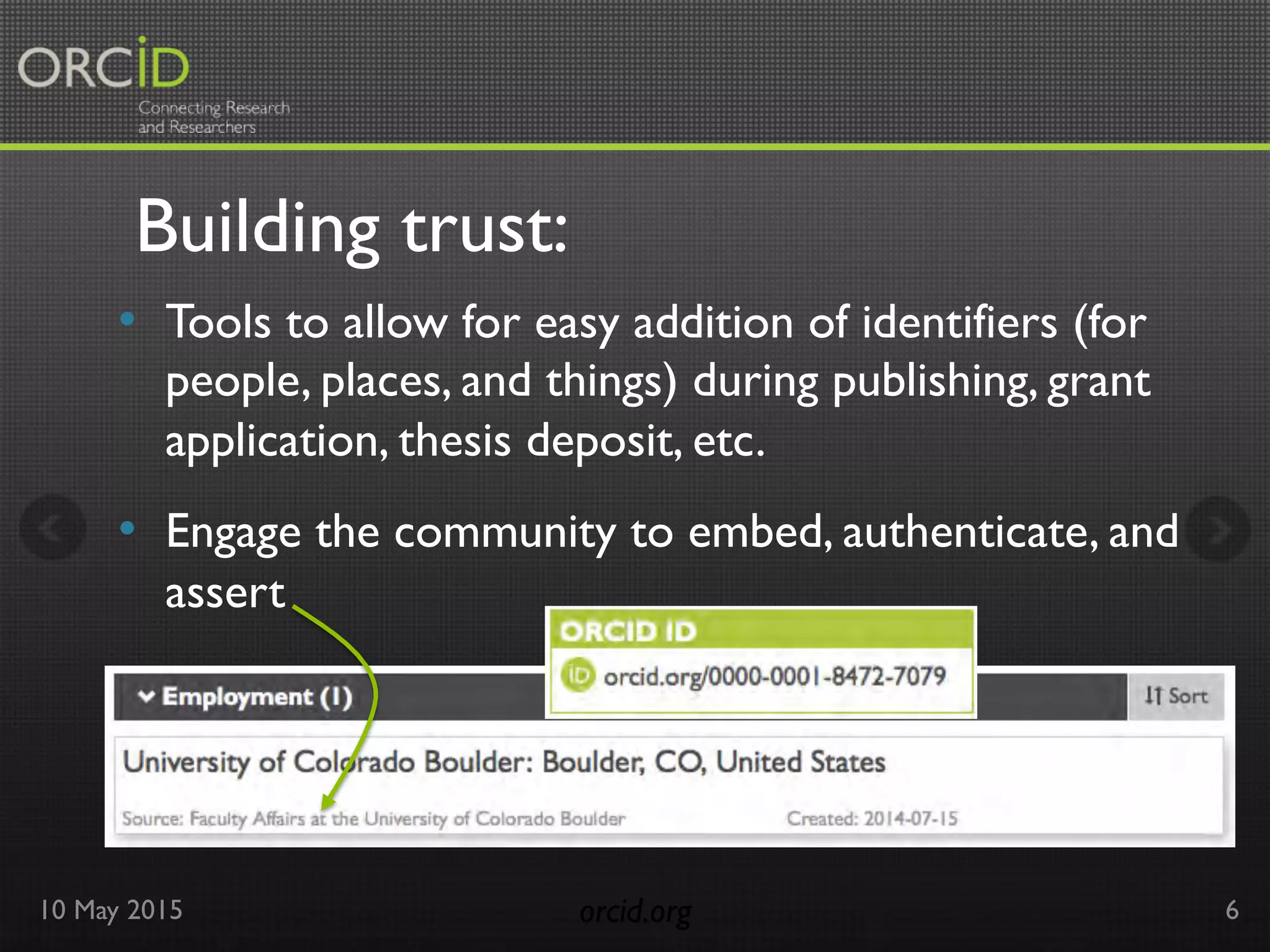
Building trust:
10 May 2015 orcid.org	

 6
•  Tools to allow for easy addition of identifiers (for
people, places, and things) during publishing, grant
application, thesis deposit, etc.
•  Engage the community to embed, authenticate, and
assert
Researcher Responsibility
10 May 2015 orcid.org	

 7
To benefit from ORCID, researchers
need only do two things:
①  Register
②  Use iD
No membership or fee is needed by the
individual or their employer.
10 May 2015 orcid.org	

 8
Over 1.3 million researchers have registered for
an ORCID identifier.
Through their actions, ORCID identifiers are
associated with:
•  2.1 million unique DOIs
•  >20 thousand unique organizations
ORCID responsibility
Build the infrastructure:
•  Engage the community to embed identifiers
•  Ensure that the iD is published with the paper /
dataset / grant / thesis, etc.
•  Encourage the community to push metadata back to
update individual’s record
10 May 2015 orcid.org	

 9
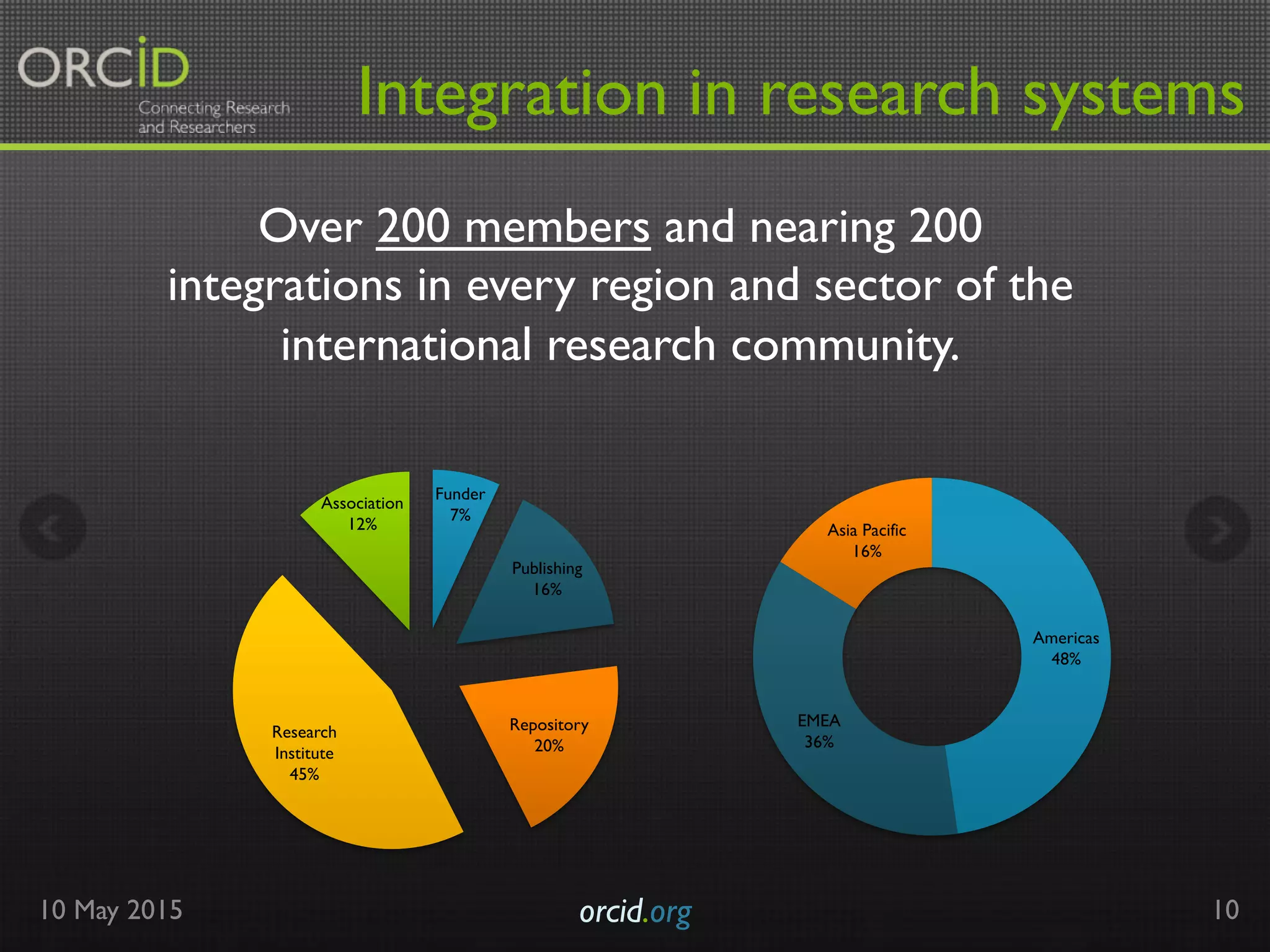
Integration in research systems
10 May 2015 orcid.org	

 10
Over 200 members and nearing 200
integrations in every region and sector of the
international research community.
Americas
48%
EMEA
36%
Asia Pacific
16%
Funder
7%
Publishing
16%
Repository
20%
Research
Institute
45%
Association
12%
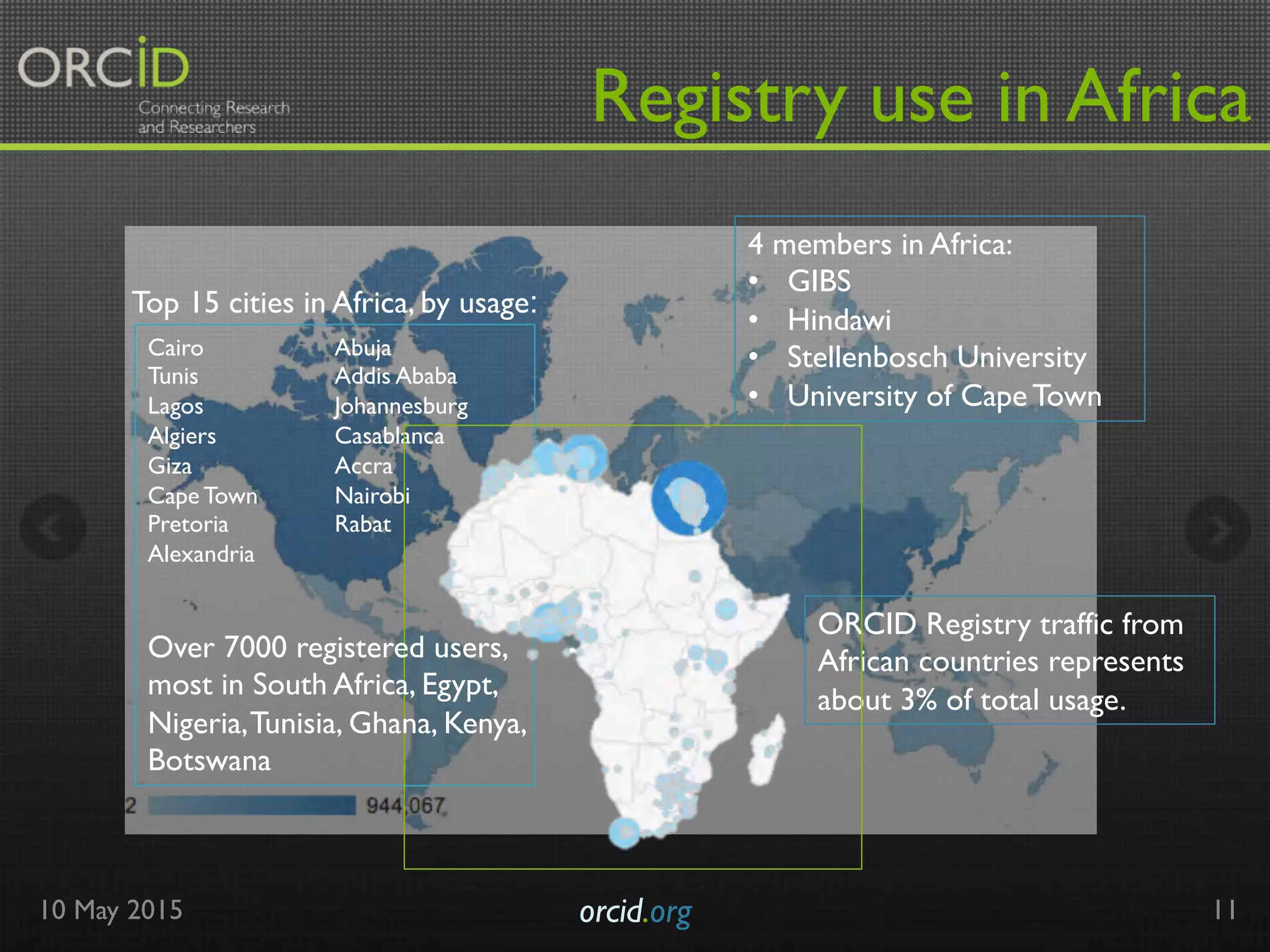
Registry use in Africa
10 May 2015 orcid.org	

 11
ORCID Registry traffic from
African countries represents
about 3% of total usage.
Cairo
Tunis
Lagos
Algiers
Giza
Cape Town
Pretoria
Alexandria
Abuja
Addis Ababa
Johannesburg
Casablanca
Accra
Nairobi
Rabat
4 members in Africa:
•  GIBS
•  Hindawi
•  Stellenbosch University
•  University of Cape Town
Over 7000 registered users,
most in South Africa, Egypt,
Nigeria,Tunisia, Ghana, Kenya,
Botswana
Top 15 cities in Africa, by usage:
Regional & national approach
•  Austria: Funder requirement 2016
•  Finland: National recommendation 2015
•  Australia: National recommendation 2015
•  Denmark: University launch 2014
•  Spain: Launched 2 consortia in 2014
•  Portugal: Funder requirement 2013
•  Sweden: National recommendation 2013
•  UK: National recommendation 2012
10 May 2015 orcid.org	

 12
Leveraging existing standards
10 May 2015 orcid.org	

 13
ORCID works collaboratively
with the research community
to ensure adoption and use of
research information standards
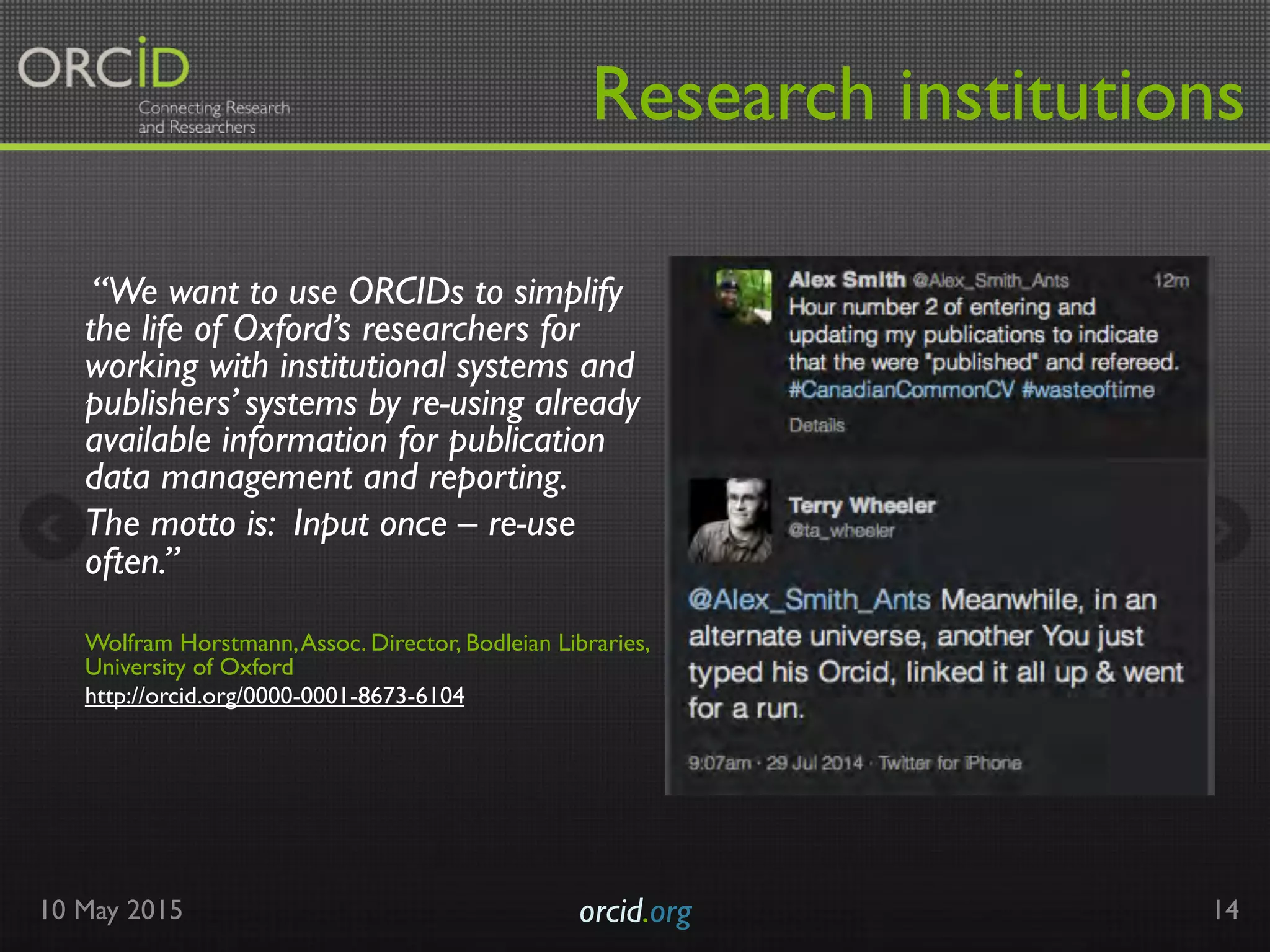
“We want to use ORCIDs to simplify
the life of Oxford’s researchers for
working with institutional systems and
publishers’ systems by re-using already
available information for publication
data management and reporting.
The motto is: Input once – re-use
often.”
 
Wolfram Horstmann,Assoc. Director, Bodleian Libraries,
University of Oxford
http://orcid.org/0000-0001-8673-6104
10 May 2015 orcid.org	

 14
Research institutions
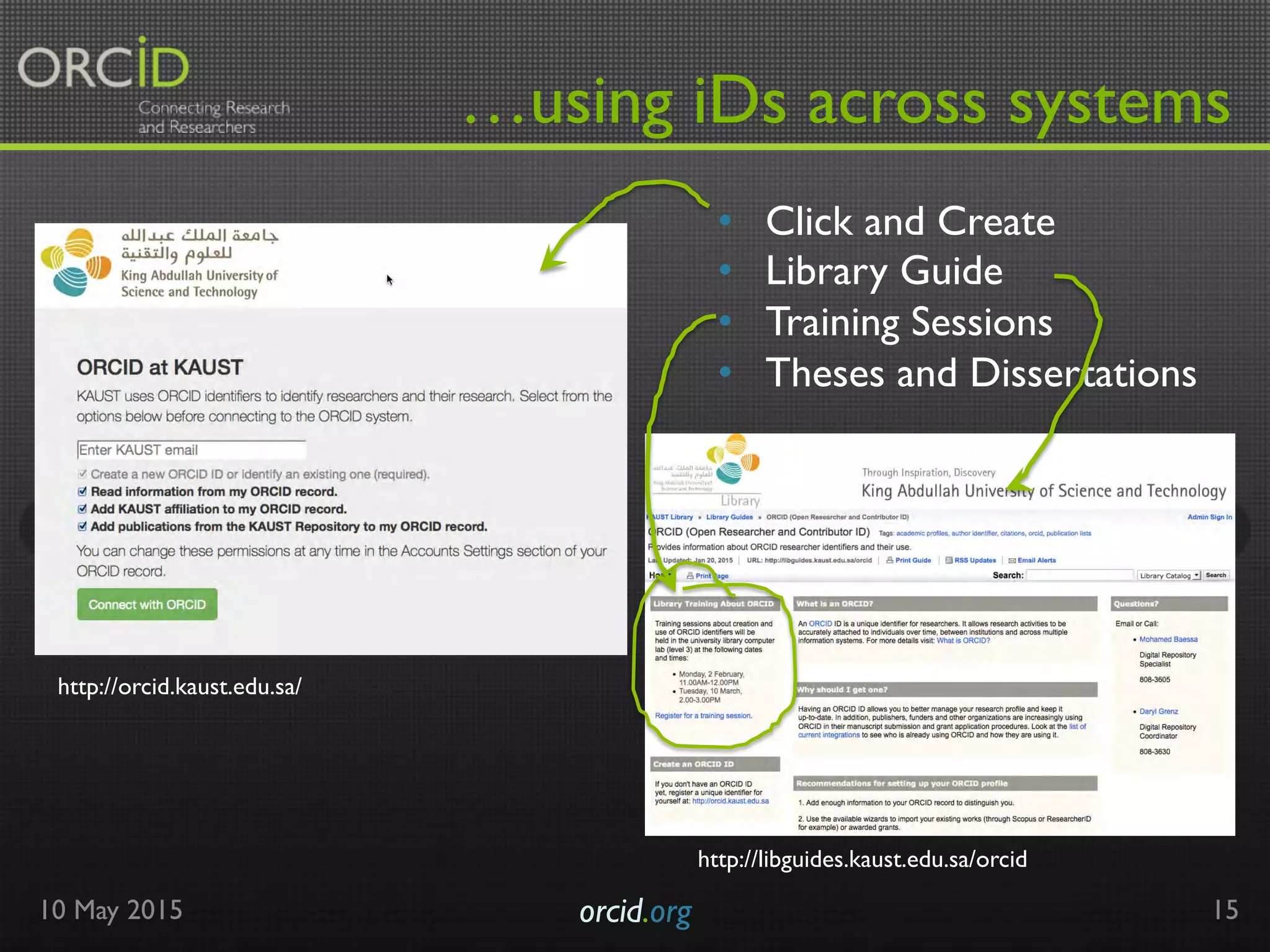
…using iDs across systems
10 May 2015 orcid.org	

 15
•  Click and Create
•  Library Guide
•  Training Sessions
•  Theses and Dissertations
http://libguides.kaust.edu.sa/orcid
http://orcid.kaust.edu.sa/
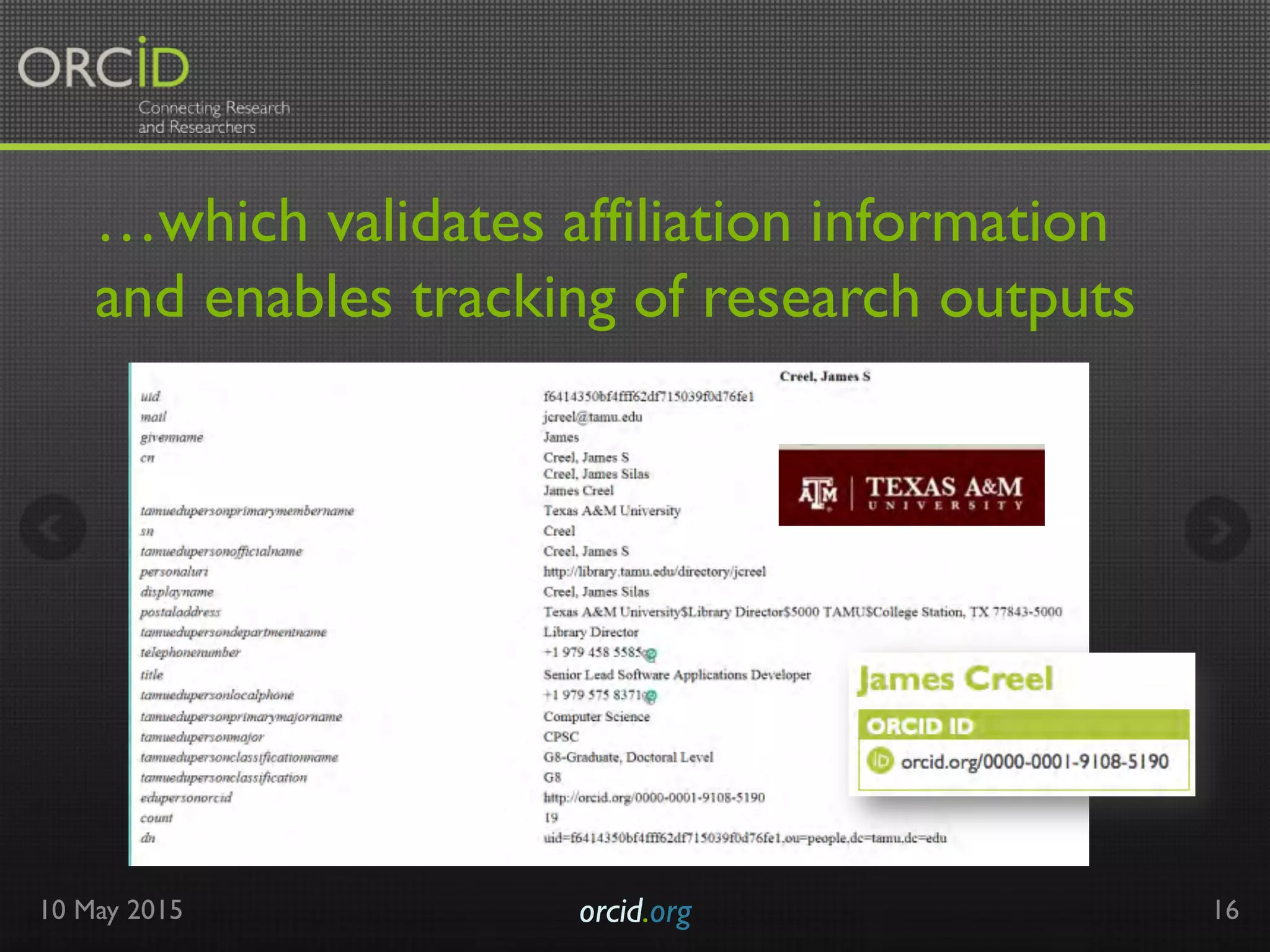
…which validates affiliation information
and enables tracking of research outputs
10 May 2015 orcid.org	

 16
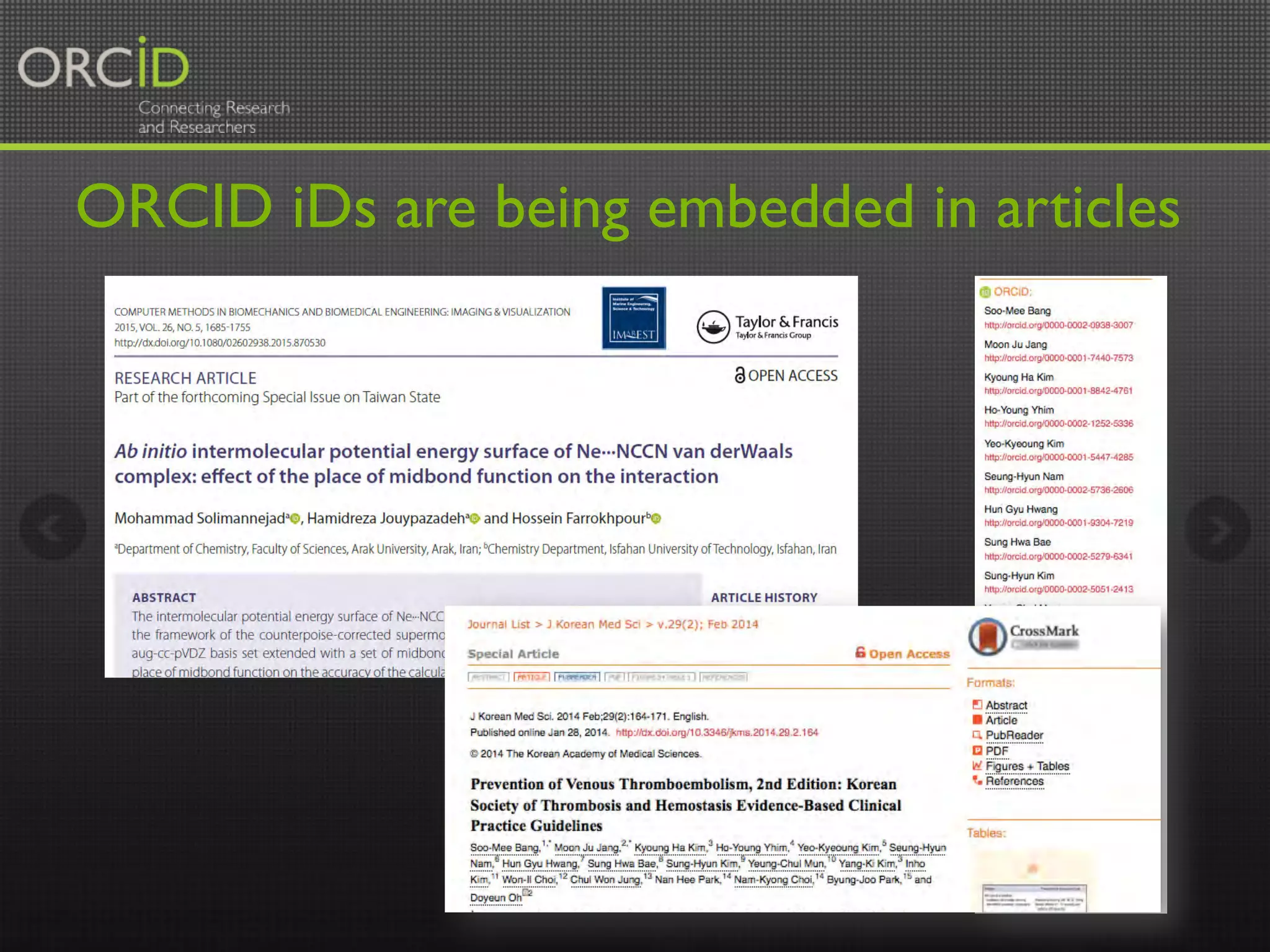
ORCID iDs are being embedded in articles
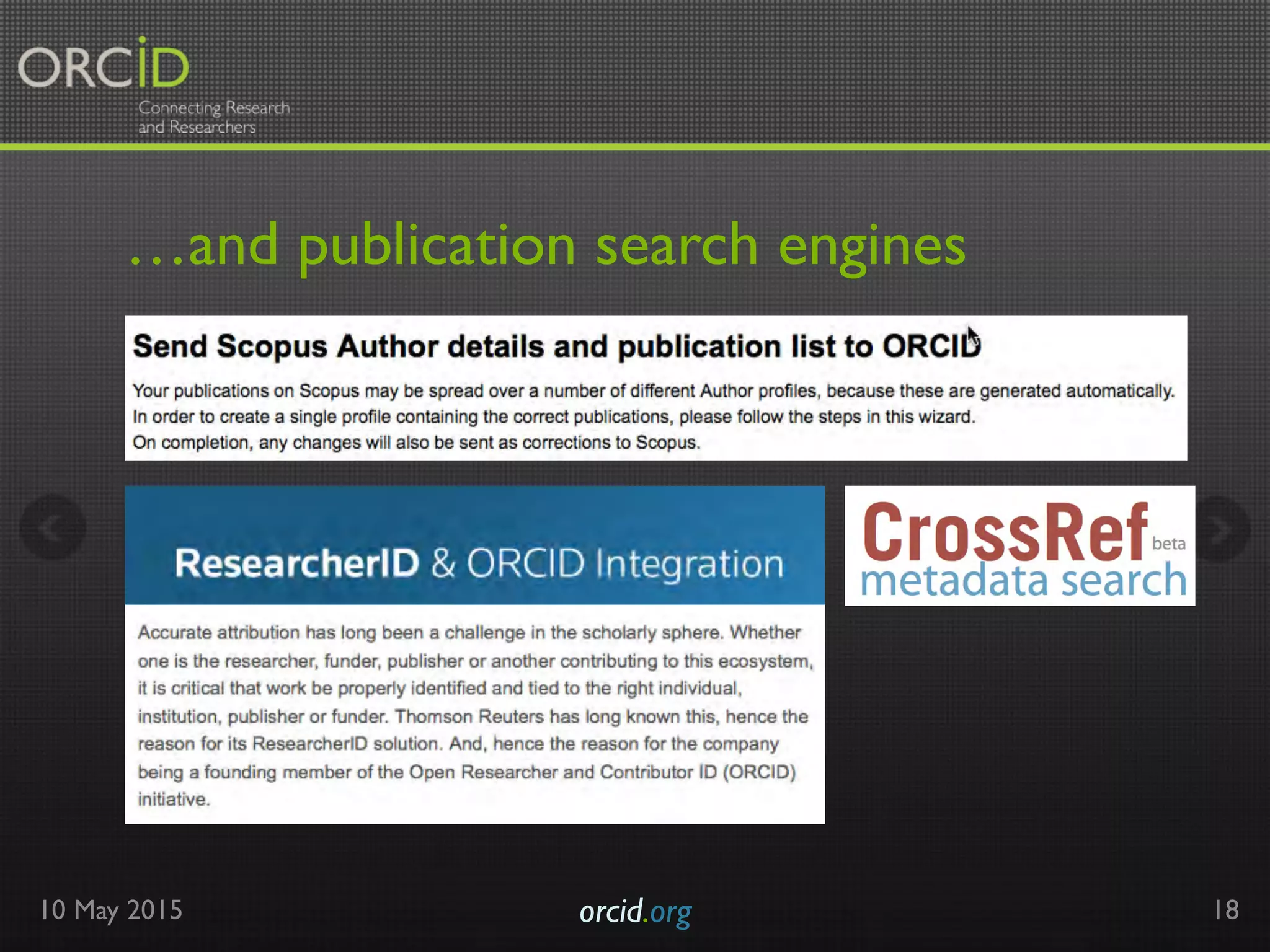
…and publication search engines
10 May 2015 orcid.org	

 18
10 May 2015 orcid.org	

 19
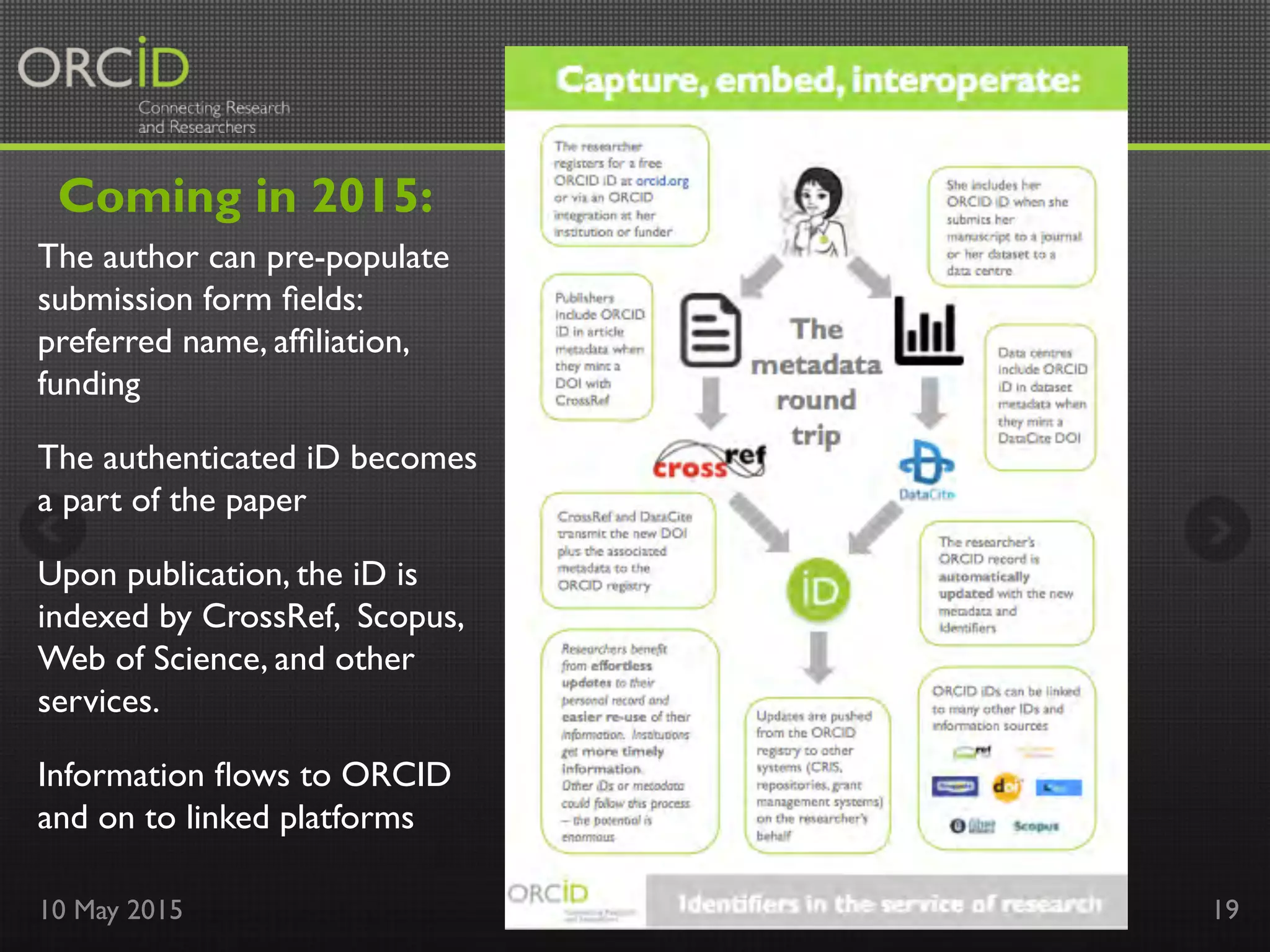
The author can pre-populate
submission form fields:
preferred name, affiliation,
funding 	

The authenticated iD becomes
a part of the paper	

Upon publication, the iD is
indexed by CrossRef, Scopus,
Web of Science, and other
services.	

Information flows to ORCID
and on to linked platforms	

Coming in 2015:
•  Over 180,000 articles have been
submitted to CrossRef with an associated
ORCID iD
•  These will start to flow into the ORCID
registry this year
•  Researchers who use their ORCID iD
when they publish will not need to
manually update their record in
ORCID or in connected systems
10 May 2015 orcid.org	

 20
10 May 2015 orcid.org	

 21
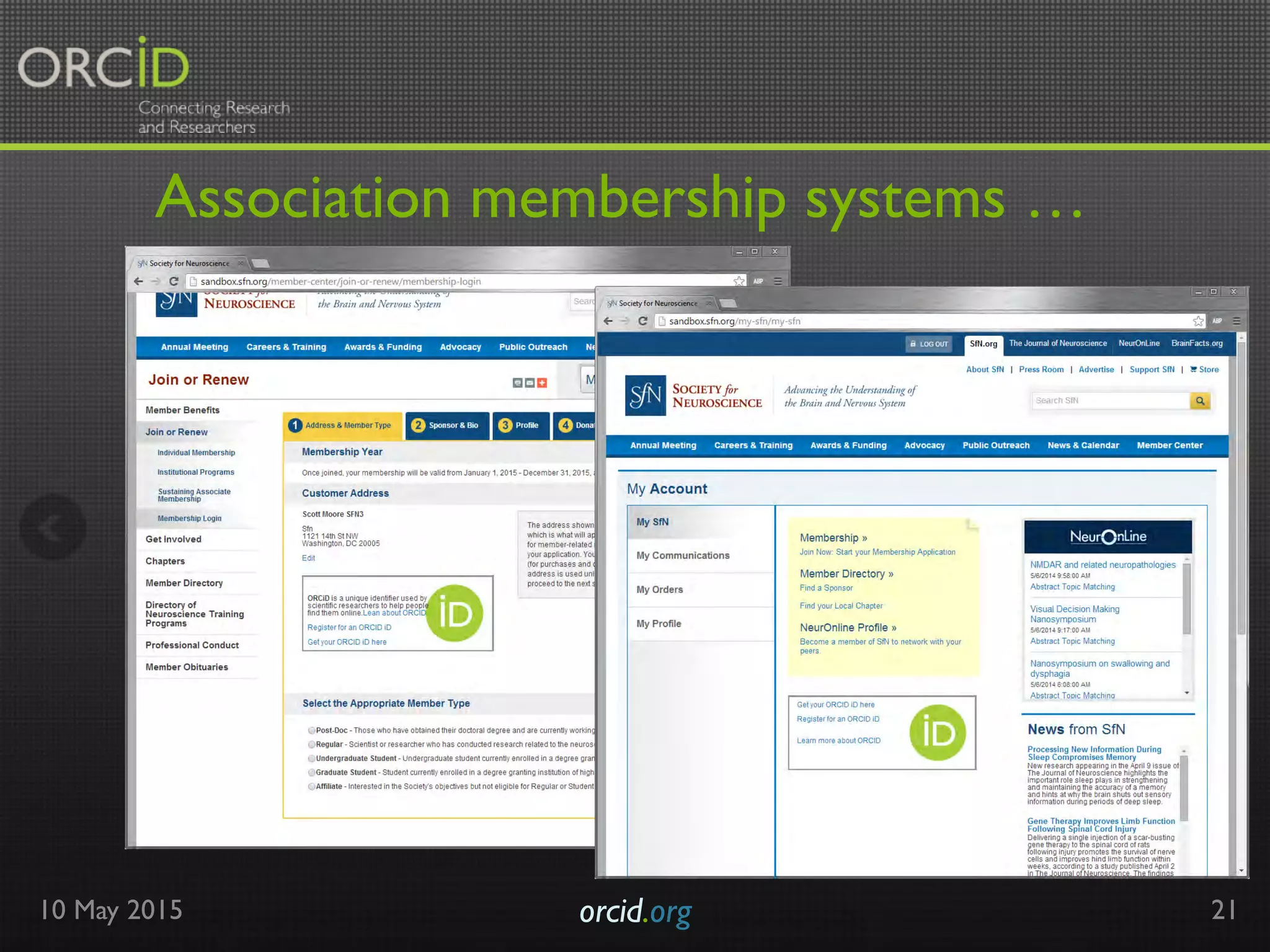
Association membership systems …
10 May 2015 orcid.org	

 22
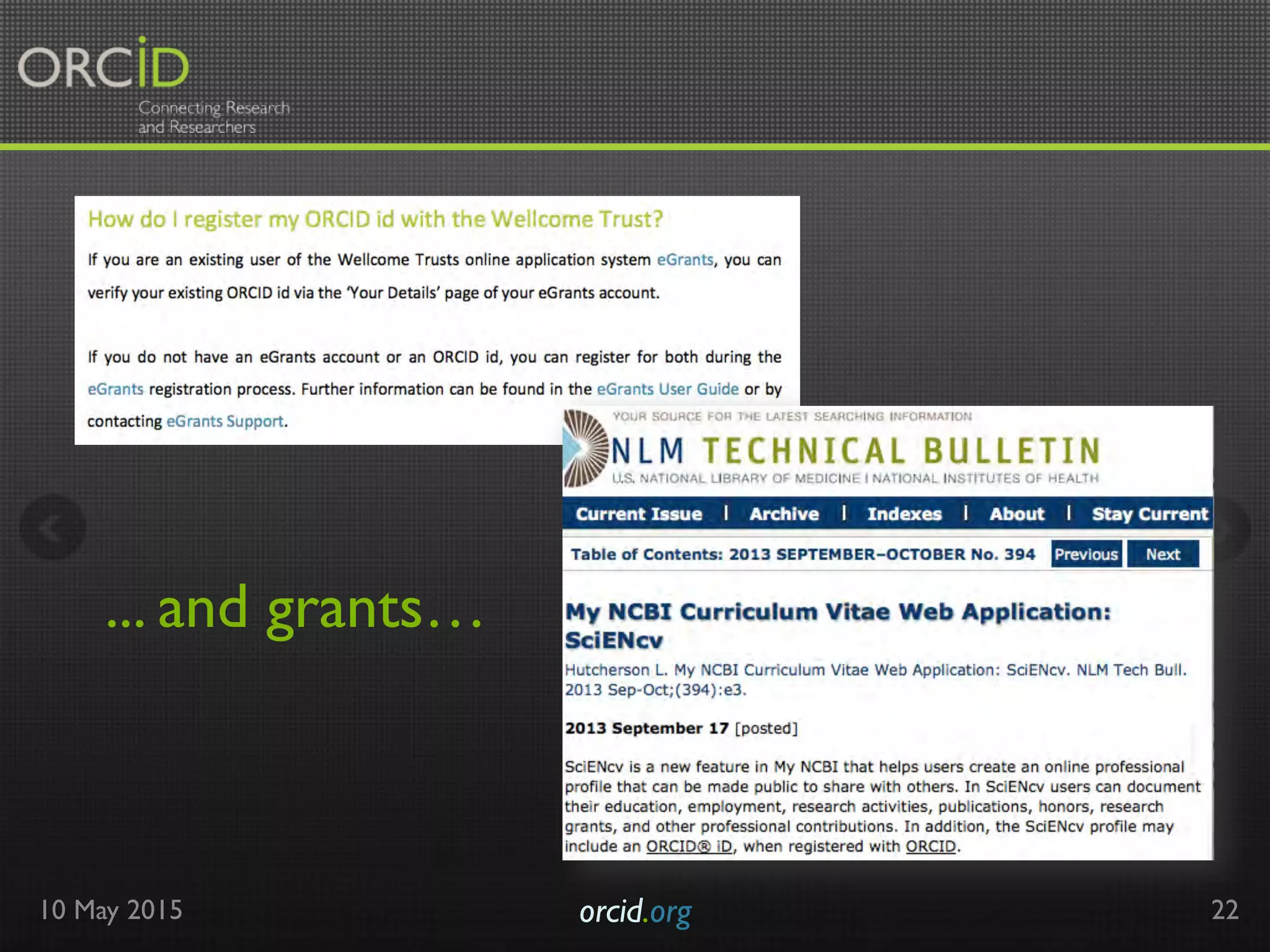
... and grants…
10 May 2015 orcid.org	

 23
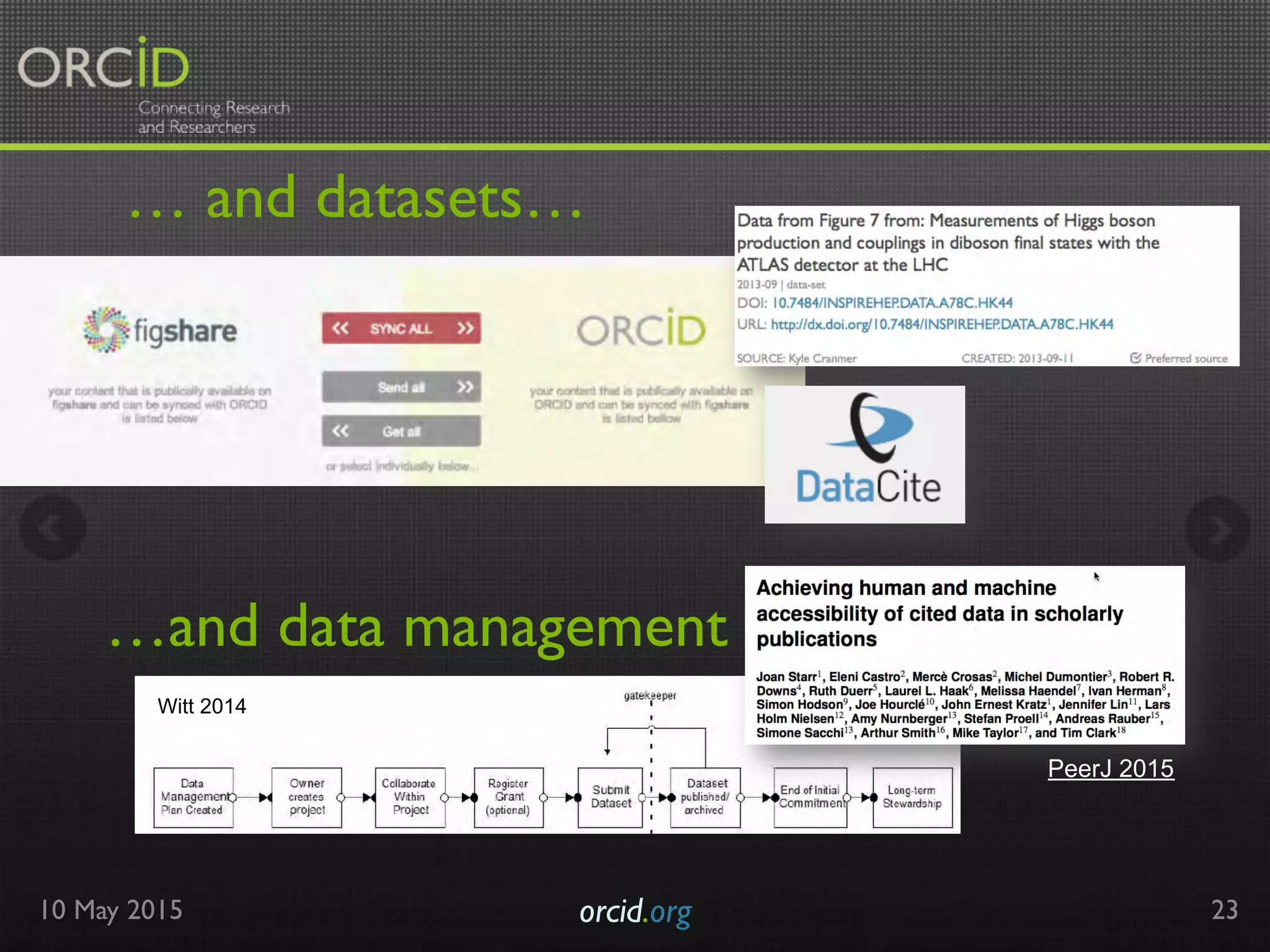
…and data management
… and datasets…
Witt 2014
PeerJ 2015
How does ORCID work?
•  Registry allows researchers to connect to
existing works and affiliations
•  Members build integrations to connect
researchers to new works and affiliations
10 May 2015 orcid.org	

 24
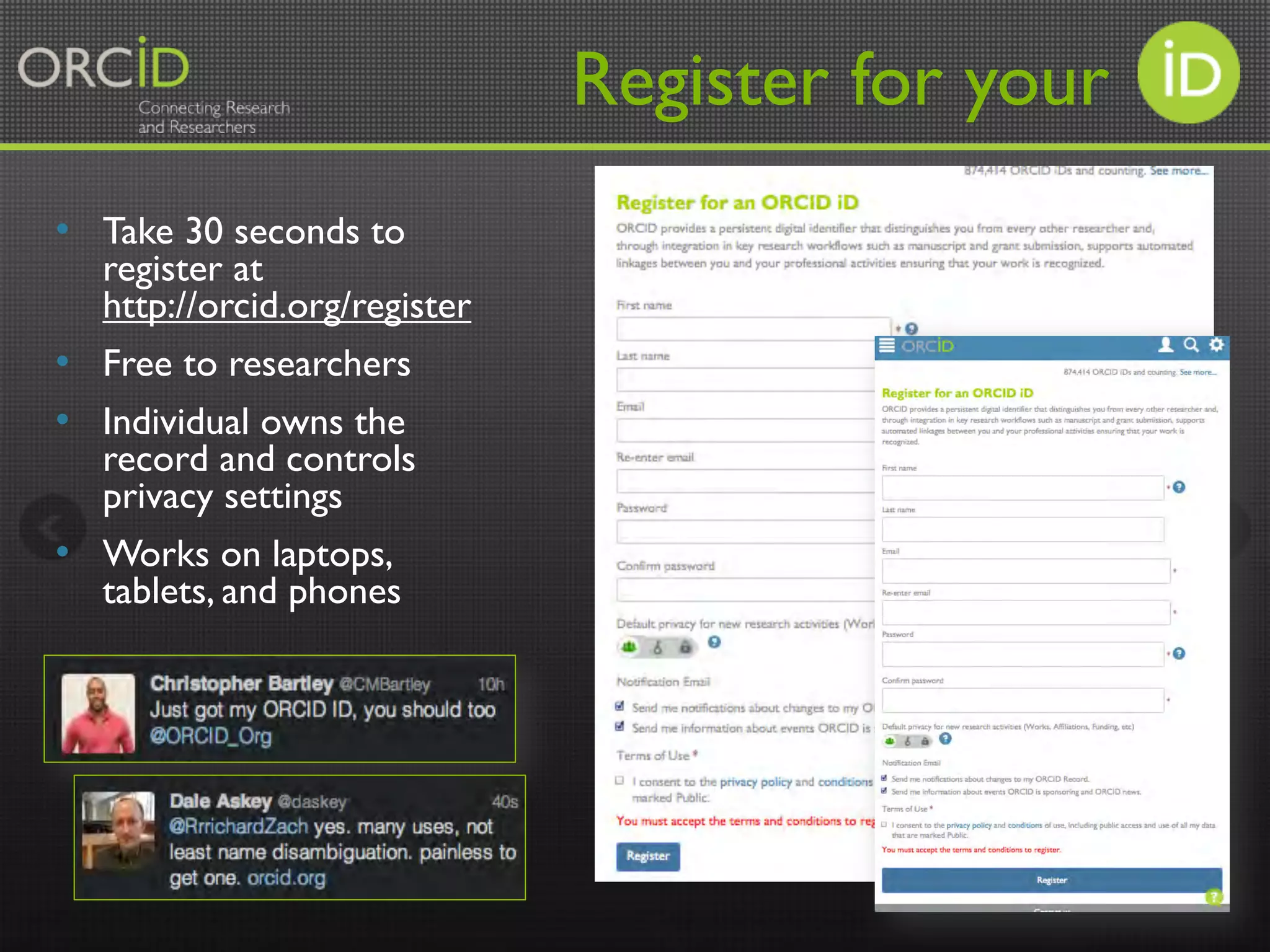
•  Take 30 seconds to
register at
http://orcid.org/register
•  Free to researchers
•  Individual owns the
record and controls
privacy settings
•  Works on laptops,
tablets, and phones
Register for your
Getting started
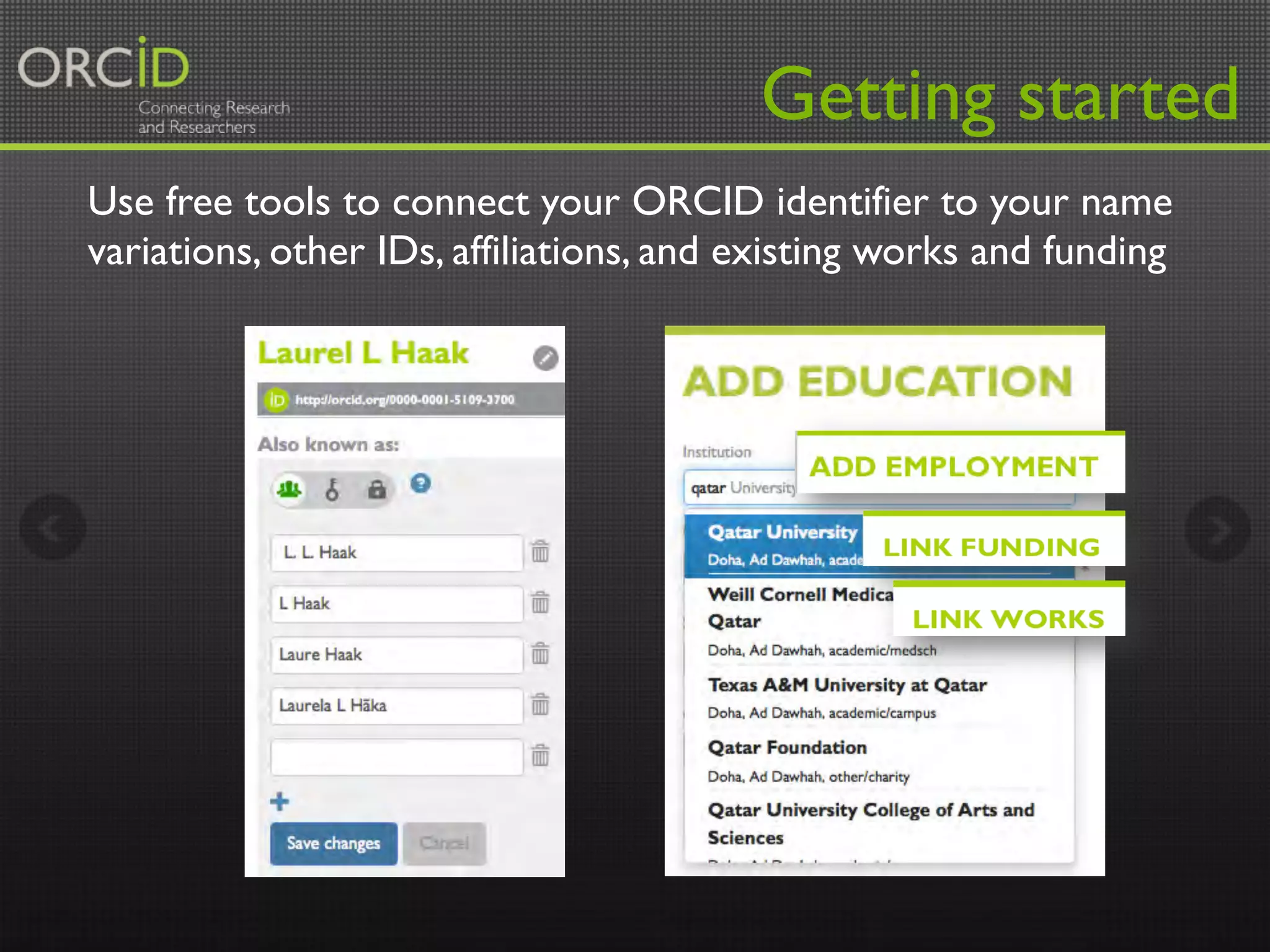
Use free tools to connect your ORCID identifier to your name
variations, other IDs, affiliations, and existing works and funding
Link to existing works
27
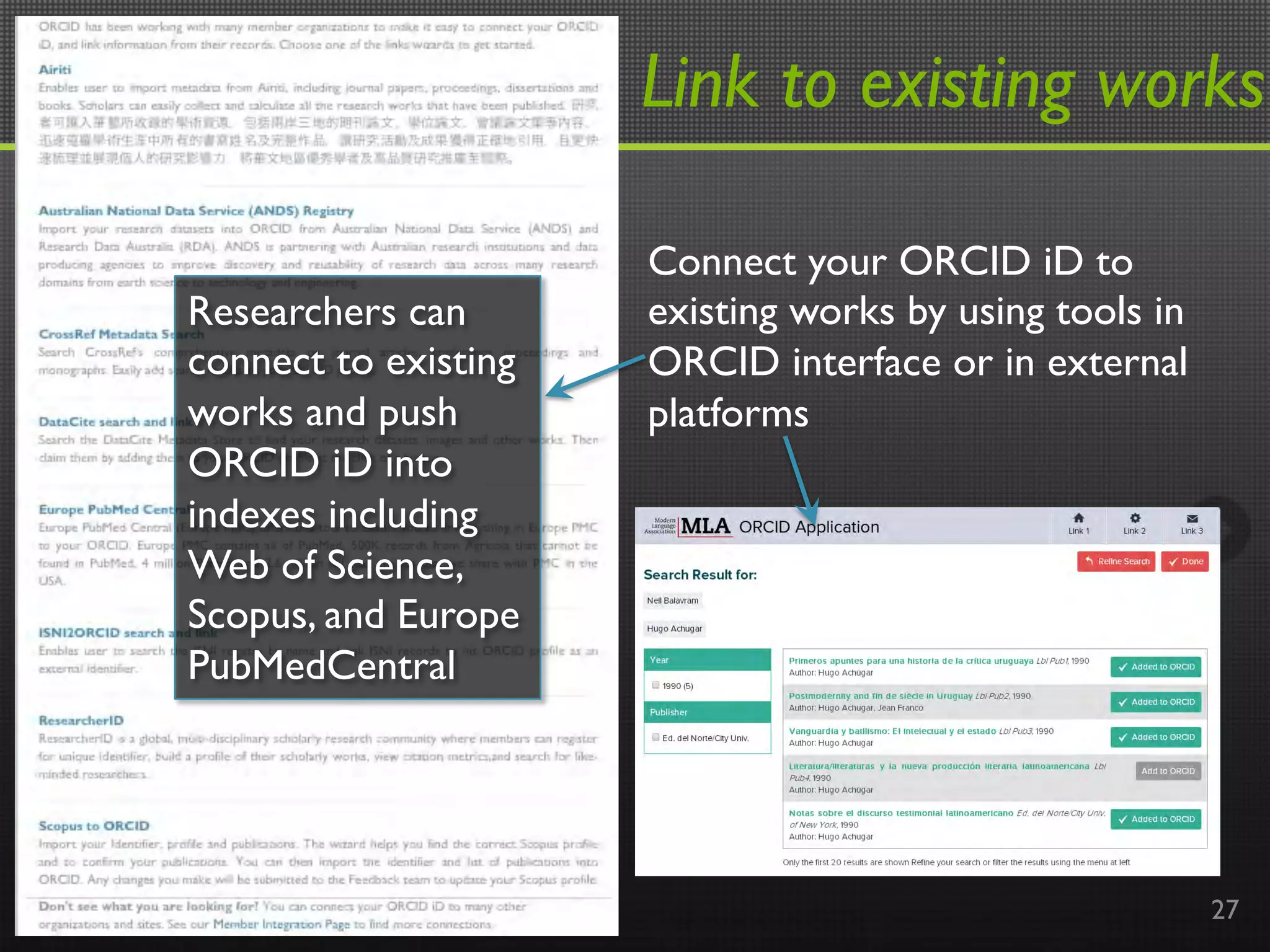
Connect your ORCID iD to
existing works by using tools in
ORCID interface or in external
platforms 	


Researchers can
connect to existing
works and push
ORCID iD into
indexes including
Web of Science,
Scopus, and Europe
PubMedCentral
Updating award information
10 May 2015 orcid.org	

 28
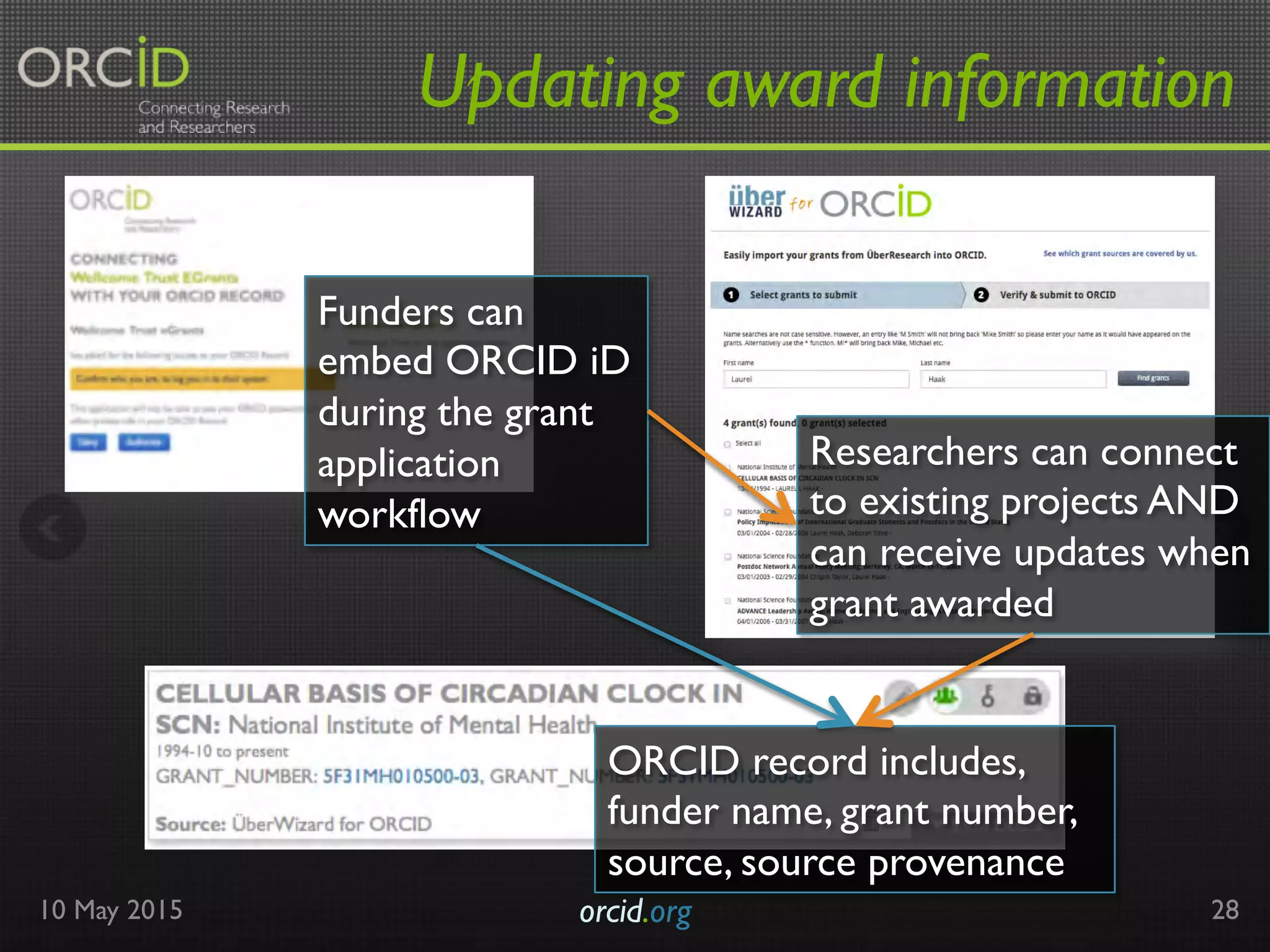
Researchers can connect
to existing projects AND
can receive updates when
grant awarded
Funders can
embed ORCID iD
during the grant
application
workflow
ORCID record includes,
funder name, grant number,
source, source provenance
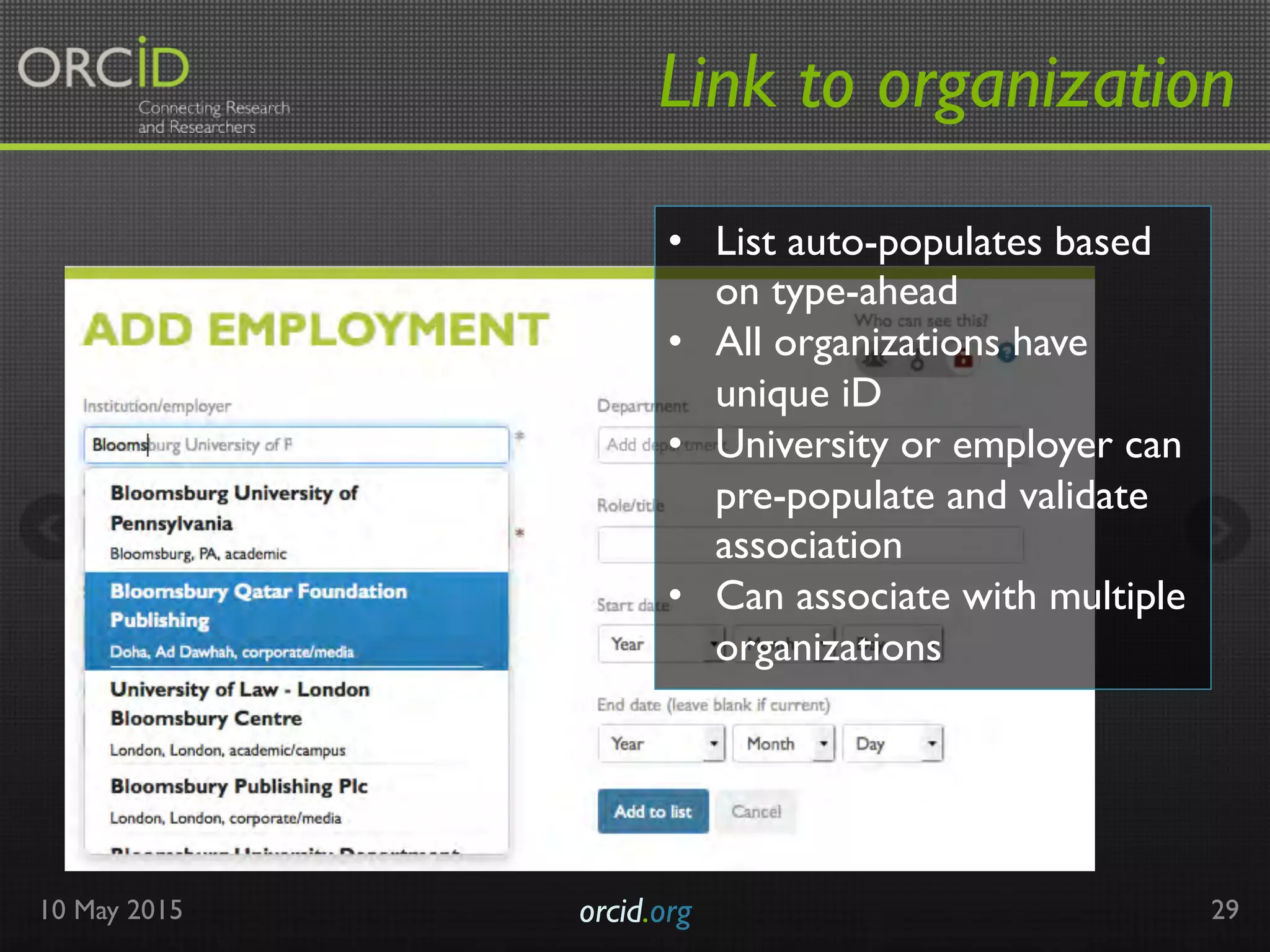
Link to organization
10 May 2015 orcid.org	

 29
•  List auto-populates based
on type-ahead
•  All organizations have
unique iD
•  University or employer can
pre-populate and validate
association
•  Can associate with multiple
organizations
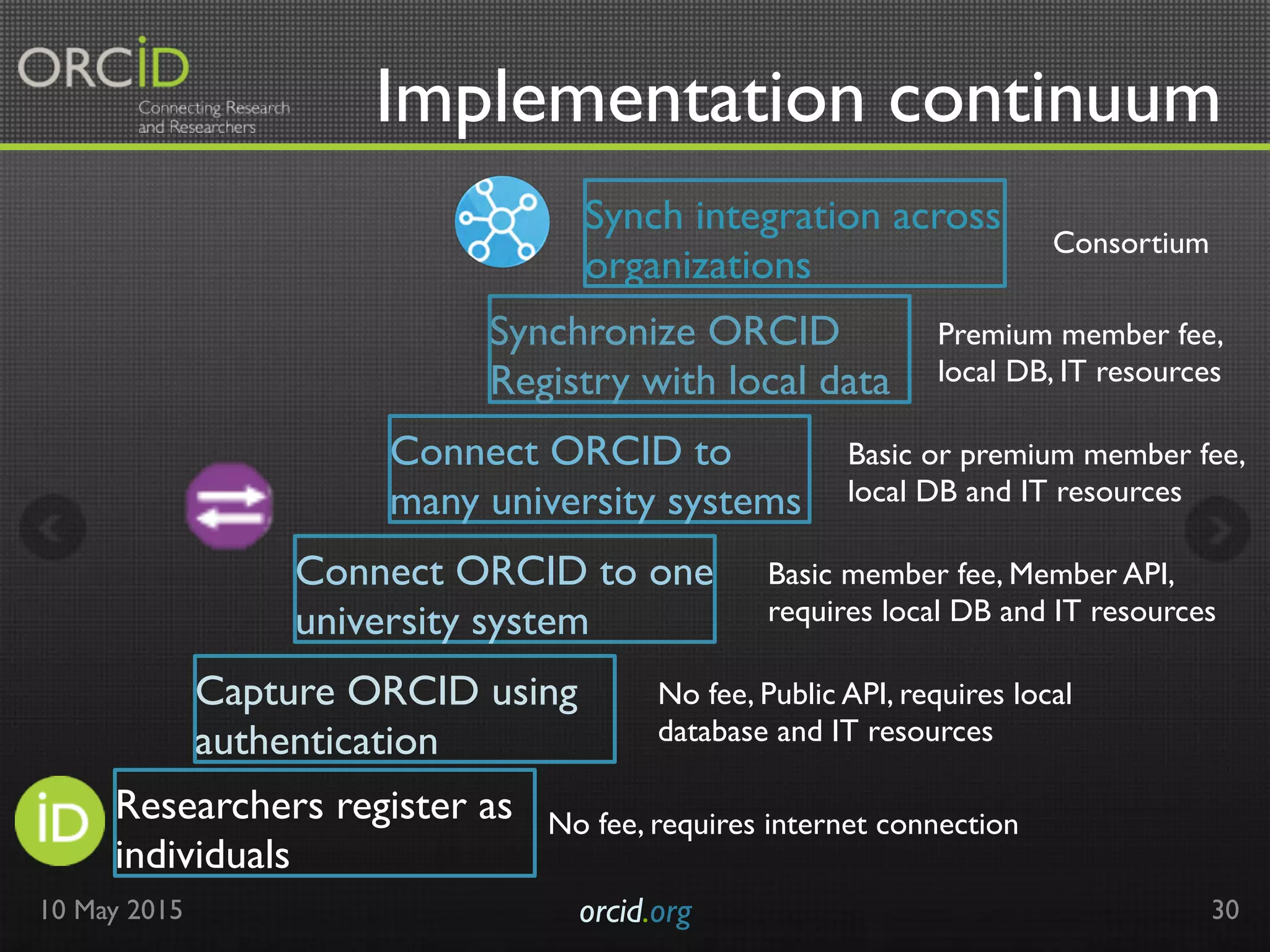
Implementation continuum
Researchers register as
individuals
Capture ORCID using
authentication
10 May 2015 orcid.org	

 30
Connect ORCID to one
university system
Connect ORCID to
many university systems
Synchronize ORCID
Registry with local data
No fee, requires internet connection
No fee, Public API, requires local
database and IT resources
Basic member fee, Member API,
requires local DB and IT resources
Basic or premium member fee,
local DB and IT resources
Premium member fee,
local DB, IT resources
Synch integration across
organizations
Consortium

ORCID Adoption and Use by the Research Community

  • 1.
    orcid.org Contact Info: p.+1-301-922-9062 a. 10411 Motor City Drive, Suite 750, Bethesda, MD 20817 USA ORCID Adoption and Use by the Research Community SARIMA Workshop, 11 May 2015 Laurel L. Haak, PhD Executive Director, ORCID L.Haak@orcid.org http://orcid.org/0000-0001-5109-3700
  • 2.
    2 Digital scholarly communicationsrequire information that is machine readable
  • 3.
    Names are notdigital •  Different versions (full name vs. initials) •  Shared names •  Transliteration •  Accents and other ALT characters •  Name changes •  Multiple family names J. Å. S. Sørensen J.Aa. S. Sørensen J. Åge S. Sørensen J.Aage S. Sørensen J. Åge Smærup Sørensen J.Aage Smaerup Sørensen
  • 4.
    4 What is ORCID? ORCIDprovides a persistent digital identifier – a machine-readable name – that distinguishes researchers from each other Member-built integrations in key research workflows such as manuscript and grant submission support automated linkages between researchers and their professional activities and affiliations, ensuring that works are appropriately attributed and discoverable ORCID serves as a hub enabling machine-readable connections between identifiers for organizations, works, and person IDs
  • 5.
    ORCID provides plumbingfor research information – and the tools to build trust in digital information 10 May 2015 orcid.org 5
  • 6.
    Building trust: 10 May2015 orcid.org 6 •  Tools to allow for easy addition of identifiers (for people, places, and things) during publishing, grant application, thesis deposit, etc. •  Engage the community to embed, authenticate, and assert
  • 7.
    Researcher Responsibility 10 May2015 orcid.org 7 To benefit from ORCID, researchers need only do two things: ①  Register ②  Use iD No membership or fee is needed by the individual or their employer.
  • 8.
    10 May 2015orcid.org 8 Over 1.3 million researchers have registered for an ORCID identifier. Through their actions, ORCID identifiers are associated with: •  2.1 million unique DOIs •  >20 thousand unique organizations
  • 9.
    ORCID responsibility Build theinfrastructure: •  Engage the community to embed identifiers •  Ensure that the iD is published with the paper / dataset / grant / thesis, etc. •  Encourage the community to push metadata back to update individual’s record 10 May 2015 orcid.org 9
  • 10.
    Integration in researchsystems 10 May 2015 orcid.org 10 Over 200 members and nearing 200 integrations in every region and sector of the international research community. Americas 48% EMEA 36% Asia Pacific 16% Funder 7% Publishing 16% Repository 20% Research Institute 45% Association 12%
  • 11.
    Registry use inAfrica 10 May 2015 orcid.org 11 ORCID Registry traffic from African countries represents about 3% of total usage. Cairo Tunis Lagos Algiers Giza Cape Town Pretoria Alexandria Abuja Addis Ababa Johannesburg Casablanca Accra Nairobi Rabat 4 members in Africa: •  GIBS •  Hindawi •  Stellenbosch University •  University of Cape Town Over 7000 registered users, most in South Africa, Egypt, Nigeria,Tunisia, Ghana, Kenya, Botswana Top 15 cities in Africa, by usage:
  • 12.
    Regional & nationalapproach •  Austria: Funder requirement 2016 •  Finland: National recommendation 2015 •  Australia: National recommendation 2015 •  Denmark: University launch 2014 •  Spain: Launched 2 consortia in 2014 •  Portugal: Funder requirement 2013 •  Sweden: National recommendation 2013 •  UK: National recommendation 2012 10 May 2015 orcid.org 12
  • 13.
    Leveraging existing standards 10May 2015 orcid.org 13 ORCID works collaboratively with the research community to ensure adoption and use of research information standards
  • 14.
    “We want touse ORCIDs to simplify the life of Oxford’s researchers for working with institutional systems and publishers’ systems by re-using already available information for publication data management and reporting. The motto is: Input once – re-use often.”   Wolfram Horstmann,Assoc. Director, Bodleian Libraries, University of Oxford http://orcid.org/0000-0001-8673-6104 10 May 2015 orcid.org 14 Research institutions
  • 15.
    …using iDs acrosssystems 10 May 2015 orcid.org 15 •  Click and Create •  Library Guide •  Training Sessions •  Theses and Dissertations http://libguides.kaust.edu.sa/orcid http://orcid.kaust.edu.sa/
  • 16.
    …which validates affiliationinformation and enables tracking of research outputs 10 May 2015 orcid.org 16
  • 17.
    ORCID iDs arebeing embedded in articles
  • 18.
    …and publication searchengines 10 May 2015 orcid.org 18
  • 19.
    10 May 2015orcid.org 19 The author can pre-populate submission form fields: preferred name, affiliation, funding The authenticated iD becomes a part of the paper Upon publication, the iD is indexed by CrossRef, Scopus, Web of Science, and other services. Information flows to ORCID and on to linked platforms Coming in 2015:
  • 20.
    •  Over 180,000articles have been submitted to CrossRef with an associated ORCID iD •  These will start to flow into the ORCID registry this year •  Researchers who use their ORCID iD when they publish will not need to manually update their record in ORCID or in connected systems 10 May 2015 orcid.org 20
  • 21.
    10 May 2015orcid.org 21 Association membership systems …
  • 22.
    10 May 2015orcid.org 22 ... and grants…
  • 23.
    10 May 2015orcid.org 23 …and data management … and datasets… Witt 2014 PeerJ 2015
  • 24.
    How does ORCIDwork? •  Registry allows researchers to connect to existing works and affiliations •  Members build integrations to connect researchers to new works and affiliations 10 May 2015 orcid.org 24
  • 25.
    •  Take 30seconds to register at http://orcid.org/register •  Free to researchers •  Individual owns the record and controls privacy settings •  Works on laptops, tablets, and phones Register for your
  • 26.
    Getting started Use freetools to connect your ORCID identifier to your name variations, other IDs, affiliations, and existing works and funding
  • 27.
    Link to existingworks 27 Connect your ORCID iD to existing works by using tools in ORCID interface or in external platforms Researchers can connect to existing works and push ORCID iD into indexes including Web of Science, Scopus, and Europe PubMedCentral
  • 28.
    Updating award information 10May 2015 orcid.org 28 Researchers can connect to existing projects AND can receive updates when grant awarded Funders can embed ORCID iD during the grant application workflow ORCID record includes, funder name, grant number, source, source provenance
  • 29.
    Link to organization 10May 2015 orcid.org 29 •  List auto-populates based on type-ahead •  All organizations have unique iD •  University or employer can pre-populate and validate association •  Can associate with multiple organizations
  • 30.
    Implementation continuum Researchers registeras individuals Capture ORCID using authentication 10 May 2015 orcid.org 30 Connect ORCID to one university system Connect ORCID to many university systems Synchronize ORCID Registry with local data No fee, requires internet connection No fee, Public API, requires local database and IT resources Basic member fee, Member API, requires local DB and IT resources Basic or premium member fee, local DB and IT resources Premium member fee, local DB, IT resources Synch integration across organizations Consortium