Oral Mucous Membrane
Presenter -
Dr. Ruchika Garg
References
• Ten Cate’s- Oral Histology (6th ed.)
• Orban’s- Oral Histology & Embryology (10th &12th ed.)
• Satish Chandra’s- Oral Histology & Embryology
• Neville’s Oral and Maxillofacial Pathology (3rd ed.)
• Shafer’s -Textbook of Oral Pathology (5th ed.)
• Burkitt’s Oral medicine (10th ed.)
Contents
 Introduction
 Organization
 Types
 Embryology
 Functions
 Histological structure
 Clinical Aspects
 Age changes
 Conclusion
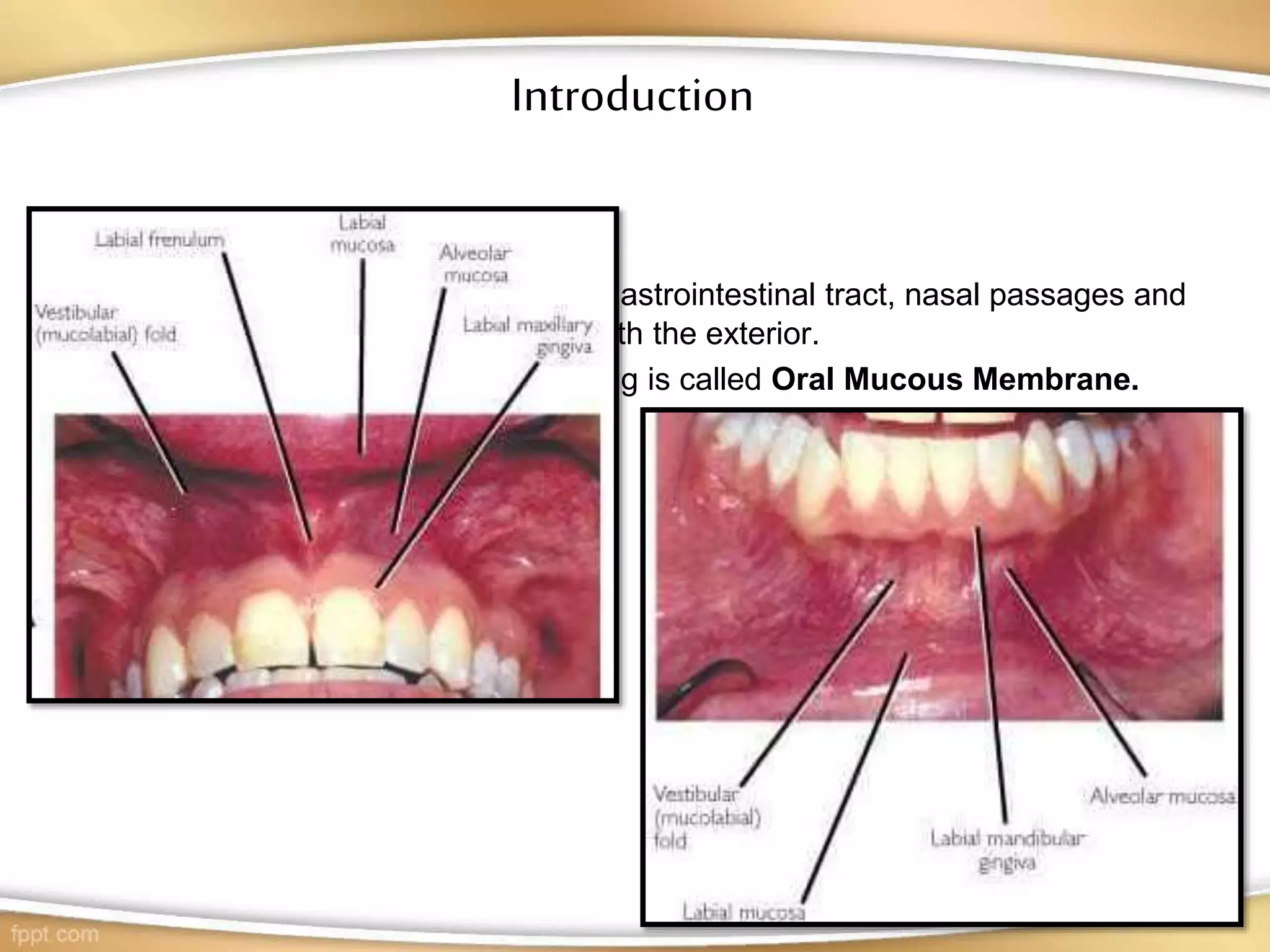
Introduction
Definition –
The moist lining of gastrointestinal tract, nasal passages and
other body cavities that communicate with the exterior.
In oral cavity this lining is called Oral Mucous Membrane.
# TEN CATE’S – Tenth edition
Organizationof oral mucosa
Based onPrimary Function
Lining Mucosa
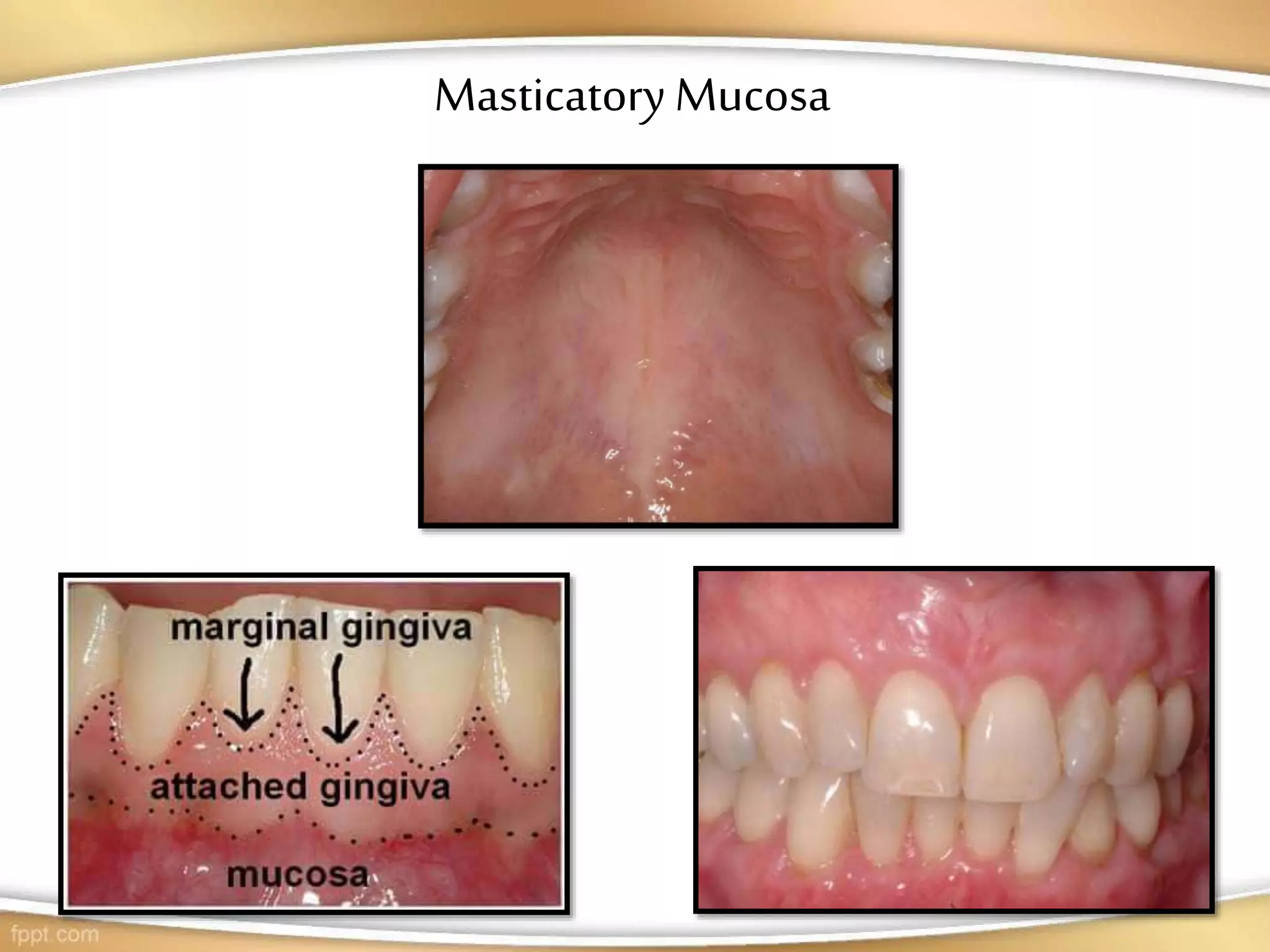
MasticatoryMucosa
SpecialisedMucosa
Embryology
Oral
mucosa
Endoderm Ectoderm
Differences between Keratinized and Non-keratinized mucosa →13-20 weeks
Reticular fibres
Collagen
fibres
Elastic fibres
Functions
1. Protection
2. Sensation
3. Secretion
4. Thermal Regulation
HistologicalStructure
Fordyce’s granules
Epithelium
EpithelialProliferation
• Stem cells - smaller population
• Amplifying cells – largerpopulation
EpithelialMaturation
• Keratinized
• Non-keratinized
Proliferation
• Stem cells
1) Small in number
2) Maintains genetics of cell
• Amplifying cells
1) Regulates mitosis
2) Thus increases number of cells
Turnover Time
MaturationOf Epithelium
Keratinised
• Stratum Basale
• Stratum Spinosum
• Stratum Granulosum
• Stratum Corneum
Non-Keratinised
• Same
• Same
• Stratum Intermediate
• Stratum Superficial
Stratum Basale
• Single layer in number
• Supported by basement membrane
• Serrated and non serrated types of cells
• Non serrated are bound to membrane
• k5 and k14 keratin chain
• High level of desmosomes
• Proteins like desmoglein and desmocollins ; desmoplakin and plakoglobin
• Stem cell markers of Stratum Basale - Early diagnosis of Neoplasias
Stratum Spinosum
• First layer of differentiation
• k1 and k10
• Desmosomes and few hemidesmosomes
• Tonofilaments network – supporting system for epithelium
• Synthesize additional proteins - Keratinization
Stratum Granulosum
• Keratohyaline granules
• Only k1
• Markers like Filaggrin and Trichohyalin are present
• Trichohyalin expression in Lichen planus - Negative
Squamous cell carcinoma – Weekly positive
• Keratinosomes also present
Seung-chul Lee et al. Expression of Trichohyalin in Dermatological Disorders: a Comparative Study with
Involucrin and Filaggrin by Immunohistochemical Staining. Acta DermVenereol (Stockh) 1999; 79: 122-126
StratumCorneum
• Entirely made of keratin filaments
• Keratohyaline granules are absent
• k1, k2, k10 and k11
• Orthokeratinization – Nuclei ; Organelles have disappeared
• Parakeratinization – Nuclei ; Organelles are retained
Shibani Shetty et at. Keratinization and its Disorders. Oman Med J. 2012 Sep; 27(5): 348–357.
doi: 10.5001/omj.2012.90.
Ryynanen M et al. Bullous pemphigoid antigens (BPAGs): identification of RFLPs in human BPAG1
and BPAG2, and exclusion as candidate genes in a large kindred with dominant epidermolysis
bullosa simplex. Genomics1991 Dec;11(4):1025-9.
BasalLamina
BasalLamina
LaminaDensa LaminaLucida
Judith Jones et al. Integrin Expression In Normal, Hyperplastic, Dysplastic, And Malignant Oral Epithelium. Journal Of Pathology, Vol.
169 235-243 (1 993)
T.Kainulainen et al. Altered distribution and synthesis of laminin-5 (kalinin) in oral lichen planus, epithelial dysplasias and squamous
cell carcinomas. British Journal of DenmiUilofjii 1997; 156: 5il-3i6.
Nonkeratinocytes In Oral Epithelium
Cell Type Level Functions
Melanocytes Basal Melanin synthesis
Langerhan’scells
Supra
basal
Antigen trap
Merkel’scells Basal Tactile
Lymphocytes Variable Inflammatory
Teresa Y Basham et al. Recombinant Gamma Interferon Induces HLA-DR Expression On Cultured Human Keratinocytes. Journal Of
Investigative Dermatology (1984) 83, 88–90; Doi:10.1111/1523-1747.Ep12262597.
Lamina propria
Papillary layer
Cells
Ground
substance
Reticular layer
Fibres
CLINICAL ASPECTS
Leukoplakia
• Hyperkeratosis – 80 %
• Dysplasia – 17 %
•Carcinoma in situ – 3 %
Enlarged and hyperchromatic nuclei
Cellular and nuclear pleomorphism
Premature keratinization of cells
Increased nucleo-cytoplasmic ratio
Increased mitotic activity
Lichen Planus
Hyperpara or ortho keratosis
Saw tooth appearance of rete pegs
Degenerating basal keratinocytes
Band like subepithelial infiltrate of T-cells
Max Joseph Spaces – Bullous lichen planus
Pemphigus Vulgaris
•Intraepithelial blisters producing
suprabasilar split
•Acantholysis
Cicatricial Pemphigoid
•Subepidermal vesicles
•BM detaches with epithelium from
connective tissue
Erythema Multiforme
Oral SquamousCell Carcinoma
•Sheets of cells of squamous
epithelial origin
•Keratin pearls
•Intercellular bridges
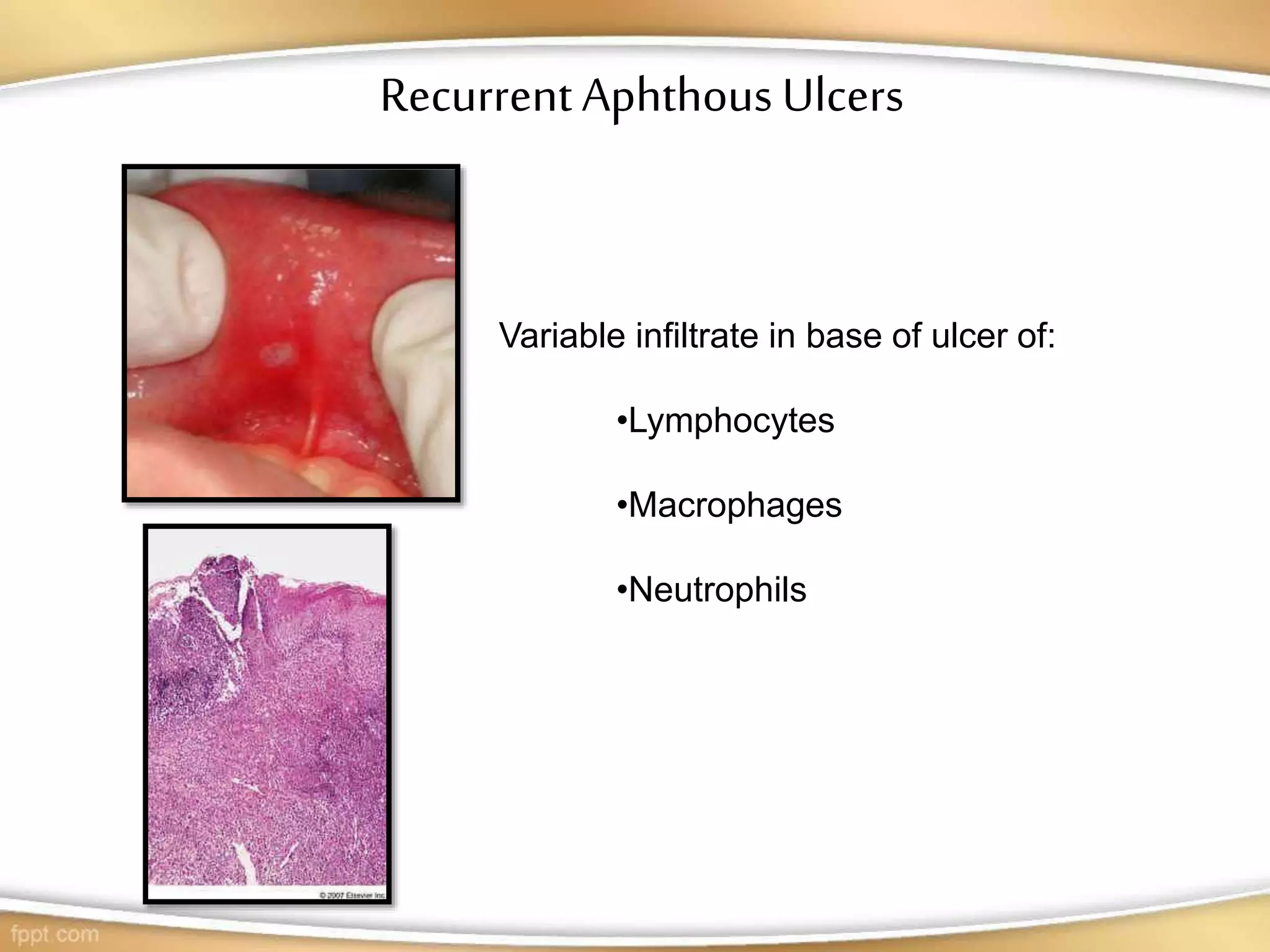
Recurrent Aphthous Ulcers
Variable infiltrate in base of ulcer of:
•Lymphocytes
•Macrophages
•Neutrophils
Herpes Simplex
BUCCAL MUCOSA
Parotid papilla
Linea alba
Leukoedema
GINGIVA
Healthy gingiva
Gingivitis
Melanin pigmentation
TONGUE
Fissured tongue
Geographic tongue
Hairy tongue
EffectOf Aging
HISTOLOGY:
I. Epithelial thinning
II. Decreased keratinization
III. Less prominent rete pegs
IV. Decreased cellular proliferation
V. Loss of submucosal elastin and fat
VI. Increased fibrotic connective tissue with degenerative
alteration in the collagen.
Renewal Rates for Oral Mucosa
Hard palate - 24 days
Floor of mouth - 20 days
Buccal &labial mucosa - 14 days
Attached gingiva - 10 days
Taste buds - 10 days
Junctional epithelium - 4-6 days
Conclusion
• Structural complexity and regional variability of oral mucosa poses a
challenge to its proper understanding.
• But it is must to understand the morphology, histology and physiology
• Many systemic diseases, cause characteristic change in the oral
mucosa and careful examination can help in early diagnosis.
• Thank you !!!!!!!

Oral mucous membrane

Editor's Notes

  • #32 Malignant neoplasm with squamous differentiation. Keratin formn or intercellular bridges. Most common malignant neoplasm of the oral cavity. Carc of tongue comprises 25 to 50 % of all intraoral cancers. Next most common sites in order of frequency are the tongue, floor of the mouth, mandibular gingiva, buccal mucosa, hard palate, and maxillary gingiva.
  • #33 extends into epithelium at margins of ulcer30,35 Some intraepithelial lymphocytes appear activated with large indented nuclei36 May be degenerating prickle cells in marginal epithelium Plasma cells: virtual absence in early lesions may be prominent in older lesion. Common disease painful recurring solitary or multiple ulcerations of oral mucosa.immunological , infectious, vit B def, FE , endocrine. Sites buccal, labial mucosa , sulcus, tongue , soft palate pharynx, gingiva. Fibrinopurulent memberane ulcerated area.. Intesne inflammat cell infiltration in CT. considerable necrosis at surface.
  • #34 Herpes labialis is clinically seen as multiple vesicles on the lip that rapidly break down to form shallow ulcers. Intraoral lesions of the gingiva are known as acute herpetic gingivostomatitis. Numerous pinhead size vesicles that rupture to form small ulcers with red base and yellow fibrin. HSV infection for more than a month in HIV patient indicates development of AIDS.
  • #35 . A horizontal ridge can often be found on the buccal mucosa at the level of the interdigitation of the teeth (ie, the linea alba), which represents a benign hyperkeratosis secondary to mild long-term irritation from the teeth cusps
  • #36 The presence of retained dental plaque and calculus also serves as a nidus for a number of reactive gingival lesions (eg, pyogenic granuloma). The gingivae also frequently are the initial site of occurrence of mucocutaneous diseases (eg, lichen planus, cicatricial pemphigoid, pemphigus vulgaris). Finally, the gingiva is often affected in HIV infection and may be the first indicator of immunosuppression.
  • #37 . The dorsal surface of the tongue should be uniformly covered by numerous hairlike filiform papillae, shown below. Interspersed among the filiform papillae are dozens of mushroom-shaped fungiform papillae, each of which contains one or more taste buds