RAC - EE, SE, One Node-
        How to Choose?
               Leighton L. Nelson


                        VirtaThon 2011
About Me
 Senior Oracle DBA with over 10 years experience

 Worked on Oracle 7.3, 8i,9i,10g,11g with RAC &
  DataGuard

 Member of IOUG, Brain Surface

 Blogger (blogs.griddba.com)


                                                    VirtaThon 2011
Agenda
 Oracle Clusterware

 Real Application Clusters Overview

 Standard Edition

 RAC One Node

 Feature Comparison

 RAC Success Factors


                                       VirtaThon 2011
Oracle Clusterware Architecture
 Provides cluster membership and high availability
  Services for RAC and ASM

 Manages instances, listeners, services, databases etc.


 Clusterware relies on private network and shared disks
  for registry and membership details –
  interconnect, OCR, Voting Disks

 High Availability API allows for non-Oracle applications
  to be managed by Oracle Clusterware


                                                      VirtaThon 2011
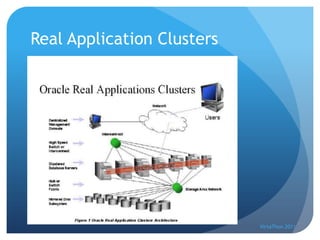
Real Application Clusters

 Provides high availability solution for databases

 A single database which consists of multiple instances

 Provides scalability for applications

 Forms the basis for Oracle’s Grid Computing

 Shared everything architecture

 Requires Oracle Clusterware (10g and higher)

 Can be run on top of third-party Clusterware*

                                                           VirtaThon 2011
Real Application Clusters


                            VirtaThon 2011
Standard Edition RAC
 From Oracle 10g SE you can use RAC without additional
  license

 Restricted to maximum of 4 sockets in cluster

 Requires the use of ASM for all database files

 11gR2 requires the use of ACFS for binaries

 Third-party Clusterware not supported

 Lower cost-entry point than Enterprise Edition


                                                   VirtaThon 2011
Standard Edition
          Advantages/Disadvantages
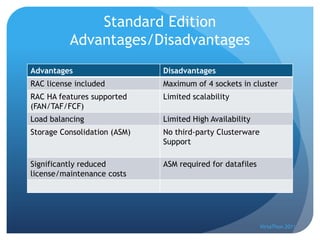
Advantages                    Disadvantages
RAC license included          Maximum of 4 sockets in cluster
RAC HA features supported     Limited scalability
(FAN/TAF/FCF)
Load balancing                Limited High Availability
Storage Consolidation (ASM)   No third-party Clusterware
                              Support

Significantly reduced         ASM required for datafiles
license/maintenance costs


                                                           VirtaThon 2011
RAC One Node
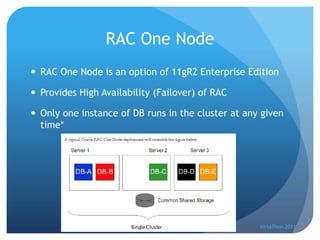
 RAC One Node is an option of 11gR2 Enterprise Edition

 Provides High Availability (Failover) of RAC

 Only one instance of DB runs in the cluster at any given
  time*


                                                    VirtaThon 2011
RAC One Node
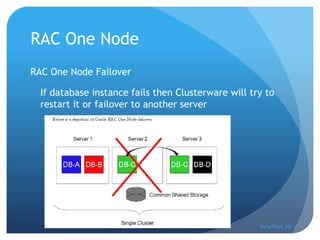
RAC One Node Failover

  If database instance fails then Clusterware will try to
  restart it or failover to another server


                                                     VirtaThon 2011
RAC One Node
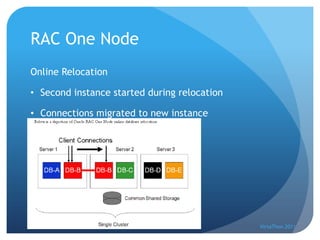
Online Relocation

• Second instance started during relocation

• Connections migrated to new instance


                                              VirtaThon 2011
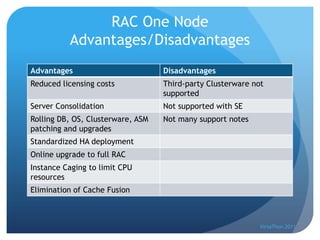
RAC One Node
          Advantages/Disadvantages
Advantages                         Disadvantages
Reduced licensing costs            Third-party Clusterware not
                                   supported
Server Consolidation               Not supported with SE
Rolling DB, OS, Clusterware, ASM   Not many support notes
patching and upgrades
Standardized HA deployment
Online upgrade to full RAC
Instance Caging to limit CPU
resources
Elimination of Cache Fusion


                                                             VirtaThon 2011
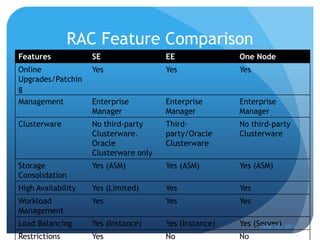
RAC Feature Comparison
Features            SE                 EE               One Node
Online              Yes                Yes              Yes
Upgrades/Patchin
g
Management          Enterprise         Enterprise       Enterprise
                    Manager            Manager          Manager
Clusterware         No third-party     Third-           No third-party
                    Clusterware.       party/Oracle     Clusterware
                    Oracle             Clusterware
                    Clusterware only
Storage             Yes (ASM)          Yes (ASM)        Yes (ASM)
Consolidation
High Availability   Yes (Limited)      Yes              Yes
Workload            Yes                Yes              Yes
Management
Load Balancing      Yes (Instance)     Yes (Instance)   Yes (Server) 2011
                                                              VirtaThon
Restrictions        Yes                No               No
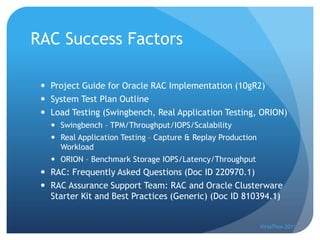
RAC Success Factors

  Project Guide for Oracle RAC Implementation (10gR2)
  System Test Plan Outline
  Load Testing (Swingbench, Real Application Testing, ORION)
    Swingbench – TPM/Throughput/IOPS/Scalability
    Real Application Testing – Capture & Replay Production
     Workload
    ORION – Benchmark Storage IOPS/Latency/Throughput
  RAC: Frequently Asked Questions (Doc ID 220970.1)
  RAC Assurance Support Team: RAC and Oracle Clusterware
   Starter Kit and Best Practices (Generic) (Doc ID 810394.1)


                                                              VirtaThon 2011
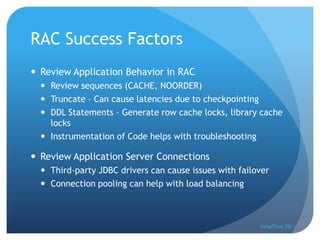
RAC Success Factors
 Review Application Behavior in RAC
   Review sequences (CACHE, NOORDER)
   Truncate – Can cause latencies due to checkpointing
   DDL Statements – Generate row cache locks, library cache
    locks
   Instrumentation of Code helps with troubleshooting

 Review Application Server Connections
   Third-party JDBC drivers can cause issues with failover
   Connection pooling can help with load balancing


                                                        VirtaThon 2011
Possible Scenarios
 Commodity servers with maximum of 2 sockets -> SE

 High End Servers, IBM P series, Sun T-series -> EE

 High End/Commodity Servers with more than 2 sockets -
  > EE/RAC One Node

 Sub-minute failover – EE/SE

 Maximum Availability Architecture - EE


                                                       VirtaThon 2011
Summary
 Have clear business requirements for RAC

 Make sure you understand the benefits of each edition
  and also thedrawbacks

 You can convert from Standard Edition to Enterprise
  Edition

 Consider Standard Edition if you don’t need features
  such as AWR/ASH


                                                   VirtaThon 2011
References
 RAC: Frequently Asked Questions (Doc ID 220970.1)

 RAC Assurance Support Team: RAC and Oracle
  Clusterware Starter Kit and Best Practices (Generic)
  (Doc ID 810394.1)

 Whitepaper: Oracle Real Application Clusters One Node:
  Better Virtualization for Databases

 Whitepaper: Oracle Real Application Clusters (RAC)
  11gR2

 “RAC or Not, Here I Come” by RiyajShamsudeen

                                                    VirtaThon 2011
Questions?
 Website - blogs.griddba.com

 LinkedIn – Leighton Nelson

 Twitter - twitter.com/leight0nn

 Email: leighton.nelson@mercy.net


                                     VirtaThon 2011

Oracle RAC - Standard Edition, Enterprise Edition & One Node

  • 1.
    RAC - EE,SE, One Node- How to Choose? Leighton L. Nelson VirtaThon 2011
  • 2.
    About Me  SeniorOracle DBA with over 10 years experience  Worked on Oracle 7.3, 8i,9i,10g,11g with RAC & DataGuard  Member of IOUG, Brain Surface  Blogger (blogs.griddba.com) VirtaThon 2011
  • 3.
    Agenda  Oracle Clusterware Real Application Clusters Overview  Standard Edition  RAC One Node  Feature Comparison  RAC Success Factors VirtaThon 2011
  • 4.
    Oracle Clusterware Architecture Provides cluster membership and high availability Services for RAC and ASM  Manages instances, listeners, services, databases etc.  Clusterware relies on private network and shared disks for registry and membership details – interconnect, OCR, Voting Disks  High Availability API allows for non-Oracle applications to be managed by Oracle Clusterware VirtaThon 2011
  • 5.
    Real Application Clusters Provides high availability solution for databases  A single database which consists of multiple instances  Provides scalability for applications  Forms the basis for Oracle’s Grid Computing  Shared everything architecture  Requires Oracle Clusterware (10g and higher)  Can be run on top of third-party Clusterware* VirtaThon 2011
  • 6.
  • 7.
    Standard Edition RAC From Oracle 10g SE you can use RAC without additional license  Restricted to maximum of 4 sockets in cluster  Requires the use of ASM for all database files  11gR2 requires the use of ACFS for binaries  Third-party Clusterware not supported  Lower cost-entry point than Enterprise Edition VirtaThon 2011
  • 8.
    Standard Edition Advantages/Disadvantages Advantages Disadvantages RAC license included Maximum of 4 sockets in cluster RAC HA features supported Limited scalability (FAN/TAF/FCF) Load balancing Limited High Availability Storage Consolidation (ASM) No third-party Clusterware Support Significantly reduced ASM required for datafiles license/maintenance costs VirtaThon 2011
  • 9.
    RAC One Node RAC One Node is an option of 11gR2 Enterprise Edition  Provides High Availability (Failover) of RAC  Only one instance of DB runs in the cluster at any given time* VirtaThon 2011
  • 10.
    RAC One Node RACOne Node Failover If database instance fails then Clusterware will try to restart it or failover to another server VirtaThon 2011
  • 11.
    RAC One Node OnlineRelocation • Second instance started during relocation • Connections migrated to new instance VirtaThon 2011
  • 12.
    RAC One Node Advantages/Disadvantages Advantages Disadvantages Reduced licensing costs Third-party Clusterware not supported Server Consolidation Not supported with SE Rolling DB, OS, Clusterware, ASM Not many support notes patching and upgrades Standardized HA deployment Online upgrade to full RAC Instance Caging to limit CPU resources Elimination of Cache Fusion VirtaThon 2011
  • 13.
    RAC Feature Comparison Features SE EE One Node Online Yes Yes Yes Upgrades/Patchin g Management Enterprise Enterprise Enterprise Manager Manager Manager Clusterware No third-party Third- No third-party Clusterware. party/Oracle Clusterware Oracle Clusterware Clusterware only Storage Yes (ASM) Yes (ASM) Yes (ASM) Consolidation High Availability Yes (Limited) Yes Yes Workload Yes Yes Yes Management Load Balancing Yes (Instance) Yes (Instance) Yes (Server) 2011 VirtaThon Restrictions Yes No No
  • 14.
    RAC Success Factors  Project Guide for Oracle RAC Implementation (10gR2)  System Test Plan Outline  Load Testing (Swingbench, Real Application Testing, ORION)  Swingbench – TPM/Throughput/IOPS/Scalability  Real Application Testing – Capture & Replay Production Workload  ORION – Benchmark Storage IOPS/Latency/Throughput  RAC: Frequently Asked Questions (Doc ID 220970.1)  RAC Assurance Support Team: RAC and Oracle Clusterware Starter Kit and Best Practices (Generic) (Doc ID 810394.1) VirtaThon 2011
  • 15.
    RAC Success Factors Review Application Behavior in RAC  Review sequences (CACHE, NOORDER)  Truncate – Can cause latencies due to checkpointing  DDL Statements – Generate row cache locks, library cache locks  Instrumentation of Code helps with troubleshooting  Review Application Server Connections  Third-party JDBC drivers can cause issues with failover  Connection pooling can help with load balancing VirtaThon 2011
  • 16.
    Possible Scenarios  Commodityservers with maximum of 2 sockets -> SE  High End Servers, IBM P series, Sun T-series -> EE  High End/Commodity Servers with more than 2 sockets - > EE/RAC One Node  Sub-minute failover – EE/SE  Maximum Availability Architecture - EE VirtaThon 2011
  • 17.
    Summary  Have clearbusiness requirements for RAC  Make sure you understand the benefits of each edition and also thedrawbacks  You can convert from Standard Edition to Enterprise Edition  Consider Standard Edition if you don’t need features such as AWR/ASH VirtaThon 2011
  • 18.
    References  RAC: FrequentlyAsked Questions (Doc ID 220970.1)  RAC Assurance Support Team: RAC and Oracle Clusterware Starter Kit and Best Practices (Generic) (Doc ID 810394.1)  Whitepaper: Oracle Real Application Clusters One Node: Better Virtualization for Databases  Whitepaper: Oracle Real Application Clusters (RAC) 11gR2  “RAC or Not, Here I Come” by RiyajShamsudeen VirtaThon 2011
  • 19.
    Questions?  Website -blogs.griddba.com  LinkedIn – Leighton Nelson  Twitter - twitter.com/leight0nn  Email: leighton.nelson@mercy.net VirtaThon 2011

Editor's Notes

  • #3 Disclaimer The descriptions mentioned in this presentation are for educational and demonstration purposes only. I accept no responsibility for any loss of data production or otherwise.
  • #5 Oracle Clusterware provides cluster membership and high availability services. It provides the cluster membership for features such as Oracle Real Application Clusters and Oracle ASM. It includes the following features:Application monitoring, restart, and failoverCluster membership servicesServer monitoring and fencingSingle Client Access Name (SCAN)Server PoolsGrid Naming ServicesOracle Clusterware can be used to protect any application (restarting or failing over the application in the event of a failure), free of charge, if one or more of the following conditions are met:The server OS is supported by a valid Oracle Unbreakable Linux support contract.The product to be protected is either:Any Oracle product (e.g. Oracle Applications, Siebel, Hyperion, Oracle Database EE, Oracle Database XE)Any third-party product that directly or indirectly stores data in an Oracle databaseAt least one of the servers in the cluster is licensed for Oracle Database (SE or EE)A cluster is defined to include all the machines that share the same Oracle Cluster Registry (OCR) and Voting Disk.
  • #6 RAC NOT required for high availability (Active/Passive Server)*Oracle Clusterware must manage RAC databaseCompare shared-everything vs Shared-nothing vs Shared-diskThird-party Clusterware solutions including IBM HACMP, Veritas Cluster, etc.
  • #8 OCFS and OCFS2 not supported in SE$10000per socket
  • #9 Limited HA and scalability due to practicality of running commodity hardware with less than 4 sockets.If you use Standard Edition or Standard Edition One on a 2 processor system you simply need 2 licenses. However, if you use Enterprise Edition you need to take the number of cores into account as well.
  • #10 *During failover more than one instance may be activeCustomers with existing ELA/ULA which includes RAC can run RAC One NodeList price of $10000 per CPUOracle RAC One Node is only supported with with version 11.2 (and above) of Oracle grid infrastructure.Oracle Restart for instance/listener/ASM/Services plus FailoverCache Fusion Overhead?
  • #11 Unattended failover from 5 - 30 minutes.
  • #12 During relocation database runs in active-active mode until all connections have been migrated
  • #13 11.2.0.2.2 provides easier installation/administration with OUI and srvctl than 11.2.0.1.0Managed using familiar clusterware commandsInstance caging using CPU_COUNT parameter
  • #14 Since there can only be a maximum of 4 sockets in a SE cluster it’s not practical to have more than a 2-node cluster
  • #15 Oracle has two whitepapers that detail test plan outlines for 10gR1/R2 and 11g and load testing toolRAC Assurance Support Team: RAC and Oracle Clusterware Starter Kit and Best Practices (Generic) (Doc ID 810394.1)OS specific RAC Starter Kits availableProject Guide for Oracle RAC Implementation – ChristopherHaskinsA critical component of any successful implementation, particularly in the High Availability arena, is testing. For a RAC environment, testing should include both load generation, to monitor and measure how the system works under heavy load, and a system test plan, to understand how the system reacts to certain types of failures. ORION – Determine I/O Workload first
  • #16 While in general – applications are not needed to be modified for RAC. It is true that in order for applications to scale in a RAC database, they should first be able to scale in a single-instance database.Sequences can cause severe degradation of performance in RAC – Use High Cache Values and NOORDER Instrumentation using DBMS_APPLICATION_INFO to set module, action, client
  • #18 How to Convert a RAC database from Standard Edition (SE) to Enterprise Edition (EE)? (Doc ID 451981.1)