Oracle application differences of Back to Back & Drop Ship sales order Webinar
Disclaimer All other trademarks, service marks and logos used in this webinar are the trademarks, service marks or logos of their respective owners. The views expressed in this webinar are views of the speakers and do not necessarily reflect the views of iWare Logic Pvt. Ltd
Agenda Introduction to Back to back & Drop ship sales order Back to back order process, its complexities Drop ship order process, its complexities Pros & Cons of the process B2B & drop ship scenarios adaptable for your business B2B and drop ship corporate benefits
Introduction to Back to back & Drop ship sales order Back to back In Back to Back order the shipment process is completed through Order Management (OM) as a standard order after the item is received against a Purchase order (PO).  For example, A orders item X from B B orders item X from C  C ships item X to B  B ships item X to A B bills A for the order, C bills B for the order
Drop Shipment Drop shipment is a method of order fulfillment where the organization taking the order may or may not maintain their own inventory for the drop-shipped product, but fulfill their orders through 3rd party vendors who directly ship to the end customer ordering the product.  For example, A orders item X from B B orders item X from C  C ships Item X to A  B bills A for the order, C bills B for the order
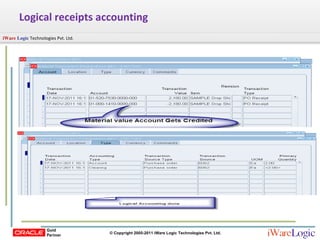
The major difference between drop shipment and Back to Back order  In B2B the source will be internal but the item would be procured after the order is created or after the demand is made. In Drop Ship the source will be external In Drop Ship orders, material is directly shipped to the customer from the supplier. Thus, inventory is not affected. In this case, only logical receiving is done. But in the case of Back-to-Back orders, material is taken from inventory.
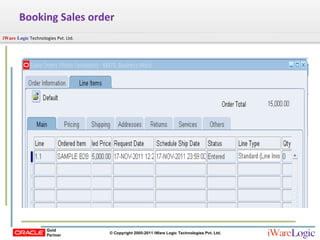
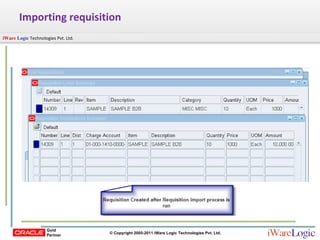
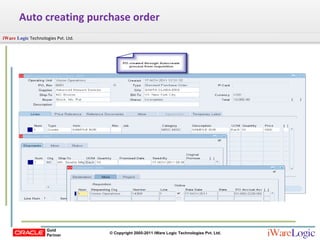
Back to back order process, its complexities Designate specific items as B2B orderable Enter sales order lines for these items, and have the supply automatically created via a requisition  Have the requisition converted into a Purchase Order or a release of a blanket Purchase Order  View the requisition number or PO number and its status from the Sales Order (using reservation details window)  Reserve the supply from the Requisition to the PO and finally to the Sales Order once the PO is received  Pick, ship and finally invoice the customer for the product  Note to Buyer's field in the requisition captures the Sales order information
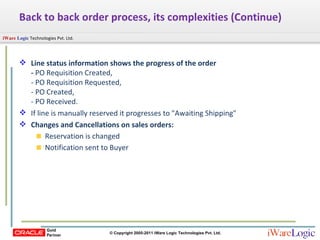
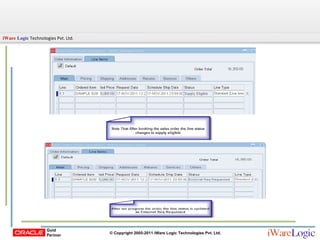
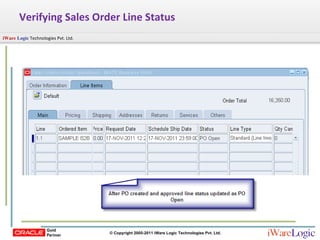
Back to back order process, its complexities (Continue) Line status information shows the progress of the order -  PO Requisition Created, - PO Requisition Requested, - PO Created, - PO Received.  If line is manually reserved it progresses to "Awaiting Shipping"  Changes and Cancellations on sales orders:  Reservation is changed  Notification sent to Buyer
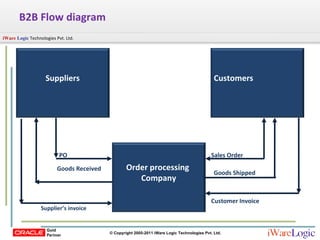
B2B Flow diagram Supplier’s invoice PO Sales Order Customer Invoice Goods Shipped Goods Received Order processing  Company Suppliers Customers
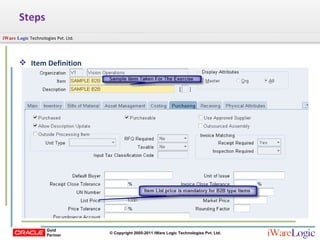
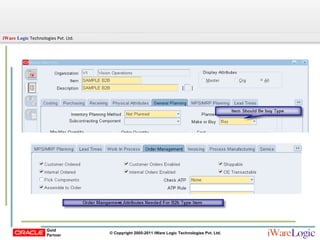
Steps Item Definition
 
Booking Sales order
 
Importing requisition
Auto creating purchase order
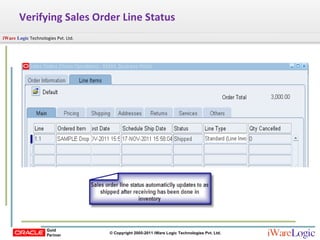
Verifying Sales Order Line Status
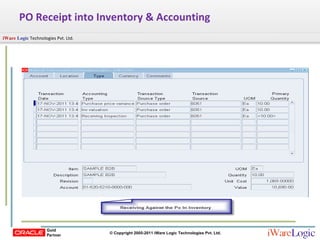
PO Receipt into Inventory & Accounting
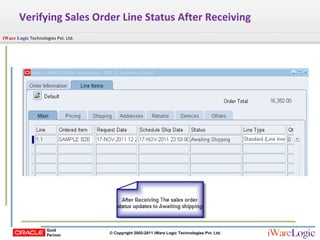
Verifying Sales Order Line Status After Receiving
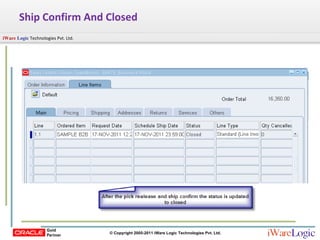
Ship Confirm And Closed
RESERVATIONS When imported the purchase requisition is reserved to the sales order line. When the requisition becomes a PO or a blanket release, the reservation moves with it. The Reservations form, supply tab, then shows the reservation is linked to a PO or a blanket. When the PO is received into inventory, the reservation is automatically transferred into Inventory, and it now looks like any other reservation from a sales order to on-hand stock.  If ATO Box is not checked in item master form normal sales order to inventory reservation happens and line directly progresses to Awaiting Shipping.
CHANGES OR CANCELLATIONS  If the sales order line is cancelled or the quantity is reduced, then the reservation is reduced and a notification is automatically sent to the buyer explaining that there is now a PO outstanding. If the schedule date on the sales order line is changed, again a notification is sent to the buyer. If the PO is cancelled or a partial quantity is cancelled, then the reservation is cancelled or reduced appropriately. The next time Auto Create Requisition is run, it will create another requisition for the unreserved amount on the sales order.
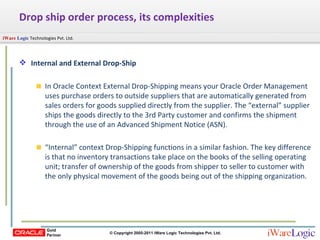
Drop ship order process, its complexities Internal and External Drop-Ship In Oracle Context External Drop-Shipping means your Oracle Order Management uses purchase orders to outside suppliers that are automatically generated from sales orders for goods supplied directly from the supplier. The “external” supplier ships the goods directly to the 3rd Party customer and confirms the shipment through the use of an Advanced Shipment Notice (ASN).  “ Internal” context Drop-Shipping functions in a similar fashion. The key difference is that no inventory transactions take place on the books of the selling operating unit; transfer of ownership of the goods from shipper to seller to customer with the only physical movement of the goods being out of the shipping organization.
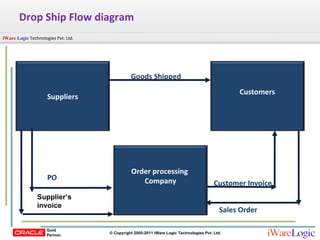
Drop Ship Flow diagram Supplier’s invoice PO Sales Order Customer Invoice Goods Shipped Order processing  Company Suppliers Customers
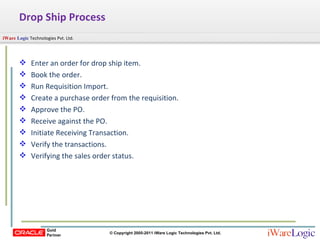
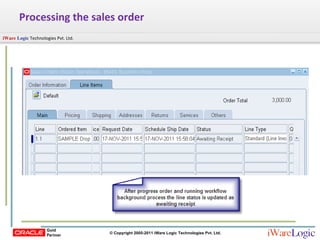
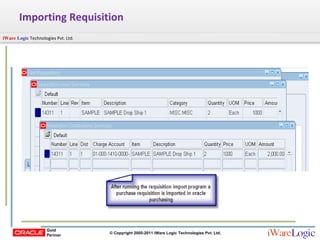
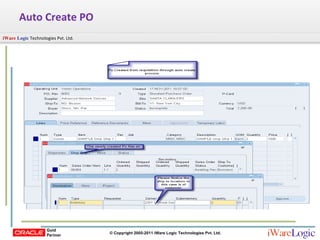
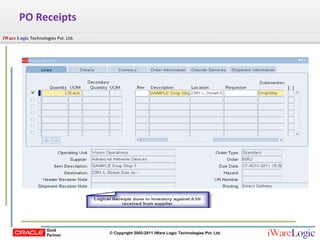
Drop Ship Process Enter an order for drop ship item. Book the order. Run Requisition Import. Create a purchase order from the requisition. Approve the PO. Receive against the PO. Initiate Receiving Transaction. Verify the transactions. Verifying the sales order status.
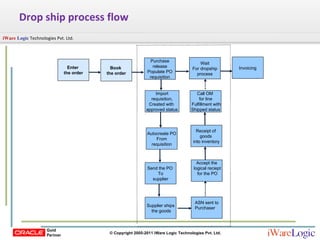
Drop ship process flow Enter  the order Book  the order ASN sent to Purchaser Send the PO  To supplier Autocreate PO From requisition Supplier ships the goods Import requisition, Created with  approved status Accept the logical reciept for the PO Receipt of  goods  into inventory Wait For dropship process I nvoicing Call OM  for line Fulfillment with Shipped status Purchase release Populate PO requisition
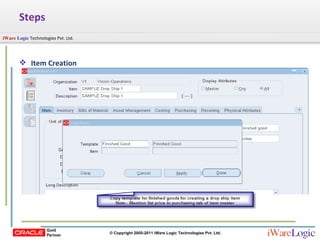
Steps Item Creation
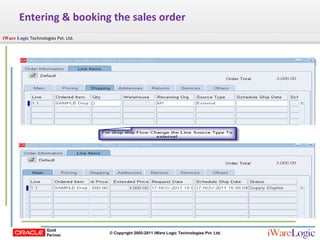
Entering & booking the sales order
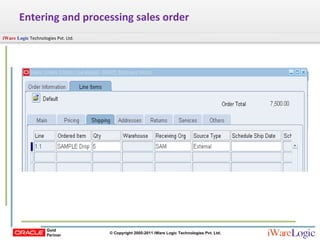
Processing the sales order
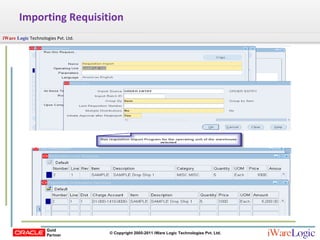
Importing Requisition
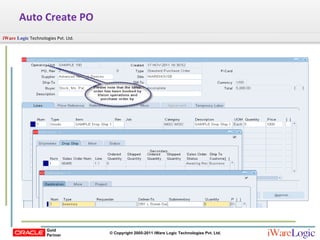
Auto Create PO
PO Receipts
Logical receipts accounting
Verifying Sales Order Line Status
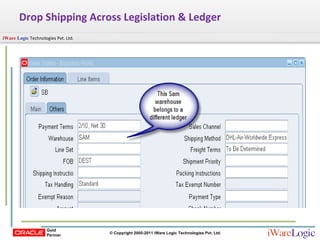
Drop Shipping Across Legislation & Ledger
Entering and processing sales order
Importing Requisition
Auto Create PO
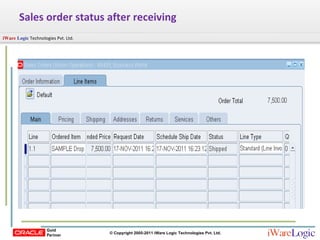
Sales order status after receiving
Pros & Cons of the process Advantages Back to Back and drop ship functionalities very well adhere to all major business needs. Order changes and cancellation has been incorporated through work flow notification to give an in-out view of total organization operations and co-ordination. Accounting has been made easy for Drop ship type of flows (Logical receipts). Dis-advantages The only dis-advantage of this process is its complexity to execute but since the actual business process also requires very well coordinated operation between departments, that has been made easy in oracle.
B2B & drop ship scenarios adaptable for your business B2B type of scenarios can be used across all showroom retailers and wholesaler type of business to cater to challenge of maintaining stocks to handle unexpected large demands from certain customers where it is not in best interest of such organizations to stock for them. Drop ship flow is most suitable for agency type of business where in companies only book orders on the behalf of other manufactures and businesses those can’t or are not willing to do it by themselves. Drop ship flow is also very suitable for large MNC type companies which have a central warehousing design to meet customer demand over a large geographical area. (For example many companies warehouse centrally at Singapore location because of Free trade policies of that country and service all of their customers in entire Asia pacific region from that location irrespective of the place and country of manufacture for their goods.)
B2B and drop ship corporate benefits B2B corporate benefits include: Corporate don’t have to over stock for meeting irregular demands in sales. Very easy to meet unexpected demands of customer as and when made. Minimizing of inventory and increase in profitability of business through controlled inventory and no loss of sale. Drop ship corporate benefits include: Accounting made easy for a very complex business flow such as drop shipment.  Ability of booking sales order by booking agents and sales offices allows better coverage of market area with minimum cost thus increasing profitability of a business.
About iWare Logic iWare Logic is an Enterprise Business Applications Consulting company, specializing in Oracle Applications and Technologies.  iWare Logic is an Oracle Gold Partner providing Offshore and Onsite IT Services in areas like Oracle E-Business Suite, OAF, ADF, BI DW and DBA.  iWare Logic offers Application Development delivery with focus on application customizations, workflows, integrations, and data conversions. We also provide skilled resources for on-site/off-shore projects for Oracle Enterprise Applications' Implementations and Support.  For any queries, feel free to drop a mail to info@iwarelogic.com
Questions and Answers Questions Answers
Thank You iWare   Logic   Technologies Pvt. Ltd.  Aditi Samruddhi, Baner, Pune,  India - 411045  Email:   [email_address] Website:  www.iwarelogic.com

Oracle Application Differences & Drop Ship Sales Orders

  • 1.
    Oracle application differencesof Back to Back & Drop Ship sales order Webinar
  • 2.
    Disclaimer All othertrademarks, service marks and logos used in this webinar are the trademarks, service marks or logos of their respective owners. The views expressed in this webinar are views of the speakers and do not necessarily reflect the views of iWare Logic Pvt. Ltd
  • 3.
    Agenda Introduction toBack to back & Drop ship sales order Back to back order process, its complexities Drop ship order process, its complexities Pros & Cons of the process B2B & drop ship scenarios adaptable for your business B2B and drop ship corporate benefits
  • 4.
    Introduction to Backto back & Drop ship sales order Back to back In Back to Back order the shipment process is completed through Order Management (OM) as a standard order after the item is received against a Purchase order (PO). For example, A orders item X from B B orders item X from C C ships item X to B B ships item X to A B bills A for the order, C bills B for the order
  • 5.
    Drop Shipment Dropshipment is a method of order fulfillment where the organization taking the order may or may not maintain their own inventory for the drop-shipped product, but fulfill their orders through 3rd party vendors who directly ship to the end customer ordering the product. For example, A orders item X from B B orders item X from C C ships Item X to A B bills A for the order, C bills B for the order
  • 6.
    The major differencebetween drop shipment and Back to Back order In B2B the source will be internal but the item would be procured after the order is created or after the demand is made. In Drop Ship the source will be external In Drop Ship orders, material is directly shipped to the customer from the supplier. Thus, inventory is not affected. In this case, only logical receiving is done. But in the case of Back-to-Back orders, material is taken from inventory.
  • 7.
    Back to backorder process, its complexities Designate specific items as B2B orderable Enter sales order lines for these items, and have the supply automatically created via a requisition Have the requisition converted into a Purchase Order or a release of a blanket Purchase Order View the requisition number or PO number and its status from the Sales Order (using reservation details window) Reserve the supply from the Requisition to the PO and finally to the Sales Order once the PO is received Pick, ship and finally invoice the customer for the product Note to Buyer's field in the requisition captures the Sales order information
  • 8.
    Back to backorder process, its complexities (Continue) Line status information shows the progress of the order - PO Requisition Created, - PO Requisition Requested, - PO Created, - PO Received. If line is manually reserved it progresses to "Awaiting Shipping" Changes and Cancellations on sales orders: Reservation is changed Notification sent to Buyer
  • 9.
    B2B Flow diagramSupplier’s invoice PO Sales Order Customer Invoice Goods Shipped Goods Received Order processing Company Suppliers Customers
  • 10.
  • 11.
  • 12.
  • 13.
  • 14.
  • 15.
  • 16.
  • 17.
    PO Receipt intoInventory & Accounting
  • 18.
    Verifying Sales OrderLine Status After Receiving
  • 19.
  • 20.
    RESERVATIONS When importedthe purchase requisition is reserved to the sales order line. When the requisition becomes a PO or a blanket release, the reservation moves with it. The Reservations form, supply tab, then shows the reservation is linked to a PO or a blanket. When the PO is received into inventory, the reservation is automatically transferred into Inventory, and it now looks like any other reservation from a sales order to on-hand stock. If ATO Box is not checked in item master form normal sales order to inventory reservation happens and line directly progresses to Awaiting Shipping.
  • 21.
    CHANGES OR CANCELLATIONS If the sales order line is cancelled or the quantity is reduced, then the reservation is reduced and a notification is automatically sent to the buyer explaining that there is now a PO outstanding. If the schedule date on the sales order line is changed, again a notification is sent to the buyer. If the PO is cancelled or a partial quantity is cancelled, then the reservation is cancelled or reduced appropriately. The next time Auto Create Requisition is run, it will create another requisition for the unreserved amount on the sales order.
  • 22.
    Drop ship orderprocess, its complexities Internal and External Drop-Ship In Oracle Context External Drop-Shipping means your Oracle Order Management uses purchase orders to outside suppliers that are automatically generated from sales orders for goods supplied directly from the supplier. The “external” supplier ships the goods directly to the 3rd Party customer and confirms the shipment through the use of an Advanced Shipment Notice (ASN). “ Internal” context Drop-Shipping functions in a similar fashion. The key difference is that no inventory transactions take place on the books of the selling operating unit; transfer of ownership of the goods from shipper to seller to customer with the only physical movement of the goods being out of the shipping organization.
  • 23.
    Drop Ship Flowdiagram Supplier’s invoice PO Sales Order Customer Invoice Goods Shipped Order processing Company Suppliers Customers
  • 24.
    Drop Ship ProcessEnter an order for drop ship item. Book the order. Run Requisition Import. Create a purchase order from the requisition. Approve the PO. Receive against the PO. Initiate Receiving Transaction. Verify the transactions. Verifying the sales order status.
  • 25.
    Drop ship processflow Enter the order Book the order ASN sent to Purchaser Send the PO To supplier Autocreate PO From requisition Supplier ships the goods Import requisition, Created with approved status Accept the logical reciept for the PO Receipt of goods into inventory Wait For dropship process I nvoicing Call OM for line Fulfillment with Shipped status Purchase release Populate PO requisition
  • 26.
  • 27.
    Entering & bookingthe sales order
  • 28.
  • 29.
  • 30.
  • 31.
  • 32.
  • 33.
  • 34.
    Drop Shipping AcrossLegislation & Ledger
  • 35.
  • 36.
  • 37.
  • 38.
    Sales order statusafter receiving
  • 39.
    Pros & Consof the process Advantages Back to Back and drop ship functionalities very well adhere to all major business needs. Order changes and cancellation has been incorporated through work flow notification to give an in-out view of total organization operations and co-ordination. Accounting has been made easy for Drop ship type of flows (Logical receipts). Dis-advantages The only dis-advantage of this process is its complexity to execute but since the actual business process also requires very well coordinated operation between departments, that has been made easy in oracle.
  • 40.
    B2B & dropship scenarios adaptable for your business B2B type of scenarios can be used across all showroom retailers and wholesaler type of business to cater to challenge of maintaining stocks to handle unexpected large demands from certain customers where it is not in best interest of such organizations to stock for them. Drop ship flow is most suitable for agency type of business where in companies only book orders on the behalf of other manufactures and businesses those can’t or are not willing to do it by themselves. Drop ship flow is also very suitable for large MNC type companies which have a central warehousing design to meet customer demand over a large geographical area. (For example many companies warehouse centrally at Singapore location because of Free trade policies of that country and service all of their customers in entire Asia pacific region from that location irrespective of the place and country of manufacture for their goods.)
  • 41.
    B2B and dropship corporate benefits B2B corporate benefits include: Corporate don’t have to over stock for meeting irregular demands in sales. Very easy to meet unexpected demands of customer as and when made. Minimizing of inventory and increase in profitability of business through controlled inventory and no loss of sale. Drop ship corporate benefits include: Accounting made easy for a very complex business flow such as drop shipment. Ability of booking sales order by booking agents and sales offices allows better coverage of market area with minimum cost thus increasing profitability of a business.
  • 42.
    About iWare LogiciWare Logic is an Enterprise Business Applications Consulting company, specializing in Oracle Applications and Technologies. iWare Logic is an Oracle Gold Partner providing Offshore and Onsite IT Services in areas like Oracle E-Business Suite, OAF, ADF, BI DW and DBA. iWare Logic offers Application Development delivery with focus on application customizations, workflows, integrations, and data conversions. We also provide skilled resources for on-site/off-shore projects for Oracle Enterprise Applications' Implementations and Support. For any queries, feel free to drop a mail to info@iwarelogic.com
  • 43.
    Questions and AnswersQuestions Answers
  • 44.
    Thank You iWare Logic Technologies Pvt. Ltd. Aditi Samruddhi, Baner, Pune, India - 411045 Email: [email_address] Website: www.iwarelogic.com