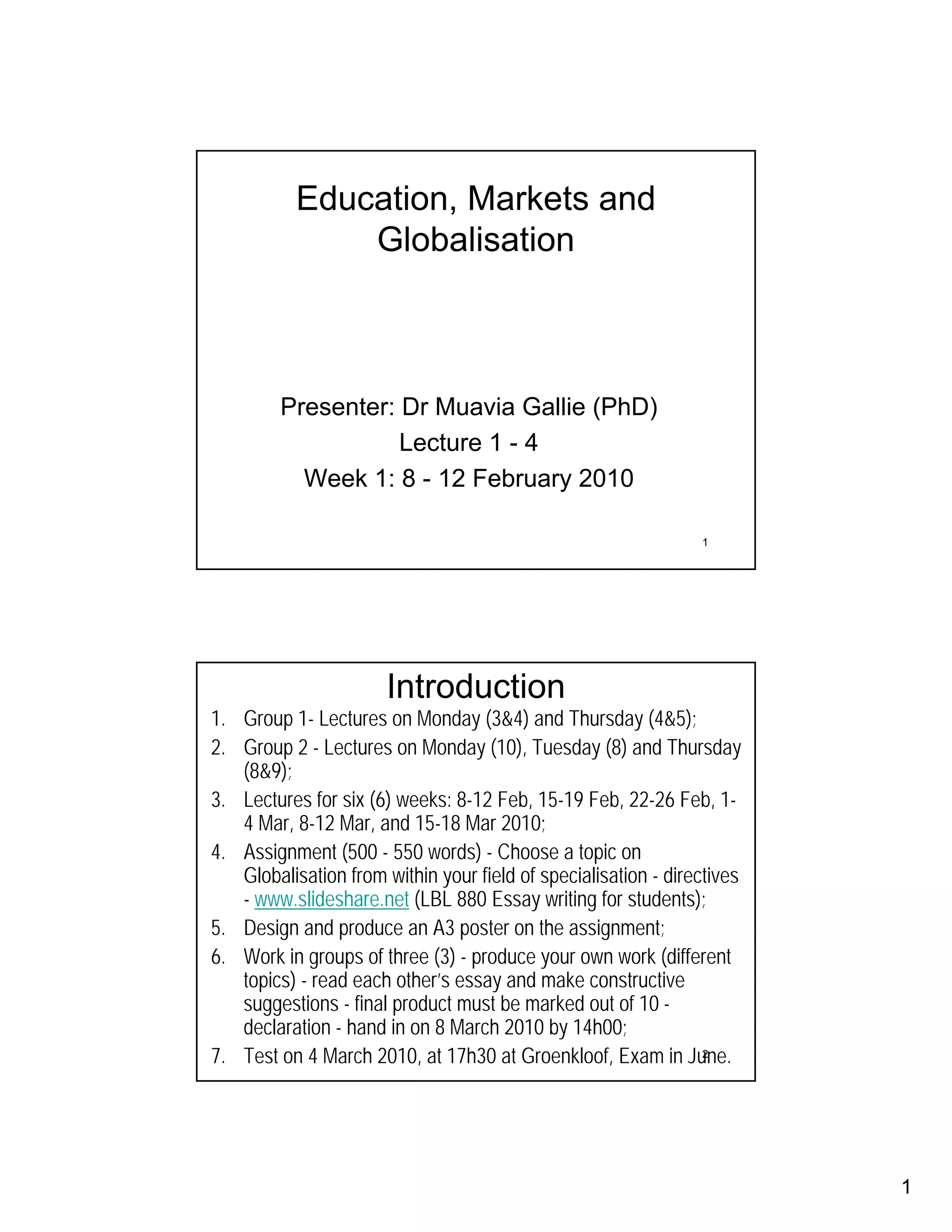
Education, Markets and
               Globalisation


         Presenter: Dr Muavia Gallie (PhD)
                    Lecture 1 - 4
           Week 1: 8 - 12 February 2010

                                                                1


                       Introduction
1. Group 1- Lectures on Monday (3&4) and Thursday (4&5);
2. Group 2 - Lectures on Monday (10), Tuesday (8) and Thursday
   (8&9);
3. Lectures for six (6) weeks: 8-12 Feb, 15-19 Feb, 22-26 Feb, 1-
   4 Mar, 8-12 Mar, and 15-18 Mar 2010;
4. Assignment (500 - 550 words) - Choose a topic on
   Globalisation from within your field of specialisation - directives
   - www.slideshare.net (LBL 880 Essay writing for students);
5. Design and produce an A3 poster on the assignment;
6. Work in groups of three (3) - produce your own work (different
   topics) - read each other’s essay and make constructive
   suggestions - final product must be marked out of 10 -
   declaration - hand in on 8 March 2010 by 14h00;
7. Test on 4 March 2010, at 17h30 at Groenkloof, Exam in June.   2


                                                                         1
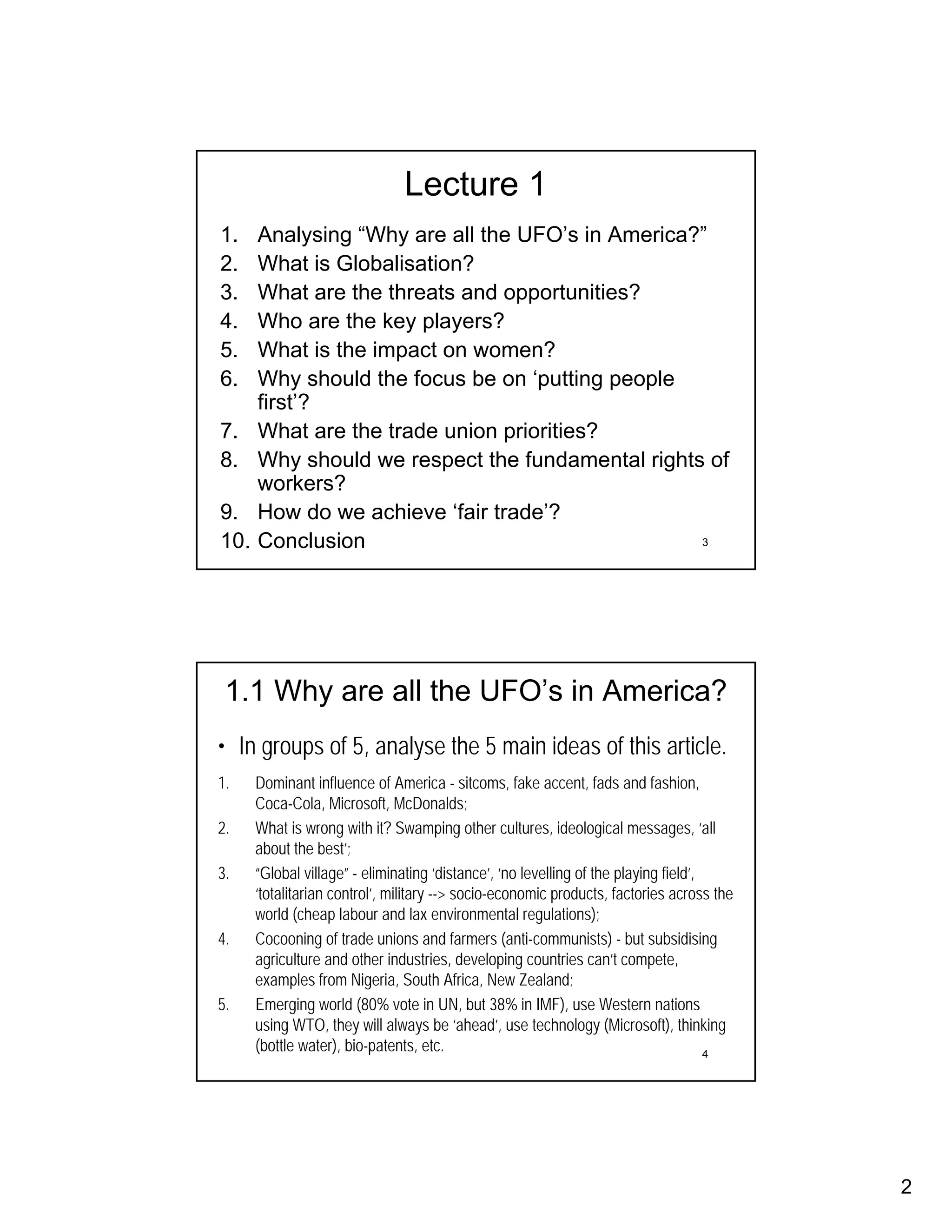
Lecture 1
1.    Analysing “Why are all the UFO’s in America?”
2.    What is Globalisation?
3.    What are the threats and opportunities?
4.    Who are the key players?
5.    What is the impact on women?
6.    Why should the focus be on ‘putting people
      first’?
7.    What are the trade union priorities?
8.    Why should we respect the fundamental rights of
      workers?
9.    How do we achieve ‘fair trade’?
10.   Conclusion                                  3


 1.1 Why are all the UFO’s in America?
• In groups of 5, analyse the 5 main ideas of this article.
1.    Dominant influence of America - sitcoms, fake accent, fads and fashion,
      Coca-Cola, Microsoft, McDonalds;
2.    What is wrong with it? Swamping other cultures, ideological messages, ‘all
      about the best’;
3.    “Global village” - eliminating ‘distance’, ‘no levelling of the playing field’,
      ‘totalitarian control’, military --> socio-economic products, factories across the
      world (cheap labour and lax environmental regulations);
4.    Cocooning of trade unions and farmers (anti-communists) - but subsidising
      agriculture and other industries, developing countries can’t compete,
      examples from Nigeria, South Africa, New Zealand;
5.    Emerging world (80% vote in UN, but 38% in IMF), use Western nations
      using WTO, they will always be ‘ahead’, use technology (Microsoft), thinking
      (bottle water), bio-patents, etc.                                               4


                                                                                           2
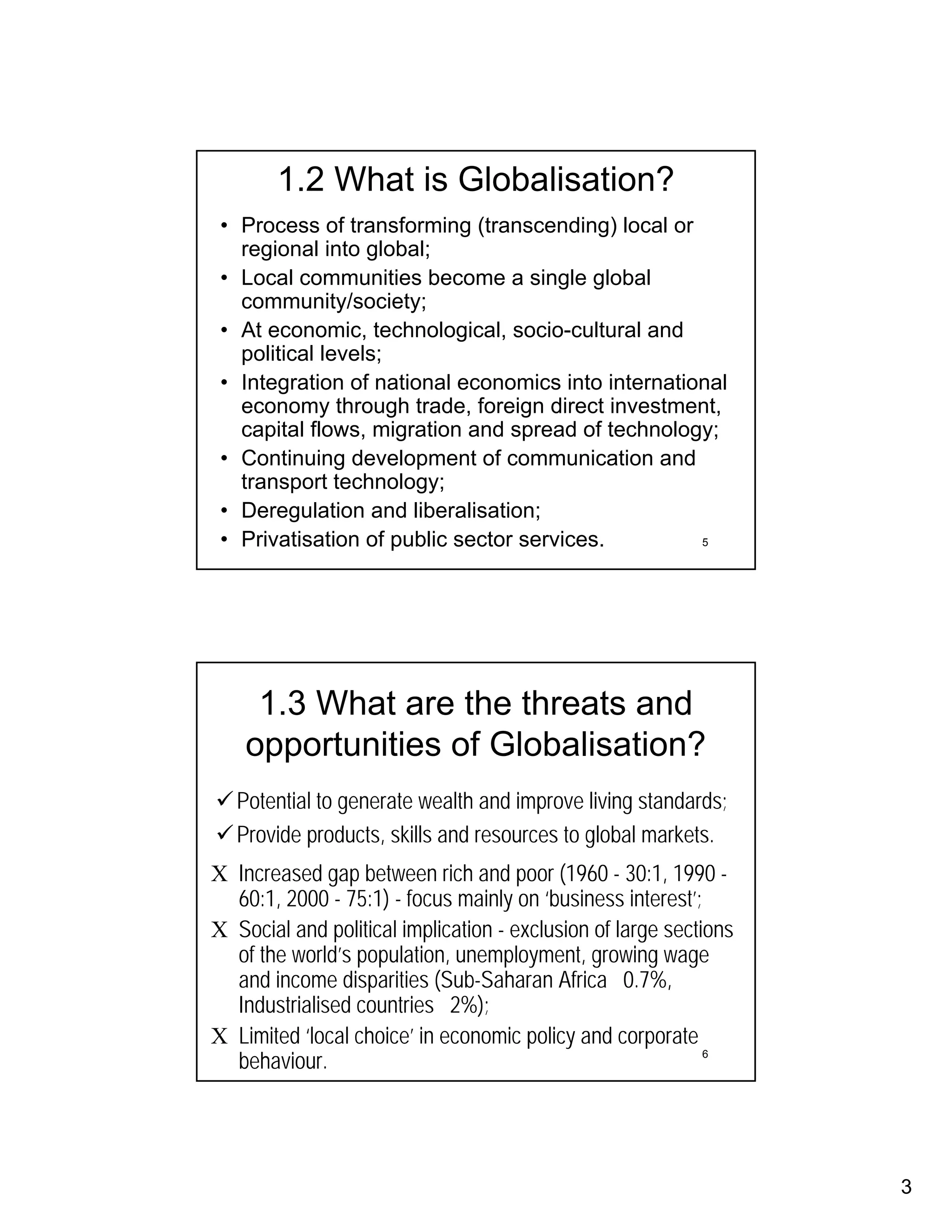
1.2 What is Globalisation?
 • Process of transforming (transcending) local or
   regional into global;
 • Local communities become a single global
   community/society;
 • At economic, technological, socio-cultural and
   political levels;
 • Integration of national economics into international
   economy through trade, foreign direct investment,
   capital flows, migration and spread of technology;
 • Continuing development of communication and
   transport technology;
 • Deregulation and liberalisation;
 • Privatisation of public sector services.         5


     1.3 What are the threats and
    opportunities of Globalisation?
   Potential to generate wealth and improve living standards;
   Provide products, skills and resources to global markets.
Χ Increased gap between rich and poor (1960 - 30:1, 1990 -
  60:1, 2000 - 75:1) - focus mainly on ‘business interest’;
Χ Social and political implication - exclusion of large sections
  of the world’s population, unemployment, growing wage
  and income disparities (Sub-Saharan Africa 0.7%,
  Industrialised countries 2%);
Χ Limited ‘local choice’ in economic policy and corporate
  behaviour.                                                 6


                                                                   3
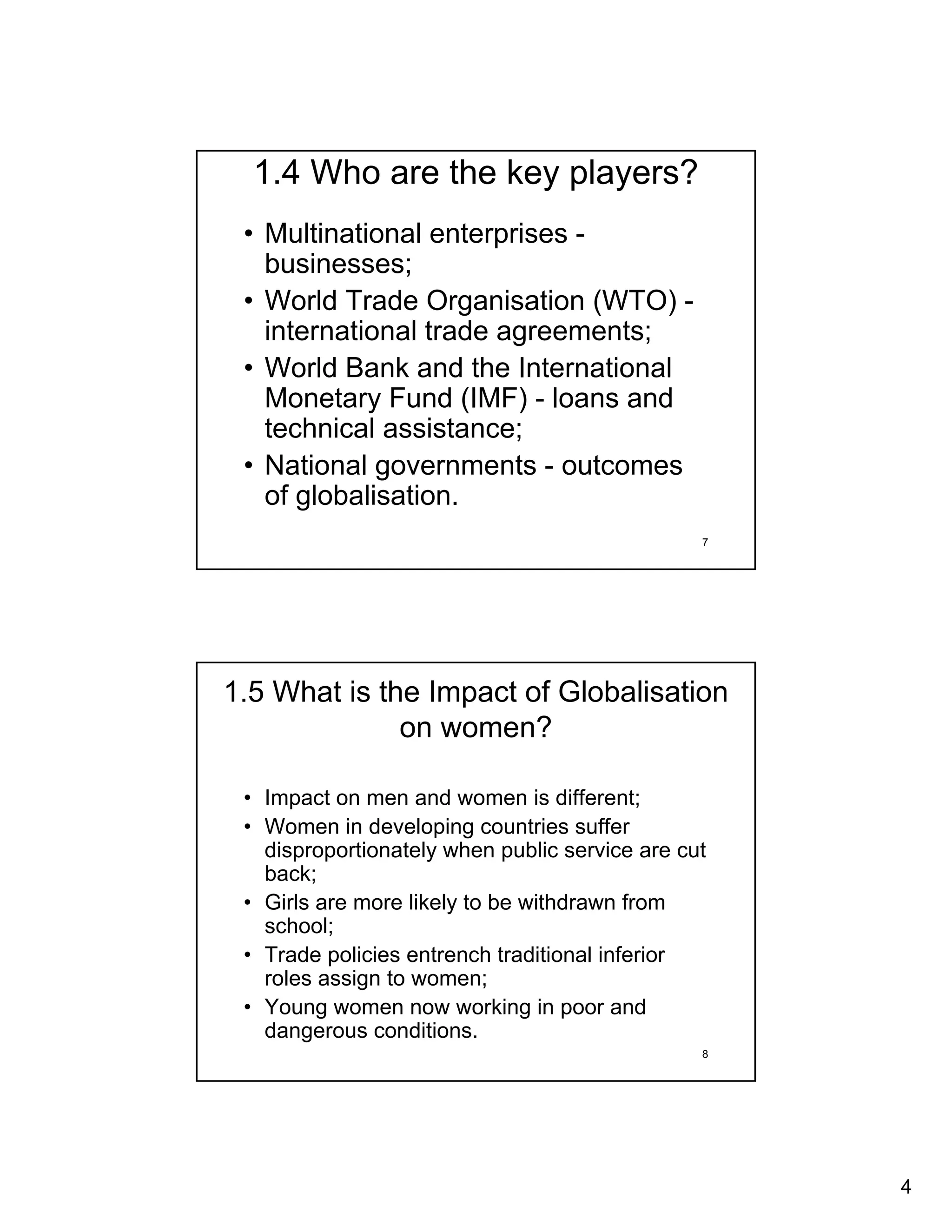
1.4 Who are the key players?
 • Multinational enterprises -
   businesses;
 • World Trade Organisation (WTO) -
   international trade agreements;
 • World Bank and the International
   Monetary Fund (IMF) - loans and
   technical assistance;
 • National governments - outcomes
   of globalisation.
                                                7


1.5 What is the Impact of Globalisation
              on women?

 • Impact on men and women is different;
 • Women in developing countries suffer
   disproportionately when public service are cut
   back;
 • Girls are more likely to be withdrawn from
   school;
 • Trade policies entrench traditional inferior
   roles assign to women;
 • Young women now working in poor and
   dangerous conditions.
                                                8


                                                    4
1.6 Why should the focus be on
      ‘putting people first’?

  • Globalisation must support the
    fundamental human rights and
    sustainable development, and
    generate prosperity for ordinary
    poor people;
  • Otherwise, it will lead to further
    marginalisation and
    impoverishment.
                                                    9


1.7 What are the trade union priorities?
• To convince governments and employers to
  assume the responsibilities of globalisation;
• Campaigns at both national and international
  levels for strong and effective regulation;
• TUC is pressing for: debt relief, increased aid, fair
  trade terms, protection for public services, access
  to essential medicines, capacity building and
  assistance with international trade negotiations,
  reform of the WTO, World Bank, IMF to ensure
  greater transparency and democracy within their
  operations.
                                                   10


                                                          5
1.8 Why should we respect the
  fundamental rights of workers?
  • Ensure core labour standards - crucial to the
    empowerment of people;
  • Freedom of association, right to effective
    collective bargaining, freedom from forced
    and child labour, freedom from discrimination
    are basic human rights;
  • Need for coordination between WTO and
    International Labour Organisation (ILO).

                                                  11


1.9 How do we achieve ‘fair trade’?
  • Ensure that producers in poor countries get a
    fair deal;
  • Fair price for their goods, long term contracts
    with real security, and support the knowledge
    and skills that they need to develop their
    businesses and increase sales;
  • Empower consumers to use their purchasing
    power in favour of the poor (Buy proudly
    South Africa);
  • Support small-scale producers to compete
    with multi-nationals.
                                                  12


                                                       6
1.10 Conclusion
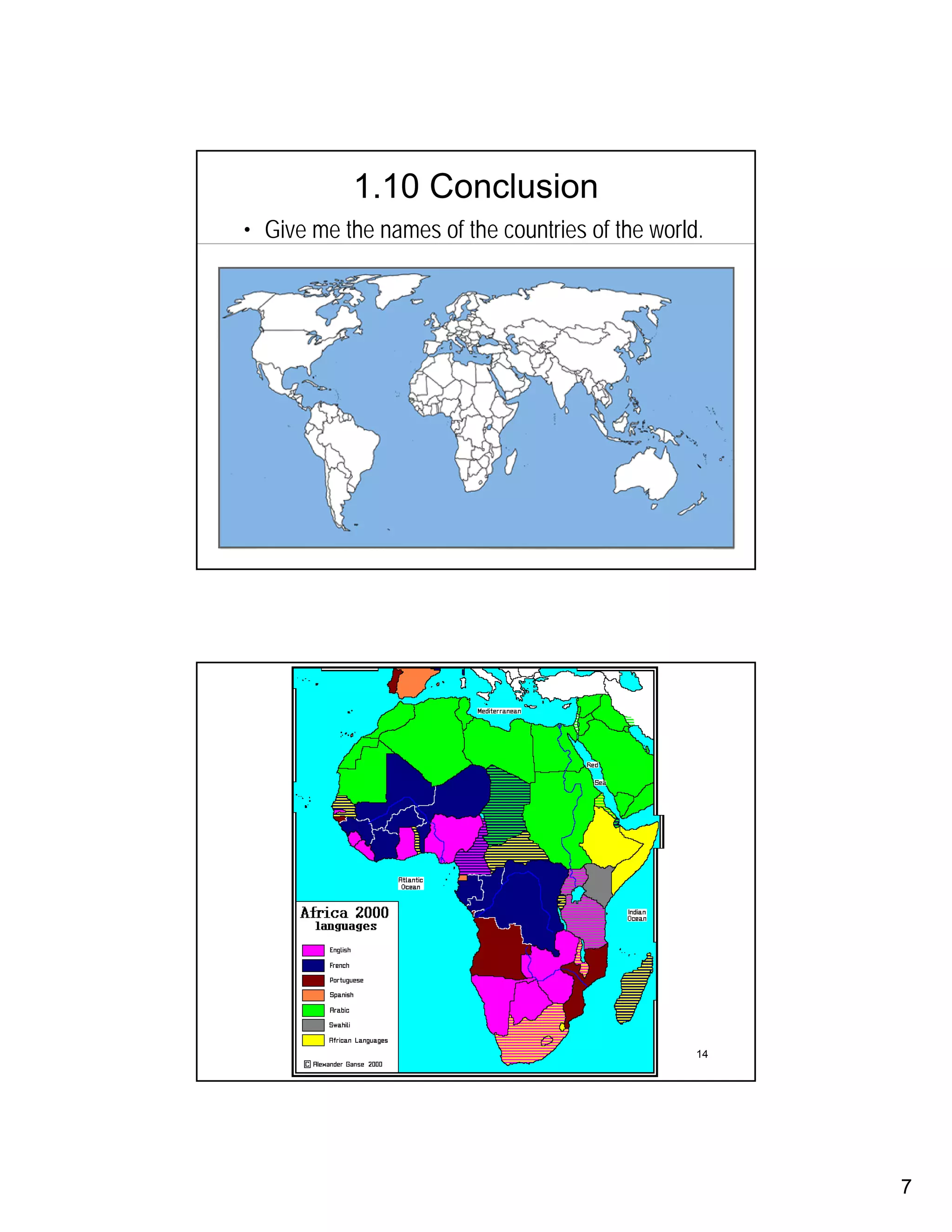
• Give me the names of the countries of the world.


                                                 13


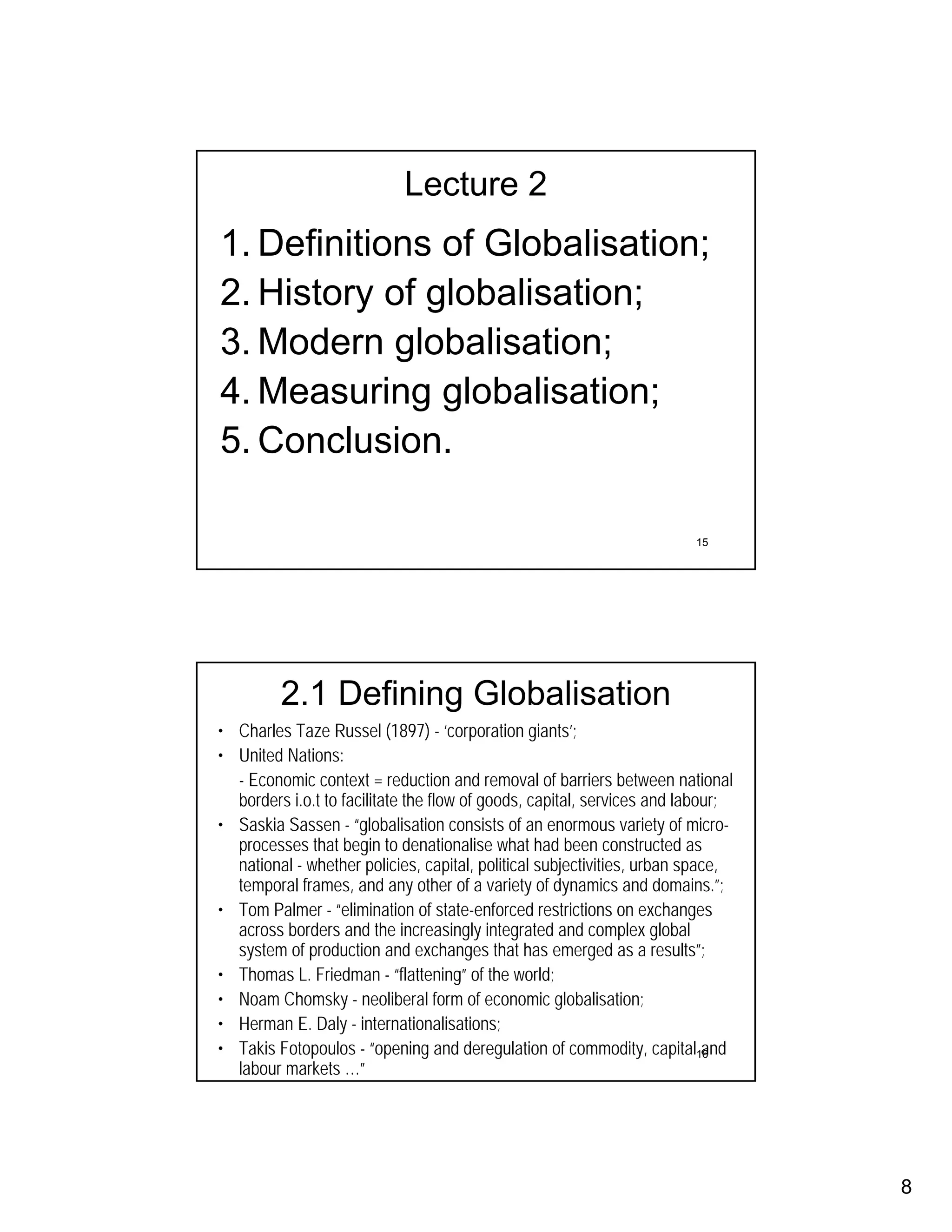
      Africa 2000 Languages


                                                 14


                                                      7
Lecture 2
1. Definitions of Globalisation;
2. History of globalisation;
3. Modern globalisation;
4. Measuring globalisation;
5. Conclusion.

                                                                        15


         2.1 Defining Globalisation
• Charles Taze Russel (1897) - ‘corporation giants’;
• United Nations:
  - Economic context = reduction and removal of barriers between national
  borders i.o.t to facilitate the flow of goods, capital, services and labour;
• Saskia Sassen - “globalisation consists of an enormous variety of micro-
  processes that begin to denationalise what had been constructed as
  national - whether policies, capital, political subjectivities, urban space,
  temporal frames, and any other of a variety of dynamics and domains.”;
• Tom Palmer - “elimination of state-enforced restrictions on exchanges
  across borders and the increasingly integrated and complex global
  system of production and exchanges that has emerged as a results”;
• Thomas L. Friedman - “flattening” of the world;
• Noam Chomsky - neoliberal form of economic globalisation;
• Herman E. Daly - internationalisations;
• Takis Fotopoulos - “opening and deregulation of commodity, capital16     and
  labour markets …”


                                                                                 8
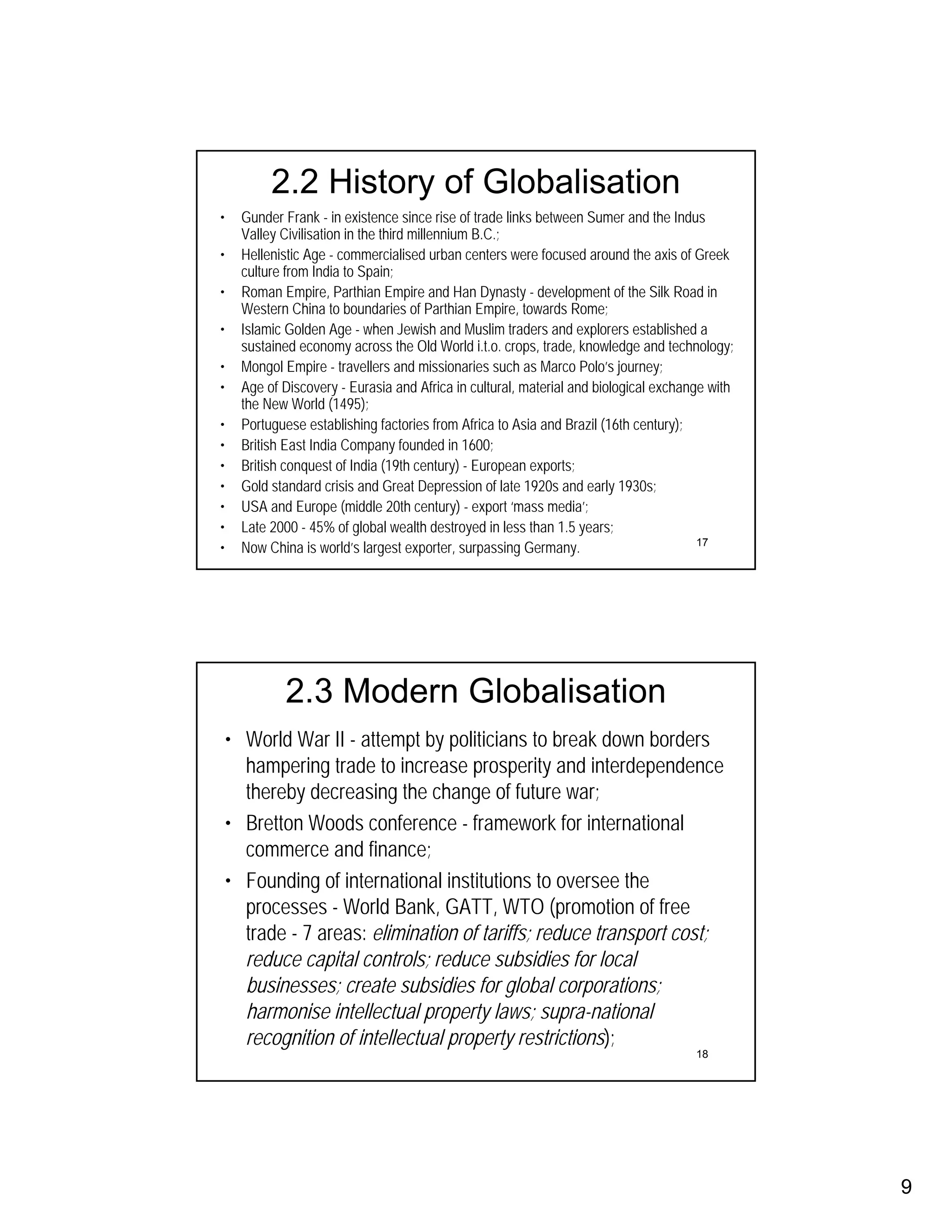
2.2 History of Globalisation
•     Gunder Frank - in existence since rise of trade links between Sumer and the Indus
      Valley Civilisation in the third millennium B.C.;
•     Hellenistic Age - commercialised urban centers were focused around the axis of Greek
      culture from India to Spain;
•     Roman Empire, Parthian Empire and Han Dynasty - development of the Silk Road in
      Western China to boundaries of Parthian Empire, towards Rome;
•     Islamic Golden Age - when Jewish and Muslim traders and explorers established a
      sustained economy across the Old World i.t.o. crops, trade, knowledge and technology;
•     Mongol Empire - travellers and missionaries such as Marco Polo’s journey;
•     Age of Discovery - Eurasia and Africa in cultural, material and biological exchange with
      the New World (1495);
•     Portuguese establishing factories from Africa to Asia and Brazil (16th century);
•     British East India Company founded in 1600;
•     British conquest of India (19th century) - European exports;
•     Gold standard crisis and Great Depression of late 1920s and early 1930s;
•     USA and Europe (middle 20th century) - export ‘mass media’;
•     Late 2000 - 45% of global wealth destroyed in less than 1.5 years;
•     Now China is world’s largest exporter, surpassing Germany.                        17


             2.3 Modern Globalisation
    • World War II - attempt by politicians to break down borders
      hampering trade to increase prosperity and interdependence
      thereby decreasing the change of future war;
    • Bretton Woods conference - framework for international
      commerce and finance;
    • Founding of international institutions to oversee the
      processes - World Bank, GATT, WTO (promotion of free
      trade - 7 areas: elimination of tariffs; reduce transport cost;
      reduce capital controls; reduce subsidies for local
      businesses; create subsidies for global corporations;
      harmonise intellectual property laws; supra-national
      recognition of intellectual property restrictions);
                                                                                       18


                                                                                                 9
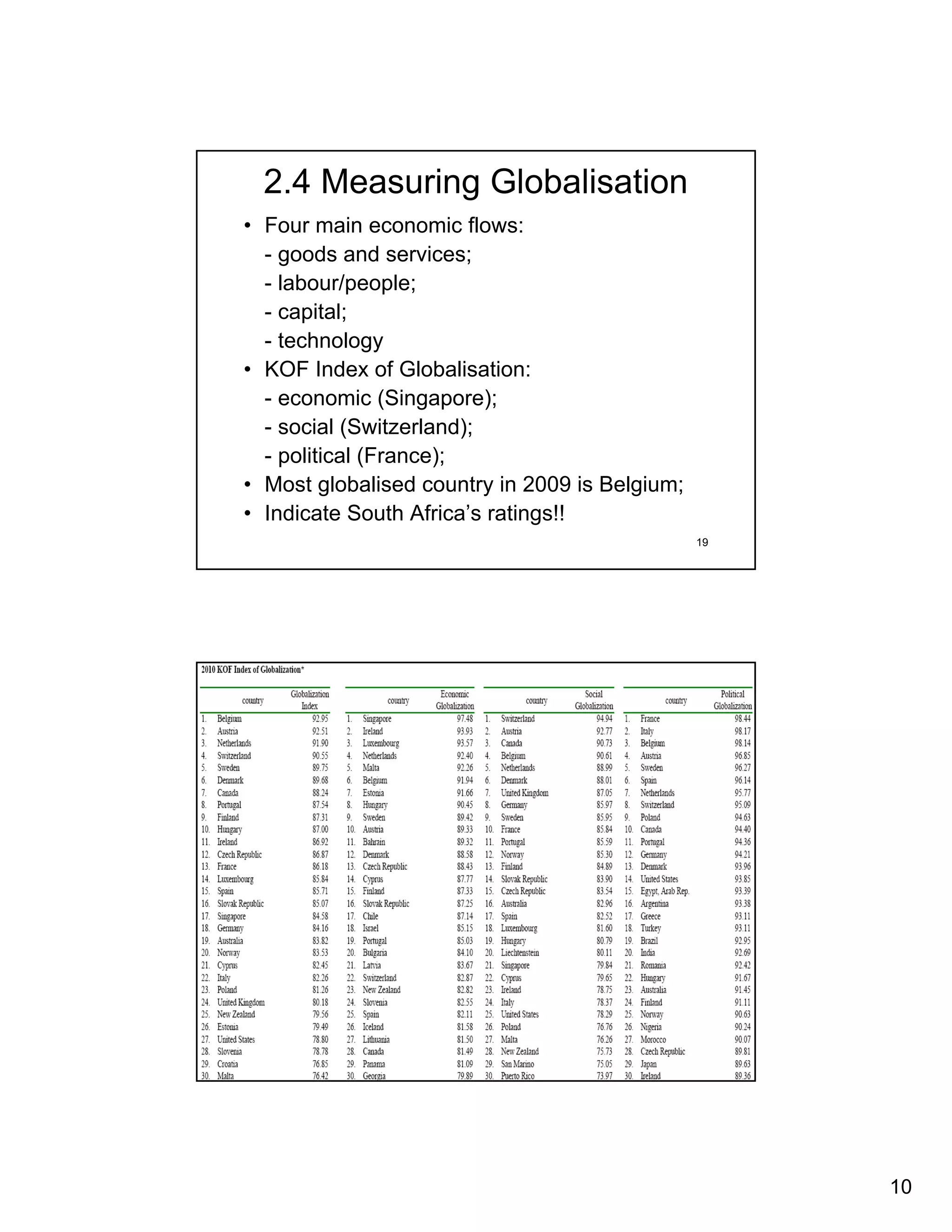
2.4 Measuring Globalisation
• Four main economic flows:
  - goods and services;
  - labour/people;
  - capital;
  - technology
• KOF Index of Globalisation:
  - economic (Singapore);
  - social (Switzerland);
  - political (France);
• Most globalised country in 2009 is Belgium;
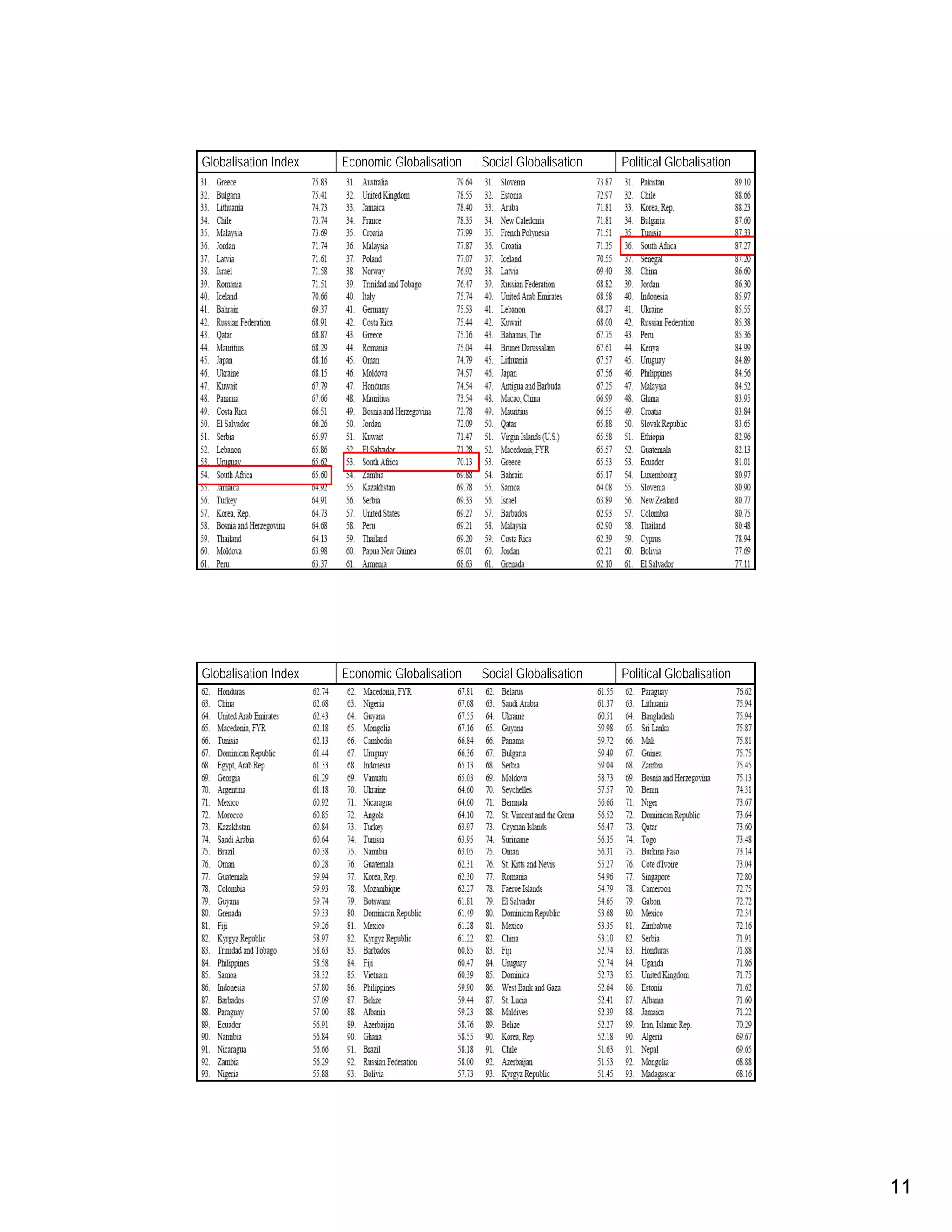
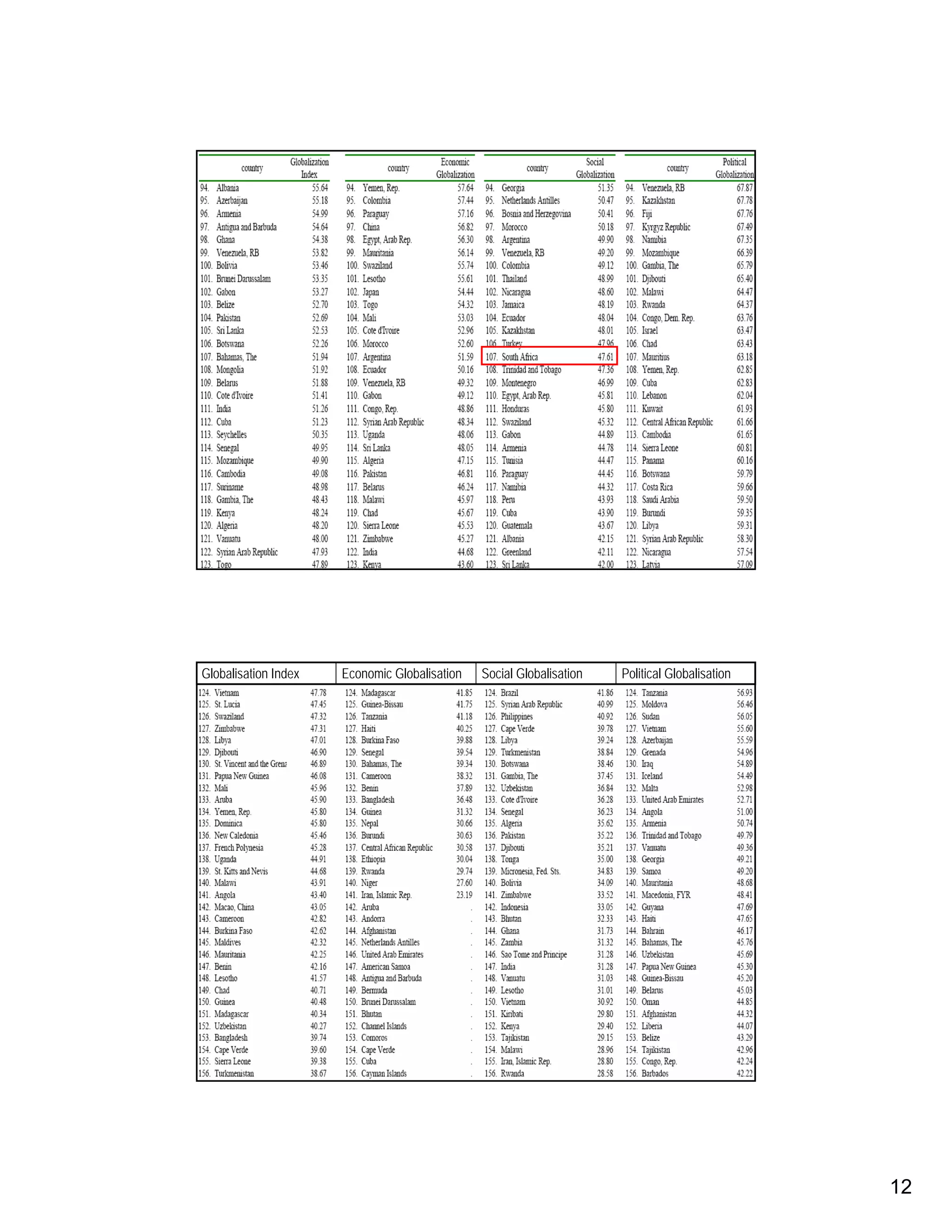
• Indicate South Africa’s ratings!!
                                                19


      2.5 Conclusion - Index


                                                20


                                                     10
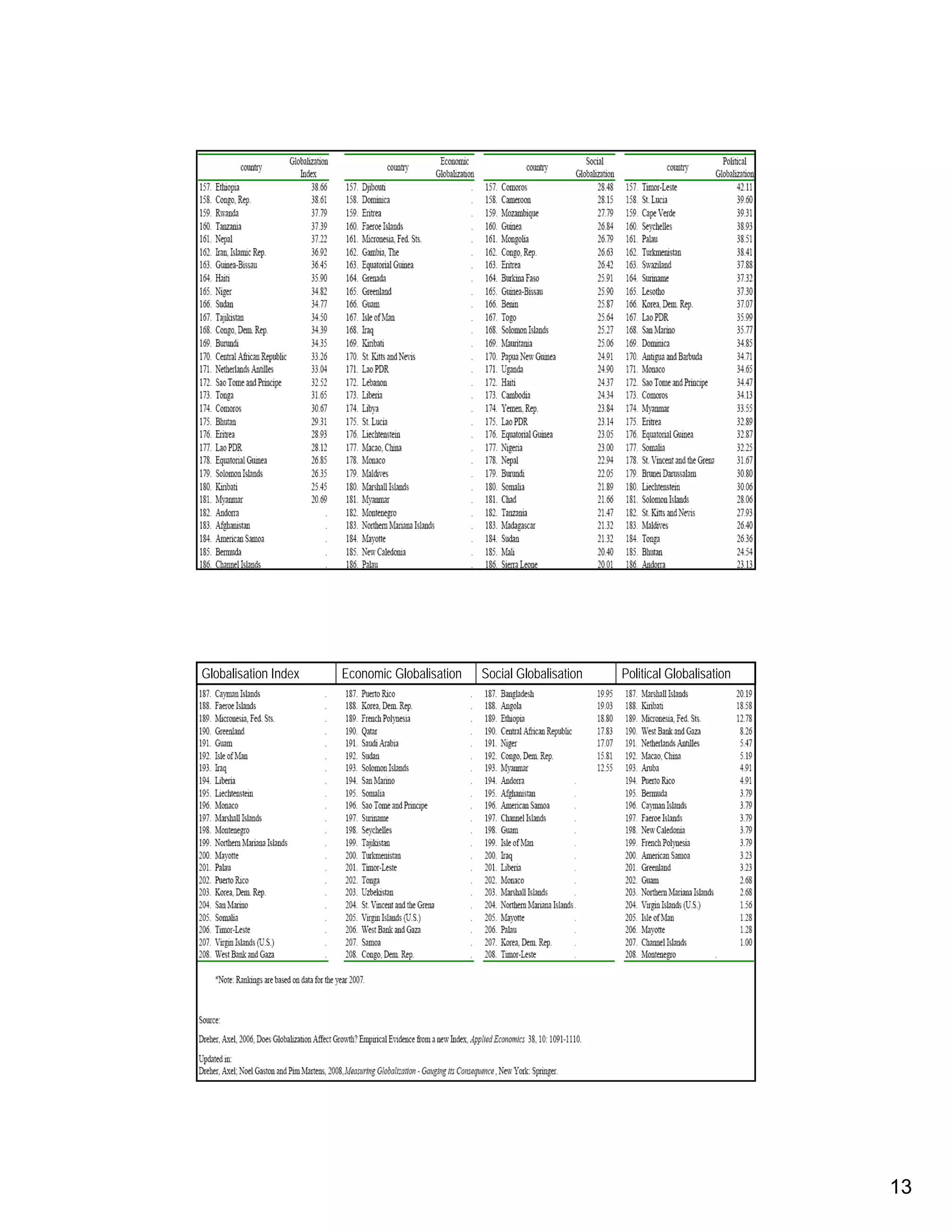
Globalisation Index    Economic Globalisation   Social Globalisation   Political Globalisation


                      Globalisation Index 2


                                                                                      21


Globalisation Index    Economic Globalisation   Social Globalisation   Political Globalisation


                      Globalisation Index 3


                                                                                      22


                                                                                                 11
Globalisation Index    Economic Globalisation   Social Globalisation   Political Globalisation


                      Globalisation Index 4


                                                                                      23


Globalisation Index    Economic Globalisation   Social Globalisation   Political Globalisation


                      Globalisation Index 5


                                                                                      24


                                                                                                 12
Globalisation Index    Economic Globalisation   Social Globalisation   Political Globalisation


                      Globalisation Index 6


                                                                                      25


Globalisation Index    Economic Globalisation   Social Globalisation   Political Globalisation


                      Globalisation Index 7


                                                                                      26


                                                                                                 13
Globalisation Video - 7.23 min


                              27


           Lecture 3

1.Effects of
  globalisation;
2.Pro-globalisation
  (globalism);
3.Conclusion.
                              28


                                   14
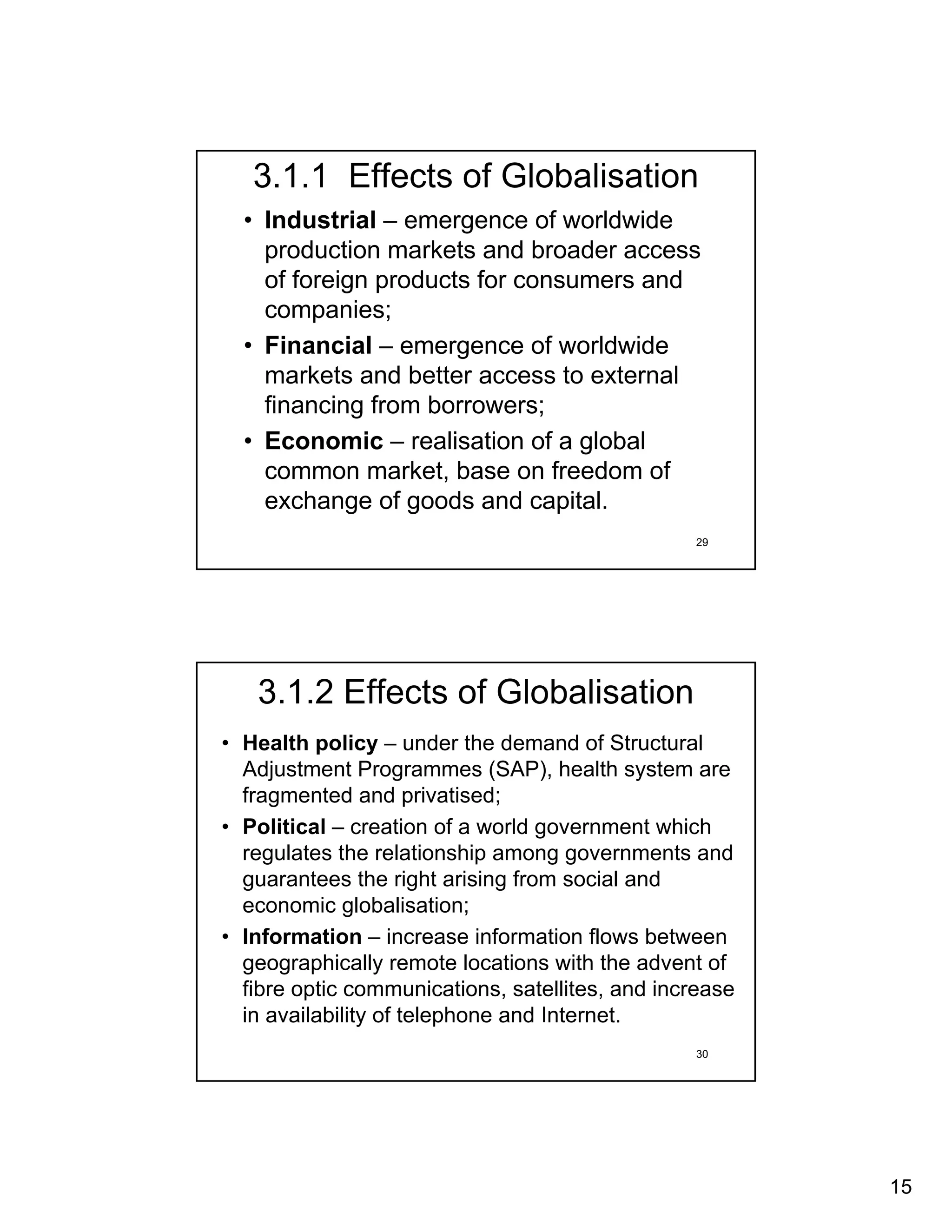
3.1.1 Effects of Globalisation
  • Industrial – emergence of worldwide
    production markets and broader access
    of foreign products for consumers and
    companies;
  • Financial – emergence of worldwide
    markets and better access to external
    financing from borrowers;
  • Economic – realisation of a global
    common market, base on freedom of
    exchange of goods and capital.
                                                 29


   3.1.2 Effects of Globalisation
• Health policy – under the demand of Structural
  Adjustment Programmes (SAP), health system are
  fragmented and privatised;
• Political – creation of a world government which
  regulates the relationship among governments and
  guarantees the right arising from social and
  economic globalisation;
• Information – increase information flows between
  geographically remote locations with the advent of
  fibre optic communications, satellites, and increase
  in availability of telephone and Internet.
                                                 30


                                                         15
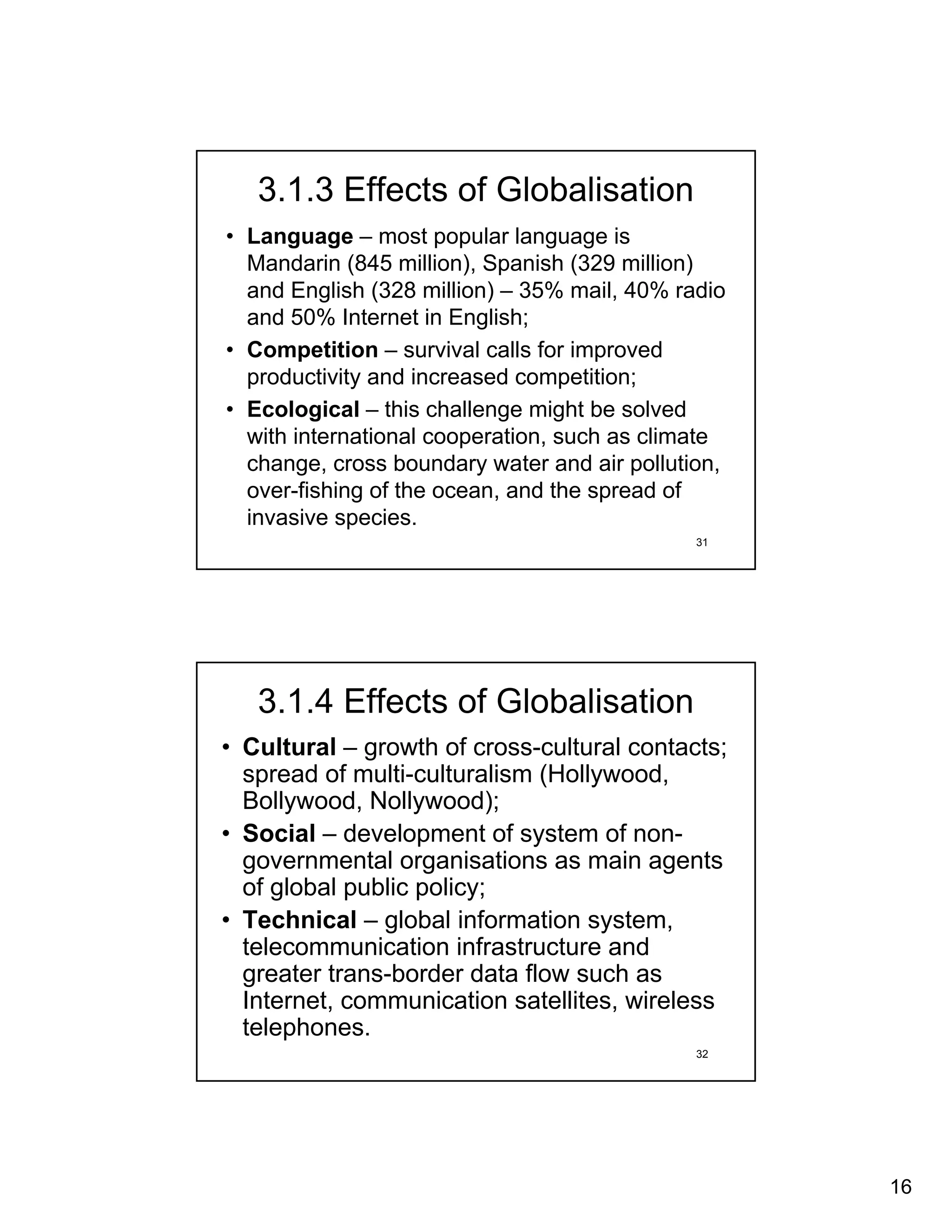
3.1.3 Effects of Globalisation
• Language – most popular language is
  Mandarin (845 million), Spanish (329 million)
  and English (328 million) – 35% mail, 40% radio
  and 50% Internet in English;
• Competition – survival calls for improved
  productivity and increased competition;
• Ecological – this challenge might be solved
  with international cooperation, such as climate
  change, cross boundary water and air pollution,
  over-fishing of the ocean, and the spread of
  invasive species.
                                              31


   3.1.4 Effects of Globalisation
• Cultural – growth of cross-cultural contacts;
  spread of multi-culturalism (Hollywood,
  Bollywood, Nollywood);
• Social – development of system of non-
  governmental organisations as main agents
  of global public policy;
• Technical – global information system,
  telecommunication infrastructure and
  greater trans-border data flow such as
  Internet, communication satellites, wireless
  telephones.
                                              32


                                                    16
3.1.5 Effects of Globalisation
• Legal/Ethical – creation of international
  criminal court and justice movements;
  crime importation and raising awareness
  of global crime-fighting efforts and
  cooperation; emergence of global
  administrative law;
• Religious – spread and increased inter-
  relations of various religious groups, ideas
  and practices and their ideas of the
  meaning and values of particular spaces.
                                                33


         3.1.7 Cultural effects
• Culture = patterns of human activity and symbols
  that give these activities significance;
• What people eat, how they dress, beliefs they
  hold, and activities they practice;
• Example: Food
  - Someone in America can be eating Japanese
  noodles for lunch while someone in Sydney,
  Australia is eating classic Italian meatballs;
  - India is known for its curry and exotic spices;
  - France is known for its cheeses;
  - America is known for its burgers and fries;
                                                34


                                                      17
3.1.6 Negative Effects
•   Globalisation is one of the most hotly debated topic in
    international economics over past few years;
•   Concern that it has increased inequality and environmental
    degradation;
•   Midwestern USA - reduced competitive edge in industry and
    agriculture, lowering the quality of life;
•   Flow of information, goods, capital and people has helped spread
    some of deadliest infectious diseases known to humans;
•   Opportunities in richer countries - brain drain;
•   2000 - 1% richest people owned 40% global assets;
•   2001 - 46.4% people in sub-Saharan Africa living in extreme
    poverty;
•   Nearly half of all Indian children are under-nourished;
•   At present rate, tropical rainforest in Indonesia logged out in 10
    years, 13-16 years in Papua New Guinea;
•   50% more energy, food and water required by 2030.               35


               3.1.7 Sweatshops
•   Foreign businesses take advantage of the
    lower wage rate in poor countries;
•   Sweatshops are widely used by sports shoe
    manufacturers (Nike);
•   Employees agree to low wages - if labour laws
    alter and stricter rules, they close down and
    relocate to other nations;
•   Focus on anti-sweatshop campaigns and
    education;
•   USA - Decent Working Conditions and Fair
    Competition Act - no child labour, no forced
    labour.                                       36


                                                                         18
3.2 Pro-Globalisation (Globalism)
• Supporters claim it increases economic
  prosperity and opportunity;
• Enhances civil liberties and more efficient
  allocation of resources;
• Leads to lower prices, more employment,
  higher output and higher living standards in
  developing countries;
• Higher degree of political and economic
  freedom;
• Spread of liberty and capitalism.
                                           37


          Sweatshop Video


                                           38


                                                 19
Lecture 4

1.Anti-globalisation;
2.International social
  forums;
3.Conclusion.
                                        39


     4.1.1 Anti-Globalisation
 • Process or actions taken by a state or
   its people in order to demonstrate its
   sovereignty and practice democratic
   decision making;
 • Maintain barriers to international
   transfer of people, goods and beliefs;
 • Single or umbrella movements;
 • They look at both damage of planet and
   perceived human cost.
                                        40


                                             20
4.1.2 Anti-Globalisation
 • Critics argue that:
   - Poorer countries suffering
   disadvantages;
   - Exploitation of foreign impoverished
   workers;
   - Shifts to oursourcing;
   - Weak labour unions;
   - increase exploitation of child labour.

                                              41


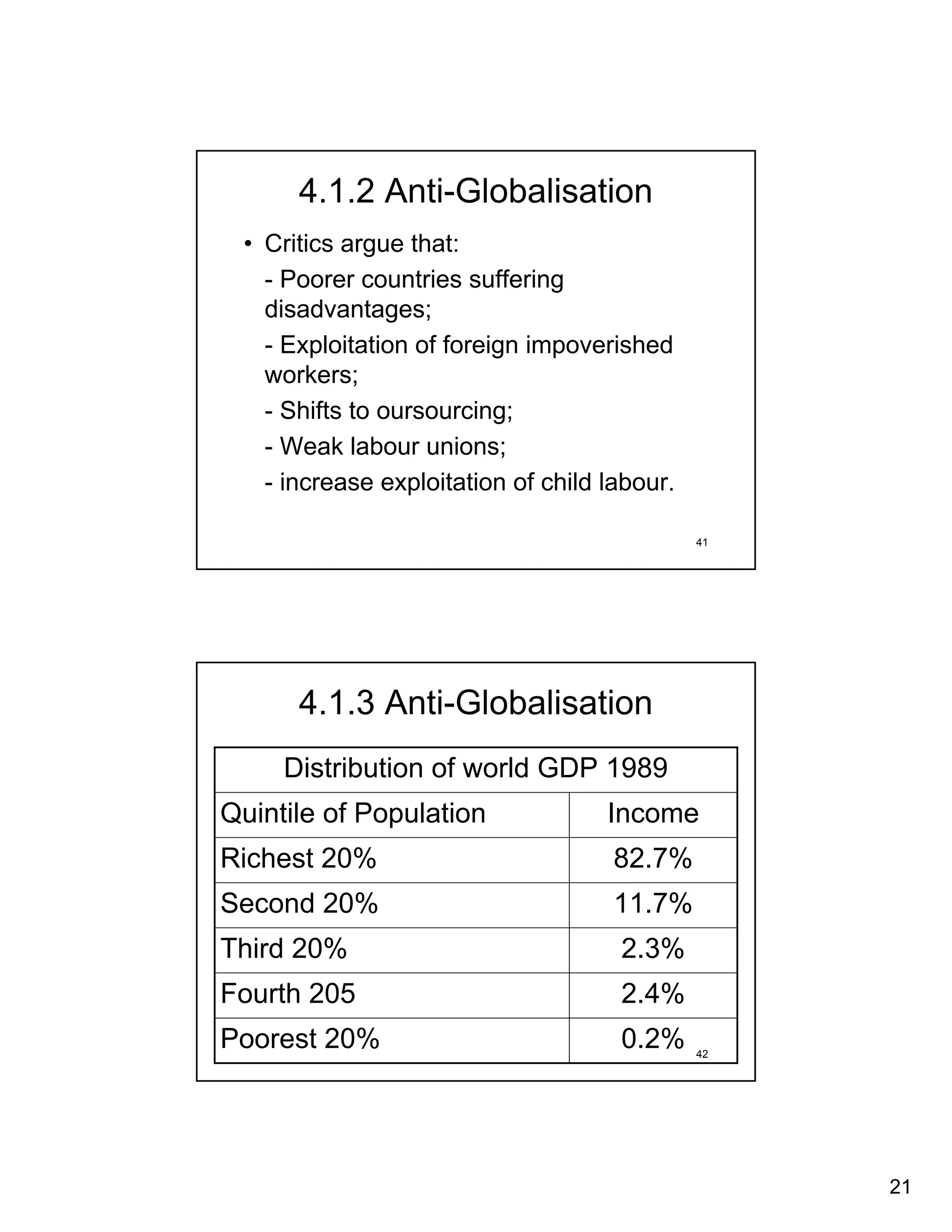
      4.1.3 Anti-Globalisation
     Distribution of world GDP 1989
Quintile of Population              Income
Richest 20%                          82.7%
Second 20%                           11.7%
Third 20%                            2.3%
Fourth 205                           2.4%
Poorest 20%                          0.2%     42


                                                   21
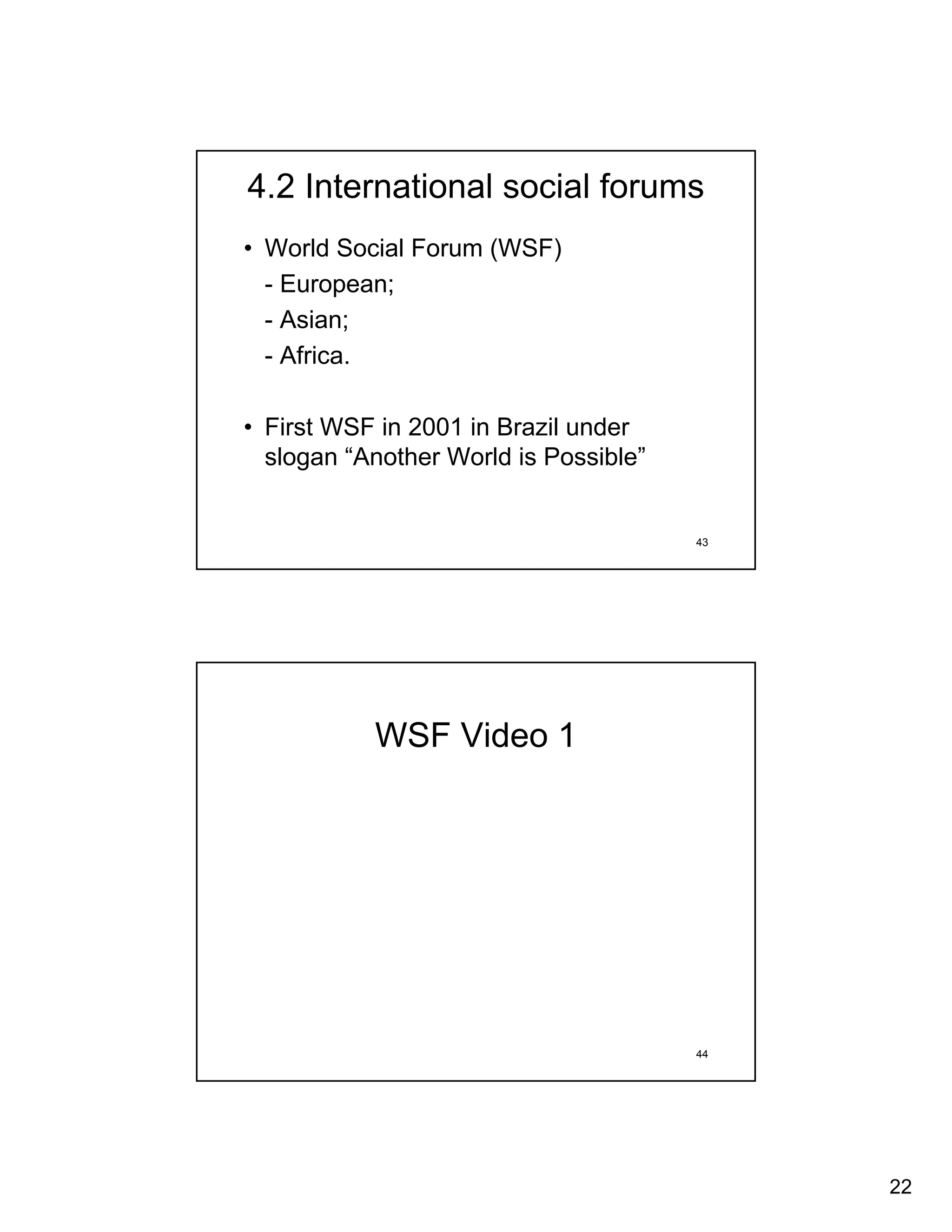
4.2 International social forums
• World Social Forum (WSF)
  - European;
  - Asian;
  - Africa.

• First WSF in 2001 in Brazil under
  slogan “Another World is Possible”


                                       43


           WSF Video 1


                                       44


                                            22
WSF Video 2


                                           45


           Contact details:
• E-mail: muavia@mweb.co.za;
  – Or muavia.gallie@mweb.co.za;


• Fax: 0866720520

• Powerpoint website: www.slideshare.net


  Thank You!                               46


                                                23

OPV 361 Globalisation Lecture 1 4 X 2

  • 1.
    Education, Markets and Globalisation Presenter: Dr Muavia Gallie (PhD) Lecture 1 - 4 Week 1: 8 - 12 February 2010 1 Introduction 1. Group 1- Lectures on Monday (3&4) and Thursday (4&5); 2. Group 2 - Lectures on Monday (10), Tuesday (8) and Thursday (8&9); 3. Lectures for six (6) weeks: 8-12 Feb, 15-19 Feb, 22-26 Feb, 1- 4 Mar, 8-12 Mar, and 15-18 Mar 2010; 4. Assignment (500 - 550 words) - Choose a topic on Globalisation from within your field of specialisation - directives - www.slideshare.net (LBL 880 Essay writing for students); 5. Design and produce an A3 poster on the assignment; 6. Work in groups of three (3) - produce your own work (different topics) - read each other’s essay and make constructive suggestions - final product must be marked out of 10 - declaration - hand in on 8 March 2010 by 14h00; 7. Test on 4 March 2010, at 17h30 at Groenkloof, Exam in June. 2 1
  • 2.
    Lecture 1 1. Analysing “Why are all the UFO’s in America?” 2. What is Globalisation? 3. What are the threats and opportunities? 4. Who are the key players? 5. What is the impact on women? 6. Why should the focus be on ‘putting people first’? 7. What are the trade union priorities? 8. Why should we respect the fundamental rights of workers? 9. How do we achieve ‘fair trade’? 10. Conclusion 3 1.1 Why are all the UFO’s in America? • In groups of 5, analyse the 5 main ideas of this article. 1. Dominant influence of America - sitcoms, fake accent, fads and fashion, Coca-Cola, Microsoft, McDonalds; 2. What is wrong with it? Swamping other cultures, ideological messages, ‘all about the best’; 3. “Global village” - eliminating ‘distance’, ‘no levelling of the playing field’, ‘totalitarian control’, military --> socio-economic products, factories across the world (cheap labour and lax environmental regulations); 4. Cocooning of trade unions and farmers (anti-communists) - but subsidising agriculture and other industries, developing countries can’t compete, examples from Nigeria, South Africa, New Zealand; 5. Emerging world (80% vote in UN, but 38% in IMF), use Western nations using WTO, they will always be ‘ahead’, use technology (Microsoft), thinking (bottle water), bio-patents, etc. 4 2
  • 3.
    1.2 What isGlobalisation? • Process of transforming (transcending) local or regional into global; • Local communities become a single global community/society; • At economic, technological, socio-cultural and political levels; • Integration of national economics into international economy through trade, foreign direct investment, capital flows, migration and spread of technology; • Continuing development of communication and transport technology; • Deregulation and liberalisation; • Privatisation of public sector services. 5 1.3 What are the threats and opportunities of Globalisation? Potential to generate wealth and improve living standards; Provide products, skills and resources to global markets. Χ Increased gap between rich and poor (1960 - 30:1, 1990 - 60:1, 2000 - 75:1) - focus mainly on ‘business interest’; Χ Social and political implication - exclusion of large sections of the world’s population, unemployment, growing wage and income disparities (Sub-Saharan Africa 0.7%, Industrialised countries 2%); Χ Limited ‘local choice’ in economic policy and corporate behaviour. 6 3
  • 4.
    1.4 Who arethe key players? • Multinational enterprises - businesses; • World Trade Organisation (WTO) - international trade agreements; • World Bank and the International Monetary Fund (IMF) - loans and technical assistance; • National governments - outcomes of globalisation. 7 1.5 What is the Impact of Globalisation on women? • Impact on men and women is different; • Women in developing countries suffer disproportionately when public service are cut back; • Girls are more likely to be withdrawn from school; • Trade policies entrench traditional inferior roles assign to women; • Young women now working in poor and dangerous conditions. 8 4
  • 5.
    1.6 Why shouldthe focus be on ‘putting people first’? • Globalisation must support the fundamental human rights and sustainable development, and generate prosperity for ordinary poor people; • Otherwise, it will lead to further marginalisation and impoverishment. 9 1.7 What are the trade union priorities? • To convince governments and employers to assume the responsibilities of globalisation; • Campaigns at both national and international levels for strong and effective regulation; • TUC is pressing for: debt relief, increased aid, fair trade terms, protection for public services, access to essential medicines, capacity building and assistance with international trade negotiations, reform of the WTO, World Bank, IMF to ensure greater transparency and democracy within their operations. 10 5
  • 6.
    1.8 Why shouldwe respect the fundamental rights of workers? • Ensure core labour standards - crucial to the empowerment of people; • Freedom of association, right to effective collective bargaining, freedom from forced and child labour, freedom from discrimination are basic human rights; • Need for coordination between WTO and International Labour Organisation (ILO). 11 1.9 How do we achieve ‘fair trade’? • Ensure that producers in poor countries get a fair deal; • Fair price for their goods, long term contracts with real security, and support the knowledge and skills that they need to develop their businesses and increase sales; • Empower consumers to use their purchasing power in favour of the poor (Buy proudly South Africa); • Support small-scale producers to compete with multi-nationals. 12 6
  • 7.
    1.10 Conclusion • Giveme the names of the countries of the world. 13 Africa 2000 Languages 14 7
  • 8.
    Lecture 2 1. Definitionsof Globalisation; 2. History of globalisation; 3. Modern globalisation; 4. Measuring globalisation; 5. Conclusion. 15 2.1 Defining Globalisation • Charles Taze Russel (1897) - ‘corporation giants’; • United Nations: - Economic context = reduction and removal of barriers between national borders i.o.t to facilitate the flow of goods, capital, services and labour; • Saskia Sassen - “globalisation consists of an enormous variety of micro- processes that begin to denationalise what had been constructed as national - whether policies, capital, political subjectivities, urban space, temporal frames, and any other of a variety of dynamics and domains.”; • Tom Palmer - “elimination of state-enforced restrictions on exchanges across borders and the increasingly integrated and complex global system of production and exchanges that has emerged as a results”; • Thomas L. Friedman - “flattening” of the world; • Noam Chomsky - neoliberal form of economic globalisation; • Herman E. Daly - internationalisations; • Takis Fotopoulos - “opening and deregulation of commodity, capital16 and labour markets …” 8
  • 9.
    2.2 History ofGlobalisation • Gunder Frank - in existence since rise of trade links between Sumer and the Indus Valley Civilisation in the third millennium B.C.; • Hellenistic Age - commercialised urban centers were focused around the axis of Greek culture from India to Spain; • Roman Empire, Parthian Empire and Han Dynasty - development of the Silk Road in Western China to boundaries of Parthian Empire, towards Rome; • Islamic Golden Age - when Jewish and Muslim traders and explorers established a sustained economy across the Old World i.t.o. crops, trade, knowledge and technology; • Mongol Empire - travellers and missionaries such as Marco Polo’s journey; • Age of Discovery - Eurasia and Africa in cultural, material and biological exchange with the New World (1495); • Portuguese establishing factories from Africa to Asia and Brazil (16th century); • British East India Company founded in 1600; • British conquest of India (19th century) - European exports; • Gold standard crisis and Great Depression of late 1920s and early 1930s; • USA and Europe (middle 20th century) - export ‘mass media’; • Late 2000 - 45% of global wealth destroyed in less than 1.5 years; • Now China is world’s largest exporter, surpassing Germany. 17 2.3 Modern Globalisation • World War II - attempt by politicians to break down borders hampering trade to increase prosperity and interdependence thereby decreasing the change of future war; • Bretton Woods conference - framework for international commerce and finance; • Founding of international institutions to oversee the processes - World Bank, GATT, WTO (promotion of free trade - 7 areas: elimination of tariffs; reduce transport cost; reduce capital controls; reduce subsidies for local businesses; create subsidies for global corporations; harmonise intellectual property laws; supra-national recognition of intellectual property restrictions); 18 9
  • 10.
    2.4 Measuring Globalisation •Four main economic flows: - goods and services; - labour/people; - capital; - technology • KOF Index of Globalisation: - economic (Singapore); - social (Switzerland); - political (France); • Most globalised country in 2009 is Belgium; • Indicate South Africa’s ratings!! 19 2.5 Conclusion - Index 20 10
  • 11.
    Globalisation Index Economic Globalisation Social Globalisation Political Globalisation Globalisation Index 2 21 Globalisation Index Economic Globalisation Social Globalisation Political Globalisation Globalisation Index 3 22 11
  • 12.
    Globalisation Index Economic Globalisation Social Globalisation Political Globalisation Globalisation Index 4 23 Globalisation Index Economic Globalisation Social Globalisation Political Globalisation Globalisation Index 5 24 12
  • 13.
    Globalisation Index Economic Globalisation Social Globalisation Political Globalisation Globalisation Index 6 25 Globalisation Index Economic Globalisation Social Globalisation Political Globalisation Globalisation Index 7 26 13
  • 14.
    Globalisation Video -7.23 min 27 Lecture 3 1.Effects of globalisation; 2.Pro-globalisation (globalism); 3.Conclusion. 28 14
  • 15.
    3.1.1 Effects ofGlobalisation • Industrial – emergence of worldwide production markets and broader access of foreign products for consumers and companies; • Financial – emergence of worldwide markets and better access to external financing from borrowers; • Economic – realisation of a global common market, base on freedom of exchange of goods and capital. 29 3.1.2 Effects of Globalisation • Health policy – under the demand of Structural Adjustment Programmes (SAP), health system are fragmented and privatised; • Political – creation of a world government which regulates the relationship among governments and guarantees the right arising from social and economic globalisation; • Information – increase information flows between geographically remote locations with the advent of fibre optic communications, satellites, and increase in availability of telephone and Internet. 30 15
  • 16.
    3.1.3 Effects ofGlobalisation • Language – most popular language is Mandarin (845 million), Spanish (329 million) and English (328 million) – 35% mail, 40% radio and 50% Internet in English; • Competition – survival calls for improved productivity and increased competition; • Ecological – this challenge might be solved with international cooperation, such as climate change, cross boundary water and air pollution, over-fishing of the ocean, and the spread of invasive species. 31 3.1.4 Effects of Globalisation • Cultural – growth of cross-cultural contacts; spread of multi-culturalism (Hollywood, Bollywood, Nollywood); • Social – development of system of non- governmental organisations as main agents of global public policy; • Technical – global information system, telecommunication infrastructure and greater trans-border data flow such as Internet, communication satellites, wireless telephones. 32 16
  • 17.
    3.1.5 Effects ofGlobalisation • Legal/Ethical – creation of international criminal court and justice movements; crime importation and raising awareness of global crime-fighting efforts and cooperation; emergence of global administrative law; • Religious – spread and increased inter- relations of various religious groups, ideas and practices and their ideas of the meaning and values of particular spaces. 33 3.1.7 Cultural effects • Culture = patterns of human activity and symbols that give these activities significance; • What people eat, how they dress, beliefs they hold, and activities they practice; • Example: Food - Someone in America can be eating Japanese noodles for lunch while someone in Sydney, Australia is eating classic Italian meatballs; - India is known for its curry and exotic spices; - France is known for its cheeses; - America is known for its burgers and fries; 34 17
  • 18.
    3.1.6 Negative Effects • Globalisation is one of the most hotly debated topic in international economics over past few years; • Concern that it has increased inequality and environmental degradation; • Midwestern USA - reduced competitive edge in industry and agriculture, lowering the quality of life; • Flow of information, goods, capital and people has helped spread some of deadliest infectious diseases known to humans; • Opportunities in richer countries - brain drain; • 2000 - 1% richest people owned 40% global assets; • 2001 - 46.4% people in sub-Saharan Africa living in extreme poverty; • Nearly half of all Indian children are under-nourished; • At present rate, tropical rainforest in Indonesia logged out in 10 years, 13-16 years in Papua New Guinea; • 50% more energy, food and water required by 2030. 35 3.1.7 Sweatshops • Foreign businesses take advantage of the lower wage rate in poor countries; • Sweatshops are widely used by sports shoe manufacturers (Nike); • Employees agree to low wages - if labour laws alter and stricter rules, they close down and relocate to other nations; • Focus on anti-sweatshop campaigns and education; • USA - Decent Working Conditions and Fair Competition Act - no child labour, no forced labour. 36 18
  • 19.
    3.2 Pro-Globalisation (Globalism) •Supporters claim it increases economic prosperity and opportunity; • Enhances civil liberties and more efficient allocation of resources; • Leads to lower prices, more employment, higher output and higher living standards in developing countries; • Higher degree of political and economic freedom; • Spread of liberty and capitalism. 37 Sweatshop Video 38 19
  • 20.
    Lecture 4 1.Anti-globalisation; 2.International social forums; 3.Conclusion. 39 4.1.1 Anti-Globalisation • Process or actions taken by a state or its people in order to demonstrate its sovereignty and practice democratic decision making; • Maintain barriers to international transfer of people, goods and beliefs; • Single or umbrella movements; • They look at both damage of planet and perceived human cost. 40 20
  • 21.
    4.1.2 Anti-Globalisation •Critics argue that: - Poorer countries suffering disadvantages; - Exploitation of foreign impoverished workers; - Shifts to oursourcing; - Weak labour unions; - increase exploitation of child labour. 41 4.1.3 Anti-Globalisation Distribution of world GDP 1989 Quintile of Population Income Richest 20% 82.7% Second 20% 11.7% Third 20% 2.3% Fourth 205 2.4% Poorest 20% 0.2% 42 21
  • 22.
    4.2 International socialforums • World Social Forum (WSF) - European; - Asian; - Africa. • First WSF in 2001 in Brazil under slogan “Another World is Possible” 43 WSF Video 1 44 22
  • 23.
    WSF Video 2 45 Contact details: • E-mail: muavia@mweb.co.za; – Or muavia.gallie@mweb.co.za; • Fax: 0866720520 • Powerpoint website: www.slideshare.net Thank You! 46 23