
Contents:
 Introduction
 Globalisation & its features
 WTO & its impact
 Impact of Global Environment
 Case Study
 Conclusion
Introduction:
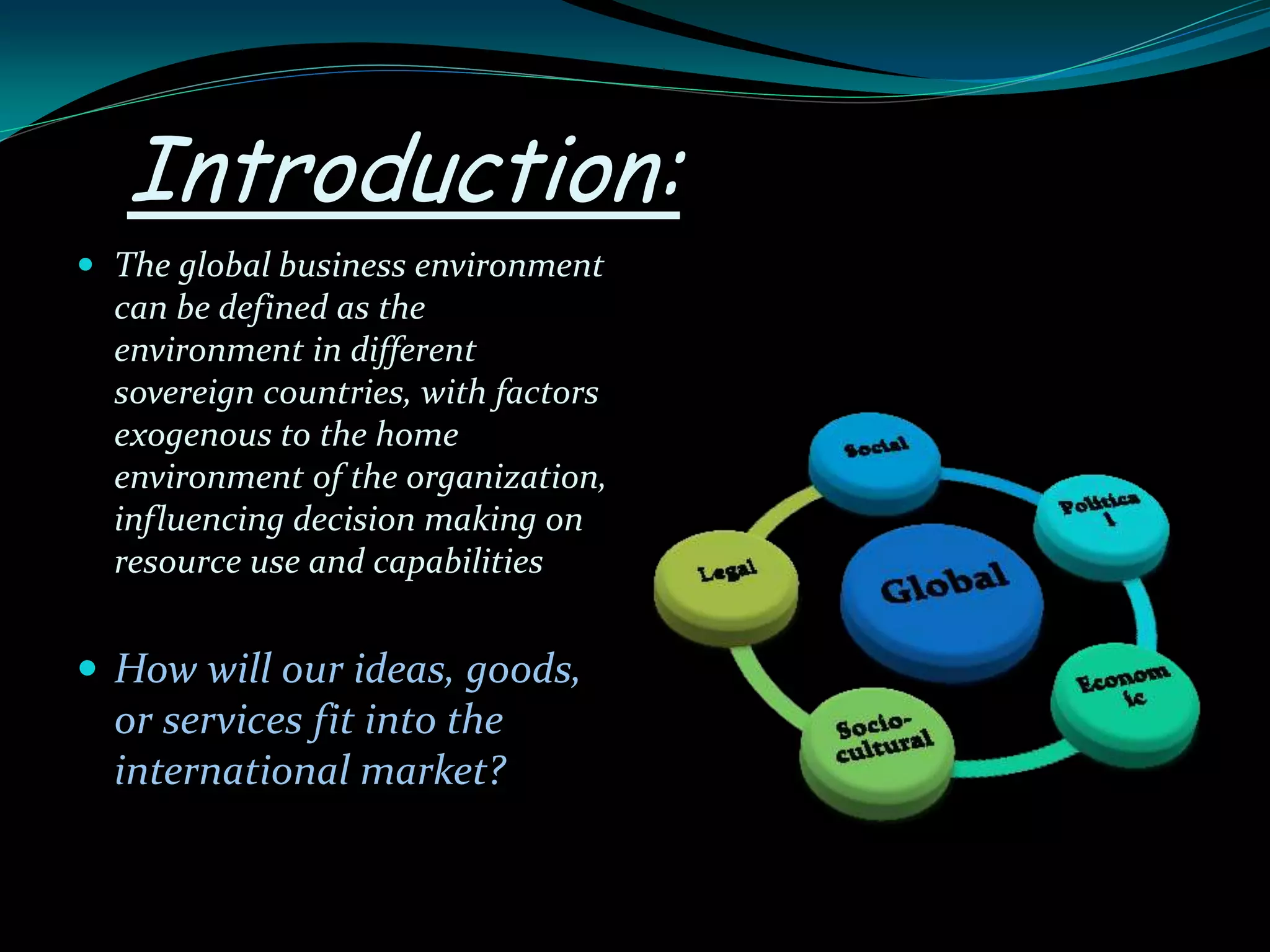
 The global business environment
can be defined as the
environment in different
sovereign countries, with factors
exogenous to the home
environment of the organization,
influencing decision making on
resource use and capabilities
 How will our ideas, goods,
or services fit into the
international market?
1) How will our ideas, goods, or services fit into the
international market?
 Knowledge of other countries, economies & cultures
 Understanding of how global economy works
 Ability to recognize & use ideas from different markets
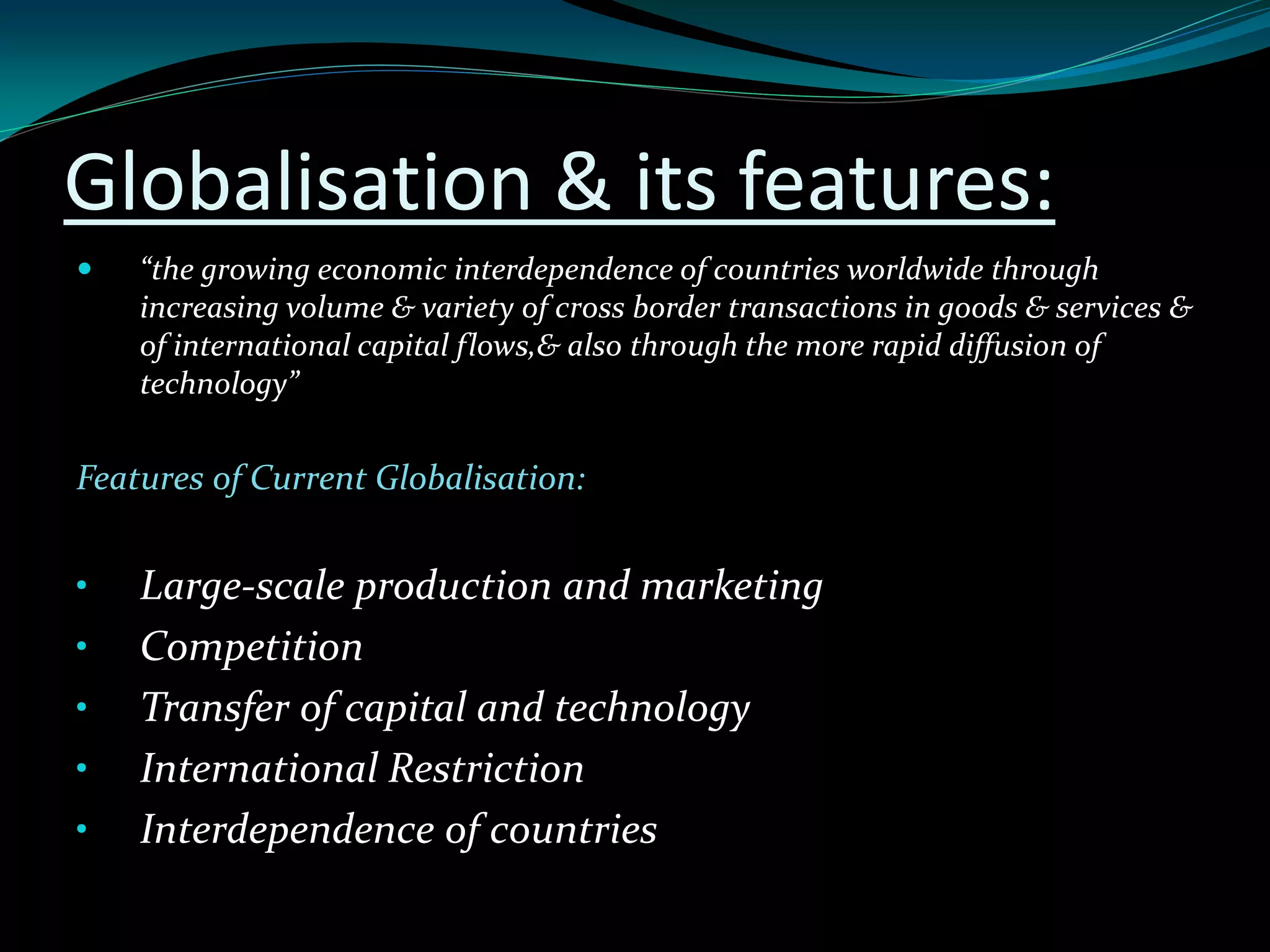
Globalisation & its features:
 “the growing economic interdependence of countries worldwide through
increasing volume & variety of cross border transactions in goods & services &
of international capital flows,& also through the more rapid diffusion of
technology”
Features of Current Globalisation:
• Large-scale production and marketing
• Competition
• Transfer of capital and technology
• International Restriction
• Interdependence of countries
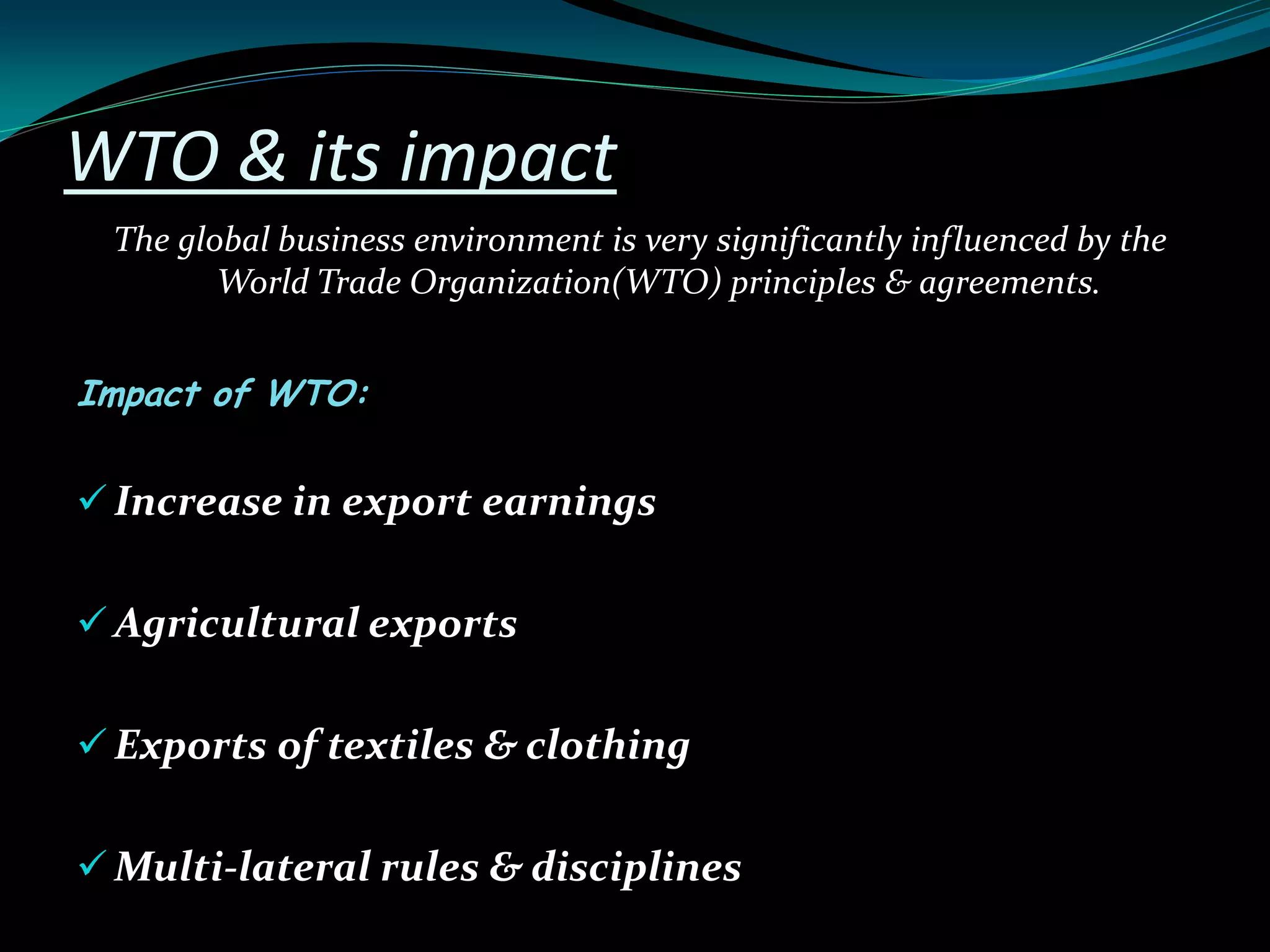
WTO & its impact
The global business environment is very significantly influenced by the
World Trade Organization(WTO) principles & agreements.
Impact of WTO:
 Increase in export earnings
 Agricultural exports
 Exports of textiles & clothing
 Multi-lateral rules & disciplines
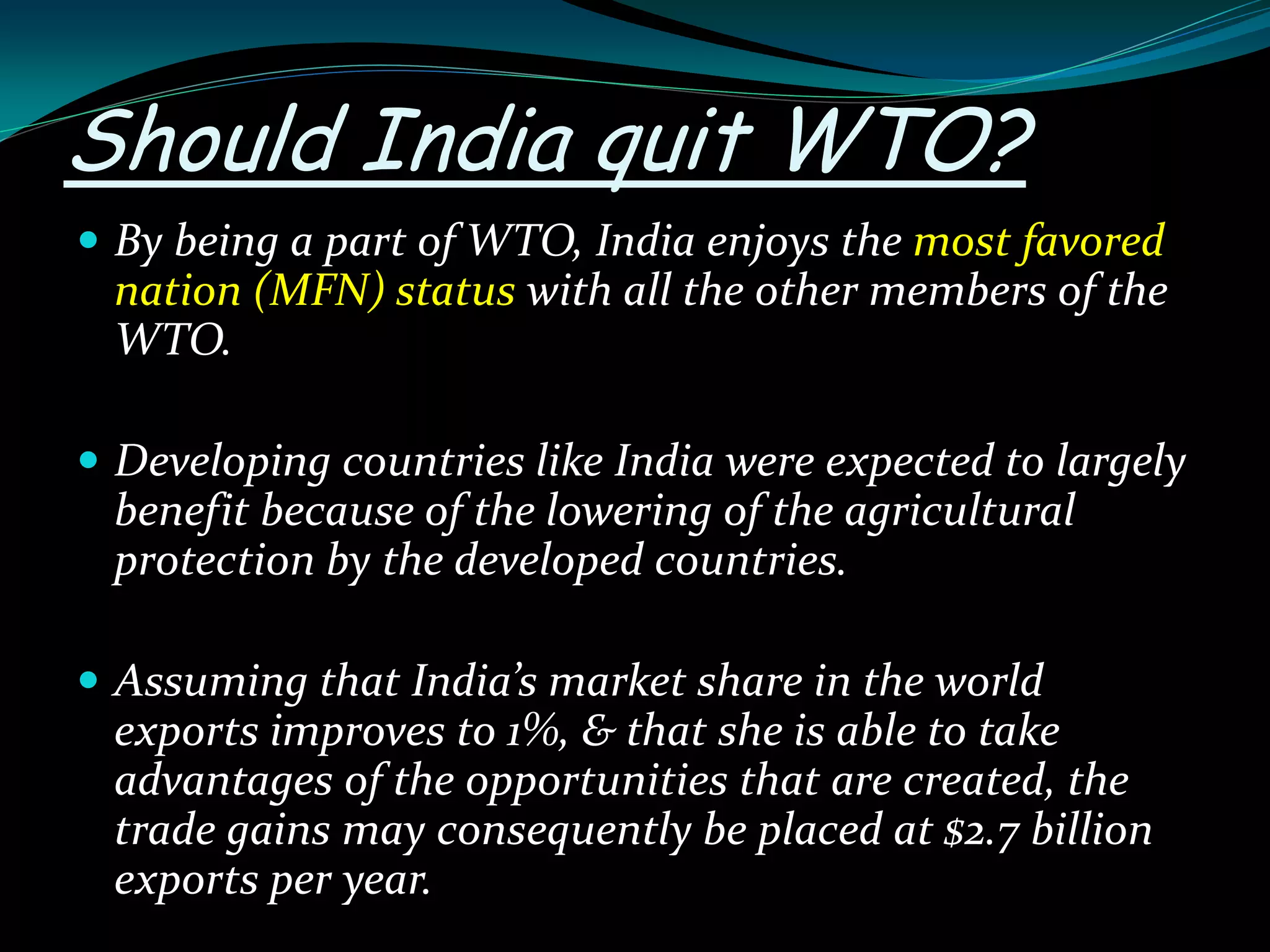
Should India quit WTO?
 By being a part of WTO, India enjoys the most favored
nation (MFN) status with all the other members of the
WTO.
 Developing countries like India were expected to largely
benefit because of the lowering of the agricultural
protection by the developed countries.
 Assuming that India’s market share in the world
exports improves to 1%, & that she is able to take
advantages of the opportunities that are created, the
trade gains may consequently be placed at $2.7 billion
exports per year.
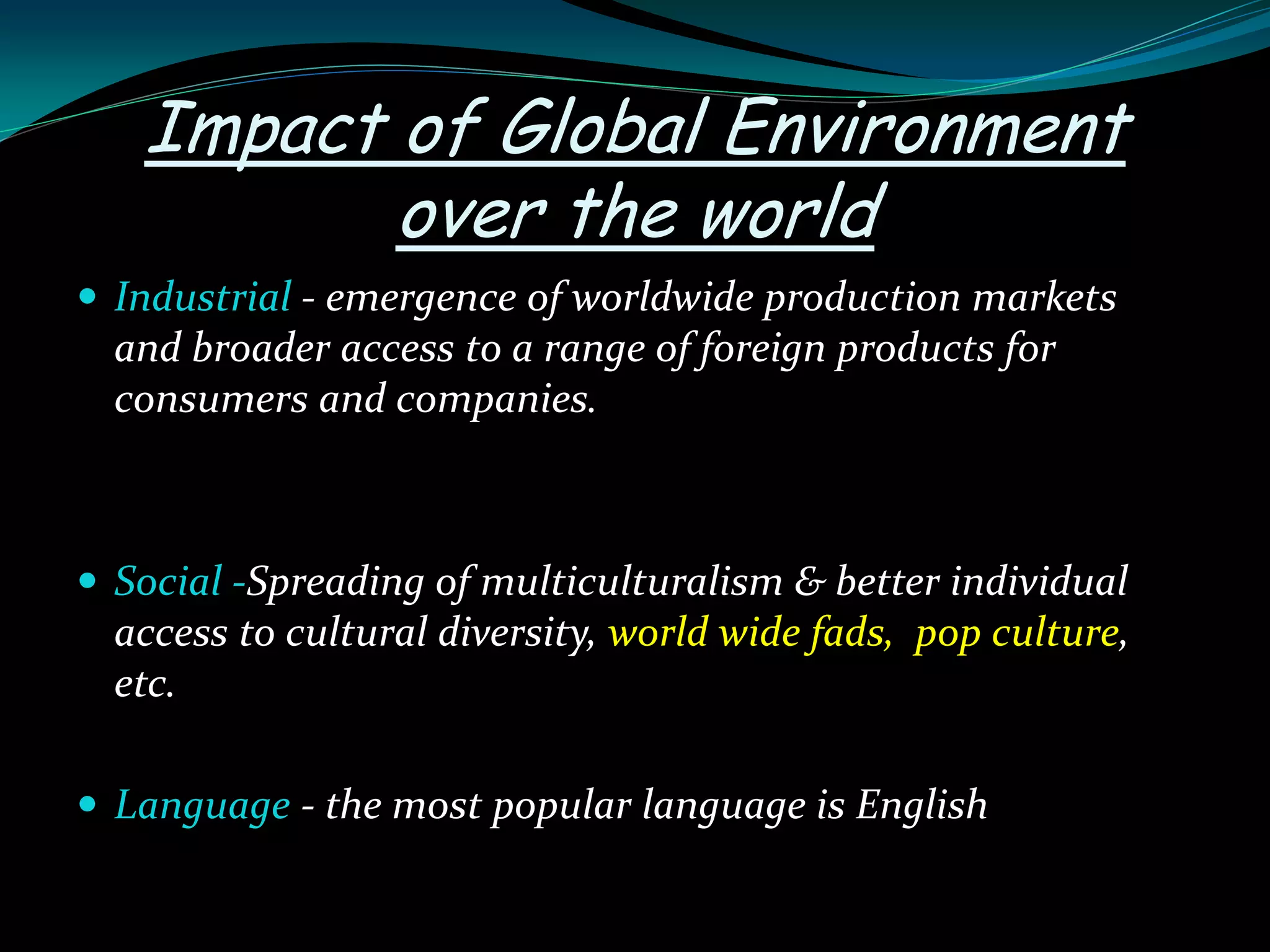
Impact of Global Environment
over the world
 Industrial - emergence of worldwide production markets
and broader access to a range of foreign products for
consumers and companies.
 Social -Spreading of multiculturalism & better individual
access to cultural diversity, world wide fads, pop culture,
etc.
 Language - the most popular language is English
 Informational - increase in information flows between
geographically remote locations.
 Legal/Ethical -Crime importation and raising awareness of
global crime-fighting efforts and cooperation.
 Technical -Development of a global telecommunications
infrastructure and greater transborder data flow, using such
technologies as the Internet, Communication satellites,
submarine fiber optic cable & wireless telephones .
 Political – world government which regulates the
relationships among governments and guarantees the rights
arising from social and economic globalization.
Case Study : Recession in the US
In the US, they gave everyone a chance to own property, even to
those who couldn’t afford it.
On top of that, we all lived in a material world. We wanted
everything we saw on TV & we wanted it at that very moment.
Hence, so many people got into debt. The same applied to the rest
of the world.
There was too much credit being given to those who couldn’t repay
it. The US then started the credit crunch & that gave rise to the
domino effect around Europe & then, the rest of the world.
Conclusion:
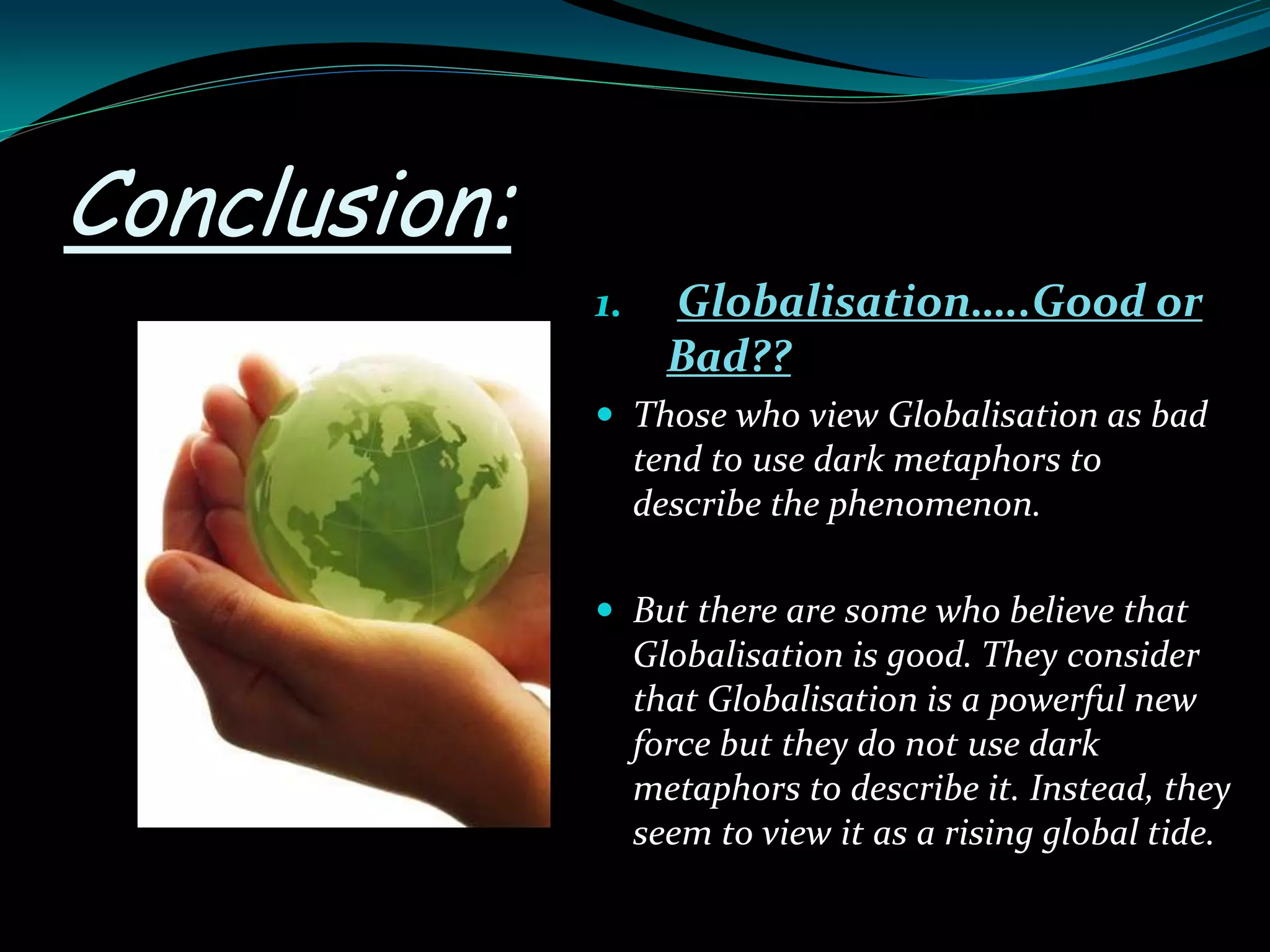
1. Globalisation…..Good or
Bad??
 Those who view Globalisation as bad
tend to use dark metaphors to
describe the phenomenon.
 But there are some who believe that
Globalisation is good. They consider
that Globalisation is a powerful new
force but they do not use dark
metaphors to describe it. Instead, they
seem to view it as a rising global tide.
2.
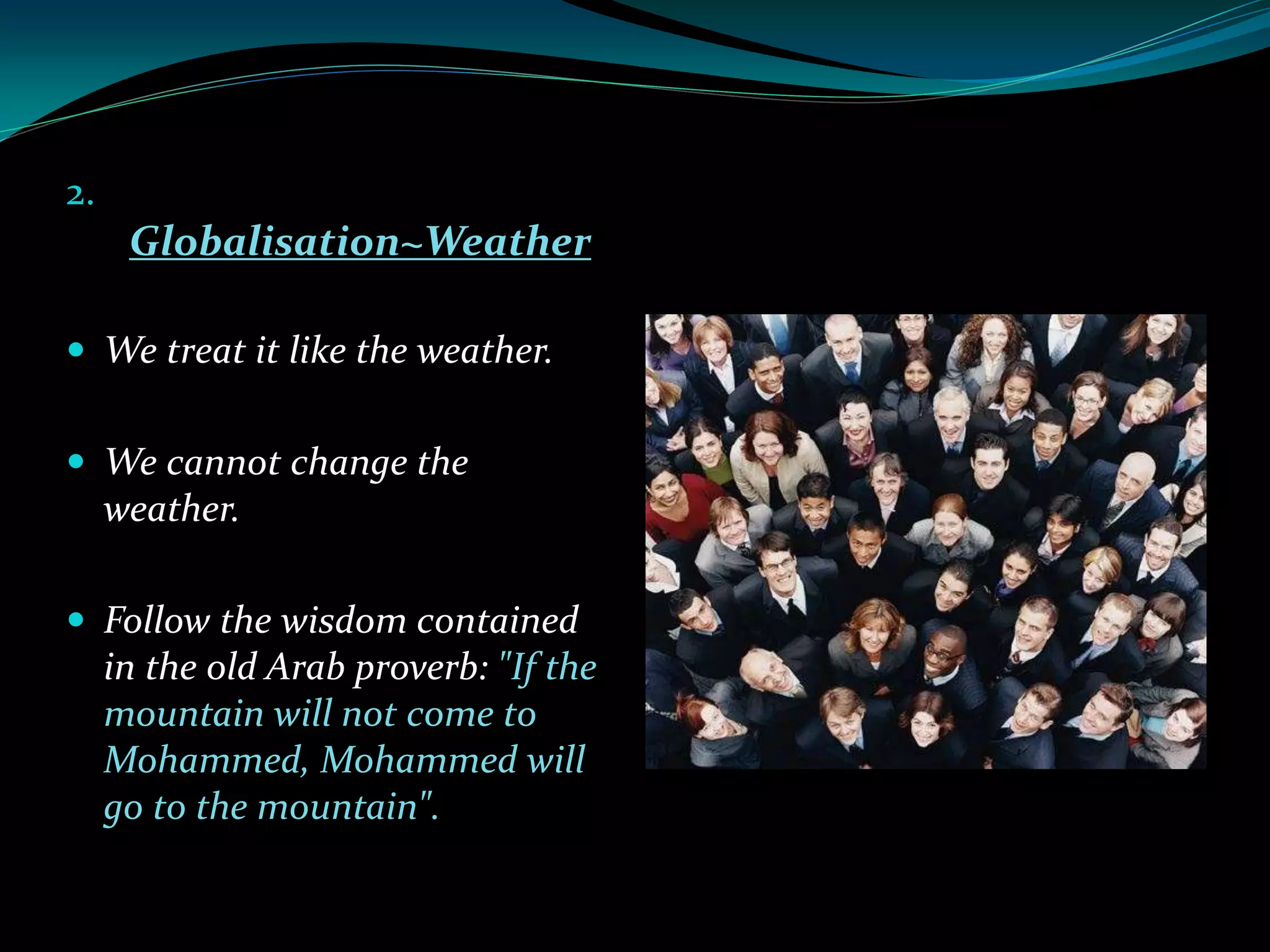
Globalisation~Weather
 We treat it like the weather.
 We cannot change the
weather.
 Follow the wisdom contained
in the old Arab proverb: "If the
mountain will not come to
Mohammed, Mohammed will
go to the mountain".
THANK YOU 

Global Environment

  • 2.
    Contents:  Introduction  Globalisation& its features  WTO & its impact  Impact of Global Environment  Case Study  Conclusion
  • 3.
    Introduction:  The globalbusiness environment can be defined as the environment in different sovereign countries, with factors exogenous to the home environment of the organization, influencing decision making on resource use and capabilities  How will our ideas, goods, or services fit into the international market?
  • 4.
    1) How willour ideas, goods, or services fit into the international market?  Knowledge of other countries, economies & cultures  Understanding of how global economy works  Ability to recognize & use ideas from different markets
  • 5.
    Globalisation & itsfeatures:  “the growing economic interdependence of countries worldwide through increasing volume & variety of cross border transactions in goods & services & of international capital flows,& also through the more rapid diffusion of technology” Features of Current Globalisation: • Large-scale production and marketing • Competition • Transfer of capital and technology • International Restriction • Interdependence of countries
  • 6.
    WTO & itsimpact The global business environment is very significantly influenced by the World Trade Organization(WTO) principles & agreements. Impact of WTO:  Increase in export earnings  Agricultural exports  Exports of textiles & clothing  Multi-lateral rules & disciplines
  • 7.
    Should India quitWTO?  By being a part of WTO, India enjoys the most favored nation (MFN) status with all the other members of the WTO.  Developing countries like India were expected to largely benefit because of the lowering of the agricultural protection by the developed countries.  Assuming that India’s market share in the world exports improves to 1%, & that she is able to take advantages of the opportunities that are created, the trade gains may consequently be placed at $2.7 billion exports per year.
  • 8.
    Impact of GlobalEnvironment over the world  Industrial - emergence of worldwide production markets and broader access to a range of foreign products for consumers and companies.  Social -Spreading of multiculturalism & better individual access to cultural diversity, world wide fads, pop culture, etc.  Language - the most popular language is English
  • 9.
     Informational -increase in information flows between geographically remote locations.  Legal/Ethical -Crime importation and raising awareness of global crime-fighting efforts and cooperation.  Technical -Development of a global telecommunications infrastructure and greater transborder data flow, using such technologies as the Internet, Communication satellites, submarine fiber optic cable & wireless telephones .  Political – world government which regulates the relationships among governments and guarantees the rights arising from social and economic globalization.
  • 10.
    Case Study :Recession in the US In the US, they gave everyone a chance to own property, even to those who couldn’t afford it. On top of that, we all lived in a material world. We wanted everything we saw on TV & we wanted it at that very moment. Hence, so many people got into debt. The same applied to the rest of the world. There was too much credit being given to those who couldn’t repay it. The US then started the credit crunch & that gave rise to the domino effect around Europe & then, the rest of the world.
  • 11.
    Conclusion: 1. Globalisation…..Good or Bad?? Those who view Globalisation as bad tend to use dark metaphors to describe the phenomenon.  But there are some who believe that Globalisation is good. They consider that Globalisation is a powerful new force but they do not use dark metaphors to describe it. Instead, they seem to view it as a rising global tide.
  • 12.
    2. Globalisation~Weather  We treatit like the weather.  We cannot change the weather.  Follow the wisdom contained in the old Arab proverb: "If the mountain will not come to Mohammed, Mohammed will go to the mountain".
  • 13.