A z A o l b g
o
i t n l i
g l o b a l I Z A T I N
O
m e o c y o n
e c o n o m y
m e o c y o n
A r e e d f r
e t
A r e e d f r
e t
e
f r e e t r a d
t l c r e u u
c u l t u r e
At the end of this lesson, the
students should be able to;
Differentiate the competing
conceptions of globalization;
Identify the underlying
philosophies of the varying
definitions of globalization;
and
Agree on a working definition
of globalization for the course.
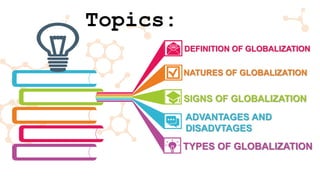
DEFINITION OF GLOBALIZATION
NATURES OF GLOBALIZATION
ADVANTAGES AND
DISADVTAGES
TYPES OF GLOBALIZATION
SIGNS OF GLOBALIZATION
Topics:
GLOBALIZATION
 is a term used to describe the
changes in societies and the world
economy that are the result of
dramatically increase trade and
cultural exchange.
 Refers almost exclusively to the
effects of trade, particularly trade
liberalization or “free trade” .
Definition
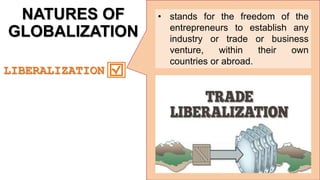
NATURES OF
GLOBALIZATION
• stands for the freedom of the
entrepreneurs to establish any
industry or trade or business
venture, within their own
countries or abroad.
. LIBERALIZATION
NATURES OF
GLOBALIZATION
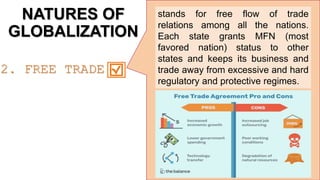
stands for free flow of trade
relations among all the nations.
Each state grants MFN (most
favored nation) status to other
states and keeps its business and
trade away from excessive and hard
regulatory and protective regimes.
2. FREE TRADE
NATURES OF
GLOBALIZATION
Economic activities are be governed
both by the domestic market and
also the world market. It stands for
the process of integrating the
domestic economy with world
economies.
Globalization of
economic activity
NATURES OF
GLOBALIZATION
stands for liberating the import-
export activity and securing a
free flow of goods and services
across borders.
Liberalization
f import-export
system
NATURES OF
GLOBALIZATION
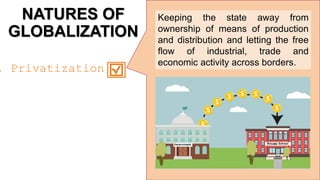
Keeping the state away from
ownership of means of production
and distribution and letting the free
flow of industrial, trade and
economic activity across borders.
. Privatization
NATURES OF
GLOBALIZATION
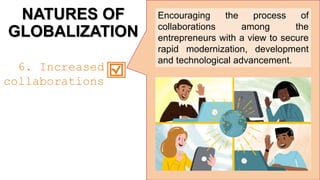
Encouraging the process of
collaborations among the
entrepreneurs with a view to secure
rapid modernization, development
and technological advancement.
6. Increased
collaborations
NATURES OF
GLOBALIZATION
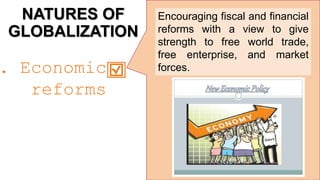
Encouraging fiscal and financial
reforms with a view to give
strength to free world trade,
free enterprise, and market
forces.
. Economic
reforms
SIGNS OF
GLOBALIZATION
1. Increase in international trade at a
faster rate than the growth in the
world economy.
2. Increase in international flow of capital
including foreign direct investment.
3. Greater trans-border data flow, using
such technologies such as the
Internet,
4. Greater international cultural
exchange, for example through the
export of Hollywood and Bollywood
movies.
5. Some argue that even terrorism had
undergone globalization. Terrorists
now have attacked places all over the
world.
SIGNS OF
GLOBALIZATION
6. Spreading of multiculturalism and better
individual access to cultural diversity,
with on the other hand, some reduction
in diversity through assimilation,
hybridization, Westernization,
Americanization or Sinosization of
cultures.
7. Erosion of national sovereignty and
national borders through international
agreements leading to organizations
like the WTO and OPEC.
8. Greater international travel and tourism.
9. Greater immigration, including illegal
immigration.
10.Development of global
telecommunications infrastructure.
SIGNS OF
GLOBALIZATION
11.Development of a global
financial systems.
12.Increase in the share of the
world economy controlled by
multinational corporations.
13.Increased role of international
organizations such as WTO,
WIPO, IMF that deal with
international transactions.
14.Increase in the number of
standards applied globally; e.g.
copyright laws.
How globalized
is the
Philippines?
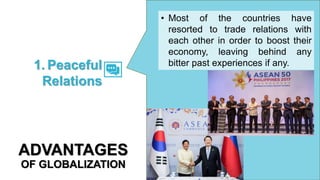
• Most of the countries have
resorted to trade relations with
each other in order to boost their
economy, leaving behind any
bitter past experiences if any.
1. Peaceful
Relations
ADVANTAGES
OF GLOBALIZATION
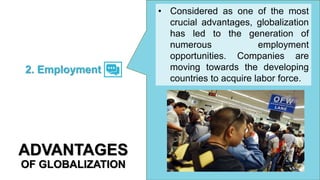
• Considered as one of the most
crucial advantages, globalization
has led to the generation of
numerous employment
opportunities. Companies are
moving towards the developing
countries to acquire labor force.
2. Employment
ADVANTAGES
OF GLOBALIZATION
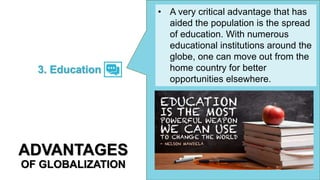
• A very critical advantage that has
aided the population is the spread
of education. With numerous
educational institutions around the
globe, one can move out from the
home country for better
opportunities elsewhere.
3. Education
ADVANTAGES
OF GLOBALIZATION
• The product quality has been
enhanced so as retain the
customers. Today the customers
may compromise with the price
range but not with the quality of
the product. Low or poor quality
can adversely affect consumer
satisfaction.
4. Product Quality
ADVANTAGES
OF GLOBALIZATION
• Globalization has
brought in fierce
competition in the
markets.
5. Cheaper Prices
ADVANTAGES
OF GLOBALIZATION
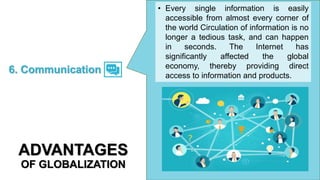
• Every single information is easily
accessible from almost every corner of
the world Circulation of information is no
longer a tedious task, and can happen
in seconds. The Internet has
significantly affected the global
economy, thereby providing direct
access to information and products.
6. Communication
ADVANTAGES
OF GLOBALIZATION
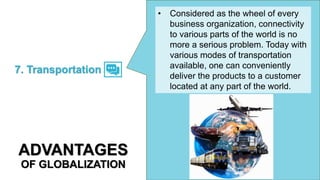
• Considered as the wheel of every
business organization, connectivity
to various parts of the world is no
more a serious problem. Today with
various modes of transportation
available, one can conveniently
deliver the products to a customer
located at any part of the world.
7. Transportation
ADVANTAGES
OF GLOBALIZATION
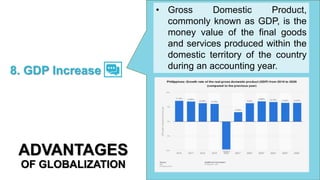
• Gross Domestic Product,
commonly known as GDP, is the
money value of the final goods
and services produced within the
domestic territory of the country
during an accounting year.
8. GDP Increase
ADVANTAGES
OF GLOBALIZATION
• Free Trade is a policy in which a country
does not levy taxes, duties, subsidies or
quota on the import/export of goods or
services from other countries. There are
countries which have resolved to free
trade in specific trade in specific
regions. This allows consumers to buy
goods and services, comparatively at a
lower cost.
9. Free Trade
ADVANTAGES
OF GLOBALIZATION
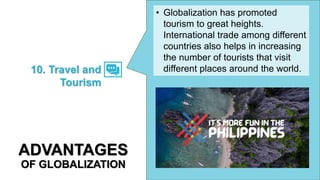
• Globalization has promoted
tourism to great heights.
International trade among different
countries also helps in increasing
the number of tourists that visit
different places around the world.
10. Travel and
Tourism
ADVANTAGES
OF GLOBALIZATION
• With the help of globalization,
there is opportunity for corporate,
national, and sub-national
borrowers to have better access
to external finance, with facilities
such as external commercial
borrowing and syndicated loans.
11. External
Borrowing
ADVANTAGES
OF GLOBALIZATION
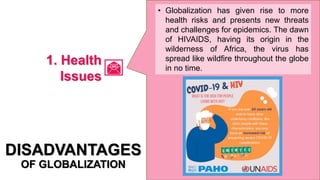
• Globalization has given rise to more
health risks and presents new threats
and challenges for epidemics. The dawn
of HIVAIDS, having its origin in the
wilderness of Africa, the virus has
spread like wildfire throughout the globe
in no time.
DISADVANTAGES
OF GLOBALIZATION
1. Health
Issues
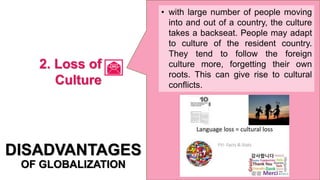
• with large number of people moving
into and out of a country, the culture
takes a backseat. People may adapt
to culture of the resident country.
They tend to follow the foreign
culture more, forgetting their own
roots. This can give rise to cultural
conflicts.
DISADVANTAGES
OF GLOBALIZATION
2. Loss of
Culture
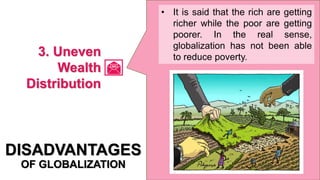
• It is said that the rich are getting
richer while the poor are getting
poorer. In the real sense,
globalization has not been able
to reduce poverty.
DISADVANTAGES
OF GLOBALIZATION
3. Uneven
Wealth
Distribution
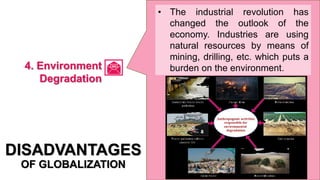
• The industrial revolution has
changed the outlook of the
economy. Industries are using
natural resources by means of
mining, drilling, etc. which puts a
burden on the environment.
DISADVANTAGES
OF GLOBALIZATION
4. Environment
Degradation
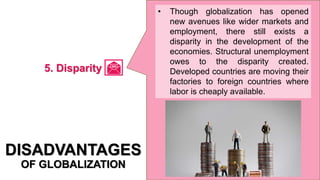
• Though globalization has opened
new avenues like wider markets and
employment, there still exists a
disparity in the development of the
economies. Structural unemployment
owes to the disparity created.
Developed countries are moving their
factories to foreign countries where
labor is cheaply available.
DISADVANTAGES
OF GLOBALIZATION
5. Disparity
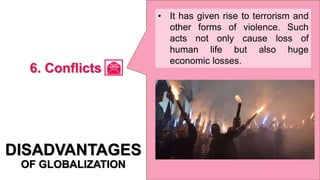
• It has given rise to terrorism and
other forms of violence. Such
acts not only cause loss of
human life but also huge
economic losses.
DISADVANTAGES
OF GLOBALIZATION
6. Conflicts
• Opening the doors of international
trade has given birth to intense
competition. This has affected the
local markets dramatically. The local
players thereby suffer huge losses as
they lack the potential to advertise or
export their products on a large
scale. Therefore, the domestic
markets shrink.
DISADVANTAGES
OF GLOBALIZATION
7. Cut-throat
Competition
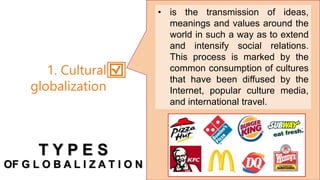
• is the transmission of ideas,
meanings and values around the
world in such a way as to extend
and intensify social relations.
This process is marked by the
common consumption of cultures
that have been diffused by the
Internet, popular culture media,
and international travel.
1. Cultural
globalization
T Y P E S
OF G L O B A L I Z A T I O N
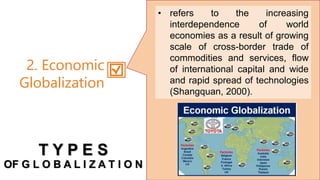
• refers to the increasing
interdependence of world
economies as a result of growing
scale of cross-border trade of
commodities and services, flow
of international capital and wide
and rapid spread of technologies
(Shangquan, 2000).
2. Economic
Globalization
T Y P E S
OF G L O B A L I Z A T I O N
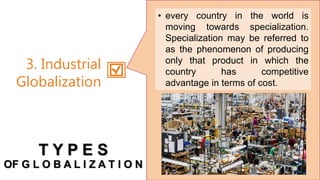
• every country in the world is
moving towards specialization.
Specialization may be referred to
as the phenomenon of producing
only that product in which the
country has competitive
advantage in terms of cost.
3. Industrial
Globalization
T Y P E S
OF G L O B A L I Z A T I O N
• it may be defined as the emergence of
worldwide financial markets and better
access to external financing for
corporate, national and sub-national
borrowers. Some projects in the
Philippines were sponsored by foreign
investors. They may be in the form of
international organizations of
independent investors.
4. Financial
Globalization
T Y P E S
OF G L O B A L I Z A T I O N
• This aspect of Globalization has
perhaps had the greatest impact on
the world today. Sitting at one end of
the world, you can have access to the
information available in any other part
of the world with just the push of a
button, Internet, television, telephone,
fax, etc. are some of the inventions
that may be considered as a part of
the informational Globalization
process where the information flow
has dramatically increased between
geographically remote areas of the
world.
5. Informational
Globalization
T Y P E S
OF G L O B A L I Z A T I O N
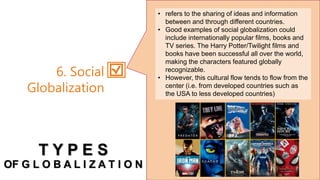
• refers to the sharing of ideas and information
between and through different countries.
• Good examples of social globalization could
include internationally popular films, books and
TV series. The Harry Potter/Twilight films and
books have been successful all over the world,
making the characters featured globally
recognizable.
• However, this cultural flow tends to flow from the
center (i.e. from developed countries such as
the USA to less developed countries)
6. Social
Globalization
T Y P E S
OF G L O B A L I Z A T I O N
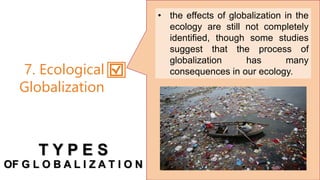
• the effects of globalization in the
ecology are still not completely
identified, though some studies
suggest that the process of
globalization has many
consequences in our ecology.
7. Ecological
Globalization
T Y P E S
OF G L O B A L I Z A T I O N
• Through globalization, political
issues such as the rights of
women and children are now
currently discussed, many laws
are now already implemented
regarding the issues on the rights
of women and children.
8. Globalization
and
the Politics
T Y P E S
OF G L O B A L I Z A T I O N
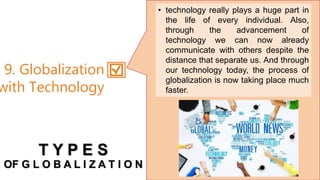
• technology really plays a huge part in
the life of every individual. Also,
through the advancement of
technology we can now already
communicate with others despite the
distance that separate us. And through
our technology today, the process of
globalization is now taking place much
faster.
9. Globalization
with Technology
T Y P E S
OF G L O B A L I Z A T I O N
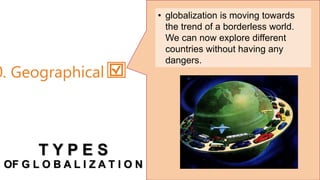
• globalization is moving towards
the trend of a borderless world.
We can now explore different
countries without having any
dangers.
0. Geographical
T Y P E S
OF G L O B A L I Z A T I O N

Module 1.pptx

  • 3.
    A z Ao l b g o i t n l i
  • 4.
    g l ob a l I Z A T I N O
  • 5.
    m e oc y o n
  • 6.
    e c on o m y m e o c y o n
  • 7.
    A r ee d f r e t
  • 8.
    A r ee d f r e t e f r e e t r a d
  • 9.
    t l cr e u u
  • 10.
    c u lt u r e
  • 11.
    At the endof this lesson, the students should be able to; Differentiate the competing conceptions of globalization; Identify the underlying philosophies of the varying definitions of globalization; and Agree on a working definition of globalization for the course.
  • 12.
    DEFINITION OF GLOBALIZATION NATURESOF GLOBALIZATION ADVANTAGES AND DISADVTAGES TYPES OF GLOBALIZATION SIGNS OF GLOBALIZATION Topics:
  • 13.
    GLOBALIZATION  is aterm used to describe the changes in societies and the world economy that are the result of dramatically increase trade and cultural exchange.  Refers almost exclusively to the effects of trade, particularly trade liberalization or “free trade” . Definition
  • 14.
    NATURES OF GLOBALIZATION • standsfor the freedom of the entrepreneurs to establish any industry or trade or business venture, within their own countries or abroad. . LIBERALIZATION
  • 15.
    NATURES OF GLOBALIZATION stands forfree flow of trade relations among all the nations. Each state grants MFN (most favored nation) status to other states and keeps its business and trade away from excessive and hard regulatory and protective regimes. 2. FREE TRADE
  • 16.
    NATURES OF GLOBALIZATION Economic activitiesare be governed both by the domestic market and also the world market. It stands for the process of integrating the domestic economy with world economies. Globalization of economic activity
  • 17.
    NATURES OF GLOBALIZATION stands forliberating the import- export activity and securing a free flow of goods and services across borders. Liberalization f import-export system
  • 18.
    NATURES OF GLOBALIZATION Keeping thestate away from ownership of means of production and distribution and letting the free flow of industrial, trade and economic activity across borders. . Privatization
  • 19.
    NATURES OF GLOBALIZATION Encouraging theprocess of collaborations among the entrepreneurs with a view to secure rapid modernization, development and technological advancement. 6. Increased collaborations
  • 20.
    NATURES OF GLOBALIZATION Encouraging fiscaland financial reforms with a view to give strength to free world trade, free enterprise, and market forces. . Economic reforms
  • 21.
    SIGNS OF GLOBALIZATION 1. Increasein international trade at a faster rate than the growth in the world economy. 2. Increase in international flow of capital including foreign direct investment. 3. Greater trans-border data flow, using such technologies such as the Internet, 4. Greater international cultural exchange, for example through the export of Hollywood and Bollywood movies. 5. Some argue that even terrorism had undergone globalization. Terrorists now have attacked places all over the world.
  • 22.
    SIGNS OF GLOBALIZATION 6. Spreadingof multiculturalism and better individual access to cultural diversity, with on the other hand, some reduction in diversity through assimilation, hybridization, Westernization, Americanization or Sinosization of cultures. 7. Erosion of national sovereignty and national borders through international agreements leading to organizations like the WTO and OPEC. 8. Greater international travel and tourism. 9. Greater immigration, including illegal immigration. 10.Development of global telecommunications infrastructure.
  • 23.
    SIGNS OF GLOBALIZATION 11.Development ofa global financial systems. 12.Increase in the share of the world economy controlled by multinational corporations. 13.Increased role of international organizations such as WTO, WIPO, IMF that deal with international transactions. 14.Increase in the number of standards applied globally; e.g. copyright laws.
  • 24.
  • 25.
    • Most ofthe countries have resorted to trade relations with each other in order to boost their economy, leaving behind any bitter past experiences if any. 1. Peaceful Relations ADVANTAGES OF GLOBALIZATION
  • 26.
    • Considered asone of the most crucial advantages, globalization has led to the generation of numerous employment opportunities. Companies are moving towards the developing countries to acquire labor force. 2. Employment ADVANTAGES OF GLOBALIZATION
  • 27.
    • A verycritical advantage that has aided the population is the spread of education. With numerous educational institutions around the globe, one can move out from the home country for better opportunities elsewhere. 3. Education ADVANTAGES OF GLOBALIZATION
  • 28.
    • The productquality has been enhanced so as retain the customers. Today the customers may compromise with the price range but not with the quality of the product. Low or poor quality can adversely affect consumer satisfaction. 4. Product Quality ADVANTAGES OF GLOBALIZATION
  • 29.
    • Globalization has broughtin fierce competition in the markets. 5. Cheaper Prices ADVANTAGES OF GLOBALIZATION
  • 30.
    • Every singleinformation is easily accessible from almost every corner of the world Circulation of information is no longer a tedious task, and can happen in seconds. The Internet has significantly affected the global economy, thereby providing direct access to information and products. 6. Communication ADVANTAGES OF GLOBALIZATION
  • 31.
    • Considered asthe wheel of every business organization, connectivity to various parts of the world is no more a serious problem. Today with various modes of transportation available, one can conveniently deliver the products to a customer located at any part of the world. 7. Transportation ADVANTAGES OF GLOBALIZATION
  • 32.
    • Gross DomesticProduct, commonly known as GDP, is the money value of the final goods and services produced within the domestic territory of the country during an accounting year. 8. GDP Increase ADVANTAGES OF GLOBALIZATION
  • 33.
    • Free Tradeis a policy in which a country does not levy taxes, duties, subsidies or quota on the import/export of goods or services from other countries. There are countries which have resolved to free trade in specific trade in specific regions. This allows consumers to buy goods and services, comparatively at a lower cost. 9. Free Trade ADVANTAGES OF GLOBALIZATION
  • 34.
    • Globalization haspromoted tourism to great heights. International trade among different countries also helps in increasing the number of tourists that visit different places around the world. 10. Travel and Tourism ADVANTAGES OF GLOBALIZATION
  • 35.
    • With thehelp of globalization, there is opportunity for corporate, national, and sub-national borrowers to have better access to external finance, with facilities such as external commercial borrowing and syndicated loans. 11. External Borrowing ADVANTAGES OF GLOBALIZATION
  • 36.
    • Globalization hasgiven rise to more health risks and presents new threats and challenges for epidemics. The dawn of HIVAIDS, having its origin in the wilderness of Africa, the virus has spread like wildfire throughout the globe in no time. DISADVANTAGES OF GLOBALIZATION 1. Health Issues
  • 37.
    • with largenumber of people moving into and out of a country, the culture takes a backseat. People may adapt to culture of the resident country. They tend to follow the foreign culture more, forgetting their own roots. This can give rise to cultural conflicts. DISADVANTAGES OF GLOBALIZATION 2. Loss of Culture
  • 38.
    • It issaid that the rich are getting richer while the poor are getting poorer. In the real sense, globalization has not been able to reduce poverty. DISADVANTAGES OF GLOBALIZATION 3. Uneven Wealth Distribution
  • 39.
    • The industrialrevolution has changed the outlook of the economy. Industries are using natural resources by means of mining, drilling, etc. which puts a burden on the environment. DISADVANTAGES OF GLOBALIZATION 4. Environment Degradation
  • 40.
    • Though globalizationhas opened new avenues like wider markets and employment, there still exists a disparity in the development of the economies. Structural unemployment owes to the disparity created. Developed countries are moving their factories to foreign countries where labor is cheaply available. DISADVANTAGES OF GLOBALIZATION 5. Disparity
  • 41.
    • It hasgiven rise to terrorism and other forms of violence. Such acts not only cause loss of human life but also huge economic losses. DISADVANTAGES OF GLOBALIZATION 6. Conflicts
  • 42.
    • Opening thedoors of international trade has given birth to intense competition. This has affected the local markets dramatically. The local players thereby suffer huge losses as they lack the potential to advertise or export their products on a large scale. Therefore, the domestic markets shrink. DISADVANTAGES OF GLOBALIZATION 7. Cut-throat Competition
  • 43.
    • is thetransmission of ideas, meanings and values around the world in such a way as to extend and intensify social relations. This process is marked by the common consumption of cultures that have been diffused by the Internet, popular culture media, and international travel. 1. Cultural globalization T Y P E S OF G L O B A L I Z A T I O N
  • 44.
    • refers tothe increasing interdependence of world economies as a result of growing scale of cross-border trade of commodities and services, flow of international capital and wide and rapid spread of technologies (Shangquan, 2000). 2. Economic Globalization T Y P E S OF G L O B A L I Z A T I O N
  • 45.
    • every countryin the world is moving towards specialization. Specialization may be referred to as the phenomenon of producing only that product in which the country has competitive advantage in terms of cost. 3. Industrial Globalization T Y P E S OF G L O B A L I Z A T I O N

  • 46.
    • it maybe defined as the emergence of worldwide financial markets and better access to external financing for corporate, national and sub-national borrowers. Some projects in the Philippines were sponsored by foreign investors. They may be in the form of international organizations of independent investors. 4. Financial Globalization T Y P E S OF G L O B A L I Z A T I O N
  • 47.
    • This aspectof Globalization has perhaps had the greatest impact on the world today. Sitting at one end of the world, you can have access to the information available in any other part of the world with just the push of a button, Internet, television, telephone, fax, etc. are some of the inventions that may be considered as a part of the informational Globalization process where the information flow has dramatically increased between geographically remote areas of the world. 5. Informational Globalization T Y P E S OF G L O B A L I Z A T I O N
  • 48.
    • refers tothe sharing of ideas and information between and through different countries. • Good examples of social globalization could include internationally popular films, books and TV series. The Harry Potter/Twilight films and books have been successful all over the world, making the characters featured globally recognizable. • However, this cultural flow tends to flow from the center (i.e. from developed countries such as the USA to less developed countries) 6. Social Globalization T Y P E S OF G L O B A L I Z A T I O N
  • 49.
    • the effectsof globalization in the ecology are still not completely identified, though some studies suggest that the process of globalization has many consequences in our ecology. 7. Ecological Globalization T Y P E S OF G L O B A L I Z A T I O N
  • 50.
    • Through globalization,political issues such as the rights of women and children are now currently discussed, many laws are now already implemented regarding the issues on the rights of women and children. 8. Globalization and the Politics T Y P E S OF G L O B A L I Z A T I O N
  • 51.
    • technology reallyplays a huge part in the life of every individual. Also, through the advancement of technology we can now already communicate with others despite the distance that separate us. And through our technology today, the process of globalization is now taking place much faster. 9. Globalization with Technology T Y P E S OF G L O B A L I Z A T I O N
  • 52.
    • globalization ismoving towards the trend of a borderless world. We can now explore different countries without having any dangers. 0. Geographical T Y P E S OF G L O B A L I Z A T I O N

Editor's Notes

  • #2 Introduce yourself Discuss the course, grading system, classroom rules
  • #14 Globalization is the word used to describe the growing interdependence of the world's economies, cultures, and populations, brought about by cross-border trade in goods and services, technology, and flows of investment, people, and information.
  • #15 Rice Tariffication Law (RTL) or Republic Act (RA) 11203. An Act Liberalizing the Importation, Exportation and Trading of Rice, Lifting for the Purpose the Quantitative Import Restriction on Rice, and For Other Purposes Thailand and Vietnam sell at very low prices against which local farmers cannot compete.
  • #16 Rice Tariffication Law (RTL) or Republic Act (RA) 11203. An Act Liberalizing the Importation, Exportation and Trading of Rice, Lifting for the Purpose the Quantitative Import Restriction on Rice, and For Other Purposes Thailand and Vietnam sell at very low prices against which local farmers cannot compete.
  • #17 Those steps related to the consumption of goods and services and activities in which money is exchanged for a product or service Non-economic activities are conducted voluntarily i.e. bagyo, pandemic, just like what I am doing
  • #19 Philippine Long Distance Telephone Company, Petron, Philippine Airlines,
  • #20 the changes introduced by the government to bring an improvement in the economy of a country through various reforms and policies
  • #21 the changes introduced by the government to bring an improvement in the economy of a country through various reforms and policies There is no constant in this world except change.
  • #22 International trade – an exchange involving a good or service conducted between at least two different countries. Borrowing money or investing  the transfer of data across a national border by anyone of a variety of media. Netflix, Kdrama Globalization is not responsible for terrorism, but misuse of technologies associated with it has aggravated the intensity and scope of terrorism.
  • #23 6. 7. Sovereignity – refers to status of a country as an independent nation WORLD TRADE ORGANIZATION & ORGANIZATION OF THE PETRELEUM EXPORTING COUNTRIES responsible for the global trade
  • #24 11. the International Monetary Fund, central banks, government treasuries and monetary authorities, the World Bank, and major private international banks. 12.  business organ- ization whose activities are located in more than two countries and is the organizational form that defines foreign direct investment.  13. WORLD INTELLECTUAL PROPERTY ORGANIZATION provides free of charge access to legal information INTERNATIONAL MONETARY FUND secure financial stability 14. HTML, HTTP, A, AA batteries, electric power 110v and 220v, paper sizes
  • #25 OFW Least most globalized
  • #26 Asean
  • #27 OFW – considered as economic heroes because of the remittances top 5 economies who benefit from remittances
  • #28 Exchange student
  • #29 Allowing foreign imports increases competition, which forces innovation in order for companies to stay in demand.
  • #30 Made in china
  • #31 Who owns the Internet?
  • #32 Shoppee, Lazada, J&T
  • #33 Goods (cars, clothes) Services (doctors, hair dresser) Income
  • #35 10.5%
  • #36 It refers to money borrowed from a source outside the country
  • #42 Economic Gain, Philippine drug war Territorial Gain Religion Nationalism Revenge Civil War Revolutionary War Defensive War
  • #43 Mcdonalds vs burger king Coke vs pepsi
  • #44 Everywhere in the world Mcdonalds, levis, nike, phones , foods, language, music
  • #45 Trade, transportation, communication trade liberations protectionism We depend on each other Car – it came from different countries
  • #46 Philippine Long Distance Telephone Company, Petron, Philippine Airlines,
  • #47 IMF – United nations 190 countries World bank – 180 member countries represented by a Board of governors and a Washington Board of directors.
  • #48 Philippine Long Distance Telephone Company, Petron, Philippine Airlines,
  • #49 Spiderman no way home
  • #50 The planet must be treated as a single ecological system (ecosystem) rather than a collection of separate ecological systems population growth. - access to food. - worldwide reduction in biodiversity. - the gap between rich and poor. Ozone depletion, global warming impacts
  • #51 Expansion of political interest to the regions and other countries
  • #52 the increasing speed of technological diffusion across the global economy. It refers to the spread of technologies around the globe, and particularly from developed to developing nations.
  • #53 set of processes (economic, social, cultural, technological, institutional) that contribute to the relationship between societies and individuals around the world.