{
Optogenetics
A Brief Recap
• Optogenetics is a technique which allows researchers to turn certain
regions of the brain on and off without damaging their function in the
long term
• This has been a major breakthrough in the field of Neuroscience as it has
advantages over previous techniques of studying brain function:
• Loss of function studies using lesions resulted in permanent
damage to brain tissue and little re-usability of test animals
• Stimulation of brain areas with electrodes were limited by the
inability to target single cells or specific cell type populations
How Does It Work?
• The genes for light-activated ion
channels are introduced to a
population of cells by a human
engineered virus
• Which cells express these light-
sensitive channels depends on the
promoter region of the inserted DNA
sequence
• Cells which contain a promoter that
can recognize the promoter sequence
will express these channels while
cells that lack a promoter specific for
the sequence will not
Beyeler et al. 2014
How Does It Work? Cont.
• Once the genes have been inserted, it
can take 1-2 weeks for them to be
fully expressed
• When studies are ready to be run, a
fiber optic cable is surgically
attached to the top of the skull or
inserted near the brain area of
interest depending on how close it is
to the surface of the brain
• The channels, and in turn the
neurons in which they are
embedded, can now be controlled by
light from the optic cable
Beyeler et al. 2014
The Channels
Depolarizing (Excitatory) Hyperpolarizing (Inhibitory)
Tracing Engrams with Optogenetics
Ramirez et al. 2014
Engram?
• The German zoologist Richard
Semon coined the term in 1921
• According to Semon, an engram was
the biological conceptualization of a
memory
• He may have inspired the initial
search for the basis of memory in the
brain
Richard Wolfgang Semon
Ramirez et al. 2014
How Can We Trace Engrams?
With the Help of IEG’s of Course!
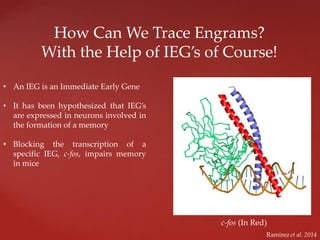
• An IEG is an Immediate Early Gene
• It has been hypothesized that IEG’s
are expressed in neurons involved in
the formation of a memory
• Blocking the transcription of a
specific IEG, c-fos, impairs memory
in mice
c-fos (In Red)
Ramirez et al. 2014
• With this information in mind the solution to
tracing a memory seems simple at first: Attach a
c-fos promoter to a Channelrhodopsin gene
• New memories are being made all the time
though. How are researchers to distinguish the
memory they want from other memories
formed?
The Solution
• Researchers inserted two genes into the Dentate
Gyrus of the Hippocampus, a region critical for
memory formation.
• tTA with a c-fos promoter (transgenic)
• ChR2-EYFP with a TRE promoter (virus)
• TRE is activated by tTA but also blocked by the
antibiotic doxycycline
• Therefore to prevent unwanted ChR2-EYFP
expression until testing, researchers put test
animals on a diet of doxycycline infused food
Ramirez et al. 2014
tTAC-fos
DO
X
ChR2-EYFPTRE
Ramirez et al. 2014
The Experiment
• Researchers wanted to know if they could trace a
memory engram with ChR2-EYFP in one context
(in this case meaning environment) and then
activate that memory with light in a completely
unrelated context
• In this case the target memory would be that of
the environment in which fear conditioning took
place
• Fear conditioning is a classic method of studying
behavior in which a stimulus (in this case the
environment) is associated with pain, usually in
the form of a quick electric shock
• When presented with that environment or
stimulus in later tests, animals exhibit a behavior
called “freezing” in which they pause in
expectation of a shock
Ramirez et al. 2014
The Experiment Cont.
• Mice were taken off of a doxycycline diet
and underwent fear conditioning in Context
B
• After fear conditioning a doxycycline diet
was immediately resumed
• Mice were then placed in Context A and blue
light was delivered to the DG. This induced
freezing despite the mice not being in a fear
conditioning environment.
• Researchers had successfully traced an
engram and induced recall out of context.
“This experiment directly tests
the hypothesis that the c-fos-
expressing cells in the
hippocampus activated during
training are sufficient for
memory recall”
– Ramirez et al. 2014
Ramirez et al. 2014
Do Engram Cell Populations Overlap?
• Mice were taken off of a doxycycline diet
and placed in Context A (The memory of
context A was traced)
• Afterwards a doxycycline diet was
immediately resumed
• While on doxycycline, the mice underwent
fear conditioning in Context B (Not traced)
• If the cells responsible for the memories of A
and B overlap then it would be expected to
see freezing when stimulated with blue
light.
• No freezing occurred
“Accordingly, we propose that
these cells form a cellular basis
of a memory engram, and that
two different contexts are
parsed out as independent
experiences represented by
independent neuronal
ensembles in DG.”
– Ramirez et al. 2014
Ramirez et al. 2014
Ramirez, Steve, Susumu Tonegawa, and
Xu Liu. "Identification and Optogenetic
Manipulation of Memory Engrams in the
Hippocampus." Frontiers in Behavioral
Neuroscience 7 (2014)
Beyeler, Anna, Christine A. Eckhardt, and
Kay M. Tye. "Deciphering Memory
Function with Optogenetics." Progress in
Molecular Biology and Translational
Science 22 (2014): 341-90. Web.

Optogenetics

  • 1.
  • 3.
    A Brief Recap •Optogenetics is a technique which allows researchers to turn certain regions of the brain on and off without damaging their function in the long term • This has been a major breakthrough in the field of Neuroscience as it has advantages over previous techniques of studying brain function: • Loss of function studies using lesions resulted in permanent damage to brain tissue and little re-usability of test animals • Stimulation of brain areas with electrodes were limited by the inability to target single cells or specific cell type populations
  • 4.
    How Does ItWork? • The genes for light-activated ion channels are introduced to a population of cells by a human engineered virus • Which cells express these light- sensitive channels depends on the promoter region of the inserted DNA sequence • Cells which contain a promoter that can recognize the promoter sequence will express these channels while cells that lack a promoter specific for the sequence will not Beyeler et al. 2014
  • 5.
    How Does ItWork? Cont. • Once the genes have been inserted, it can take 1-2 weeks for them to be fully expressed • When studies are ready to be run, a fiber optic cable is surgically attached to the top of the skull or inserted near the brain area of interest depending on how close it is to the surface of the brain • The channels, and in turn the neurons in which they are embedded, can now be controlled by light from the optic cable Beyeler et al. 2014
  • 6.
    The Channels Depolarizing (Excitatory)Hyperpolarizing (Inhibitory)
  • 7.
    Tracing Engrams withOptogenetics Ramirez et al. 2014
  • 8.
    Engram? • The Germanzoologist Richard Semon coined the term in 1921 • According to Semon, an engram was the biological conceptualization of a memory • He may have inspired the initial search for the basis of memory in the brain Richard Wolfgang Semon Ramirez et al. 2014
  • 9.
    How Can WeTrace Engrams? With the Help of IEG’s of Course! • An IEG is an Immediate Early Gene • It has been hypothesized that IEG’s are expressed in neurons involved in the formation of a memory • Blocking the transcription of a specific IEG, c-fos, impairs memory in mice c-fos (In Red) Ramirez et al. 2014
  • 10.
    • With thisinformation in mind the solution to tracing a memory seems simple at first: Attach a c-fos promoter to a Channelrhodopsin gene • New memories are being made all the time though. How are researchers to distinguish the memory they want from other memories formed?
  • 11.
    The Solution • Researchersinserted two genes into the Dentate Gyrus of the Hippocampus, a region critical for memory formation. • tTA with a c-fos promoter (transgenic) • ChR2-EYFP with a TRE promoter (virus) • TRE is activated by tTA but also blocked by the antibiotic doxycycline • Therefore to prevent unwanted ChR2-EYFP expression until testing, researchers put test animals on a diet of doxycycline infused food Ramirez et al. 2014
  • 12.
  • 13.
  • 14.
    The Experiment • Researcherswanted to know if they could trace a memory engram with ChR2-EYFP in one context (in this case meaning environment) and then activate that memory with light in a completely unrelated context • In this case the target memory would be that of the environment in which fear conditioning took place • Fear conditioning is a classic method of studying behavior in which a stimulus (in this case the environment) is associated with pain, usually in the form of a quick electric shock • When presented with that environment or stimulus in later tests, animals exhibit a behavior called “freezing” in which they pause in expectation of a shock Ramirez et al. 2014
  • 15.
    The Experiment Cont. •Mice were taken off of a doxycycline diet and underwent fear conditioning in Context B • After fear conditioning a doxycycline diet was immediately resumed • Mice were then placed in Context A and blue light was delivered to the DG. This induced freezing despite the mice not being in a fear conditioning environment. • Researchers had successfully traced an engram and induced recall out of context. “This experiment directly tests the hypothesis that the c-fos- expressing cells in the hippocampus activated during training are sufficient for memory recall” – Ramirez et al. 2014 Ramirez et al. 2014
  • 16.
    Do Engram CellPopulations Overlap? • Mice were taken off of a doxycycline diet and placed in Context A (The memory of context A was traced) • Afterwards a doxycycline diet was immediately resumed • While on doxycycline, the mice underwent fear conditioning in Context B (Not traced) • If the cells responsible for the memories of A and B overlap then it would be expected to see freezing when stimulated with blue light. • No freezing occurred “Accordingly, we propose that these cells form a cellular basis of a memory engram, and that two different contexts are parsed out as independent experiences represented by independent neuronal ensembles in DG.” – Ramirez et al. 2014 Ramirez et al. 2014
  • 17.
    Ramirez, Steve, SusumuTonegawa, and Xu Liu. "Identification and Optogenetic Manipulation of Memory Engrams in the Hippocampus." Frontiers in Behavioral Neuroscience 7 (2014) Beyeler, Anna, Christine A. Eckhardt, and Kay M. Tye. "Deciphering Memory Function with Optogenetics." Progress in Molecular Biology and Translational Science 22 (2014): 341-90. Web.