HMB300 - Neuroscience

Try not to be afraid of CREB
The CREB and flow of memory
Season and Series Finale

HMB300H1 - Dr. JU - Bye Class!

1
It’s something to be afraid of
•
•
•
•
•

HMB300 - Neuroscience

As we last left off in the world of neuroscience
CREB – another synaptic tag?
Molecules, transport and cargo
Fear memory – similar to other forms of memory
Altering fear memory – cool story bro’ but you have
to pay attention

HMB300H1 - Dr. JU - Bye Class!

2
HMB300 - Neuroscience

Be afraid, very, very afraid
• Electrical stimulation of the amygdala in humans
elicits fear and anxiety (Gloor et al., 1981)
• Reward system from dopaminergic fibres that
project from amygdala to the hippocampus? (Blum
et al., 1996)
• Panic attacks and aggression? Herman et
al., 1992 reported that ictal fear predominant in
amygdala- shows prominent EEG activity
•Classic paper by Mesulam 1981 shows abnormal
EEG activity with panic attacks, fear and
paranormal delusions in amygdala
HMB300H1 - Dr. JU - Bye Class!

3
HMB300 - Neuroscience

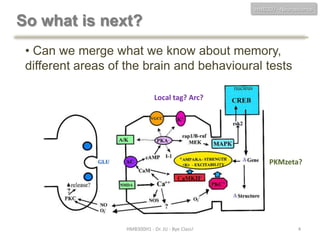
So what is next?
• Can we merge what we know about memory,
different areas of the brain and behavioural tests
Local tag? Arc?

PKMzeta?

HMB300H1 - Dr. JU - Bye Class!

4
HMB300 - Neuroscience

Understanding memory (again)
• One of the major tenets of memory theory, any
type of memory is that groups of neurons have
to be involved (a memory trace)
• These neuron ensembles (groups) are very
sparse however – so it makes the detection of a
memory trace very challenging
• Good correlation between certain neurons and
memory encoding or expression but no definitive
or direct proof

HMB300H1 - Dr. JU - Bye Class!

5
HMB300 - Neuroscience

Technical challenges part II
• Must find a discrete area that is easily
targeted that has been associated with a
memory
• Must be able to selectively eliminate these
neurons and not others
• Must also show directly, that by eliminating
these neurons, you have selectively ablated
those memories
• Optogenetics is one approach but this is yet
another very useful technique
HMB300H1 - Dr. JU - Bye Class!

6
HMB300 - Neuroscience

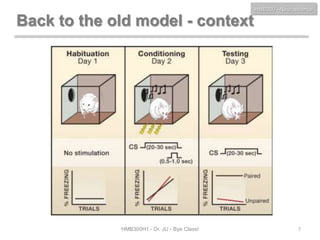
Back to the old model - context
HMB300H1 - Dr. JU - Bye Class!

7
HMB300 - Neuroscience

A new molecule in our repertoire
• Previous work had established that a group of
neurons within the lateral amygdala (LA) increased
levels of CREB following auditory fear training
• Have neurons in this area overexpressing CREB
(both active and dominant negative as control)
• Ones expressing CREB much more likely to be
activated during a contextual fear training model
• So within this area, can we lesion these CREB
overexpressing neurons?

HMB300H1 - Dr. JU - Bye Class!

8
HMB300 - Neuroscience

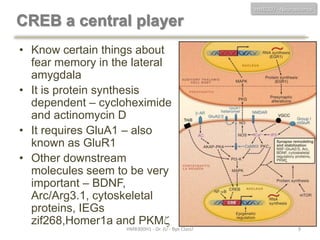
CREB a central player
• Know certain things about
fear memory in the lateral
amygdala
• It is protein synthesis
dependent – cycloheximide
and actinomycin D
• It requires GluA1 – also
known as GluR1
• Other downstream
molecules seem to be very
important – BDNF,
Arc/Arg3.1, cytoskeletal
proteins, IEGs
zif268,Homer1a and PKM
HMB300H1 - Dr. JU - Bye Class!

9
HMB300 - Neuroscience

Just a quick review of molecules
• Activated synapses increase signaling of CaMKII AD
etc. that lead to activation of MAPK (mitogen
activated protein kinase) – among others...
• MAPK can translocate to the nucleus to cause the
increased phosphorylation of CREB
• phosphoCREB is the activated transcription factor
that binds to nuclear DNA sequences that contain
cyclic AMP response elements (CRE)
• Also binds to CREB Binding Protein (CBP) which
acts to enhance activity to cause transcription of
factors such as c-fos, zif268, BDNF, etc.
HMB300H1 - Dr. JU - Bye Class!

10
Let’s take stock for a moment

HMB300 - Neuroscience

• Use a contextual fear response to evoke a fear
memory
• Neurons that are involved in LTP-like responses
are express more CREB
• Have a unique mouse that expresses iDTR in
every cell in every part of the body including the
amygdala (DTR is not normally found in mice)
• Create a specific vector that incorporates both
things CREB-Cre and put it into a viral vector
that infects specific neurons
HMB300H1 - Dr. JU - Bye Class!

11
HMB300 - Neuroscience

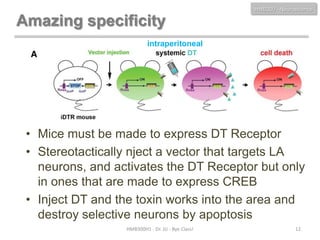
Amazing specificity
intraperitoneal

• Mice must be made to express DT Receptor
• Stereotactically nject a vector that targets LA
neurons, and activates the DT Receptor but only
in ones that are made to express CREB
• Inject DT and the toxin works into the area and
destroy selective neurons by apoptosis
HMB300H1 - Dr. JU - Bye Class!

12
HMB300 - Neuroscience

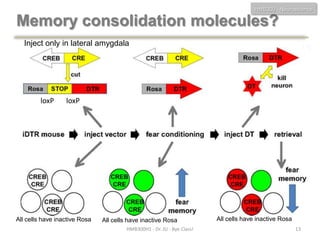
Memory consolidation molecules?
Inject only in lateral amygdala

loxP

AD

loxP

All cells have inactive Rosa

All cells have inactive Rosa
HMB300H1 - Dr. JU - Bye Class!

All cells have inactive Rosa
13
HMB300 - Neuroscience

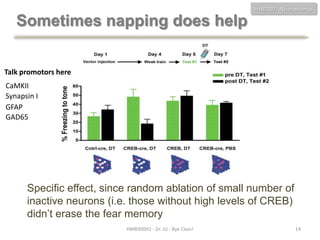
Sometimes napping does help
Talk promotors here
CaMKII
Synapsin I
GFAP
GAD65

Specific effect, since random ablation of small number of
inactive neurons (i.e. those without high levels of CREB)
didn’t erase the fear memory
HMB300H1 - Dr. JU - Bye Class!

14
HMB300 - Neuroscience

Incredible effect
• Rosa mouse allows specific ablation of neurons
that overexpress CREB that has become
associated with a learned fear response
• Effects were specific and offer a different route
for being able to manipulate discrete group of
neurons – in this case ablation of neurons
associated with a memory
• Still cited as a classic paper and variations are
still being published today

HMB300H1 - Dr. JU - Bye Class!

15
HMB300 - Neuroscience

For your information (FYI only)
• If you want to learn more on this technique
and some of the challenges associated with
it check out the following paper
• Han J-H, Kushner SA, Yiu AP, Cole CA, Matynia A, Brown
RA, Neve RL, Guzowski JF, Silva AJ, Josselyn SA. (2007)
Neuronal competition and selection during memory
formation. Science 316:457-460.
• Han J-H, Kushner SA, Hsiang HL, Yiu AP, Buch
T, Waisman A, Bontempi B, Neve RL, Frankland
PW, Josselyn SA. (2009) Selective erasure of a fear
memory. Science 323:1492-1496
HMB300H1 - Dr. JU - Bye Class!

16
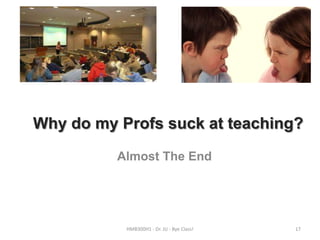
Why do my Profs suck at teaching?
Almost The End

HMB300H1 - Dr. JU - Bye Class!

17
HMB300 - Neuroscience

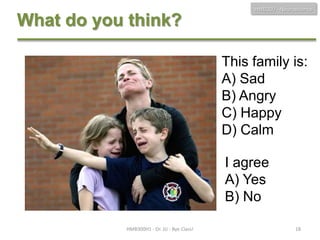
What do you think?
This family is:
A) Sad
B) Angry
C) Happy
D) Calm
I agree
A) Yes
B) No
HMB300H1 - Dr. JU - Bye Class!

18
HMB300 - Neuroscience

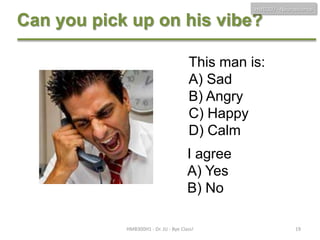
Can you pick up on his vibe?
This man is:
A) Sad
B) Angry
C) Happy
D) Calm
I agree
A) Yes
B) No
HMB300H1 - Dr. JU - Bye Class!

19
HMB300 - Neuroscience

The beginnings of a theory
How did you come to understand the context?
• Different theories to try and understand what
happens when you observe things in others
• You have basically taken on the perspective of
someone else
• How did this occur? How did you understand the
other person’s perspective?
• Intuitive learning model
• Theory of Mind model
HMB300H1 - Dr. JU - Bye Class!

20
HMB300 - Neuroscience

Great theory but controversial
• How do we understand what is going on?
• How do we process what we perceive?
• Is this a simple model such as sensory
perception (what we see), cognition (processing)
and then turn this into action?
• In many ways this process resembles what is
known as the Theory of Mind

HMB300H1 - Dr. JU - Bye Class!

21
HMB300 - Neuroscience

Does your Prof understand?
• Theory of Mind allows an individual to
understand the mental states and belief systems
of others (that may be different from their own)
• Very closely associated with empathy
• This may be what allows us to understand those
pictures without any other clues or guidance
• Our ability to understand or take on the
viewpoint of others may allow us to imitate them
better

HMB300H1 - Dr. JU - Bye Class!

22
HMB300 - Neuroscience

Profs unlearn this ability?
• Are we born with this ability to understand
others?
• Do we have the innate ability to understand the
intention of others?
• Most researchers believe that we have to
develop or learn a theory of mind
• It turns out that children are incapable of truly
understanding others until they reach a critical
age

HMB300H1 - Dr. JU - Bye Class!

23
HMB300 - Neuroscience

Beginning of a new theory
• Famous research on what is known as the falsebelief system (other individuals may have an
inappropriate understanding) Wimmer, H., &
Perner, J. (1983) Beliefs about beliefs:
Representation and constraining function of
wrong beliefs in young children's understanding
of deception. Cognition, 13, 103-128

HMB300H1 - Dr. JU - Bye Class!

24
HMB300 - Neuroscience

A simple test
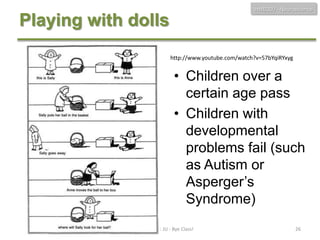
• One of the tests originally used to understand
false beliefs in the theory of mind was known as
the Sally-Anne task
• There are 2 containers, 2 characters and
children are asked whether one character will
have a false belief or not
• Can the child predict behaviour correctly?

HMB300H1 - Dr. JU - Bye Class!

25
HMB300 - Neuroscience

Playing with dolls
http://www.youtube.com/watch?v=57bYqiRYxyg

• Children over a
certain age pass
• Children with
developmental
problems fail (such
as Autism or
Asperger’s
Syndrome)
HMB300H1 - Dr. JU - Bye Class!

26
HMB300 - Neuroscience

How do we account for this?
• One of our central tenets in this course is
that behaviour can be explained by
examining the brain
• How can we account for our ability to understand
others, and to show empathy?
• There must be a structure or structures in the
brain that accounts for this
• 1970s through to the 1990s

HMB300H1 - Dr. JU - Bye Class!

27
HMB300 - Neuroscience

Great mistakes – great findings

• Italian neuroscientists Giacomo Rizzolatti, Vittorio
Gallese, Leonardo Fogassi and colleagues
studying brain and motor activity
• Using electrodes, measured activity of single
neurons in macaque brains in the premotor
cortex
• In monkeys, this area had been shown to be
active during the times where monkey grasps or
manipulates objects
• i.e. neurons are active when monkey picks up a
peanut or cracks the shell
HMB300H1 - Dr. JU - Bye Class!

28
HMB300 - Neuroscience

Strange results
• Activity within the monkey premotor
cortex triggers movements
• In humans, stimulation of premotor
cortex results in patients reporting
urge to perform actions
• In other words, it is part of our ability
to trigger voluntary movement
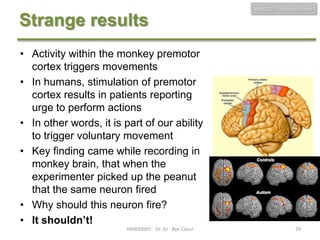
• Key finding came while recording in
monkey brain, that when the
experimenter picked up the peanut
that the same neuron fired
• Why should this neuron fire?
• It shouldn’t!
HMB300H1 - Dr. JU - Bye Class!

29
HMB300 - Neuroscience

If you see it, you feel it
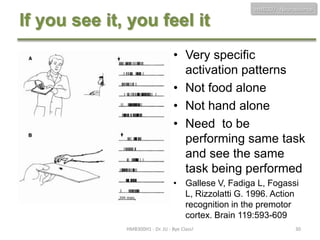
• Very specific
activation patterns
• Not food alone
• Not hand alone
• Need to be
performing same task
and see the same
task being performed
• Gallese V, Fadiga L, Fogassi
L, Rizzolatti G. 1996. Action
recognition in the premotor
cortex. Brain 119:593-609
HMB300H1 - Dr. JU - Bye Class!

30
Mirror neurons – so cool!

HMB300 - Neuroscience

• As the activity that was elicited was so specific, it was
hypothesized to be an actual finding
• Interestingly, only specific to a point
• Later it was determined that these types of neurons –
now known as mirror neurons – were activated by
sound as well (Christian Keysers)
• The experimenters proposed that these specific cells
within the monkey’s brain could transform what they
were seeing into motor programs

HMB300H1 - Dr. JU - Bye Class!

31
HMB300 - Neuroscience

Is your whole brain full of these?
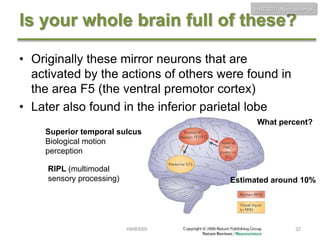
• Originally these mirror neurons that are
activated by the actions of others were found in
the area F5 (the ventral premotor cortex)
• Later also found in the inferior parietal lobe
What percent?
Superior temporal sulcus
Biological motion
perception
RIPL (multimodal
sensory processing)

Estimated around 10%

HMB300H1 - Dr. JU - Bye Class!

32
HMB300 - Neuroscience

Actions speak louder than words
• Originally thought to be important for action
understanding
• In other words, these mirror neurons allow us to
truly understand actions that we couldn’t
understand just by seeing them alone (i.e.
holding that cup of coffee – beyond just seeing
cup and a hand)
• As part of this, these neurons are also likely
important for imitation and imitation learning (big
proponent being the Iacoboni group
HMB300H1 - Dr. JU - Bye Class!

33
HMB300 - Neuroscience

We’re better than supercomputers
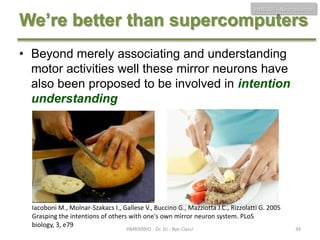
• Beyond merely associating and understanding
motor activities well these mirror neurons have
also been proposed to be involved in intention
understanding

Iacoboni M., Molnar-Szakacs I., Gallese V., Buccino G., Mazziotta J.C., Rizzolatti G. 2005
Grasping the intentions of others with one's own mirror neuron system. PLoS
biology, 3, e79
HMB300H1 - Dr. JU - Bye Class!

34
HMB300 - Neuroscience

Even more complex actions?
• Watch someone cut their finger? Your response?
• Are mirror neurons responsible for empathy?
• There is a parieto-premotor circuit that seems to
be activated in response to emotions
• Exposure to disgusting odours activates the
insula and the anterior cingulate cortex
• Interestingly watching people who showed
disgust also activated the insula
•

Wicker B., Keysers C, Plailly J, Royet JP, Gallese V, Rizzolatti G.. (2003) Both
of us disgusted in my insula: The common neural basis of seeing and feeling
disgust. Neuron 40, 655-664.
HMB300H1 - Dr. JU - Bye Class!

35
HMB300 - Neuroscience

I was once a groupie
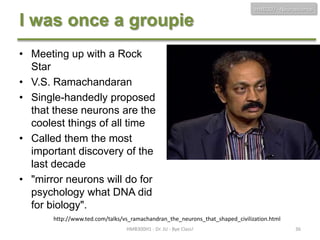
• Meeting up with a Rock
Star
• V.S. Ramachandaran
• Single-handedly proposed
that these neurons are the
coolest things of all time
• Called them the most
important discovery of the
last decade
• "mirror neurons will do for
psychology what DNA did
for biology".
http://www.ted.com/talks/vs_ramachandran_the_neurons_that_shaped_civilization.html
HMB300H1 - Dr. JU - Bye Class!

36
HMB300 - Neuroscience

But can they slice and dice?
• Mirror neurons have been proposed to be what
allowed humans to develop language (originally
proposed back in 1998)
• Morality? If I can feel your pain, if I can see your
point of view – it would mean that I would have
to change my value systems
• Still a matter of great debate

HMB300H1 - Dr. JU - Bye Class!

37
HMB300 - Neuroscience

The search for UFOs in the brain
• The big question – not sure
• Likely yes, but no one has yet recorded
electrically from neurons in the proposed
areas of the HUMAN brain
• All of the studies to date have been using
EEG, MEG and fMRI
•

Lingnau, Angelika; Gesierich, Benno; Caramazza, Alfonso
(2009), "Asymmetric fMRI adaptation reveals no evidence for mirror neurons
in humans", PNAS 106 (24): 9925–9930,

HMB300H1 - Dr. JU - Bye Class!

38
HMB300 - Neuroscience

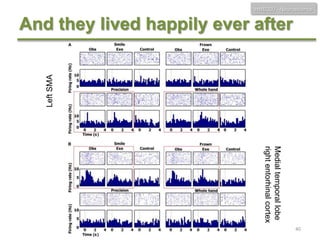
And they lived happily ever after
• Until this year down in UCLA
• Mukamel et al. Single-Neuron Responses in
Humans during Execution and Observation
of Actions. Current Biology, 2010
• 1177 cells in 21 patients human medial frontal
and temporal cortices (seizure patients)
• patients executed or observed hand grasping
actions and facial emotional expressions

HMB300H1 - Dr. JU - Bye Class!

39
HMB300 - Neuroscience

Left SMA

And they lived happily ever after

Medial temporal lobe
right entorhinal cortex

HMB300H1 - Dr. JU - Bye Class!

40
HMB300 - Neuroscience

And they lived happily ever after
• Cells in SMA respond during execution and
observation of actions
• Cells in medial temporal lobe respond during
observation and execution of actions
• Some respond with excitation during execution
and inhibition during observation
• Did not find evidence of such cells in the
ACC, amygdala or in the pre-SMA
• Did not record from F5 but SMA (lateral vs
medial)
HMB300H1 - Dr. JU - Bye Class!

41
HMB300 - Neuroscience

Review of autism
•
•
•
•
•
•
•
•

Developmental issues within brain
Typical symptoms occur by the age of 2-3 years
Poor social interactions
Lack of communication/speech difficulties
Repetitive almost obsessive behaviour
Often exhibit echolalia
Deficits in motor skills also tightly linked
Genetic causes not fully established

HMB300H1 - Dr. JU - Bye Class!

42
HMB300 - Neuroscience

Super controversial
• In autism, there are very poor social skills, and an
inability to imitate and understand the intent of
others
• Could this be due to problems with mirror neurons
• Anatomic evidence showing that the areas where
mirror neurons are supposed to be localized are
thinner or smaller in autistic patients
• fMRI studies suggest that these areas are also
less active during imitation in autistic children

HMB300H1 - Dr. JU - Bye Class!

43
HMB300H1S:
Keep Calm – It’sThe END
Dr. Bill Ju
105C Wetmore Hall
wmyh.ju@utoronto.ca
theprofessor.bill@gmail.com
HMB300H1 - Dr. JU - Bye Class!

44
HMB300 - Neuroscience

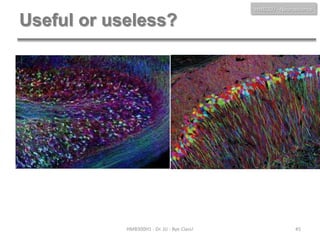
Useful or useless?

HMB300H1 - Dr. JU - Bye Class!

45
HMB300 - Neuroscience

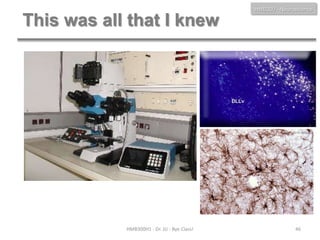
This was all that I knew

HMB300H1 - Dr. JU - Bye Class!

46
HMB300 - Neuroscience

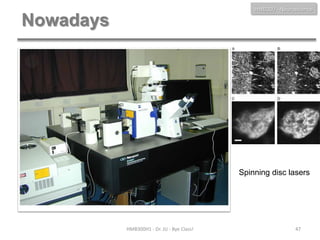
Nowadays

Spinning disc lasers

HMB300H1 - Dr. JU - Bye Class!

47
HMB300 - Neuroscience

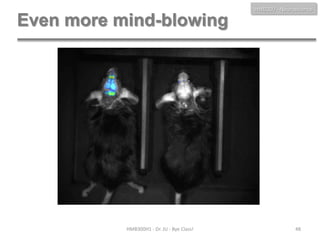
Even more mind-blowing

HMB300H1 - Dr. JU - Bye Class!

48
HMB300 - Neuroscience

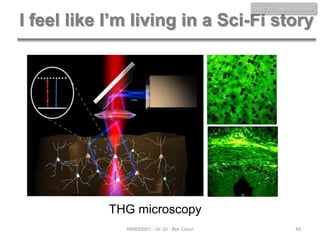
I feel like I’m living in a Sci-Fi story

THG microscopy
HMB300H1 - Dr. JU - Bye Class!

49
HMB300 - Neuroscience

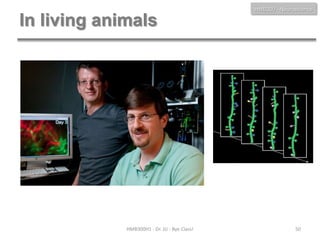
In living animals

HMB300H1 - Dr. JU - Bye Class!

50
HMB300 - Neuroscience

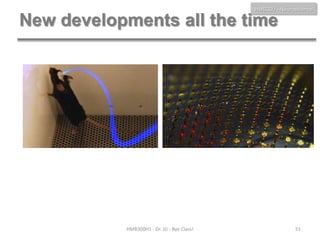
New developments all the time

HMB300H1 - Dr. JU - Bye Class!

51
HMB300 - Neuroscience

What my students picked
•
•
•
•
•
•
•

Stem cell therapy
Brain machine interfaces
Imaging studies (human and research)
Machine and artificial intelligence
Beyond fMRI
RNAi technology
Nanotechnology including brain nanotechnology

HMB300H1 - Dr. JU - Bye Class!

52
HMB300 - Neuroscience

And now for the Glogster Awards
• Thanks for your continued excellence
• Amazing material – best I’ve seen and amazing!
• Very creative and I’m glad I didn’t have to
choose
• All of you did so well but your peers have
nominated:
• Then off to Project Impact

HMB300H1 - Dr. JU - Bye Class!

53
HMB300 - Neuroscience

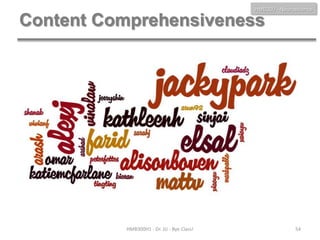
Content Comprehensiveness

HMB300H1 - Dr. JU - Bye Class!

54
HMB300 - Neuroscience

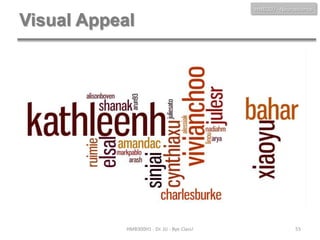
Visual Appeal

HMB300H1 - Dr. JU - Bye Class!

55
HMB300 - Neuroscience

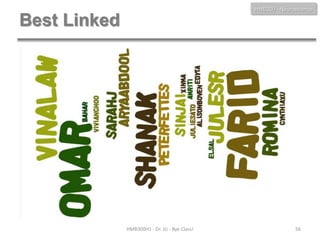
Best Linked

HMB300H1 - Dr. JU - Bye Class!

56
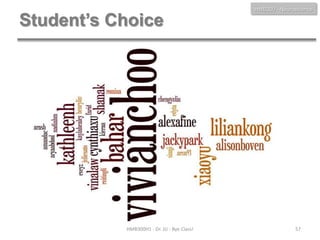
Student’s Choice

HMB300H1 - Dr. JU - Bye Class!

HMB300 - Neuroscience

57
HMB300 - Neuroscience

Most Nominated (Other)
•
•
•
•
•
•

Alison Boven
Shana Kim
Bahar Amani
Xiao Yu
Arya Abdool
Cynthia Xu

HMB300H1 - Dr. JU - Bye Class!

58
HMB300H1 - Dr. JU - Bye Class!

59
HMB300H1 - Dr. JU - Bye Class!

60
HMB300H1 - Dr. JU - Bye Class!

61
HMB300H1 - Dr. JU - Bye Class!

62
HMB300H1 - Dr. JU - Bye Class!

63
HMB300H1 - Dr. JU - Bye Class!

64
HMB300H1 - Dr. JU - Bye Class!

65
HMB300H1 - Dr. JU - Bye Class!

66
Your final exam
• 20 MCQs – more on this online
• 4 SA (with parts – longer – the current online
assignment)
• 2 hours long – you will need the time
• Tutorial scheduled for 11th and 12th
• Sample questions will be posted Dec. 9th

HMB300H1 - Dr. JU - Bye Class!

67
HMB300H1 - Dr. JU - Bye Class!

68

Hmb300 h1f 2013final lecture

  • 1.
    HMB300 - Neuroscience Trynot to be afraid of CREB The CREB and flow of memory Season and Series Finale HMB300H1 - Dr. JU - Bye Class! 1
  • 2.
    It’s something tobe afraid of • • • • • HMB300 - Neuroscience As we last left off in the world of neuroscience CREB – another synaptic tag? Molecules, transport and cargo Fear memory – similar to other forms of memory Altering fear memory – cool story bro’ but you have to pay attention HMB300H1 - Dr. JU - Bye Class! 2
  • 3.
    HMB300 - Neuroscience Beafraid, very, very afraid • Electrical stimulation of the amygdala in humans elicits fear and anxiety (Gloor et al., 1981) • Reward system from dopaminergic fibres that project from amygdala to the hippocampus? (Blum et al., 1996) • Panic attacks and aggression? Herman et al., 1992 reported that ictal fear predominant in amygdala- shows prominent EEG activity •Classic paper by Mesulam 1981 shows abnormal EEG activity with panic attacks, fear and paranormal delusions in amygdala HMB300H1 - Dr. JU - Bye Class! 3
  • 4.
    HMB300 - Neuroscience Sowhat is next? • Can we merge what we know about memory, different areas of the brain and behavioural tests Local tag? Arc? PKMzeta? HMB300H1 - Dr. JU - Bye Class! 4
  • 5.
    HMB300 - Neuroscience Understandingmemory (again) • One of the major tenets of memory theory, any type of memory is that groups of neurons have to be involved (a memory trace) • These neuron ensembles (groups) are very sparse however – so it makes the detection of a memory trace very challenging • Good correlation between certain neurons and memory encoding or expression but no definitive or direct proof HMB300H1 - Dr. JU - Bye Class! 5
  • 6.
    HMB300 - Neuroscience Technicalchallenges part II • Must find a discrete area that is easily targeted that has been associated with a memory • Must be able to selectively eliminate these neurons and not others • Must also show directly, that by eliminating these neurons, you have selectively ablated those memories • Optogenetics is one approach but this is yet another very useful technique HMB300H1 - Dr. JU - Bye Class! 6
  • 7.
    HMB300 - Neuroscience Backto the old model - context HMB300H1 - Dr. JU - Bye Class! 7
  • 8.
    HMB300 - Neuroscience Anew molecule in our repertoire • Previous work had established that a group of neurons within the lateral amygdala (LA) increased levels of CREB following auditory fear training • Have neurons in this area overexpressing CREB (both active and dominant negative as control) • Ones expressing CREB much more likely to be activated during a contextual fear training model • So within this area, can we lesion these CREB overexpressing neurons? HMB300H1 - Dr. JU - Bye Class! 8
  • 9.
    HMB300 - Neuroscience CREBa central player • Know certain things about fear memory in the lateral amygdala • It is protein synthesis dependent – cycloheximide and actinomycin D • It requires GluA1 – also known as GluR1 • Other downstream molecules seem to be very important – BDNF, Arc/Arg3.1, cytoskeletal proteins, IEGs zif268,Homer1a and PKM HMB300H1 - Dr. JU - Bye Class! 9
  • 10.
    HMB300 - Neuroscience Justa quick review of molecules • Activated synapses increase signaling of CaMKII AD etc. that lead to activation of MAPK (mitogen activated protein kinase) – among others... • MAPK can translocate to the nucleus to cause the increased phosphorylation of CREB • phosphoCREB is the activated transcription factor that binds to nuclear DNA sequences that contain cyclic AMP response elements (CRE) • Also binds to CREB Binding Protein (CBP) which acts to enhance activity to cause transcription of factors such as c-fos, zif268, BDNF, etc. HMB300H1 - Dr. JU - Bye Class! 10
  • 11.
    Let’s take stockfor a moment HMB300 - Neuroscience • Use a contextual fear response to evoke a fear memory • Neurons that are involved in LTP-like responses are express more CREB • Have a unique mouse that expresses iDTR in every cell in every part of the body including the amygdala (DTR is not normally found in mice) • Create a specific vector that incorporates both things CREB-Cre and put it into a viral vector that infects specific neurons HMB300H1 - Dr. JU - Bye Class! 11
  • 12.
    HMB300 - Neuroscience Amazingspecificity intraperitoneal • Mice must be made to express DT Receptor • Stereotactically nject a vector that targets LA neurons, and activates the DT Receptor but only in ones that are made to express CREB • Inject DT and the toxin works into the area and destroy selective neurons by apoptosis HMB300H1 - Dr. JU - Bye Class! 12
  • 13.
    HMB300 - Neuroscience Memoryconsolidation molecules? Inject only in lateral amygdala loxP AD loxP All cells have inactive Rosa All cells have inactive Rosa HMB300H1 - Dr. JU - Bye Class! All cells have inactive Rosa 13
  • 14.
    HMB300 - Neuroscience Sometimesnapping does help Talk promotors here CaMKII Synapsin I GFAP GAD65 Specific effect, since random ablation of small number of inactive neurons (i.e. those without high levels of CREB) didn’t erase the fear memory HMB300H1 - Dr. JU - Bye Class! 14
  • 15.
    HMB300 - Neuroscience Incredibleeffect • Rosa mouse allows specific ablation of neurons that overexpress CREB that has become associated with a learned fear response • Effects were specific and offer a different route for being able to manipulate discrete group of neurons – in this case ablation of neurons associated with a memory • Still cited as a classic paper and variations are still being published today HMB300H1 - Dr. JU - Bye Class! 15
  • 16.
    HMB300 - Neuroscience Foryour information (FYI only) • If you want to learn more on this technique and some of the challenges associated with it check out the following paper • Han J-H, Kushner SA, Yiu AP, Cole CA, Matynia A, Brown RA, Neve RL, Guzowski JF, Silva AJ, Josselyn SA. (2007) Neuronal competition and selection during memory formation. Science 316:457-460. • Han J-H, Kushner SA, Hsiang HL, Yiu AP, Buch T, Waisman A, Bontempi B, Neve RL, Frankland PW, Josselyn SA. (2009) Selective erasure of a fear memory. Science 323:1492-1496 HMB300H1 - Dr. JU - Bye Class! 16
  • 17.
    Why do myProfs suck at teaching? Almost The End HMB300H1 - Dr. JU - Bye Class! 17
  • 18.
    HMB300 - Neuroscience Whatdo you think? This family is: A) Sad B) Angry C) Happy D) Calm I agree A) Yes B) No HMB300H1 - Dr. JU - Bye Class! 18
  • 19.
    HMB300 - Neuroscience Canyou pick up on his vibe? This man is: A) Sad B) Angry C) Happy D) Calm I agree A) Yes B) No HMB300H1 - Dr. JU - Bye Class! 19
  • 20.
    HMB300 - Neuroscience Thebeginnings of a theory How did you come to understand the context? • Different theories to try and understand what happens when you observe things in others • You have basically taken on the perspective of someone else • How did this occur? How did you understand the other person’s perspective? • Intuitive learning model • Theory of Mind model HMB300H1 - Dr. JU - Bye Class! 20
  • 21.
    HMB300 - Neuroscience Greattheory but controversial • How do we understand what is going on? • How do we process what we perceive? • Is this a simple model such as sensory perception (what we see), cognition (processing) and then turn this into action? • In many ways this process resembles what is known as the Theory of Mind HMB300H1 - Dr. JU - Bye Class! 21
  • 22.
    HMB300 - Neuroscience Doesyour Prof understand? • Theory of Mind allows an individual to understand the mental states and belief systems of others (that may be different from their own) • Very closely associated with empathy • This may be what allows us to understand those pictures without any other clues or guidance • Our ability to understand or take on the viewpoint of others may allow us to imitate them better HMB300H1 - Dr. JU - Bye Class! 22
  • 23.
    HMB300 - Neuroscience Profsunlearn this ability? • Are we born with this ability to understand others? • Do we have the innate ability to understand the intention of others? • Most researchers believe that we have to develop or learn a theory of mind • It turns out that children are incapable of truly understanding others until they reach a critical age HMB300H1 - Dr. JU - Bye Class! 23
  • 24.
    HMB300 - Neuroscience Beginningof a new theory • Famous research on what is known as the falsebelief system (other individuals may have an inappropriate understanding) Wimmer, H., & Perner, J. (1983) Beliefs about beliefs: Representation and constraining function of wrong beliefs in young children's understanding of deception. Cognition, 13, 103-128 HMB300H1 - Dr. JU - Bye Class! 24
  • 25.
    HMB300 - Neuroscience Asimple test • One of the tests originally used to understand false beliefs in the theory of mind was known as the Sally-Anne task • There are 2 containers, 2 characters and children are asked whether one character will have a false belief or not • Can the child predict behaviour correctly? HMB300H1 - Dr. JU - Bye Class! 25
  • 26.
    HMB300 - Neuroscience Playingwith dolls http://www.youtube.com/watch?v=57bYqiRYxyg • Children over a certain age pass • Children with developmental problems fail (such as Autism or Asperger’s Syndrome) HMB300H1 - Dr. JU - Bye Class! 26
  • 27.
    HMB300 - Neuroscience Howdo we account for this? • One of our central tenets in this course is that behaviour can be explained by examining the brain • How can we account for our ability to understand others, and to show empathy? • There must be a structure or structures in the brain that accounts for this • 1970s through to the 1990s HMB300H1 - Dr. JU - Bye Class! 27
  • 28.
    HMB300 - Neuroscience Greatmistakes – great findings • Italian neuroscientists Giacomo Rizzolatti, Vittorio Gallese, Leonardo Fogassi and colleagues studying brain and motor activity • Using electrodes, measured activity of single neurons in macaque brains in the premotor cortex • In monkeys, this area had been shown to be active during the times where monkey grasps or manipulates objects • i.e. neurons are active when monkey picks up a peanut or cracks the shell HMB300H1 - Dr. JU - Bye Class! 28
  • 29.
    HMB300 - Neuroscience Strangeresults • Activity within the monkey premotor cortex triggers movements • In humans, stimulation of premotor cortex results in patients reporting urge to perform actions • In other words, it is part of our ability to trigger voluntary movement • Key finding came while recording in monkey brain, that when the experimenter picked up the peanut that the same neuron fired • Why should this neuron fire? • It shouldn’t! HMB300H1 - Dr. JU - Bye Class! 29
  • 30.
    HMB300 - Neuroscience Ifyou see it, you feel it • Very specific activation patterns • Not food alone • Not hand alone • Need to be performing same task and see the same task being performed • Gallese V, Fadiga L, Fogassi L, Rizzolatti G. 1996. Action recognition in the premotor cortex. Brain 119:593-609 HMB300H1 - Dr. JU - Bye Class! 30
  • 31.
    Mirror neurons –so cool! HMB300 - Neuroscience • As the activity that was elicited was so specific, it was hypothesized to be an actual finding • Interestingly, only specific to a point • Later it was determined that these types of neurons – now known as mirror neurons – were activated by sound as well (Christian Keysers) • The experimenters proposed that these specific cells within the monkey’s brain could transform what they were seeing into motor programs HMB300H1 - Dr. JU - Bye Class! 31
  • 32.
    HMB300 - Neuroscience Isyour whole brain full of these? • Originally these mirror neurons that are activated by the actions of others were found in the area F5 (the ventral premotor cortex) • Later also found in the inferior parietal lobe What percent? Superior temporal sulcus Biological motion perception RIPL (multimodal sensory processing) Estimated around 10% HMB300H1 - Dr. JU - Bye Class! 32
  • 33.
    HMB300 - Neuroscience Actionsspeak louder than words • Originally thought to be important for action understanding • In other words, these mirror neurons allow us to truly understand actions that we couldn’t understand just by seeing them alone (i.e. holding that cup of coffee – beyond just seeing cup and a hand) • As part of this, these neurons are also likely important for imitation and imitation learning (big proponent being the Iacoboni group HMB300H1 - Dr. JU - Bye Class! 33
  • 34.
    HMB300 - Neuroscience We’rebetter than supercomputers • Beyond merely associating and understanding motor activities well these mirror neurons have also been proposed to be involved in intention understanding Iacoboni M., Molnar-Szakacs I., Gallese V., Buccino G., Mazziotta J.C., Rizzolatti G. 2005 Grasping the intentions of others with one's own mirror neuron system. PLoS biology, 3, e79 HMB300H1 - Dr. JU - Bye Class! 34
  • 35.
    HMB300 - Neuroscience Evenmore complex actions? • Watch someone cut their finger? Your response? • Are mirror neurons responsible for empathy? • There is a parieto-premotor circuit that seems to be activated in response to emotions • Exposure to disgusting odours activates the insula and the anterior cingulate cortex • Interestingly watching people who showed disgust also activated the insula • Wicker B., Keysers C, Plailly J, Royet JP, Gallese V, Rizzolatti G.. (2003) Both of us disgusted in my insula: The common neural basis of seeing and feeling disgust. Neuron 40, 655-664. HMB300H1 - Dr. JU - Bye Class! 35
  • 36.
    HMB300 - Neuroscience Iwas once a groupie • Meeting up with a Rock Star • V.S. Ramachandaran • Single-handedly proposed that these neurons are the coolest things of all time • Called them the most important discovery of the last decade • "mirror neurons will do for psychology what DNA did for biology". http://www.ted.com/talks/vs_ramachandran_the_neurons_that_shaped_civilization.html HMB300H1 - Dr. JU - Bye Class! 36
  • 37.
    HMB300 - Neuroscience Butcan they slice and dice? • Mirror neurons have been proposed to be what allowed humans to develop language (originally proposed back in 1998) • Morality? If I can feel your pain, if I can see your point of view – it would mean that I would have to change my value systems • Still a matter of great debate HMB300H1 - Dr. JU - Bye Class! 37
  • 38.
    HMB300 - Neuroscience Thesearch for UFOs in the brain • The big question – not sure • Likely yes, but no one has yet recorded electrically from neurons in the proposed areas of the HUMAN brain • All of the studies to date have been using EEG, MEG and fMRI • Lingnau, Angelika; Gesierich, Benno; Caramazza, Alfonso (2009), "Asymmetric fMRI adaptation reveals no evidence for mirror neurons in humans", PNAS 106 (24): 9925–9930, HMB300H1 - Dr. JU - Bye Class! 38
  • 39.
    HMB300 - Neuroscience Andthey lived happily ever after • Until this year down in UCLA • Mukamel et al. Single-Neuron Responses in Humans during Execution and Observation of Actions. Current Biology, 2010 • 1177 cells in 21 patients human medial frontal and temporal cortices (seizure patients) • patients executed or observed hand grasping actions and facial emotional expressions HMB300H1 - Dr. JU - Bye Class! 39
  • 40.
    HMB300 - Neuroscience LeftSMA And they lived happily ever after Medial temporal lobe right entorhinal cortex HMB300H1 - Dr. JU - Bye Class! 40
  • 41.
    HMB300 - Neuroscience Andthey lived happily ever after • Cells in SMA respond during execution and observation of actions • Cells in medial temporal lobe respond during observation and execution of actions • Some respond with excitation during execution and inhibition during observation • Did not find evidence of such cells in the ACC, amygdala or in the pre-SMA • Did not record from F5 but SMA (lateral vs medial) HMB300H1 - Dr. JU - Bye Class! 41
  • 42.
    HMB300 - Neuroscience Reviewof autism • • • • • • • • Developmental issues within brain Typical symptoms occur by the age of 2-3 years Poor social interactions Lack of communication/speech difficulties Repetitive almost obsessive behaviour Often exhibit echolalia Deficits in motor skills also tightly linked Genetic causes not fully established HMB300H1 - Dr. JU - Bye Class! 42
  • 43.
    HMB300 - Neuroscience Supercontroversial • In autism, there are very poor social skills, and an inability to imitate and understand the intent of others • Could this be due to problems with mirror neurons • Anatomic evidence showing that the areas where mirror neurons are supposed to be localized are thinner or smaller in autistic patients • fMRI studies suggest that these areas are also less active during imitation in autistic children HMB300H1 - Dr. JU - Bye Class! 43
  • 44.
    HMB300H1S: Keep Calm –It’sThe END Dr. Bill Ju 105C Wetmore Hall wmyh.ju@utoronto.ca theprofessor.bill@gmail.com HMB300H1 - Dr. JU - Bye Class! 44
  • 45.
    HMB300 - Neuroscience Usefulor useless? HMB300H1 - Dr. JU - Bye Class! 45
  • 46.
    HMB300 - Neuroscience Thiswas all that I knew HMB300H1 - Dr. JU - Bye Class! 46
  • 47.
    HMB300 - Neuroscience Nowadays Spinningdisc lasers HMB300H1 - Dr. JU - Bye Class! 47
  • 48.
    HMB300 - Neuroscience Evenmore mind-blowing HMB300H1 - Dr. JU - Bye Class! 48
  • 49.
    HMB300 - Neuroscience Ifeel like I’m living in a Sci-Fi story THG microscopy HMB300H1 - Dr. JU - Bye Class! 49
  • 50.
    HMB300 - Neuroscience Inliving animals HMB300H1 - Dr. JU - Bye Class! 50
  • 51.
    HMB300 - Neuroscience Newdevelopments all the time HMB300H1 - Dr. JU - Bye Class! 51
  • 52.
    HMB300 - Neuroscience Whatmy students picked • • • • • • • Stem cell therapy Brain machine interfaces Imaging studies (human and research) Machine and artificial intelligence Beyond fMRI RNAi technology Nanotechnology including brain nanotechnology HMB300H1 - Dr. JU - Bye Class! 52
  • 53.
    HMB300 - Neuroscience Andnow for the Glogster Awards • Thanks for your continued excellence • Amazing material – best I’ve seen and amazing! • Very creative and I’m glad I didn’t have to choose • All of you did so well but your peers have nominated: • Then off to Project Impact HMB300H1 - Dr. JU - Bye Class! 53
  • 54.
    HMB300 - Neuroscience ContentComprehensiveness HMB300H1 - Dr. JU - Bye Class! 54
  • 55.
    HMB300 - Neuroscience VisualAppeal HMB300H1 - Dr. JU - Bye Class! 55
  • 56.
    HMB300 - Neuroscience BestLinked HMB300H1 - Dr. JU - Bye Class! 56
  • 57.
    Student’s Choice HMB300H1 -Dr. JU - Bye Class! HMB300 - Neuroscience 57
  • 58.
    HMB300 - Neuroscience MostNominated (Other) • • • • • • Alison Boven Shana Kim Bahar Amani Xiao Yu Arya Abdool Cynthia Xu HMB300H1 - Dr. JU - Bye Class! 58
  • 59.
    HMB300H1 - Dr.JU - Bye Class! 59
  • 60.
    HMB300H1 - Dr.JU - Bye Class! 60
  • 61.
    HMB300H1 - Dr.JU - Bye Class! 61
  • 62.
    HMB300H1 - Dr.JU - Bye Class! 62
  • 63.
    HMB300H1 - Dr.JU - Bye Class! 63
  • 64.
    HMB300H1 - Dr.JU - Bye Class! 64
  • 65.
    HMB300H1 - Dr.JU - Bye Class! 65
  • 66.
    HMB300H1 - Dr.JU - Bye Class! 66
  • 67.
    Your final exam •20 MCQs – more on this online • 4 SA (with parts – longer – the current online assignment) • 2 hours long – you will need the time • Tutorial scheduled for 11th and 12th • Sample questions will be posted Dec. 9th HMB300H1 - Dr. JU - Bye Class! 67
  • 68.
    HMB300H1 - Dr.JU - Bye Class! 68