

Optiq: a SQL front-end for everything

 Julian Hyde @julianhyde

 http://github.com/julianhyde/optiq
 http://github.com/julianhyde/optiq-splunk

 Pentaho Community Meetup
 Amsterdam, 2012
http://www.flickr.com/photos/torkildr/3462606643
http://www.flickr.com/photos/sylvar/31436961/
“Big Data”
Right data, right time
Diverse data sources / Performance / Suitable format
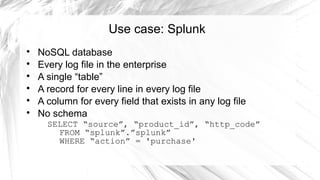
Use case: Splunk

    NoSQL database

    Every log file in the enterprise

    A single “table”

    A record for every line in every log file

    A column for every field that exists in any log file

    No schema
      SELECT “source”, “product_id”, “http_code”
        FROM “splunk”.”splunk”
        WHERE “action” = 'purchase'
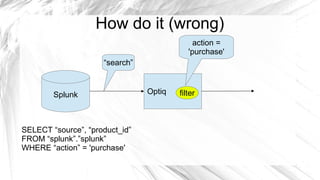
How do it (wrong)
                                             action =
                                           'purchase'
                     “search”


        Splunk                  Optiq   filter


SELECT “source”, “product_id”
FROM “splunk”.”splunk”
WHERE “action” = 'purchase'
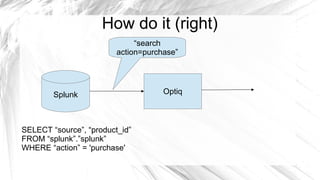
How do it (right)
                              “search
                         action=purchase”


        Splunk                       Optiq


SELECT “source”, “product_id”
FROM “splunk”.”splunk”
WHERE “action” = 'purchase'
Example #2
Combining data from 2 sources (Splunk & MySQL)
Also possible: 3 or more sources; 3-way joins; unions
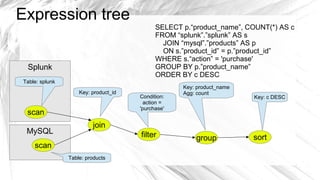
Expression tree
                                            SELECT p.“product_name”, COUNT(*) AS c
                                            FROM “splunk”.”splunk” AS s
                                              JOIN “mysql”.”products” AS p
                                              ON s.”product_id” = p.”product_id”
                                            WHERE s.“action” = 'purchase'
 Splunk                                     GROUP BY p.”product_name”
                                            ORDER BY c DESC
Table: splunk
                                                   Key: product_name
                    Key: product_id                Agg: count
                                      Condition:                       Key: c DESC
                                        action =
                                      'purchase'
 scan
                         join
 MySQL                                filter           group           sort
    scan
                Table: products
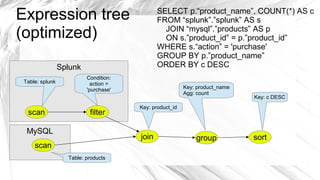
Expression tree                               SELECT p.“product_name”, COUNT(*) AS c
                                              FROM “splunk”.”splunk” AS s
(optimized)                                     JOIN “mysql”.”products” AS p
                                                ON s.”product_id” = p.”product_id”
                                              WHERE s.“action” = 'purchase'
                                              GROUP BY p.”product_name”
                 Splunk                       ORDER BY c DESC
                          Condition:
 Table: splunk              action =
                          'purchase'                     Key: product_name
                                                         Agg: count
                                                                             Key: c DESC
                                       Key: product_id
  scan                     filter

  MySQL
                                       join                  group           sort
     scan
                   Table: products
Optiq is not a database.
http://www.flickr.com/photos/torkildr/3462606643
http://www.flickr.com/photos/telstra-corp/5069403309/
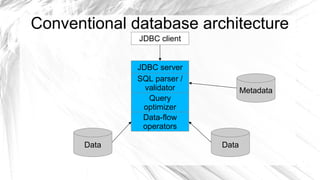
Conventional database architecture
              JDBC client


              JDBC server
              SQL parser /
                validator           Metadata
                 Query
               optimizer
               Data-flow
               operators

       Data                  Data
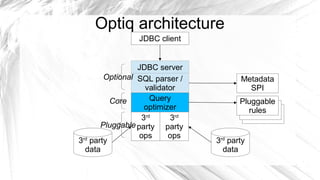
Optiq architecture
                JDBC client


                 JDBC server
        Optional SQL parser /          Metadata
                   validator             SPI
          Core       Query             Pluggable
                   optimizer             rules
                  3rd     3rd
       Pluggable party party
                  ops     ops
3rd party                       3rd party
  data                            data
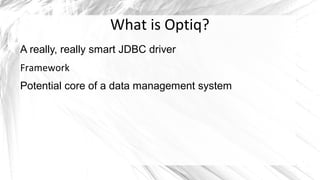
What is Optiq?
A really, really smart JDBC driver
Framework
Potential core of a data management system
Writing an adapter
Driver – if you want a vanity URL like “jdbc:splunk:”
Schema – describes what tables exist (Splunk has just one)
Table – what are the columns, and how to get the data. (Splunk's
  table has any column you like... just ask for it.)
Operators (optional) – non-relational operations
Rules (optional, but recommended) – improve efficiency by
  changing the question
Parser (optional) – to query via a language other than SQL
http://www.flickr.com/photos/walkercarpenter/4697637143/
Optiq roadmap ideas
Mondrian use Optiq to read from data sources such as Splunk &
  MongoDB, combine multiple data sources
Kettle integration: JDBC front-end; optimize jobs; push down
  filters & aggregations to data sources (e.g. SQL database)
Adapters: Cascading, MongoDB, Hbase, Apache Drill, …?
Front-ends: linq4j, Scala SLICK, Java8 streams
Contributions
Conclusions
Liberate your data!
Optiq is a framework
Build & share Optiq adapters
Questions?


@julianhyde
http://julianhyde.blogspot.com
http://github.com/julianhyde/optiq
http://github.com/julianhyde/optiq-splunk
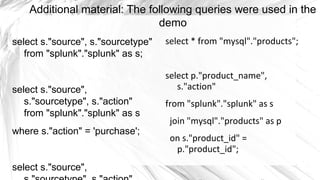
Additional material: The following queries were used in the
                               demo
select s."source", s."sourcetype"   select * from "mysql"."products";
   from "splunk"."splunk" as s;

                                    select p."product_name",
select s."source",                     s."action"
   s."sourcetype", s."action"       from "splunk"."splunk" as s
   from "splunk"."splunk" as s
                                     join "mysql"."products" as p
where s."action" = 'purchase';
                                     on s."product_id" =
                                      p."product_id";
select s."source",

Optiq: a SQL front-end for everything

  • 1.
    Optiq: a SQLfront-end for everything Julian Hyde @julianhyde http://github.com/julianhyde/optiq http://github.com/julianhyde/optiq-splunk Pentaho Community Meetup Amsterdam, 2012
  • 2.
  • 3.
  • 4.
    “Big Data” Right data,right time Diverse data sources / Performance / Suitable format
  • 5.
    Use case: Splunk  NoSQL database  Every log file in the enterprise  A single “table”  A record for every line in every log file  A column for every field that exists in any log file  No schema SELECT “source”, “product_id”, “http_code” FROM “splunk”.”splunk” WHERE “action” = 'purchase'
  • 6.
    How do it(wrong) action = 'purchase' “search” Splunk Optiq filter SELECT “source”, “product_id” FROM “splunk”.”splunk” WHERE “action” = 'purchase'
  • 7.
    How do it(right) “search action=purchase” Splunk Optiq SELECT “source”, “product_id” FROM “splunk”.”splunk” WHERE “action” = 'purchase'
  • 8.
    Example #2 Combining datafrom 2 sources (Splunk & MySQL) Also possible: 3 or more sources; 3-way joins; unions
  • 9.
    Expression tree SELECT p.“product_name”, COUNT(*) AS c FROM “splunk”.”splunk” AS s JOIN “mysql”.”products” AS p ON s.”product_id” = p.”product_id” WHERE s.“action” = 'purchase' Splunk GROUP BY p.”product_name” ORDER BY c DESC Table: splunk Key: product_name Key: product_id Agg: count Condition: Key: c DESC action = 'purchase' scan join MySQL filter group sort scan Table: products
  • 10.
    Expression tree SELECT p.“product_name”, COUNT(*) AS c FROM “splunk”.”splunk” AS s (optimized) JOIN “mysql”.”products” AS p ON s.”product_id” = p.”product_id” WHERE s.“action” = 'purchase' GROUP BY p.”product_name” Splunk ORDER BY c DESC Condition: Table: splunk action = 'purchase' Key: product_name Agg: count Key: c DESC Key: product_id scan filter MySQL join group sort scan Table: products
  • 11.
    Optiq is nota database.
  • 12.
  • 13.
  • 14.
    Conventional database architecture JDBC client JDBC server SQL parser / validator Metadata Query optimizer Data-flow operators Data Data
  • 15.
    Optiq architecture JDBC client JDBC server Optional SQL parser / Metadata validator SPI Core Query Pluggable optimizer rules 3rd 3rd Pluggable party party ops ops 3rd party 3rd party data data
  • 16.
    What is Optiq? Areally, really smart JDBC driver Framework Potential core of a data management system
  • 17.
    Writing an adapter Driver– if you want a vanity URL like “jdbc:splunk:” Schema – describes what tables exist (Splunk has just one) Table – what are the columns, and how to get the data. (Splunk's table has any column you like... just ask for it.) Operators (optional) – non-relational operations Rules (optional, but recommended) – improve efficiency by changing the question Parser (optional) – to query via a language other than SQL
  • 18.
  • 19.
    Optiq roadmap ideas Mondrianuse Optiq to read from data sources such as Splunk & MongoDB, combine multiple data sources Kettle integration: JDBC front-end; optimize jobs; push down filters & aggregations to data sources (e.g. SQL database) Adapters: Cascading, MongoDB, Hbase, Apache Drill, …? Front-ends: linq4j, Scala SLICK, Java8 streams Contributions
  • 20.
    Conclusions Liberate your data! Optiqis a framework Build & share Optiq adapters
  • 21.
  • 22.
    Additional material: Thefollowing queries were used in the demo select s."source", s."sourcetype" select * from "mysql"."products"; from "splunk"."splunk" as s; select p."product_name", select s."source", s."action" s."sourcetype", s."action" from "splunk"."splunk" as s from "splunk"."splunk" as s join "mysql"."products" as p where s."action" = 'purchase'; on s."product_id" = p."product_id"; select s."source",

Editor's Notes

  • #5 The obligatory “big data” definition slide. What is “big data”? It's not really about “big”. We need to access data from different parts of the organization, when we need it (which often means we don't have time to copy it), and the performance needs to be reasonable. If the data is large, it is often larger than the disks one can fit on one machine. It helps if we can process the data in place, leveraging the CPU and memory of the machines where the data is stored. We'd rather not copy it from one system to another. It needs to be flexible, to deal with diverse systems and formats. That often means that open source is involved. Some systems (e.g. reporting tools) can't easily be changed to accommodate new formats. So it helps if the data can be presented in standard formats, e.g. SQL.
  • #7 The wrong way to execute the query is for Splunk to send all of the data to Optiq. Splunk does more work than it needs to, it doesn't use any indexes, the network sends too much data, Optiq does too much work.
  • #8 The right way to execute the query is to pass the filter down to Splunk. This lets Splunk use its indexes, so it does less work, passes less data over the network, and the query finishes faster. This is just a simple answer, but a lot of problems can be solved by “pushing down” expressions, filters, computation of summaries. Do the work, and reduce the volume of data, as early in the process as possible.
  • #9 Demo connecting to Splunk via the Optiq driver. We aer using sqlline as the shell (it works with any JDBC driver). Se;ect “source” from “splunk”.”splunk” where “sourcetype=” = 'mysqld-4'; In the generated Java on the screen, Note how sourcetype is pushed down to Splunk.
  • #10 It's much more efficient if we psuh filters and aggregations to Splunk. But the user writing SQL shouldn't have to worry about that. This is not about processing data. This is about processing expressions. Reformulating the question. The question is the parse tree of a query. The parse tree is a data flow. In Splunk, a data flow looks like a pipeline of Linux commands. SQL systems have pipelines too (sometimes they are dataflow trees) built up of the basic relational operators. Think of the SQL SELECT, WHERE, JOIN, GROUP BY, ORDER BY clauses.
  • #11 It's much more efficient if we psuh filters and aggregations to Splunk. But the user writing SQL shouldn't have to worry about that. This is not about processing data. This is about processing expressions. Reformulating the question. The question is the parse tree of a query. The parse tree is a data flow. In Splunk, a data flow looks like a pipeline of Linux commands. SQL systems have pipelines too (sometimes they are dataflow trees) built up of the basic relational operators. Think of the SQL SELECT, WHERE, JOIN, GROUP BY, ORDER BY clauses.
  • #12 To recap. Optiq is not a database. It does as little of the database processing as it can get away with. Ideally, nothing at all. But what is it?
  • #14 Optiq is not a database... it is more like a telephone exchange. Applications can get the data they need, quickly and efficiently.
  • #15 Conventional database has ODBC/JDBC driver, SQL parser, . Data sources. Expression tree. Expression transformation rules. Optimizer. For NoSQL databases, the language may not be SQL, and the optimizer may be less sophisticated, but the picture is basically the same. For frameworks, such as Hadoop, there is no planner. You end up writing code (e.g MapReduce jobs).
  • #16 In Optiq, the query optimizer (we modestly call it the planner) is central. The JDBC driver/server and SQL parser are optional; skip them if you have another language. Plug-ins provide metadata (the schema), planner rules, and runtime operators. There are built-in relational operators and rules, and there are built-in operators implemented in Java. But to access data, you need to provide at least one operator.
  • #17 It needs to be said. Optiq is not a database. It looks like a database to your applications, and that's great. But when you want to integrate data from multiple sources, in different formats, and have those systems talk to each other, it doesn't force you to copy the data around. It gets out of your way. You configure Optiq by writing Java code. Therefore it is a framework, like Spring and, yes, like Hadoop. Optiq masquerades as a really, really smart JDBC driver. It has a SQL parser and JDBC driver. And actually you can embed it into another data management system, with a language other than SQL.