Optimising Supply Chains -Using   APs  Integrated SCM business suiteOur mission is to help youTo work in partnership with our clients, radically improving their operational excellence, business process throughput and resource efficiency.To enable business success by delivering powerful supply chain and warehouse management solutions that incorporate SAP, technology and best practice.Presenter: Mat EamesDate: Feb 2010Copyright © Rocket Consulting Limited 2010.All Trademarks are hereby acknowledged. This document contains information that is proprietary to  Rocket Consultingand must not be disclosed in whole or in part to any third party.
AgendaSeminar Objectives
Introduction to Rocket Consulting
Supply Chain Challenges
SAP Supply Chain management (SCM)
What is SAP SCM?
Enhanced Warehouse Management (EWM)
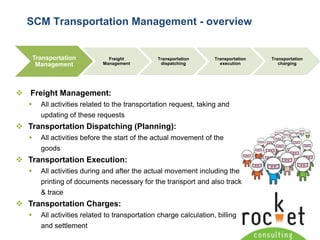
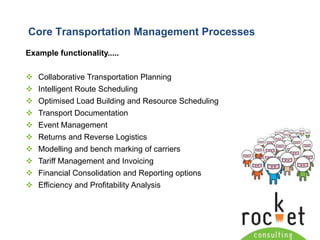
Transportation Management (TM)
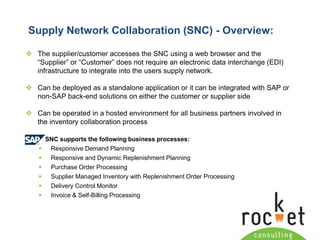
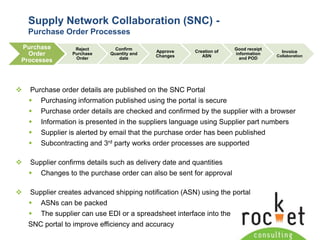
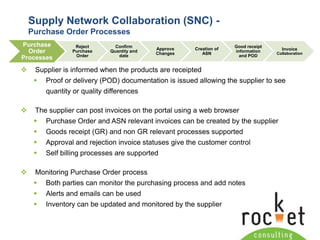
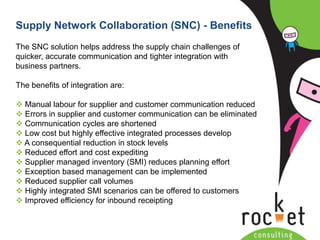
Supply Network Collaboration (SNC)
Event Management (EM)
Auto-ID infrastructure
Conclusion
Solutions to real world challenges – The Rocket ApproachSeminar ObjectivesOptimising Supply Chains using SAP’s integrated Supply Chain Management (SCM) business suite
Seminar ObjectivesAn overview of how the different components of SAP's Supply Chain Management (SCM) software can:Apply to real world challenges
Create opportunities for cost savings and efficiency gains The seminar will provide an insight into how the components of SAP’s SCM supply chain products can:Drive efficiency
Improve communication
Increase availability of information
Remove cost from a wide range of supply chain activities 
Introduction toRocket Consulting"Rocket has helped transform our operation, introducing efficient material flows and effective working practices that have allowed us to significantly increase throughput, improve stock and picking accuracy, and further improve on customer service."Andy Lilley, Chanel Operations Director
Rocket ConsultingYOUR MISSION IN OUR CONTROL / ORBIT AND BEYOND ... Rocket Consulting is a specialist SAP consultancy, and official SAP partner
Dedicated to helping businesses meet the increasing demands of today’s supply chains and warehouse operations
Delivering optimised and adaptive supply chain solutions through extensive and deep knowledge of SAP’s software, complementary technology, best practice process design and our own specially designed SAP add-ons called Rocket Packs
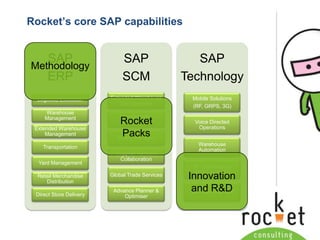
Used by major companies across the globe, Rocket is highly regarded for its professionalism, knowledge and expertise. With a proven track record of successfully delivering practical and effective resultsRocket’s core SAP capabilitiesMethodologyRocket PacksInnovation and R&D
What are today’s Supply Chain Challenges?
Supply Chain ChallengesThe last decade has witnessed:GlobalisationIncreased competitiveness from multinational and highly specialised companies
A significant increase in globalisation across all industry segments due to global competition
Sourcing and manufacturing have migrated to the Far East resulting in extended supply networks
Geographically dispersed partners to bring products and services to market
Unrelenting pressure on costs and quality
Long and costly supply pipelines
Shrinking capital availability driving lean manufacturing and supply operations
Difficulties with communication, mutual language compatibility, time zones, seasons and holiday calendars add complexity and potential for supply chain failureSupply Chain ChallengesThe last decade has witnessed:Trade EnvironmentPolitical instability is affecting strategic sourcing decisions
Tariffs and unpredictable currency fluctuations creating constant review of sourcing decisions
Changes in legislation and significant world agreements (CFC’s, Fair Trade, CO2 emissions, Tariff areas, Trade blocks e.g. NAFTA, EFTA, EU..etc)
Volatile fuel, energy and transportation costs
Pandemics (SARS, Swine flu, BSE, Foot and Mouth, Blue tongue, etc.) impacting on willingness to travel, training, supervision, inspection and concerns with food products
Guaranteeing minimum standards (Baby milk, human rights, chemical additives and compliance)Supply Chain ChallengesThe last decade has witnessed:Innovation Cycle and Time to MarketDemand for innovative and fashion products have driven down innovation cycles and time to market
Extended supply chains compromise the ability to react to market changes and customer requirements (product lead time cycles etc), Technology Increasing use of technology and automation (reduced flexibility, higher training costs)
High cost of intercompany communication as strong and compulsory supplier involvement in Original Equipment Manufacturer (OEM) product development becomes necessary
Need for effective integration of design of transactional systems to remain competitive
Ever increasing influence of Web enabled technologies as cost, reach and availability extends
Consolidation of disparate legacy systems to drive down total cost of ownership and improve system integrationSupply Chain ChallengesCustomersMore demanding (and less tolerant) customers who insist on higher levels of responsiveness, collaboration and visibility
Customer require suppliers and contract manufacturers to be integrated into the supply chain with improved and more cost effective products
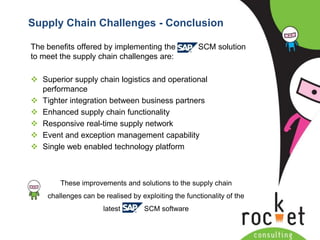
Customers are armed with detailed information about the real cost of manufacture and value of products which is reducing customer loyaltySupply Chain Challenges - summaryRemove cost, improve delivery performance and better manage exceptions - Need to transform existing linear, sequential supply chain into a responsive supply network Reduce costs while improving quality and customer service throughout the supply chain - Integrate the design, sourcing, supply, stocking and delivery with the full supply networkReduce time to market, eliminate costly errors and false starts -Promoting closer collaboration, planning, execution, and coordination throughout the supply network
Supply Chain Challenges - summaryImprove the probability of successful business expansion - Addressing separate specific business challenges with their own timelines and without costly system upgradesWorld class product, process and supply chain  performance - Develop processes which are customer-centric, demand-driven, enabling knowledge sharing between partnersReduce system cost and increase system integration – Adopt a functionally rich common system platform which meets flexible business process requirements without costly support models
Introduction to SAP SCM 7.0 -Supply Chain Management
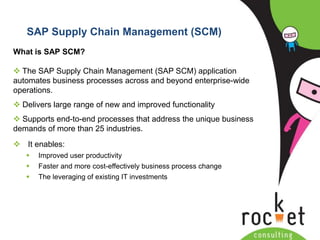
SAP Supply Chain Management (SCM)What is SAP SCM? The SAP Supply Chain Management (SAP SCM) application automates business processes across and beyond enterprise-wide operations.
 Delivers large range of new and improved functionality
 Supports end-to-end processes that address the unique business demands of more than 25 industries.
 It enables:
Improved user productivity
Faster and more cost-effectively business process change
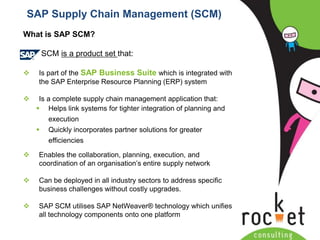
The leveraging of existing IT investmentsSAP Supply Chain Management (SCM)What is SAP SCM?SAP SCM is a product set that:Is part of the SAP Business Suite which is integrated with the SAP Enterprise Resource Planning (ERP) system
Is a complete supply chain management application that:
Helps link systems for tighter integration of planning and execution
Quickly incorporates partner solutions for greater efficiencies
Enables the collaboration, planning, execution, and coordination of an organisation’s entire supply network
Can be deployed in all industry sectors to address specific business challenges without costly upgrades.
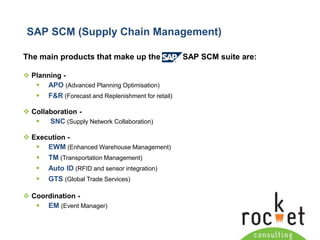
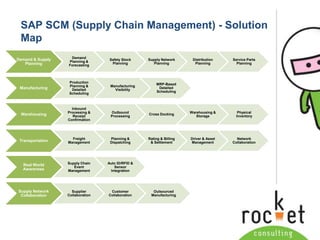
SAP SCM utilises SAP NetWeaver® technology which unifies all technology components onto one platformSAP SCM (Supply Chain Management)The main products that make up the          SAP SCM suite are: Planning -
APO (Advanced Planning Optimisation)

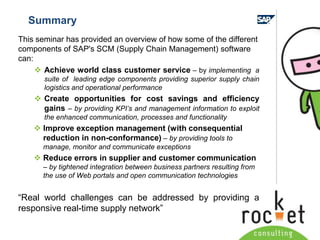
Optimising supply chains using SAPs integrated SCM business suite

  • 1.
    Optimising Supply Chains-Using APs Integrated SCM business suiteOur mission is to help youTo work in partnership with our clients, radically improving their operational excellence, business process throughput and resource efficiency.To enable business success by delivering powerful supply chain and warehouse management solutions that incorporate SAP, technology and best practice.Presenter: Mat EamesDate: Feb 2010Copyright © Rocket Consulting Limited 2010.All Trademarks are hereby acknowledged. This document contains information that is proprietary to Rocket Consultingand must not be disclosed in whole or in part to any third party.
  • 2.
  • 3.
  • 4.
  • 5.
    SAP Supply Chainmanagement (SCM)
  • 6.
  • 7.
  • 8.
  • 9.
  • 10.
  • 11.
  • 12.
  • 13.
    Solutions to realworld challenges – The Rocket ApproachSeminar ObjectivesOptimising Supply Chains using SAP’s integrated Supply Chain Management (SCM) business suite
  • 14.
    Seminar ObjectivesAn overviewof how the different components of SAP's Supply Chain Management (SCM) software can:Apply to real world challenges
  • 15.
    Create opportunities forcost savings and efficiency gains The seminar will provide an insight into how the components of SAP’s SCM supply chain products can:Drive efficiency
  • 16.
  • 17.
  • 18.
    Remove cost froma wide range of supply chain activities 
  • 19.
    Introduction toRocket Consulting"Rockethas helped transform our operation, introducing efficient material flows and effective working practices that have allowed us to significantly increase throughput, improve stock and picking accuracy, and further improve on customer service."Andy Lilley, Chanel Operations Director
  • 20.
    Rocket ConsultingYOUR MISSIONIN OUR CONTROL / ORBIT AND BEYOND ... Rocket Consulting is a specialist SAP consultancy, and official SAP partner
  • 21.
    Dedicated to helpingbusinesses meet the increasing demands of today’s supply chains and warehouse operations
  • 22.
    Delivering optimised andadaptive supply chain solutions through extensive and deep knowledge of SAP’s software, complementary technology, best practice process design and our own specially designed SAP add-ons called Rocket Packs
  • 23.
    Used by majorcompanies across the globe, Rocket is highly regarded for its professionalism, knowledge and expertise. With a proven track record of successfully delivering practical and effective resultsRocket’s core SAP capabilitiesMethodologyRocket PacksInnovation and R&D
  • 24.
    What are today’sSupply Chain Challenges?
  • 25.
    Supply Chain ChallengesThelast decade has witnessed:GlobalisationIncreased competitiveness from multinational and highly specialised companies
  • 26.
    A significant increasein globalisation across all industry segments due to global competition
  • 27.
    Sourcing and manufacturinghave migrated to the Far East resulting in extended supply networks
  • 28.
    Geographically dispersed partnersto bring products and services to market
  • 29.
    Unrelenting pressure oncosts and quality
  • 30.
    Long and costlysupply pipelines
  • 31.
    Shrinking capital availabilitydriving lean manufacturing and supply operations
  • 32.
    Difficulties with communication,mutual language compatibility, time zones, seasons and holiday calendars add complexity and potential for supply chain failureSupply Chain ChallengesThe last decade has witnessed:Trade EnvironmentPolitical instability is affecting strategic sourcing decisions
  • 33.
    Tariffs and unpredictablecurrency fluctuations creating constant review of sourcing decisions
  • 34.
    Changes in legislationand significant world agreements (CFC’s, Fair Trade, CO2 emissions, Tariff areas, Trade blocks e.g. NAFTA, EFTA, EU..etc)
  • 35.
    Volatile fuel, energyand transportation costs
  • 36.
    Pandemics (SARS, Swineflu, BSE, Foot and Mouth, Blue tongue, etc.) impacting on willingness to travel, training, supervision, inspection and concerns with food products
  • 37.
    Guaranteeing minimum standards(Baby milk, human rights, chemical additives and compliance)Supply Chain ChallengesThe last decade has witnessed:Innovation Cycle and Time to MarketDemand for innovative and fashion products have driven down innovation cycles and time to market
  • 38.
    Extended supply chainscompromise the ability to react to market changes and customer requirements (product lead time cycles etc), Technology Increasing use of technology and automation (reduced flexibility, higher training costs)
  • 39.
    High cost ofintercompany communication as strong and compulsory supplier involvement in Original Equipment Manufacturer (OEM) product development becomes necessary
  • 40.
    Need for effectiveintegration of design of transactional systems to remain competitive
  • 41.
    Ever increasing influenceof Web enabled technologies as cost, reach and availability extends
  • 42.
    Consolidation of disparatelegacy systems to drive down total cost of ownership and improve system integrationSupply Chain ChallengesCustomersMore demanding (and less tolerant) customers who insist on higher levels of responsiveness, collaboration and visibility
  • 43.
    Customer require suppliersand contract manufacturers to be integrated into the supply chain with improved and more cost effective products
  • 44.
    Customers are armedwith detailed information about the real cost of manufacture and value of products which is reducing customer loyaltySupply Chain Challenges - summaryRemove cost, improve delivery performance and better manage exceptions - Need to transform existing linear, sequential supply chain into a responsive supply network Reduce costs while improving quality and customer service throughout the supply chain - Integrate the design, sourcing, supply, stocking and delivery with the full supply networkReduce time to market, eliminate costly errors and false starts -Promoting closer collaboration, planning, execution, and coordination throughout the supply network
  • 45.
    Supply Chain Challenges- summaryImprove the probability of successful business expansion - Addressing separate specific business challenges with their own timelines and without costly system upgradesWorld class product, process and supply chain performance - Develop processes which are customer-centric, demand-driven, enabling knowledge sharing between partnersReduce system cost and increase system integration – Adopt a functionally rich common system platform which meets flexible business process requirements without costly support models
  • 46.
    Introduction to SAPSCM 7.0 -Supply Chain Management
  • 47.
    SAP Supply ChainManagement (SCM)What is SAP SCM? The SAP Supply Chain Management (SAP SCM) application automates business processes across and beyond enterprise-wide operations.
  • 48.
    Delivers largerange of new and improved functionality
  • 49.
    Supports end-to-endprocesses that address the unique business demands of more than 25 industries.
  • 50.
  • 51.
  • 52.
    Faster and morecost-effectively business process change
  • 53.
    The leveraging ofexisting IT investmentsSAP Supply Chain Management (SCM)What is SAP SCM?SAP SCM is a product set that:Is part of the SAP Business Suite which is integrated with the SAP Enterprise Resource Planning (ERP) system
  • 54.
    Is a completesupply chain management application that:
  • 55.
    Helps link systemsfor tighter integration of planning and execution
  • 56.
    Quickly incorporates partnersolutions for greater efficiencies
  • 57.
    Enables the collaboration,planning, execution, and coordination of an organisation’s entire supply network
  • 58.
    Can be deployedin all industry sectors to address specific business challenges without costly upgrades.
  • 59.
    SAP SCM utilisesSAP NetWeaver® technology which unifies all technology components onto one platformSAP SCM (Supply Chain Management)The main products that make up the SAP SCM suite are: Planning -
  • 60.

Editor's Notes

  • #2 Business card and marketing material on seats before the presentation starts:Seminar Objectives (2 mins)Introduction to Rocket Consulting (4 mins)Supply Chain Challenges (3 mins)SAP SCM (Supply Chain management) (4 mins)What is SAP SCM?Technology & LandscapeEWM (Enhanced Warehouse Management) (4 mins)TM (Transportation Management) (4 mins)SNC (Supply Network Collaboration) (4 mins)EM (Event Management) (2 mins)Auto-ID infrastructure (1 mins)Solutions to real world challenges -Example Company (4 mins)
  • #3 Optimising supply chains using SAPs integrated SCM business suite An overview of how the different components of SAP's SCM (Supply Chain Management) software can be applied to create the opportunities for cost savings and efficiency gains. The seminar will provide an insight into how the components of SAP’s SCM supply chain products can be used to drive efficiency, improve communication, increase availability of information and remove cost from a wide range of supply chain activities.  The following components will be discussed. EWM (Enhanced Warehouse Management)TM (Transportation Management)SNC (supply Network Collaboration)EM (Event management)Auto-ID infrastructure
  • #4 Seminar ObjectivesOptimising Supply Chains using SAPs integrated SCM Stress the – focus on supply chain execution rather than planning
  • #7 Consider how long been going for? 10 yearsNumber of employees? 20Projects/life cycles 5 - 10 a yearMethodologyRocket packs etc
  • #8 Picking one or two solution areas with examples, such as voice and plaisio/tm/conveyorHow this supported by own methodology (inception through benefit realisation and beyond)Full life cycle projects or discreet improvements in existing supply chain
  • #11 Political instability (Kenya, Nigeria, Iran Venezuela, Thailand, UK, etc....) affecting strategic sourcing decisions
  • #12 product rectification and modification with raw materials, WIP and finished goods stock
  • #18 technology components into a single platform, enabling organizations to reduce IT complexity and obtain more business value from their IT investments.And it provides the best way to integrate all systems running SAP or non-SAP software
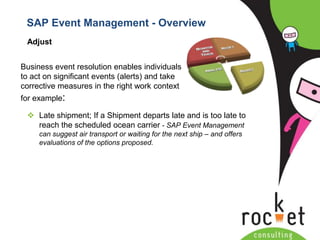
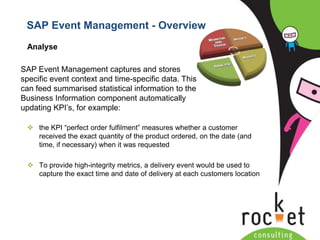
  • #19 EM Event Management sits across all areas
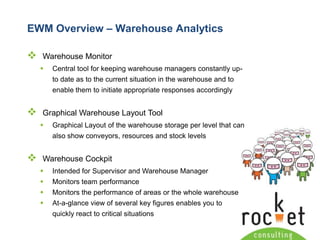
  • #20 help you focus on the core processes and functions that can increase your company's ability to compete, strengthen your relationships with partners, and help your company become closely oriented to the markets and customers you serveOutbound processing:Improving Customer Service Better service levels  Reduce late orders Lowering Working Capital Fewer returns, more efficient process  Lower cost procured goods and services Reducing Operating Costs & Increasing Efficiency Reduce order processing costs Increasing Revenue Improve order fill rate Driver and asset managementAsset Management and driver management is becoming increasable important. Asset Management will enable the customer to maximize the profits by utilization the capacity restrictions of the assets, having a global visibility in the system their different assets are hence also enabling track and trace for container movements. Driver management allow to maintain the driver qualification and checks for sufficient driver qualification during the manual assignment of drivers to assets.
  • #21 Purpose of Slide:-Outline how SCM-EWM is linked with other systems.Key Points to Make:EWM can either be connected to an SAP ERP or non-SAP ERP system. An Enterprise Resource Planning (ERP) system is used to capture sales, purchasing and planning data (among other things).An ERP system also captures customer, vendor and product master information.Some tasks of an ERP can be done better as a separate solution:Customer Relationship Management (CRM)Supplier Relationship Management (SRM)Master Data Management (MDM)Extended Warehouse Management (EWM)Additional -N/A
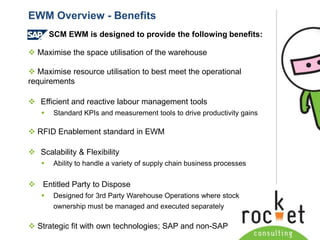
  • #24 Purpose of Slide:-Introduce EWM as a warehouse management system.Key Points to Make:EWM allows you to automate the management of your stocks and goods.All of your logistics process can be executed by EWM in a planned and efficient manner.Additional - There are two products available from SAP called EWM. The differentiator is ERP or SCM EWM. SCM EWM is the new version.
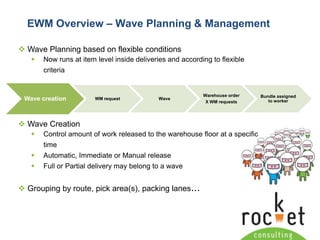
  • #25 Wave Management @ Delivery Item LevelVast flexibility and planning capabilities
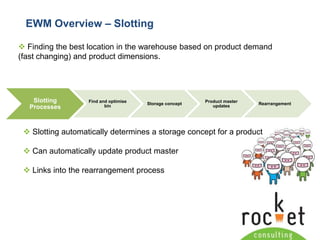
  • #26 Slotting automatically determines a storage concept for a product Find and optimise bin for material Physical criteria to find appropriate bin typeResult -> Space optimisation Demand criteria to find appropriate bin sectionResult -> Time optimisation Rule based Rearrangement of material in bins Result -> Closing the optimizing loopSlotting provides the basis for Rearrangement (carrying out the results of the slotting run)It is also possible to simulate the slotting run
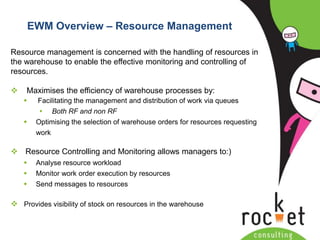
  • #28 Facilitating the management and distribution of work via queues Enabling the execution of work by resources in a radio frequency (RF) and non-RF environmentOptimizing the selection of warehouse orders for resources requesting workEnabling effective monitoring and controlling of resourcesControlled Distribution of Work via QueuesThe assignment of resources to queues enables focused management and distribution of work in the warehouseWarehouse Order Execution in RF and Non-RF EnvironmentsResources can execute work via RF and non-RF transactionsManual and Automatic Assignment of Warehouse Orders to ResourcesWarehouse orders (WOs) can either be manually assigned to a resource by a warehouse manager, or automatically assigned by the systemoptimised Warehouse Order SelectionResources that require system-guided work are offered the most appropriate WOs. Here a number of factors are taken into consideration, for example, the mode, latest start date (LSD), execution priorities, assigned queues, qualification of resource type, and WO status
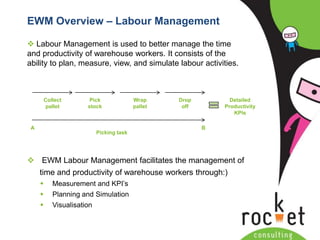
  • #29 Steps can be:Fixed valueDynamicUse Conditions to determine when each is usedCan group up to shift reportFor effective management of the labour supply chain, it is necessary to: Get the right person to the right place at the right time Track people throughout the day and measure performance on individual tasks Measure the quality and safety for each employee’s performance Provide alerts when performance falls below expectations Calculate costs and incentives for employees Simulate impacts to labour as a result of changes to the process flow or inventory Highlight the cost and efficiency of individual employees, facilities, teams, and the enterprise
  • #33 1st para – ERP originally designed based on shipper’s requirements, TM based on LSP2nd para – can be used as standalone – often better
  • #34 FM Receive, update, and confirm transportation requestsPredefine a specific route through the transportation network with dynamic route determinationPlanning and dispatching Optimise, create, and manage planning processes using best-in-class optimisation,Dynamic routing and scheduling, and continuous move optimisation Use denied-party and embargo lists to ensure compliance for cross-border shipments Transportation chargesRating, billing, and settlement Evaluate, calculate, and distribute transportation charges for the ordering party and the supplying partyEnable financial transactions for customer billing and for supplier invoicingTE – Linked into EM
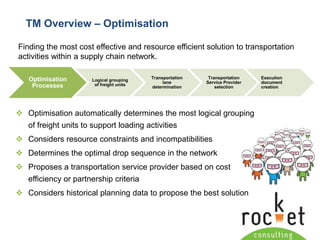
  • #37 The TM Optimiser performs multiple functions.It controls the grouping of freight units (product or product combinations) to offer the optimal loading plan to make the most efficient use of the truck or trailer or container volume.It considers the available transport resources from vehicle to driver and considers incompatibilities where certain product types cannot be shipped together or on certain vehicle typesIt calculates the most efficient drop sequence for multi leg multi drop tours taking into account any transhipment stops for change of driver and or change of trailer / tractor unitIt can select or propose for selection multiple TSP service providers ranking each based on criteria, ie lowest cost or partnership agreementsIt can consider previous planning decisions in the optimisation process.
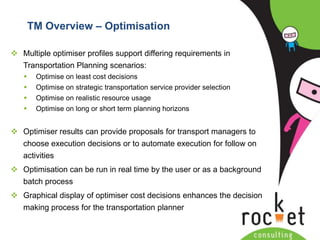
  • #38 Users can define optimiser profiles tailored to different scenarios in the supply chain process.For example the optimiser may be run in certain circumstances to make decisions based on lowest cost results but alternatively can make proposals for transportation service provider selection based on partner agreements , quota of usage arrangements etcThe optimiser can be run in real time dialogue for users or can be run as part of a background planning batch process.The optimiser graphical user interface provides easy understanding of the automatic decision making process
  • #44 Linked into event management
  • #47 Integrated with other SCM products (TM, SNC etc)
  • #57 Improved operational efficiency –automated processesgain visibility and intelligence through automated data discovery, finer granularity of data, and automated processing of events. more efficient due to reduced paperwork and access data more efficiently, including from partners, with better security controls. Higher customer satisfaction –improve the accuracy and speed of their shipping, receiving, and handling operations, leads to higher customer satisfaction. Improved supply chain management, enterprise asset management, and product tracking and authentication –better efficiency and visibility throughout the entire supply chain and ensure that the supply chain is safe and secure. improve tracking and tracing, maintenance, and utilization of all assets, resulting in reduced downtime and higher availability of all equipment as well as reduced asset inventories. Lower costs and higher return on investment – SAP solution has low TCO and low risk because leverage their existing skill sets, infrastructure, system landscapes, and enterprise software. scalable solutions that are viable for the long term, which reduces project costs and training costs and leads to higher ROI. Competitive advantage – can serve customers more efficiently, collaborate with partners more effectively, and position themselves as leading-edge organizations, ready for future growth
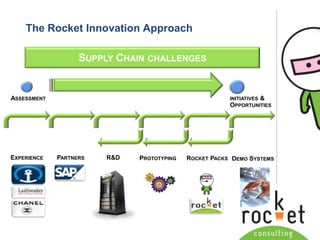
  • #61 Process begins before project startsUtilise own and customer experienceNew release/new functionality R&DProof of concept through protoFill any gaps through RPsDemonstrate and sign off ready for implementationAll combine to prove the appropriateness of the solution
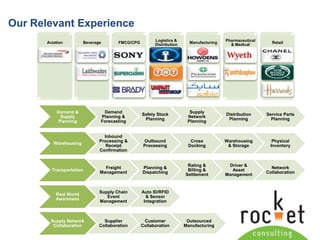
  • #62 Howdens – Cost reduction on transportation optimisation, mission critical system gapKNDL – Integrated supplier network for drinks distribution, WM integrated into third party managementHallmark – EWM, consolidation of business process to drive efficiency and reduction of dependency of workforce knowledge.