• What islight?
• A form of energy whose interaction with retina gives
a sensation of sight.
• A visible portion of electromagnetic radiation
spectrum.
3.
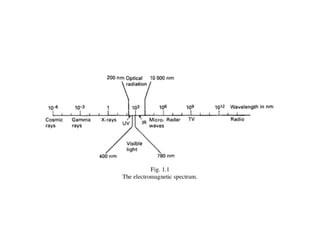
• Electromagnetic Spectrum
•The range of frequencies (the spectrum) of
electromagnetic radiation and their respective
wavelengths.
• Visible spectrum and invisible spectrum
6.
• Visible Spectrum
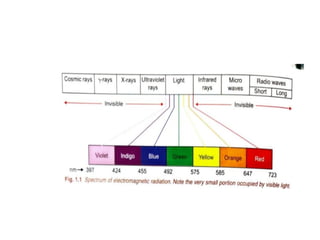
•LIGHT lies in visible spectrum.
• Between 400nm to 700nm.
• White light consists of seven colours: VIBGYOR
• Violet, Indigo, Blue, Green, Yellow, Orange, Red
• Optical Radiation
•Optical radiation lies between X-rays and microwaves
in the electromagnetic spectrum and is subdivided
into seven wavebands
• These seven domains are
• Ultraviolet C (UV-C), 200–280 nm;
• Ultraviolet B (UV-B), 280–315 nm;
• Ultraviolet A (UV-A), 315–400 nm;
9.
• visible radiation,400– 780 nm;
• Infrared A (IRA), 780–1400 nm;
• Infrared B (IRB), 1400–3000 nm; and
• Infrared C (IRC), 3000– 10000 nm.
• As with all electromagnetic radiation, the shorter the
wavelength, the greater the energy of the individual
quanta, or photons, of optical radiation
10.
Wavelength Absorption
• Wavelengthabsorbed by cornea and sclera
• UV-C, UV-B ,
• IR-B, IR-C,
• Wavelength absorbed by crystalline lens
• UV- A
• Wavelengths in the range 400– 1400 nm (visible light
and near infrared), pass through the ocular media to
fall on the retina
11.
Thermal Effect
• Thevisible wavelengths stimulate the retinal
photoreceptors giving the sensation of light while the
near infrared may give rise to thermal effects.
• The refractive surfaces of the eye focus the incident
infrared radiation on the retina, it can cause retinal
damage, e.g. eclipse burns.
12.
Nature of Light
•Dual nature of light.
1. Wave nature
2. Particle nature.
13.
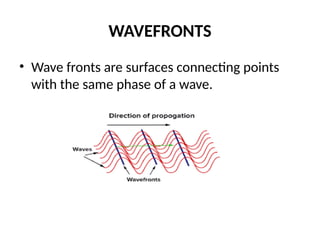
• WAVE THEORYOF LIGHT
• A portion of electromagnetic spectrum
• Light behave as s wave as it passes through air,
vacuum or other transparent medium also
transparent Ocular tissue.
• Path of light is straight if no obstacle encountered.
• Light really travels as waves although its path is often
represented as a 'ray’.
14.
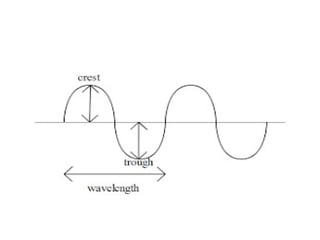
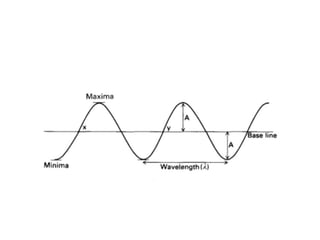
• Huygens in1678 proposed that light moves in the
form of waves from light source.
• These waves consists of crests and troughs
• CREST
• The highest surface part of a wave is called the crest.
• TROUGH
• The lowest part is the trough
16.
• Wavelengths
• Thewavelength, λ, is defined as the distance
between two symmetrical parts of the wave motion.
• Cycle
• One complete oscillation is called a cycle.
• Amplitude (A)
• The maximum displacement of an imaginary particle
on the wave from the base line
18.
• Phase
• Anyportion of a cycle is called a phase.
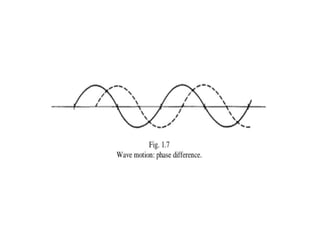
• Phase Difference
• If two waves of equal wavelength (but not
necessarily of equal amplitude) are travelling in the
same direction but are 'out of step' with each other,
the fraction of a cycle or wavelength by which one
leads the other is known as the phase difference
20.
• Incoherent waves
•Light waves that are out of phase are called
incoherent.
• Coherent waves
• light composed of waves exactly in phase is termed
coherent.
Particle Nature ofLight
• Light exhibits some characteristics of particle
(photons) when it is absorbed or generated by light
source.
• Einstein in 1905 proposed that light of a given
frequency consists of quanta with same energy.
• Quanta or photons – units in which electromagnetic
radiations are measured.
Color vision
• Thecolour of any object is determined by the
wavelengths emitted or reflected from the surface.
• White light is a mixture of wavelengths of the visible
spectrum.
• Colour is perceived by three populations of cone
photoreceptors in the retina which are sensitive to
light of short (blue), middle (green), or long (red)
wavelength
27.
• A congenitalcolour vision defect occurs if a cone
pigment is absent. OR
• If there is a shift in its spectral sensitivity.
• Deuteranopia, Protanopia and Tritanopia indicate
absence of green, red and blue cone function
• Deuteranomaly, Protanomaly and Tritanomaly
indicate a shift in the corresponding cone sensitivity
28.
• X-chromosome
• carriesgenes encoding for red and green pigment
• Chromosome 7
• carries the blue pigment gene.
• Of men 8% and of women 0.5% have a defect of the
red/green system.
• The commonest is deuteranomaly which occurs in
5% of men and 0.3% of women.
• Tritan defects are rare
29.
• Congenital colourdefects characteristically affect
particular parts of the colour spectrum.
• Acquired colour defects occur throughout the
spectrum but may be more pronounced in some
regions.
• For example, acquired optic nerve disease tends to
cause red–green defects.
30.
• Clinical Testingof Colour Vision
• Farnsworth–Munsell (FM) hue 100 test
• D-15 test
• Ishihara pseudoisochromatic test plates
• Lanthony New Colour Test